• 검색 결과가 없습니다.

N-nitroso-N-methylurea and N-nitroso-N-ethylurea Decrease in Nitric Oxide Production in Human Malignant Keratinocytes

N/A
N/A
Protected

Academic year: 2021

Share "N-nitroso-N-methylurea and N-nitroso-N-ethylurea Decrease in Nitric Oxide Production in Human Malignant Keratinocytes"

Copied!
5
0
0

로드 중.... (전체 텍스트 보기)

전체 글

(1)

Biomedical Science Letters 2018, 24(1): 50~54 https://doi.org/10.15616/BSL.2018.24.1.50 eISSN : 2288-7415

N-nitroso-N-methylurea and N-nitroso-N-ethylurea Decrease in Nitric Oxide Production in Human Malignant Keratinocytes

Ki-Young Moon

BioMedicinal Chemistry Laboratory, Department of Clinical Pathology, Gwangju Health University, Gwangju 62287, Korea

N-nitroso-N-methylurea (NMU) and N-nitroso-N-ethylurea (NEU), direct alkylating chemical mutagens and carcinogens, are shown to be the upregulators of cellular NF-κB, regulating various genes that mediate tumorigenesis and carcinogenesis.

Nitric oxide (NO), a toxic reactive radical gas, has been known to induce programmed cell death or apoptosis in various cells. Therefore, the assessment of NO production was examined to elucidate the possible contribution of NO release to the chemical carcinogenic potency of NMU and NEU in human skin cells. NMU and NEU did not alter the NO production, but they caused a significant downregulation of the NO generation on lipopolysaccharide (LPS)-induced NO production at concentrations ranging from 2~5 μM. The degree of downregulation of NO by NMU and NEU decreased up to 15%

and 20%, respectively, compared to the control. These results demonstrate that the LPS-inducible keratinocytes NO synthase is involved in modulating carcinogenic potency by NMU and NEU, and the regulation of the cellular NF-κB activity by NMU and NEU is negatively correlated with the level of LPS-induced NO production in human skin cells.

The findings of this study suggest the hypothesis that NMU and NEU-induced carcinogenesis may be associated with the downregulation of NO production, and the inducible NO may play an important role in NMU and NEU-induced carcinogenicity in human epidermal keratinocytes.

Key Words: Chemical carcinogenesis, NMU and NEU, NF-κB activity, Nitric oxide, Human malignant keratinocytes

Exposure to low levels of many environmental stimuli, i.e., ultraviolet radiation and hazardous chemicals in the environment is essentially unavoidable, and skin is a primary target for a variety of chemical carcinogens. Direct alkylating chemicals such as N-nitroso-N-methylurea (NMU) and N- nitroso-N-ethylurea (NEU) are known to be mutagens and carcinogens (Likhachev et al., 1983; Sukumar et al., 1983;

Zarbl et al., 1985; Nakamura et al., 1994), and the covalent modification of cellular DNA has been recognized in the initiation of carcinogenic processes through mutagenic mech- anisms (Scheme 1).

NF-κB expression has been involved in the development or progression of a variety of human cancers, as well as in the regulation of apoptosis both in normal and cancer cells (Bours et al., 1994, 2000; Rayet and Gelinas, 1999; Li et al., 2015). Several studies have demonstrated that chemical car- cinogens are frequently causing carcinogenicity associated with the regulation of NF-κB activity (Saliou et al., 1999;

Perez et al., 2000; Moon et al., 2003; Moon, 2007, 2010, 2011). In particular, NMU and NEU are reported to signifi- cantly upregulated cellular NF-κB activation, and suggested that their carcinogenicity might be associated with the modu-

Brief Communication

*Received: January 3, 2018 / Revised: March 5, 2018 / Accepted: March 6, 2018

Corresponding author: Ki-Young Moon. Department of Clinical Pathology, Gwangju Health University, Gwangju 62287, Korea.

Tel: +82-62-958-7621, Fax: +82-62-958-7526, e-mail: [email protected]

CThe Korean Society for Biomedical Laboratory Sciences. All rights reserved.

CCThis is an Open Access article distributed under the terms of the Creative Commons Attribution Non-Commercial License (http://creativecommons.org/licenses/by-nc/3.0/) which permits unrestricted non-commercial use, distribution, and reproduction in any medium, provided the original work is properly cited.

(2)

lation of cellular NF-κB activity in human skin cells (Moon et al., 2003; Moon, 2007, 2010).

Nitric oxide (NO), a reactive and toxic radical gas, has been known to induce programmed cell death or apoptosis in various cells (Moncada et al., 1991; Nathan and Xie, 1994).

However, little attention has been focused on the role of cellular NF-κB activation in modulating NO production by NMU and NEU and the possible implication of NO on the NMU and NEU-induced carcinogenicity. NF-κB is known to be a central regulator of inducible nitric oxide synthase (iNOS) expression. Therefore, iNOS dependent production of NO was assessed to examine the regulatory effect of NMU and NEU on the NF-κB activity correlating to NO release (Roméro-Graillet et al., 1997; Seo et al., 2002; Lee et al., 2005) and a possible contribution of NO to the chemical carcinogenic potency of NMU and NEU as well in human skin cells.

The effect of NMU and NEU on the cellular NF-κB activation was evaluated to investigate a possible correlation between the activation of cellular NF-κB activity and its consecutive sequence, NO production in human skin cells.

The change in NF-κB activity was measured in human keratinocytes, stably transfected with pNF-κB-SEAP-NPT plasmid (Moon et al., 2001; Moon, 2007, 2010, 2011). The treatment of transfectant keratinocytes with NMU (5 μM) and NEU (5 μM) resulted in the upregulation of cellular

NF-κB activity up to 38% and 35% compared to the control, respectively, and was consistent with the previous results (Moon et al., 2003; Moon, 2007, 2010). This data suggests that the cellular NF-κB activation regulated by NMU and NEU may be involved in NMU and NEU-induced carcino- genicity in human skin cells.

The cytotoxicity of the NMU, NEU, and LPS evaluated by the MTT assay (Scudiero et al., 1988) showed that the alkylating carcinogens and LPS concentrations used for the in vitro studies did not affect the keratinocyte cell viability (Table 1).

Because cellular NF-κB is a central regulator of inducible nitric oxide synthase (iNOS) expression, iNOS dependent production of nitric oxide (NO) was measured to examine the upregulatory effect of NMU and NEU on NF-κB acti- vation correlating to the regulation of NO production in human skin cells.

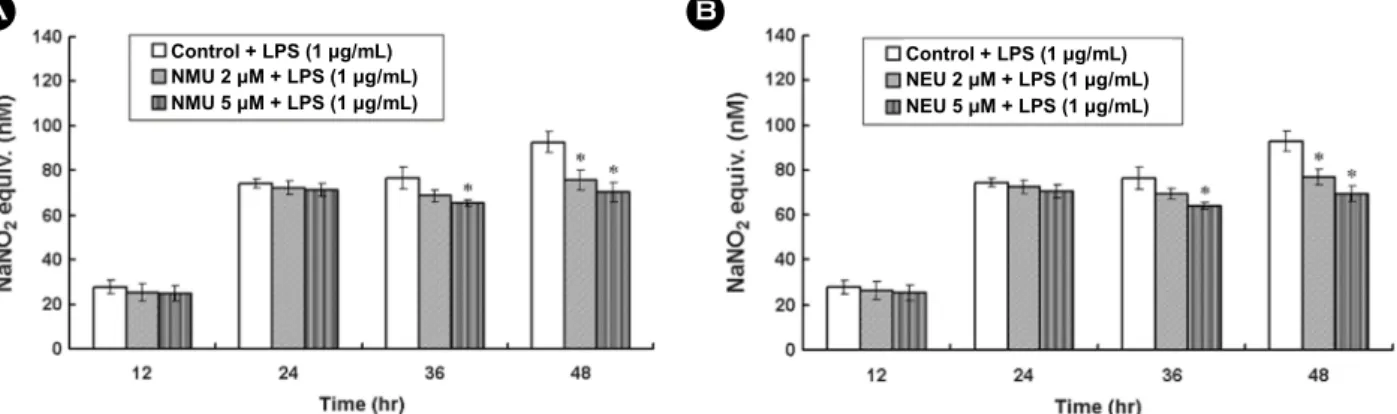
To investigate the possible correlation of cellular NF-κB activity with the generation of NO by NMU and NEU, the cultured malignant human epidermal keratinocytes were treated with alkylating chemicals with or without lipopoly- saccharide (LPS). The human keratinocytes revealed a mar- ginal NO production ability in the absence of LPS, showing no distinguishable difference in NO releases between the control and NMU or NEU treated cells (Fig. 1A and 1B), but NMU and NEU significantly decreased the LPS-induced Table 1. Relative mitochondrial dehydrogenase (MDH) activity from NMU, NEU, and LPS in transfectant human malignant keratinocytes

Treatments MDH activity (%)

a

Control 100

b

NMU (5 M) 101.6 ± 5.4

NEU (5 M) 102.4 ± 9.2

NMU (5 M) + LPS (1 g/mL) 103.2 ± 8.4 NEU (5 M) + LPS (1 g/mL) 104.6 ± 7.6

a

The values are represented as Mean ± S.D. of three independent experiments.

b

This value is defined as 100 for each experiment.

Cell survival was determined by measuring the MDH activities of transfectant human malignant keratinocytes when exposed to the concentrations of NMU, NEU, and LPS tested. No significant difference in cell viability was found between alkylating agents and LPS-treated and nontreated cells.

Scheme 1. Involvement of NF-κB and iNOS on carcinogenic

potency of NMU and NEU

(3)

NO production in a dose response manner at concentrations of 2~5 μM (Fig. 2A and 2B).

These results demonstrate that human malignant keratino- cytes (SCC-13) secrete nitric oxide (NO) in response to LPS, and the LPS-inducible keratinocytes NO synthase is involved in NMU and NEU-induced chemical carcinogenesis (Heck et al., 1992; Bécherel et al., 1997; Moon, 2011). Remarkably, the data showed that NMU and NEU decreased the iNOS- dependent production of NO, representing that the regulation of cellular NF-κB activity by NMU and NEU was negatively correlated to the level of LPS-induced NO production, sug-

gesting that the downregulation of inducible NO generation may play an important role in NMU and NEU-induced car- cinogenesis and cell proliferations as well in human epidermal keratinocytes.

The inducible transcription factor NF-κB-mediated signal transduction has been implicated in the regulation of the inflammatory response, tumorigenesis, apoptosis, and car- cinogenesis (Bours et al., 1994, 2000; Rayet and Gelinas, 1999; Moon, 2007, 2010, 2011). The overproduction and long lasting of NO have been established to initiate apoptosis in various cells (Messmer et al., 1995; Jun et al., 1998; Brüne

Control + LPS (1 μg/mL) NMU 2 μM + LPS (1 μg/mL) NMU 5 μM + LPS (1 μg/mL)

Control + LPS (1 μg/mL) NEU 2 μM + LPS (1 μg/mL) NEU 5 μM + LPS (1 μg/mL)

Fig. 2. Dose-dependent inhibition of LPS-induced nitric oxide (NO) production by NMU and NEU in transfected human malignant keratinocytes. (A) Downregulatory effect of NMU on LPS-induced NO production. (B) Downregulatory effect of NEU on LPS-induced NO production. NMU and NEU were added to the culture medium on 0 h of incubation, and NO productions were measured at 12, 24, 36, and 48 h after exposure to the chemicals. Each value represents the mean ± S.E. of three experiments. A significant difference in LPS-induced NO productions between the control and NMU or NEU treated samples was indicated by P < 0.01.

Fig. 1. Effect of NMU and NEU on nitric oxide (NO) production in transfected human malignant keratinocytes. (A) No regulatory effect of NMU on NO production. (B) No regulatory effect of NEU on NO production.

Control NEU 2 μM NEU 5 μM Control

NMU 2 μM NMU 5 μM
(4)

et al., 1999). However, the molecular mechanisms associated with NMU and NEU-mediated carcinogenic process, as linked to NO, for carcinogenicity has not been studied.

Therefore, this study examined whether the carcinogenic alkylating chemicals such as NMU and NEU regulate chem- ical carcinogenesis through the modulation of NO produc- tion and then attempted to elucidate a possible correlation between the upregulation of cellular NF-κB activity and its consecutive sequence, NO generation in cultured human skin cells by NMU and NEU.

Acrolein is known to be an alkylating chemical carcinogen, downregulating the NF-κB activity in an I-κBα independent manner, which in turn reduce the generation of NO in human malignant keratinocytes (Moon, 2011). This result indicates that acrolein inhibits iNOS-dependent production of NO by a mechanism involving the downregulation of NF-κB acti- vation. NMU and NEU are reported to be direct alkylating chemical carcinogens upregulating the cellular NF-κB activity (Moon et al., 2003; Moon, 2007), indicating that their up- regulatory effect was via the protein kinase C-mediated signaling pathway in human malignant keratinocytes (Moon, 2010).

In this study, NMU and NEU also induced the upregu- lation of NF-κB activity in epidermal keratinocytes, and their regulatory effect on cellular NF-κB activity was not consistent with the inhibitory effect on the LPS-induced NO production, even they have demonstrated characteristics of a potent alkylating carcinogens. Therefore, a number of different alkylating carcinogenic chemicals revealed marked differences in the mode of the activation pathways of NF-κB and its consecutive sequence, NO generation (Scheme 1).

This study reports the upregulation of NF-κB activity in- duced by NMU and NEU, which in turn decreases the NO production in cultured human keratinocytes and shows marked differences in the mode of the generation of NO with a number of different alkylating carcinogenic chemicals, i.e., acrolein (Bomsztyk et al., 1991; Legrand-Poels et al., 1997; Moon, 2010, 2011).

These results may provide the feasibility of a novel thera- peutic approach for preventing or treating cancer based on the specific regulation of the NF-κB activation pathway as well as NO production and further suggests that the NF-

κB-mediated signal pathway and NO release may play an important role in NMU and NEU-induced chemical carcino- genesis in human epidermal keratinocytes (Moon et al., 2003;

Moon, 2007, 2010, 2011).

The findings now suggest that the downregulation of inducible NO production may play an important role in NMU and NEU-induced carcinogenesis in human skin cells.

ACKNOWLEDGMENTS

This study was supported by Grant from the IMHWAN Foundation to Prof. Ki-Young Moon.

CONFLICT OF INTEREST

"No conflicts of interest, financial or otherwise, are declared by the author".

REFERENCES

Bécherel PA, Chosidow O, Le Goff L, Francès C, Debré P, Mossalayi MD, Arock M. Inducible nitric oxide synthase and proinflammatory cytokine expression by human keratinocytes during acute urticaria. Molecular Medicine. 1997. 3: 686-694.

Bours V, Bentires-Alj M, Hellin AC, Viatour P, Robe P, Delhalle S, Benoit V, Merville MP. Nuclear factor-κB, cancer, and apop- tosis. Biochemical Pharmacology. 2000. 60: 1085-1090.

Bours V, Dejardin E, Goujon-Letawe F, Merville MP, Castronovo V. The NF-kappa B transcription factor and cancer: high expression of NF-kappa B-and I kappa B-related proteins in tumor cell lines. Biochemical Pharmacology. 1994. 47: 145 -149.

Bomsztyk K, Rooney JW, Iwasaki T, Rachie NA, Dower SK, Sibley CH. Evidence that interleukin-1 and phorbol esters activate NF-κB by different pathways: role of protein kinase C. Cell Regulation. 1991. 2: 329-335.

Brüne B, von Knethen A, Sandau KB. Nitric oxide (NO): an effector of apoptosis. Cell Death and Differentiation. 1999. 6: 969-975.

Heck DE, Laskin DL, Gardner CR, Laskin JD. Epidermal growth factor suppresses nitric oxide and hydrogen peroxide pro- duction by keratinocytes. Potential role for nitric oxide in the regulation of wound healing. Journal of Biological Chemistry.

1992. 267: 21277-21280.

Jun CD, Pae HO, Yoo JC, Kwak HJ, Park RK, Chung HT. Cyclic

adenosine monophosphate inhibits nitric oxide-induced apop-

(5)

tosis in human leukemic HL-60 cells. Cellular Immunology.

1998. 183: 13-21.

Lee SH, Lee SY, Son DJ, Lee H, Yoo HS, Song S, Oh KW, Han DC, Kwon BM, Hong JT. Inhibitory effect of 2'-hydroxycinnam- aldehyde on nitric oxide production through inhibition of NF- κB activation in RAW 264.7 cells. Biochemical Pharmacology.

2005. 69: 791-799.

Legrand-Poels S, Zecchinon L, Piret B, Schoonbroodt S, Piette J.

Involvement of different transduction pathways in NF-κB activation by several inducers. Free Radical Research. 1997.

27: 301-309.

Likhachev AJ, Ivanov MN, Bresil H, Planche-Martel G, Montesano R, Margison GP. Carcinogenicity of single doses of N-nitroso- N-methylurea and N-nitroso-N-ethylurea in syrian golden hamsters and the persistence of alkylated purines in the DNA of various tissues. Cancer Research. 1983. 43: 829-833.

Li F, Zhang J, Arfuso F, Chinnathambi A, Zayed ME, Alharbi SA, Kumar AP, Ahn KS, Sethi G. NF-κB in cancer therapy.

Archives of Toxicology. 2015. 89: 711-731.

Messmer UK, Lapetina EG, Brüne B. Nitric oxide-induced apoptosis in RAW 264.7 macrophages is antagonized by protein kinase C- and protein kinase A-activating compounds. Molecular Pharmacology. 1995. 47: 757-765.

Moncada S, Palmer RMJ, Higgs EA. Nitric oxide: physiology, pathophysiology, and pharmacology. Pharmacological Reviews.

1991. 43: 109-140.

Moon KY. The chemopreventive effect of retinoids on cellular NF-κB activity induced by NMU and NEU in human malig- nant keratinocytes. Cancer Research and Treatment. 2007. 39:

82-87.

Moon KY. N-nitroso-N-methylurea and N-nitroso-N-ethylurea induce upregulation of cellular NF-κB activity through protein kinase C-dependent pathway in human malignant keratinocytes.

Archives of Pharmacal Research. 2010. 33: 133-139.

Moon KY. Acrolein, an I-κBα-independent downregulation of NF- κB activity, causes the decrease in nitric oxide production in human malignant keratinocytes. Archives of Toxicology. 2011.

85: 499-504.

Moon KY, Hahn BS, Lee J, Kim YS. A cell-based assay system for monitoring NF-κB activity in human HaCaT transfectant cells. Analytical Biochemistry. 2001. 292: 17-21.

Moon KY, Lee YJ, Kim YS. Upregulation of cellular NF-κB activity by alkylating carcinogens in human epidermal kerainocytes.

Biological and Pharmaceutical Bulletin. 2003. 26: 1195-1197.

Nakamura T, Ushijima T, Ishizaka Y, Nagao M, Nemoto T, Hara

M, Ishikawa T. Neu proto-oncogene mutation is specific for the neurofibromas in a N-nitroso-N-ethylurea-induced hamster neurofibromatosis model but not for hamster melanomas and human Schwann cell tumors. Cancer Research. 1994. 54: 976 -980.

Nathan C, Xie QW. Nitric oxide synthases: roles, tolls, and controls.

Cell. 1994. 78: 915-918.

Perez P, Page A, Jorcano JL. Role of phosphorylated p50-NF-κB in the ultraviolet response of mouse skin. Molecular Carcino- genesis. 2000. 27: 272-279.

Rayet B, Gelinas C. Aberrant rel/nfkb genes and activity in human cancer. Oncogene. 1999. 18: 6938-6947.

Roméro-Graillet C, Aberdam E, Clément M, Ortonne JP, Ballotti R. Nitric oxide produced by ultraviolet-irradiated keratinocytes stimulates melanogenesis. Journal of Clinical Investigation.

1997. 99: 635-642.

Saliou C, Kitazawa M, McLaughlin L, Yang JP, Lodge JK, Tetsuka T, Iwasaki K, Cillard J, Okamoto T, Packer L. Antioxidants modulate acute solar ultraviolet radiation-induced NF-kappa-B activation in a human keratinocyte cell line. Free Radical Biology and Medicine. 1999. 26: 174-183.

Scudiero DA, Shoemaker RH, Paull KD, Monks A, Tierney S, Nofziger TH, Currens MJ, Seniff D, Boyd MR. Evaluation of a soluble tetrazolium/formazan assay for cell growth and drug sensitivity in culture using human and other tumor cell lines. Cancer Research. 1988. 48: 4827-4833.

Seo SJ, Choi HG, Chung HJ, Hong CK. Time course of expression of mRNA of inducible nitric oxide synthase and generation of nitric oxide by ultraviolet B in keratinocyte cell lines. British Journal of Dermatology. 2002. 147: 655-662.

Sukumar S, Notario V, Martin-Zanca D, Barbacid M. Induction of mammary carcinomas in rats by nitroso-methylurea involves malignant activation of H-ras-1 locus by single point mutations.

Nature. 1983. 306: 658-661.

Zarbl H, Sukumar S, Arthur AV, Martin-Zanca D, Barbacid M.

Direct mutagenesis of Ha-ras-1 oncogenes by N-Nitroso-N- methylurea during initiation of mammary carcinogenesis in rats. Nature. 1985. 315: 382-385.

https://doi.org/10.15616/BSL.2018.24.1.50

Cite this article as: Moon KY. N-nitroso-N-methylurea

and N-nitroso-N-ethylurea Decrease in Nitric Oxide Pro-

duction in Human Malignant Keratinocytes. Biomedical

Science Letters. 2018. 24: 50-54.

수치

Fig. 1. Effect of  NMU and NEU on nitric oxide (NO) production in transfected human malignant keratinocytes

참조

관련 문서

[r]

학술연구단체나 기술연구단체가 학술연구 또는 기술연구와 관련하여 공급하는 재화 또는 용역 (「산업교육진흥 및 산학연협력촉진에 관한 법률」에 따라

학교・유관기관・지역사회 협력

1) Effects of methanol extracts of Capsella bursa-pastoris on cyclooxygenase-2 (COX-2) and Inducible Nitric oxide synthase (iNOS) expression in human prostate cancer cell

[r]

– 자신이 선택하는 직업 진로에 입문하기

The Study on the Changes of Bacterial Inorganic Phosphate Metabolism in Interactions between Nitric Oxide and Salmonlla enterica serovar Typhimurium..

융합인재교육의 개념을 이해하고 교육내용을 재구성하며, 나... 초․중․고등학생용 융합인재소양