약학회 지 제 48 권 제 2 호 159〜 164 (2004) = 5 = ! = ! = !
Yakhak Hoeji Vol. 48,No. 2 雜 学 會 ■ 확
RAW 264.7 Cell 에서 세이지에 의한 염증성 Cytokine 및 iNOS 억제 효과
현은아
•
이혜자•
윤 원 종•
박수 영•
강희 경•
김세재* ■
유은숙#
제주대학교 의과대학 약리학교실 , * 제주대학교 자연과학대학 생명과학과 (Received March 22,2004; Revised April 19,2004)
Inhibitory Effect of Salvia officinalis on the Inflammatory Cytokines and Inducible Nitric Oxide Synthasis in Murine Macrophage RAW264.7
Eun-A H y u n , Hye-Ja L ee, W eon-Jong Yoon, Soo-Young Park, H ee-K young K ang, Se-Jae K im * and E un- S ook Yoo#
Department of Pharmaclogy, College of Medicine, Cheju National University, Ara 1-dong, Jeju 690-756’ Korea College of Natural Science, ^Department of Life Science, Cheju National University, Ara 1-dong, Jeju 690-756’ Korea
Abstract — Primary pro-inflammatory cytokines are a trio : tumor necrosis- a (TNF-a), interleukine-ip (IL-1 (3), and inter- leukine-6 (IL-6). These cytokines initiate and regulate the acute-phase inflammatory response during infection, trauma, or stress and appear to play an important role in the immune process. Nitric oxide (NO) is a multi-functional mediator, which plays an important role in regulating various biological functions in vivo. NO production by inducible nitric oxide synthase (iNOS) in macrophages is essential for the defense mechanisms against microorganisms and tumor cells. However, over
expression of iNOS by various stimuli, resulting in over-production of NO, contributes to the pathogenesis of septic shock and some inflammatory and auto-immune disease. Solvent fractions of sage ( Salvia officinalis L.),which is cultivated in Jeju- Do, was assayed for their effects on TNF- a and IL-6 production in LPS-stimulated RAW 264.7 macrophages. Hexane and ethylacetate (EtOAc) fraction of sage inhibited the protein and mRNA expression of TNF- a and IL-6 in LPS stimulated RAW 264.7 cells at the concentration of 100 [ig/ml. Also, incubation of RAW 264.7 cells with the fraction of hexane or EtOAc (50 |ig/m/) inhibited the LPS induced nitrite accumulation and the LPS/IFN- y induced iNOS protein. And this inhibition of iNOS protein is concordant with the inhibition of iNOS mRNA expression. Above results suggest that extract of sage may have anti-inflammatory activity through the inhibition of pro-inflammatory cytokines (TNF- a, IL-1 (3, IL-6), iNOS and NO.
Keywords □ inflammation, Salvia officinalis L., tumor necrosis factor-a, interleukin-1(3, interleukin-6, inducible nitric oxide synthase, nitric oxide
최근
,
고령화와식생활의 변화에 따라 급성 염증질환과 류마 티스관절염,천식과 같은 만성 염증질환이 증가하는 추세이다.
염증반응은 생체나조직에 물리적 작용이나화학적 물질,
세균 감염 등과같은기질적 변화를가져오는 침습이 가해질때그 손 상부위를 수복 재생하려는 기전이다^
염증을 일으키는 요인 중에서 세균에 의한것이 가장 많으며,
일단자극이 가해지면 국 소적으로 histamine, serotonine, bradykinin, prostaglandins, hydroxyeicosatetraenoic acid(HETE), leukotriene과 같은 혈관 활성 물질이 유리되어 혈관투과성이 증대되면서 염증을유발한다
.2>
그런데지속적인 염증반응은도리어 점막손상을 촉진하고,그결과일ᅵ부서}서는암발생등과같은질환의요인이 되기도한다
.
#본 논문에 관한 문의는 저자•에게로
(
전화
) 064-754-3847 (팩스
) OW-TTO-MS?(E-mail) [email protected]
Gram-negative bacteria의 세포외막에 존재하는 lipopolysac-
charide(LPS
)는내독소로 잘알려져 있으며,박테리아가 죽으면서 세포외막으로부터 방줄되어 gram-negative sepsis와 septic shock를 일으킨다. LPS는 RAW264.7와 같은 macrophage 또는 monocyte 어1서 pro-inflammatory cytokine 인 tumor necrosis factor-a(TNF-a), Interleukin-6(IL-6), Interleukin-ip(IL-ip)을 증가시키고
,
특히TNF-a, IL-1(3
는inducible nitric oxide
synthase(iNOS)의 발현을 유도한다.iN O S
는평소에는세포내에존재하지 않으나 일단유도되면 장시간동안다량의
nitric oxide(N 0
)를생성하며,생성된N O
는 병 리적인 혈관확장,
세포독성,
조직손상 등과 같은 생체에 유해한 작용을나타낸다.
그리고,
염증상태에서iN OS
에 의해 생성된N O
는혈관투과성,
부종등의 염증반§ 을 촉진시킬 뿐만 아니라 염증매개체의 생합성을촉진하여 염증을심화시키는 것으로 알려
져 있다.3ᅦ
159
160
현은아
■이헤자
•윤원종
■빅수영
■강희경
■김세재
•유은숙
허브
(Herb
)는라틴어의herba
에서 비롯된 '푸른 풀미라는 뜻이지만현대에 와서는 줄기,잎
,
꽃,
뿌리 둥의 부위가 인간에게 유용하게 이용되는식물의 총칭의 의미로쓰이고 있다.
허브는대략
2,500
여종으로꿀풀과,
국화과,미나리과,
백합과등이 있으며
,
고대 이집트시대 이래 지금까지 서구에서 약초혹은 향초로서 용되어져 왔다
.1’2)
오래 전부터 허브는소화촉진,
방부,
항균,강장
,
염증치료,식욕부진,
살균,
노화방지,
감기치료,
혈액순 환촉진 등의 작용을이용하여 요리에 첨가하기도하고 민간요법
’아로마테라피로이용되어 왔다.8’9)
세이지
(sage;
Salvia officinalisL
.)는꿀풀과에 속하는 다년생초본으로줄기는
30~ 90cm
로자라며 포기 전체에 강한 향기가있다
.
그리고,
예로부터 민간에 널리알려진 역사가오래된약용 식물이며,
지중해연안과유럽남부에 분포하며 잎은민간에서 약 용혹은부향제로사용된다.
세이지 잎은강장작용 외에신경계 통이나소화기계통에 뛰어난약효가있으며 방부,
항균,항염 등 살균 소독작용이 있어 각종염중에 소염제로시용되었고,
또한 해열,구풍,정혈작용도 알려져 있다.
또한,
세이지를육류요리에 넣으면지방을분해시키는역할을 하고소화를 촉진시킨다고알려져 있다
.10)
일반적으로꿀풀과에 많이포함되어 있는천연 정유는면역성증강
,
함범'
및노화억제 둥약리적인효과와함균,
항 산화 활성등을 가지고 있어 의약,식품 및화장품업계에서 이를 이용하려는 연구들이 활발하게 이루어지고 있다.u)
그중 세이 지의 생리활성에 의한 연구는 항산화 활성 연구에 많이 치중되 어 왔으나 항염중과 관련된 연구는미약한 수준이다.
12ᅵ16)
따라 서,본 논문에서는LPS
로활성화된RAW 264.7
세포에서 세이 지 추출물에 대한TNF-oc, IL
- 6 및N O
생성억제효과를 조사하였으며 또한
iN O S
의유전자와단백질 발현을검색하였다.
실험방법
시료추출
제주도에서 재배되고 있는 세이지 지상부를 채집하여 음건한
다음마쇄기로 갈아미세말로하였다
.
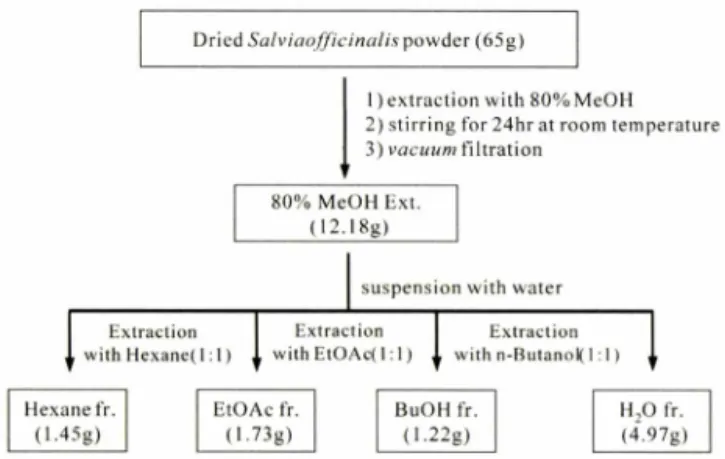
미세말시료(65 g
)를80%
m ethanol(M eOH
)로2
회 교반추출 후 여과하여 감압농축하여용매를증발시켰다
.
여기에서 얻은M eO H
추출물(12.18 g
)을 계 통적 주줄 방법에 의하여hexane
분획(1.45 g), ethylacetate (EtOAc)
분획(1.73 g), butanol(n-BuOH)
분획(1.22 g)
,H 20
분획(4.97 g
)을얻어 실험시료로사용하였다(Fig. 1).
세포 및 시약
M urine macrophage cell line
인RAW264.7
세포는KCLB (Korean Cell Line Bank
)로부터 분양 받아100 units/m/
penicillin-sfreptomycin
파10% fetal bovine serum (FBS
)이함유 된D M E M
배지를사용하여37°C, 5% C 0
2 항온기에서 배양하Dried
S a h ia o ffic in a lispowder (65g)
1) extraction with 80% MeOH 2) stirring for 24hr at room temperature 3)
vacuumfiltration
80% MeOH Ext.
(12.l8g)
suspension with water Extraction I Extraction I Extraction with Hexane(l: 1) i with EtOAc(l :1) 1 with n-Butan
이(1:i >
Hexane fr. EtOAc fr. BuOH fr. H20 fr.
(4.97g)
(1.45g) (1.73g) (1.22g)
Fig. 1
- Systematic purification using solvent partitioning from Salvia officinalis L.였으며
,
계대 배양은3
〜4
일에 한번씩 시행하였다. Lipopolys-
accharide(LPS. E. coli serotype 0111: B4)는 Sigma로부터 구입 하여 사용하였으며, Interferon-7(mIFN-Y,recombinant E. coli) 는Roche
로부터 구입하여 실험에 사'§•
하였다.
In vitro c y t o k i n e
생성 및 정량TNF-a, IL
- 6 정량은m urine macrophage cell line
인RAW 264.7
세포를D M E M
배지를 이용하여24 microwell plate
에1
.
0X
1 0 6cells/m
/로 넣고, 18
시간동안 전배양하였다.
이후 배지를 제거하고,시료와
LPS
최종농도(1
를함유한새로운 배지를동시에 처리하여 전배양과동일조건에서 6시간동안 배양하였다
.
배양이 끝나면 배양 배지를 원심분리(
1 2,
0 0 0rpm,
3 m in
)하여 상증액을 얻어mouse ELISA kit(R & D Systemes, Inc., USA
)를이용하여 정량하였다.
R N A
분리 및RT-PCR
RAW264.7
세포(1.5X10
6celh/m
/)를18
시간 전배양하고시험약물과
LPS
(최종농도1
를동시 처리하여24
시간배양한후
total RN A
추출은TRI-reagent(M RC
)를이용하여분리하 였으며,모든 실험은RNase-free
한조건 하에서 이루어졌다.
cDNA
합성은Improm-IITM cDN A kit(Prom ega
)를이용하였 고, 1 |ig의 total RNA를 oligo(dT)18 primer, dNTP(0.5 jxM),1 unit RNase inhibitor
그리고M-MuLV reverse transcriptase (2 U
)로70oC 5 m in, 37°C 5 m in, 37°C 60 m in,
그리고70oC
에 서10 m in heating
시킴으로서 반응을중지시켰다. Polymerase chain reaction(PCR
)은합성된cDNA
로부터iN OS, P-actin
를중 폭시키기 위하여2|o/ cDNA, 4 | iM
의5
'과3' primer,
1 0x buffer(10 m M Tris-HCl, pH 8.3, 50 m M KC1, 0.1% Triton X- 100),250 |iM dNTR 25 m M M gCl2, 1 unit Taq polymerase (Promega, USA
)를섞고distilled water
로최종25 !
그/로맞춘다 음Perkin-Elmer Thermal Cyclei
를 이용하여PCR
을실시하였/.
Pharm. Soc. Korea
염증성
Cytokine및
iNOS억제효파
161Table I
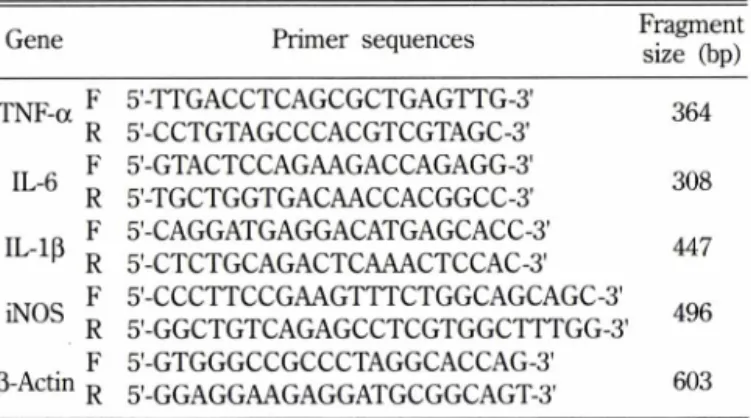
- Sequences of primers and fragment sizes of the investigated genes in RT-PCR analysisGene Primer sequences Fragment
size (bp) TNF-a F S'-TTGACCTCAGCGCTGAGTTG-S' 364
R 5'-CCTGTAGCCCACGTCGTAGC-3' IL-6 F 5’-GTACTCCAGAAGACCAGAGG-3’
R 5'-TGCTGGTGACAACCACGGCC-3’ 308 IL-lp F 5'-CAGGATGAGGACATGAGCACC-3'
R 5'-CTCTGCAGACTCAAACTCCAC-3’ 447
iNOS F 5’-CCCTTCCGAAGTTTCTGGCAGCAGC-3' AQC R 5’-GGCTGTCAGAGCCTCGTGGCTTTGG-3’
P-ActinF 5'-GTGGGCCGCCCTAGGCACCAG-3' R 5’-GGAGGAAGAGGATGCGGCAGT-3’ 603
다
.
이때PC R
조건은94
0C/45
초, 580C/45
초, 72°C/6Q
초30
회이 며, PCR
에의하여 생성된산물은1.2% agarose gel
에서 전기영 동을실시하고ethidium bromide
로염색하여 특정band
를확인 하였다. RT-PCR
에서 사용된prim er
는Table I
과 같다.
Im m u n o b lo ttin g
RAW264.7
세포(1.0X10
6cells/m
/)를18
시간전배양을하고, L P S (1 1
그g/m/)/IFN-7(50 U/m
/)로자극을주고시료(50
를동 시처리하여 전배양과동일 조건에서24
시간동안배양하였다.
배양이 끝난 후,세포를2~ 3
회PBS(Phosphate Buffered Saline
)로 세척 후300 |o
/의lysis bufier[50 m M Tris-HCl (pH 7.5), 150 m M NaCl, 2 m M EDTA, 1 m M EGTA, 1 m M N aV 03> 10 m M NaR 1% Nonidet P40, 1 m M dithiothreitol, 1 m M phenylm ethylsulfonyl fluoride
]을첨가,30& ~ 1
시간동안lysis
시킨후 원심분리(15,000 rpm, 15 m in
)하여 세포막성분둥 을 제거하였다.
단백질 농도는BSA(bovine serum album in
)을 표준화하여Bio-Rad Protein assay kit
를 사용하여 정량하였다. 20—30 (ig
의lysatel-
8% m ini gel SDS-PAGE(poly acrylamide gel electrophoresis
)로 변성 분리하여,이를PV DF membrane (BIO-RAD
)에200 m A
로2
시간 동안transfer
하였다.
그리고 membrane의 blocking은 5% skim milk가 함유된 TTBS(TBS+0.1%
Tween20)
용액에서 상온에서2
시간 동안 실시하였다. iNOS
의발현잉을측정하기위해1
차항체로서anti-mouse iN O S ( 1 : 1000)(Santa-Cruz
>을TTBS
용액에서 희석하여 상온에서2
시간반응시킨후 TTBS로3
회세정하였다. 2
차항체로는 HRP (horse radish peroxidase)가 결합된 anti-mouse IgG(AmershamCo
.)를1:5000
으로 희석하여 상온에서30
분 간 반응시킨 후, TTBS
로3
회세정하여E C L
기질(Amersham Co
.)과5~ 10
분간 빈응후 X-ray 필름에 감광하였다.
N itric oxide
측정RAW264.7
세포에서LPS
에의해 생성된N O
의양은Griess
reagent
로측정하였다. RAW 264.7
세포(1.5X 10
5cells/m
/)를24 m icrowell plate
에넣고18
시간전배양을하였다.
이후
배지를제거하고
,
시료와LPS(1 ng/m
/)가 함유된 배지를 동시 처리하여전배양과동일 조건에서
24
시간동안 배양하였다. 100 |i
/의 배 양액을 96 microwell plate에넣고동량의 Griess reagent[0.1%(w/v) N-l-naphthylethylen deamine, l% (w/v) sulfanilamide in 2.5%(v/v) H3P 0 4] » 첨가하고 10분간 실온에서 배양한 후 ELISA
reader
를 이용하여5 4 0 n m
에서 정량하였다.
표준농도곡선은NaN
ᄋ2를 serial dilution하여 얻었다.
실험결고
h
Sage
용매분획 추출물의T N F -a
및IL *6
억제효과RAW264.7 세포에 의LPS와 100|ig/m/의세이지 용매 분획 추출물을 동시 처리하여 염증성 cytokine 억제 효과를 mouse ELISA kit를이용하여 정량하였다
.
그결과 hexane 분획 물과 EtOAc 분획물이 T N F-ot 각각 71.0%, 33.1%, IL -6를 각 각 78.1%, 70.2% 억제하였다(Table II). 또한 실험에 사용된 농 도는 세포독성 평가에서 독성을 나타내지 않았다(결과는나타내 지Sage
용매분획추출물의TNF-a, IL - ip , IL-
6의m R N A
발현 에 미치는영향RAW264.7 세포에서 염증성 cytokine인TNF-a, IL -6와 IL-lp 를 mRNA 수준에서 RT-PCR 방법으로 분석하였다
.
1 |ag/m/의 LPS와세이지의 용매분획 추출물을 100|ig/m/ 농도로 처리하였 을때 hexane, EtOAc 분획물이 TNF-a와IL-6 발현을강하케 억 제하였으며,
hexane 분획물이 IL-ip 발현을강하게 억제하였고,
EtOAc 분획물은 약한 IL-1|3 발현 억제 효과를보였다(Fig. 2).Sage
용매분획 추출울의iN O S
의m R N A
빌현 및p ro te in
level
에미치는영향RAW264.7 세포에서 iNOS의 mRNA 발현을 RT-PCR 방법으
Table I I
- The effect of solvent fractions of S. officinalis on LPS induced TNF-a and IL-6 release in RAW264.7 cellsFraction Inhibition (%)
TNF-a IL-6
MeOH 33.72 33.65
Hexane 71.03 78.05
EtOAc 33.09 70.24
BuOH - -
H20 2.29 2.28
The productions of TNF-a and IL-6, were assayed from culture supernatant of RAW264.7 cells (1.0 x 10⁶ cells/m/) stimulated by LPS (1 |ig/m/) in the presence of testing samples (100 (ig/m/).
Vol. 48’ No. 2’ 2004
162
현'은아
•이혜자
.윤원종
•박수영
.강희경
•김세재
•유은숙
I.PS (1 Ug/ni?) - + + + + +
5 . Hexane) - 0 6 12 25 50 (pg/ill^.)
P -Actin
mmm mmmmmm42 kD a
Fig. 4 -
Inhibitory effect of solvent fractions of S. officinalis on the protein level of iNOS activated with LPS (1 (ig/m/) plus IFN-y (50 U/m/) in murine macrophage cell line RAW264.7.RAW264.7 cells (1.0xlO6 cells/m/) were pre-incubated for 18 hr, and the cells were stimulated by LPS (1 ^ig/m/) plus IFN-y (50 U/m/) in the presence of testing samples (50 |ig/
ml) for 24 hr.
IL-13
IL -6
P -A ctin
3 0 8 b p
4 4 7 b p
6 0 3 b p
Fig. 2
- Inhibitory effects of solvent fractions of S. offcinalis on the mRNA expression of pro-inflammatory cytokines (TNF-a, IL-6, and IL-lp) in LPS (1 (ig/m/) stimulated RAW264.7 cells. RAW264.7 Cells (1.5xlO6 cells/m/) were pre- incubated for 18 hr, and the mRNA expression of pro- inflammatory cytokines were determined from the 6 hr culture of cells stimulated by LPS (1 [ig/ml) in the presence of testing samples (100 |ig/m/).L P S (1 u g / m l) - S. o ffic in a lis -
T N F - a
S. officinalis(\ 0 0 pg/inO
+ + + + + +
一 M e O H H c x a n e E tO A c B u O H H 20
3 6 4 b p
IL-13
Fig. 3
- Inhibitory effect of solvent fractions of S. officinalis on the mRNA expression of iNOS in LPS (1 }ig/m/)-stimulated RAW264.7 cells. RAW264.7 cells (1.5xlO 6 cells/m/) were pre-incubated for 18 hr, and the mRNA expression of iNOS were determined from the 24 hr culture of cells stimulated by LPS (1 ^xg/m/) in the presence of testing samples (50 jig/ml).
로 조사하였다
. 1
나g/m/
의LPS
와 세이지의 용매분획 추출물을50|ig/m/
농도로 처리하였을 때, hexane
분획물이 가장 강한발현억제효과를 나타내었고,
EtOAc
분획물과B uO H
분획물에서도
iN OS
발현이 현저하게 저해되는 것을 확인할 수 있었다(Fig. 3).
그리고, iN O S
의protein level
에 미치는 억제효과를Im m unoblot
방법으로 석하였다. Hexane
분획물과EtOAc
분획물에서
iN O S
단백질이 현저히 감소된것을 확인할수 있었다(Fig. 4).
Sage
용매분획 추출물의N O
생성억제 활성 측정세이지 용매분획 추출물이
iN OS
의산물인N O
생성에 미치는영향을조사하기 위하여
Griess
시약을 이용하여N O
생성량을측정하였다
. 1
나g/m/
의LPS
와세이지의용매분획추출물을50
^Fig. 5 - The effect of solvent fractions (A), hexane fraction (B) and EtOAc fraction (C) of S. officinalis on NO production in LPS induced RAW264.7 cells. The productions of NO was assayed from culture supernatant of RAW264.7 cells (1.5xlO5 cells/m/) stimulated by LPS (1 |xg/m/) in the presence of testing samples.
S.
o ffic in a lis (100\aglm) L P S ( l u g / m l )
S. o ffic in alis
+ + + + + +
- M e O H H e x a n e E tO A c B u O H H zO
T N F - a 3 6 4 b p
L P S / I F N - y S. o fficin alis
iN O S
S. officinal is (50 }ig/niE)
+ + + + + +
- M e O H H e x an e E tO A cB u O H H zO
m rn 퀠a»» mm mmm
13 0kD a
(C)
III.
(Mg/
+
12
le n ) A C ) 80 60 40 20 G
K 1
< s r U 0 !1 J o
o z
s (l /y *t
J. Pharm. Soc. Korea
염증성
Cytokine및
iNOS억제효과
163ml농도로 처리하였을때 LPS 단독 처리군에서 43.36 nM로생 성되었으나 hexane 분획물과 EtOAc 분획물에서 각각 NO 생성 량이 2.93|iM, 5.54 nM로 현저히 줄어드는 것을 확인할수 있 었다(Fig. 5(A)). Hexane 분획물과 EtOAc 분획물을농도별로 처 리하였을 때
,
농도 의존적으로 NO 생성량이 줄어드는 것을 확 인할수있었다(Fig. 5(B), 5(C)). Hexane 분획물과 EtOAc 분획 물에서의 NO 생성 억제율에 대한 IC50 값은 각각18 |ig/m/이었다
.
고 찰 및 결론
Monocyte
및macrophage
는능동및수동 면역반응에서 매우 중요한 역할을 한다. Gram-negative bacteria의 세포외막에 존재 하는 lipopolysaccharide(LPS)는 내독소로 잘 알려져 있으며,박 테리아가 죽으면서 세포외막으로부터 방줄되어gram-negative
sepsis와 septic shock를 일으킨다. LPS는 RAW264.7와 같은 macrophage 2는' monocyte로■부터 pro-inflammatory cytokine^로 알려진 tumor necrosis factor-a(TNF-a), Interleukin-6(IL-
6
),
Interleukin-ip(IL-ip)을증가시킨다. TNF-ot
와같은 다기능성
cytokine
은 정상조직에서 발현될 뿐만아니라 병변과정에서그발현 정도가증가되며 피부염증
,
류마티스 관절염과도 관련 이 있다. 17_20>Nitric oxide(NO)는 작고 비교적 불안정하며 독성이 있는 무 기저분자라디칼로서 신경 전달기능
,
혈액응고 및 혈압의 조진 및종양세포나세포내기생 생물에 대한숙주 면역계의 방어기 능 둥에 관여하고 있다. 2u
NO를 생성하는 효소(NOS:
nitric oxide synthase)는 정상적인 생리적 기능을 위한 NO 생성을 담당하는 constitutive NOS(c-NOS)와특별한 상황에서 유도되 는 inducible NOS(iNOS)로두가지로크게 분류된다.
하지만,
염 증반응 동에 의해 생성되는 N O는 lipopolysaccharide(LPS), tumor necrosis factor-a(TNF-a), interleukin-1 (3(IL-(3) 또는 interferon-7(IFN-y)에의해 자극 받은 대식세포,
간세포,
신장세 포에서 생성되는iN O S
에의해 유도된다.
22)Inducible nitric oxide synthase(iNOS)는 평소에는 세포 내 에존재하지 않으나 일단 유도되면 장시간동안 다량의 NO를 생성한다
.
이렇게 생성된 NO는병리적인 혈관확장,
세포독성,
조 직손상등과 같은 생체에유해한 작용을나타낸다.
염증상태에 서 iNOS에의해 생성된 NO가혈관 투과성,
부종등의 염증반 응을촉진시킬 뿐 아니라,
cyclooxygenase(COX)를 활성화하여 prostaglandins과 같은 염증매개체의 생합성을촉진하여 염증을 심화시키는것으로알려져 있다.
iNOS에의한 NO 생성은 iNOS 유전자의 발현에 의존하므로iNOS 유전자의 발현에 영향을주 는 TNF-(x, IL-1|3 등과 같은cytokine이나 다른 chemical을 억 제시킴으로서 조절할수 있다.
이러한과정을설명하기 위하여
RAW 264.7
세포에LPS(1
\ig/m
/)로 자극시켜 세이지(Sage;
Salvia officinalisL
.)의 용매분획 추출물을 세포독성이 없는 농도에서 처리하여TNF-a, IL
- 6 생 성을관찰한 결과hexane
분획물과EtO A c
분획물이TNF-a
생성과
IL
- 6 생성을LPS
단독처리 군에 비하여 생성 억제효과를나타내었다
.
또한hexane
분획물과EtOA c
분획물이TNF-a, IL-
lp , IL
- 6 유전자의 발현을LPS
단독처리 군에 비하여 현저하게억제하는 것을확인할수 있었다
.
염증 전구물질인TNF-a, IL- ip
그리고IL-
6은in vivo 및 iny
細에서 서로 상호작용이 있는 것으로 알려져 있으며,
염증 반응을 일으키는동안 일정하게 생 성된다.23’24)
분자적 수준에서hexane
분획물과E tO A c
분획물이TNF-a, IL-1(3
그리고IL-
6을유의적으로 억제하는 것은 이러한 시심을 뒷받침해 주는것이라 할수 있다.
그리고,
LPS
에의한iN O S
의발현 정도를m R N A
수준과 단 백질 수준에서 관찰한 결과hexane
분획물과E tO A c
분획물이LPS
단독처리 군에 비하여iN O S
발현을 현저하게 억제시키는것을 확인 할수 있었고
, iN O S
의산물인N O
생성량도 줄어: L
는것을 확인할수 있었다.
따라서, N O
의 생성 억제는iN O S
의 발현 저해를 경유한것임을 알수 있었다.25)
이러한iN O S
발현에는
NF-kB
가promoter
로 작용하며 발현을 조절함으로써 이러한유전자의 발현조절물질 등의 활성도 연구되어야 한다
.
본실험 결과를 요약하면,
.세이지의hexane
분획물과EtO A c
분획물에서iN OS
의발현및N O
생성그리고TNF-a, IL - lp, IL-
6 생성을강하게 억제되는 것을알수 있었으며,세이지의 유효 성분추출을통한항명증물질의 연구와치료할수 있는 염중 억 제 성분의 분리 및 그 작용기전 연구에 중요한 기초 자료가 될 것이라사료된다
.
감사의 말씀
본연구는 한국과학재단지정 제주대학교아열대원예산업연구
센터 지원으로수행되었기에 감사 드립니다
.
문 헌
1) Park, S. Y., Lee, H. J., Hyun, E. A., Moon, J, Y., Yang, H . C
.,Lee, N. H .’ Kim, S. J., Kang, H. K. and Yoo, E. S. : Inhibitory effect of eurya emarginata on the production of pro- inflammatory cytokines in murine macrophage RAW264.7.
Yakhak Hoeji
47,5 (2003).
2) Willoughby, D. A. : Human arthritis applied to animal models.
Towards a better therapy.
Ann. Rheum. Dis.34 (1971).
3) Scott, M . G. and Hancock, R. E. : Cationic antimicrobial peptides and their multifunctional role in the immune system.
Crit. Rev. Immunol.
20 (2000).
Vol. 48,No. 2,2004
164
현은아
•이헤자
•윤원종
•빅수영
•강희경
•김세재
•숙
4) An, S. J., Pae, H. 0., Oh, G. S., Choi, B. M., Jeong, S., Jang, S.
I., Oh, H., Kwon, T. 0., Song, C. E. and Chung, H. T. : Inhibition of TNF-a, IL-lp and IL-6 productions and NF-kB activation in lipopolysaccharide-activated RAW 264.7 macro
phages by catalposide, an iridoid glycoside isolated from Catalpa ovata G. Don (Bignoniaceae). Int. Immunopharmacol.
2 ( 2002 ).
5) Lee, H. J., Jeong, Y. S., Ryu, S. Y. and Ryu, J. H. : Inhibition of nitric oxide synthesis by 8-epi-xanthatin in activated RAW 264.7 cells. Yakhak Hoeji 42,5 (1998).
6) Axtelle, T. and Pribble, J. : IC14, a CD14 specific monoclonal antibody is a potential treatment for patients with severe sepsis. J. Endotoxin Res. 7 (2001).
7) MukIS, N., Ishikawa, Y., Ikeda, N.,Fujioka, N.,Watanabe, S.
and Kuno, K. : Novel insight into molecular mechanism of endotoxin shock; biochemical analysis of LPS receptor signaling in a cell-free system targeting NF-kapperB and regulation of cytokine production/action through beta2 integrin in vivo. J. Leukoc. Biol. 59 (1995).
8) Ryoo, J. W. and Cha, B. C. : Mineral content and antioxidative activity in some herb plants. Kor. J. Med. Crop Sci. 6,1 (1998).
9) Chung, H. Y. and Kim, H. B. : In vitro studies on the superoxide scavenging activities, the cytotoxic and the immunomodulating effects of thirteen kinds of herbal extracts.
Korean J. Food Sci. Technol. 32, 3 (2000).
10) 최영전 : 허브와 스파이스 가이드북. 도서출판 예가 p. 258 (1998).
11) Song, E. S., Ku, C. S., Mun, S. P., Ryu, J. S., Kim, D. H., Choi, J. S. and Choi, Y. G. : Volatile aroma compounds and their characteristics of Labiatae by soild-phase microextraction (SPME). Kor. J. Med Crop Sci. 10,2 (2002).
12) Dorman, H. J. D.,Peltoketo, A., Hiltunen, R. and Tikkanen, M. J. : Characterisation of the antioxidant properties of de- odourised aqueous extracts from selected Lamiaceae herbs.
Food Chemistry 83 (2003).
13) Cuppett, S. L. and Hall, C. A. : Antioxidant activity of the Labiatae. Adv. Food Nutr. Res. 42 (1998).
14) Bandonien, D.,Venskutonis, R R., Gruzdien, D. and Murkovic, M .: Antioxidative activity of sage (Salvia officinalis L.), savory (Satureja hortensis L.) and borage (Borago officinalis L.) extracts in rapeseed oil. Eur. J. Lipid Sci. Technol 104 (2002).
15) Santos-Gomes, R C.,Seabra, R. M., Andrade, R B. and Femandes-Ferreira, M. : Phenolic antioxidant compounds produced by in vitro shoots of sage (Salvia officinalis L.). Plant Science 162 (2002).
16) Hohmann, J., Rdei, D., Mth, I. and Blunden, G. : Phenylpropanoid glycosides and diterpenoids from Salvia officinalis. Biochem. Syst. Ecol. 31 (2003).
17) Ashutosh, K. M.,Amita, A. and Sita, N. : Gold sodium thimalaate (GSTM) inhibits lipopolysaccaride stimulated tumor necrosis factor-a through ceramide pathway. Cell Immunol. 219 (2002).
18) Groves, R. W., Allen, M. H. and Ross, E. L .: Tumour necrosis factor alpha is pro-inflammatory in normal human skin and modulates cutaneous adhesion molecule expression. Br. J.
Dermatol. 32 (1994).
19) Wakefield, R E.,James, W D., Samlaska, C. R and Mettzes, M.
S. : Tumour necrosis factor. J. Am. Acad. Dermatol. 24 (1991).
20) Ishii, R.,Hone, M., Saito, K.,Arisawa, M. and Kitanaka, S. : Inhibition of lipopolysaccharide induced pro-inflammatory
cytokine expression via suppression of nuclear £actor-KB
activation by Mallotus japonicus phloroglucinol derivatives.Biochim. Biophys. ACTA 1620 (2003).
21) Korean society of medical biochemistry and molecular biology : Trends in medical research. Korean Society of Medical Biochemistry and Molecular Biology 64 (1998).
22) Tezuka, Y., Irikawa, S., Kaneko, X,Banskota, A. H.’ Nagaoka, T., Xiong, Q., Hase, K. and Kadota, S. : Screening of Chinese herval drug extracts for inhibitory activity on nitric oxide production and identification of an active compound of Zanthoxylum bugeanum. J. Ethnopharmacol. 77 (2001).
23) Feldmann, M.,Brennan, E M. and Maini. R. N. : Role of cytokine in rheumatoid arthritis. Annu. Rev. Immunol. 14 (1996).
24) Harada, A., Sekido, N.,Akahoshi, T,Wada/L, Mukaida, N. and Matsushima, K. J. : Essential involvement of interleukin-8 in acute inflammation. J. Leukoc. Biol. 56,5 (1994).
25) Kim, R. G., Shin, K. M.,Chun, S. K., Ji, S. Y, Seo, S. H., Park, H. J., Choi, J. W. and Lee, K. T. : In vitro antiinflammatory activity of the essential oil from Ligularia fischeri var.
spiciformis in murine macrophage RAW 264.7 cells. Yakhak Hoeji 46,5 (2002).