• 검색 결과가 없습니다.

Inhibitory Effect of a Sesquiterpene from Artemisia iwayomogi on Expression of Inducible Nitric Oxide Synthase by Suppression of I-κBα Degradation in LPS-stimulated RAW 264.7 Cells

N/A
N/A
Protected

Academic year: 2022

Share "Inhibitory Effect of a Sesquiterpene from Artemisia iwayomogi on Expression of Inducible Nitric Oxide Synthase by Suppression of I-κBα Degradation in LPS-stimulated RAW 264.7 Cells"

Copied!
5
0
0

로드 중.... (전체 텍스트 보기)

전체 글

(1)

23(2) : 92-96 (2017)

https://doi.org/10.20307/nps.2017.23.2.92

92

Inhibitory Effect of a Sesquiterpene from Artemisia iwayomogi on Expression of Inducible Nitric Oxide Synthase by Suppression of I- κBα Degradation

in LPS-stimulated RAW 264.7 Cells

Na Yeon Kim

1

, Hye Jin Koh

1

, Hua Li

1

, Hwa Jin Lee

2,

*, and Jae-Ha Ryu

1,

*

1

College of Pharmacy, Sookmyung Women’s University, Seoul 04310, Republic of Korea

2
Department of Natural Medicine Resources, Semyung University, Jecheon, Chungbuk 27136, Republic of Korea

Abstract – A sesquiterpene was purified from Artemisia iwayomogi methanolic extract during the course of searching anti-inflammatory principle from medicinal plants. A sesquiterpene identified as armefolin inhibited the production of nitric oxide (NO) and attenuated inducible nitric oxide synthase (iNOS) protein level in lipopoly- saccharide (LPS)-activated RAW 264.7 cells. Armefolin also down-regulated mRNA expressions of iNOS and pro-inflammatory cytokines, interleukin-1β and interleukin-6 in LPS-activated macrophages. Moreover, armefolin suppressed the degradation of inhibitory-κBα (I-κBα) in LPS-activated macrophages. These data suggest that armefolin from A. iwayomogi can suppress the LPS-induced production of NO and the expression of iNOS gene through inhibiting the degradation of I-κBα. Taken together, armefolin from A. iwayomogi might be a candidate as promising anti-inflammatory agent.

Keywords – Artemisia iwayomogi, Armefolin, Sesquiterpene, Nitric oxide, Inducible nitric oxide synthase

Introduction

Artemisia iwayomogi Kitamura (Compositae) is a perennial plant that is widely distributed throughout Korea. The aerial parts of this plant have been used as traditional herbal medicine for treating various diseases.

1

A. iwayomogi has been exhibited the cytoprotective activty on oxidative damaged cells and anti-atoptic der- matitis activity.

2,3

Aqueous extract of A. iwayomogi attenuats cholestatic liver fibrosis in rat model.

4

In addition, essential oil of A. iwayomogi shows the antibacterial activity.

5

Genkwanin (flavonoid) and scopoletin (coumarin) from A. iwayomogi scavenged peroxynitrite, a potent cytotoxic oxidant formed by the reaction of nitric oxide (NO) with superoxide radical.

6

We previously reported two sesquiterpenes from A. iwayomogi that suppressed NO production by down-regulated inducible nitric oxide synthase (iNOS) expression.

7

Nitric oxide (NO), an unstable free radical and inflammatory mediator, is synthesized from L-arginine by nitric oxide synthase (NOS). Constitutive NOS (cNOS) produces low concentration of NO which plays an important role in the regulation of blood pressure and neurotransmission in normal condition. However, a large amounts of NO was produced by inducible NOS (iNOS) in inflammatory conditions.

8

High levels of NO and iNOS expression were found in various inflammatory diseases such as cardiovascular disease, cancer, rheumatoid arthritis, neurological disease, and metabolic disorder.

9-12

Furthermore, it has been suggested that overproduction of NO provokes the pathogenesis of various inflammatory processes

13,14

and plays role in carcinogenic process in vivo.

15,16

Therefore, regulation of inflammatory response by inhibition of NO overproduction or iNOS expression could be therapeutic strategy for inflammatory diseases.

In present study, a sesquiterpene from A. iwayomogi was isolated as an inhibitor of NO production in LPS- stimulated macrophages. We examined the effects of this active sesquiterpene on the expressions of iNOS and pro- inflammatory cytokines and revealed the possible molecular mechanism for these responses.

*Author for correspondence

Prof. Jae-Ha Ryu, College of Pharmacy, Sookmyung Women’s Uni- versity, Seoul 04310, Korea.

Tel: +82-2-710-9568; E-mail: [email protected]

Hwa Jin Lee, Department of Natural Medicine Resources, Semyung University, Jecheon, Chungbuk 27136, Korea.

Tel: +82-43-649-1682; E-mail: [email protected]

*These two authors contributed equally to the study.

(2)

Experimental

General experimental procedures − Mass spectrum was obtained on a JEOL JMS-700 mass spectrometer.

NMR spectra were recorded on a Varian UNITY INOVA 400 NMR spectrometer. Column chromatography was carried out over silica gel (40 - 60 μm, Merk) and HPLC was performed on μ-Bondapak C

18

column (5 μm, 3.9 × 300 mm, Waters Co., Milford, MA, USA). TLC was performed using Merck precoated silica gel F

254

plates.

Spots were detected on thin layer chromatography (TLC, RP-C18 F

254S

and silica gel 60 F

254

, Merck, Kenilworth, NJ, USA) under UV light or by heating after spraying 10% H

2

SO

4

in CH

3

OH (v/v).

Plant materials − The aerial parts of Artemisia iwayomogi was provided by Professor Young-Kyoon Kim at department of Forest Science, College of Forest Science, Kookmin University, Korea. The leaves and stems of A. iwayomogi were collected from Pochun-Gun, the northern part of Kyung-Gi province, Korean in November 1997. A voucher specimen was deposited in the department of Forest Science, College of Forest Science, Kookmin University, Korea.

Extraction and isolation − The methanolic extract (183 g) of the air-dried A. iwayomogi (1.3 kg) was suspended in water and extracted with diethyl ether to give an ether soluble layer (40 g). The ether soluble layer was subjected to silica gel column chromatography using CHCl

3

/MeOH gradient system (100:1 to 1:1, v/v) to give 10 fractions (Fr.1-Fr.10). Fr.6 (2 g) was further silica gel chromatographed using n-Hexane/EtOAc (20:1, v/v) and semipreparative HPLC with 20% aqueous acetonitrile to yield 1 (6 mg). The structure of compound 1 was identified as armefolin (Fig. 1.A) by

1

H and

13

C-NMR spectra which were consistent with the previously reported spectroscopic data.

17

Armefolin (1) − C

15

H

20

O

4

, white powder, EI-MS m/z : 264 [M]

+

,

1

H NMR (400 MHz, CDCl

3

): 1.08 (3H, s, Me), 1.41 (1H, td, J = 12.8, 4.0 Hz, H-9b), 1.59 (1H, m, H-8b), 1.91 (2H, m, H-2), 2.05 (3H, s, Me), 2.17 (1H, dd, J = 5.6, 2.4 Hz, H-9a), 2.21 (1H, m, H-8a), 2.67 (1H, m, H-7), 3.85 (1H, dd, J = 10.0, 6.0 Hz, H-1), 4.03 (1H, s, H- 3), 4.58 (1H, td, J = 11.6, 1.6 Hz, H-6), 5.50 (1H, d, J = 2.8 Hz, H-13b), 6.18 (1H, d, J = 3.2 Hz, H-13a);

13

C NMR (100 MHz, CDCl

3

): 17.5 (C-14), 17.9 (C-15), 23.1(C-8), 36.1 (C-2), 38.1 (C-9), 42.7 (C-10), 49.5 (C-7), 71.7 (C-3), 72.9 (C-1), 82.6 (C-6), 127.2 (C-4), 133.9 (C- 5), 138.7 (C-12), 170.2 (C-11).

Cell culture − RAW 264.7 cells (a murine macrophage cell line, ATCC, Rockville, MD, USA) were cultured in

DMEM medium containing 10% FBS, 100 units/mL penicillin, and 100 μg/mL streptomycin (Life Technologies, Frederick, MD, USA). Cells were incubated at 37

o

C in 5% CO

2

in a humidified atmosphere. All test concentrations of armefolin showed no significant toxicity. The cell viability was determined by MTT assay.

Nitrite assay − RAW 264.7 cells (1 × 10

5

cells/mL in 48-well plate) were incubated for 20 h in the absence or presence of armefolin with LPS (1 μg/mL). NO was assessed by measuring the accumulated nitrite by Griess method. Briefly, samples (100 μL) of culture media were incubated with 150 μL of Griess reagent (1% sulfanilamide, 0.1% naphthylethylene diamine in 2.5% phosphoric acid solution) at room temperature for 10 min in a 96-well microplate. Absorbance at 540 nm was measured by using a microplate reader (Molecular Devices, CA, USA).

The concentration of NO was determined by the sodium nitrite standard curve.

Western blot analysis − RAW 264.7 cells (5 × 10

5

cells/ 60 mm dish) were treated with 1 μg/mL of LPS in the absence or presence of armefolin. Following 20 h treatment, cells were harvested and gently lysed with cell lysis buffer (Cell Signaling Technologies, Beverly, MA, USA). Cell lysates were then centrifuged at 10,000 × g for 20 min at 4

o

C. Supernatants were collected and protein concentrations were determined by the Bradford method.

Antibodies against iNOS (BD Biosciences, Franklin Lakes, NJ, USA), I- κBα (Santa Cruz Biotechnologies Inc., Santa Cruz, CA, USA), phospho-ERK, ERK, phospho-JNK, JNK, phospho-p38, and p38 (Cell Signaling Technologies, Beverly, MA, USA) were used for immunoblot analysis.

Reverse transcription and polymerase chain reaction (RT-PCR) − RAW 264.7 cells (5 × 10

5

cells/ 60 mm dish) were stimulated for 6 h with LPS (1 μg/mL) in the absence or presence of armefolin. Total RNA was isolated by TRIzol (Life technologies, Frederick, MD, USA) extraction according to the manufacturer’s instructions, and then reverse transcribed into cDNA using reverse transcriptase (Life technologies, Frederick, MD, USA) and random hexamer (Cosmo, Seoul, Korea). Then PCR analyses were performed on the aliquots of cDNA preparations to detect gene expression of iNOS, IL-1 β, IL-6, and β-actin using a recombinant Taq polymerase (Promega, Madison, WI, USA).

Statistical analysis − The results were expressed as mean ± S.D. of three experiments, and statistical analysis was performed by one way ANOVA and Student’s t-test.

A p value of < 0.05 was considered to indicate a significant

difference.

(3)

Result and Discussion

The activity-guided purification of diethyl ether soluble fractions from the methanolic extract of A. iwayomogi was performed and led to the isolation of an active compound 1 (Fig. 1. A). The structure of compound 1 was determined on the basis of spectroscopic analysis and by comparison with previous data.

17

Compound 1 was identified as naphtho[1,2-b]furan-2(3H)-one, 3a,4,5,5a,6, 7,8,9b-octahydro-6,8-dihydroxy-5a,9-dimethyl-3-methylene-, (3aS, 5aR,6R,8R,9bS)-, and named as armefolin.

17

This compound was isolated from A. iwayomogi for the first time.

The armefolin was examined the inhibitory effects on NO production in LPS-activated macrophages. As shown in Fig. 1.B., armefolin concentration-dependently reduced NO production while LPS induced excessive NO produc- tion. In addition, cell viability was not affected by armefolin.

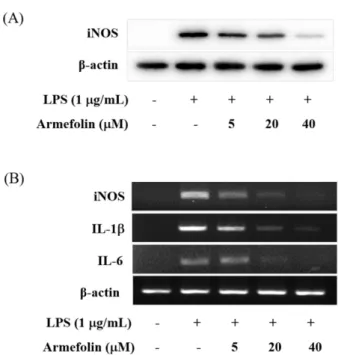
Next, we examined the effect of armefolin on the expression of iNOS, an enzyme for NO production in inflammatory response. Armefolin attenuated the expression of iNOS protein levels, whereas LPS treatment markedly up-regulated the protein level of iNOS in RAW 264.7 cells (Fig. 2.A). Moreover, RT-PCR analysis showed down-regulation of mRNA level of iNOS by the treatment with armefolin in Fig. 2.B. These results indicate that armefolin regulates the expressions of LPS-induced iNOS

at the transcriptional level.

To examine the the suppressive potential of armefolin on pro-inflammatory cytokines, we investigated its effect on the levels of IL-1 β and IL-6 mRNA expression in LPS-treated RAW 264.7 cells. As shown in Fig. 2.B., armefolin down-regulated the IL-1 β and IL-6 mRNA levels in a dose dependent manner. Taken together, these data suggest that armefolin, a sesquiterpene from A.

iwayomogi has the anti-inflammatory potential by suppre- ssion of NO production through down-regulation of iNOS expression, and by inhibition of IL-1 β and IL-6 expression in activated macrophage cells.

To reveal the molecular mechanism for the suppression of LPS-induced iNOS, IL-1 β and IL-6 expressions by armefolin, we examined whether the armefolin affect the LPS-induced inhibitor κBα (I-κBα) degradation. I-κBα is located in cytoplasm as an active form that is physically binds with nuclear factor κB (NF-κB). NF-κB is an important transcription factor directing the expression of pro-inflammatory enzymes and cytokines such as iNOS, IL-1 β and IL-6.

18

In response to stimuli such as LPS, I- κBα is phosphorylated, ubiquitinated, and rapidly degraded to release the NF- κB.

19

The free NF- κB moves to the Fig. 1. The structure of armefolin purified from A. iwayomogi

(A) and the effect of armefolin on LPS-induced NO production in RAW 264.7 macrophages (B). The amount of nitrite in culture medium was measured by using Griess reagents (bar). Cell viability was determined by MTT assay (•). The values are expressed as the means ± S.D. of three individual experiments. * p < 0.05 indicate significant differences from the LPS alone.

Fig. 2. Effects of armefolin on iNOS expression (A) and inflammatory cytokines (B) in LPS-activated RAW 264.7 macrop- hages. Cells were treated with armefolin for 20 h during LPS (1 μg/mL) activation. Cell lysates were prepared and the iNOS and β-actin protein levels were determined by Western blotting (A). Cells were treated with armefolin for 6 h during LPS (1 μg/

mL) activation. The mRNA levels for iNOS, IL-1 β, IL-6 and β- actin were determined by RT-PCR from total RNA extracts (B).

β-Actin was used as an internal control. Images are the represen-

tative of three independent experiments that shows similar results.

(4)

nucleus and induces the expression of inflammatory genes.

20

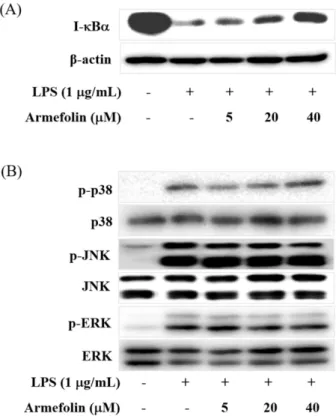
As shown in Fig. 3.A., armefolin concentration- dependently suppressed the LPS-induced degradation of I- κBα. These results suggest that armefolin from A.

iwayomogi stabilize I-κBα, which results in suppression of the nuclear translocation and activation of NF- κB.

We also examined whether the armefolin could affect the mitogen-activated protein kinases (MAPKs) such as p38, JNK and ERK, because MAPKs are involved in the stabilization of I- κBα to activate NF-κB pathway.

21

It has been also reported that MAPK family proteins regulate inflammatory mediators such as NO and pro-inflammatory cytokines.

22,23

To investigate the effect of armefolin on the LPS-induced activation of MAPK family proteins, we assessed the levels of phosphorylated p38, JNK and ERK in LPS-activated RAW 264.7 cells. As shown in Fig. 3.B., armefolin did not affect the LPS-induced phosphorylation of p38, JNK and ERK, which suggests that suppression of LPS-induced I- κBα degradation by armefolin is not associated with p38, JNK and ERK activation. Aremfolin

might regulate different pathway than p38, JNK and ERK to inhibit the expression of iNOS and inflammatory cytokines.

Taken together, armefolin from A. iwayomogi significantly suppressed the production of inflammatory mediator such as NO by suppressing the iNOS mRNA expression. This activity of armefolin was exhibited by inhibiting NF- κB pathway via suppression of I- κBα degradation in LPS- activated macrophages. The active sesquiterpene, armefolin, from A. iwayomogi may be a beneficial candidate for the treatment of inflammatory diseases accompanying the overproduction of NO.

Acknowledgments

This work was supported by the Sookmyung Women’s University Research Grant in 2015.

References

(1) Kim, J. K. Illustrated Natural Drugs Encyclopedia; Namsandang publisher: Seoul, 1989, p 79.

(2) Yan, X. T.; Ding, Y.; Lee, S. H.; Li, W.; Sun, Y. N.; Yang, S. Y.;

Jang, H. D.; Kim, Y. H. Nat. Prod. Sci. 2014, 20, 176-181.

(3) Ha, H.; Lee, H.; Seo, C. S.; Lim, H. S.; Lee, M. Y.; Lee, J. K.; Shin, H. Evid. Based Complement. Alternat. Med. 2014, 2014, 673286.

(4) Wang, J. H.; Choi, M. K.; Shin, J. W.; Hwang, S. Y.; Son, C. G. J.

Ethnopharmacol. 2012, 140, 179-185.

(5) Yu, H. H.; Kim, Y. H.; Kil, B. S.; Kim, K. J.; Jeong, S. I.; You, Y. O.

Planta Med. 2003, 69, 1159-1162.

(6) Kim, A. R.; Zou, Y. N.; Park, T. H.; Shim, K. H.; Kim, M. S.; Kim, N. D.; Kim, J. D.; Bae, S. J.; Choi, J. S.; Chung, H. Y. Phytother. Res.

2004, 18, 1-7.

(7) Ahn H.; Kim J. Y.; Lee H. J.; Kim Y. K.; Ryu J. H. Arch. Pharm.

Res. 2003, 26, 301-305.

(8) Nathan, C.; Xie, Q. W. J. Biol. Chem. 1994, 269, 13725-13728.

(9) Thomsen, L. L.; Miles, D. W. Cancer Metastasis Rev. 1998, 17, 107- 118.

(10) Weinberg, J. B.; Fermor, B.; Guilak, F. Subcell. Biochem. 2007, 42, 31-62.

(11) Mittal, R.; Gonzalez-Gomez, I.; Goth, K. A.; Prasadarao, N. V. Am.

J. Pathol. 2010, 176, 1292-1305.

(12) Kapur, S.; Picard, F.; Perreault, M.; Deshaies, Y.; Marette, A. Int. J.

Obes. Relat. Metab. Disord. 2000, 24, S36-S40.

(13) Förstermann, U.; Schmidt, H. H.; Pollock, J. S.; Sheng, H.;

Mitchell, J. A.; Warner, T. D.; Nakane, M.; Murad, F. Biochem. Pharmacol.

1991, 42, 1849-1857.

(14) Förstermann, U.; Pollock, J. S.; Tracey, W. R.; Nakane, M.

Methods Enzymol. 1994, 233, 258-264.

(15) Hiraku, Y.; Kawanishi, S.; Ichinose, T.; Murata, M. Ann. N. Y.

Acad. Sci. 2010, 1203, 15-22.

(16) Hiraku, Y.; Kawanishi, S. Methods Mol. Biol. 2009, 512, 3-13.

(17) Mata, R.; Delgado, G.; de Vivar, A. R. Phytochemistry 1984, 23, 1665-1668.

(18) Gasparini, C.; Feldmann, M. Curr. Pharm. Des. 2012, 18, 5735- 5745.

(19) Kanarek, N.; Ben-Neriah, Y. Immunol. Rev. 2012, 246, 77-94.

(20) Valera, F. C.; Umezawa, K.; Brassesco, M. S.; Castro-Gamero, A.

Fig. 3. The effects of armefolin on LPS-induced I-κBα degradation

(A) and phosphorylation of p38, JNK and ERK (B) in RAW 264.7

macrophages. Cells were pre-treated with armefolin for 30 min

prior to LPS treatment. Cell lysates were prepared after LPS

treatment for an additional 15 min, and then levels of degraded I-

κBα (A), phosphorylated p38, JNK and ERK (B) were deter-

mined by Western blot. Images are the representative of three

independent experiments that shows similar results.

(5)

M.; Queiroz, R. G. D. P.; Scrideli, C. A.; Tone, L. G.; Anselmo-Lima, W.

T. Cell. Physiol. Biochem. 2012, 30, 13-22.

(21) Ganai, A. A.; Khan, A. A.; Malik, Z. A.; Farooqi, H. Toxicol. Appl.

Pharmacol. 2015, 283, 139-146.

(22) Kaminska, B. Biochim. Biophys. Acta 2005, 1754, 253-262.

(23) Kim, E. K.; Choi, E. J. Arch. Toxicol. 2015, 89, 867-882.

Received December 29, 2016

Revised January 23, 2017

Accepted January 30, 2017

수치

Fig. 2. Effects of armefolin on iNOS expression (A) and inflammatory cytokines (B) in LPS-activated RAW 264.7  macrop-hages
Fig. 3. The effects of armefolin on LPS-induced I-κBα degradation (A) and phosphorylation of p38, JNK and ERK (B) in RAW 264.7 macrophages

참조

관련 문서

The anti-inflammatory effects of Pyrolae herva extract through the inhibition of the expression of inducible nitric oxide synthase (iNOS) and NO

Western blot and RT-PCR analyses revealed that SAL inhibited the LPS-induced expressions of inducible nitric oxide synthase (iNOS) and cyclooxygenase-2 (COX-2) at the protein

Sup- pressive effects of nitric oxide production and inducible nitric oxide synthase (iNOS) gene expression by Calystegia soldanella methaxl extract on

The present study elucidated the effect of the selective inducible nitric oxide synthase (iNOS) inhibitor N 6 -(1-iminoethyl)-L-lysine (L-NIL) on monosodium urate (MSU)

Abstract Assessment was made of the effects of Aralia cordata Thunb (DH) on the cell proliferation, inducible nitric oxide synthase (iNOS) mRNA gene expression and nitric

Inducible nitric oxide synthase (iNOS) level was decreased in the liver of rats treated with YH439.. The increased iNOS activity induced by LPS and

Curcumin은 ovalbumin에 의해서 유도된 inducible nitric oxide synthase 억제.. 김지수·안희진·신화정 1 ·구교정 1 ·엄상훈·이청호·민인순

Abstract Assessment was made of the effects of Aralia cordata Thunb (DH) on the cell proliferation, inducible nitric oxide synthase (iNOS) mRNA gene expression and nitric oxide