IntroductIon
The family Pomacentridae (Perciformes) is one of the largest fish groups, comprising 377 species worldwide (Allen and Erdmann, 2012), including 17 species in Ko- rea (Kim et al., 2005; Song et al., 2014). Most species of Pomacentridae inhabit coral reefs, mangroves, and sea- grass beds of the west and central Indo-Pacific regions (Allen, 1991; Nelson, 2006; Allen and Erdmann, 2012).
A total of 20 species in the genus Abudefduf Forsskål, 1775, have been recognized worldwide, but only five species have been reported in Korea (Kim et al., 2005):
A. bengalensis (Bloch, 1787), A. notatus (Day, 1870), A. sexfasciatus (Lacepède, 1801), A. sordidus (Forsskål, 1775), and A. vaigiensis (Quoy and Gaimard, 1825). This genus is characterized by a compressed body with five or more lateral bands, 13 dorsal fin spines, and a smooth posterior margin of the preopercle (Aonuma et al., 2013).
In this study, three specimens of the genus Abudefduf, collected from tidal pools on Jeju Island, were identified as A. septemfasciatus using molecular methods. We pro- vide morphological description of these specimens.
MaterIals and Methods
Three specimens collected from tidal pools on the southern and northern coasts of Jeju Island, with hand nets, in August 2015 were fixed as whole-body speci- mens in 99% ethanol. Counts and measurements were made according to Hubbs and Lagler (2004). The fin rays and lateral-line scales were counted under a stereomicro- scope (Leica M205C, Germany). The specimens were de- posited at the Biodiversity Dynamics Team (BDT) of the National Marine Biodiversity Institute of Korea.
The specimens were identified at the molecular level with a universal primer set that amplifies a fragment of the mitochondrial DNA cytochrome oxidase subunit I gene (COI) (Ward et al., 2005). Genomic DNA extraction and polymerase chain reaction (PCR) were performed accord- ing to Ivanova et al. (2007). The nucleotide sequences were deposited in the DDBJ/EMBL/GenBank databases (accession numbers: KT879787-879789). The sequences were aligned with ClustalW (Thompson et al., 1994) in BioEdit ver. 7 (Hall, 1999). The sequences of A. sordidus (JF434711, JQ431399) and A. septemfasciatus (JQ431396, KF009558, KJ967810) from the National Center for Bio- logical Information (NCBI) database were used for se- quence comparisons. The genetic distances were calcu-
—47 — http://www.fishkorea.or.kr
* Corresponding author: Hyuck Joon Kwun Tel: 82-41-950-0711, Fax: 82-41-950-0708, E-mail: [email protected]
ISSn: 1225-8598(Print), 2288-3371(online)
accepted: December 26, 2015
First Record of the Banded Sergeant, Abudefduf septemfasciatus (Perciformes: Pomacentridae) from Jeju Island, Korea
By Hyuck Joon Kwun*, Jinsoon Park, Hye Seon Kim and Hanna Bae
National Marine Biodiversity Institute of Korea, 75, 101 Jangsan-ro, Janghang-eup, Seocheon-gun, Chungcheongnam-do 33662, Korea
ABSTRACT three specimens of Abudefduf septemfasciatus were collected firstly from tidal pools on the southern and northern coasts of Jeju Island, Korea in august 2015. this species is character
ized by black blotches on the upper origin of the pectoral fin, upper caudal peduncle and a dorsal fin between the second and fourth spines, predorsal scales beyond to above the middle of the eye, 12~13 soft dorsal and anal fin rays, and 20 lateralline scales. this species is distinguishable from Abudefduf sordidus by soft dorsal and anal fin rays, location of caudal peduncle blotch, and location of the dorsal fin blotch. the newly proposed Korean name is “Ilgopjuljadom”.
Key words: First record, Abudefduf septemfasciatus, Pomacentridae, tidal pool, Jeju Island
lated with MEGA 6 (Tamura et al., 2013).
Abudefduf septemfasciatus
(Cuvier, 1830) (New Korean name: Il-gop-jul-ja-dom)
(Fig. 1; Table 1)
Glyphisodon septemfasciatus Cuvier in Cuvier and Val- enciennes, 1830: 463 (type locality: Mascarenes, south- western Indian Ocean).
Abudefduf septemfasciatus: Allen and Erdmann, 2012:
563; Aonuma et al., 2013: 1049.
Materials examined. BDT-196-197, 2 specimens, 24.3
~ 32.7 mm in standard length (SL), Aerae (126°23ʹ49ʺE, 33°14ʹ23ʺN), Seogwipo, Jeju Island, Korea, hand net, 26 August 2015; BDT-198, 1 specimen, 22.9 mm SL, Oedo (126°25ʹ25ʺE, 33°29ʹ42ʺN), Jeju, Jeju Island, Korea, hand net, 24 August 2015.
Description. Counts are shown in Table 1. Proportions
as % SL: body depth 48.9~54.1 (51.1); head length 35.5
~ 40.6 (38.0); snout length 9.6~11.1 (10.3); postorbital length of the head 13.6~14.8 (14.3); suborbital width 1.7
~ 4.6 (2.8); interorbital width 10.4~13.1 (11.7); eye dia- meter 12.3~13.5 (13.0); upper jaw length 8.2~10.5 (9.1);
predorsal length 37.9~42.4 (40.7); prepelvic length 37.9
~ 47.3 (42.2); preanal length 68.1~72.4 (70.6); caudal pe- duncle depth 16.9~17.5 (17.2); pectoral fin length 23.9
~ 27.2 (25.0); pelvic fin length 32.9~35.4 (34.2).
Body oval, compressed, and moderately deep. Head moderate and eyes large. Snout short and slightly point- ed. Mouth small and terminal; posterior margin of the maxilla reaches slightly beyond the anterior margin of the eye. Interorbital region slightly concave. Two pairs of nostrils present. Conical teeth present on both jaws. Sen- sory pores well developed around eye. Posterior margins of preopercle and opercle smooth. Opercle ending poster- iorly in a small flat spine, its tip slightly obtuse. Upper
Table 1. Comparison of meristic characters of Abudefduf septemfasciatus and Abudefduf sordidus
Abudefduf septemfasciatus Abudefduf sordidus
Present study Cuvier(1830) Aonuma et al.(2013) Present study
Number of specimens 3 - - 2
Standard length(mm) 22.9~32.7 - - 27.4~36.9
Dorsal fin rays XIII, 12~13 XIII, 13 XIII, 12~14 XIII, 15~16
Anal fin rays II, 12~13 II, 12 II, 11~13 II, 15
Pectoral fin rays 17~18 - 17~19 19
Pelvic fin rays I, 5 - - I, 5
Caudal fin rays 8+7 - - 8+7
Lateral line scales 20+8~9 - 20~22+8~10 20~21+7
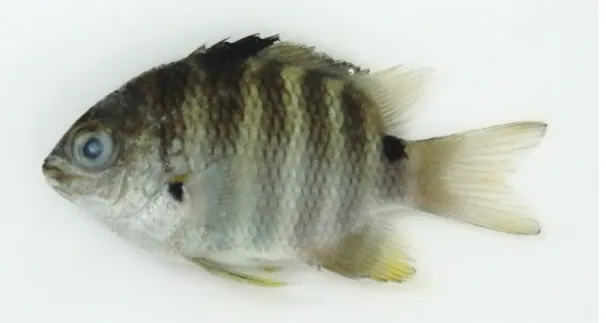
Fig. 1. Abudefduf septemfasciatus, BDT-196, 32.7mm SL.
and lower procurrent caudal rays not spinous. Head and body covered with ctenoid scales, including cheek. Pre- dorsal scales beyond to above the middle of the eye. Lat- eral-line scales tubular. Lateral line incomplete, scales interrupted below between third and fourth soft dorsal fin ray. Posterior margin of soft portion of dorsal fin slightly rounded. Posterior tip of pelvic fin beyond origin of first anal fin spine.
Coloration. When fresh, the head and body greenish white, darker dorsally than ventrally. Seven broad and diffuse black bars on lateral body. Dark blotches on upper origin of pectoral fin, upper caudal peduncle, and spinous portion of dorsal fin between second and fourth spines above third black bar (Fig. 2A). All fins semi-transparent and white, except pelvic and anal fins, which yellowish distally. After alcohol fixation, head and body whitish gray with seven distinct light black bars. All fins whitish, with tiny melanophores on the membranes.
Distribution. Abudefduf septemfasciatus is distributed in the east Africa, and the western Indian Ocean to east- ern Australia (Allen and Erdmann, 2012), the Maldives (MRS, 1997), the Indo-Pacific, including southern Japan (Aonuma et al., 2013). In Korea, it occurs on the north- ern and southern coasts of Jeju Island (present study).
Remarks. Morphologically, the present specimens can be assigned in the genus Abudefduf based on the follow- ing characters: 13 dorsal fin spines, posterior margin of the preopercle smooth, and body with numerous lateral bands (Aonuma et al., 2013). Among Abudefduf species, these specimens are most similar to A. sordidus in that they have a dark blotch on the upper caudal peduncle.
However, they differ from A. sordidus in having fewer soft dorsal and anal fin rays (12~13 and 12~13, respec- tively, in A. septemfasciatus vs. 15~16 and 15, respec- tively, in A. sordidus) (Table 1). They also correspond to the original description of A. septemfasciatus in their greenish body coloration, seven dark bands on the body, and the dorsal and anal fin counts (Cuvier, 1830; Table 1).
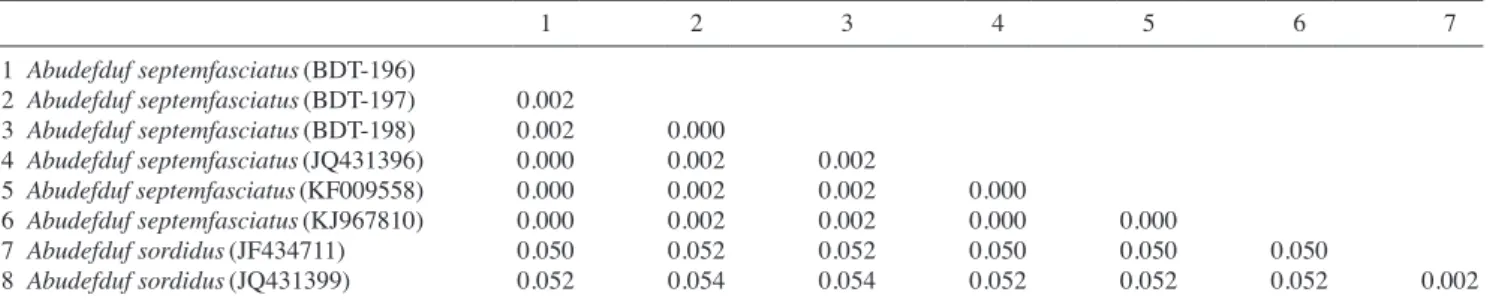
Three specimens of the genus Abudefduf collected from tidal pools on Jeju Island had identical mtDNA COI se- quences and were more closely related to that of A. sep
temfasciatus (d=0.000~0.002) than to that of A. sordi
dus (d=0.050~0.054) (Table 2). Therefore, we identified these three specimens as A. septemfasciatus based on both morphological and molecular analyses. Interestingly, sev- eral references state that A. septemfasciatus has no black blotch on the upper caudal peduncle (MRS, 1997; Allen and Erdmann, 2012; Aonuma et al., 2013), but the present
Table 2. Genetic divergence of Abudefduf septemfasciatus and Abudefduf sordidus
1 2 3 4 5 6 7
1 Abudefduf septemfasciatus(BDT-196)
2 Abudefduf septemfasciatus(BDT-197) 0.002
3 Abudefduf septemfasciatus(BDT-198) 0.002 0.000
4 Abudefduf septemfasciatus(JQ431396) 0.000 0.002 0.002
5 Abudefduf septemfasciatus(KF009558) 0.000 0.002 0.002 0.000
6 Abudefduf septemfasciatus(KJ967810) 0.000 0.002 0.002 0.000 0.000
7 Abudefduf sordidus(JF434711) 0.050 0.052 0.052 0.050 0.050 0.050
8 Abudefduf sordidus(JQ431399) 0.052 0.054 0.054 0.052 0.052 0.052 0.002
Fig. 2. Location of blotches on the dorsal fin membranes and upper caudal peduncle. (A) Abudefduf septemfasciatus, BDT-196;(B) Abudefduf sordidus, BDT-195.
A B
specimens have a distinct black blotch on the upper cau- dal peduncle (Fig. 2A), which is similar to A. sordidus, so this seems to be an ontogenic, regional, or environmental variation. We also found newly characters that distinguish A. septemfasciatus and A. sordidus: location of the cau- dal peduncle blotch (anterior margin of the blotch reaches above the last or second last soft dorsal fin ray in A. sep
temfasciatus vs. beyond above the third last soft dorsal fin ray in A. sordidus) and the location of the dorsal fin blotch (above the third black bar on the body in A. septemfascia
tus vs. above the second and third black bars on the body in A. sordidus) (Fig. 2). We propose the new Korean name,
“Il-gop-jul-ja-dom”, for A. septemfasciatus.
acKnowledgMents
This research was supported by National Marine Bio- diversity Institute of Korea Research Program (2016M 00200).
references
Allen, G.R. 1991. Damselfishes of the world. Mergus Publishers, Melle, Germany, 271pp.
Allen, G.R. and M.V. Erdmann. 2012. Reef fishes of the East Indies.
Tropical Reef Research, Perth, Australia, 1292pp.
Aonuma, Y., T. Yoshino and N. Yagishita. 2013. Pomacentridae. In:
Nakabo, T.(ed.), Fishes of Japan with pictorial keys to the species. 3rd ed. Tokai University Press, Tokyo, Japan, pp.
1029-1066.(in Japanese)
Bloch, M.E. 1787. Naturgeschichte der ausländischen Fische. Ber- lin, 146pp.
Cuvier, G. and A. Valenciennes. 1830. Histoire naturelle des pois- sons. Tome cinquième. Livre cinquième. Des Sciénoïdes.
499pp.
Day, F. 1870. Remarks on some of the fishes in the Calcutta museum.
Proc. Zool. Soc. Lond., 1869: 511-527.
Forsskål, P.S. 1775. Descriptiones animalium avium, amphibiorum, piscium, insectorum, vermium; quae in itinere orientali ob-
servavit Petrus Forskål. Post mortem auctoris edidit Carsten Niebuhr. Adjuncta est materia medica kahirina atque tabula maris rubri geographica. Hauniæ, 164pp.
Hall, T.A. 1999. BioEdit: a user-friendly biological sequence align- ment editor and analysis program for Windows 95/98/NT.
Nucl. Acids Symp. Ser., 41: 95-98.
Hubbs, C.L. and K.F. Lagler. 2004. Fishes of the Great Lakes region.
Revised ed. The University of Michigan Press, Ann Arbor, MI, 276pp.
Ivanova, N.V., T.S. Zemlak, R.H. Hanner and P.D.N. Hebert. 2007.
Universal primer cocktails for fish DNA barcoding. Mol.
Ecol. Notes, 7: 544-548.
Kim, I.S., Y. Choi, C.L. Lee, Y.J. Lee, B.J. Kim and J.H. Kim. 2005.
Illustrated book of Korean fishes. Kyo-Hak Publishing Co., Seoul, 615pp.(in Korean)
Lacepède, B.G.E. 1801. Histoire naturelle des poissons. 558pp.
MRS. 1997. Fishes of the Maldives. Marine Research Section, Min- istry of Fisheries and Agriculture, Republic of Maldives, 408pp.
Nelson, J.S. 2006. Fishes of the world. 4th ed. John Wiley and Sons, Inc., Hoboken, New Jersey, 601pp.
Quoy, J.R.C. and J.P. Gaimard. 1824-25. Description des Poissons.
Chapter IX. In: Freycinet, L.(ed.), de, Voyage autour du Monde...exécuté sur les corvettes de L. M. “L’Uranie” et “La Physicienne,” pendant les années 1817, 1818, 1819 et 1820.
Paris. pp. 192-401.
Song, Y.S., H.J. Kwun, J.K. Kim and H. Senou. 2014. A new record of juvenile Chromis mirationis(Perciformes: Pomacentridae) from Korea, revealed by molecular analysis, with a compar- ison to juvenile Chromis notata. Fish. Aquat. Sci., 17: 263- 267.
Tamura, K., G. Stecher, D. Peterson, A. Filipski and S. Kumar. 2013.
MEGA6: Molecular Evolutionary Genetics Analysis version 6.0. Mol. Biol. Evol., 30: 2725-2729.
Thompson, J.D., D.G. Higgins and T.J. Gibson. 1994. CLUSTAL W:
improving the sensitivity of progressive multiple sequence alignment through sequence weighting, position-specific gap penalties and weight matrix choice. Nucl. Acids Res., 22: 4673-4680.
Ward, R.D., T.S. Zemlak, B.H. Innes, P.R. Last and P.D.N. Hebert.
2005. DNA barcoding Australia’s fish species. Philosophi- cal Transactions of the Royal Society of London, Series B, Biological Sciences, 360: 1847-1857.
한국산 자리돔과 (Pomacentridae) 어류 1미기록종, Abudefduf septemfasciatus
권혁준
·
박진순·
김혜선·
배한나국립해양생물자원관
요 약 :
2015년 8월, 우리나라 제주도 남부 및 북부 연안 조수웅덩이에서 Abudefduf septemfasciatus 3개체가 처 음 채집되었다. 본 종은 가슴지느러미 기점 위, 꼬리자루 위 및 2번째와 4번째 등지느러미 극조 사이에 검은 반점이 있고 등지느러미 전방 비늘은 눈의 중앙을 지나며, 등지느러미 및 뒷지느러미 연조는 12~13개, 측선비늘은 20
개이다. 본 종은 줄자돔과 등지느러미 및 뒷지느러미 연조수, 꼬리자루 반점 위치 및 등지느러미 반점 위치에서 차
이를 보인다. 본 종의 새로운 국명으로 ‘일곱줄자돔’을 제안한다.