INTRODUCTION
The family Carangidae comprises about 147 species in 30 genera of four subfamilies worldwide (Nelson, 2016).
All members of Carangidae have two dorsal fins, anal fin with two anterior spines, scutes present and prominent, or reduced in some species and absent in some genera (Smith- Vaniz, 1999; Nelson, 2016). Fifty-nine species in 24 gen- era have been reported from Japan (Senou, 2013) and 35 species in 18 genera from Korea so far (MABIK, 2017;
Kim et al., 2018a).
The genus Scomberoides Lacepède, 1801 is character- ized by the posterior soft dorsal and anal fin rays consist- ing of semi-detached filets, distal quarter to half of rays not connected by interradial membrane (unattached por- tion of rays increasing with growth); upper lip joined to snout at midline by a bridge of skin (frenum), except cross- ed by a shallow groove in very young (Gushiken, 1983;
Smith-Vaniz, 1999). Four species have been reported in this genus worldwide (Froese and Pauly, 2017) and one
species from Korea (Kim et al., 2018b).
During the fish survey using a set net, we collected two specimens of unrecorded Scomberoides species belonging to the subfamily Scomberoidinae of Carangidae from the southern coastal waters of Jejudo Island, Korea. The spec- imens were identified as Scomberoides lysan according to the method of Senou (2013). We here describe the mor- phological characters of S. lysan and add the species to the list of Korean fishes.
Counts and measurements followed the method of Hubbs and Lagler (1964) and Gushiken (1983). The examined specimens were deposited at the Fish Genetics and Breed- ing Laboratory, Jeju National University (JNU), Korea.
Scmberoides lysan (Forsskål, 1775) (New Korean name: Du-jeom-jul-ga-si-jeon-gaeng-i)
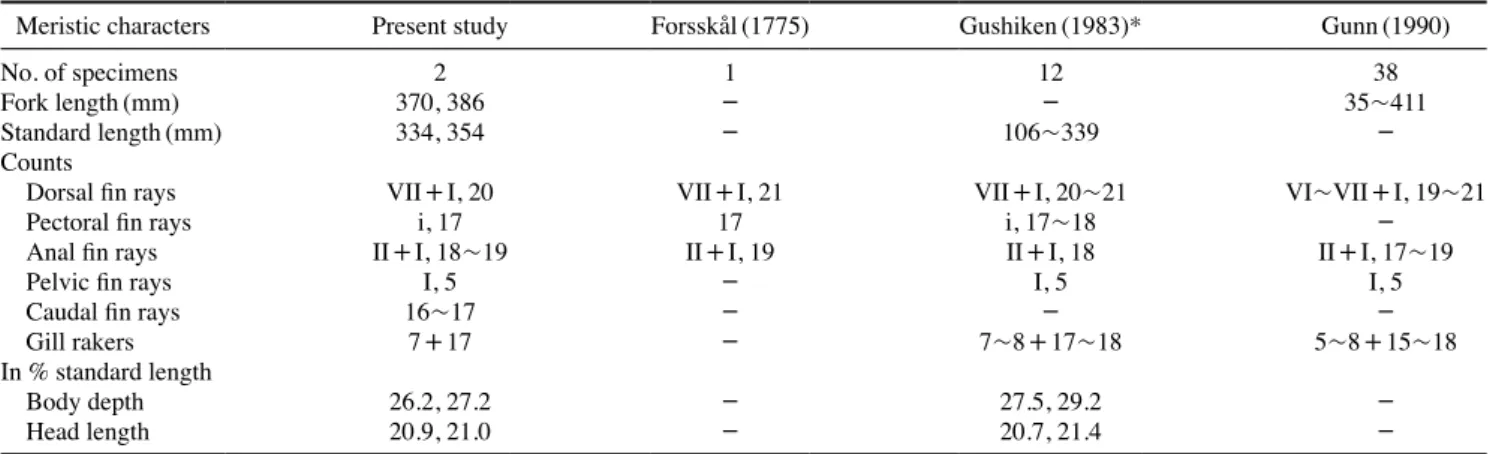
(Fig. 1; Table 1)
Scomber lysan Forsskål, 1775: 54 (type locality: Red Sea).
Scomberoides lysan: Gushiken, 1984: 153 (Japan); Smith- Vaniz, 1986: 655 (southern Africa); Winterbottom et al., 1989: 34 (Chagos Archipelago): Gunñ, 1990: 44 (Aus- tralia), Talwar and Jhingran, 1991: 825 (India); Randall, 1995: 185 (Oman); Mohsin et al., 1996: (Malaysia); Lin
—242 — http://www.fishkorea.or.kr
* Corresponding author: Choon Bok Song Tel: 82-64-754-3471, Fax: 82-64-756-3493, E-mail: [email protected]
First Record of the Doublespotted Queenfish, Scomberoides lysan (Perciformes: Carangidae) from Korea
By Maeng Jin Kim, Joon Sang Kim
1and Choon Bok Song
2,*
West Fisheries Research Institute, National Institute of Fisheries Sciences, Incheon 22383, Republic of Korea
1Korea Fisheries Resources Agency, Jeju Branch, Jeju 63012, Republic of Korea
2College of Ocean Sciences, Jeju National University, Jeju 63243, Republic of Korea
ABSTRACT
This is the first report of Scomberoides lysan (Perciformes: Carangidae) from Korea. Two specimens (334 and 354 mm standard length) were collected by a set net from the coastal waters of Jejudo Island on 30 September, 2010. This species is characterized and distinguishable from a morpho- logically similar Scomberoides tol as follows. It has the posterior end of maxilla reaching to the poste- rior margin of eye (vs. not reaching in S. tol) and two rows of 5~8 small blotches on both sides of body (vs. one row of blotches). We add S. lysan to the Korean fish fauna and propose a new Korean name,
“Du-jeom-jul-ga-si-jeon-gaeng-i” for the species because it has two series of dusk blotches on both sides of body.
Key words: Scomberoides lysan, Carangidae, first record, Jejudo Island, Korea
and Shao, 1999: 64 (Taiwan); Myers, 1999: 142 (Micro- nesia); Randall and Lim, 2000: 616 (South China Sea);
Randall, 2007: 237 (Hawaii).
Material. JNU0057-1~2, two specimens, 334 and 354 mm in standard length (SL), Daepo-dong, Seogwipo city, Jejudo Island, Korea, set net, 30 September, 2010.
Description. Meristic and morphometric characters for the present specimens appear in Table 1.
Measurements as a percentage against SL are as follows:
body width, 10.1~11.3; upper jaw length, 10.6; snout length, 6.1~6.3; eye dimeter, 3.3~3.5; interorbital width, 6.8; second predorsal fin, 49.4~49.7; prepectoral fin length, 22.3~22.5; preanal fin length, 47.9~50.3; length of longest dorsal fin ray, 9.9~10.7; pectoral fin length, 10.9~11.7; length of long est anal fin ray, 8.8~9.6; caudal peduncle length, 3.3~3.5; caudal peduncle depth, 4.9~5.0.
Body elongated to elliptical and strongly compressed;
dorsal and ventral profile nearly equal, slightly concave on dorsal profile of head; snout pointed, upper jaw extended to below posterior margin of eye; orbit diameter smaller than snout length; upper jaw with an outer row of small conical teeth and an inner band of fine teeth; lower jaw with two rows of subequal conical teeth; lateral line only slightly irregular, weakly to moderately convex above pectoral fins becoming straight posteriorly; soft dorsal and soft anal fins low, its anterior part only slightly falcate;
posterior soft dorsal and anal rays consisting of semide- tached finlets, last one elongated, base of anal and second dorsal fins about equal in length; pectoral fin short, almost equal to pelvic fin; scales on mid-body below lateral line partially embedded and sharply lanceolate; no scute and groove on caudal peduncle; deeply fork caudal fin.
Coloration. When fresh, head and body grey-green above, silver gray to midline, silver white below; two series of dusk blotches on both sides of body (six blotches above
Fig. 1. Scomberoides lysan, JNU0057-1, 334.0 mm SL, Jejudo Island, Korea.
Table 1. Comparison of morphological characters between present and previous studies on Scomberoides lysan
Meristic characters Present study Forsskål(1775) Gushiken(1983)* Gunn(1990)
No. of specimens 2 1 12 38
Fork length(mm) 370, 386 - - 35~411
Standard length(mm) 334, 354 - 106~339 -
Counts
Dorsal fin rays Ⅶ+I, 20 Ⅶ+I, 21 Ⅶ+I, 20~21 VI~Ⅶ+I, 19~21
Pectoral fin rays ⅰ, 17 17 ⅰ, 17~18 -
Anal fin rays Ⅱ+I, 18~19 Ⅱ+I, 19 Ⅱ+I, 18 Ⅱ+I, 17~19
Pelvic fin rays I, 5 - I, 5 I, 5
Caudal fin rays 16~17 - - -
Gill rakers 7+17 - 7~8+17~18 5~8+15~18
In % standard length
Body depth 26.2, 27.2 - 27.5, 29.2 -
Head length 20.9, 21.0 - 20.7, 21.4 -
*Measurements were based on two specimens(193 and 215mm SL).
anal soft fin white with anterior margin black blotch; pec- toral fin black; ventral fin white with margin small black blotch; upper lobe of caudal fin and lower lobe dusky black. After fixation in formalin, grayish midline above and light below; two series of dark blotches on side faint;
dorsal, pectoral and caudal fin dark brown; ventral and anal fin pale brown.
Distribution. Known from subtropical and temperate waters in Indo-Pacific Ocean: South Africa Sea, Red Sea to Australia, India, Malaysia, Taiwan, China, Japan to Hawai- ian Islands (Smith-Vaniz and Staiger, 1973; Smith-Vaniz, 1999), and Korea (Jejudo Island, present study).
Remarks. The present specimens, belonging to the fami- ly Carangidae, are characterized by having body elongate, soft dorsal and soft anal fins with semi-detached finlets posteriorly, scales needle-like to lanceolate, two rows of black blotches on body side and upper jaw extended to below the posterior margin of eye. The morphological characteristics of present specimens were compared with those in the previous reports of Scomberoides species (Gunñ, 1990; Smith-Vaniz, 1999; Senou, 2013), which revealed that all morphological traits examined were well matched with those of S. lysan (Table 1). Thus, we identi- fied our specimens to be S. lysan based on the morpholog- ical characters.
This species morphologically resembles Scomberoides tol (Cuvier, 1832) inhabiting the Korean water, but it is distinguishable from the latter by having the posterior end of maxilla reaching the posterior margin of eye (vs. not reaching in the latter) and two rows of 5~8 small blotches on both sides of body (vs. one row of blotches) (Gunñ, 1990; Senou, 2013). We suggest its new Korean name,
“Du-jeom-jul-ga-si-jeon-gaeng-i” for species since it has two rows of small blotches on the body.
ACKNOWLEDGMENTS
This work was funded by a grant from the National In- stitute of Fisheries Sciences (No: R2018030), Korea.
REFERENCES
Cuvier, G. and A. Valenciennes. 1832. Histoire naturelle des Pois- sons. Tome huitième. Livre neuvième. Des Scombéroïdes, 8: 385.
Forsskål, P. 1775. Descriptions animalium avium, amphibiorum, pi- scium, insectorum, vermium; quae in itinere orentali obser-
Froese, R. and D. Pauly(eds.). 2018. FishBase. World Wide Web elec- tronic publication(Internet). Retrieved from www.fishbase.
org, version(6/2018).
Gunñ, J.S. 1990. A revision of selected genera of the family Carangi- dae(Pisces) from Australian waters. Rec. Aus. Mus. Suppl., 12: 1-77.
Gushiken, S. 1983. Revision of the carangid fishes of Japan. Galaxea, Publ. Sesoko Mar. Sci. Cent. Univ. Ryukyus, 2: 135-264.
Gushiken, S. 1984. Family Carangidae. In: Masuda, H., K. Amaoka, C. Araga, T. Uyeno and T. Yoshino(eds.), The Fishes of the Japanese Archipelago. Tokai Univ. Press, Tokyo, pp. 153- 158.
Hubbs, C.L. and K.F. Lagler. 1964. Fishes of the Great Lakes Region.
Bull. Granbrook Inst. Sci., 26: 19-27.
Kim, J.S., M.J. Kim and C.B. Song. 2018a. First record of the blue- fin travelly, Caranx melampygus(Percicormes: Carangidae) from Korea. Korean J. Ichthyol., 30: 170-174.
Kim, K.M., S.H. Choi and J.K. Kim. 2018b. First record of the need- scaled queenfish, Scomberoides tol(Percicormes: Carangi- dae) from Korea. Korean J. Fish. Aquat. Sci., 51: 444-449.
(in Korean)
Lacepède, B.G.E. 1801. Histoire naturelle des poissons. 3: 1-558, pls. 1-34.
Lin, P.L. and K.T. Shao. 1999. A review of the carangid fishes(Fam- ily Carangidae) from Taiwan with descriptions of four new records. Zool. Stud., 38: 33-68.
MABIK(National Marine Biodiversity Institute of Korea). 2017.
National list of marine species. National Marine Biodiversi- ty Institute of Korea, Seocheon, 1071pp.(in Korean) Mohsin, A.K.M. and M.A. Ambak. 1996. Marine fishes and fisheries
of Malaysia and neighbouring countries. Univ. Pertanian Malaysia Press, Serdan, 744pp.
Myers, R.F. 1999. Micronesian reef fishes. A comprehensive guide to the coral reef fishes of Micronesia. 3rd revised ed. Coral Graphics, Guam, 330pp., 192pls.
Nelson, J.S., T.C. Grande and M.V.H. Wilson. 2016. Fishes of the world. 5th ed. John Wiley & Sons Inc., Hoboken, New Jer- sey, 705pp.
Randall, J.E. 1995. Coastal fishes of Oman. Crawford House Pub- lishing Pty Ltd., Bathurst, 439pp.
Randall, J.E. 2007. Reef and shore fishes of the Hawaiian Islands.
Sea Grant College Program, University of Hawaiʼi, Hono- lulu, 546pp.
Senou, H. 2013. Carangidae. In: Nakabo, T.(ed.), Fishes of Japan with Pictorial Keys to the Species. 3rd ed. Tokai Univ. Press, Kanagawa, pp. 878-892.(in Japanese)
Smith-Vaniz, W.F. 1986. Family No. 210: Carangidae. In: Smith, M.M. and P.C. Heemstra.(eds.), Heemstra Smithʼs Sea Fish- es. Springer-Verlag, Grahamstown, pp. 638-661.
Smith-Vaniz, W.F. 1999. Carangidae. In: Carpenter, K.E. and V.H.
Niem(eds.), FAO species identification guide for fishery
purposes. The living marine resources of the Western Cen- tral Pacific. Vol. 4. Bony fishes part 2(Mugilidae to Carangi- dae). Rome, FAO, pp. 2659-2756.
Smith-Vaniz, W.F. and J.C. Staiger. 1973. Comparative revision of Scomberoides, Oligoplites, Parona, and Hypacanthus with comments on the phylogenetic position of Campogramma (Pisces: Carangidae). Proceedings of the California Academy of Sciences(Series 4), 39: 185-256.
Talwar, P.K. and A.G. Jhingran. 1991. Inland fishes of India and ad- jacent countries. Oxford & IBH Publishing Co., New Delhi, Bombay, Calcutta, 1-2: 1-1158.
Winterbottom, R., A.R. Emery and E. Holm. 1989. An annotated checklist of the fishes of the Chagos Archipelago, central Indian Ocean. Royal Ontario Museum Life Science Contri- butions, 145: 1-226, pls. 1-8.
한국산 전갱이과 어류 1 미기록종, Scomberoides lysan
김맹진
·
김준상1·
송춘복2국립수산과학원 서해수산연구소, 1한국수산자원관리공단 제주지소, 2제주대학교 해양과학대학
요 약 :
농어목 전갱이과에 속하는 Scomberoides lysan 2개체(표준체장 334, 354mm)가 2010년 9월 제주도 서귀포시 대포동의 정치망에서 처음으로 채집되었다. 이 종은 최근 우리나라에 보고된 가시전갱이(S. tol)와 형태적
으로 유사하지만 주둥이 뒤쪽 끝이 눈의 말단에 이르며, 체측에 5∼8개의 작은 검은색 반점들이 두 줄로 나열되는
특징을 갖는다. 따라서 체측에 두 줄의 작은 반점을 가지는 형태적 특징에 근거해서 이 미기록종의 국명을 “두점줄
가시전갱이”로 제안한다.