—220—
The family Cepolidae comprises two subfamilies, Cepolinae and Owstoniinae, four genera and about 19 species in the eastern Atlantic and Indo-West Pacific (including New Zealand) (Nelson, 2006). The Cepolinae is composed of two genera, Acanthocepola Bleeker, 1874 and Cepola Linnaeus, 1764, based on presence or absence of preopercular spines (Smith-Vaniz, 2001).
This family was firstly reviewed by Jordan and Fowler (1903) in Japan, recognizing three species, Cepola schle- gelii Bleeker, 1854, A. krusensternii (Temminck and Schlegel, 1845) and A. limbata (Valenciennes in Cuvier and Valenciennes, 1835). In the genus Acanthocepola, three species are known from Japan (Nakabo, 2002a), and two species, A. krusensternii and A. limbata have been reported from Korea at present (Kim et al., 2005).
During a bottom trawl conducted survey near Maemul Island, off east-southern Korea, we collected a single specimen of Acanthocepola indica (Day, 1888), which represents an unrecorded species from the Korean waters (Fig. 1).
Methods of counts and measurements followed those of Nakabo (2002b). The number of vertebrae, dorsal and anal fin rays were counted from radiographs. The exam- ined specimen is deposited at Ichthyology Laboratory in Pukyong National University (PKU) in Korea.
Acanthocepola indica (Day, 1888) (New Korean name: Nam-bang-hong-gal-chi)
(Fig. 2; Table 1)
Cepola indica Day, 1888: 796 (Madras, India).
Acanthocepola indica: Araga in Masuda et al., 1984:
First Record of a Bandfish, Acanthocepola indica (Cepolidae: Perciformes) from Korea
By Jeong-Ho Park
1,2, Jung Hwa Ryu
3, Jun Mo Lee
4and Jin Koo Kim
1,*
1Department of Marine Biology, Pukyong National University, Busan 608-737, Korea
2Fisheries Resources Research Division, NFRDI, Busan 619-705, Korea
3RYMI, 444-10 Gaya 3-dong, Jin-gu, Busan 614-803, Korea
4CCORA, 701-8 Jongdal-ri, Gujwa-eup, Bukjeju-gun, Jeju 695-976, Korea
ABSTRACT A single specimen (220.4 mm SL) of the bandfish Acanthocepola indica was collected near Maemul Island, off southeastern Korea. This species is characterized by having a serrated post- erior margin of preopercle and a black blotch on anterior part of dorsal fin. It differs from two other species, A. limbata and A. krusensternii, in having a deeper body, 88 dorsal fin rays, and 101 anal fin rays. Our specimen of A. indica is the first record of the species from Korea, for which we propose the new Korean name “Nam-bang-hong-gal-chi.”
Key words : Acanthocepola indica, Cepolidae, first record
*Corresponding author: Jin Koo Kim Tel: 82-51-629-5927, Fax: 82-51-629-5931, E-mail: [email protected]
KOREAN JOURNAL OF ICHTHYOLOGY, Vol. 20, No. 3, 220-223, September 2008 ISSN: 1225-8598
Received : July 18, 2008 Revised : September 1, 2008 Accepted : September 17, 2008
http://www.fishkorea.or.kr Fig. 1. Map showing the sampling area of Acanthocepola indica near Maemul Island, off east-southern Korea.
40�
35
30 N N CHINA
KOREA
JAPAN
125 130�E
First Record of Acanthocepola indica from Korea 221
201, pl. 192-D (Japan); Zhang, 1983: 74 (South China Sea); Smith-Vaniz in Smith and Heemstra, 1986: 728 (Arabian Sea); Shen et al., 1993: 437, pl. 137-1 (Tai- wan); Okamura in Okamura and Amaoka, 1997: 432 (Japan); Shinohara et al., 2001: 327 (listed, Tosa Bay, Japan); Randall and Lim, 2002: 915 (South China Sea);
Nakabo in Nakabo, 2002a: 915 (Key, description, Ja- pan).
Material examined. PKU 25, 1 specimen, 220.4 mm in standard length (SL), near Maemul Island, Korea, 40 m depth, 17 September 2007, bottom trawl, collected by J.H. Ryu.
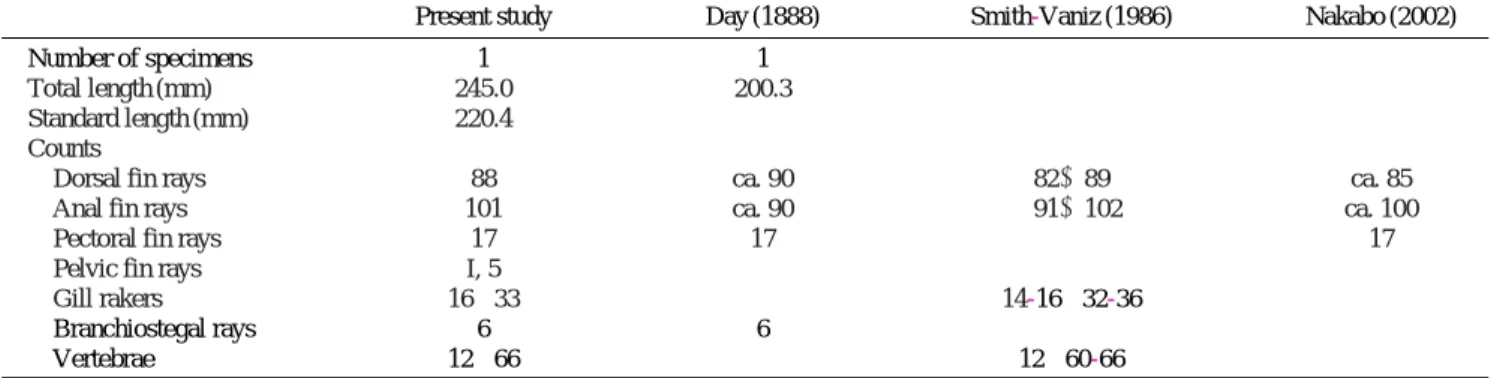
Description. Meristic characters are shown in Table 1.
Measurements in percentage of SL: Body depth 13.7;
body width 5.7; head length 14.4; postorbital length 6.8;
snout length 3.3; eye diameter 4.4; upper jaw length 6.0;
interorbital width 3.2; suborbital width 2.8; predorsal length 11.3; prepectoral length 14.4; prepelvic length 13.8; preanal length 17.2; preanus length 16.6; pectoral fin length 8.8; pelvic fin length 7.8; length of longest dorsal fin ray 8.8; length of longest dorsal fin ray 8.1.
Body elongated, highly compressed and gradually tapering to caudal fin; snout short and blunt, its length shorter than eye diameter; eye large and located dorsal- ly; interorbital space flatten; mouth large and oblique,
both jaws equally protruding; preopercular margin ser- rated with six spines; upper jaw reach to the middle of eye; a single row of recurved canine teeth on both jaws, anterior teeth slightly bigger than lateral ones; two nos- trils, posterior nostril a simple pore, located just anterior edge of eye, slightly bigger than anterior one; gill rakers long and slender; dorsal and anal fin bases long and confluent with caudal fin; posterior margin of pectoral fin rounded, all rays branched; pelvic fin inserted slight- ly anterior to pectoral fin; outermost ray of pelvic fin longest; anus located just before origin of anal fin; later- al line ascending from the upper part of gill opening, then running very close to dorsal fin base; caudal fin pointed; scales minute, ctenoid in cheek and body.
Color of preserved specimen. Body and head overall pale beige, bases of dorsal and anal fins more darker;
interorbital space dark brown; anterior part of 9th to 13th dorsal fin rays with a black blotch; dorsal and anal fins blackish; pectoral fin translucent; pelvic fin translu- cent with many melanophores.
Distribution. Indo-western Pacific: Korea (Maemul Island, present study), Japan (Nakabo, 2002), China (Randall and Lim, 2000), Taiwan (Shen et al., 1993), India (Day, 1888), and South Africa (Smith-Vaniz, 1986).
Remarks. Meristic characters of the present specimen agreed well with those of the previous descriptions of
A B
C
Fig. 2. Acanthocepola indica (Day), PKU 25, 220.4 mm SL, near Maemul Island, Korea. (A) Lateral view; (B) Black blotch between 9th and 13th dorsal fin rays; (C) X-ray photograph.
Table 1. Comparison of meristic characters for Acanthocepola indica
Present study Day (1888) Smith-Vaniz (1986) Nakabo (2002)
Number of specimens 1 1 - -
Total length (mm) 245.0 200.3 - -
Standard length (mm) 220.4 - - -
Counts
Dorsal fin rays 88 ca. 90 82~89 ca. 85
Anal fin rays 101 ca. 90 91~102 ca. 100
Pectoral fin rays 17 17 - 17
Pelvic fin rays I, 5 - - -
Gill rakers 16++33 - 14-16++32-36 -
Branchiostegal rays 6 6 - -
Vertebrae 12++66 - 12++60-66 -
222 Jeong-Ho Park, Jung Hwa Ryu, Jun Mo Lee and Jin Koo Kim
Acanthocepola indica (Day, 1888), including the origi- nal description (Table 1). A. indica is easily distinguish- ed from A. limbata by the number of dorsal fin rays (88 in the former vs. 102~104 in the latter) and body depth (7.3 vs. 13 in SL). A. indica also differs from A. krusen- sternii by a black blotch on anterior part of dorsal fin (vs. absent in the latter), the number of dorsal fin rays (88 vs. 78~82), anal fin rays (101 vs. 76~82), pectoral fin rays (17 vs. 19), and body depth (7.3 vs. about 8 in SL) (Nakabo, 2002b). We proposed the new Korean name, “Nam-bang-hong-gal-chi”, for this species.
ACKNOWLEDGMENTS
We express our thanks to Drs. Y. Kai (Kyoto Univer- sity, Japan) and K.T. Shao (Academia Sinica, Taiwan) for providing valuable references. This study was sup- ported by 2007 the wild organism excavation project of National Institute Biological Resources.
REFERENCES
Araga, C. 1984. Family Cepolidae. In: Masuda, H., K. Ama- oka, C. Araga, T. Uyeno and T. Yoshino (eds.), The fishes of the Japanese Archipelago, English text. To- kai Univ. Press, Tokyo, 201pp.
Bleeker, P. 1854. Faunae ichthyologicae japonicae. Species Novae. Natuurkundig Tijdschrift voor Nederlandsch Indië, 6: 395-426.
Bleeker, P. 1874. Typi nonnuli generici piscium neglecti.
Verslagen en Mededeelingen der Koninklijke Aka- demie van Wetenschappen. Afdeling Natuurkunde (Ser. 2), 8: 367-371.
Cuvier, G. and A. Valenciennes. 1835. Histoire naturelle des poissons. Tome dixième. Suite du livre neuvième.
Scombéroïdes. Livre dixième. De la famille des Teu- thyes. Livre onzième. De la famille des Taenioïdes.
Livre douzième. Des Athérines. Historie naturelle des poissons. Tome Sixième, 10: 1-482, pls. 280-306.
Day, F. 1888. The fishes of India; being a natural history of the fishes known to inhabit the seas and fresh waters of India, Burma, and Ceylon. Fishes of India, Suppl., pp. 779-816.
Jordan, D.S. and H.W. Fowler. 1903. A review of the Cepo- lidae or band-fishes of Japan. Proc. U. S. Natl. Mus.,
26: 699-702.
Kim, I.S., Y. Choi, C.L. Lee, Y.J. Lee, B.J. Kim and J.H.
Kim. 2005. Illustrated Book of Korean Fishes. Kyo- hak Publishing, Seoul, 615pp. (in Korean)
Linnaeus, C. 1764. Museum S.R.M. Adolphi Friderici Regis Suecorum, Gothorum, Vandalorumque, in quo Ani- malia Rariora imprimis & exotica: Aves, Amphibia, Pisces. Tomi secundi prodromus, 133pp., pls. 1-32.
Nakabo, T. 2002a. Family Cepolidae. In: Nakabo, T. (ed.), Fishes of Japan with pictorial keys to the species, English ed. Tokai Univ. Press, Tokyo, pp. 914-915.
Nakabo, T. 2002b. Introduction of Ichthyology. In: Nakabo, T. (ed.), Fishes of Japan with pictorial keys to the species, English ed. Tokai Univ. Press, Tokyo, pp.
xxi-xlii.
Nelson, J.S. 2006. Fishes of the world, 4th ed. John Wiley
& Sons, New York, 601pp.
Okamura, O. 1997. Family Cepolidae. In: Okamura, O. and K. Amaoka (eds.), Sea fishes of Japan. Yama-kei Publishers, Tokyo, 432pp.
Randall, J.E. and K.K.P. Lim. 2000. A checklist of the fishes of the South China Sea. Raffles Bull. Zool., Suppl.
8: 569-667.
Shen, S.C., K.T. Shao, C.T. Chen, C.H. Chen, S.C. Lee and H.K. Mok. 1993. Fishes of Taiwan. Depart. Zool., Natl. Taiwan Univ., Taipei, 960pp. (in Chinese) Shinohara, G., H. Endo, K. Matsuura, Y. Machida and H.
Honda. 2001. Annotated checklist of the deepwater fishes from Tosa Bay, Japan. Natl. Sci. Mus. Monogr., 20: 283-343.
Smith-Vaniz, W.F. 1986. Family Cepolidae. In: Smith, M.M. and P.C. Heemstra (eds.), Smith’s sea fishes.
Springer-Verlag, Grahamstown, pp. 727-728.
Smith-Vaniz, W.F. 2001. Family Cepolidae. In: Carpenter, K.E. and V. Niem (eds.), FAO species identification guide of fishery purposes. The living marine resour- ces of the Western Central Pacific vol. 6. FAO, Rome, pp. 3331-3332.
Temminck, C.J. and H. Schlegel. 1845. Fauna Japonica, sive descriptio animalium quae in itinere per Japoni- am (parts 7-9): 113-172, pls. 1-143.
Zhang, R. 1983. Morphological studies of the postlarvae
and juvenile fishes of Acanthocepola krusensterni
(Temminck et Schlegel) and Acanthocepola indica
(Day). Mar. Fish. Res., 5: 73-76.
First Record of Acanthocepola indica from Korea 223
한국산 농어목(Perciformes) 홍갈치과(Cepolidae) 어류 1 미기록종, Acanthocepola indica
박정호
1,2∙유정화
3∙이준모
4∙김진구
11부경대학교 자원생물학과, 2국립수산과학원 자원연구과, 3유정화해양연구소, 4한국해수관상어센터
요 약 : 농어목 홍갈치과에 속하는 Acanthocepola indica 1개체(체장 220.4 mm)가 경남 거제도 남부 매물도 주변해역에서 채집되었다. 본종은 전새개골 후단에 거치 모양의 가시가 있고, 등지느러미 전방에 1개의 검은 반 점을 가진다. 또한, 체고가 다소 높고 등지느러미 연조수가 88개, 뒷지느러미 연조수가 101개인 점에서 이미 알 려진 먹점홍갈치(A. limbata)와 점줄홍갈치(A. krusensternii)와 잘 구분된다. 본종은 국내에서 처음으로 보고되는 종으로서, 신한국명을 “남방홍갈치”로 제안한다.
찾아보기 낱말 :Acanthocepola indica, 남방홍갈치, 홍갈치과, 한국미기록종