Kor. J. Pharmacogn.
46(4) : 352∼ 364 (2015)
352
LC-MS/MS 를 이용한 향사육군자탕의 주요성분의 함량분석
서창섭·신현규* 한국한의학연구원 K-herb연구단
Quantitative Analysis of Hyangsayukgunja-Tang Using an Ultra-Performance Liquid Chromatography Coupled to Electrospray Ionization
Tandem Mass Spectrometry
Chang-Seob Seo and Hyeun-Kyoo Shin*
K-herb Research Center, Korea Institute of Oriental Medicine, 1672 Yuseong-daero, Yuseong-gu, Daejeon, 34054, Korea
Abstract − The aim of this study was to quantitatively analyze for quality assessment of eighteen marker compounds, including homogentisic acid, 3,4-dihydroxybenzaldehyde, spinosin, liquiritin, hesperidin, ginsenoside Rg1, liquiritigenin, ginsenoside Rb1, glycyrrhizin, 6-gingerol, atractylenolide III, honokiol, costunolide, dehydrocostuslactone, atractylenolide II, nootkatone, magnolol, and atractylenolide I, in Hyangsayukgunja-tang using an ultra–performance liquid chromatography–electrospray ion- ization-mass spectrometer. The column for separation of eighteen marker components were used a UPLC BEH C18 analytical column (2.1×100 mm, 1.7 μm) and kept at 45oC by gradient elution with 0.1% (v/v) formic acid in water and acetonitrile as mobile phase. The flow rate and injection volume were 0.3 mL/min and 2.0 μL, respectively. The correlation coefficient of all marker compounds was ≥0.9914, which means good linearity, within the test ranges. The limits of detection and quantification values of the all analytes were in the ranges 0.04–1.11 and 0.13–3.33 ng/mL, respectively. As a result, five compounds, homo- gentisic acid, 3,4-dihydroxybenzaldehyde, spinosin, liquiritigenin, and atractylenolide I, in this sample were not detected and the amounts of the 13 compounds except for the 5 compounds were 8.10-6736.37 μg/g in Hyangsayukgunja-tang extract.
Key words − Hyangsayukgunja-tang, Quantitative Analysis, LC-MS/MS
향사육군자탕(香砂六君子湯)은 明代 의『萬病回春』1)
에 처음으로 수록된 처방으로 향부자(香附子, Cyperi Rhizoma), 백출(白朮, Atractylodis Rhizoma Alba), 백복령 (白茯 , Poria Sclerotium), 반하(半夏, Pinelliae Tuber), 진 피(陳皮, Citri Unshius Pericarpium), 백두구(白豆 , Amomi Fructus Rotundus), 후박(厚朴, Magnoliae Cortex), 사인(砂仁, Amomi Fructus), 인삼(人蔘, Ginseng Radix Alba), 목향(木香, Aucklandiae Radix), 익지인(益智仁, Aipiniae Oxyphyllae Fructus), 감초(甘草, Glycyrrhizae Radix et Rhizoma), 생강(生薑, Zingiberis Rhizoma Crudus) 및 대조(大棗, Zizyphi Fructus) 등 14종의 한약재로 구성되 어 있으며, 비허(脾虛)로 인한 불사음식(不思飮食)과 식후도 포(食後倒飽)의 치료하는 방제로 사용되었다. 이 후 許浚의
『東醫寶鑑』2)에서도 ‘治不思飮食食不化食後倒飽者脾虛也’
라고 하여 비장이 허하고, 식육부진이나 식후 복부팽만감 등의 증상에 본 처방을 사용한다고 기록되어 있다. 본 처방 의 현대과학적 연구로는 위액 분비 및 장관수송능,3) 위장관 점막 손상에 보호 및 치료4) 및 항궤양5) 효과 등이 보고되었 으며, 정 등6)은 소아복통 환아에 대한 향사육군자탕 가미방 의 임상적 효능에 관한 연구를 보고하였다. 따라서 저자들 은 본 연구에서는 위장관 질환에 주로 사용되는 처방 중 하 나인 향사육군자탕을 선정하여, 본 처방의 효율적인 품질관 리에 대한 기초 자료를 제공하고자 주요 성분에 대한 함량 분석을 실시하였다. 본 처방을 구성하는 구성 생약의 성분 에 관한 연구는 향부자의 nootkatone 등과 같은 sesquiterpenoid,7) 백출의 atractylenolide I, II 및 III 등과 같 은 sesquiterpenoid,8) 백복령의 pachymic acid와 dehydropac- hymic acid 등과 같은 triterpenoids,9)반하의 homogentisic acid와 3,4-dihydrobenzaldehyde 등과 같은 phenolic compounds,10)진피의 hesperidin 등과 같은 flavonoid,11)백
*교신저자(E-mail):[email protected] (Tel): +82-42-868-9464
두구의 renealtin A 등과 같은 diarylheptanoid,12) 후박의 honokiol과 magnolol 등과 같은 lignans,13) 사인의 quercetin-3- O-β-D-glucopyranoside 등과 같은 flavonoid,14) 인삼의 ginsenosid Rb1과 Rg1 등과 같은 triterpenoid saponins,15) 목향의 costunolide와 dehydrocstuslactone 등과 같은 sesquiterpenoids,16) 익지인의 yakuchinone A와 oxyphyllacinol 등과 같은 diarylheptanoids,17) 감초의 glycyrrhizin, liquiritin 및 liquiritigenin 등과 같은 triterpene saponin과 flavonoids,18) 생강의 6-, 8- 및 10-gingerol 등과 같은 phenols,19) 및 대조 의 spinosin과 6ʹʹʹ-feruloylspinosin 등과 같은 flavonoids20) 계 열이 분리 보고되었다. 이들 성분 중 본 연구에서는 향부자 의 nootkatone, 백출의 atractylenolide I, II 및 III, 반하의 homogentisic acid와 3,4-dihydroxybenzaldehyde, 진피의 hesperidin, 후박의 honokiol과 magnolol, 인삼의 ginsenoside Rb1과 ginsenoside Rg1, 목향의 costunolide와 dehydrocos- tuslactone, 감초의 glycyrrhizin, liquiritingenin 및 liquiritin, 생강의 6-gingerol 및 대조의 spinosin 등 18종에 대하여 질 량분석기가 결합된 초고성능 액체크로마토그래피(ultra–
performance liquid chromatography-electrospray ionization- mass spectrometer; UPLC–ESI–MS)를 이용하여 함량분석을 실시하였다.
재료 및 방법
실험재료 − 향사육군자탕을 구성하는 14종의 한약재는 모 두 광명당제약(Ulsan, Korea)에서 규격품을 구입하여 동국 대학교 한의과대학 이제현 교수(Gyeongju, Korea)로부터 감 정 후 사용하였다(Table I). 본 처방을 이루는 구성 한약재
들의 표본(2012–KE36–1~2012–KE36–14)은 한국한의학연 구원 K-herb연구단에 보관하였다.
시약 및 기기 − Homogentisic acid와 3,4-dihydroxyben- zaldehyde는 Sigma-Aldrich(St. Louis, MO, USA), spinosin, hesperidin 및 ginsenoside Rg1은 Chengdu Biopurify Phytochemicals(Chengdu, China), liquiritin, ginsenoside Rb1, glycyrrhizin, 6-gingerol, nootkatone 및 magnolol은 Wako Pure Chemical Industries, Ltd. (Osaka, Japan), liquiritigenin, honokiol, costunolide 및 dehydrocostuslactone 는 ChemFaces(Wuhan, China) 및 atractylenolide I, II 및 III는 KOC BioTec(Daejeon, Korea)로부터 각각 구입하였다.
모든 표준품의 순도는 98.0%이상이었으며, 화학적 구조는 Fig. 1과 같다. LC–MS/MS 분석을 위한 메탄올, 아세토나 이트릴 및 물은 J.T. Baker(Phillipsburg, NJ, USA)에서 구입 하였으며, 개미산은 Sigma-Aldrich(St. Louis, MO, USA)에 서 구입하여 사용하였다.
시료 조제를 위한 추출기는 경서기계산업의 초고속진공 저온농축추출기(COSMOS660, Incheon, Korea)를 사용하여 추출하였다. 본 처방의 함량분석에 사용된 UPLC는 Waters 의 ACQUITY UPLC system(Milford, MA, USA)으로 pump, digasser, column oven 및 autosampler로 구성되었다.
질량분석기는 ESI source가 장착된 탠덤 사중극자 질량분석 기(ACQUITY TQD LC-MS/MS, Waters, Milford, MA,
USA)를 사용하여 분석하였다. 모든 데이터의 수집과 처리
는 Waters MassLynx software(version 4.1, Milford, MA, USA)를 사용하였다.
향사육군자탕 추출물 조제 − 향사육군자탕을 구성하는 14 종의 한약재에 대하여 Table I과 같이 같은 비율로 배합한 Table I. Composition of Hyangsayukgunja-tang
Scientific name Family Parts of using Origin Amount (g)
Cyperus rotundus Cyperaceae Rhizoma Yeongcheon, Korea 3.750
Atractylodes macrocephala Compositae Rhizoma China 3.750
Poria cocos Polyporaceae Sclerotium Pyeongchang, Korea 3.750
Pinellia ternate Araceae Tuber China 3.750
Citrus unshiu Rutaceae Pericarpium Jeju, Korea 3.750
Amomum cadamomum Zingiberaceae Fructus Indonesia 3.750
Magnolia officinalis Magnoliaceae Cortex China 3.750
Amomum villosum Zingiberaceae Fructus Laos 1.875
Panax ginseng Araliaceae Radix Yeongju, Korea 1.875
Aucklandia lappa Compositae Radix China 1.875
Alpinia oxyphylla Zingiberaceae Fructus China 1.875
Glycyrrhiza uralensis Leguminosae Rhizoma China 1.875
Zingiber officinale Zingiberaceae Rhizoma Ulsan, Korea 3.750
Zizyphus jujuba Rhamnaceae Fructus Yeongcheon, Korea 3.750
Total amount 43.125
후 총 시료 양을 5.0 kg(1첩 43.125 g×115.9배)으로 맞춘 후 초고속진공저온추출기(Cosmos 660, Kyungseo Machine Co., Incheon, Korea)에 넣고, 물을 시료의 10배(50 L)로 첨 가하여 98 kPa 압력으로 100oC에서 2시간 전탕 한 후 표준 체(No. 270, 53 μm, Chung Gye Sang Gong Sa, Seoul, Korea)를 이용하여 여과하였다. 여과액은 동결건조기 (PVTFD100R, IlShinBioBase, Dongduchun, Korea)를 사용 하여 동결건조하여 647.6 g(13.0%)의 추출물을 얻었다.
표준액 및 검액의 조제 − Homogentisic acid, 3,4- dihydroxybenzaldehyde, spinosin, liquiritin, hesperidin, ginsenoside Rg1, liquiritigenin, ginsenoside Rb1, glycyrrhizin,
6-gingerol, atractylenolide III, honokiol, costunolide, dehydrocostuslactone, atractylenolide II, nootkatone, magnolol 및 atractylenolide I 등 18종의 표준품에 대한 표준용액은 메탄올을 이용하여 100.0 μg/mL의 농도로 조제한 후 4°C에 보관하면서 사용 전에 희석하여 사용하였다. 또한 이들 성 분들에 대한 LC-MS/MS 정량분석을 위하여 동결 건조된 향사육군자탕 시료 61.7 mg을 정확히 취한 후 70% 메탄올 을 넣어 5 mL로 맞춘 후 5분간 초음파 추출 및 1 분간 vortexing하였다. 추출액에 0.1 mL을 정확히 취한 후 물을 넣어 10 mL로 100배 희석 후 0.22 μm 멤브레인 필터하여 검액으로 하였다.
Fig. 1. Chemical structures of 18 marker compounds of Hyangsayukgunja-tang.
UPLC 및 LC-MS/MS 분석 조건 − 향사육군자탕 내 주 요성분의 함량 분석을 위해 ACQUITY TQD LC-MS/MS system(Waters, Milford, MA, USA)을 사용하였다. Table II 와 Table III의 조건을 이용하여 각 성분의 분리 및 검출을 위한 최적의 조건을 설정하였으며, 설정된 조건을 이용하여 다중반응탐색법(multiple reaction monitoring, MRM)을 이 용하여 정량을 실시하였다.
검량선 작성 − Homogentisic acid, 3,4-dihydroxybenzal- dehyde, spinosin, liquiritin, hesperidin, ginsenoside Rg1, liquiritigenin, ginsenoside Rb1, glycyrrhizin, 6-gingerol, atractylenolide III, honokiol, costunolide, dehydrocostu- slactone, atractylenolide II, nootkatone, magnolol 및 atractylenolide I 등 18종의 표준품에 대한 검량선은 0, 10, 50, 100 및 500 ng/mL의 농도로 계열 희석하여 농도에 따 른 피크 면적을 이용하여 작성하였다. 검량선의 직선성은 작성된 검량선의 상관계수(r2)를 구하여 판단하였다. 검출한 계(limit of detection, LOD)와 정량한계(limit of quantification, LOQ)는 신호 대 잡음 비로 3과 10으로 각각 계산하였다.
결과 및 고찰
LC-MS/MS 분석조건 확립 − 향사육군자탕 구성하는 구 성 생약 중 nootkatone(향부자), atractylenolide I, II, III(이 상 백출), homogentisic acid, 3,4-dihydroxybenzaldehyde(이 상 반하), hesperidin(진피), honokiol, magnolol(이상 후박), ginsenoside Rb1, ginsenoside Rg1(이상 인삼), costunolide,
Table II. Conditions for LC-MS/MS analysis of Hyangsayukgunja-tang
HPLC condition
Column ACQUITY UPLC BEH C18
(2.1×100 mm, 1.7 µm)
Flow rate 0.3 mL/min
Injection volume 2.0 µL Column temperature 45°C Sample temperature 5°C Mobile phase
MS condition
Capillary voltage(kV) 3.3 Extract voltage(V) 3.0 Source temperature(°C) 120
RF lens(V) 0.3
Desolvation temperature(°C) 300 Desolvation gas(L/h) 600
Cone gas(L/h) 50
Collision gas(mL/min) 0.14
1
0.1%(v/v) formic acid in water
2
Acetonitrile
Time(min) A(%)
1B(%)
20 80 20
0.1 80 20
14.0 5 95
15.0 0 100
15.1 80 20
18.1 80 20
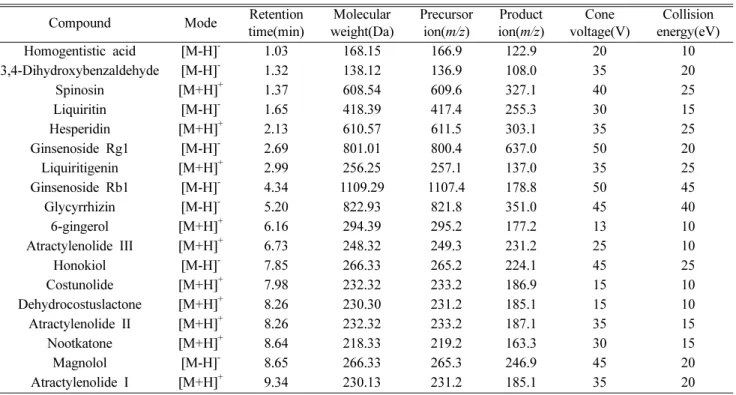
Table III. Chromatographic retention time, MRM parameters, cone voltage, and collision energy for 18 compounds
Compound Mode Retention
time(min)
Molecular weight(Da)
Precursor ion(m/z)
Product ion(m/z)
Cone voltage(V)
Collision energy(eV)
Homogentistic acid [M-H]- 1.03 168.15 166.9 122.9 20 10
3,4-Dihydroxybenzaldehyde [M-H]- 1.32 138.12 136.9 108.0 35 20
Spinosin [M+H]+ 1.37 608.54 609.6 327.1 40 25
Liquiritin [M-H]- 1.65 418.39 417.4 255.3 30 15
Hesperidin [M+H]+ 2.13 610.57 611.5 303.1 35 25
Ginsenoside Rg1 [M-H]- 2.69 801.01 800.4 637.0 50 20
Liquiritigenin [M+H]+ 2.99 256.25 257.1 137.0 35 25
Ginsenoside Rb1 [M-H]- 4.34 1109.29 1107.4 178.8 50 45
Glycyrrhizin [M-H]- 5.20 822.93 821.8 351.0 45 40
6-gingerol [M+H]+ 6.16 294.39 295.2 177.2 13 10
Atractylenolide III [M+H]+ 6.73 248.32 249.3 231.2 25 10
Honokiol [M-H]- 7.85 266.33 265.2 224.1 45 25
Costunolide [M+H]+ 7.98 232.32 233.2 186.9 15 10
Dehydrocostuslactone [M+H]+ 8.26 230.30 231.2 185.1 15 10
Atractylenolide II [M+H]+ 8.26 232.32 233.2 187.1 35 15
Nootkatone [M+H]+ 8.64 218.33 219.2 163.3 30 15
Magnolol [M-H]- 8.65 266.33 265.3 246.9 45 20
Atractylenolide I [M+H]+ 9.34 230.13 231.2 185.1 35 20
dehydrocostuslactone(이상 목향), glycyrrhizin, liquiritingenin, liquiritin(이상 감초), 6-gingerol(생강) 및 spinosin(대조) 등 18종 성분에 대하여 LC-MS/MS를 이용하여 동시분석을 실 시하였다. UPLC BEH C18(2.1×100 mm, 1.7 μm) 분석용 칼 럼을 이용하여 이들 18종 성분의 분리 위해 기울기 용매 조 건으로 분석을 실시하였다. 이동상으로는 물-메탄올, 물-아 세토나이트릴 및 산이 함유된 물-메탄올과 물-아세토나이트 릴 등을 이용하여 분석 조건을 설정하였다. 그 결과 최적의 이동상 조건으로 산이 함유된 물-아세토나이트릴로 결정하 였다. 이와 같이 최적의 이동상을 이용하여 ESI 방법의 양 이온 모드와 음이온 모드에서 Table II와 III의 조건과 같이 분석을 실시하였으며, 칼럼온도는 45oC, 유속은 분당 0.3 mL 로 하여 모든 성분을 10분 이내로 분리하였다.
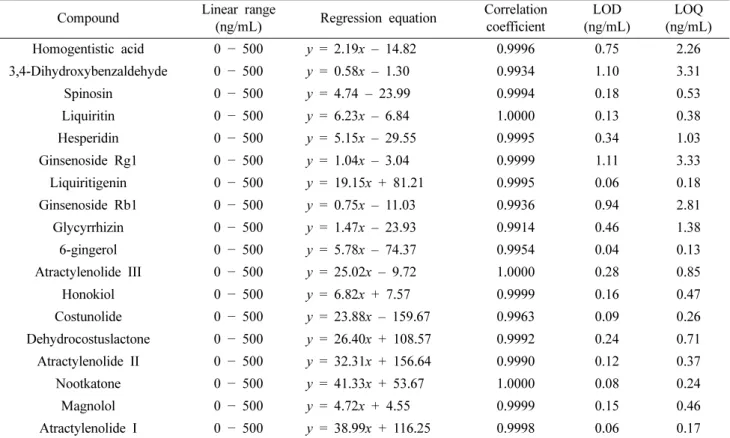
검량선, 검출한계 및 정량한계 작성 − LC-MS/MS를 이 용하여 표준용액의 농도에 대한 피크 면적 값의 회귀방정 식을 이용하여 18종 성분의 검량선 작성 결과 상관 계수(r2) 값이 0.9914이상으로 양호한 직선성을 나타내었으며, 검출 한계와 정량한계는 0.04-1.11 ng/mL와 0.13-3.33 ng/mL로 각 각 나타났다(Table IV).
향사육군자탕 추출물 중 주요성분의 함량분석 − 산이 첨 가된 물-아세토나이트릴의 이동상을 이용하여 설정된 LC-
MS/MS 분석 방법으로 표준물질에 대한 분자이온을 확인하
였다. 그 결과 homogentisic acid, 3,4-dihydroxybenzal-
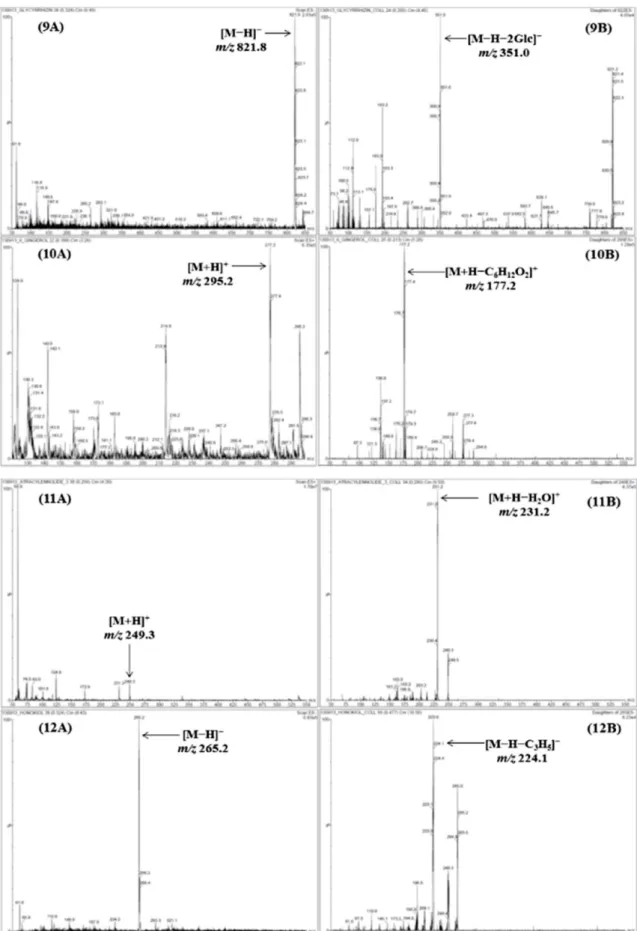
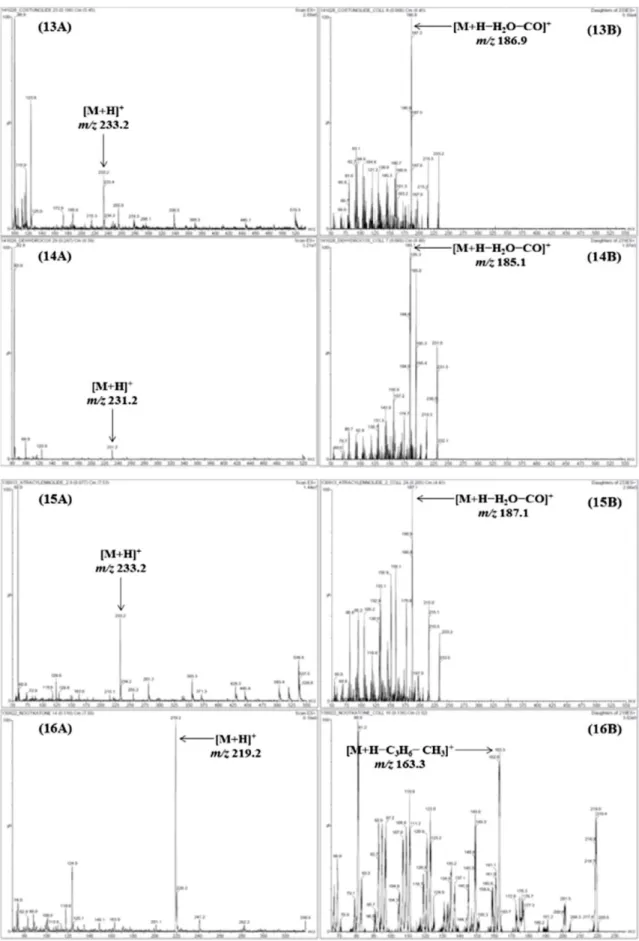
dehyde, liquiritin, ginsenoside Rg1, ginsenoside Rb1, glycyrrhizin, honokiol, 및 magnolol 등 8종은 m/z 166.9, 136.9, 417.4, 800.4, 1107.4, 821.8, 265.2 및 265.3에서 [M−H]− 형태의 분자이온 피크를 확인하였으며, spinosin, hesperidin, liquiritigenin, 6-gingerol, atractylenolide III, costunolide, dehydrocostuslactone, atractylenolide II, nootkatone 및 atractylenolide I 등 10종의 성분은 m/z 609.6, 611.5, 257.1, 295.2, 249.3, 233.2, 231.2, 233.2, 219.2 및 231.2에서 [M+H]+ 형태의 분자이온 피크를 각각 확인하였다 (Table III). LC-MS/MS를 이용하여 확인된 성 분들의 분자이온 피크에 대한 MRM 모드 방법으로 정량분 석을 하기 위하여 precursor ion(Q1)과 product ion(Q3)을 Fig. 2와 Table III과 같이 설정하였다. Homogentisic acid 의 MRM 조건은 Q1 피크인 m/z 166.9에서 COO−가 떨어져 나 간 [M−COO−−H]−형태의 Q3 피크를 m/z 122.9에서 확인 하였으며,21) 3,4-dihydroxybenzaldehyde는 m/z 136.9(Q1)에 서 1개의 aldehyde기가 떨어져 나간 [M−H−COH−]− 형태로 m/z 108.0(Q3)에서 분자 이온 피크를 확인하였다.22) Spinosin 은 m/z 609.6에서 glucose 1분자와 C4H6O4가 떨어져 나간 [M+H−Glc−C4H6O4]+ 형태의 m/z 327.1에서 Q3 피크를 확 인하였으며,23) liquiritin과 ginsenoside Rg1은 m/z 417.4과 800.4에서 각각 확인된 Q1 피크에서 두 성분 모두 glucose 1분자가 떨어진 [M−H−Glc]− 형태로 m/z 255.3과 637.0에서
Table IV. Linearities, regression equation, correlation coefficients, LOD, and LOQ for 18 marker compounds Compound Linear range
(ng/mL) Regression equation Correlation coefficient
LOD (ng/mL)
LOQ (ng/mL)
Homogentistic acid 0 − 500 y = 2.19x – 14.82 0.9996 0.75 2.26
3,4-Dihydroxybenzaldehyde 0 − 500 y = 0.58x – 1.30 0.9934 1.10 3.31
Spinosin 0 − 500 y = 4.74 – 23.99 0.9994 0.18 0.53
Liquiritin 0 − 500 y = 6.23x – 6.84 1.0000 0.13 0.38
Hesperidin 0 − 500 y = 5.15x – 29.55 0.9995 0.34 1.03
Ginsenoside Rg1 0 − 500 y = 1.04x – 3.04 0.9999 1.11 3.33
Liquiritigenin 0 − 500 y = 19.15x + 81.21 0.9995 0.06 0.18
Ginsenoside Rb1 0 − 500 y = 0.75x – 11.03 0.9936 0.94 2.81
Glycyrrhizin 0 − 500 y = 1.47x – 23.93 0.9914 0.46 1.38
6-gingerol 0 − 500 y = 5.78x – 74.37 0.9954 0.04 0.13
Atractylenolide III 0 − 500 y = 25.02x – 9.72 1.0000 0.28 0.85
Honokiol 0 − 500 y = 6.82x + 7.57 0.9999 0.16 0.47
Costunolide 0 − 500 y = 23.88x – 159.67 0.9963 0.09 0.26
Dehydrocostuslactone 0 − 500 y = 26.40x + 108.57 0.9992 0.24 0.71 Atractylenolide II 0 − 500 y = 32.31x + 156.64 0.9990 0.12 0.37
Nootkatone 0 − 500 y = 41.33x + 53.67 1.0000 0.08 0.24
Magnolol 0 − 500 y = 4.72x + 4.55 0.9999 0.15 0.46
Atractylenolide I 0 − 500 y = 38.99x + 116.25 0.9998 0.06 0.17
Fig. 2. Precursor ion (Q1, A) and product ion (Q3, B) mass spectra of 18 biomarker compounds. Homogentisic acid (1), 3,4-dihy- droxybenzaldehyde (2), spinosin (3), liquiritin (4), hesperidin (5), ginsenoside Rg1 (6), liquiritigenin (7), ginsenoside Rb1 (8), gly- cyrrhizin (9), 6-gingerol (10), atractylenolide III (11), honokiol (12), costunolide (13), dehydrocostuslactone (14), atractylenolide II (15), nootkatone (16), magnolol (17), and atractylenolide I (18).
Fig. 2. Continued.
Fig. 2. Continued.
Q3 피크가 관찰되었다.24,25) Ginsenoside Rb1은 [Glc−H]− 형 태로 m/z 178.8에서 Q3 분자 이온 피크를 확인하였으며,25) hesperidin은 m/z 611.5에서 rhamnose와 glucose 1분자가 각 각 떨어진 [M−Rham−Glc+H]+ 형태로 m/z 303.1에서 Q3 분 자 이온 피크를 확인하였다.26) Liquiritigenin은 m/z 257.1에 서 C8H8O8가 떨어진 [M+H−C8H8O8]+형태의 m/z 137.0에 서,24) glycyrrhizin은 m/z 821.8에서 2분자의 glucose가 떨어 진 aglycon 형태인 [M−H−2Glc]− 로 m/z 351.0에서 Q3 분 자 이온 피크를 확인하였다.27) 6-Gingerol과 honokiol은 m/z 295.2와 265.2에서 C6H12O2와 C3H5가 각각 떨어진 [M+H−C6H12O2]+와 [M−H−C3H5]− 형태의 m/z 177.2과 224.1에서 Q3 피크를 확인하였다.27,28) Atractylenolide III와 magnolol은 Q1 피크가 m/z 249.3와 265.3에서 확인되었으 며, Q3 피크는 두 성분 모두 1개의 물 분자가 떨어진 [M+H−H2O]+와 [M−H−H2O]− 형태로 m/z 231.2와 246.9에 서 확인되었다.28,29) Atractylenolide II와 atractylenolide I은 m/z 233.2와 231.2에서 Q1 피크가 검출되었으며, 두 성분 모두 1개의 물 분자와 CO가 떨어진 [M+H−H2O−CO]+ 형 태의 m/z 187.1과 185.1에서 Q3 피크가 검출되었다.29) Nootkatone은 m/z 219.2에서 Q1 피크가 검출되었으며, C3H6 과 메틸기가 떨어진 [M+H−C3H6−CH3]+ 형태의 m/z 163.3
에서 Q3 피크가 검출되었다.30) Costunolide와 dehydroco- stuslactone은 m/z 233.2와 231.2에서 Q1 피크가 확인되엇으 며, 두 성분 모두 1개의 물 분자와 CO가 떨어진 [M+H−H2O−CO]+ 형태의 m/z 186.9와 185.1에서 Q3 피크 를 확인하였다.31) 이와 같이 각 성분의 Q1과 Q3 피크를 설 정한 후 향사육군자탕 물 추출물에서의 성분들의 정량을 실 시하였다. 설정된 LC-MS/MS MRM 분석법에 의해 분석한 결과 homogentisic acid, 3,4-dihydroxybenzaldehyde, spinosin, liquiritin, hesperidin, ginsenoside Rg1, liquiritigenin, ginsenoside Rb1, glycyrrhizin, 6-gingerol, atractylenolide III, honokiol, costunolide, dehydrocostuslactone, atractylenolide II, nootkatone, magnolol 및 atractylenolide I 등 18종의 성 분은 1.03, 1.32, 1.37, 1.65, 2.13, 2.69, 2.99, 4.34, 5.20, 6.16, 6.73, 7.85, 7.98, 8.26, 8.26, 8.64, 8.65 및 9.34분에서 각각 검출되었다(Table III 및 Fig. 3). Table V와 같이
MRM 분석법으로 각 성분의 함량을 분석한 결과 향사육군
자탕 추출물 중에서 반하의 주요 성분인 homogentisic acid 와 3,4-dihydroxybenzaldehyde, 대조의 spinosin, 감초의 liquiritigenin 및 백출의 atractylenolide I 등 5종의 성분은 검 출이 되지 않았다. 이들 성분을 제외한 13종의 성분은 8.10- 6736.37 μg/g으로 나타났다.
Fig. 2. Continued.
Fig. 3. Total ion chromatogram of 18 marker compounds (A) and Hyangsayukgunja-tang sample (B) by LC-MS/MS MRM mode.
Homogentisic acid (1), 3,4-dihydroxybenzaldehyde (2), spinosin (3), liquiritin (4), hesperidin (5), ginsenoside Rg1 (6), liquiritigenin (7), ginsenoside Rb1 (8), glycyrrhizin (9), 6-gingerol (10), atractylenolide III (11), honokiol (12), costunolide (13), dehydrocostus- lactone (14), atractylenolide II (15), nootkatone (16), magnolol (17), and atractylenolide I (18).
결 론
향사육군자탕은 위장관 질환에 사용되어지는 한약 처방 중 하나로 이를 구성하는 14가지 구성 생약의 주요 성분 중 homogentisic acid, 3,4-dihydroxybenzaldehyde, spinosin, liquiritin, hesperidin, ginsenoside Rg1, liquiritigenin, ginsenoside Rb1, glycyrrhizin, 6-gingerol, atractylenolide III, honokiol, costunolide, dehydrocostuslactone, atractylenolide II, nootkatone, magnolol 및 atractylenolide I 등 18종의 성 분에 대하여 LC-MS/MS를 이용한 MRM 모드로 함량분석 을 실시하였다. 분석 결과 본 한약 처방에서는 진피의 주요 성분인 hesperidin이 6763.37 μg/g으로 가장 많이 검출되었 으며, 감초의 glycyrrhizin(5054.02 μg/g)과 liquiritin(2200.16 μg/g), 목향의 dehydrocostuslactone(216.10 μg/g) 및 후박의 magnolol(211.78 μg/g) 등이 다른 성분에 비해 다량으로 함 유되어 있음을 확인하였다. 이러한 분석 결과는 향 후 향사 육군자탕의 품질관리 또는 새로운 생리활성 연구를 위한 기 초 자료로 활용될 수 있을 것으로 사료된다.
사 사
본 연구는 한국한의학연구원에서 지원하는 ‘한약 처방의
과학적 근거 기반 구축사업(K14030)’에 의해 수행되었으며 이에 감사 드린다.
인용문헌
1. 廷賢. (1995) 萬病回春, 106. 人民衛生出版社, 北京.
2. Heo, J. (2004) Donguibogam, 435. Namsandang, Seoul.
3. Kim, J. H. and Lee, T. H. (1988) A study of effects on secre- tion of gastric juice activity, transport of intestinal contents with Hyangsayukgunja-tang. J. Korean Orient. Med. Pathol.
3: 71-77.
4. Kong, K. H. and Baik, T. H. (2001) The effects of Hyang- sayukgunja-tang extract on indomethacin-induced gastric mucosal lesions. Korean J. Orient. Int. Med. 22: 589-599.
5. Chang, H. Y. and Kang, Y. H. (1993) The effects of Hyang- Sa-Yuk-Gun-Ja-Tang and Oh-Pe-San on the gastric mucosal repair. J. Dong Guk Orient. Med. 2: 127-137.
6. Jeong, M. J., Lyu, S. A. and Lee, S. Y. (2007) Effects of the Hyangsayukgunjatanggamibang on children with abdominal pain. J. Korean Orient. Pediatrics. 21: 57-69.
7. Seo, J., Kim, J., Kim, S., Liu, T. and Whang, W. K. (2012) Development of content analysis for Cyperus rotundus by HPLC-UV and a comparison between Chinese and domestic Cyperi Rhizoma. Yakhak Hoeji. 56: 280-287.
Table V. Amount of 18 marker compounds in Hyangsayukgunja-tang
Compound Amount(µg/g)
Source
Mean SD RSD(%)
Homogentistic acid ND1 - - P. ternate
3,4-Dihydroxybenzaldehyde ND - - P. ternate
Spinosin ND - - Z. jujuba
Liquiritin 2200.16 93.38 4.24 G. uralensis
Hesperidin 6763.37 148.71 2.20 C. unshiu
Ginsenoside Rg1 141.00 29.17 20.69 P. ginseng
Liquiritigenin ND - - G. uralensis
Ginsenoside Rb1 147.22 24.42 16.59 P. ginseng
Glycyrrhizin 5054.02 160.81 3.18 G. uralensis
6-gingerol 118.31 8.02 6.78 Z. officinale
Atractylenolide III 110.48 3.83 3.47 A. macrocephala
Honokiol 177.47 2.14 1.21 M. officinalis
Costunolide 64.83 5.61 8.66 A. lappa
Dehydrocostuslactone 216.10 21.69 10.04 A. lappa
Atractylenolide II 14.99 6.30 42.04 A. macrocephala
Nootkatone 8.10 1.15 14.14 C. rotundus
Magnolol 211.78 18.78 8.87 M. officinalis
Atractylenolide I ND - - A. macrocephala
1
ND: not detected-
8. Tsai, C. J., Liang, J. W. and Lin, H. R. (2012) Sesquiter- penoids from Atractylodes macrocephala act as farnesoid X receptor and progesterone receptor modulators. Bioorg. Med.
Chem. Lett. 22: 2326-2329.
9. Li, G., Xu, M. L., Lee, C. S., Woo, M. H., Chang, H. W. and Son, J. K. (2004) Cytotoxicity and DNA topoisomerases inhibitory of constituents from the sclerotium of Poria cocos.
Arch. Pharm. Res. 27: 829-833.
10. Han, J. H., Jo, S. G., Lee, M. J., Baek, S. H. and Park, S. H.
(2004) Contents of homogentisic acid and 3,4-dihydrobenz- aldehyde in the Pinellia ternate by various processing method and its safety estimate. Korean J. Orient. Physiol.
Pathol. 18: 846-853.
11. Liu, E. H., Zhao, P., Duan, L., Zheng, G. D., Guo, L., Yang, H. and Li, P. (2013) Simultaneous determination of six bio- active flavonoids in Citri Reticulatae Pericarpium by rapid resolution liquid chromatography coupled with triple quad- rupole electrospray tandem mass spectrometry. Food Chem.
141: 3977-3983.
12. Yin, H., Luo, J. G. and Kong, L. (2013) Diarylheptanoids from the fruits of Amomum kravanh and their inhibitory activities of nitric oxide production. Phytochem. Lett. 6: 403- 406.
13. Jiang, Y., Vaysse, J., Gilard, V., Balayssac, S., Déjean, S., Malet-Martino, M., David, B., Fiorini, C. and Barbin, Y.
(2012) Quality assessment of commercial Magnoliae offi- cinalis cortex by 1H-NMR-based metabolomics and HPLC methods. Phytochem. Anal. 23: 387-395.
14. Ying, H., Liu, J. and Du, Q. (2014) Analysis and deter- mination of oestrogen-active compounds in Fructus Amomi by the combination of high-speed counter-current chroma- tography and high performance liquid chromatography. J.
Chromatogr. B. 958: 36-42.
15. Shan, S. M., Luo, J. G., Huang, F. and Kong, L. Y. (2014) Chemical characteristics combined with bioactivity for com- prehensive evaluation of Panax ginseng C.A.Meyer in dif- ferent ages and seasons based on HPLC-DAD and chemometric methods. J. Pharm. Biomed. Anal. 89: 76-82.
16. Li, A., Sun, A. and Liu, R. (2005) Preparative isolation and purification of costunolide and dehydrocostuslactone from Aucklandia lappa Decne by high-speed counter-current chro- matography. J. Chromatogr. A. 1076: 193-197.
17. Han, J. T., Lee, S. Y., Lee, Y. H. and Baek, N. I. (2007) Anti- oxidative diarylheptanoids from the fruits of Alpinia oxy- phylla. Food Sci. Biotechnol. 16: 1060-1063.
18. Zhang, Q. and Ye, M. (2009) Chemical analysis of the Chi- nese herbal medicine Gan-Cao (licorice). J. Chromatogr. A.
1216: 1954-1969.
19. Zick, S. M., Ruffin, M. T., Djuric, Z., Normolle, D. and Bren- ner, D. E. (2010) Quantitation of 6-, 8- and 10-gingerols and 6-shogaol in human plasma by high-performance liquid chro- matography with electrochemical detection. Int. J. Biomed.
Sci. 6: 233-240.
20. Niu, C. and Zhang, J. (2011) Quantitative analysis and chro- matographic fingerprinting of the Semen Zizyphi Spinosae by ultra-high-performance liquid chromatography coupled with diode-array detector. J. Sep. Sci. 34: 2989-2996.
21. Elgstoen, K. B., Zhao, J. Y., Anacleto, J. F. and Jellum, E.
(2001) Potential of capillary electrophoresis, tandem mass spectrometry and coupled capillary electrophoresis-tandem mass spectrometry as diagnostic tools. J. Chroamtogr. A 914:
265-275.
22. Li, Y., Qu, H. and Cheng, Y. (2008) Identification of major constituents in the traditional Chinese medicine “QI-SHEN- YI-QI” dropping pill by high-performance liquid chroma- tography coupled with diode array detection-electrospray ion- ization tandem mass spectrometry. J. Pharm. Biomed. Anal.
47: 407-412.
23. Ren, Y., Wang, P., Wu, C., Zhang, J. and Niu, C. (2013) Iden- tification of the metabolites after oral administration of extract of Ziziphi Spinosae Semen to rats or dogs by high- performance liquid chromatography/linear ion trap FTICR hybrid mass spectrometry. Biomed. Chromatogr. 27: 17-26.
24. Wang, Y., Yang, L., He, Y. Q., Wang, C. H., Welbeck, E. W., Bligh, S. W. and Wang, Z. T. (2008) Characterization of fifty- one flavonoids in a Chinese herbal prescription Longdan Xie- gan Decoction by high-performance liquid chromatography coupled to electrospray ionization tandem mass spectrometry and photodiode array detection. Rapid Commun. Mass Spec- trom. 22: 1767-1778.
25. Zhao, J., Su, C., Yang, C., Liu, M., Tang, L., Su, W. and Liu, Z. (2012) Determination of ginsenosides Rb1, Rb2, and Rb3 in rat plasma by a rapid and sensitive liquid chromatography tandem mass spectrometry method: Application in a phar- macokinetic study. J. Pharm. Biomed. Anal. 64-65: 94-97.
26. Zhou, D., Xu, Q., Xue, X., Zhang, F. and Liang, X. (2006) Identification of O-diglycosyl flavanones in Fructus Aurantii by liquid chromatography with electrospray ionization and collision-induced dissociation mass spectrometry. J. Pharm.
Biomed. Anal. 42: 441-448.
27. Tan, G., Zhu, Z., Jing, J., Lv, L., Lou, Z., Zhang, G. and Chai, Y. (2005) Characterization of constituents in Sini decoction and rat plasma by high-performance liquid chromatography with diode array detection coupled to time-of-flight mass spectrometry. Biomed. Chromatogr. 25: 913-924.
28. Yu, Q., Xiang, J., Tang, W. F., Liang, M. Z., Qin, Y. P. and Nan, F. (2009) Simulataneous determination of the 10 major components of Da-Cheng-Qi decoction in dog plasma by liq- uid chromatography tandem mass spectrometry. J. Chro- matogr. B 877: 2025-2031.
29. Chen, L., Qi, J., Chang, Y., Zhu, D. and Yu, B. (2009) Iden- tification and determination of the major constituents in Tra- ditional Chinese Medicinal formula Danggui-Shaoyao-San by HPLC-DAD-ESI-MS/MS. J. Pharm. Biomed. Anal. 50:
127-137.
30. Li, P., Liu, M., Hu, J. and Su, W. (2014) Systematic chemical profiling of Citrus grandis ‘Tomentosa’ by ultra-fast liquid chromatography/diode-array detector/quadrupole time-of- flight tandem mass spectrometry. J. Pharm. Biomed. Anal.
90: 167-179.
31. Peng, Z., Wang, Y., Gu, X., Guo, X. and Yan, C. (2014) Study on the pharmacokinetics andmetabolism of costunolide and dehydrocostus lactone in rats by HPLC-UV and UPLC- Q-TOF/MS. Biomed. Chromatogr. 28: 1325-1334.
(2015. 9. 21 접수; 2015. 10. 30 심사; 2015. 11. 10 게재확정)