Kor. J. Pharmacogn.
47(1) : 62∼ 72 (2016)
62
LC-MS/MS 를 이용한 반하사심탕 물 추출물 중 13종 성분의 함량분석
서창섭·신현규* 한국한의학연구원 K-herb연구단
Quantitative Determination of the Thirteen Marker Components in Banhasasim-Tang Decoction Using an Ultra-Performance Liquid
Chromatography Coupled to Electrospray Ionization Tandem Mass Spectrometry
Chang-Seob Seo and Hyeun-Kyoo Shin*
K-herb Research Center, Korea Institute of Oriental Medicine, 1672 Yuseong-daero, Yuseong-gu, Daejeon, 34054, Korea
Abstract − Banhasasim-tang is a well-known traditional Korean herbal formula and has been used clinically for the treatment of gastric disease, including acute and chronic gastritis, diarrhea and gastric ulcers in Korea. In this study, an ultra-performance liquid chromatography-electrospray ionization-mass spectrometer method was developed for the quantitative determination of the 13 marker constituents, homogentisic acid (1), 3,4-dihydroxybenzaldehyde (2), spinosin (3), liquiritin (4), baicalin (5), gin- senoside Rg1 (6), liquiritigenin (7), wogonoside (8), ginsenoside Rb1 (9), baicalein (10), glycyrrhizin (11), wogonin (12), and 6-gingerol (13) in Banhasasim-tang decoction. Separation of the compounds 1-13 was using an UPLC BEH C18 (100×2.1 mm, 1.7μm) column and column oven temperature was maintained at 45oC. The mobile phase consisted of 0.1% (v/v) formic acid in water (A) and acetonitrile (B) by gradient elution. The injection volume and flow rate were 2.0μL and 0.3 mL/min, respec- tively. Calibration curves of the compounds 1-13 were showed with r2 values ≥ 0.9908. The limit of detection and limit of quan- tification values of the compounds 1-13 were 0.04-1.11 ng/mL and 0.13-3.33 ng/mL, respectively. Among the these compounds, the compounds 1-3 were not detected, while the compounds 4-13 were detected in the ranges of 3.20-107,062.98 μg/g in Banha- sasim-tang sample.
Key words − LC-MS/MS, Banhasasim-tang, Quantitative Determination
한국을 비롯한 전세계적으로 고령화와 더불어 만성 난치 성 질환이 증가함에 따라 보완대체의학에 대한 관심과 이 용율이 증가하고 있다.1) 이러한 보완대체의학 중 하나인 한 약 처방은 일반적으로 두 가지 이상의 한약재로 구성되어 있으며, 이들 구성 한약재의 수많은 종류의 성분과 약재의 상호작용으로 다양한 질환들의 치료 또는 예방을 위해 사 용되어 왔다.2,3) 그 중 비위불화(脾胃不和)로 심하(心下)가 비만불통( 滿不通)하고 건구(乾嘔) 또는 구토(嘔吐)하며 장 명하리(腸鳴下痢)한 증상과 같은 소화기 질환의 치료에 사 용되어진 반하사심탕(半夏瀉心湯)4)은 張仲景의「傷寒論」5) 에 최초로 수록된 후 許浚의 「東醫寶鑑」6)에도 수록되어 있으며, 반하(Pinelliae Tuber, Araceae), 황금(Scutellariae
Radix, Labiatae), 인삼(Ginseng Radix, Araliaceae), 감초 (Glycyrrhizae Radix et Rhizoma, Leguminosae), 건강 (Zingiberis Rhizoma, Zingiberaceae), 황련(Coptidis Rhizoma, Ranunculaceae), 생강(Zingiberis Rhizoma Crudus, Zingi- beraceae) 및 대조(Zizyphi Fructus, Rhamnaceae) 등 8종의 생약이 4:3:3:3:2:1:2:2의 비율로 구성되어 있다. 본 처방의 생리활성 연구로 알코올 처리를 통한 초기 역류성 식도염 유발 생쥐에 대한 효능 규명7)과 급성 십이지장 손상에 대 한 방어효과8), 에탄올 유도 위궤양 모델에서의 보호 효과9) 및 항지사 효과10) 등과 같은 실험적 연구와 윤 등11)의 기능 성 소화불량증 환자에 대한 반하사심탕 엑기스제의 임상효 과에 대한 증례 보고가 보고되었다. 반하사심탕을 구성하는 약재들의 품질관리를 위한 분석 연구는 액체크로마토그래 피(high-performance liquid chromatography; HPLC)를 이용
*교신저자(E-mail):[email protected] (Tel): +82-42-868-9464
한 반하의 homogentisic acid와 3,4-dihydroxybenzaldehyde12), 황금의 baicalin 등과 같은 flavonoid류13), 인삼의 ginsenoside 류14), 생강과 건강의 6-gingerol15)및 대조의 spinosin 등과 같은 flavonoid류16), 질량분석기가 결합된 초고성능 액체크 로마토그래피(ultra-performance liquid chromatography-MS) 를 이용한 감초의 glycyrrhizin 등과 같은 triterpene류와 liquiritin과 liquiritigenin 등과 같은 flavonoid류17)및 모세관 전기이동(capillary electrophoresis)을 이용한 황련의 alkaloid 류18)의 동시분석법 등이 보고되었다. 이와 같이 한약 처방 에 대한 실험적 효능과 임상적 증례보고는 보고가 되었지 만 품질관리를 위한 분석 연구는 미비한 실정이다. 따라서 본 연구에서는 한약제제의 품질관리에 기초 자료를 제공하 고자 한의학에서 소화기 질환에 널리 사용되는 반하사심탕 을 선정하여 구성 성분에 대한 함량 분석을 실시하였다.4) 본 연구에서는 처방을 구성하는 구성 약재 중 반하의 homogentisic acid(1)와 3,4-dihydroxybenzaldehyde(2), 황금 의 baicalin(5), wogonoside(8), baicalein(10) 및 wogonin (12), 인삼의 ginsenoside Rg1(6)과 ginsenoside Rb1(9), 감
초의 liquiritin(4), liquiritigenin(7) 및 glycyrrhizin(11), 건강 과 생강의 6-gingerol(13) 및 대조의 spinosin(3) 등 13종의 성분을 대상으로 전자분무이온화(electrospray ionization, ESI) 방식의 UPLC-MS를 이용하여 함량을 분석하였다. 또 한 한약 처방의 품질관리 및 이를 이용한 효능 검색에 대한 기초 자료를 제공하고자 하였다.
재료 및 방법
실험재료 − Table I과 같이 본 실험에 사용된 반하사심탕 을 구성하는 8종의 구성 생약은 모두 광명당제약(Ulsan, Korea)에서 규격품을 구입하여 본초학 전문가인 동국대학교 이제현 교수(Gyeongju, Korea)로부터 감정 후 사용하였다.
반하사심탕을 구성하는 생약들의 표본(2012-KE38−1~
KE38−8)은 한국한의학연구원 K-herb연구단에 보관하였다.
시약 및 기기 − 표준물질 1과 2는 Sigma-Aldrich(St.
Louis, MO, USA), 표준물질 3과 6 등 2종은 Chengdu Biopurify Phytochemicals Ltd.(Chengdu, China), 표준물질 Fig. 1. Chemical structures of 13 marker components in Banhasasim-tang.
4, 5, 9, 10-13 등 7종은 Wako Pure Chemical Ltd.(Osaka, Japan), 표준물질 7과 8은 ChemFaces(Wuhan, China)와 Tauto Biotech(Shanghai, China)로부터 각각 구입하여 사용 하였다. 이들 표준물질의 순도는 모두 98% 이상이었다. LC- MS 분석을 위한 물, 아세토나이트릴 및 물은 J.T. Baker (Phillipsburg, NJ, USA)에서 구입하였으며, 개미산은 특급 시약으로 Sigma-Aldrich(St. Louis, MO, USA)에서 구입하 여 사용하였다. 함량분석을 위한 UPLC는 pump, degasser, column oven 및 autosampler로 구성된 Waters의 ACQUITY UPLC(Milford, MA, USA)를 사용하였으며, 질량분석기는 ESI source가 장착된 탠덤 사중극자 질량분석기(ACQUITY TQD LC-MS/MS, Waters, Milford, MA, USA)를 사용하여 분석하였다. 모든 데이터는 Waters MassLynx software (version 4.1, Milford, MA, USA)를 사용하여 처리하였다.
시료는 경서기계산업의 초고속진공저온농축추출기(Cosmos 660, Inchon, Korea)를 사용하여 추출하였다.
표준액의 조제 − 13종의 표준품에 대한 표준용액은 메탄 올을 이용하여 모두 1,000 µg/mL의 농도로 조제한 후 4oC 에 보관하면서 사용 전에 희석하여 사용하였다.
반하사심탕 물 추출물 및 검액의 조제 − Table I과 같이 8종의 생약으로 구성된 반하사심탕 5.0 kg(37.50 g×133.3)을 초고속진공저온농축추출기(Cosmos 660, Inchon, Korea)에 넣고, 물 50 L를 첨가하여 100oC에서 98 kPa 압력하에서 2 시간 전탕 한 후 표준체(No. 270, 53 µm, Chung Gye Sang Gong Sa, Seoul, Korea)를 이용하여 여과하였다. 여과 후 동 결건조기(PVTFD100R, IlShinBioBase, Dongduchun, Korea) 를 사용하여 동결 건조한 결과 749.5 g의 추출물을 얻었다 (14.99%). LC-MS/MS 정량분석을 위해 동결 건조된 반하사 심탕 추출물 약 55.0 mg을 취한 후 물을 넣어 5 mL로 맞 춘 후 5분간 초음파 추출하였다. 그 후 추출액 0.1 mL를 물 을 이용하여 10 mL로 100배 희석한 후 0.22 µm 멤브레인 여과하여 검액으로 하였다.
UPLC 및 LC-MS/MS 분석 조건 − 반하사심탕의 13종
물질의 분리를 위해 사용된 UPLC는 Waters사의 ACQUITY UPLC(Milford, MA, USA)를 사용하였으며, 정량을 위한 LC-MS/MS는 ESI source가 장착된 Waters사의 ACQUITY TQD LC-MS/MS(Milford, MA, USA)를 사용하여 Table II 와 Table III의 조건으로 다중반응탐색법(multiple reaction Table I. Composition of Banhasasim-tang
Herbal name Scientific name Origin Amount (g)
Pinelliae Tuber Pinellia ternate Breitenbach China 7.500
Scutellariae Radix Scutellaria baicalensis Georgi Gurye, Korea 5.625
Ginseng Radix Panax ginseng C. A. Meyer Yeongju, Korea 5.625
Glycyrrhizae Radix et Rhizoma Glycyrrhiza uralensis Fischer China 5.625
Zingiberis Rhizoma Zingiber officinale Roscoe Taean, Korea 3.750
Coptidis Rhizoma Coptis japonica Makino China 1.875
Zingiberis Rhizoma Crudus Zingiber officinale Roscoe Ulsan, Korea 3.750 Zizyphi Fructus Zizyphus jujube Miller var. inermis Rehder Yeongcheon, Korea 3.750
Total amount 37.500
Table II. Conditions for LC-MS/MS analysis of Banhasasim- tang
HPLC condition
Column ACQUITY UPLC BEH
C18(100×2.1 mm, 1.7µm)
Flow rate 0.3 mL/min
Injection volume 2.0 µL Column temperature 45°C Sample temperature 5°C
Mobile phase Time(min) A(%)a B(%)b
0 80 20
0.1 80 20
14.0 5 95
15.0 0 100
15.1 80 20
18.1 80 20
MS condition
Capillary voltage(kV) 3.3 Extract voltage(V) 3.0 Source temp.(°C) 120
RF lens(V) 0.3
Desolvation temp.(°C) 300 Desolvation gas(L/h) 600
Cone gas(L/h) 50
Collision gas(mL/min) 0.14
a
0.1%(v/v) aqueous formic acid
b
acetonitrile
monitoring; MRM) 모드로 함량분석을 실시하였다.
검량선 작성 − 13종 성분의 검량선은 0, 10, 50, 100 및 500 ng/mL의 농도로 작성하였으며, 작성된 검량선의 상관 계수(r2)를 구하여 직선성을 판단하였다. 검출한계와 정량한 계는 신호 대 잡음 비인 3과 10으로 계산하였다.
결과 및 고찰
LC-MS/MS 분석조건 확립 − 반하사심탕을 구성하는 8종 생약의 주요 성분으로는 반하의 homogentisic acid와 3,4- dihydroxybenzaldehyde12), 황금의 baicalin, wogonoside, baicalein 및 wogonin 등과 같은 flavonoid류13), 인삼의 ginsenoside Rb1과 ginsenoside Rg114), 감초의 glycyrrhizin, liquiritin 및 liquiritigenin19), 생강과 건강의 6-gingerol15), 황 련의 berberine 등과 같은 alkaloid류20) 및 대조의 spinosin 등과 같은 flavonoid류16)등이 보고 되었으며, 이들 성분들 중 13종의 주요 성분에 대하여 ACQUITY TQD LC-MS/
MS를 이용하여 정확성과 감도가 우수한 ESI 방법의 MRM 방법으로 함량분석을 실시하였다. 성분의 분리를 위해 물- 메탄올, 물-아세토나이트릴 등의 이동상을 이용하여 최적의 분리 조건을 설정하였으며, 산을 추가하여 꼬리 끌림 현상 을 줄이고 각 성분의 이온에 대한 검출 감도를 높이고자 하 였다. 그 결과 이동상으로 0.1%(v/v) 개미산이 함유된 물-아 세토나이트릴을 이용한 기울기 용매 조건이 다른 용매 조 건에 비해 성분의 분리가 양호하게 이루어 졌다. 확립된 최 적의 분석 조건을 이용하여 13종의 성분을 분석한 결과 성 분 3, 5, 7, 8, 10, 12 및 13 등 7종은 양이온 모드에서 성
분 1, 2, 4, 6, 9 및 11 등 6종은 음이온 모드에서 7분 이내 로 검출되었다(Table III).
분석법의 검량선, 검출한계 및 정량한계 설정 − 반하사 심탕의 주요 성분에 대한 함량 분석을 위해 LC-MS/MS를 이용한 MRM 방식에서 0-500 ng/mL의 농도 범위에서 표준 품의 농도에 대한 피크 면적을 이용하여 검량선을 작성한 결과 상관 계수(r2) 값이 0.9908-0.9999로 양호한 직선성을 보여주었다. 또한 이들 성분에 대한 검출한계와 정량한계는 0.04-1.11 ng/mL와 0.13-3.33 ng/mL의 범위로 각각 나타났 으며, 이들 결과는 Table IV에 나타내었다.
LC-MS/MS를 이용한 주요 성분의 피크 동정 및 함량분 석 − 설정된 LC-MS/MS 분석 방법을 이용하여 반하사심탕 의 주요 성분에 대한 피크 확인 및 함량분석을 실시하였다.
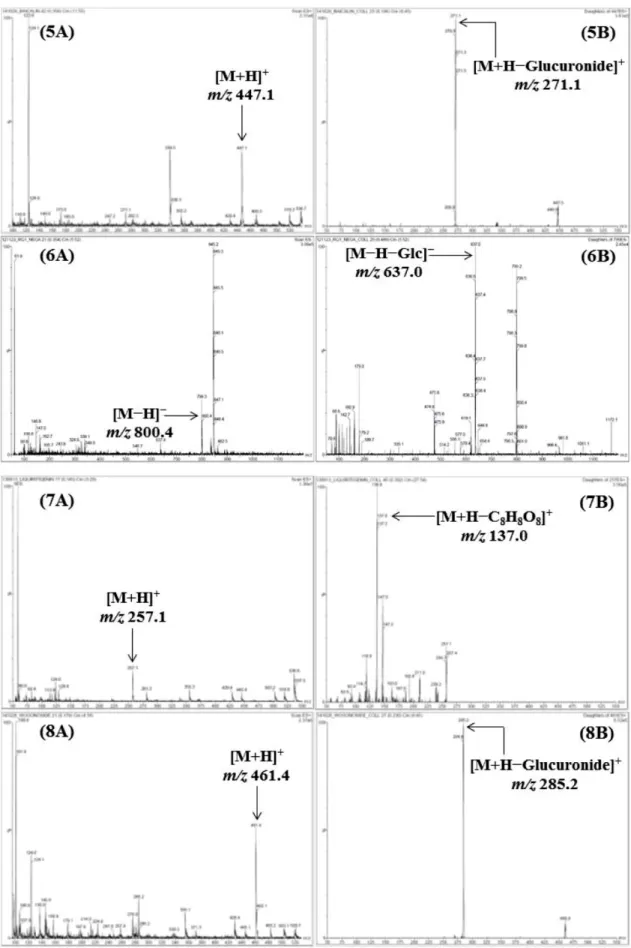
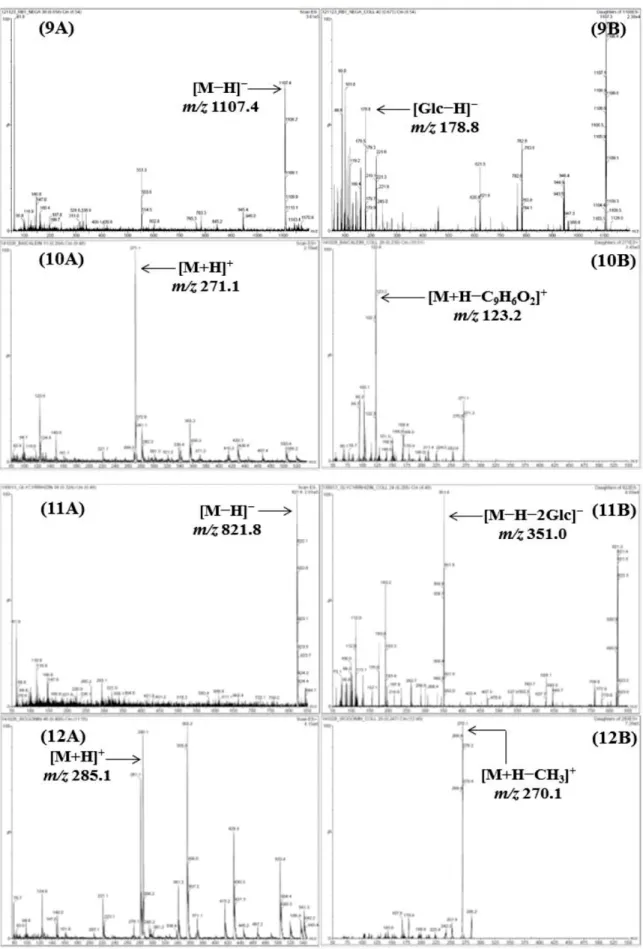
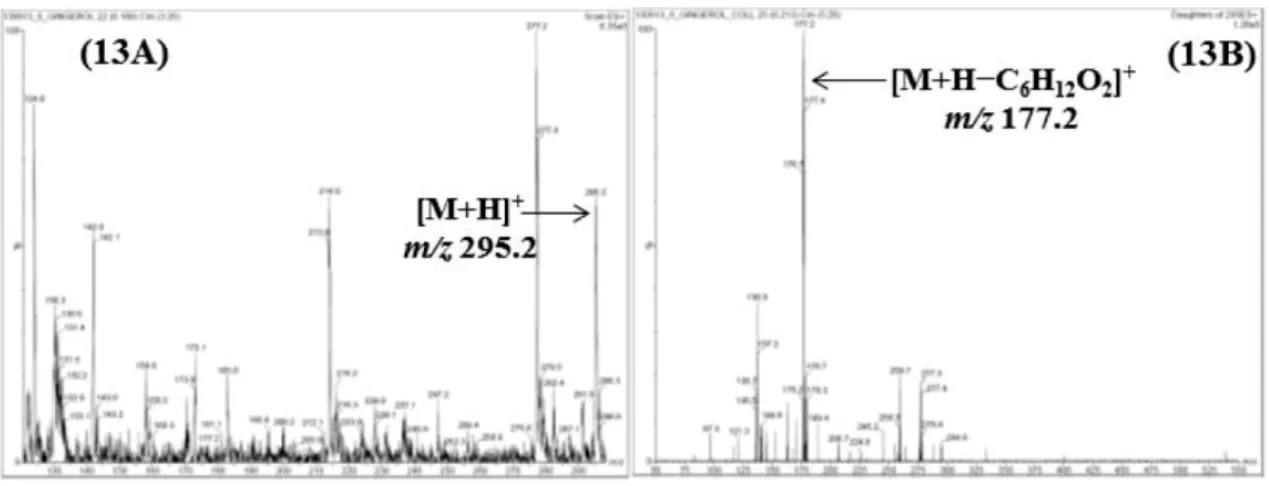
그 결과 성분 3, 5, 7, 8, 10, 12 및 13 등 7종은 양이온 모 드인 [M+H]+ 형태로 m/z 609.6, 447.1, 257.1, 461.4, 271.1, 285.1 및 295.2에서 분자이온 피크를 확인하였으며, 성분 1, 2, 4, 6, 9 및 11 등 6종은 음이온 모드인 [M−H]− 형태로 m/z 166.9, 136.9, 417.4, 799.3, 1107.4 및 821.8에 서 분자이온 피크를 각각 확인하였다(Table III). 이와 같이 확인된 각각의 성분들을 MRM 모드 방법으로 함량을 분석 하기 위해 precursor ion(Q1)과 product ion(Q3)을 설정하였 다(Fig. 2 and Table III). 성분 1의 MRM 조건은 m/z 166.9 의 Q1 피크에서 COO−가 이탈된 [M−COO−−H]−형태의 Q3 피크를 m/z 122.9에서 확인하였으며,21) 성분 2는 m/z 136.9 의 Q1 피크에서 aldehyde 1분자가 이탈된 [M−H−COH−]− 형태로 m/z 108.0에서 Q3 피크를 확인하였다.22)성분 3은 m/z 609.6의 Q1피크에서 1분자의 glucose와 C4H6O4가 이탈 Table III. Mass detection condition of 13 marker compounds
Compound Molecular weight (Da)
Ionization Mode
Retention time (min)
Precursor ion (m/z)
Product ion (m/z)
Cone voltage (V)
Collision energy (eV)
1 168.15 [M−H]− 1.03 166.9 122.9 20 10
2 138.12 [M−H]− 1.32 136.9 108.0 35 20
3 608.54 [M+H]+ 1.37 609.6 327.1 40 25
4 418.39 [M−H]− 1.65 417.4 255.3 30 15
5 446.36 [M+H]+ 2.68 447.1 271.1 25 15
6 801.01 [M−H]− 2.69 799.3 637.0 50 20
7 256.25 [M+H]+ 2.99 257.1 136.9 35 25
8 460.39 [M+H]+ 3.57 461.4 285.2 30 20
9 1109.29 [M−H]− 4.34 1107.4 178.8 50 45
10 270.24 [M+H]+ 4.50 271.1 123.2 40 30
11 822.93 [M−H]− 5.20 821.8 351.0 45 40
12 284.26 [M+H]+ 5.75 285.1 270.1 40 20
13 294.39 [M+H]+ 6.16 295.2 177.2 13 10
Homogentisic acid( 1), 3,4-dihydroxybenzaldehyde(2), spinosin(3), liquiritin(4), baicalin(5), ginsenoside Rg1(6), liquiritigenin(7),
wogonoside(8), ginsenoside Rb1(9), baicalein(10), glycyrrhizin(11), wogonin(12), and 6-gingerol(13).
Fig. 2. Precursor ion (Q1, A) and product ion (Q3, B) mass spectra of 13 marker compounds. Homogentisic acid (1), 3,4-dihy- droxybenzaldehyde (2), spinosin (3), liquiritin (4), baicalin (5), ginsenoside Rg1 (6), liquiritigenin (7), wogonoside (8), ginsenoside Rb1 (9), baicalein (10), glycyrrhizin (11), wogonin (12), and 6-gingerol (13).
Fig. 2. Continued.
Fig. 2. Continued.
된 [M+H−Glc−C4H6O4]+ 형태로 m/z 327.1에서 Q3 피크를 확인하였으며,23) 성분 4와 6은 각각 m/z 417.4와 799.3의 Q1 피크에서 두 성분 모두 1분자의 glucose가 이탈된 [M−
H−Glc]− 형태의 Q3 피크가 m/z 255.3과 637.0에서 각각 검 출되었다.24,25) 성분 5와 8은 m/z 447.1과 461.4의 Q1 피크 에서 두 성분 모두 1분자의 glucuronide가 이탈된 [M+H−
Glucuronide]+ 형태의 Q3 피크가 m/z 271.1과 285.2에서 각 각 검출되었다.13) 성분 7은 Q1 피크가 m/z 257.1에서 검출 되었으며, Q1 피크에서 C8H8O8가 이탈된 [M+H−C8H8O8]+ 형태로 m/z 136.9에서 Q3 피크를 확인하였으며,24) 성분 9 와 10은 m/z 1107.4와 271.1에서 Q1 피크를 확인하였으며,
Q3 피크는 [Glc−H]− 형태로 m/z 178.8과 C9H6O2가 이탈된 trihydroxyphenyl 골격의 [M+H−C9H6O2]+ 형태로 m/z 123.2 에서 각각 확인되었다.13,25)성분 11-13은 m/z 821.8, 285.1 및 295.2에서 Q1 피크를 확인하였으며, Q1 피크에서 2분자 의 glucose, 1분자의 methyl기 C6H12O2가 각각 이탈된 [M−
H−2Glc]−, [M+H−CH3]+및 [M+H−C6H12O2]+로 m/z 351.0, 270.1 및 177.2에서 Q3 분자 이온 피크를 확인하였다.13,24,26) 이상과 같이 13종 성분에 대하여 Q1과 Q3 피크를 각각 설 정한 후 반하사심탕 물 추출물에서 함량 분석을 실시하였 다. 최종적으로 확립된 LC-MS/MS MRM 분석법을 이용하 여 13종의 성분을 분석한 결과 1.03, 1.32, 1.37, 1.65, 2.68, Fig. 2. Continued.
Table IV. Linear range, regression equation, correlation coefficients, LOD, and LOQ for 13 marker compounds Analyte Linear range
(ng/mL) Regression equationa Correlation coefficient
LODb (ng/mL)
LOQc (ng/mL)
1 0 − 500 y = 2.20 x – 20.12 0.9970 0.75 2.26
2 0 − 500 y = 0.58 x – 1.30 0.9934 1.10 3.31
3 0 − 500 y = 5.06 x – 35.18 0.9983 0.18 0.53
4 0 − 500 y = 6.20 x + 15.89 0.9996 0.46 1.38
5 0 − 500 y = 9.41 x – 201.56 0.9908 0.22 0.66
6 0 − 500 y = 0.94 x + 2.64 0.9986 1.11 3.33
7 0 − 500 y = 19.24 x + 52.97 0.9997 0.06 0.18
8 0 − 500 y = 70.39 x + 6.92 0.9999 0.10 0.29
9 0 − 500 y = 0.84 x – 10.56 0.9925 0.94 2.81
10 0 − 500 y = 14.40 x – 258.4 0.9946 0.44 1.31
11 0 − 500 y = 1.65 x –21.77 0.9966 0.46 1.38
12 0 − 500 y = 102.25 x + 606.41 0.9991 0.16 0.49
13 0 − 500 y = 6.17x – 62.58 0.9970 0.04 0.13
a
y: peak area(mAU) of compounds; x: concentration(ng/mL) of compounds.
b
LOD = 3×signal-to-noise ratio.
c
LOQ = 10×signal-to-noise ratio.
Homogentisic acid( 1), 3,4-dihydroxybenzaldehyde(2), spinosin(3), liquiritin(4), baicalin(5), ginsenoside Rg1(6), liquiritigenin(7),
wogonoside(8), ginsenoside Rb1(9), baicalein(10), glycyrrhizin(11), wogonin(12), and 6-gingerol(13).
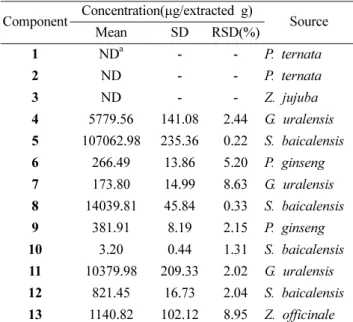
2.69, 2.99, 3.57, 4.34, 4.50, 5.20, 5.75 및 6.16분에서 각각 검출되었다(Table III 및 Fig. 3). Table V와 같이 동결건조 된 반하사심탕 물 추출물 중 13종의 물질에 대한 함량 분 석을 실시한 결과 반하와 대조의 주요 성분인 1-3의 3종의 성분은 검출이 되지 않았다. 이들 성분을 제외한 10종의 성 분은 3.20-107,062.98 µg/ extracted g으로 검출이 되었다.
결 론
소화기 질환에 주로 사용되며, 반하, 황금, 인삼, 감초, 건 강, 황련, 생강 및 대조 등 8종의 생약으로 구성된 반하사 심탕에서 13종의 주요 성분에 대하여 LC-MS/MS MRM 방 법을 이용한 함량분석을 실시하였다. 분석 결과 황금의 주 Fig. 3. Total ion chromatograms of 13 reference compounds (A) and Banhasasim-tang decoction (B) by LC-MS/MS MRM mode.
Homogentisic acid (1), 3,4-dihydroxybenzaldehyde (2), spinosin (3), liquiritin (4), baicalin (5), ginsenoside Rg1 (6), liquiritigenin (7), wogonoside (8), ginsenoside Rb1 (9), baicalein (10), glycyrrhizin (11), wogonin (12), and 6-gingerol (13).
요성분인 baicalin(3)과 wogonoside(8)가 107,062.98과 14,039.81µg/g으로 가장 많이 검출되었으며, 감초의 glycyrrhizin(11)과 liquiritin(4), 건강과 생강의 6-gingerol(13) 이 10,379.98, 5,779.56 및 1,140.82 µg/g으로 다른 성분에 비해 다량 검출되었다. 이러한 결과는 향 후 반하사심탕의 품질관리를 위한 기초 자료로 활용될 수 있을 것으로 사료 된다.
사 사
본 연구는 한국한의학연구원에서 지원하는 ‘한약 처방의 과학적 근거 기반 구축사업(K15251)’에 의해 수행되었으며 이에 감사 드린다.
인용문헌
1. Han, Y. J., Lee, S. D., Choi, J. H., Park, J. G., Park, H. M. and Jang, J. S. (2006) Effects of high frequency herbal medication administrations on the liver functions in rats − Focusing on Sipjeondaebo-tang, Yukmijihwang-tang, Bojungikgi-tang, and Ojeoksan -. J. Korean Orient. Med. 27: 78-90.
2. Qiu, J. (2007) Back to the future for Chinese herbal med- icines. Nat. Rev. Drug Discov. 6: 506-507.
3. Wang, L., Zhou, G. B., Liu, P., Song, J. H., Liang, Y., Yan, X.
J., Xu, F., Wang, B. S., Mao, J. H., Shen, Z. X., Chen, S. J.
and Chen, Z. (2008) Dissection of mechanisms of Chinese medicinal formula Realgar-Indigo naturalis as an effective treatment for promyelocytic leukemia. Proc. Natl. Acad. Sci.
U. S. A. 105: 4826-4831.
4.한의과대학 방제학 교수 공편저 (1999) 방제학, 162. 영림 사, 서울.
5.張仲景 (1993) 傷寒論, 112. 대성문화사, 서울.
6. Heo, J. (2007) Donguibogam, 397. Namsandang, Seoul.
7. Jang, M. and Lim, S. (2013) Experimental study for effect of Banhasasim-tang on mice with reflux esophagitis. Korean J.
Orient. Int. Med. 34: 362-374.
8. Han, I. S., Choi, J. H. and Lim, S. W. (2002) A study on the defence effect of Banhasasim-tang for white rat’s acute duo- denal injury. J. Korean Orient. Med. 23: 188-199.
9. Kawashima, K., Fujimura, Y., Makino, T. and Kano, Y.
(2006) Pharmacological properties of traditional medicine (XXXII): Protective effects of Hangeshashinto and the com- binations of its major constituents on gastric lesions in rats.
Bio. Pharm. Bull. 29: 1973-1975.
10. Kase, Y., Hayakawa, T., Takeda, S., Ishige, A., Aburada, M.
and Okada, M. (1996) Pharmacological studies on antidi- arrheal effects of Hange-Shashin-To. Biol. Pharm. Bull. 19:
1367-1370.
11. Yoon, S. H., Ryu, B. H., Ryu, K. W. and Kim, J. S. (2003) Evaluation for therapeutic effectiveness of Banwhasashim- tang in functional dyspepsia. Korean J. Orient. Int. Med. 24:
329-336.
12. Han, J. H., Jo, S. G., Lee, M. J., Baek, S. H. and Park, S. H.
(2004) Contents of homogentisic acid and 3,4-dihydroxy- benzaldehyde in the Pinellia ternate by various processing method and its safety estimate. Korean J. Orient. Physiol.
Pathol. 18: 846-853.
13. Tong, L., Wan, M., Zhang, L., Zhu, Y., Sun, H. and Bi, K.
(2012) Simultaneous determination of baicalin, wogonoside, baicalein, wogonin, oroxylin A and chrysin of Radix scute- llariae extract in rat plasma by liquid chromatography tandem mass spectrometry. J. Pharm. Biomed. Anal. 70: 6-12.
14. Shan, S. M., Luo, J. G., Huang, F. and Kong, L. Y. (2014) Chemical characteristics combined with bioactivity for com- prehensive evaluation of Panax ginseng C.A. Meyer in dif- ferent ages and seasons based on HPLC-DAD and chemometric methods. J. Pharm. Biomed. Anal. 89: 76-82.
15. Zick, S. M., Ruffin, M. T., Djuric, Z., Normolle, D. and Bren- ner, D. E. (2010) Quantitation of 6-, 8- and 10-gingerols and 6-shogaol in human plasma by high-performance liquid chro- matography with electrochemical detection. Int. J. Biomed.
Sci. 6: 233-240.
16. Niu, C. and Zhang, J. (2011) Quantitative analysis and chro- matographic fingerprinting of the Semen Zizyphi Spinosae by ultra-high-performance liquid chromatography coupled with diode-array detector. J. Sep. Sci. 34: 2989-2996.
17. Zhou, S., Cao, J., Qiu, F., Kong, W., Yang, S. and Yang, M.
Table V. Concentration of 13 marker compounds in Banhasasim-tang
Component Concentration(µg/extracted g)
Source
Mean SD RSD(%)
1 NDa - - P. ternata
2 ND - - P. ternata
3 ND - - Z. jujuba
4 5779.56 141.08 2.44 G. uralensis 5 107062.98 235.36 0.22 S. baicalensis 6 266.49 13.86 5.20 P. ginseng 7 173.80 14.99 8.63 G. uralensis 8 14039.81 45.84 0.33 S. baicalensis 9 381.91 8.19 2.15 P. ginseng 10 3.20 0.44 1.31 S. baicalensis 11 10379.98 209.33 2.02 G. uralensis 12 821.45 16.73 2.04 S. baicalensis 13 1140.82 102.12 8.95 Z. officinale
a
ND: not detected.
Homogentisic acid(1), 3,4-dihydroxybenzaldehyde(2), spinosin(3),
liquiritin( 4), baicalin(5), ginsenoside Rg1(6), liquiritigenin(7),
wogonoside(8), ginsenoside Rb1(9), baicalein(10), glycyrrhizin
( 11), wogonin(12), and 6-gingerol(13).
(2013) Simultaneous determination of five bioactive com- ponents in Radix Glycyrrhizae by pressurized liquid extraction combined with UPLC-PDA and UPLC/ESI- QTOF-MS confirmation. Phytochem. Anal. 24: 527-533.
18. Chen, J., Zhao, H., Wang, X., Lee, F. S. C., Yang, H. and Zheng, L. (2008) Analysis of major alkaloids in Rhizoma Coptidis by capillary electrophoresis-electrospray-time of flight mass spectrometry with different background electro- lytes. Electrophoresis. 29: 2135-2147.
19. Zhang, Q. and Ye, M. (2009) Chemical analysis of the Chi- nese herbal medicine Gan-Cao (licorice). J. Chromatogr. A.
1216: 1954-1969.
20. Ma, B. L., Ma, Y. M., Shi, R., Wang, T. M., Zhang, N., Wang, C. H. and Yang, Y. : (2010) Identification of the toxic con- stituents in Rhizoma Coptidis. J. Ethnopharmacol. 128: 357- 364.
21. Elgstoen, K. B., Zhao, J. Y., Anacleto, J. F. and Jellum, E.
(2001) Potential of capillary electrophoresis, tandem mass spectrometry and coupled capillary electrophoresis-tandem mass spectrometry as diagnostic tools. J. Chroamtogr. A. 914:
265-275.
22. Li, Y., Qu, H. and Cheng, Y. (2008) Identification of major constituents in the traditional Chinese medicine “QI-SHEN- YI-QI” dropping pill by high-performance liquid chroma- tography coupled with diode array detection-electrospray ion- ization tandem mass spectrometry. J. Pharm. Biomed. Anal.
47: 407-412.
23. Ren, Y., Wang, P., Wu, C., Zhang, J. and Niu, C. (2013) Iden- tification of the metabolites after oral administration of extract of Ziziphi Spinosae Semen to rats or dogs by high- performance liquid chromatography/linear ion trap FTICR hybrid mass spectrometry. Biomed. Chromatogr. 27: 17-26.
24. Wang, Y., Yang, L., He, Y. Q., Wang, C. H., Welbeck, E. W., Bligh, S. W. and Wang, Z. T. (2008) Characterization of fifty- one flavonoids in a Chinese herbal prescription Longdan Xie- gan Decoction by high-performance liquid chromatography coupled to electrospray ionization tandem mass spectrometry and photodiode array detection. Rapid Commun. Mass Spec- trom. 22: 1767-1778.
25. Zhao, J., Su, C., Yang, C., Liu, M., Tang, L., Su, W. and Liu, Z. (2012) Determination of ginsenosides Rb1, Rb2, and Rb3 in rat plasma by a rapid and sensitive liquid chromatography tandem mass spectrometry method: Application in a phar- macokinetic study. J. Pharm. Biomed. Anal. 64-65: 94-97.
26. Tan, G., Zhu, Z., Jing, J., Lv, L., Lou, Z., Zhang, G. and Chai, Y. (2005) Characterization of constituents in Sini decoction and rat plasma by high-performance liquid chromatography with diode array detection coupled to time-of-flight mass spectrometry. Biomed. Chromatogr. 25: 913-924.
(2015. 12. 2 접수; 2016. 1. 25 심사; 2016. 2. 2 게재확정)