ISSN 0377-9556 (PRINT) ISSN 2383-9457 (ONLINE) 약학회지 제 60 권 제 2 호 64~72 (2016)
Yakhak Hoeji Vol. 60, No. 2 DOI 10.17480/psk.2016.60.2.64
UPLC-MS/MS를 이용한 작약감초탕 물 추출물 중 11종 성분의 함량분석
서창섭 · 신현규# 한국한의학연구원 K-herb연구단
(Received December 24, 2015; Revised February 19, 2016; Accepted March 7, 2016)
Quantitative Analysis of the Eleven Marker Components in Traditional Korean Formula, Jakyakgamcho-Tang Decoction Using an Ultra-Performance Liquid Chromatography
Coupled to Electrospray Ionization Tandem Mass Spectrometry
Chang-Seob Seo and Hyeun-Kyoo Shin#
K-herb Research Center, Korea Institute of Oriental Medicine, Daejeon 34054, Korea
Abstract — Jakyakgamcho-tang is a well-known traditional herbal medicine and has been used for the treatment of mainly pains in oriental medicine. In this study, analytical method for the quantitative determination of the eleven marker com- ponents, gallic acid (1), oxypaeoniflorin (2), paeoniflorin (3), albiflorin (4), liquiritin (5), isoliquiritin (6), ononin (7), liquir- itigenin (8), benzoylpaeoniflorin (9), paeonol (10), and glycyrrhizin (11) in Jakyakgamcho-tang decoction was performed using an ultra-performance liquid chromatography-electrospray ionization-mass spectrometer. The analytical column for separation of the compounds 1~11 was used an UPLC BEH C18 (100×2.1 mm, 1.7µm) column and column oven tem- perature was maintained at 45oC. The mobile phase consisted of 0.1% (v/v) aqueous formic acid (A) and acetonitrile (B) by gradient elution. The flow rate was 0.3 ml/min and injection volume was 2.0µl. Correlation coefficient in the calibration curves of the compounds 1~11 were showed a good linearity with more than 0.99. The limit of detection and limit of quan- tification values of the compounds 1~13 were detected in the ranges 0.06~18.43 ng/ml and 0.18~58.29 ng/ml, respectively.
Among the compounds 1~11, the compounds 10 were not detected in this sample, while the ten compounds, 1~9 and 11, were detected 44.05~19,289.05µg/g in Jakyakgamcho-tang extract.
Keywords □ UHLC-MS/MS, Jakyakgamcho-tang, quantitative analysis
작약감초탕(芍藥甘草湯)은 後漢代 張의 『傷寒論』에 처음으로 수록되었으며, 작약(芍藥, Paeoniae Radix)과 감초(甘草, Glycyrrhizae Radix et Rhizoma) 두 종류의 한약재가 동량(1 : 1) 의 비율로 구성되어 痛症, 鎭痙劑, 腹痛, 痙攣 및 四肢痛 등에 사 용되어 왔다.1,2)이 후 우리나라에서도 許浚의 『東醫寶鑑』3)에 기록되어 있으며, 『東醫寶鑑』에서는 작약과 감초가 2 : 1의 비 율로 구성되어 “治 煩躁 脚攣急 坊見” 즉, 가슴이 달아 오르면서 답답한 증상(煩躁)이 있거나 운동 후 종아리 근육이 갑자기 뭉치 면서 통증이 날 때(脚攣急) 사용된다고 기록되어 있다. 본 처방
의 현대과학적 생리활성 연구로는 이 등4)의 LPS로 유도된 동물 의 혈액 및 간장 내의 염증성 cytokine을 처리한 후 본 처방의 항염증 효과, 손 등1)의 elevated plus-maze와 open field test 등 동물행동실험을 통한 항불안증에 대한 효과, 이 등5)의 작약감초 탕 및 구성약물의 항진통 효과, Omiya 등6)의 diabetic mice에서 의 항통증 효과 및 Lee 등7)의 항진경 효과 등이 보고되었으며, 정신병 치료 동안 발생되는 부작용인 추체외로증상과 같은 신경 계통 질환에 대한 작약감초탕의 치료 효과,8)내시경 역행 췌담 관 조영술에 따른 작약감초탕의 췌장염 예방에 대한 효과9)및 흉곽출구증후군의 통증 완화를 위한 증례보고10)등이 보고되었 다. 작약감초탕을 구성하는 작약과 감초의 품질관리를 위한 분석 연구로는 액체크로마토그래피(high-performance liquid chromatography, HPLC)를 이용한 작약의 gallic acid 등과 같은 phenol류와 albiflorin, paeoniflorin 및 paeaoniflorin 유도체 등과 같은 monoterpenoid류11)와 질량분석기가 결합된 초고성능 액체
#
Corresponding Author Hyeun-Kyoo Shin
K-herb Research Center, Korea Institute of Oriental Medicine, 1672 Yuseong-daero, Yuseong-gu, Daejeon 34054, Korea
Tel.: 042-868-9464 Fax.: 042-864-2120 E-mail: [email protected]
Short Report
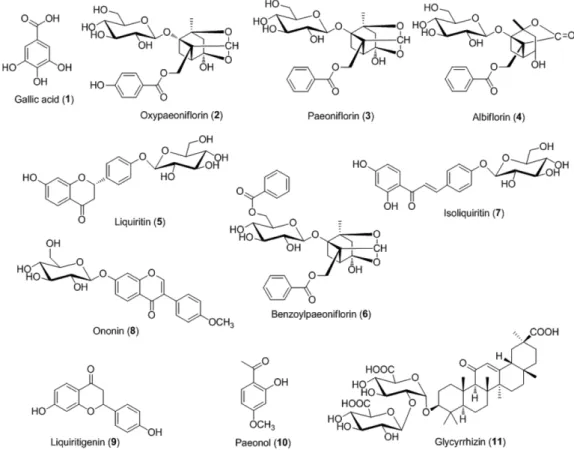
종설크로마토그래피(ultra-performance liquid chromatography-mass spectrometer, UPLC-MS)를 이용한 감초의 glycyrrhizin과 glycyrrhetinic acid 등과 같은 triterpene류와 liquiritin, liquiritin apioside 및 liquiritigenin 등과 같은 flavonoid류12)의 동시분석법 등이 보고되었다. 이와 같이 작약감초탕의 구성 약재의 품질관 리를 위한 분석 연구는 보고가 되었지만 작약감초탕에 대한 분 석 연구는 미비한 실정이다. 따라서 본 연구에서는 작약감초탕 을 구성하는 구성 약재 중 작약의 gallic acid(1), oxypaeoniflorin (2), paeoniflorin(3), albiflorin(4), benzoylpaeoniflorin(9) 및 paeonol(10)과 감초의 liquiritin(5), isoliquiritin(6), ononin(7), liquiritigenin(8) 및 glycyrrhizin(11) 등 11종의 성분을 대상으로 전자분무이온화(electrospray ionization, ESI) 방식의 UPLC-MS 를 이용하여 함량을 분석하였다.
실험 방법
실험재료
작약[Paeoniae Radix, Paeonia lactiflora Pallas(Paeoniaceae), Uiseong, Korea]과 감초[Glycyrrhizae Radix et Rhizoma, Glycyrrhiza uralensis Fischer(Leguminosae), China]로 이루어진 작약감초탕의 구성생약은 모두 광명당제약(Ulsan, Korea)에서 규
격품(작약-국산, 감초-중국산)을 구입하여 본초학 전문가로부터 감정 후 사용하였다. 작약과 감초 표본(2012-KE41-1 and 2012- KE42-2)은 한국한의학연구원 K-herb 연구단에 보관하였다.
시약 및 기기
표준품 1과 10은 Sigma-Aldrich(St. Louis, MO, USA), 2, 5~9는 Biopurify Phytochemicals(Chengdu, China) 및 3, 4 및 11은 Wako(Osaka, Japan)에서 각각 구입하여 사용하였다. 11종 표준물질의 순도는 모두 98.0% 이상이었다. 표준품의 용해를 위 한 메탄올과 LC-MS 분석을 위한 물과 아세토나이트릴 등은 J.T.
Baker(Phillipsburg, NJ, USA)에서 구입하였으며, 개미산은 특급 시약으로 Sigma-Aldrich(St. Louis, MO, USA)에서 구입하여 사 용하였다. 함량분석은 Waters의 ACQUITY UPLC(Milford, MA, USA)를 사용하였으며, pump, degasser, column oven 및 autosampler로 구성되어 있다. 분석 성분의 정확한 검출을 위한 질량분석기는 ESI source가 장착된 Waters사의 탠덤 사중극자 질량분석기(ACQUITY TQD LC-MS/MS, Milford, MA, USA)를 사용하였다. UPLC와 LC-MS/MS 등의 모든 데이터는 Waters MassLynx software(version 4.1, Milford, MA, USA)를 사용하 여 처리하였다. 시료 추출은 경서기계산업의 Cosmos 660 초고 속진공저온농축추출기(Inchon, Korea)를 사용하였다.
Fig. 1 − Chemical structures of the eleven marker components Jakyakgamcho-tang.
66 서창섭 · 신현규
작약감초탕 물 추출물 및 검액의 조제
작약과 감초로 구성된 작약감초탕 1첩 분량의 약 222.22배인 5.0 kg(22.50 g×222.22)을 초고속진공저온농축추출기(Cosmos 660, Inchon, Korea)에 넣고, 물 50 l를 첨가하여 100oC에서 98 kPa 압력하에서 2시간 전탕 한 후 표준체(No. 270, 53 mm, Chung Gye Sang Gong Sa, Seoul, Korea)를 이용하여 여과하였 다. 여과 된 추출액은 동결건조기(PVTFD100R, IlShinBioBase, Dongduchun, Korea)를 사용하여 동결 건조하였으며, 그 결과 967.5 g의 작약감초탕 물 추출물을 얻었다(19.35%). LC-MS/MS
Table II − Mass detection condition of the eleven marker compounds Compound Molecular weight
(Da)
Ionization mode
Retention time (min)
Precursor ion
(m/z) Product ion
(m/z) Cone voltage (V)
Collision energy (eV)
01
170.12 [M−H]
−0.81 169.0 125.0 25 15
02
496.46 [M −H]
−0.81 495.4 137.0 40 25
03
480.46 [M−H]
−1.39 479.2 121.0 32 25
04
480.46 [M+H]
+1.40 481.4 197.1 20 15
05
418.39 [M−H]
−1.65 417.4 255.2 30 15
06
418.39 [M+H]
+2.30 419.3 257.0 35 15
07
430.40 [M+H]
+2.77 431.3 269.0 25 15
08
256.25 [M+H]
+2.99 257.2 137.0 35 25
09
584.57 [M−H]
−2.13 583.4 121.0 40 25
10 166.18 [M+H]
+4.72 166.9 120.9 30 20
11 822.93 [M−H]
−5.20 821.9 351.2 45 40
Gallic acid (1), oxypaeoniflorin (2), paeoniflorin (3), albiflorin (4), liquiritin (5), isoliquiritin (6), ononin (7), liquiritigenin (8), benzoylpaeoniflorin (9), paeonol (10), and glycyrrhizin (11).
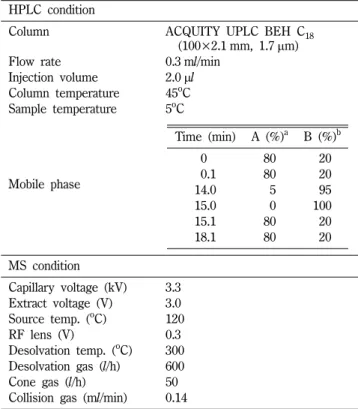
Table I − Conditions for LC-MS/MS analysis of Jakyakgamcho-tang HPLC condition
Column ACQUITY UPLC BEH C
18(100×2.1 mm, 1.7 µm)
Flow rate 0.3 m l/min
Injection volume 2.0 µl Column temperature 45
oC Sample temperature 5
oC
Mobile phase
MS condition
Capillary voltage (kV) 3.3 Extract voltage (V) 3.0 Source temp. (
oC) 120
RF lens (V) 0.3
Desolvation temp. (
oC) 300 Desolvation gas (l/h) 600
Cone gas (l/h) 50
Collision gas (m l/min) 0.14
a
0.1% (v/v) aqueous formic acid.
b
Acetonitrile.
Time (min) A (%)
aB (%)
b0. 80
02000.1
80
02014.0
05 09515.0
00100
15.1 80
02018.1 80
020MRM 모드를 이용하여 작약감초탕 추출물 중 주요 성분의 함량 분석을 위해 동결 건조된 추출물 약 70.0 mg을 정확히 취한 후 70% 메탄올을 넣어 5 ml로 맞춘 후 5분간 초음파 추출 및 vortex 하였다. 그 후 추출액 0.1 ml를 물을 이용하여 10 ml로 100배 희 석한 후 0.22 mm 멤브레인 여과하여 검액으로 하였다.
UPLC 및 LC-MS/MS 분석 조건
Gallic acid를 비롯한 11종의 표준품에 대한 표준용액은 메탄 올을 이용하여 모두 1,000 µg/ml의 농도로 조제한 후 냉장 보 관하였다. 제조된 표준용액은 사용 전에 희석하여 사용하였다.
ACQUITY UPLC BEH C18(100×2.1 mm, 1.7µm, Milford, MA, USA)을 사용하여 작약감초탕 물 추출물 중 주요 성분의 분리를 실시하였으며, 칼럼 온도는 45oC를 유지하였다(Table I). 또한 분리된 성분의 정량을 위해 ESI source가 장착된 Waters사의 ACQUITY TQD LC-MS/MS(Milford, MA, USA) 를 사용하여 Table I과 Table II의 조건으로 다중반응탐색법 (multiple reaction monitoring; MRM) 모드로 분석을 실시하 였다.
검량선 작성
Gallic acid를 비롯한 11종 성분의 검량선은 제조된 표준용액 을 이용하여 0, 10, 50, 100 및 500 ng/ml의 농도 범위에서 작성 하였다. 작성된 검량선의 직선성을 검토하기 위하여 상관계수(r2) 를 구하여 판단하였으며, 각각의 성분에 대한 검출한계와 정량한 계는 신호 대 잡음 비인 3과 10으로 계산하였다.
결과 및 고찰
LC-MS/MS 분석조건 확립
작약감초탕의 구성 생약 중 작약의 albiflorin과 paeoniflorin 등 과 같은 monoterpenes13)과 감초의 glycyrrhizin, liquiritin 및
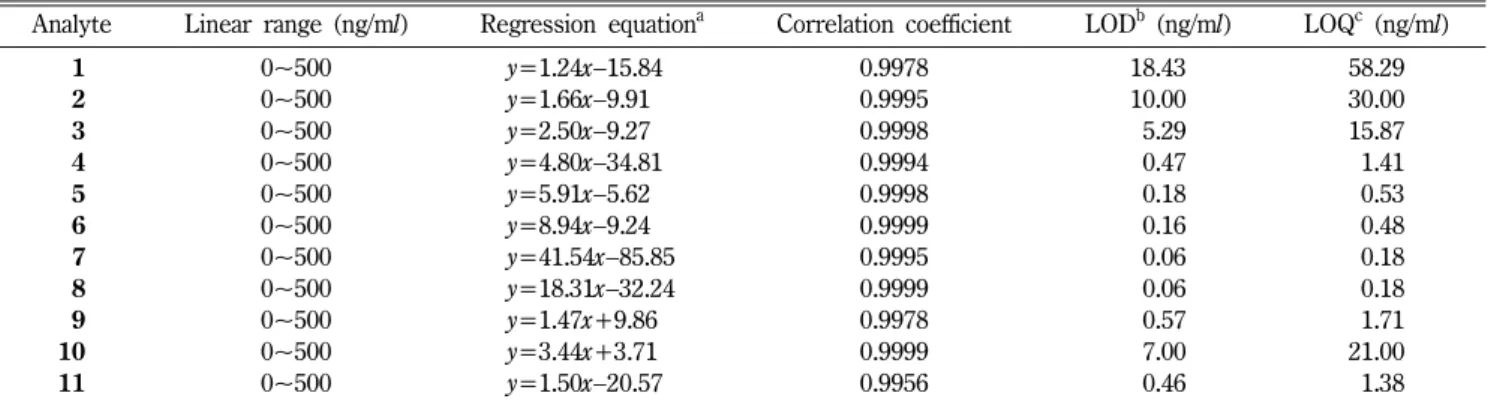
Table III − Linear range, regression equation, correlation coefficients, LOD, and LOQ for the eleven marker compounds
Analyte Linear range (ng/ml) Regression equation
aCorrelation coefficient LOD
b(ng/ml) LOQ
c(ng/ml)
01
0~500 y=1.24x−15.84 0.9978 18.43 58.29
02
0~500 y=1.66x−9.91 0.9995 10.00 30.00
03
0~500 y=2.50x−9.27 0.9998
05.2915.87
04
0~500 y=4.80x−34.81 0.9994
00.47 01.4105
0~500 y=5.91x−5.62 0.9998
00.18 00.5306
0~500 y=8.94x−9.24 0.9999
00.16 00.4807
0~500 y=41.54x−85.85 0.9995
00.06 00.1808
0~500 y=18.31x−32.24 0.9999
00.06 00.1809
0~500 y=1.47x+9.86 0.9978
00.57 01.7110 0~500 y=3.44x+3.71 0.9999
07.0021.00
11 0~500 y=1.50x−20.57 0.9956
00.46 01.38a
y: peak area (mAU) of compounds; x: concentration (µg/ml) of compounds.
b
LOD=3×signal-to-noise ratio.
c
LOQ=10×signal-to-noise ratio.
Gallic acid (1), oxypaeoniflorin (2), paeoniflorin (3), albiflorin (4), liquiritin (5), isoliquiritin (6), ononin (7), liquiritigenin (8), benzoylpaeoniflorin (9), paeonol (10), and glycyrrhizin (11).
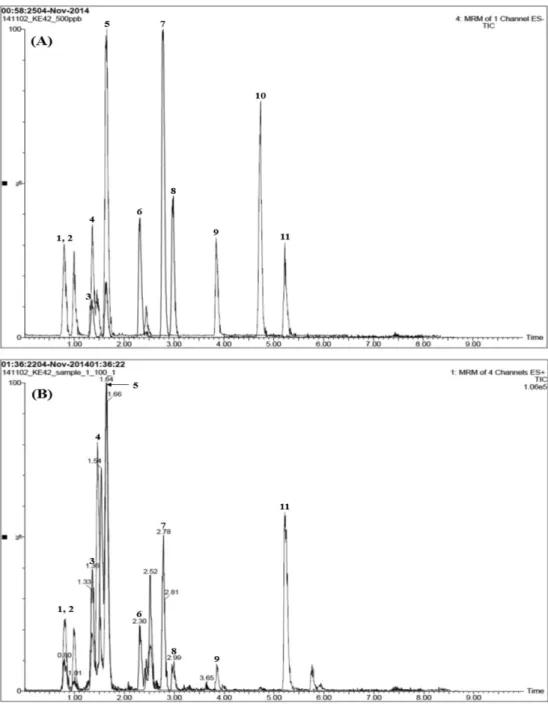
Fig. 2 − Total ion chromatogram of 11 marker compounds (A) and Jakyakgamcho-tang sample (B) by LC-MS/MS MRM mode. Gallic acid (1),
oxypaeoniflorin (2), paeoniflorin (3), albiflorin (4), liquiritin (5), isoliquiritin (6), ononin (7), liquiritigenin (8), benzoylpaeoniflorin (9),
paeonol (10), and glycyrrhizin (11).
68 서창섭 · 신현규
liquiritigenin 등과 같은 triterpenes와 flavonoids14)등이 분리 보 고 되었다. 분리 보고된 성분들 중 11종의 주요 성분에 대하여 ACQUITY TQD LC-MS/MS를 이용하여 정확성과 감도가 우수 한 ESI 방법의 MRM 방법으로 함량분석을 실시하였다. 성분의 분리를 위해 0.1%(v/v) 개미산이 함유된 물-아세토나이트릴 조건
의 이동상을 이용하여 기울기 용매 조건으로 분리 조건을 설정 하였다. 설정된 최적의 분석 조건을 이용하여 11종의 성분을 분 석한 결과 성분 1~3, 5, 9 및 11 등 6종은 음이온 모드에서 검 출되었으며, 성분 4, 6~8 및 10 등 5종은 양이온 모드에서 6분 이내로 검출되었다(Table II).
Fig. 2 − Continued.
분석법의 검량선, 검출한계 및 정량한계 설정
작약감초탕의 주요 성분에 대하여 0~500 ng/ml의 농도 범위 에서 표준품의 농도에 대한 피크 면적을 이용하여 검량선을 작 성한 결과 상관 계수(r2) 값이 0.9956~0.9999로 양호한 직선성 을 보였다. 또한 이들 성분에 대한 검출한계와 정량한계 범위는
0.06~18.43 ng/ml와 0.18~58.29 ng/ml로 나타났다(Table III).
LC-MS/MS를 이용한 주요 성분의 피크 동정 및 함량분석 설정된 LC-MS/MS MRM 모드 분석 방법을 이용하여 작약감 초탕 중 주요 성분에 대한 함량분석을 위한 피크 동정을 실시하
Fig. 2 − Continued.
70 서창섭 · 신현규
였다. 그 결과 성분 4, 6~8 및 10 등 5종은 양이온 모드인 [M+H]+ 형태로 m/z 481.4, 419.3, 431.3, 257.2 및 166.9에서 분자이온 피크를 확인하였으며, 성분 1~3, 5, 9 및 11 등 6종 은 음이온 모드인 [M−H]− 형태로 m/z 169.0, 495.4, 479.2, 417.4, 583.4 및 821.9에서 분자이온 피크를 각각 확인하였다 (Table II). 이와 같이 동정된 각각의 성분들을 MRM 모드를 이 용하여 정량 분석을 실시하고자 precursor ion(Q1)과 product ion(Q3)을 설정하였다(Table II). 성분 1의 MRM 조건은 m/z 169.0의 Q1 피크에서 COO−가 이탈된 [M−H−COO−]−형태로 m/z
125.0을 Q3 피크로 설정하였으며,15)성분 2는 m/z 495.4의 Q1 에서 [M−H−CH2O−(p-hydroxy-benzoic acid)−Glu−CO]− 형태로 m/z 137.0을 Q3 피크로 설정하였다.16)성분 3과 9는 m/z 479.2 와 583.4에서 Q1 피크를 확인하였으며 두 성분 모두 [benzoic acid−H]−의 형태인 m/z 121.0로 Q3를 설정하였다.16,17)성분 4는 m/z 481.4의 Q1에서 glucose와 benzoic acid가 떨어져 나간 [M+H−Glu−benzoic acid]+형태로 m/z 197.1로 Q3를 설정하였 으며,17)성분 5는 m/z 417.4에서 확인된 Q1 피크에서 glucose 1 분자가 이탈된 [M−H−Glu]− 형태로 m/z 255.2로 Q3를 설정하였
Fig. 3 − Total ion chromatograms of the standard solution (A) and Jakyakgamcho-tang decoction (B) by LC-MS/MS MRM mode. Gallic acid (1),
oxypaeoniflorin (2), paeoniflorin (3), albiflorin (4), liquiritin (5), isoliquiritin (6), ononin (7), liquiritigenin (8), benzoylpaeoniflorin (9),
paeonol (10), and glycyrrhizin (11).
다.18)성분 6과 7은 m/z 419.3과 431.3에서 Q1 피크를 확인하 였으며 두 성분 모두 glucose 1분자가 이탈된 [M+H−Glu]+형 태로 m/z 257.0과 269.0으로 Q3를 설정하였으며,19,20) 성분 8은 m/z 257.2(Q1)에서 C8H8O8이 떨어진 [M+H−C8H8O8]+형태로 m/z 137.0으로 Q3를 설정하였다.18) 성분 10은 m/z 166.9(Q1)에 서 물 1분자와 CO 분자가 이탈된 [M+H−H2O−CO]+형태로 m/z 120.9를 Q3로 설정하였으며,21) 성분 11은 m/z 821.9의 Q1에서 2분자의 glucose가 이탈된 [M−H−2Glu]−형태로 m/z 351.2(Q3) 로 설정하였다.18)이상과 같이 정량 분석을 위해 11종 성분에 대 하여 Q1과 Q3 피크를 각각 설정한 후 작약감초탕 시료에 대하 여 함량 분석을 실시하였다(Fig. 2). 최종적으로 확립된 LC-MS/
MS MRM 분석법을 이용하여 11종의 지표 성분을 분석한 결과 0.81, 0.81, 1.39, 1.40, 1.65, 2.30, 2.77, 2.99, 3.85, 4.72 및 5.20분에서 각각 검출되었다(Table II 및 Fig. 3). Table IV와 같 이 동결 건조된 작약감초탕 물 추출물에서 11종 물질을 분석한 결과 10은 검출이 되지 않은 반면 다른 10종의 성분은 244.05~
19,289.05 g/extracted g으로 검출이 되었다.
결 론
작약과 감초로 구성되어 주로 진통제로 사용되는 한약 처방인 작약감초탕의 품질관리를 위한 기초 자료 구축을 위해 11종의 주요 성분에 대하여 LC-MS/MS MRM 방법으로 함량분석을 실 시하였다. 분석 결과 작약에서는 paeaoniflorin(3)이 16,156.90 µg/g으로 가장 많이 검출되었으며, 감초에서는 glycyrrhizin(11) 이 19,289.05 µg/g으로 가장 많이 검출되었다. 두 성분 외에도 작 약에서는 gallic acid(1)와 albiflorin(4), 감초에서는 liquiritin(5)이 9,123.10, 4,681.67 및 7,149.29 µg/g으로 다른 성분에 비해 다량
검출되었다. 이러한 결과는 향 후 작약감초탕의 품질관리를 위 한 기초 자료로 활용될 수 있을 것으로 사료된다.
감사의 말씀
본 연구는 한국한의학연구원에서 지원하는 ‘한약 처방의 과학 적 근거 기반 구축사업(K15251)’에 의해 수행되었으며 이에 감 사 드린다.
References
1) Son, S. K., Im, C. K. and Kim, K. J. : Anxiolytic-like effects of Jackyakgamcho-tang using the elevated plus-maze in mice. J.
East-West Med. 35, 107 (2010).
2) Lee, Y. S., Kim, H. C., Whang, E. H., Jo, S. K., Lim, I. G. and Han, J. H. : Study on the effect of Jakyakgamcho-tang. Korean J. Orien. Physiol. Pathol. 17, 493 (2003).
3) Heo, J. : Donguibogam, Namsandang, Seoul, p. 276, 392 (2004).
4) Kim, B. : Anti-inflammatory effect of Jakyakgamcho-tang.
Korean J. Orient. Int. Med. 31, 365 (2010).
5) Lee, K. O., Kuk, Y. B. and Yun, Y. G. : Effects of Jakyakgamchotang extract on the analgesic effect in mice.
Korean J. Orient. Med. Prescrip. 11, 161 (2003).
6) Omiya, Y., Suzuki, Y., Yuzurihara, M., Murata, M., Aburada, M., Kase, Y. and Takeda, S. : Antinociceptive effect of Shakuyakukanzoto, a kampo medicine, in diabetic mice. J.
Pharm. Sci. 99, 373 (2005).
7) Lee, K. K., Omiya, Y., Yuzurihara, M., Kase, Y. and Kobayashi, H. : Antispasmodic effect of Shakuyakukanzoto extract on experimental muscle cramps in vivo: Role of the active constituents of Glycyrrhizae Radix. J. Ethnopharmacol. 145, 286 (2013).
8) Ota, T., Miura, I., Kanno-Nozaki, K., Hoshino, H., Horikoshi, S., Fujimori, H., Kanno, T, Mashiko, H. and Tabe, H. : Effects of Shakuyaku-Kanzo-to on extrapyramidal symptoms during antipsychotic treatment: A randomized, poen-label study. J.
Clin. Psychopharmacol. 35, 304 (2015).
9) Fujinami, H., Kajiura, S., Ando, T., Mihara, H., Hosokawa, A.
and Sugiyama, T. : Direct spraying of shakuyakukanzoto onto the duodenal papilla: A novel method for preventing pancreatitis following endoscopic retrograde cholangiopan- creatography. Digestion. 91, 42 (2015).
10) Kubota, T. and Miyata, A. : Successful use of Shakuyaku-kanzo- to, a traditional herbal medicine, for intractable symptoms of thoracic outlet syndrome: A case report. J. Anesth. 19, 157 (2005).
11) Xu, S., Yang, L., Tian, R., Wang, Z., Liu, Z., Xie, P. and Feng, Q. : Species differentiation and quality assessment of Radix
Table IV − Concentration of the eleven marker compounds in
Jakyakgamcho-tang
Component Concentration ( µg/extracted g)
Source
Mean SD RSD (%)
01 09123.10
495.57 5.43 P. lactiflora
02 03822.14372.05 9.73 P. lactiflora
0316156.90 329.46 2.04 P. lactiflora
04 04681.67194.79 4.16 P. lactiflora
05 07149.29157.40 2.20 G. uralensis
06 01192.38 086.717.27 G. uralensis
07 00496.90 020.074.04 G. uralensis
08 00244.05 011.484.70 G. uralensis
09 01925.48 091.234.74 P. lactiflora
10 ND
a- - P. lactiflora
11 19289.05 545.38 2.83 G. uralensis
a
ND: not detected.
Gallic acid (1), oxypaeoniflorin (2), paeoniflorin (3), albiflorin (4),
liquiritin (5), isoliquiritin (6), ononin (7), liquiritigenin (8),
benzoylpaeoniflorin (9), paeonol (10), and glycyrrhizin (11).
72 서창섭 · 신현규
Paeoniae Rubra (Chi-shao) by means of high-performance liquid chromatographic fingerprint. J. Chromatogr. A. 1216, 2163 (2009).
12) Zhou, S., Cao, J., Qiu, F., Kong, W., Yang, S. and Yang, M. : Simultaneous determination of five bioactive components in Radix Glycyrrhizae by pressurized liquid extraction combined with UPLC-PDA and UPLC/ESI-QTOF-MS confirmation.
Phytochem. Anal. 24, 527 (2013).
13) Li, P., Zhang, Z. M., Li, T., Zhang, Y. B., Sze, S. C. W., Wang, G. C., Li, Y. L. and Ye, W. C. : Monoterpene derivatives from the roots of Paeonia lactiflora and their anti-proliferative activity. Fitoterapia. 98, 124 (2014).
14) Zhang, Q. and Ye, M. : Chemical analysis of the Chinese herbal medicine Gan-Cao (licorice). J. Chromatogr. A. 1216, 1954 (2009).
15) Huang, H., Ji, L., Song, S., Wang, J., Wei, N., Jiang, M., Bai, G.
and Luo, G. : Identification of the major constituents in Xuebijing injection by HPLC-ESI-MS. Phytochem. Anal. 22, 330 (2011).
16) He, Q., Hu, X. J. and Cheng, Y. Y. : Analysis of ‘SHUANGDAN’
granules by high-performance liquid chromatography-diode array detection-electrospray ionization tandem mass spec- trometry. J. Pharm. Biomed. Anal. 41, 485 (2006).
17) Cao, W., Wang, X., Li, H., Shi, X., Fan, W., Zhao, S., Liu, M. and
Niu, L. : Studies on metabolism of total glucosides of paeony from Paeoniae Radix Alba in rats by UPLC-Q-TOF-MS/MS.
Biomed. Chromagogr. 29, 1769 (2015).
18) Tan, G., Zhu, Z., Jing, J., Lv, L., Lou, Z., Zhang, G. and Chai, Y. : Characterization of constituents in Sini decoction and rat plasma by high-performance liquid chromatography with diode array detection coupled to time-of-flight mass spectrometry.
Biomed. Chromagogr. 25, 913 (2011).
19) Huang, W., Wang, M., Shi, H., Peng, Y., Peng, C., Zhang, M., Li, Y., Lu, J. and Li, X. : Comparative study of bioactive constituents in crude and processed Glycyrrhizae Radix and their respective metabolic profiles in gastrointestinal tract in vitro by HPLC-DAD and HPLC-ESI/MS analysis. Arch. Pharm.
Res. 35, 1945 (2012).
20) Zhang, R., Wang, S., Lu, M., Zhang, Z., Tian, X. and Lv, D. : Simultaneous determination and pharmacokinetic study of three isoflavones from Trifolium pretense extract in rat plasma by LC-MS/MS. Biomed. Chromatogr. 29, 210 (2015).
21) He, Q., Ge, Z. W., Song, Y. and Cheng, Y. Y. : Quality evaluation of Cortex Moutan by high performance liquid chromatography coupled with diode array detector and electrospray ionization tandem mass spectrometry. Chem. Pharm. Bull. 54, 1271 (2006).