47(1) : 92∼ 101 (2016)
92
UPLC-ESI-MS/MS 를 이용한 온경탕 중 25종 성분의 함량분석
서창섭·신현규* 한국한의학연구원 K-herb연구단
Quantification of the 25 Components in Onkyung-Tang by Ultra Performance Liquid Chromatography-Electrospray Ionization-Tandem
Mass Spectrometry
Chang-Seob Seo and Hyeun-Kyoo Shin*
K-herb Research Center, Korea Institute of Oriental Medicine, 1672 Yuseong-daero, Yuseong-gu, Daejeon 34054, Korea.
Abstract − In this study, an ultra–performance liquid chromatography–electrospray ionization-mass spectrometry (UPLC-ESI- MS/MS) method was established for simultaneous determination of the 25 marker components, including chlorogenic acid, gal- lic acid, oxypaeoniflorin, homogentisic acid, methyl gallate, caffeic acid, 3,4-dihydroxybenzaldehyde, paeoniflorin, albiflorin, liquiritin, nodakenin, ferulic acid, ginsenoside Rg1, liquiritigenin, coumarin, cinnamic acid, benzoylpaeoniflorin, ginsenoside Rb1, cinnamaldehyde, paeonol, glycyrrhizin, 6-gingerol, evodiamine, rutecarpine, and spicatoside A in traditional Korean for- mula, Onkyung-tang. All analytes were separated on a Waters Acquity UPLC BEH C18 analytical column (2.1×100 mm, 1.7µm) at 45oC using a mobile phase of 0.1% (v/v) formic acid in water and acetonitrile with gradient elution. The MS analysis was carried out using a Waters ACQUITY TQD LC-MS/MS coupled with an electrospray ionization (ESI) source in the pos- itive and negative modes. The flow rate and injection volume were 0.3 mL/min and 2.0µL, respectively. The correlation coef- ficient of all analytes in the test ranges was greater than 0.98. The limits of detection and quantification values of the 25 marker compounds were in the ranges 0.03-19.43 and 0.09-58.29 ng/mL, respectively. As a result, methyl gallate, 3,4-dihydroxy- benzaldehyde, evodiamine, and rutecarpine were not detected in this sample and the concentrations of the 21 compounds except for the above 4 compounds were 33.09-3,496.32µg/g in Onkyung-tang decoction. Among these compounds, paeonol was detected at the highest amount as a 3,496.32µg/g.
Key words − Onkyung-tang, Quantification, UPLC-MS/MS
온경탕(溫經湯)은 後漢代 張의『金 要略·婦人産後炳脈證 幷治』1)에 처음으로 수록된 처방으로 溫經散寒 補血調經 養 血去瘀의 효능이 있으며, 맥문동(麥門冬, Liriopis Tuber), 당 귀(當歸, Angelicae Gigantis Radix), 인삼(인삼, Ginseng Radix Alba), 반하(半夏, Pinelliae Tuber), 작약(芍藥, Paeoniae Radix), 천궁(川芎, Cnidii Rhizoma), 목단피(牧丹 皮, Moutan Radicis Cortex), 아교(阿膠, Anisi Corii Colla) 감초(甘草, Glycyrrhizae Radix et Rhizoma), 오수유(吳茱萸, Evodiae Fructus), 육계(肉桂, Cinnamomi Cortex) 및 생강 (生薑, Zingiberis Rhizoma Crudus) 등 12종의 한약재로 구 성되어 충임맥(衝任脈)의 허한(虛寒)으로 어혈(瘀血)이 저체
(低滯)하여 루하(漏下)가 그치지 않고 월경부조(月經不調)가 혹전혹후(或前或後) 또는 유기부지(逾期不止)하거나 혹은 한 달에 두 번하거나 월경이 그치지 않으면서 방일발열(傍晩發 熱), 수족번열(手足煩熱), 순구건조(脣口乾燥), 소복리급(小 腹裏急) 및 복만(服滿) 등의 증상이 있을 경우와 부인 불잉 증(不孕症)을 치료하는데 사용되어져 왔다.2)이후 우리나라
에서도 許浚의『東醫寶鑑』3)에 월경불순, 자궁의 부정기출
혈, 냉증으로 인한 불임증이나 하복부의 팽만감, 유산벽(流 産癖), 혈행불순 및 갱년기장애 등 주로 부인과 질환에 사 용된다고 기록되어 있다. 본 처방의 현대과학적 생리활성 연구로는 골다공증,4-6) 월경통,7,8) 자궁내막증,9,10) 진정,11,12)
진통11,12) 및 항경련11) 효과 등이 보고되었다. 이에 저자들은
본 연구에서 부인과 질환에 사용되는 처방 중 하나인 온경 탕을 선정하여 처방의 함량 분석에 대한 이화학적 분석을
*교신저자(E-mail):[email protected] (Tel): +82-42-868-9464
실시하였다. 본 처방을 구성하는 구성 생약의 성분에 관한 연구는 맥문동의 spicatoside A와 같은 saponin,13) 당귀의 nodakenin, decursin 및 decursinol angelate 등과 같은 coumarins,14) 인삼의 ginsenoside Rb1과 Rg1 등과 같은 triterpenoid saponins,15) 반하의 homogentisic acid와 3,4- dihydrobenzaldehyde 등과 같은 phenolic compounds,16)작 약의 albiflorin과 paeoniflorin 등과 같은 monoterpenes,17) 천 궁의 ferulic acid 등과 같은 pheylpropanoid,18) 목단피의 paeonol과 paeoniflorin 등과 같은 phenols과 monoterpenes,19) 감초의 glycyrrhizin, liquiritin 및 liquiritigenin 등과 같은 triterpene saponins과 flavonoids,20) 오수유의 rutecarpine과 evodiamine 등과 같은 alkaloids,21) 육계의 cinnamic acid와 cinnamaldehyde 등과 같은 phenylpropanoids22) 및 생강의 6-, 8- 및 10-gingerol 등과 같은 phenols23) 등이 분리 보고 되었 다. 온경탕을 구성하는 생약들의 성분 중 본 연구에서는 맥 문동의 spicatoside A, 당귀의 nodakenin, 인삼의 ginsenoside Rb1과 Rg1, 반하의 homogentisic acid와 3,4-dehydroxyben- zaldehyde, 작약과 목단피의 gallic acid, methyl gallate, oxypaeoniflorin, benzoylpaeoniflorin, paeaoniflorin, albiflorin 및 paeonol, 천궁의 chlorogenic acid, caffeic acid 및 ferulic acid, 감초의 liquiritin, liquiritigenin 및 glycyrrhizin, 오수유 의 evodiamine과 rutecarpine, 육계의 coumarin, cinnamic acid 및 cinnamaldehyde 및 생강의 6-gingerol 등 25종에 대 하여 질량분석기가 결합된 초고성능 액체크로마토그래피 (ultra–performance liquid chromatography-electrospray ioni- zation-mass spectrometer; UPLC–ESI–MS)를 이용하여 함량 분석을 실시하였다.
재료 및 방법
실험재료 − 온경탕을 구성하는 12종의 한약재는 모두 의
약품용 한약재 전문제조회사인 광명당제약(Ulsan, Korea)에 서 규격품을 구입하여 본초학 전공인 동국대학교 한의과대 학 이제현 교수(Gyeongju, Korea)와 대전대학교 한의과대학 서영배 교수(Daejeon, Korea)로부터 감정 후 사용하였다 (Table I). 본 처방을 이루는 구성 한약재들의 표본(2012–
KE41–1~2012–KE41–12)은 한국한의학연구원 K-herb연구 단에 보관하였다.
시약 및 기기 − 온경탕의 함량분석에 사용된 표준품인 chlorogenic acid, methyl gallate 및 caffeic acid는 Acros Organics(Pittsburgh, PA, USA)에서 구입하였으며, gallic acid, coumarin 및 evodiamine은 Sigma-Aldrich(St. Louis, MO, USA)에서 구입하였다. Oxypaeoniflorin, ginsenoside Rb1, liquiritigenin 및 benzoylpaeoniflorin은 Biopurify Phytochemicals(Chengdu, China)에서 구입하였으며, homo- gentisic acid, 3,4-dihydroxybenzaldehyde, paeoniflorin, albiflorin, liquiritin, ferulic acid, cinnamic acid, ginsenoside Rb1, cinnamaldehyde, paeonol, glycyrrhizin 및 6-gingerol 은 Wako Pure Chemical(Osaka, Japan)에서 구입하였다.
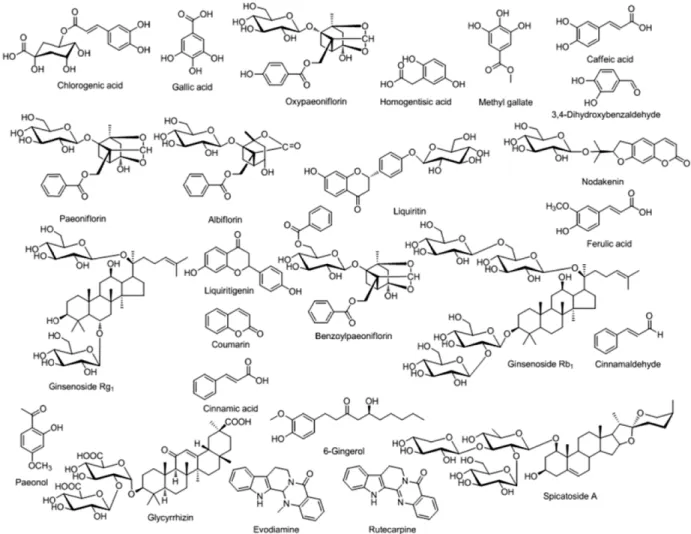
Nodakenin과 rutecarpine은 NPC Biotech(Yeongi, Korea)와 Shanghai Sunny Biotech(Shanghai, China)에서 각각 구입하 였으며, spicatoside A는 맥문동으로부터 분리하여 사용하였 다. 이들 표준품들의 순도는 98.0%이상이었으며, 화학적 구 조는 Fig. 1과 같다. LC–MS/MS 분석을 위한 메탄올, 아세 토나이트릴 및 물은 J.T. Baker(Phillipsburg, NJ, USA)에서 구입하였으며, 개미산은 Sigma-Aldrich(St. Louis, MO, USA)에서 구입하여 사용하였다.
온경탕 물 추출 조제를 위한 추출기는 경서기계산업의 초 고속진공저온농축추출기(COSMOS660, Incheon, Korea)를 사용하여 추출하였다. 본 처방의 함량분석은 pump, digasser, column oven 및 autosampler로 구성된 Waters의 ACQUITY UPLC system(Milford, MA, USA)을 사용하였으며, 질량분 Table I. Composition of Onkyung-tang
Scientific name Family Parts of using Origin Amount (g)
Liriope platyphylla Wang et Tang Liliaceae Tuber Miryang, Korea 7.500
Angelica gigas Nakai Umbelliferae Radix Bonghwa, Korea 5.625
Panax ginseng C. A. Meyer Araliaceae Radix Yeongju, Korea 3.750
Pinellia ternate Breitenbach Araceae Tuber China 3.750
Paeonia lactiflora Pallas Paeoniaceae Radix Uiseong, Korea 3.750
Cnidium officinale Makino Umbelliferae Rhizoma Yeongyang, Korea 3.750 Paeonia suffruticosa Andrews Paeoniaceae Radicis Jecheon, Korea 3.750
Equus asinus Linne Equidae Colla Busan, Korea 2.8125
Glycyrrhiza uralensis Fischer Leguminosae Rhizoma China 2.8125
Evodia rutaecarpa Bentham Rutaceae Fructus China 1.875
Cinnamomum cassia Presl Lauraceae Cortex Vietnam 1.875
Zingiber officinale Zingiberaceae Rhizoma Ulsan, Korea 3.750
Total amount 45.000
석기는 ESI source가 장착된 탠덤 사중극자 질량분석기 (ACQUITY TQD LC-MS/MS, Waters, Milford, MA, USA)를 사용하였다. 모든 데이터의 수집과 처리는 Waters MassLynx software(version 4.1, Milford, MA, USA)를 사 용하였다.
온경탕 물 추출물 조제 − 12종의 한약재로 구성된 온경탕 의 물 추출물을 조제하기 위해 Table I과 같은 비율로 배합 하여 총 시료 양을 5.0 kg(1첩 45.0 g×111.1배)으로 맞춘 후 물을 시료의 10배(50 L)로 첨가하였다. 혼합된 시료를 초고 속진공저온추출기(Cosmos 660, Kyungseo Machine Co., Incheon, Korea)를 이용하여 98 kPa 압력으로 100oC에서 2 시간 전탕한 후 표준체(No. 270, 53 µm, Chung Gye Sang Gong Sa, Seoul, Korea)를 이용하여 여과하였다. 여과액은 동결건조기(PVTFD100R, IlShinBioBase, Dongduchun, Korea)를 사용하여 동결건조하여 1.53 kg(30.6%)의 물 추출 물을 얻었다.
표준액 및 검액의 조제 − Chlorogenic acid를 비롯한 25 종의 표준품에 대한 표준용액은 메탄올을 이용하여 100.0 µg/
mL의 농도로 조제한 후 4°C에 보관하면서 사용 전에 희석 하여 사용하였다. LC-MS/MS 정량분석을 위하여 동결 건 조된 온경탕 물 추출물 68.0 mg을 정확히 취한 후 70% 메 탄올을 넣어 5 mL로 맞춘 후 5분간 초음파 추출 및 1 분간 vortexing 하였다. 추출액에 0.1 mL을 정확히 취한 후 70%
메탄올을 넣어 10 mL로 100배 희석 후 0.22 µm 멤브레인 필터하여 검액으로 하였다.
UPLC 및 LC-MS/MS 분석 조건 − 온경탕 중 주요성분 의 함량 분석을 위해 Table II와 Table III의 조건으로 ACQUITY TQD LC-MS/MS system(Waters, Milford, MA, USA)으로 분석하였다. 25종 성분의 분리와 검출을 위해 최 적의 조건을 설정한 후 설정된 분석 조건을 사용하여 다중 반응탐색법(multiple reaction monitoring, MRM)으로 분석 을 실시하였다.
검량선 작성 − Chlorogenic acid를 비롯한 25종의 표준품 에 대한 검량선은 0, 10, 50, 100 및 500 ng/mL의 농도 범 위에서 농도에 따른 피크 면적을 이용하여 작성하였다. 직 선성은 작성된 검량선의 상관계수(r2)를 구하여 판단하였다.
Fig. 1. Chemical structures of 25 marker compounds of Onkyung-tang.
검출한계(limit of detection, LOD)와 정량한계(limit of quantification, LOQ)는 신호 대 잡음 비로 3과 10으로 각각 계산하였다.
결과 및 고찰
LC-MS/MS 분석조건 확립 − 온경탕의 구성 생약 중 맥문 동의 spicatoside A, 당귀의 nodakenin, 인삼의 ginsenoside Rb1과 Rg1, 반하의 homogentisic acid와 3,4-dihydroxy- benzaldehyde, 작약과 목단피의 gallic acid, methyl gallate, oxypaeoniflorin, benzoylpaeoniflorin, paeaoniflorin, albiflorin 및 paeonol, 천궁의 chlorogenic acid, caffeic acid 및 ferulic acid, 감초의 liquiritin, liquiritigenin 및 glycyrrhizin, 오수유 의 evodiamine과 rutecarpine, 육계의 coumarin, cinnamic acid 및 cinnamaldehyde 및 생강의 6-gingerol 등 25종에 대 하여 LC-MS/MS를 이용하여 동시분석을 실시하였다. 25종 성분의 분리를 위해 UPLC BEH C18(2.1×100 mm, 1.7µm) 분석용 칼럼을 사용하였으며, 이동상으로는 물-메탄올, 물-
아세토나이트릴 및 산이 함유된 물-메탄올과 물-아세토나이 트릴 등을 이용하여 분석 조건을 설정하였다. 그 결과 최적 의 이동상 조건으로 산이 함유된 물-아세토나이트릴로 결정 하였으며, 두 용매를 이용하여 기울기 용매조건으로 분석을 실시하였다. 최적화된 이동상의 최종 조건을 이용하여 ESI 방법의 양이온 모드와 음이온 모드에서 Table II와 III의 조 건과 같이 분석을 실시하였으며, 칼럼온도는 45oC, 유속은 분당 0.3 mL로 하여 모든 성분을 10분 이내로 분리하였다.
검량선, 검출한계 및 정량한계 작성 − 25종 성분에 대하 여 LC-MS/MS를 이용하여 검량선을 작성하였다. 각각의 표 준용액의 농도에 대한 피크 면적 값을 이용하여 회귀방정 식을 작성한 결과 25종 성분의 직선성을 나타내는 상관 계 수(r2) 값이 0.9833-0.9999로 양호한 직선성을 나타내었다.
또한 이들 성분들의 검출한계와 정량한계는 0.03-19.43 ng/
mL와 0.09-58.29 ng/mL로 각각 나타났다(Table III).
온경탕 물 추출물 중 주요성분의 동정 및 함량분석 − 온 경탕을 구성하는 12종의 구성 생약 중 주요성분의 함량분 석을 위해 산이 첨가된 물-아세토나이트릴을 이용하여 LC-
MS/MS 분석법으로 표준물질에 대한 분자이온을 동정하였
다. 그 결과 chlorogenic acid, gallic acid, oxypaeoniflorin, homogentisic acid, caffeic acid, 3,4-dihydroxybenzaldehyde, paeoniflorin, liquiritin, ginsenoside Rg1, benzoylpaeoniflorin, ginsenoside Rb1 및 glycyrrhizin 등 12종은 m/z 353.3, 169.0, 495.4, 167.0, 179.0, 137.0, 479.2, 417.4, 799.2, 583.4, 1107.5 및 821.9에서 [M−H]−형태의 분자이온 피크 를 확인하였으며, methyl gallate, albiflorin, nodakenin, ferulic acid, liquiritigenin, coumarin, cinnamic acid, cinnamaldehyde, paeonol, 6-gingerol, evodiamine, rutecarpine 및 spicatoside A 등 13종의 성분은 m/z 185.0, 481.4, 409.4, 195.0, 257.2, 147.1, 149.1, 133.1, 166.9, 295.3, 304.2, 288.2 및 871.8에서 [M+H]+ 형태의 분자이온 피크를 각각 확인하였다(Table III). 또한 LC-MS/MS를 이용하여 음 이온 및 양이온 모드에서 확인된 지표성분들의 함량을 분 석하기 위하여 각각의 성분에 대하여 precursor ion(Q1)과 product ion(Q3)을 Table III과 같이 설정한 후 MRM 방법 으로 분석하였다. 각각의 성분에 대한 MRM 조건은 chlorogenic acid의 경우 m/z 353.3(Q1)에서 caffeoyl기가 떨 어져 나간 [M−H−caffeoyl]− 형태로 m/z 191.0으로 Q3를 설 정하였으며,24) gallic acid, homogentisic acid 및 caffeic acid 는 m/z 169.0, 167.0 및 179.0의 Q1에서 COO−가 각각 이 탈된 [M−H−COO−]− 형태로 m/z 1125.0, 123.0 및 135.0으 로 Q3 피크를 설정하였다.25-27) Oxypaeoniflorin은 m/z 495.4(Q1)에서 [M−H−CH2O−(p-hydroxy-benzoic acid)−
Glu−CO]− 형태의 m/z 137.0(Q3), methyl gallate는 m/z 185.0(Q1)에서 methoxy기가 떨어져 나간 m/z 153.0(Q3)으 로 설정하였다.28,29) 3,4-dihydroxybenzaldehyde는 m/z 136.9 Table II. Conditions for LC-MS/MS analysis of Onkyung-
tang
HPLC condition
Column ACQUITY UPLC BEH
C18 (2.1×100 mm, 1.7 µm)
Flow rate 0.3 mL/min
Injection volume 2.0 µL Column temperature 45oC Sample temperature 5oC
Mobile phase Time (min) A (%)1 B (%)2
0 80 20
0.1 80 20
14.0 5 95
15.0 0 100
15.1 80 20
18.1 80 20s
MS condition
Capillary voltage (kV) 3.3 Extract voltage (V) 3.0 Source temperature (oC) 120
RF lens (V) 0.3
Desolvation temperature (oC) 300 Desolvation gas (L/h) 600
Cone gas (L/h) 50
Collision gas (mL/min) 0.14
10.1%(v/v) formic acid in water
2Acetonitrile
(Q1)에서 1개의 aldehyde기가 떨어져 나간 [M−H−COH−]− 형태의 m/z 108.0(Q3)로 설정하였으며,30) paeoniflorin과 benzoylpaeoniflorin은 m/z 479.2와 583.4(Q1)에서 두 성분 모두 [benzoic acid−H]−의 형태인 m/z 121.0(Q3)로 설정하
였다.28,31) Albiflorin은 m/z 481.4의 Q1에서 glucose와
benzoic acid가 이탈된 [M+H−Glu−benzoic acid]+ 형태로 m/z 197.1에서 Q3를 설정하였으며,31) liquiritin, nodakenin 및 ginsenoside Rg1은 m/z 417.4, 409.4 및 799.2에서 각각 확인된 Q1 피크에서 세 성분 모두 glucose 1분자가 떨어진 [M−H−Glu]−, [M+H−Glu]+ 및 [M−H−Glu]− 형태로 m/z 255.2, 247.2 및 637.0으로 Q3를 설정하였다.32-34) Ferulic acid, cinnamic acid 및 cinnamaldehyde는 m/z 195.0, 149 및 133.1의 Q1에서 세 성분 모두 1개의 물 분자가 이탈된 [M+H−H2O]+형태로 m/z 177.0, 131.0 및 115.0으로 Q3를 설정하였으며,27,35,36) liquiritigenin은 m/z 257.2(Q1)에서
C8H8O8이 떨어진 [M+H−C8H8O8]+ 형태로 m/z 137.0으로 Q3를 설정하였다.32) Coumarin은 m/z 147.1의 Q1에서 2개 의 CO분자가 떨어진 [M+H−2CO]+ 형태로 m/z 91.0으로 Q3를 설정하였으며,37) Ginsenoside Rb1은 m/z 1107.5(Q1) 에서 [Glu−H]−로 m/z 179.0(Q3)로 설정하였다.38) Paeonol과 6-gingerol은 m/z 166.9와 295.3의 Q1에서 1분자의 물과 CO 및 C6H12O2가 떨어진 [M+H−H2O−CO]+와 [M+H−C6H12O2]+ 형태인 m/z 120.9와 177.1을 Q3로 설정하였으며,32,39) glycyrrhizin은 m/z 821.9(Q1)에서 2분자의 glucose가 떨어진 aglycon인 [M−H−2Glu]−형태로 m/z 351.2(Q3)로 설정하였 다.32) Evodiamine과 rutecarpine은 m/z 304.2와 288.2의 Q1에 서 m/z 134.0과 115.0으로 Q3를 설정하였으며,40) spicatoside A는 m/z 871.8(Q1)에서 Glu-Xyl-Fuc가 떨어진 [M+H−Glu−
Xyl−Fuc]+형태로 m/z 431.4(Q3)로 설정하였다.41) 이와 같 이 지표 성분으로 설정된 각 성분에 대하여 Q1과 Q3를 설 Table III. Linearities, regression equation, correlation coefficients, LOD, and LOQ for 25 marker compounds
Compound Linear range
(ng/mL) Regression equation Correlation coefficient
LOD (ng/mL)
LOQ (ng/mL)
Chlorogenic acid 0 − 500 y = 1.79x – 45.61 0.9833 7.28 21.84
Gallic acid 0 − 500 y = 0.91x – 11.90 0.9888 19.43 58.29
Oxypaeoniflorin 0 − 500 y = 1.31 – 22.65 0.9851 10.00 30.00
Homogentisic acid 0 − 500 y = 2.22x – 49.64 0.9880 0.75 2.26
Methyl gallate 0 − 500 y = 1.80x – 6.07 0.9991 7.65 22.96
Caffeic acid 0 − 500 y = 6.72x – 16.85 0.9972 9.00 26.99
3,4-Dihydroxybenzaldehyde 0 − 500 y = 0.55x – 5.38 0.9898 1.10 3.31
Paeoniflorin 0 − 500 y = 2.03x – 16.01 0.9928 5.29 15.87
Albiflorin 0 − 500 y = 3.87x – 1.80 0.9997 0.47 1.41
Liquiritin 0 − 500 y = 6.13x – 35.99 0.9997 0.18 0.53
Nodakenin 0 − 500 y = 7.76x – 61.00 0.9994 0.09 0.26
Ferulic acid 0 − 500 y = 21.80x – 53.32 0.9998 0.34 1.03
Ginsenoside Rg1 0 − 500 y = 0.73x - 7.13 0.9983 1.11 3.33
Liquiritigenin 0 − 500 y = 16.79x + 150.40 0.9974 0.06 0.18
Coumarin 0 − 500 y = 44.24x + 155.21 0.9997 0.26 0.77
Cinnamic acid 0 − 500 y = 12.64x + 55.68 0.9988 0.87 2.62
Benzoylpaeoniflorin 0 − 500 y = 1.40x + 15.45 0.9977 0.57 1.71
Ginsenoside Rb1 0 − 500 y = 0.68x – 5.17 0.9990 0.94 2.81
Cinnamaldehyde 0 − 500 y = 0.61x + 6.48 0.9963 1.00 3.00
Paeonol 0 − 500 y = 3.44x – 23.10 0.9992 7.00 21.00
Glycyrrhizin 0 − 500 y = 1.52x – 28.17 0.9935 0.46 1.38
6-gingerol 0 − 500 y = 4.73x – 19.18 0.9999 0.04 0.13
Evodiamine 0 − 500 y = 104.44x + 600.29 0.9988 0.03 0.09
Rutecarpine 0 − 500 y = 39.38x + 484.92 0.9974 0.16 0.48
Spicatoside A 0 − 500 y = 5.24x – 35.06 0.9973 1.41 4.23
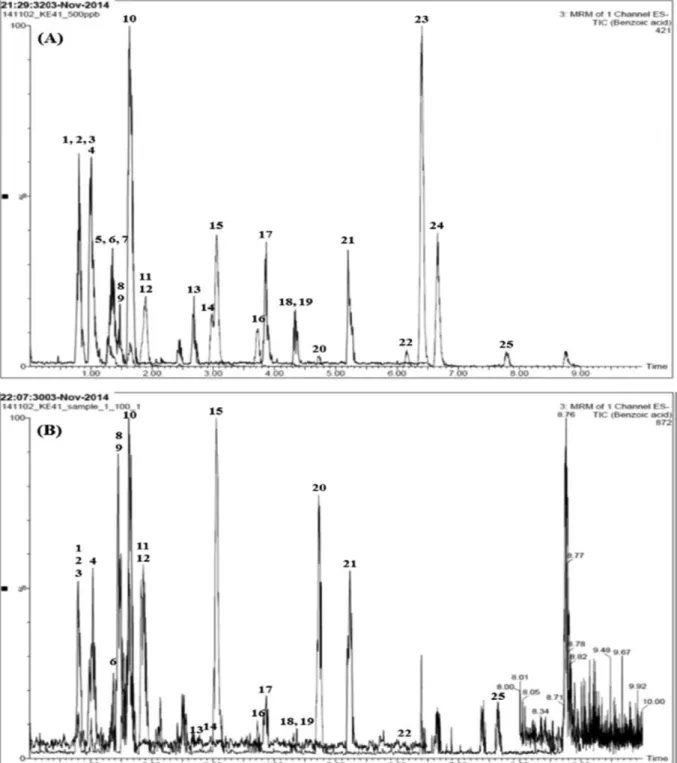
정한 후 온경탕 물 추출물에서 이들 성분의 함량 분석을 실 시하였다. 설정된 LC-MS/MS MRM 분석법에 의해 분석한 결과 chlorogenic acid, gallic acid, oxypaeoniflorin, homogentisic acid, methyl gallate, caffeic acid, 3,4- dihydroxybenzaldehyde, paeoniflorin, albiflorin, liquiritin, nodakenin, ferulic acid, ginsenoside Rg1, liquiritigenin, coumarin, cinnamic acid, benzoylpaeoniflorin, ginsenoside Rb1, cinnamaldehyde, paeonol, glycyrrhizin, 6-gingerol, evodiamine, rutecarpine 및 spicatoside A 등 25종의 성분은 0.80, 0.81, 0.81, 1.03, 1.28, 1.30, 1.32, 1.39, 1.40, 1.65, 1.85, 1.89, 2.69, 2.99, 3.06, 3.74, 3.86, 4.34, 4.42, 4.72, 5.20, 6.16, 6.40, 6.66 및 7.77분에서 각각 검출되었다 (Table IV 및 Fig. 2). MRM 분석법으로 10분 내에 분리를 시킨 후 각각의 성분에 대하여 추출물 68.0 mg을 전처리한 후 3회 분석한 결과 온경탕 물 추출물 중에서 작약과 목단피에서 유래한 methyl gallate와 반하에서 유래한 3,4-dihydroxy-
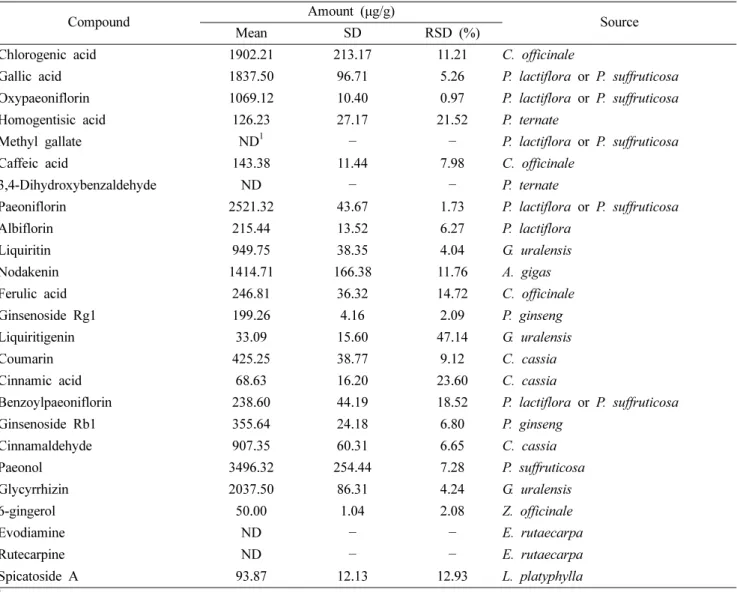
benzaldehyde 및 오수유에서 유래한 evodiamine과 rutecarpine 등 4종은 검출이 되지 않았으며, 이를 제외한 20종의 성분 은 33.09-3,496.32 µg/g으로 나타났다(Table V).
결 론
12종의 한약재로 구성되어 주로 부인과 질환에 사용되어
지는 한약 처방 중 하나인 온경탕에 대하여 chlorogenic acid, gallic acid, oxypaeoniflorin, homogentisic acid, methyl gallate, caffeic acid, 3,4-dihydroxybenzaldehyde, paeoniflorin, albiflorin, liquiritin, nodakenin, ferulic acid, ginsenoside Rg1, liquiritigenin, coumarin, cinnamic acid, benzoylpaeoniflorin, ginsenoside Rb1, cinnamaldehyde, paeonol, glycyrrhizin, 6- gingerol, evodiamine, rutecarpine 및 spicatoside A 등 25종 의 성분에 대하여 LC-MS/MS를 이용한 MRM 모드로 함량 분석을 실시하였다. 분석 결과 본 한약 처방 추출물에서는 Table IV. Chromatographic retention time, MRM parameters, cone voltage, and collision energy for 25 compounds
Compound Mode Retention
time (min)
Molecular weight (Da)
Precursor ion (m/z)
Product ion (m/z)
Cone voltage (V)
Collision energy (eV)
Chlorogenic acid [M-H]- 0.80 354.31 353.3 191.0 20 20
Gallic acid [M-H]- 0.81 170.12 169.0 125.0 25 15
Oxypaeoniflorin [M-H]- 0.81 496.46 495.4 137.0 40 25
Homogentisic acid [M-H]- 1.03 168.15 167.0 123.0 20 10
Methyl gallate [M+H]+ 1.28 184.15 185.0 153.0 20 10
Caffeic acid [M-H]- 1.30 180.16 179.0 135.0 20 10
3,4-Dihydroxybenzaldehyde [M-H]- 1.32 138.12 137.0 108.0 35 20
Paeoniflorin [M-H]- 1.39 480.46 479.2 121.0 32 25
Albiflorin [M+H]+ 1.40 480.46 481.4 197.1 20 15
Liquiritin [M-H]- 1.65 418.39 417.4 255.2 30 15
Nodakenin [M+H]+ 1.85 408.4 409.4 247.2 30 15
Ferulic acid [M+H]+ 1.89 194.18 195.0 177.0 15 10
Ginsenoside Rg1 [M-H]- 2.69 801.01 799.2 637.0 50 20
Liquiritigenin [M+H]+ 2.99 256.25 257.2 137.0 35 25
Coumarin [M+H]+ 3.06 146.14 147.1 91.0 30 20
Cinnamic acid [M+H]+ 3.74 148.16 149.1 131.0 20 10
Benzoylpaeoniflorin [M-H]- 3.86 584.57 583.4 121.0 40 25
Ginsenoside Rb1 [M-H]- 4.34 1109.29 1107.5 179.0 50 45
Cinnamaldehyde [M+H]+ 4.42 132.16 133.1 115.0 25 15
Paeonol [M+H]+ 4.72 166.18 166.9 120.9 30 20
Glycyrrhizin [M-H]- 5.20 822.93 821.9 351.2 45 40
6-gingerol [M+H]+ 6.16 294.39 295.3 177.1 13 10
Evodiamine [M+H]+ 6.40 303.36 304.2 134.0 25 20
Rutecarpine [M+H]+ 6.66 287.32 288.2 115.0 45 40
Spicatoside A [M+H]+ 7.77 871.03 871.8 431.4 20 15
작약과 목단피로부터 유래된 paeonol과 paeoniflorin이 3,496.32와 2,521.32 µg/g으로 가장 많이 검출되었으며, 감 초의 glycyrrhizin(2037.50 µg/g)과 천궁의 chlorogenic acid
(1,902.21µg/g) 등이 다른 성분에 비해 높은 함량을 보였다.
이러한 분석 결과는 향후 온경탕 또는 다른 한약 처방의 함 량분석을 위한 기초 자료로 활용될 수 있을 것으로 사료된다.
Fig. 2. Total ion chromatograms of the 25 standard solutions (A) and Onkyung-tang decoction (B) by LC-MS/MS MRM mode.
Chlorogenic acid (1), gallic acid (2), oxypaeoniflorin (3), homogentisic acid (4), methyl gallate (5), caffeic acid (6), 3,4-dihy- droxybenzaldehyde (7), paeoniflorin (8), albiflorin (9), liquiritin (10), nodakenin (11), ferulic acid (12), ginsenoside Rg1 (13), liquir- itigenin (14), coumarin (15), cinnamic acid (16), benzoylpaeoniflorin (17), ginsenoside Rb1 (18), cinnamaldehyde (19), paeonol (20), glycyrrhizin (21), 6-gingerol (22), evodiamine (23), rutecarpine (24), and spicatoside A (25).
사 사
본 연구는 한국한의학연구원에서 지원하는 ‘한약 처방의 과학적 근거 기반 구축사업(K14030)’에 의해 수행되었으며 이에 감사 드린다.
인용문헌
1.곽동렬. (2002) 금궤요락역해, 512. 성보사, 성남.
2.한의과대학방제학 교수 공편저. (1999) 방제학, 419-420.
영림사, 서울.
3. Heo, J. (2004) Donguibogam, 605. Namsandang, Seoul.
4. Chen, H., Emura, S., Isono, H. and Shoumura, S. (2005) Effects of traditional Chinese medicine on bone loss in SAMP6: A murine model for senile osteoporosis. Biol.
Pharm. Bull. 28: 865-869.
5. Kno, S. T. and Kim, I. R. (2000) Preventive effects of Onkyungtang against ovarioectomized rat’s osteoporosis.
Kor. J. Herbology. 15: 129-136.
6. Okamoto, Y., Hidaka, S., Yamada, Y., Ouchi, K., Miyazaki, K. and Liu, SY. (1998) Thermal analysis of bones from ova- riectomized rats. J. Biomed. Mater. Res. 41: 221-226.
7. Chen, H. Y., Lin, Y. H., Su, I. H., Chen, Y. C., Yang, S. H.
and Chen, J. L. (2014) Inverstigation on Chinese herbal med- icine for primary dysmenorrhea: Implication from a nation- wide prescription database in Taiwan. Complement. Ther.
Med. 22: 116-125.
8. Hsu, C. S., Yang, J. K. and Yang, L. L. (2003) Effect of a dys- menorrhea Chinese medicinal prescription on uterus con- tractility in vitro. Phytother. Res. 17: 778-783.
9. Kim, H. I., Lim, E. M. and Kwon, K. R. (2006) Effects of Onkyung-tang on surgically induced endometriosis in rats. J.
Orient. Obstetrics Gynecol. 19: 18-33.
Table V. Amount of 25 marker compounds in Onkyung-tang (n=3)
Compound Amount (µg/g)
Source
Mean SD RSD (%)
Chlorogenic acid 1902.21 213.17 11.21 C. officinale
Gallic acid 1837.50 96.71 5.26 P. lactiflora or P. suffruticosa
Oxypaeoniflorin 1069.12 10.40 0.97 P. lactiflora or P. suffruticosa
Homogentisic acid 126.23 27.17 21.52 P. ternate
Methyl gallate ND1 − − P. lactiflora or P. suffruticosa
Caffeic acid 143.38 11.44 7.98 C. officinale
3,4-Dihydroxybenzaldehyde ND − − P. ternate
Paeoniflorin 2521.32 43.67 1.73 P. lactiflora or P. suffruticosa
Albiflorin 215.44 13.52 6.27 P. lactiflora
Liquiritin 949.75 38.35 4.04 G. uralensis
Nodakenin 1414.71 166.38 11.76 A. gigas
Ferulic acid 246.81 36.32 14.72 C. officinale
Ginsenoside Rg1 199.26 4.16 2.09 P. ginseng
Liquiritigenin 33.09 15.60 47.14 G. uralensis
Coumarin 425.25 38.77 9.12 C. cassia
Cinnamic acid 68.63 16.20 23.60 C. cassia
Benzoylpaeoniflorin 238.60 44.19 18.52 P. lactiflora or P. suffruticosa
Ginsenoside Rb1 355.64 24.18 6.80 P. ginseng
Cinnamaldehyde 907.35 60.31 6.65 C. cassia
Paeonol 3496.32 254.44 7.28 P. suffruticosa
Glycyrrhizin 2037.50 86.31 4.24 G. uralensis
6-gingerol 50.00 1.04 2.08 Z. officinale
Evodiamine ND − − E. rutaecarpa
Rutecarpine ND − − E. rutaecarpa
Spicatoside A 93.87 12.13 12.93 L. platyphylla
1ND: not detected.
10. Kwon, C. N. and Lee, I. S. (2001) The effect of Onkyung- tang on uterine changes of ovariectomized rats. J. Orient.
Gynecol. 14: 56-68.
11. Choi, K. H., Kim, C. W. and Yu, S. K. (1996) The influence of Onkyungtang for soothing of pain, spasmolutic, removal of uterus muscle by animal experiment. J. Orient. Gynecol. 9:
27-39.
12. Kim, C. W. (1994) Studies on the effects of Onkyungtang. J.
Korean Med. 12: 269-280.
13. Kim, S. h., Kim, H. K., Yang, E. S., Lee, K. Y., Kim, S. D., Kim, Y. C. and Sung, S. H. (2010) Optimization of pres- surized liquid extraction for spicatoside A in Liriope platy- phylla. Sep. Purif. Technol. 71: 168-172.
14. Ahn, M. J., Lee, M. K., Kim, Y. C. and Sung, S. H. (2008) The simultaneous determination of coumarins in Angelica gigas root by high performance liquid chromatography-diode array detector coupled with electrospray ionization/mass spectrometry. J. Pharm. Biomed. Anal. 46: 258-266.
15. Shan, S. M., Luo, J. G., Huang, F. and Kong, L. Y. (2014) Chemical characteristics combined with bioactivity for com- prehensive evaluation of Panax ginseng C.A.Meyer in dif- ferent ages and seasons based on HPLC-DAD and chemometric methods. J. Pharm. Biomed. Anal. 89: 76-82.
16. Han, J. H., Jo, S. G., Lee, M. J., Baek, S. H. and Park, S. H.
(2004) Contents of homogentisic acid and 3,4-dihydrobenz- aldehyde in the Pinellia ternate by various processing method and its safety estimate. Korean J. Orient. Physiol.
Pathol. 18: 846-853.
17. Li, P., Zhang, Z. M., Li, T., Zhang, Y. B., Sze, S. C. W., Wang, G. C., Li, Y. L. and Ye, W. C. (2014) Monoterpene derivatives from the roots of Paeonia lactiflora and their anti- proliferative activity. Fitoterapia. 98: 124-129.
18. Lu, G. H., Chan, K., Liang, Y. Z., Leung, K., Chan, C. L., Jiang, Z. H. and Zhao, Z. Z. (2005) Development of high-per- formance liquid chromatography fingerprints for distinguish- ing Chinase Angelica form related umbelliferae herbs. J.
Chromatogr. A. 1073: 383-392.
19. Li, G., Seo, C. S., Lee, K. S., Kim, H. J., Chang, H. W., Jung, J. S., Song, D. K. and Son, J. K. (2004) Protective con- stituents against sepsis in mice from the root cortex of Pae- onia suffruticosa. Arch. Pharm. Res. 27: 1123-1126.
20. Zhang, Q. and Ye, M. (2009) Chemical analysis of the Chi- nese herbal medicine Gan-Cao (licorice). J. Chromatogr. A.
1216: 1954-1969.
21. Xu, M. L., Li, G., Moon, D. C., Lee, C. S., Woo, M. H., Lee, E. S., Jahang, Y., Chang, H. W., Lee, S. H. and Son, J. K.
(2006) Cytotoxicity and DNA topoisomerase inhibitory activity of constituents isolated from the fruits of Evodia offi- cinalis. Arch. Pharm. Res. 29: 541-547.
22. Lv, G. P., Huang, W. H., Yang, F. Q., Li, J. and Li, S. P. (2010) Pressurized liquid extraction and GC-MS analysis for simul- taneous determination of seven components in Cinnamomum
cassia and the effect of sample preparation. J. Sep. Sci. 33:
2341-2348.
23. Zick, S. M., Ruffin, M. T., Djuric, Z., Normolle, D. and Bren- ner, D. E. (2010) Quantitation of 6-, 8- and 10-gingerols and 6-shogaol in human plasma by high-performance liquid chro- matography with electrochemical detection. Int. J. Biomed.
Sci. 6: 233-240.
24. Jaiswal, R., Muller, H., Muller, A., Karar, M. G. E. and Kuh- nert, N. (2014) Identification and characterization of chlo- rogenic acid, chlorogenic acid glycosides and flavonoids from Lonicera henryi L. (Caprifoliaceae) leaves by LC-MSn. Phytochemistry. 108: 252-263.
25. Huang, H., Ji, L., Song, S., Wang, J., Wei, N., Jiang, M., Bai, G. and Luo, G. (2011). Identification of the major constituents in Xuebijing injection by HPLC-ESI-MS. Phytochem. Anal.
22: 330-338.
26. Elgstoen, K. B., Zhao, J. Y., Anacleto, J. F. and Jellum, E.
(2001) Potential of capillary electrophoresis, tandem mass spectrometry and coupled capillary electrophoresis-tandem mass spectrometry as diagnostic tools. J. Chroamtogr. A. 914:
265-275.
27. Wang, X., Ma, X., Li, W., Chu, Y., Guo, J., Li, S., Wang, J., Zhang, H., Zhou, S. and Zhu, Y. (2013) Simultaneous deter- mination of five phenolic components and paeoniflorin in rat plasma by liquid chromatography-tandem mass spectrometry and pharmacokinetic study after oral administration of Cere- bralcare granule®. J. Pharm. Biomed. Anal. 86: 82-91.
28. He, Q., Hu, X. J. and Cheng, Y. Y. (2006) Analysis of
‘SHUANGDAN’ granules by high-performance liquid chro- matography-diode array detection-electrospray ionization tandem mass spectrometry. J. Pharm. Biomed. Anal. 41: 485- 492.
29. Sudjaroen, Y., Hull, W. E., Erben, G., Wurtele, G., Chang- bumrung, S., Ulrich, C. M. and Owen, R. W. (2012) Isolation and characterization of ellagitannins as the major polyphe- nolic components of Longan (Dimocarpus longan Lour) seeds. Phytochemistry. 77: 226-237.
30. Li, Y., Qu, H. and Cheng, Y. (2008) Identification of major constituents in the traditional Chinese medicine “QI-SHEN- YI-QI” dropping pill by high-performance liquid chroma- tography coupled with diode array detection-electrospray ion- ization tandem mass spectrometry. J. Pharm. Biomed. Anal.
47: 407-412.
31. Cao, W., Wang, X., Li, H., Shi, X., Fan, W., Zhao, S., Liu, M.
and Niu, L. (2015) Studies on metabolism of total glucosides of paeony from Paeoniae Radix Alba in rats by UPLC-Q- TOF-MS/MS. Biomed. Chromagogr. 29: 1769-1779.
32. Tan, G., Zhu, Z., Jing, J., Lv, L., Lou, Z., Zhang, G. and Chai, Y. (2011) Characterization of constituents in Sini decoction and rat plasma by high-performance liquid chromatography with diode array detection coupled to time-of-flight mass spectrometry. Biomed. Chromagogr. 25: 913-924.
33. Kim, M. K., Yang, D. H., Jung, M., Jung, E. H., Eom, H. Y., Suh, J. H., Min, J. W., Kim, U., Min, H., Kim, J. and Han, S.
B. (2011) Simultaneous determination of chromones and cou- marins in Radix Saposhnikoviae by high performance liquid chromatography with diode array and tandem mass detectors.
J. Chromatogr. A. 1218: 6319-6330.
34. Zhao, J., Su, C., Yang, C., Liu, M., Tang, L., Su, W. and Liu, Z. (2012) Determination of ginsenosides Rb1, Rb2, and Rb3 in rat plasma by a rapid and sensitive liquid chromatography tandem mass spectrometry method: Application in a phar- macokinetic study. J. Pharm. Biomed. Anal. 64-65: 94-97.
35. Gardana, C., Scaglianti, M., Pietta, P. and Simonetti, P. (2007) Analysis of the polyphenolic fraction of propolis from dif- ferent sources by liquid chromatography-tandem mass spec- trometry. J. Pharm. Biomed. Anal. 45: 390-399.
36. Flamini, R., Vedova, A. D., Cancian, D., Panifhel, A. and Rosso, M. D. (2007) GC/MS-positive ion chemical ionization and MS/MS study of volatile benzene compounds in five dif- ferent woods used in barrel making. J. Mass Spectrom. 42:
641-646.
37. Concannon, S., Ramachandran, V. N. and Smyth, W. F.
(2000) A study of the electrospray ionization of selected cou- marin derivatives and their subsequent fragmentation using
an ion trap mass spectrometer. Rapid Commun. Mass Spec- trom. 14: 1157-1166.
38. Zhao, J., Su, C., Yang, C., Liu, M., Tang, L., Su, W. and Liu, Z. (2012) Determination of ginsenosides Rb1, Rb2, and Rb3 in rat plasma by a rapid and sensitive liquid chromatography tandem mass spectrometry method: Application in a phar- macokinetic study. J. Pharm. Biomed. Anal. 64-65: 94-97.
39. He, Q., Ge, Z. W., Song, Y. and Cheng, Y. Y. (2006) Quality evaluation of Cortex Moutan by high performance liquid chromatography coupled with diode array detector and elec- trospray ionization tandem mass spectrometry. Chem. Pharm.
Bull. 54: 1271-1275.
40. Zhao, Y., Zhao, Y., Zhou, X. and Gong, X. (2014) Devel- opment and validation of an UPLC-ESI-MS/MS method for determination of dehydroevodiamine, limonin, evodiamine, and rutaecarpine in Eovidae Fructus. Pharmacogn. Mag. 10:
374-383.
41. Choi, S. J., Choi, J., Jeon, H., Bae, S. K., Ko, J., Kim, J. and Yoon, K. E. (2015) Application of high-performance coun- tercurrent chromatography for the isolation of steroidal sapo- nins from Liriope plathyphylla. J. Sep. Sci. 38: 18-24.
(2015. 12. 24 접수; 2016. 1. 25 심사; 2016. 2. 2 게재확정)