Natural Product Sciences 23(2) : 84-91 (2017)
https://doi.org/10.20307/nps.2017.23.2.84
84
Quantitative Analysis of Eleven Bioactive Constituents of a Traditional Herbal Medicine, Yeonggyechulgam-tang using, Liquid Chromatography-Electrospray
Ionization Tandem Mass Spectrometry
Chang-Seob Seo and Hyeun-Kyoo Shin*
K-herb Research Center, Korea Institute of Oriental Medicine, 1672 Yuseong-daero, Yuseong-gu, Daejeon 34054, Korea
Abstract – This study proposes a sensitive and selective liquid chromatography-electrospray ionization tandem mass spectrometry method of efficiently assessing the quality of a traditional herbal medicine called Yeonggyechulgam- tang (YGCGT). The following compounds 1 – 11, namely, liquiritin apioside (1), liquiritin (2), liquiritigene (3), coumarin (4), cinnamic acid (5), cinnamaldehyde (6), glycyrrhizin (7), atractylenolide III (8), atractylenolide II (9), atractylenolide I (10), and pachymic acid (11) were separated on a UPLC BEH C18 column (2.1 × 100 mm, 1.7μm) at a column temperature of 45oC eluted with a gradient condition of 0.1% (v/v) formic acid in distilled water and acetonitrile. The correlation coefficient of the calibration curve of the eleven constituents was ≥ 0.9936.
The limits of detection and quantification of the compounds 1 – 11 were 0.06 – 4.73 ng/mL and 0.17–14.20 ng/
mL, respectively. Using this analytical method, the compound 11 in lyophilized YGCGT decoction extract was not detected, while the compounds 1 – 10 were detected 0.13–166.43 mg/g.
Keywords – Quantitative analysis, Yeonggyechulgam-tang, LC-MS/MS
Introduction
Yeonggyechulgam-tang (YGCGT), known as Lingguiz- hugan-tang in Chinese and Ryokeijutsukan-to in Japanese, is a traditional herbal medicine that consists of the four herbal ingredients, Poria Sclerotium (Polyporaceae), Cinnamomi Ramulus (Lauraceae), Atractylodis Rhizoma Alba (Compositae), and Glycyrrhizae Radix et Rhizoma (Leguminosae). YGCGT was first recorded in Shang Han Lun by Zhongjing Zhang of the Han Dynasty
1, and was also recorded in the medical encyclopedia Dongeuibogam by Jun Heo during the Joseon Dynasty in Korea, and has long been used to treat phlegm.
2The various pharmacological efficacies of YGCGT have been reported, including anti- inflammation,
3anti-obesity,
4chronic heart failure,
5,6and protection of liver and kidneys.
7,8As described above, research on the various efficacies of YGCGT has been conducted, but research aimed at assessing the quality of YGCGT is insufficient. Therefore, this study was designed to help assess the quality of YGCGT via the qualitative and quantitative analysis of eleven bioactive components,
namely, liquiritin apioside (1), liquiritin (2), liquiritigenin (3), coumarin (4), cinnamic acid (5), cinnamaldehyde (6), glycyrrhizin (7), atractylenolide III (8), atractylenolide II (9), atractylenolide I (10), and pachymic acid (11) using a sensitive and selective liquid chromatography (LC) coupled with a method of electrospray ionization (ESI) tandem mass spectrometry (MS).
Experimental
Plant materials – Four crude medicinal herbs, Poria Sclerotium, Cinnamomi Ramulus, Atractylodis Rhizoma Alba, and Glycyrrhizae Radix et Rhizoma, were purchased from the Korean herbal market, Kwangmyungdang Medicinal Herbs (Ulsan, Korea), in February 2012. The botanical origins of all the plant materials were identified by Professor Jung-Hoon Kim, of the School of Korean Medicine of Pusan National University (Yangsan, Korea) according to the guidelines on the visual and organoleptic examination of herbal medicine
9,10). Voucher specimens (2012–KE48–1 ~ KE48–4) have been deposited at the K- herb Research Center, Korea Institute of Oriental Medicine.
General experimental procedures – For the reference standards, compound 1 (98.0%) was purchased from Shanghai Sunny Biotech (Shanghai, China); compounds 2
*Author for correspondence
Dr. Hyeun-Kyoo Shin, K-herb Research Center, Korea Institute of Oriental Medicine, 1672 Yuseong-daero, Yuseong-gu, Daejeon 34054, Korea.
Tel: +82-42-868-9464; E-mail: [email protected]
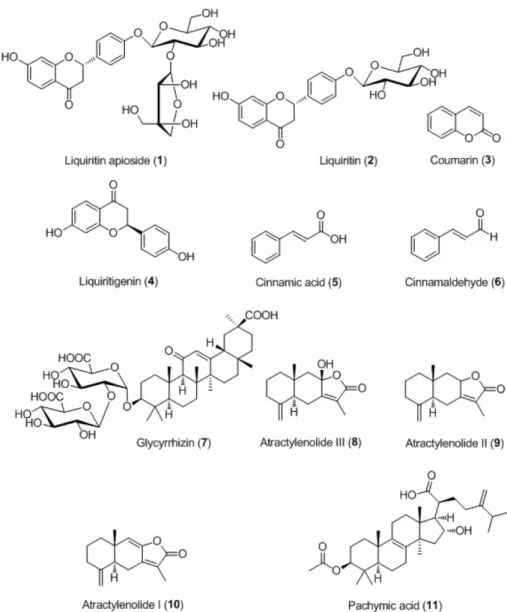
(99.6%), 3 (99.8%), 7 (99.1%), and 11 (98.6%) from Biopurify Phytochemicals (Chengdu, China); compounds 4 and 5 (both 99.0%) from Sigma-Aldrich (St Louis, MO, USA); compound 6 (98.0%) from Wako Chemicals (Osaka, Japan); and compounds 8 – 10 (all 99.0%) from KOC Biotec (Daejeon, Korea). The chemical structures of the eleven bioactive compounds subjected to qualitative and quantitative analysis are shown in Fig. 1. The methanol, acetonitrile, and water used in the study were all HPLC- grade products purchased from J.T. Baker (Phillipsburg, NJ, USA). The formic acid (analytical reagent-grade) was purchased from Sigma-Aldrich (St. Louis, MO, USA).
Apparatus – The Waters ACQUITY UPLC system (Milford, MA, USA), which is equipped with a pump, degasser, column oven, and auto-sampler, was used to
conduct the qualitative and quantitative analysis of the eleven bioactive compounds in a lyophilized YGCGT decoction. Advisable chromatographic separation of the eleven bioactive compounds was performed on an ACQUITY UPLC BEH C
18column (2.1 × 100 mm, 1.7 μm). Sensitive and accurate MS data were obtained using the Waters ACQUITY TQD MS system (Milford, MA, USA) coupled with an electrospray ionization (ESI) source in a negative or positive ion mode. The collected and measured data were processed using Waters Mass- Lynx software (version 4.1, Milford, MA, USA).
Preparation of standard solutions – Individual standard stock solutions of the certified eleven reference standard compounds were prepared at a concentration of 1.0 mg/
mL using methanol and kept at 4
oC until analysis.
Fig. 1. Chemical structures of the compounds 1 – 11 in Yeonggyechulgam-tang.
86 Natural Product Sciences
Preparation of YGCGT water extract and quality control sample – The YGCGT water extract is composed of four crude herbal medicines as listed in Table 1 (total weight = 5.0 kg, approximately 222 times the amount of a single dose). In other words, four raw materials, 1,667 g of Poria Sclerotium, 1,250 g of Cinnamomi Ramulus, 1,250 g of Atractylodis Rhizoma Alba, and 833 g of Glycyrrhizae Radix et Rhizoma were mixed and extracted in a ten-fold mass of water, then boiled for 2 h at 100
oC under pressure (98 kPa) using an electric extractor (COSMOS-660; Kyungseo Machine Co., Incheon, Korea).
The extracted water solution was filtered using a standard sieve (no. 270, 53 μm, 203 φ; Chung Gye Sang Gong Sa, Seoul, Korea); then the filtrates were freeze-dried to obtain a powdered YGCGT extract using a PVT100 freeze-drier (IlShinBioBase, Yangju, Korea). The amount of lyophilized YGCGT extract was 636.5 g (12.7%). For the analysis of the eleven bioactive components using a LC–MS/MS, 34.0 mg of the freeze-dried YGCGT sample was dissolved in 5 mL of 70% methanol by sonication for 5 min; and then the sample solution was diluted 100-fold and filtered through a 0.22 μm membrane filter before qualitative and quantitative analysis using the LC–MS/
MS system.
LC–MS/MS conditions – The mobile phase for the efficient separation of analytes consisting of 0.1% (v/v) formic acid in water (A) and acetonitrile (B) was flowed with gradient elution at a flow rate of 0.3 mL/min. The gradient system of mobile phase was as follows: 20 – 95%
B for 0 – 14 min, 95 – 100% B for 14 – 15 min, 100 – 20%
B for 15 – 15.1 min, and 20% B for 15.1 – 18.1 min. The MS conditions were as follows: capillary voltage 3.3 kV, extractor voltage 3.0 V, RF lens voltage 0.3 V, source temperature 120
oC, de-solvation temperature 300
oC, de- solvation gas 600 L/h, cone gas 50 L/h and collision gas 0.14 mL/min.
Calibration curves, limits of detection (LOD), and quantification (LOQ) – Each calibration curve was carried out using the standard mixtures of analytes at the tested concentration levels (10, 50, 100, and 500 ng/mL) and drawn by plotting the peak areas (y) versus the corres- ponding concentrations (x, ng/mL) using standard solutions.
The LOD and LOQ were determined at signal-to-noise (S/N) ratios of approximately 3 and 10, respectively.
Table 1. Composition of Yeonggyechulgam-tang
Herbal medicine Scientific name Origin Amount (g)
Poria Sclerotium Poria cocos Wolf Pyeongchang, Korea 7.500
Cinnamomi Ramulus Cinnamomum cassia Presl Vietnam 5.625
Atractylodis Rhizoma Alba Atractylodes macrocephala Koidzumi China 5.625
Glycyrrhizae Radix et Rhizoma Glycyrrhiza uralensis Fischer China 3.750
Total amount 22.500
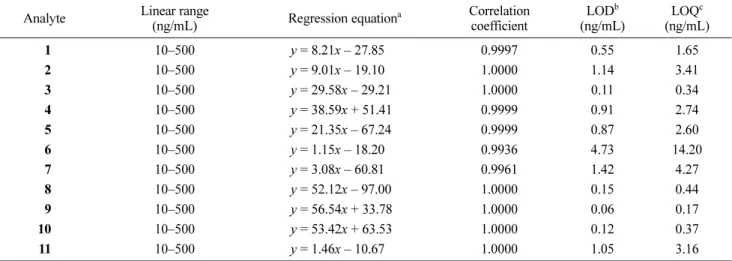
Table 2. Linearities, regression equation, correlation coefficients, LOD, and LOQ for the compounds 1 – 11
Analyte Linear range
(ng/mL) Regression equationa Correlation
coefficient
LODb (ng/mL)
LOQc (ng/mL)
1 10–500 y = 8.21x – 27.85 0.9997 0.55 1.65
2 10–500 y = 9.01x – 19.10 1.0000 1.14 3.41
3 10–500 y = 29.58x – 29.21 1.0000 0.11 0.34
4 10–500 y = 38.59x + 51.41 0.9999 0.91 2.74
5 10–500 y = 21.35x – 67.24 0.9999 0.87 2.60
6 10–500 y = 1.15x – 18.20 0.9936 4.73 14.20
7 10–500 y = 3.08x – 60.81 0.9961 1.42 4.27
8 10–500 y = 52.12x – 97.00 1.0000 0.15 0.44
9 10–500 y = 56.54x + 33.78 1.0000 0.06 0.17
10 10–500 y = 53.42x + 63.53 1.0000 0.12 0.37
11 10–500 y = 1.46x – 10.67 1.0000 1.05 3.16
ay: peak area of compounds; x: concentration (ng/mL) of compounds.
bLOD = 3× signal-to-noise ratio.
cLOQ = 10× signal-to-noise ratio.
Results and Discussion
Calibration curve, LOD, and LOQ – As shown in Table 2, the calibration curve drawn in this condition showde good linearity with the correlation coefficient (r
2)
≥ 0.9936 at the tested concentration range levels. The LOD and LOQ values of all the analytes were in the ranges of 0.01 – 4.53 ng/mL and 0.03 – 13.60 ng/mL, respectively, suggesting that this method is sufficiently sensitive for quantitatively analyzing the eleven bioactive components of the YGCGT sample.
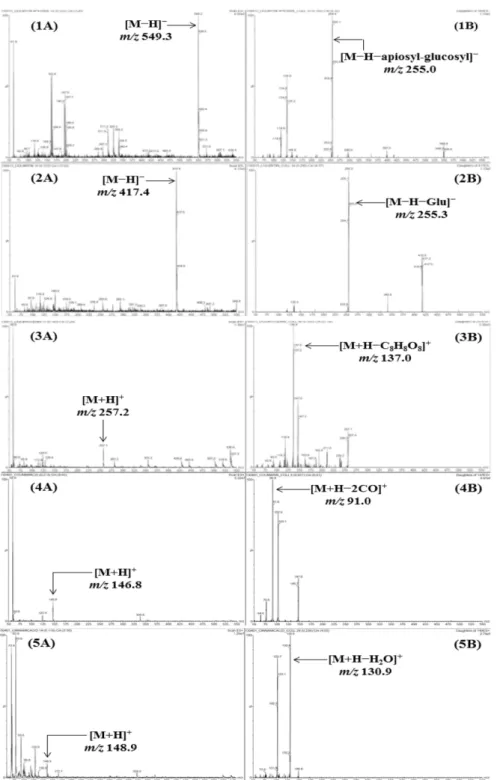
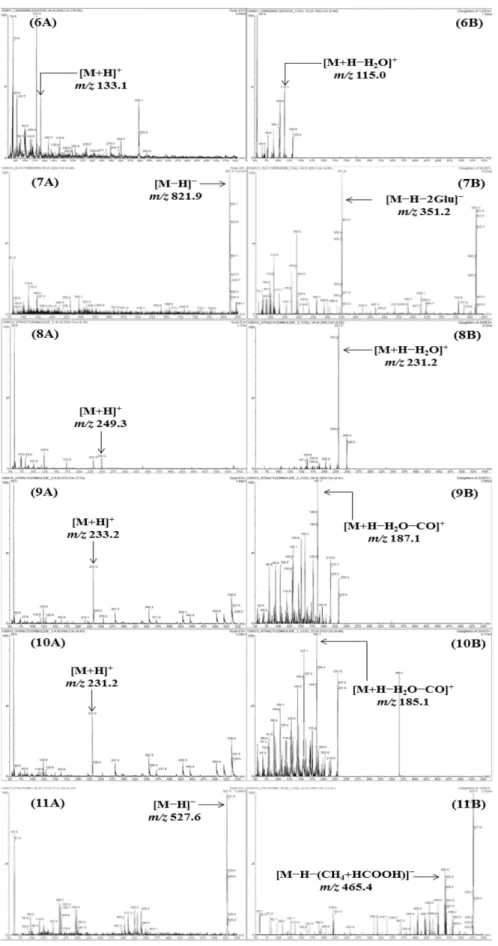
Identification of the compounds 1 – 13 – The LC- ESI-MS/MS analysis of the eleven bioactive components was conducted in both the negative and positive ion modes. The results showed that compounds 1, 2, 7, and 11 were detected in the negative ion mode ([M–H]
–) at m/
z 549.3, 417.4, 821.9, and 527.6, respectively, whereas
compounds 3 – 6 and 8 – 10 were detected in the positive ion mode ([M+H]
+) at m/z 257.2, 147.1, 149.1, 133.1, 249.3, 233.3, and 231.2, respectively (Table 3 and Fig. 2).
The LC-MS/MS multiple reaction monitoring (MRM) mode conditions, such as the precursor ion (Q1), product ion (Q3), cone voltage, and collision energy were used for the quantitative analysis, as shown in Table 3 and Fig. 2.
Compound 1 was detected at m/z 549.3 (Q1) as [M–H]
–], this ion was formed by loss of the apiosy-glucosyl function group from Q1.
11Compounds 2 and 7 were detected at m/z 255.2 [M–H–Glc]
–and 351.2 [M–H–
2Glc]
–, respectively, by eliminating one glucose and two glucose groups, respectively, from each Q1.
12The Q3 peaks of compounds 3, 4 and 11 were detected at m/z 137.0 [M+H–C
8H
8O
8]
+, 91.0 [M+H–2CO]
+, and 465.4 [M–H–(CH
4+HCOOH)]
–, respectively, by eliminating the C
8H
8O
8, 2CO, and C
6H
12O
2molecules from each Q1.
12-14Table 3. Mass detection condition of the compounds 1 – 11
Analyte Molecular weight (Da)
Ionization mode
Retention time (min)
Precursor ion (m/z)
Product ion (m/z)
Cone voltage (V)
Collision energy (eV)
1 550.5 [M−H]− 1.53 549.3 255.0 45 30
2 418.4 [M−H]− 1.65 417.4 255.2 30 15
3 256.3 [M+H]+ 2.99 257.2 137.0 35 25
4 146.1 [M+H]+ 3.06 147.1 91.0 30 20
5 148.1 [M+H]+ 3.74 148.9 130.9 20 20
6 132.1 [M+H]+ 4.42 133.1 115.0 25 15
7 822.9 [M−H]− 5.25 821.9 351.2 45 40
8 248.3 [M+H]+ 6.73 249.3 231.2 25 10
9 248.3 [M+H]+ 8.26 233.2 187.1 35 15
10 230.3 [M+H]+ 9.34 231.2 185.1 35 20
11 528.8 [M−H]− 11.97 527.6 465.4 45 35
Table 4. Amounts of the compounds 1 – 11 in lyophilized Yeonggyechulgam-tang extract (n = 3)
Compound Amount (mg/g)
Source
Mean SD RSD (%)
1 81.58 1.28 1.56 G. uralensis
2 79.88 0.31 0.39 G. uralensis
3 8.96 0.27 3.02 G. uralensis
4 54.52 1.45 2.65 C. cassia
5 10.18 0.25 2.50 C. cassia
6 121.09 1.11 0.92 C. cassia
7 166.43 11.17 6.71 G. uralensis
8 2.47 0.04 1.58 A. macrocephala
9 0.88 0.03 2.94 A. macrocephala
10 0.13 0.01 4.44 A. macrocephala
11 N.D.a – – P. cocos
aN.D. means not detected.
88 Natural Product Sciences
The MS fragmentations of compounds 5, 6 and 8 were detected at m/z 130.9 [M+H–H
2O]
+, 115.0 [M+H–H
2O]
+, and 231.2 [M+H–H
2O]
+, with the loss of all one H
2O molecules from the Q1 [M+H]
+at m/z 148.9, 133.1, and 249.3.
15-17The Q3 peaks of compounds 9 and 10 were detected at m/z 187.1 and 185.1, respectively by eliminating
both one H
2O and one CO molecule from each Q1 peak.
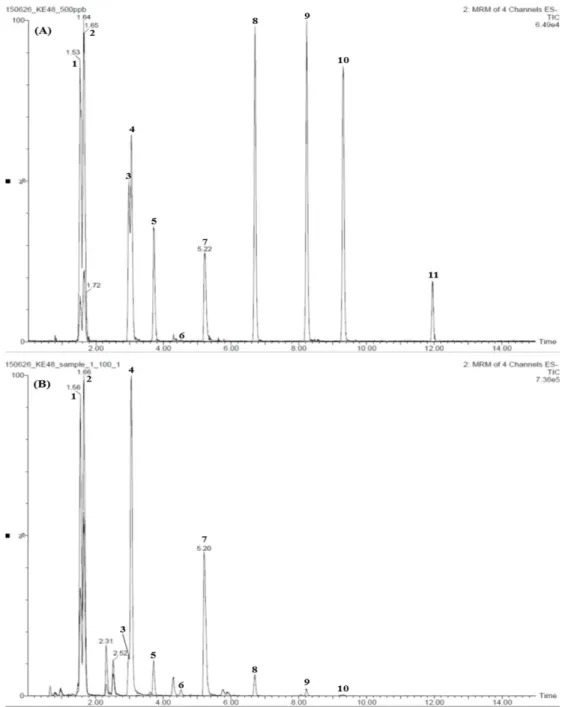
17Quantitative analysis of eleven bioactive compounds in lyophilized YGCGT – The established LC–MS/MS MRM method was applied in the quantitative analysis of the eleven bioactive components in the lyophilized YGCGT decoction (Fig. 3). The amounts of compounds 1 – 11 were
Fig. 2. Mass spectra of the precursor ion (Q1, A) and product ion (Q3, B) for LC-MS/MS MRM mode of the compounds 1 – 11.
Liquiritin apioside (1), liquiritin (2), liquiritigene (3), coumarin (4), cinnamic acid (5), cinnamaldehyde (6), glycyrrhizin (7), atractylenolide III (8), atractylenolide II (9), atractylenolide I (10), and pachymic acid (11).
Table 2. continued.
90 Natural Product Sciences
observed up to 166.43 mg/g (Table 4). Among these com- ponents, compound 7, the main component of G. uralensis, was observed to be the most abundant compound in the YGCGT decoction at 166.43 mg/g. However, compound 11, a marker compound of P. cocos, was not detected in this method. These results are summarized in Table 4.
In conclusion, this study presents a more sensitive and selective LC–MS/MS MRM method of qualitative and quantitative analysis of the eleven bioactive constituents
of the traditional herbal medicine, YGCGT. This newly established method is expected to serve as the basis for assessing the quality of YGCGT extract or other related herbal medicines.
Acknowledgments
This research was supported by a grant (no. K16251) from the Korea Institute of Oriental Medicine.
Fig. 3. Total ion chromatograms of the reference standard (A) and lyophilized Yeonggyechulgam-tang extract (B) by LC-MS/MS MRM mode. Liquiritin apioside (1), liquiritin (2), liquiritigene (3), coumarin (4), cinnamic acid (5), cinnamaldehyde (6), glycyrrhizin (7), atractylenolide III (8), atractylenolide II (9), atractylenolide I (10), and pachymic acid (11, not detected).
References
(1) Zhang, J.; Qian, C. C.; Hao, W. S.; Shang Han Lun; People’s Medical Publishing House: Beijing, 2005; p 41-42.
(2) Heo, J.; Dongeuibogam; Namsandang: Seoul, 2004; p 128.
(3) Xi, F.; Sang, F.; Zhou, C.; Ling, Y. Neural Regener. Res. 2012, 7, 2867-2873.
(4) Yuanyuan, W.; Minghua, J.; Lina, Z.; Suhua, L.; Jiayu, Z.; Yongzhi, S.; Chunyu, C.; Jian, Q. J. Tradit. Chin. Med. 2015, 35, 218-221.
(5) Fu, S.; Zhang, J.; Gao, X.; Xia, Y.; Ferrelli, R.; Fauci, A.; Guerra, R.; Hu, L. Heart Asia 2010, 2, 24-27.
(6) Huang, J.; Wang, L.; Shi, H.; Hou, X. J. Tradit. Chin. Med. 2013, 33, 343-348.
(7) Kim, T. H.; Yang, K. S.; Park, S. A. Kor. J. Pharmacogn. 1999, 30, 12-17.
(8) Park, S. A; Kim, T. H.; Yang, K. S. Kor. J. Pharmacogn. 2000, 31, 364-372.
(9) Kim, S. H.; The guideline on the visual and organoleptic examination of herbal medicine II; National Institute of Food and Drug Safety Evaluation: Seoul, 2007; p 19.
(10) Moon, C. J.; The guideline on the visual and organoleptic examination of herbal medicine I; Ministry of Food and Drug Safety:
Seoul, 2006; p 17, 52, 54.
(11) Li, L.; Liang, S.; Du, F; Li, C. J. Am. Soc. Mass Spectrom. 2007, 18, 778-782.
(12) Tan, G.; Zhu, Z.; Jing, J.; Lv, L.; Lou, Z.; Zhang, G.; Chai, Y.
Biomed. Chromagogr. 2011, 25, 913-924.
(13) Concannon, S.; Ramachandran, V. N.; Smyth, W. F. Rapid Commun. Mass Spectrom. 2000, 14, 1157-1166.
(14) Wu, L. F.; Wang, K. F.; Mao, X.; Liang, W. Y.; Chen, W. J.; Li, S.;
Qi, Q.; Cui, Y. P.; Zhang, L. Z. Molecules 2016, 21, 227, doi:10.3390/
molecules21020227.
(15) Gardana, C.; Scaglianti, M.; Pietta, P.; Simonetti, P. J. Pharm.
Biomed. Anal. 2007, 45, 390-399.
(16) Flamini, R.; Vedova, A. D,; Cancian, D.; Panighel, A.; De Rosso, M. J. Mass Spectrom. 2007, 42, 641-646.
(17) Chen, L.; Qi, J.; Chang, Y.; Zhu, D.; Yu, B. J. Pharm. Biomed.
Anal. 2009, 50, 127-137.
Received November 25, 2016 Revised January 19, 2017 Accepted January 23, 2017