48(4) : 320∼ 328 (2017)
320
LC-ESI-MS/MS 를 이용한 용담사간탕의 주요 성분 분석
서창섭 · 하혜경*
한국한의학연구원 K-herb연구단
Quantitative Analysis of the Marker Constituents in Yongdamsagan-Tang using Liquid Chromatography-Electrospray Ionization-Tandem Mass
Spectrometry
Chang-Seob Seo and Hyekyung Ha*
K-herb Research Center, Korea Institute of Oriental Medicine, 1672 Yuseong-daero, Yuseong-gu, Daejeon 34054, Korea
Abstract – Yongdamsagan-tang has been used to treat the urinary disorders, acute- and chronic-urethritis, and cystitis in Korea.
In this study, an ultra–performance liquid chromatography–electrospray ionization-mass spectrometry (UPLC-ESI-MS/MS) method was established for simultaneous analysis of the 20 bioactive marker compounds, geniposidic acid, chlorogenic acid, geniposide, liquiritin apioside, acteoside, calceolarioside B, liquiritin, nodakenin, baicalin, liquiritigenin, wogonoside, baicalein, glycyrrhizin, wogonin, glycyrrhizin, wogonin, saikosaponin A, decursin, decursinol angelate, alisol B, alisol B acetate, and pachy- mic acid in traditional herbal formula, Yongdamsagan-tang. Chromatographic separations of all marker compounds were con- ducted using a Waters Acquity UPLC BEH C18 analytical column (2.1 × 100 mm, 1.7 µm) at 45°C using a mobile phase of 0.1%
(v/v) formic acid in water and acetonitrile with gradient elution. The MS analysis was performed using a Waters ACQUITY TQD LC-MS/MS coupled with an electrospray ionization source in the positive and negative modes. The flow rate was 0.3 mL/min and injection volume was 2.0 µL. The correlation coefficient of 20 marker compounds in the test ranges was 0.9943–1.0000.
The limits of detection and quantification values of the all marker components were 0.11–6.66 and 0.34–19.99 ng/mL, respec- tively. As a result of the analysis using the optimized LC-ESI-MS/MS method, three compounds, geniposidic acid (from Plan- taginis Semen), alisol B (from Alismatis Rhizoma), and pachymic acid (from Poria Sclerotium), were not detected in this sample. While the amounts of the 17 compounds except for the geniposidic acid, alisol B, and pachymic acid were 0.04–548.13 µg/g in Yongdamsagan-tang sample. Among these compounds, baicalin, bioactive marker compound of Scutellariae Radix, was detected at the highest amount as a 548.13 µg/g.
Keywords – Yongdamsagan-tang, Quantitative analysis, LC-MS/MS
용담사간탕(龍膽瀉肝湯)은 金·元代 李東垣의 『東垣十書 –蘭室秘臧』1 )에 처음으로 기재된 처방으로 瀉肝膽實火 淸下 焦濕熱하는 효능이 알려져 있으며, 용담(龍膽, Gentianae Scabrae Radix et Rhizoma), 시호(柴胡, Bupleuri Radix), 택 사(澤瀉, Alismatis Rhizoma), 목통(木通, Akebiae Caulis), 차전자(車前子, Plantaginis Semen), 적복령(赤茯苓, Poria Sclerotium), 생지황(生地黃, Rehmanniae Radix), 당귀(當歸, Angelicae Gigantis Radix), 치자(梔子, Gardeniae Fructus), 황금(黃芩, Scutellariae Radix) 및 감초(甘草, Glycyrrhizae Radix et Rhizoma) 등 11종의 생약으로 구성되어 있다. 이
후 우리나라에서도 許浚의 『東醫寶鑑』2 )에 간장(肝藏)의 습열(濕熱)로 인하여 남자(男子)는 음정(陰挺)이 종창(腫脹) 하고 부인(婦人)은 음정(陰挺)이 창양(瘡瘍)한 증상과 혹은 남자의 음경(陰莖)이 습양(濕瘍)하여 농수(膿水)가 나오는 증 상을 치료하는데 사용된다고 기록되어 있다. 본 처방의 현 대과학적 생리활성 연구로는 estradiol valerate로 유발된 흰 쥐의 다낭성 난소 발달과 수태에 미치는 영향,2)간암 세포 주인 HepG2에서의 세포사멸 효과3) 및 항염증, 항산화, 간 보호 및 항간염바이러스 효과4) 등이 보고되었다. 또한 용담 사간탕 투여로 호전된 대상포진 환자의 임상 증례 보고5,6) 및 화농성 슬관절염 환자의 임상 증례 보고7) 등이 보고되 었다. 이에 저자들은 본 연구에서 비뇨기과 질환에 주로 처
*교신저자(E-mail):[email protected] (Tel): 042-868-9513
방되는 용담사간탕을 선정하여 처방에 함유된 주요 성분들의 함량을 분석하고자 하였다. 따라서 본 처방을 구성하는 구성 생약의 성분에 관한 연구는 용담의 gentiopicroside 및 sweroside 등과 같은 secoiridoid glycosides,8) 시호의 saikosapinin A, C 및 D 등과 같은 oleanane계 saponin,9)택사의 aliso B 및 alisol B acetate 등과 같은 triterpenoids,10)목통의 chlorogenic acid와 calceolarisoide B 등과 같은 pheylpropanoid,11,12)차 전자의 acteoside와 geniposide 등과 같은 pheylpropanoid와 iridoid,13,14) 복령의 pachymic acid와 dehydropachymic acid 등과 같은 triterpenoids,15) 생지황의 aucubin과 catalpol 등과 같은 iridoid glycosides,16) 당귀의 nodakenin, decursin 및 decursinol angelate 등과 같은 coumarins,17) 치자의 geniposide와 gardenoside 등과 같은 iridoids,18) 황금의 baicalin과 baicalein 등 과 같은 flavonoids19)및 감초의 glycyrrhizin, liquiritin 및 liquiritin apioside 등과 같은 triterpene saponin과 flavonoids20)) 등이 분리 보고 되었다. 이들 성분들 중 본 연구에서는 용담사간 탕을 구성하는 생약들의 성분 중 본 연구에서는 시호의 saikosapinin A, 택사의 aliso B와 alisol B acetate, 목통의 chlorogenic acid와 calceolarisoide B, 차전자의 acteoside, geniposide 및 geniposidic acid, 복령의 pachymic acid, 당귀의 nodakenin, decursin 및 decursinol angelate, 치자의 geniposide, 황금의 baicalin, baicalein, wogonoside 및 wogonin 및 감초의 glycyrrhizin, liquiritin, liquiritin apioside 및 liquiritigenin 등 20종에 대하여 질량분석기가 결합된 초고성능 액체크로 마토그래피(ultra–performance liquid chromatography–mass spectrometer; UPLC–MS)를 이용하여 이들 성분의 함량 분 석을 실시하였다.
재료 및 방법
실험재료 – 용담사간탕을 구성하는 11종의 한약재는 광명
당제약(Ulsan, Korea)에서 규격품을 구입하여 본초학 전공 인 동국대학교 한의과대학 이제현 교수(Gyeongju, Korea)와 대전대학교 한의과대학 서영배 교수(Daejeon, Korea)로부터 한약재 관능검사 해설서21)에 따라 감정 후 사용하였다(Table I). 본 처방을 이루는 구성 한약재(2012–KE49–1∼2012–
KE49–11)와 용담사간탕 추출물(2012–KE49)의 표본은 한국 한의학연구원 K-herb연구단에 보관하였다.
시약 및 기기 – 용담사간탕 물 추출물로부터 주요 성분의 함량 분석을 위해 사용된 표준품으로 alisol B, alisol B acetate, geniposide, geniposidic acid, liquiritin, baicalin, glycyrrhizin, saikosaponin A, wogonin은 Wako Chemicals (Osaka, Japan), acteoside와 pachymic acid는 Biopurify Phytochemicals(Chengdu, China), calceolarioside B와 liquiritigenin 은 ChemFaces(Wuhan, China) 및 nodakenin, decursin 및 decursinol angelate는 NPC Bio Technology(Yeongi, Korea) 에서 구입하였으며, chlorogenic acid, liquiritin apioside, baicalein 및 wogonoside는 Acros Organics(Pittsburgh, PA, USA), Shanghai Sunny Biotech(Shanghai, China), Sigma- Aldrich(St. Louis, MO, USA) 및 Tauto Biotech(Shanghai, China)로부터 각각 구입하였다(Fig. 1). 이들 성분들의 순도는 모두 98.0%이상이었다. 성분 분석을 위해 사용된 메탄올, 아세토나이트릴 및 물은 HPLC용으로 J.T. Baker(Phillipsburg, NJ, USA)에서 구입하였으며, 개미산은 Sigma-Aldrich(St.
Louis, MO, USA)에서 구입하여 사용하였다.
용담사간탕 물 추출은 경서기계산업의 초고속진공저온농 축추출기(COSMOS660, Incheon, Korea)를 사용하였으며, 주요 성분의 함량 분석은 Waters의 ACQUITY UPLC system (Milford, MA, USA)을 사용하였다. 질량분석기는 전자분무 이온화(electrospray ionization; ESI) source가 장착된 탠덤 사중극자 질량분석기(ACQUITY TQD LC-MS/MS, Waters, Milford, MA, USA)를 사용하였다. 모든 데이터의 수집과 Table I. Composition of Yongdamsagan-tang
Scientific name Family Parts of using Origin Amount (g)
Gentiana scabra Bunge Gentianaceae Root and Rhizome China 3.750
Bupleurum falcatum Linne Umbelliferae Root Gurye, Korea 3.750
Alisma orientale Juzepczuk Alismataceae Rhizome Yeongcheon, Korea 3.750
Akebia quinata Decaisne Lardizabalaceae Stem Yeongcheon, Korea 1.875
Plantago asiatica Linne Plantaginaceae Seed China 1.875
Poria cocos Wolf Polyporaceae Sclerotium Pyeongchang, Korea 1.875
Rehmannia glutinosa (Gaertner) Liboschitz ex Steudel Scrophulariaceae Root Gunwi, Korea 1.875
Angelica gigas Nakai Umbelliferae Root Bonghwa, Korea 1.875
Gardenia jasminoides Ellis Rubiaceae Fruit Gurye, Korea 1.875
Scutellaria baicalensis Georgi Labiatae Root Gurye, Korea 1.875
Glycyrrhiza uralensis Fischer Leguminosae Root and Rhizome China 1.875
Total amount 26.250
처리는 Waters MassLynx software(version 4.1, Milford, MA, USA)를 사용하였다.
용담사간탕 물 추출물 조제 – 11종의 생약으로 구성된 용 담사간탕의 물 추출물을 조제하기 위해 Table I과 같은 무 게 비율로 배합하여 총 시료 5.0 kg(1첩 26.25 g × 190.5배)을 넣은 후 물을 10배수인 50 L를 첨가하였다. 혼합된 시료를 초고속진공저온추출기(Cosmos 660, Kyungseo Machine Co., Incheon, Korea)를 이용하여 98 kPa 압력으로 100oC에서 2시간 전탕한 후 표준체(No. 270, 53 μm, Chung Gye Sang Gong Sa, Seoul, Korea)를 이용하여 여과하였다. 여과액은 동결건 조기(PVTFD100, IlShinBioBase, Yanju, Korea)를 사용하여 동결건조하여 926.4 g (18.5%)의 건조된 물 추출물을 얻었다.
표준액 및 검액의 조제 – Geniposidic acid를 비롯한 20종 의 표준품을 각각 메탄올에 1,000 μg/mL의 농도로 녹인 후 냉장 보관한 후 분석 전에 희석하여 사용하였다. LC-MS/
MS를 이용하여 용담사간탕의 주요 성분을 분석하기 위하여
조제된 용담사간탕 물 추출물 38.3 mg을 정확히 취한 후 70% 메탄올을 5 mL을 넣은 후 5분간 초음파 추출 후 1분 간 vortexing 하였다. 그 후 0.1 mL을 정확히 취한 후 70%
메탄올을 넣어 10 mL로 100배 희석한 후 0.22 μm 멤브레인 필터하여 검액으로 하였다.
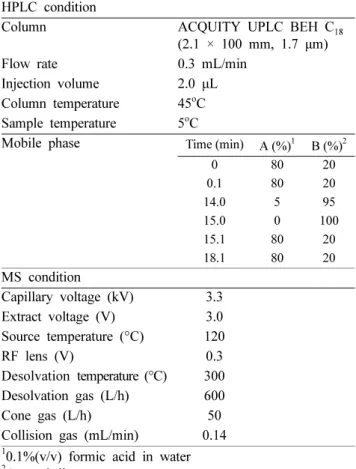
UPLC 및 LC-MS/MS 분석 조건 – 용담사간탕 물 추출 물에서 geniposidic acid를 비롯한 20종의 함량 분석을 위해 Table II와 Table III의 조건으로 분석하였다. 20종 성분의 정 Fig. 1. Chemical structures of biomarker compounds of Yongdamsagan-tang.
량은 다중반응탐색법(multiple reaction monitoring, MRM) 으로 실시하였다.
결과 및 고찰
LC-MS/MS 분석조건 확립 – 용담사간탕의 구성 생약 중 시호의 saikosapinin A, 택사의 aliso B와 alisol B acetate, 목통의 chlorogenic acid와 calceolarisoide B, 차전자의 acteoside, geniposide 및 geniposidic acid, 복령의 pachymic acid, 당귀의 nodakenin, decursin 및 decursinol angelate, 치 자의 geniposide, 황금의 baicalin, baicalein, wogonoside 및 wogonin 및 감초의 glycyrrhizin, liquiritin, liquiritin apioside 및 liquiritigenin 등 20종에 대하여 LC-MS/MS MRM 분석 법을 이용하여 동시 정량을 실시하였다. 모든 성분 UPLC BEH C18(2.1 × 100 mm, 1.7 μm) 분석용 칼럼을 사용하여 분리하였다. 이동상으로는 물과 메탄올 및 아세토나이트릴 과 산의 첨가 여부를 확인하여 최적의 분석 조건을 탐색하 였으며, 그 결과 0.1%(v/v) 개미산이 각각 함유된 물-아세토 나이트릴을 이용하여 기울기 용매조건으로 정량 분석을 실 시하였다. 45oC의 칼럼온도와 0.3 mL/min의 유속으로 최적 화된 이동상을 이용하여 ESI 방법의 양이온 모드와 음이온 모드에서 Table II와 III의 조건으로 MRM 분석을 실시한 결과 모든 성분이 15분 이내로 분리되었다.
검량선, 검출한계 및 정량한계 작성 – Geniposidic acid를 Table II. Conditions for LC-MS/MS analysis of Yongdamsagan-tang
HPLC condition
Column ACQUITY UPLC BEH C18
(2.1 × 100 mm, 1.7 µm)
Flow rate 0.3 mL/min
Injection volume 2.0 µL Column temperature 45oC Sample temperature 5oC
Mobile phase
Time (min) A (%)
1B (%)
20 80 20
0.1 80 20
14.0 5 95
15.0 0 100
15.1 80 20
18.1 80 20
MS condition
Capillary voltage (kV) 3.3 Extract voltage (V) 3.0 Source temperature (°C) 120
RF lens (V) 0.3
Desolvation temperature (°C) 300 Desolvation gas (L/h) 600
Cone gas (L/h) 50
Collision gas (mL/min) 0.14
10.1%(v/v) formic acid in water
2Acetonitrile
Table III. Linearities, regression equation, correlation coefficients, LOD, and LOQ for marker compounds
Compound Linear range (ng/mL) Regression equation Correlation coefficient LOD (ng/mL) LOQ (ng/mL)
Geniposidic acid 0 − 500 y = 1.08x − 16.78 0.9953 3.49 10.48
Chlorogenic acid 0 − 500 y = 2.06x − 27.62 0.9943 1.50 4.50
Geniposide 0 − 500 y = 0.24x − 2.69 0.9961 6.66 19.99
Liquiritin apioside 0 − 500 y = 7.87x − 25.18 0.9997 0.55 1.65
Acteoside 0 − 500 y = 4.81x − 33.99 0.9987 2.18 6.55
Calceolarioside B 0 − 500 y = 3.95x − 12.72 0.9994 1.43 4.28
Liquiritin 0 − 500 y = 8.95x − 6.62 0.9995 1.14 3.41
Nodakenin 0 − 500 y = 21.41x − 137.19 0.9993 0.21 0.64
Baicalin 0 − 500 y = 13.71x − 192.14 0.9956 2.00 6.00
Liquiritigenin 0 − 500 y = 26.98x − 92.39 0.9996 0.11 0.34
Wogonoside 0 − 500 y = 75.43x − 36.21 0.9999 1.50 4.50
Baicalein 0 − 500 y = 1.78x + 42.37 0.9796 1.00 3.00
Glycyrrhizin 0 − 500 y = 3.46x − 31.98 0.9982 1.42 4.27
Wogonin 0 − 500 y = 105.76x + 21.44 0.9999 1.50 4.50
Saikosaponin A 0 − 500 y = 7.15x − 14.71 0.9998 0.49 1.46
Decursin 0 − 500 y = 222.99x + 206.64 1.0000 0.38 1.13
Decursinol angelate 0 − 500 y = 80.80x + 66.10 0.9999 0.96 2.89
Alisol B 0 − 500 y = 5.25x + 24.48 0.9970 0.32 0.97
Alisol B acetate 0 − 500 y = 7.67x − 27.60 0.9989 0.37 1.10
Pachymic acid 0 − 500 y = 1.52x − 6.98 0.9972 1.05 3.16
비롯한 20종의 성분에 대한 검량선은 0, 10, 50, 100 및 500 ng/mL의 농도 범위에서 농도에 따른 피크 면적을 이용하여 작성하였으며, 작성된 검량선의 상관계수(r2)를 구하여 직선 성을 판단하였다. 또한 검출한계(limit of detection, LOD)와 정량한계(limit of quantification, LOQ)는 신호 대 잡음 비 로 3과 10으로 각각 계산하였다. 20종 성분에 대한 검량선 작성 결과 각 성분의 직선성을 나타내는 r2 값이 0.9943–
1.0000으로 우수한 직선성을 나타내었으며, LOD와 LOQ 값 은 0.11–6.66 ng/mL와 0.34–19.99 ng/mL로 각각 나타났다 (Table III).
용담사간탕 물 추출물 중 주요성분의 동정 및 함량분석 – LC-MS/MS를 이용하여 11종의 생약으로 구성된 용담사간 탕 중 주요 성분의 함량 분석을 위해 0.1% 개미산이 함유 된 물-아세토나이트릴의 이동상 시스템으로 지표 성분으로 선정된 20종의 성분에 대한 분자 이온을 동정하였다. 그 결과 geniposidic acid, chlorogenic acid, geniposide, liquiritin apioside, acteoside, calceolarioside B, liquiritin, glycyrrhizin, saikosaponin A 및 pachymic acid 등 10종은 m/z 373.2, 353.2, 387.2, 549.3, 623.4, 477.3, 417.4, 821.9, 779.7 및 527.6에서 [M−H]− 형태의 분자 이온 피크를 확인하였으며, nodakenin, baicalin, liquiritigenin, wogonoside, baicalein, wogonin, decursin, decursinol angelate, alisol B 및 alisol B acetate 등 10종의
성분은 m/z 409.4, 447.3, 257.2, 461.3, 271.1, 285.1, 329.2, 329.2, 473.6 및 515.6에서 [M+H]+ 형태의 분자 이온 피크를 각각 확인하였다(Table IV). 또한 LC-MS/MS를 이용하여 음이온 및 양이온 모드에서 동정 된 지표 성분들에 대한 함 량을 분석하기 위하여 Table IV와 같이 각각의 성분에 대 한 precursor ion(Q1)과 product ion(Q3)을 설정하였으며, 각 성분의 MRM 분석 조건은 다음과 같다. Geniposidic acid는 m/z 373.2(Q1)에서 glucose 1분자와 H2O 1분자가 떨어져 나간 [M−H−Glu]− 형태의 m/z 193.05에서 Retro-Diels- Alder 반응에 의해 생성된 m/z 123.0으로 Q3를 설정하였으 며22), chlorogenic acid는 m/z 353.2(Q1)에서 caffeoyl기가 떨어져 나간 [M−H−caffeoyl]− 형태로 m/z 191.0으로 Q3를 설정하였다.23) Geniposide는 m/z 387.2의 Q1에서 C10H16O8 이 떨어진 [M–H−C10H16O8]− 형태인 m/z 123.0을 Q3로 설 정하였다.24) Liquiritin apioside는 m/z 549.3의 Q1 피크에서 apiosyl-glucosyl 그룹이 떨어져 나간 [M−H−apiosyl-glucosyl]− 형태로 m/z 255.0으로 Q3 피크를 설정하였으며,25) acteoside 와 calceolarioside B는 m/z 623.4와 477.3(Q1)에서 두 성분 모두 [Caffeoyl−H2O]−의 형태인 m/z 161.0을 Q3로 설정하 였다.26,27) Liquiritin, nodakenin 및 saikosaponin A는 m/z 417.4, 409.4 및 779.7에서 각각 확인된 Q1 피크에서 세 성분 모두 glucose 1분자가 떨어진 [M−H−Glu]−, [M+H−Glu]+및 Table IV. Chromatographic retention time, MRM parameters, cone voltage, and collision energy for marker compounds
Compound Mode Retention time
(min)
Molecular weight (Da)
Precursor ion (m/z)
Product ion (m/z)
Cone voltage (V)
Collision energy (eV)
Geniposidic acid [M−H]− 0.79 374.3 373.2 123.0 25 20
Chlorogenic acid [M−H]− 0.80 354.3 353.2 191.0 20 20
Geniposide [M−H]− 1.22 388.4 387.2 123.0 25 15
Liquiritin apioside [M−H]− 1.53 550.5 549.3 255.0 45 30
Acteoside [M−H]− 1.55 624.6 623.4 161.0 45 35
Calceolarioside B [M−H]− 1.62 478.5 477.3 161.0 35 25
Liquiritin [M−H]− 1.65 418.4 417.4 255.2 30 15
Nodakenin [M+H]+ 1.85 408.4 409.4 247.2 30 15
Baicalin [M+H]+ 2.68 446.4 447.3 271.0 25 15
Liquiritigenin [M+H]+ 2.99 256.3 257.2 137.0 35 25
Wogonoside [M+H]+ 3.57 460.4 461.3 285.1 30 20
Baicalein [M+H]+ 4.50 270.2 271.1 123.0 40 30
Glycyrrhizin [M−H]− 5.20 822.9 821.9 351.2 45 40
Wogonin [M+H]+ 5.75 284.3 285.1 270.0 40 20
Saikosaponin A [M−H]− 6.06 781.0 779.7 617.3 45 35
Decursin [M+H]+ 8.04 328.4 329.2 229.0 35 20
Decursinol angelate [M+H]+ 8.15 328.4 329.2 229.0 35 20
Alisol B [M+H]+ 10.57 472.7 473.6 365.4 30 15
Alisol B acetate [M+H]+ 11.6 514.7 515.6 437.5 20 15
Pachymic acid [M−H]− 11.97 528.8 527.6 465.4 45 35
[M−H−Glu]−형태로 m/z 255.2, 247.2 및 617.3으로 Q3를 설정하였으며,27-29) baicalin과 wogonoside는 m/z 447.3과 461.3의 Q1 피크에서 두 성분 모두 1분자의 glucuronide가 이탈된 [M+H−Glucuronide]+ 형태의 Q3 피크가 m/z 271.0과 285.1에서 각각 검출되었다.30) Liquiritigenin은 m/z 257.2(Q1)에 서 C8H8O8이 떨어진 [M+H−C8H8O8]+ 형태인 m/z 137.0을 Q3를 설정하였다.27) Baicalein은 m/z 271.1에서 Q1 피크를 확인하였으며, Q3 피크는 C9H6O2가 이탈된 trihydroxyphenyl 골격의 [M+H−C9H6O2]+ 형태로 m/z 123.0으로 설정하였으 며,31) glycyrrhizin은 Q1피크인 m/z 821.9로부터 glucose 2
분자가 떨어져 나간 aglycon 형태로 [M−H−2Glu]−로 m/z 351.2를 Q3로 설정하였다.27) Wogonin은 m/z 285.1에서 Q1 피크를 확인하였으며, Q1 피크에서 1분자의 methyl group이 이탈된 [M+H−CH3]+ 로 m/z 270.0에서 Q3를 설정하였으며,32) decursin과 decursinol angelate는 m/z 329.2의 Q1으로부터 isoprenyl 골격과 hydroxy group이 떨어진 [M+H−C5H8O2]+ 형태인 m/z 229.0에서 Q3를 설정하였다.33) Aisol B, alisol B acetate 및 pachymic acid는 Q1피크가 m/z 473.6, 515.6 및 527.6에서 각각 나타났으며, 이들로부터 Q3는 m/z 365.4, 437.5 및 465.4인 [M+H–2H2O–C4H8O]+, [M+H–H2O–
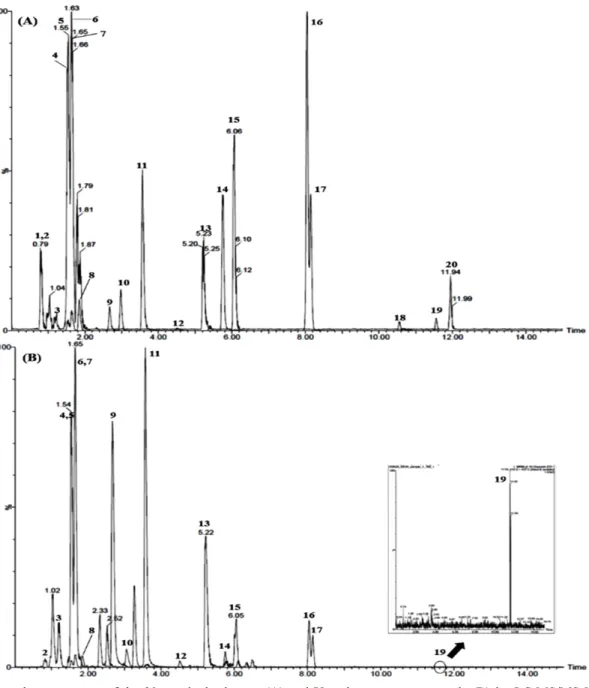
Fig. 2. Total ion chromatograms of the 20 standard mixtures (A) and Yongdamsagan-tang sample (B) by LC-MS/MS MRM mode.
Geniposidic acid (1), chlorogenic acid (2), geniposide (3), liquiritin apioside (4), acteoside (5), calceolarioside B (6), liquiritin (7), nodakenin (8), baicalin (9), liquiritigenin (10), wogonoside (11), baicalein (12), glycyrrhizin (13), wogonin (14), saikosaponin A (15), decursin (16), decursinol angelate (17), alisol B (18), alisol B acetate (19), and pachymic acid (20).
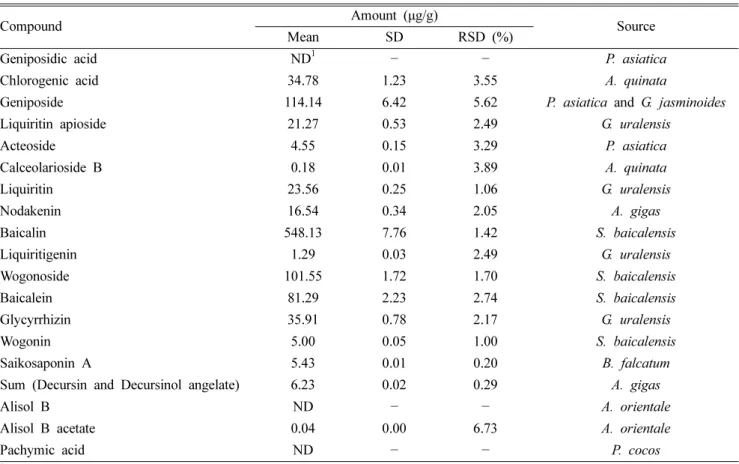
AcOH]+ 및 [M−H–H2O–CO2]−로 설정하였다.34) 이와 같이 본 분석 처방의 지표 성분으로 선정한 20종의 성분에 대하 여 Q1 및 Q3를 설정한 후 이들 성분의 함량 분석을 실시 하였다. 설정된 LC-MS/MS MRM 분석법을 이용하여 주요 성분을 분석한 결과 geniposidic acid, chlorogenic acid, geniposide, liquiritin apioside, acteoside, calceolarioside B, liquiritin, nodakenin, baicalin, liquiritigenin, wogonoside, baicalein, glycyrrhizin, wogonin, glycyrrhizin, wogonin, saikosaponin A, decursin, decursinol angelate, alisol B, alisol B acetate 및 pachymic acid 등 20종의 성분은 0.79, 0.80, 1.22, 1.53, 1.55, 1.62, 1.65, 1.85, 2.68, 2.99, 3.57, 4.50, 5.20, 5.75, 6.06, 8.04, 8.15, 10.57, 11.60 및 11.97분으로 15분 이내에 모든 성분이 분리되었다(Table IV 및 Fig. 2). 설정된 분석 법을 사용하여 용담사간탕 추출물을 분석한 결과 차전자로 부터 유래된 geniposidic acid, 택사로부터 유래된 alisol B 및 복령으로부터 유래된 pachymic acid 등 2종은 검출이 되 지 않았으며, 이를 제외한 17종의 성분은 0.04–548.13 μg/g 으로 나타났다(Table V).
결 론
11종의 생약으로 구성되어 급·만성 요도염과 방광염 등의
비뇨기과 질환에 처방되어지는 한약 처방 중 하나인 용담 사간탕에 대하여 geniposidic acid, chlorogenic acid, geniposide, liquiritin apioside, acteoside, calceolarioside B, liquiritin, nodakenin, baicalin, liquiritigenin, wogonoside, baicalein, glycyrrhizin, wogonin, glycyrrhizin, wogonin, saikosaponin A, decursin, decursinol angelate, alisol B, alisol B acetate 및 pachymic acid 등 20종의 성분에 대하여 LC-MS/MS
MRM 방법으로 함량을 분석하였다. 그 결과 본 한약 처방
추출물인 용담사간탕에서 황금의 주요성분인 baicalin이 548.13 μg/g으로 가장 많이 검출되었으며, geniposide(차전 자와 치자)와 wogonoside와 baicalein(이상 황금)이 114.14, 101.55 및 81.29 μg/g으로 다른 성분에 비해 비교적 많이 함 유되어 있었다. 이러한 분석 결과는 향후 용담사간탕 및 관 련 한약 처방의 성분 분석을 위한 기초 자료로 활용될 수 있을 것으로 사료된다.
사 사
본 연구는 한국한의학연구원에서 지원하는 ‘한약 처방의 과학적 근거 기반 구축사업(K17251)’에 의해 수행되었으며 이에 감사 드린다.
Table V. Amount of marker compounds in Yongdamsagan-tang (n = 3)
Compound Amount (µg/g)
Source
Mean SD RSD (%)
Geniposidic acid ND1 − − P. asiatica
Chlorogenic acid 34.78 1.23 3.55 A. quinata
Geniposide 114.14 6.42 5.62 P. asiatica and G. jasminoides
Liquiritin apioside 21.27 0.53 2.49 G. uralensis
Acteoside 4.55 0.15 3.29 P. asiatica
Calceolarioside B 0.18 0.01 3.89 A. quinata
Liquiritin 23.56 0.25 1.06 G. uralensis
Nodakenin 16.54 0.34 2.05 A. gigas
Baicalin 548.13 7.76 1.42 S. baicalensis
Liquiritigenin 1.29 0.03 2.49 G. uralensis
Wogonoside 101.55 1.72 1.70 S. baicalensis
Baicalein 81.29 2.23 2.74 S. baicalensis
Glycyrrhizin 35.91 0.78 2.17 G. uralensis
Wogonin 5.00 0.05 1.00 S. baicalensis
Saikosaponin A 5.43 0.01 0.20 B. falcatum
Sum (Decursin and Decursinol angelate) 6.23 0.02 0.29 A. gigas
Alisol B ND − − A. orientale
Alisol B acetate 0.04 0.00 6.73 A. orientale
Pachymic acid ND − − P. cocos
1
ND: not detected.
인용문헌
1. Lee, I. J., Lee, D. N., Seo, I. B. and Kim, H. J. (2011) Effects of Yongdamsagan-tang on the progression of the estradiol valerate-induced polycystic ovaries and on the conception in rats. J. Orient. Obstet. Gynecol. 24: 48-72.
2. Heo, J. (2004) Donguibogam, 313. Namsandang, Seoul.
3. Yun, H. J., Kim, H. S., Heo, S. K., Hwang, S. G., Park, W. H.
and Park, S. D. (2007) Effect of Yong-dan-sa-gan-tang on apoptosis in human hepatoma HepG2. Korean J. Orient.
Med. Prescr. 15: 127-137.
4. Qi, F., Wang, Z., Cai, P., Zhao, L., Gao, J., Kokudo, N., Li, A., Han, J. and Tang, W. (2013) Traditional Chinese medicine and related active compounds: A review of their role on hep- atitis B virus infection. Drug Discov. Ther. 7: 212-224.
5. Jung, M. Y., Kin, D. S., Kim, M. J., Song, J. S., Park, S. Y., Kim, J. H. and Choi, J. H. (2008) Three cases of herpes zoster improved by Yongdamsagantang. J. Korean Orient. Med.
Ophthalmol. Otolaryngol. Dermatol. 21: 176-183.
6. Koo, C. M., Park, Y. J., Park, J. H., Heo, G. J., Nam, C. G. and Sun, J. K. (2003) A case report of herpes zoster with acute pain by Yongdamsagan-tang (longdanxiegan-tang). Korean J.
Orient. Int. Med. 24: 151-156.
7. Kang, D. H., Kim, Y. D., Kim, C. N. and Min, J. Y. (2003) The effect of Youndamsagan-tang on a case of septic knee: A case report. Korean J. Physiol. Pathol. 17: 1547-1551.
8. He, Y. M., Zhu, S., Ge, Y. W., Kazuma, K., Zou, K., Cai, S.
Q. and Komatsu, K. (2015) The anti-inflammatory secoir- idoid glycosides from Gentianae Scabrae Radix: the root and rhizome of Gentiana scabra. J. Nat. Med. 69: 303-312.
9. Han, D. S. and Lee. D. K. (1985) Separation and determination of saikosaponins in Bupleuri Radix with HPLC. Kor. J. Phar- macogn. 16: 175-179.
10. Lee, J. H., Kwon, O. S., Jin, H. G., Woo, E. R., Kim, Y. S. and Kim, H. P. (2012) The rhizomes of Alisma orientale and ali- sol derivatives inhibit allergic response and experimental atopic dermatitis. Biol. Pharm. Bull. 35: 1581-1587.
11. Gao, H. M., Wang, Z. M., Qu, L., Fu, X. T. and Li, L. (2007) Determination of calceolarioside B in Caulis Akebiae by RP- HPLC. Zhongguo Zhong Tao Za Zhi 32: 476-478.
12. Sung, Y. Y., Kim, D. S. and Kim, H. K. (2015) Akebia qui- nata extract exerts anti-obesity and hypolipidemic effects in high-fat diet-fed mice and 3T3-L1 daipocytes. J. Ethno- pharmacol. 168: 17-24.
13. Oh, J. S., Lee, J. G., Jung, H. W., Choi, J. Y., Choi, E. H., Kim, D. C., Kim, J. A., Son, J. K. and Lee, S. H. (2007) Iso- lation of melanin biosynthesis inhibitory compounds from the seeds of Plantago asiatica L. Kor. J. Pharmacogn. 38: 376- 381.
14. Kim, B. H., Park, K. s. and Chang, L. M. (2009) Elucidation of anti-inflammatory potencies of Eucommia ulmoides bark and Plantago asiatica seeds. J. Med. Food 12: 764-769.
15. Li, G., Xu, M. L., Lee, C. S., Woo, M. H., Chang, H. W. and Son, J. K. (2004) Cytotoxicity and DNA topoisomerases inhibitory of constituents from the sclerotium of Poria cocos.
Arch. Pharm. Res. 27: 829-833.
16. Kim, N. J., Jung, E. A., Kim, H. J., Sim, S. B. and Kim, J.
W. (2000) Quality evaluation of various dried roots of Reh- mannia glutinosa. Kor. J. Pharmacogn. 31: 130-141.
17. Ahn, M. J., Lee, M. K., Kim, Y. C. and Sung, S. H. (2008) The simultaneous determination of coumarins in Angelica gigas root by high performance liquid chromatography-diode array detector coupled with electrospray ionization/mass spectrometry. J. Pharm. Biomed. Anal. 46: 258-266.
18. Lee, E. J., Hong, J. K. and Whang, W. K. (2014) Simultaneous determination of bioactive marker compounds from Garde- niae Fructus by high performance liquid chromatography. Arch.
Pharm. Res. 37: 992-1000.
19. Tong, L., Wan, M., Zhang, L., Zhu, Y., Sun, H. and Bi, K.
(2012) Simultaneous determination of baicalin, wogonoside, baicalein, wogonin, oroxylin A and chrysin of Radix Scute- llariae extract in rat plasma by liquid chromatography tandem mass spectrometry. J. Pharm. Biomed. Anal. 70: 6-12.
20. Zhang, Q. and Ye, M. (2009) Chemical analysis of the Chi- nese herbal medicine Gan-Cao (licorice). J. Chromatogr. A.
1216: 1954-1969.
21. Lee, K. H. (2013) The dispensatory on the visual and organ- oleptic examination of herbal medicine, 24-723. National Institute of Food and Drug Safety Evaluation, Seoul.
22. Peng, M., Zhang, Y., Shi, S. and Peng, S. (2013) Simul- taneous ligand fishing and identification of human serum albumin binders from Eucommia ulmoides bark using surface plasmon resonance-high performance liquid chromatogra- phy-tandem mass spectrometry. J. Chromatogr. B 940: 86-93.
23. Jaiswal, R., Muller, H., Muller, A., Karar, M. G. E. and Kuh- nert, N. (2014) Identification and characterization of chlo- rogenic acid, chlorogenic acid glycosides and flavonoids from Lonicera henryi L. (Caprifoliaceae) leaves by LC-MSn. Phytochemistry 108: 252-263.
24. Zhou, T., Liu, H., Wen, J., Fan, G., Chai, Y. and Wu, Y. (2010) Fragmentation study of iridoid glycosides including epimers by liquid chromatography-diode array detection/electrospray ionization mass spectrometry and its application in metabolic fingerprint analysis of Gardenia jasminoides Ellis. Rapid Commun. Mass Spectrom. 24: 2520-2528.
25. Li, L., Liang, S., Du, F. and Li, C. (2007) Simultaneous quan- tification of multiple licorice flavonoids in rat plasma. J. Am.
Soc. Mass Spectrom. 18: 778-782.
26. Li, Y., Gan, L., Li, G. Q., Deng, L., Zhang, X. and Deng, Y.
(2014) Pharmacokinetics of plantamajoside and acteoside from Plantago asiatica in rats by liquid chromatography-mass spectrometry. J. Pharm. Biomed. Anal. 89: 251-256.
27. Tan, G., Zhu, Z., Jing, J., Lv, L., Lou, Z., Zhang, G. and Chai, Y. (2011) Characterization of constituents in Sini decoction
and rat plasma by high-performance liquid chromatography with diode array detection coupled to time-of-flight mass spectrometry. Biomed. Chromagogr. 25: 913-924.
28. Kim, M. K., Yang, D. H., Jung, M., Jung, E. H., Eom, H. Y., Suh, J. H., Min, J. W., Kim, U., Min, H., Kim, J. and Han, S.
B. (2011) Simultaneous determination of chromones and cou- marins in Radix Saposhnikoviae by high performance liquid chromatography with diode array and tandem mass detectors.
J. Chromatogr. A. 1218: 6319-6330.
29. Xu, L., Song, R., Tian, J. X., Tian, Y., Liu, G. Q. and Zhang, Z. J. (2012) Analysis of saikosaponins in rat plasma by anionic adducts-based liquid chromatography tandem mass spec- trometry method. Biomed. Chromatogr. 26: 808-815.
30. Tong, L., Wan, M., Zhang, L., Zhu, Y., Sun, H. and Bi, K.
(2012) Simultaneous determination of baicalin, wogonoside, baicalein, wogonin, oroxylin A and chrysin of Radix Scute- llariae extract in rat plasma by liquid chromatography tandem mass spectrometry. J. Pharm. Biomed. Anal. 70: 6-12.
31. Zhao, J., Su, C., Yang, C., Liu, M., Tang, L., Su, W. and Liu, Z. (2012) Determination of ginsenosides Rb1, Rb2, and Rb3 in rat plasma by a rapid and sensitive liquid chromatography
tandem mass spectrometry method: Application in a phar- macokinetic study. J. Pharm. Biomed. Anal. 64-65: 94-97.
32. Wang, Y., Yang, L., He, Y. Q., Wang, C. H., Welbeck, E. W., Bligh, S. W. and Wang, Z. T. (2008) Characterization of fifty- one flavonoids in a Chinese herbal prescription Longdan Xie- gan Decoction by high-performance liquid chromatography coupled to electrospray ionization tandem mass spectrometry and photodiode array detection. Rapid Commun. Mass Spec- trom. 22: 1767-1778.
33. Ahn, M. J., Lee, M. K., Kim, Y. C. and Sung, S. H. (2008) The simultaneous determination of Coumarin in Angelica gigas root by high performance liquid chromatography-diode array detector coupled with electrospray ionization/mass spectrometry. J. Pharm. Biomed. Anal. 46: 258-266.
34. Chen, L., Qi, J., Chang, Y., Zhu, D. and Yu, B. (2009) Iden- tification and determination of the major constituents in tra- ditional Chinese medicinal formula Danggui-Shaoyao-San by HPLC-DAD-ESI-MS/MS. J. Pharm. Biomed. Anal. 50: 127- 137.
(2017. 10. 27 접수; 2017. 11. 22 심사;
2017. 12. 1 게재확정)