Korean Journal of Microbiology (2020) Vol. 56, No. 1, pp. 94-97 pISSN 0440-2413
DOI https://doi.org/10.7845/kjm.2020.9159 eISSN 2383-9902
Copyright ⓒ 2020, The Microbiological Society of Korea
Draft genome sequence of Blautia sp. KGMB01111 isolated from a healthy Korean human faeces
Jam-Eon Park
1, Ji-Sun Kim
1, Seung-Hyeon Choi
1, Kook-Il Han
1, Se Won Kang
1, Ju Huck Lee
1, Byeong Seob Oh
1, Seung Yeob Yu
1, Keun Chul Lee
1, Mi Kyung Eom
1, Min Kuk Suh
1, Han Sol Kim
1, Dong Ho Lee
2, Hyuk Yoon
2, Byung-Yong Kim
3, Je Hee Lee
3, Jung-Sook Lee
1,4, and Seung-Hwan Park
1*
1
Korean Collection for Type Cultures, Korea Research Institute of Bioscience and Biotechnology, Jeongeup 56212, Republic of Korea
2
Seoul National University Bundang Hospital, Seongnam 13620, Republic of Korea
3
ChunLab, Inc., 2477, 6F, JW Tower, Seoul 06725, Republic of Korea
4
University of Science and Technology (UST), Daejeon 34113, Republic of Korea
건강한 한국인 분변으로부터 분리된 Blautia sp. KGMB01111 균주의 유전체 염기서열 초안
박잠언
1・ 김지선
1・ 최승현
1・ 한국일
1・ 강세원
1・ 이주혁
1・ 오병섭
1・ 유승엽
1・ 이근철
1・ 엄미경
1・ 서민국
1・ 김한솔
1・ 이동호
2・ 윤혁
2・ 김병용
3・ 이제희
3・ 이정숙
1,4・ 박승환
1*
1
한국생명공학연구원 생물자원센터,
2분당서울대학교병원,
3천랩,
4과학기술연합대학원대학교
(Received December 30, 2019; Revised February 26, 2020; Accepted March 6, 2020)
*For correspondence. E-mail: [email protected];
Tel.: +82-63-570-5636; Fax: +82-63-570-5609
Blautia sp. KGMB01111 was isolated from fecal samples obtained from a healthy Korean. The whole-genome sequence of Blautia sp. KGMB01111 was analyzed using the PacBio Sequel platform. The genome comprises a 3,738,517 bp chro- mosome with G + C content of 44.6 mol%, 3,390 total genes, 3,154 protein-coding genes, 18 rRNA genes, and 63 tRNA genes. Blautia sp. KGMB01111 was confirmed to produce short chain fatty acid such as acetic acid by fermentation. We found that strain KGMB01111 had some genes for synthesis of acetic acid using galactose and amino acid in its genome based on the result of genome analysis. Those genes of KGMB01111 may be related to regulation of human health and digest by promoting gut epithelial lining.
Keywords: Blautia sp. KGMB01111, draft genome sequence, human faeces, PacBio Sequel, short chain fatty acid
The human gut contains a wide variety of microbes, including
archaeology, bacteria and fungi, and gut flora and their res-
pective genome are called the microbiome. They function to
maintain the structural integrity of host nutrient metabolism,
xenobiotics and drug metabolism, and protection against
embedded mucous barrier, immuno-control and pathogens
(O’Hara and Shanahan, 2006). Thus, changes in the composition
of intestinal microorganisms in humans are linked to gastro-
intestinal diseases such as inflammatory intestinal diseases
(IBD), colorectal cancer, obesity, and outdoor diseases such as
allergies and autism (Luu et al., 2017). For example, IBD
patients are typically reduced short chain fatty acids (SCFAs)
in mucosa and their feces (Parada Venegas et al., 2019). SCFA,
which are known to be produced by intestinal microorganisms,
can affect host metabolism by maintaining the epithelial lining,
and regulating digestion, inflammation and other functions (Gill
et al., 2018; Cuevas-Sierra et al., 2019). The genus Blautia, a
Draft genome sequence of Blautia sp. KGMB01111 ∙
95
Korean Journal of Microbiology, Vol. 56, No. 1
Table 1. General features of Blautia sp. KGMB01111Property Value
Genome assembly
Assemble method SMRT Analysis version 4.0
Genome coverage 311X
Genome features
Genome size (bp) 3,738,517
G + C content (%) 44.6
No. of contigs 5
Total genes 3,390
Protein-coding genes 3,154
Pseudo genes 151
rRNA genes (5S, 16S, 23S) 18 (6, 6, 6)
tRNA genes 63
CRISPR array 2
GenBank Accession No. SDKC00000000
member of intestinal microorganisms, separated primarily from humans and/or mammals and produced acetic, formic, lactic, and succinic acids, which are Gram-positive, non-motile, cocoa, or elliptic and which are ethanol and short chain fatty acids by carbohydrate fermentation (Park et al., 2012). Strain KGMB01111 was isolated during the investigation into the bacterial diversity of the Korean gut microbiome. Based on the 16S rRNA gene sequence similarity and average nucleotide identity, the strain KGMB01111 is most closely related to Blautia stercoris GAM6-1
Twith the values of 93.88%, respectively. Based on the phylogenetic, phenotypic and chemotaxonomic characteristics, strains KGMB01111 (= KCTC 15706 = DSM 107827) was found to be a novel species of the genus Blautia within the family Lachnospiraceae of Clostridia.
The fecal samples were collected from Seoul National University Bundang Hospital, Republic of Korea. Strain Blautia sp. KGMB01111 was grown in Tryptic soy agar (TSA) supple- mented with 5% (v/v) horse blood for 2~3 days at 37°C under N
2/H
2/CO
2(86:7:7, by volume) gas mixture. The genomic DNA was extracted using a Wizard genomic DNA purification kit (Promega). Purified genomic DNA sheared to a size of 10 kb using a g-TUBE
TMdevice according to the manufacturing company instructions (Covaris) and Fragmented DNA quantity was analyzed by a Qubit 2.0 fluorometer with a Qubit dsDNA HS Assay Kit (Invitrogen). DNA size was measured using the DNA 12000 Analysis Kit (Agilent) and Agilent 2100 Bioanalyzer.
Single-Molecule Real-Time (SMRT) bell library was prepared according to the manufacturer’s instructions (Pacific Biosciences) without a non-size selection and genome sequencing was per- formed using a Pacific Biosciences Sequel (Pacific Biosciences) with 2.0 sequencing chemistry and 600-min movies.
The de novo genome assembly was performed with the Hierarchical Genome Assembly Process (HGAP version 4.0, Pacific Biosciences) in SMRT analysis (version 4.0, graphical user interface). Potential phosphorus contamination was identified by the Contamination Estimator by 16S (ContEst16S; Lee et al., 2017). tRNA estimates used tRNAscan-SE (Lowe and Chan, 2016). CRISPR was detected using PILER-CR and CRISPR- aware tools, while rRNA and other non-coded RNA were retrieved by covariance model searches based on Rfam 12.0 (Nawrocki et al., 2015). Genetic annotations of each CDS were performed as homologous searches for the protection of
Switzerland (Bairoch and Apweiler, 2000), EgNOG 4.5 (Huerta- Cepas et al., 2016), SEED (Aziz et al., 2012), and KEGG databases.
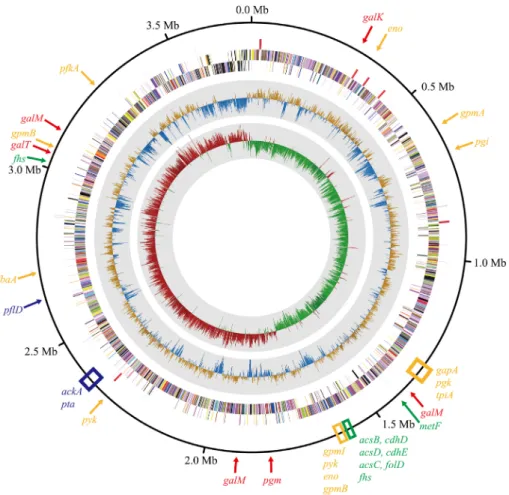
The genome statistics are shown in Table 1. The draft genome of Blautia sp. KGMB01111 was composed of a 3,738,517 bp chromosome with a G + C content of 44.6 mol%. The genome features of Blautia sp. KGMB01111 are summarized in Fig. 1.
The genome is showed to contain 3,154 Protein-coding genes, 18 rRNAs (5S, 16S, 23S), 63 tRNAs and 2 CRISPR arrays were annotated. The majority of the genes are related to replication, recombination and repair [224 genes (7.6%)], carbohydrate transport and metabolism [219 genes (7.4%)] and transcription [217 genes (7.4%)].
Acetic acid in bacteria is usually produced by glucose fermentation. The strain KGMB01111 was also produced acetic acid, but could not use extracellular glucose in media because of the absence of glucose PTS system (PTS-Glc-EIIA, PTS-Glc-EIIB, PTS-Glc-EIIC, PTS-MalGlc-EIIB, and PTS- MalGlc-EIIC). We explored the acetic acid generation pathway conserved in strain KGMB01111’s genome using KEGG pathway.
The strain KGMB01111 may convert galactose into pyruvate through galactose metabolism and glycolysis/gluconeogenesis.
Produced pyruvate is possible to be converted to Acetyl-CoA,
acetate and formate by pyruvate metabolism. During carbon
fixation and methane metabolism, it is supposed that acetate is
produced by formate. According to genome analysis, the strain
96
∙Park et al.미생물학회지 제56권 제1호
Fig. 1. Graphical circular map of Blautia sp. KGMB01111. From outside to the center; ring 1 shows tRNA and rRNA, as well as coding DNA sequences (CDS) on the forward strand and reverse strand from the outside; ring 2 shows G + C% content and ring 3 shows GC skew. Locations of specific functional genes (galactose metabolism, red; glycolysis, yellow; pyruvate metabolism, blue; carbon fixation pathway, green) are presented in circular whole genome map.
KGMB01111 may convert L-serine and L-alanine to acetate using amino acid metabolism and carbohydrate. As above mentioned, the genome sequence contained genes for acetic acid biosynthesis and metabolism such as D-galactose-binding periplasmic protein (mglB), aldose 1-epimerase (galM), galac- tokinase (galK), UDP-glucose-hexose-1-phosphate uridylyl- transferase (galT), phosphoglucomutase (α-D-glucose-1,6- bisphosphate-dependent) (pgm), glucose-6-phosphate isomerase (pgi), 6-phosphofructokinase (pfkA), fructose-bisphosphate aldolase (fbaA), triose-phosphate isomerase (tpiA), glyceraldehyde- 3-phosphate dehydrogenase (phosphorylating) (gapA), phospho- glycerate kinase (pgk), phosphoglycerate mutase (2,3-dipho- sphoglycerate-dependent) (gpmA), phosphoglycerate mutase (2,3-diphosphoglycerate-independent) (gpmI and gpmB), pho- sphopyruvate hydratase (eno), pyruvate kinase (pyk), Formate C-acetyltransferase (pflD), phosphate acetyltransferase (pta),
acetate kinase (ackA), acylphosphatase (acyP), formate-tetra- hydrofolate ligase (fhs), methylenetetrahydrofolate dehydro- genase (NADP(+)) (folD), methylenetetrahydrofolate reductase (NAD(P)H) (metF), CO-methylating acetyl-CoA synthase (acsB), 5-methyltetrahydrosarcinapterin:corrinoid/iron-sulfur protein Co-methyl-transferase (acsC, acsD, cdhD, and cdhE), formate dehydrogenase (coenzyme F420) (fdhB), anaerobic carbon- monoxide dehydrogenase (cooS and acsA), serine O-acetyl- transferase (cysE), cysteine synthase (cysK), valine-pyruvate transaminase (alaA), cystathionine β-lyase (patB and malY), cystathionine γ-lyase (CTH), L-serine ammonia-lyase (sdaA, sdaB, and tdcG) and threonine ammonia-lyase (ilvA and tdcB).
The draft genome sequence of Blautia sp. KGMB01111 will
contribute to understanding the physiological functions of
Blautia sp. KGMB01111 in the gut.
Draft genome sequence of Blautia sp. KGMB01111 ∙
97
Korean Journal of Microbiology, Vol. 56, No. 1 Nucleotide sequence accession number
Blautia sp. KGMB01111 has been deposited in the Korean Collection for Type Cultures under accession number KCTC 15706. The GenBank/EMBL/DDBJ accession number for the genome sequence of Blautia sp. KGMB01111 is SDKC00000000.
적 요
본 연구에서는 건강한 한국인 분변 샘플로부터 Blautia sp.
KGMB01111 균주를 분리하였으며 PacBio Sequel 플랫폼을 이 용하여 유전체서열을 분석하였다. 염색체의 크기는 3,738,517 bp이며, 유전체는 G + C 구성 비율이 44.6 mol%, 3,390개의 유 전자와 3,154개의 단백질 코딩 유전자, 18개의 rRNA 및 63개 tRNA로 구성되어있다. Blautia sp. KGMB01111 균주는 탄수 화물을 이용하여 단쇄지방산 사슬 중 아세트산을 생성하는 것 을 확인하였다. KGMB01111 균주에서 탄수화물 발효와 관련 된 유전자를 조사하였고 갈락토스와 아미노산을 이용한 아세 트산 합성에 관련된 유전자를 포함한다. 이러한 유전체의 분 석은 KGMB01111 균주에 의해 생성된 아세트산이 장 내벽 상 피세포를 증진시켜 사람의 건강 및 소화에 관여할 것으로 여 겨진다.
Acknowledgments
This work was supported by the Bio & Medical Technology Development program (Project No. NRF-2016M3A9F3947962) of the National Research Foundation of Korea (NRF) funded by the Ministry of Science and ICT (MSIT) of the Republic of Korea and a grant from the Korea Research Institute of Bioscience & Biotechnology (KRIBB) Research initiative program. S.-H.P. was supported by the Basic Science Research Program through the NRF funded by the Ministry of Education (NRF-2014R1A6A3A04057492).
References
Aziz RK, Devoid S, Disz T, Edwards RA, Henry CS, Olsen GJ, Olson R, Overbeek R, Parrello B, Pusch GD, et al. 2012. Seed servers:
High-performance access to the seed genomes, annotations, and metabolic models. PLoS One 7, e48053.
Bairoch A and Apweiler R. 2000. The swiss-prot protein sequence database and its supplement trembl in 2000. Nucleic Acids Res.
28, 45–48.
Cuevas-Sierra A, Ramos-Lopez O, Riezu-B oj JI, Milagro FI, and Martinez JA. 2019. Diet, gut microbiota, and obesity: Links with host genetics and epigenetics and potential applications. Adv.
Nutr. 10, S17–S30.
Gill PA, van Zelm MC, Muir JG, and Gibson PR. 2018. Review article:
Short chain fatty acids as potential therapeutic agents in human gastrointestinal and inflammatory disorders. Aliment. Pharmacol.
Ther. 48, 15–34.
Huerta-Cepas J, Szklarczyk D, Forslund K, Cook H, Heller D, Walter MC, Rattei T, Mende DR, Sunagawa S, Kuhn M, et al. 2016.
Eggnog 4.5: A hierarchical orthology framework with improved functional annotations for eukaryotic, prokaryotic and viral sequences. Nucleic Acids Res. 44, D286–293.
Lee I, Chalita M, Ha SM, Na SI, Yoon SH, and Chun J. 2017.
ContEst16S: An algorithm that identifies contaminated prokaryotic genomes using 16S RNA gene sequences. Int. J. Syst. Evol.
Microbiol. 67, 2053–2057.
Lowe TM and Chan PP. 2016. Trnascan-se on-line: Integrating search and context for analysis of transfer RNA genes. Nucleic Acids Res. 44, W54–W57.
Luu TH, Michel C, Bard JM, Dravet F, Nazih H, and Bobin-Dubigeon C. 2017. Intestinal proportion of Blautia sp. is associated with clinical stage and histoprognostic grade in patients with early- stage breast cancer. Nutr. Cancer. 69, 267–275.
Nawrocki EP, Burge SW, Bateman A, Daub J, Eberhardt RY, Eddy SR, Floden EW, Gardner PP, Jones TA, Tate J, et al. 2015. Rfam 12.0: Updates to the rna families database. Nucleic Acids Res. 43, D130–137.
O’Hara AM and Shanahan F. 2006. The gut flora as a forgotten organ.
EMBO Rep. 7, 688–693.
Parada Venegas D, De la Fuente MK, Landskron G, Gonzalez MJ, Quera R, Dijkstra G, Harmsen HJM, Faber KN, and Hermoso MA. 2019. Corrigendum: Short chain fatty acids (SCFAs)- mediated gut epithelial and immune regulation and its relevance for inflammatory bowel diseases. Front Immunol. 10, 1486.
Park SK, Kim MS, Roh SW, and Bae JW. 2012. Blautia stercoris sp.
nov., isolated from human faeces. Int. J. Syst. Evol. Microbiol.
62, 776–779.