Korean Journal of Microbiology (2019) Vol. 55, No. 3, pp. 289-292 pISSN 0440-2413
DOI https://doi.org/10.7845/kjm.2019.9086 eISSN 2383-9902
Copyright ⓒ 2019, The Microbiological Society of Korea
건강한 한국인 분변으로부터 분리된 Lachnospiraceae bacterium
KGMB03038 (=KCTC 15821) 균주의 유전체 염기서열 초안
김지선1 ・ 강세원1 ・ 한국일1 ・ 이근철1 ・ 엄미경1 ・ 서민국1 ・ 김한솔1 ・ 이주혁1 ・ 박승환1 ・ 박잠언1 ・ 오병섭1 ・ 유승엽1 ・ 최승현1 ・ 유승우1 ・ 이동호2 ・ 윤혁2 ・ 김병용3 ・ 이제희3 ・ 이정숙1,4*
1한국생명공학연구원 생물자원센터, 2분당서울대학교병원, 3천랩, 4과학기술연합대학원대학교
Complete genome sequence of
Lachnospiraceae bacterium
KGMB03038 (=KCTC 15821) isolated from healthy Korean feces
Ji-Sun Kim1, Se Won Kang1, Kook-Il Han1, Keun Chul Lee1, Mi Kyung Eom1, Min Kuk Suh1, Han Sol Kim1, Ju Huck Lee1, Seung-Hwan Park1, Jam-Eon Park1, Byeong Seob Oh1, Seung Yeob Yu1, Seung-Hyeon Choi1, Seoung Woo Ryu1, Dong Ho Lee2, Hyuk Yoon2, Byung-Yong Kim3, Je Hee Lee3, and Jung-Sook Lee1,4*1
Korean Collection for Type Cultures, Korea Research Institute of Bioscience and Biotechnology, Jeongeup 56212, Republic of Korea
2Seoul National University Bundang Hospital, Seongnam 13620, Republic of Korea 3ChunLab, Inc., Seoul 06725, Republic of Korea
4
University of Science and Technology (UST), Daejeon 34113, Republic of Korea
(Received August 7, 2019; Revised August 21, 2019; Accepted September 1, 2019)
*For correspondence. E-mail: [email protected]; Tel.: +82-63-570-5618; Fax: +82-63-570-5609
Lachnospiraceae bacterium KGMB03038 (=KCTC 15821) belonging to the class Clostridia in phylum Firmicutes, was isolated from a stool sample of a healthy Korean. Herein, we report the complete genome sequence of strain KGMB03038 analyzed using the PacBio Sequel platform. The genome comprises of 3,334,474 bp with G + C content of 47.8%, which includes 3,099 predicted protein-coding genes, 12 ribosomal RNAs, 54 transfer RNAs, and 4 ncRNAs. Genome analysis revealed that strain KGMB03038 possesses a number of genes involved in hydrolysis of carbohydrates, including mono-, di-, and oligo-saccharides, and biosynthesis of various amino acids.
Keywords: Lachnospiraceae, KGMB03038, carbohydrate, hu-man feces
The human gastrointestinal tract contains a diverse micro-bial community such as bacteria, virus, archaea and eukarya. This microbial community plays a pivotal role in human health and disease. In particular, the family Lachnospiraceae has been known as major players in the human gut (Manson et al., 2008) because of their ability to produce secondary metabolites such as short chain fatty acids (SCFAs). The designation of the family Lachnospiraceae was first proposed by Rainey (2009). The family Lachnospiraceae is a phylogenetically and mor-phologically heterogeneous taxon of the class Clostridia in phylum Firmicutes. The members of the family are anaerobic, fermentative, chemoorganotrophic, and some have potential hydrolytic activity such as pectin methylesterase, pectate lyase, xylanase, galactosidase, and glucosidase. The digestive tract of humans or animals is a major habitat for most members and some have been isolated from the oral cavity and soil. On the
290
∙ Kim et al.미생물학회지 제55권 제3호
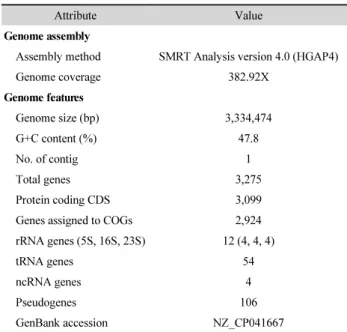
Table 1. General genomic features of Lachnospiraceae bacterium KGMB 03038
Attribute Value
Genome assembly
Assembly method SMRT Analysis version 4.0 (HGAP4)
Genome coverage 382.92X Genome features Genome size (bp) 3,334,474 G+C content (%) 47.8 No. of contig 1 Total genes 3,275 Protein coding CDS 3,099
Genes assigned to COGs 2,924
rRNA genes (5S, 16S, 23S) 12 (4, 4, 4)
tRNA genes 54
ncRNA genes 4
Pseudogenes 106
GenBank accession NZ_CP041667
basis of phylogenetic analysis of 16S rRNA gene sequence, Lachnospiraceae bacterium KGMB03038 was closely related to Merdimonas faecis BR31T (94.3% 16S rRNA gene similarity) and formed a distinct genus-level lineage within the family Lachnospiraceae. This result indicated that strain KGMB03 038 represents a novel species within the novel genus be-longing to family Lachnospiraceae of the class Clostridia.
Lachnospiraceae bacterium KGMB03038 was isolated from a healthy Korean feces. The fresh stool sample was collected in anaerobic pouch from Seoul National University Bundang Hospital. The isolation and cultivation of bacteria were performed in the anaerobic chamber (Coy Laboratory Products Inc.) filled with 86% N2, 7% CO2, and 7% H2. The
fecal sample suspended in 0.85% saline solution was serially diluted and spread onto Eggerth-Gagnon (EG) agar [2.4 g lab-lemco meat extract, 10 g proteose peptone No. 3, 5 g yeast extract, 4 g Na2HPO4, 1.5 g D-(+)-glucose, 0.5 g soluble starch, 0.2 g L-cystine, 0.5 g L-cysteine, 50 ml horse blood per 1 L; pH 7.6].
Genomic DNA was extracted from cells grown on EG medium as described previously (Chun and Goodfellow, 1995). The genomic DNA of strain KGMB03038 was sequenced using the Pacific Biosciences Sequel platform using a 10 kb Single-Molecule Real-Time (SMRT) bell library by Chun Lab, Inc. De novo genome assembly was performed with the Hierarchical Genome Assembly Process (HGAP4) pipeline in the SMRT Analysis version 4.0 (GUI) using default para-meters. Potential contamination in genome assembles was inspected by the Contamination Estimator by 16S (ContEst 16S) and CheckM tools (Lee et al., 2017). The protein coding sequences (CDS) were predicted by prodigal (Hyatt et al., 2010) and the CRISPRs were searched using PILER-CR (Edgar, 2007) and CRISPR Recognition Tool (CRT) (Bland et al., 2007). The annotation of each CDS was performed using the National Center for Biotechnology Information (NCBI)’s Prokaryotic Genome Annotation Pipeline 2.0 (PGAP) (Tatusova et al., 2016).
Whole genome sequencing by the PacBio platform pro-duced a total of 46,321 reads with an average length of 3,288 bp and genome coverage depth, about 383. As described in Table 1, the complete genome of strain KGMB03038 consists of a single circular 3,334,474 bp chromosome with G + C content of
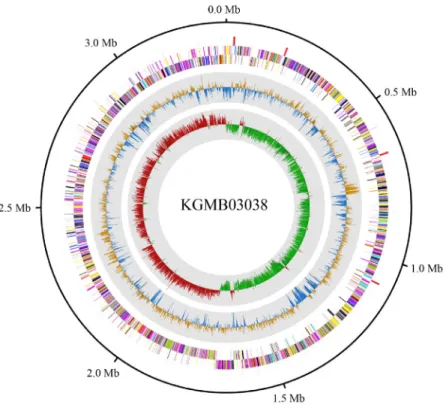
47.8%. No functional plasmid was detected in genome. The genome is predicted to contain 3,099 coding sequences (CDSs), 12 rRNAs (5S, 16S, 23S), 54 tRNAs, and 4 ncRNA genes. A total of 2,924 genes were functionally assigned to categories based on clusters of orthologous group (COG) assignments and the categorized genes were presented in the circular representation with color codes (Fig. 1). Among them, major categories were following as: “unknown function” (S, 37.3%), “amino acid transport and metabolism” (E, 8.7%), “transcription” (K, 8.2%), “replication, recombination and re-pair” (L, 6.9%), and “carbohydrate transport and metabolism” (G, 6.4%). Genome analysis revealed that strain KGMB03038 possesses putative enzymes for a variety of carbohydrates metabolism. The genome sequence contains key enzymes in glycerol metabolism (glycerol kinase and glycerol dehydro-genase) and D-sorbitol metabolism (aldose reductase and sorbitol dehydrogenase). This strain also possesses α-/β- galactosidase, galactokinase, α-glucosidase, xylanase, α-amylase, and amylosucrase, which hydrolyze mono-, di-, and oligo- saccharides such as galactose, maltose, sucrose, xylan, and starch. In addition, genome contains enzymes related with biosynthesis of various amino acid such as alanine, glycine, serine, threonine, cysteine, valine, lysine, arginine, phenyla-lanine, tyrosine, tryptophan and selenocompound. Overall, the
Complete genome sequence of Lachnospiraceae bacterium KGMB03038∙
291
Korean Journal of Microbiology, Vol. 55, No. 3
Fig. 1. Complete genome map of Lachnospiraceae bacterium KGMB03038. From the center to the outside: GC skew (red and green), G + C content (yellow and blue), CDS on the forward strand (colored by COG categories), CDSs on the reverse strand (colored by COG categories), and RNA genes (rRNAs-red and tRNAs-blue).
genome analysis suggests that strain KGMB03038 is able to break down various kinds of mono-, di-, and oligo-saccharides, and biosynthesizes amino acids in human gut, indicating that this novel Lachnospiraceae bacterium KGMB03038 will contribute to human health promotion.
Nucleotide sequence accession number
Lachnospiraceae bacterium KGMB03038 has been depo-sited in the Korean Collection for Type Cultures under accession number, KCTC 15821. The GenBank/EMBL/DDBJ accession number for the genome sequence of Lachnospiraceae bacterium KGMB03038 is NZ_CP041667.
적 요
Lachnospiraceae bacterium KGMB03038 (=KCTC 15821) 은 건강한 한국인의 대변 시료로부터 분리된 Lachnospiraceae 과, Clostridia 강, Firmicutes 문에 속하는 신속 균주이다. 본 연 구에서는 PacBio Sequel 플랫폼을 이용하여 KGMB03038 균 주의 유전체를 해독하고 분석하였으며 그 결과, 47.8% G + C 함량을 가진 3,334,474 bp 길이의 완전한 하나의 유전체 컨티 그를 얻었다. 이 유전체는 3,099개의 단백질 암호화 유전자와 12개의 rRNA 유전자, 54개의 rRNA 유전자, 그리고 4개의 ncRNA 유전자를 포함하고 있다. 이 유전체 분석 결과, KGMB 03038 균주가 탄수화물의 가수화와 아미노산의 생합성에 관 련되어 있는 중요 유전자들을 가지고 있음을 확인하였다.Acknowledgements
This work was supported by the Bio & Medical Technology Development program (Project No. NRF-2016M3A9F39479 62) of the National Research Foundation of Korea (NRF) funded by the Ministry of Science and ICT (MSIT) of the Republic of Korea and a grant from the Korea Research Institute of Bioscience & Biotechnology (KRIBB) Research initiative program.
292
∙ Kim et al.미생물학회지 제55권 제3호
References
Bland C, Ramsey TL, Sabree F, Lowe M, Brown K, Kyrpides NC, and Hugenholtz P. 2007. CRISPR recognition tool (CRT): a tool for automatic detection of clustered regularly interspaced palind-romic repeats. BMC Biofinformatics 18, 209.
Chun J and Goodfellow M. 1995. A phylogenetic analysis of the genus Nocardia with 16S rRNA gene sequences. Int. J. Syst. Bacteriol. 45, 240–245.
Edgar RC. 2007. PILER-CR: fast and accurate identification of CRISPR repeats. BMC Bioinformatics 8, 18.
Hyatt D, Chen GL, Locascio PF, Land ML, Larimer FW, and Hauser LJ. 2010. Prodigal: prokaryotic gene recognition and translation initiation site identification. BMC Biofinformatics 11, 119. Lee I, Chalita M, Ha SM, Na SI, Yoon SH, and Chun J. 2017.
ContEst16S: an algorithm that identifies contaminated proka-ryotic genomes using 16S RNA gene sequences. Int. J. Syst. Evol. Microbiol. 67, 2053–2057.
Manson JM, Rauch M, and Gilmore MS. 2008. The commensal microbiology of the gastrointestinal tract. Adv. Exp. Med. Biol. 635, 15–28.
Rainey FA. 2009. Family V. Lachnospiraceae fam. nov., pp. 921. In De Vos P, Garrity GM, Jones D, Krieg NR, Ludwig W, et al. (eds.), Bergey’s Manual of Systematic Bacteriology, 2nd edn, Springer, New York, USA.
Tatusova T, DiCuccio M, Badretdin A, Chetvernin V, Nawrocki EP, Zaslavsky L, Lomsadze A, Pruitt KD, Borodovsky M, and Ostell J. 2016. NCBI prokaryotic genome annotation pipeline. Nucleic Acids Res. 44, 6614–6624.