A yellow-pigmented marine bacterium, designated strain GrpM- 11, was isolated from coastal seawater of East Sea, Korea.
Phylogenetically, strain GrpM-11 formed a cluster with the genus Parasphingopyxis, and showed 16S rRNA gene sequence similarities of less than 97% with related type strains. Its draft genome sequence was determined using Illumina HiSeq platform, and obtained a draft genome sequence of a total length of approximately 3.3 Mbp with G + C content of 63.7%. The annotated genome sequence included a total of 3,212 protein- coding genes, 3 rRNA genes, 47 tRNA genes, 4 non-coding RNA genes, and 10 pseudo genes. The draft genome of strain GrpM-11 contained aromatic compound degradation related genes and bacterial secretion system-related genes, which could be useful for biotechnological application, such as bioremediation and a protein secretion host.
Keywords: Parasphingopyxis, draft genome sequence, Illumina HiSeq
The genus Parasphingopyxis, a member of the class Alphaproteobacteria, the order Sphingomonadales, the class Sphingomonadaceae, was first described by Uchida et al.
(2012) to accommodate Gram-stain-negative, aerobic, non- spore-forming, yellow-pigmented, motile and rod-shaped bacteria possessing ubiquinone-10 (Q-10) and C
18:1ω7c and C
16:0as major quinone and cellular fatty acids, respectively. Recently, Jeong et al. (2017) emended that cells were motile or non- motile bacteria containing C
18:1ω7c, C
16:0and C
17:1ω6c as major cellular fatty acids. In this study, we described the draft genome sequence and annotation of a Parasphingopyxis sp.
strain GrpM-11 isolated from a coastal seawater of Korea.
A yellow-pigmented marine bacterium, designated strain GrpM-11, was isolated from coastal seawater, Guryongpo (35°
59' 23.3'' N, 129° 33' 56.3'' E) of Korea, using a standard dilution plating method on 10 fold-diluted marine agar 2216 (MA; Difco). The strain GrpM-11 was routinely cultured on MA at 30°C for 3 days. Phylogenetic analyses based on 16S rRNA gene sequence revealed that strain GrpM-11 formed a phylogenic lineage with the genus Parasphingopyxis and shared the highest sequence similarities to Parasphingopyxis algicola ATAX6-5
T(96.3%) and Parasphingopyxis lamellibrachiae JAMH 0132
T(96.2%).
The genomic DNA was extracted using MagAttract
®HMW DNA kit (Qiagen) according to the instructions of the manufacturer. The genomic DNA of strain GrpM-11 was
Korean Journal of Microbiology (2020) Vol. 56, No. 4, pp. 416-418 pISSN 0440-2413
DOI https://doi.org/10.7845/kjm.2020.0121 eISSN 2383-9902
Copyright ⓒ 2020, The Microbiological Society of Korea
Draft genome sequence of Parasphingopyxis strain GrpM-11 isolated from coastal seawater
Ji-Sung Oh and Dong-Hyun Roh*
Department of Biological Sciences and Biotechnology, Chungbuk National University, Cheongju 28644, Republic of Korea
연안 해수로부터 분리된 Parasphingopyxis 균주 GrpM-11의 유전체 서열분석
오지성 ・ 노동현*
충북대학교 대학원 생명시스템학과
(Received November 24, 2020; Revised December 3, 2020; Accepted December 3, 2020)
*For correspondence. E-mail: [email protected];
Tel.: +82-43-261-3368; Fax: +82-43-264-9600
Draft genome of Parasphingopyxis strain GrpM-11∙
417
Korean Journal of Microbiology, Vol. 56, No. 4 sequenced using Illumina Hiseq platform with TruSeq Nano
DNA (350 bp insert size) library by Macrogen Inc.. The de novo assembly was performed by SPAdes (version 3.10.0), and estimated genome completeness and contamination were verified with CheckM (Version 1.0.18) (Parks et al., 2015).
Genome annotation was performed by the NCBI Prokaryotic Genome Annotation Pipeline (PGAP) (Tatusova et al., 2016) and additional function of the predicted genes were conducted by EggNOG 5.0 (Huerta-Cepas et al., 2019), BlastKOALA with KEGG database (Kanehisa et al., 2016) and Rapid Annotations using Subsystems Technology (RAST) server with SEED (Aziz et al., 2008). Average nucleotide identity (ANI) was calculated using the OrthoANIu algorithm of the Chun lab’s online Average Nucleotide Identity calculator (Lee et al., 2016).
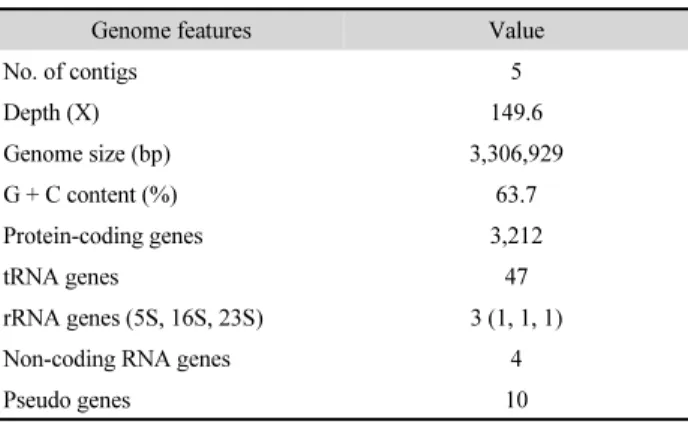
The genome statistics are shown in Table 1. Total five contigs were obtained from the assembly. The draft genome sequence of strain GrpM-11 consisted of a 3,306,929 bp with a DNA G + C content of 63.7%. The CheckM estimation results indicated that genome completeness was 99.14% with 0.95%
contamination and 37.5% strain heterogeneity. Total 3,276 genes were identified in the draft genome; 3,212 protein- coding genes, 3 rRNA genes (5S, 16S, 23S), 47 tRNA genes, 4 non-coding RNA genes and 10 pseudo genes.
The draft genome sequence of strain GrpM-11 contained complete carbohydrates metabolism such as glycolysis, gluco- neogenesis, pyruvate oxidation, citrate cycle, pentose phosphate pathway, and PRPP biosynthesis. The draft genome also completely encoded energy metabolism related genes such as reductive pentose phosphate cycle, crassulacean acid metabolism, NADH:quinone oxidoreductase, succinate dehydrogenase, cyto- chrome bc
1complex respiratory unit, cytochrome c oxidase,
and F-type ATPase. β-Lactam resistance related genes such as bla regulator protein BlaR1, penicillinase repressor BlaI, and β- lactamase class A PenP were also completely encoded. The draft genome contained aromatic compound degradation related genes;
aryl-alcohol dehydrogenase, alcohol dehydrogenase AdhC/AdhE/
YiaY, benzaldehyde dehydrogenase XylC, 4-oxalocrotonate tautomerase XylH, salicylate hydroxylase, ρ-hydroxybenzoate 3-monooxygenase PobA/PobB, gluconolactonase Gnl, 4-car- boxymuconolactone decarboxylase PcaC, and phthalate 4,5- dioxygenase Pht3. It also contained bacterial motility related genes; chemotaxis protein methyltransferase CheR, prepilin peptidase CpaA, pilus assembly protein CpaB/CPaC/CpaD/
CpaE/CpaF/PilA, prepilin peptidase PilD, chemotaxis family CheA/CheB/CheY, fimbrial chaperone protein FimC, and outer membrase usher protein FimD. Bacterial secretion system- related genes such as outer membrane protein TolC, general secretion pathway protein GspC/GspD/GspE/GspF/GspG/
GspH/GspI/GspJ/GspK/GspL/GspM, preprotein translocase subunit SecA/SecB/SecD/SecE/SecG/SecY/YajC, YidC/Oxa1 family membrane protein insertase YidC, fused signal recognition particle receptor FtsY, signal recognition particle subunit SRP54 and sec-independent protein translocase protein TatA/TatB/
TatC were also found in the genome sequence.
The average nucleotide identity (ANI) values between strain GrpM-11 and related closest type strains, Parasphingopyxis algicola ATAX6-5
Tand Parasphingopyxis lamellibrachiae JAMH 0132
T, were below 78.0%, which could be that isolated strain GrpM-11 is a novel species of the genus Parasphingopyxis.
As a result of these genomic analysis, it is believed that the isolated strain GrpM-11 can be used and applied for the degradation of aromatic compounds and a secretion host for overexpression of recombinant proteins.
Nucleotide sequence accession numbers
The strain GrpM-11 is available at Korean Culture Center of Microorganisms with a accession number of KCCM 43343.
The draft genome sequence is accessible in Genbank under the accession number JACJVJ000000000. The version described in this paper is Version JACJVJ010000000.
Table 1. Genome features of strain GrpM-11
Genome features Value
No. of contigs 5
Depth (X) 149.6
Genome size (bp) 3,306,929
G + C content (%) 63.7
Protein-coding genes 3,212
tRNA genes 47
rRNA genes (5S, 16S, 23S) 3 (1, 1, 1)
Non-coding RNA genes 4
Pseudo genes 10
418
∙ Oh and Roh미생물학회지 제56권 제4호
적 요
동해 연안 해수로부터 GrpM-11 균주로 명명된 노란 색소 를 생산하는 해양 세균을 분리하였다. 계통학적으로 GrpM-11 균주는 Parasphingopyxis 속과 무리를 형성하였고, 관련된 표준 균주들과 97% 미만의 16S rRNA 유전자 서열 상동성 을 보였다. 이 균주의 초안 유전체 염기 서열은 Illumina Hiseq platform을 사용하여 결정하였고, 63.7%의 G + C 함량을 지 닌 대략 3.3 Mbp의 길이의 초안 유전체 서열을 확보하였다.
주석이 달린 유전자 서열은 전체 3,212개의 단백질 코딩 유전 자, 3개의 rRNA 유전자, 47개의 tRNA 유전자, 4개의 비코딩 RNA 유전자 및 10개의 위 유전자(pseudo gene)를 포함하였 다. GrpM-11 균주의 초안 유전체는 방향족 화합물 분해 관련 유전자 및 세균 분비 시스템 관련 유전자들을 가지고 있으며, 이러한 것들은 생물학적 환경 정화와 단백질 분비 숙주와 같 은 생명공학적 응용에 유용할 것이다.
Acknowledgments
This research was supported by Basic Science Research Program through the National Research Foundation of Korea (NRF) funded by the Ministry of Education (NRF-2017R1D 1A3B04033871).
References
Aziz RK, Bartels D, Best AA, DeJongh M, Disz T, Edwards RA, Formsma K, Gerdes S, Glass EM, Kubal M, et al. 2008. The RAST Server: rapid annotations using subsystems technology.
BMC Genomics 9, 75.
Huerta-Cepas J, Szklarczyk D, Heller D, Hernández-Plaza A, Forslund SK, Cook H, Mende DR, Letunic I, Rattei T, Jensen LJ, et al.
2019. eggNOG 5.0: a hierarchical, functionally and phylogenetically annotated orthology resource based on 5090 organisms and 2502 viruses. Nucleic Acids Res. 47, D309–D314.
Jeong SE, Kim KH, Baek K, and Jeon CO. 2017. Parasphingopyxis algicola sp. nov., isolated from a marine red alga Asparagopsis taxiformis and emended description of the genus Parasphingopyxis Uchida et al. 2012. Int. J. Syst. Evol. Microbiol. 67, 3877–3881.
Kanehisa M, Sato Y, and Morishima K. 2016. BlastKOALA and GhostKOALA: KEGG tools for functional characterization of genome and metagenome sequences. J. Mol. Biol. 428, 726–731.
Lee I, Kim YO, Park SC, and Chun J. 2016. OrthoANI: an improved algorithm and software for calculating average nucleotide identity.
Int. J. Syst. Evol. Microbiol. 66, 1100–1103.
Parks DH, Imelfort M, Skennerton CT, Hugenholtz P, and Tyson GW.
2015. CheckM: assessing the quality of microbial genomes recovered from isolates, single cells, and metagenomes. Genome Res. 25, 1043–1055.
Tatusova T, DiCuccio M, Badretdin A, Chetvernin V, Nawrocki EP, Zaslavsky L, Lomsadze A, Pruitt KD, Borodovsky M, and Ostell J. 2016. NCBI prokaryotic genome annotation pipeline. Nucleic Acids Res. 44, 6614–6624.
Uchida H, Hamana K, Miyazaki M, Yoshida T, and Nogi Y. 2012.
Parasphingopyxis lamellibrachiae gen. nov., sp. nov., isolated from a marine annelid worm. Int. J. Syst. Evol. Microbiol. 62, 2224–2228.