Korean Journal of Microbiology (2020) Vol. 56, No. 1, pp. 65-68 pISSN 0440-2413
DOI https://doi.org/10.7845/kjm.2020.9143 eISSN 2383-9902
Copyright ⓒ 2020, The Microbiological Society of Korea
Complete genome sequence of Sutterella sp. KGMB03119 isolated from healthy Korean feces
Seoung Woo Ryu
1, Byeong Seob Oh
1, Seung Yeob Yu
1, Seung-Hwan Park
1, Se Won Kang
1, Ji-Sun Kim
1, Kook-Il Han
1, Keun Chul Lee
1, Mi Kyung Eom
1, Jam-Eon Park
1, Seung-Hyeon Choi
1, Min Kuk Suh
1, Han Sol Kim
1, Dong Ho Lee
2, Hyuk Yoon
2, Byung-Yong Kim
3, Je Hee Lee
3, Jung-Sook Lee
1,4, and Ju Huck Lee
1*
1
Korean Collection for Type Cultures, Korea Research Institute of Bioscience and Biotechnology, Jeongeup 56212, Republic of Korea
2
Seoul National University Bundang Hospital, Seongnam 13620, Republic of Korea
3
ChunLab, Inc., Seoul 06725, Republic of Korea
4
University of Science and Technology (UST), Daejeon 34113, Republic of Korea
건강한 한국인 분변으로부터 분리된 Sutterella sp. KGMB03119 균주의 유전체 염기서열
유승우
1・ 오병섭
1・ 유승엽
1・ 박승환
1・ 강세원
1・ 김지선
1・ 한국일
1・ 이근철
1・ 엄미경
1・ 박잠언
1・ 최승현
1・ 서민국
1・ 김한솔
1・ 이동호
2・ 윤혁
2・ 김병용
3・ 이제희
3・ 이정숙
1,4・ 이주혁
1*
1
한국생명공학연구원 생물자원센터,
2분당서울대학교병원,
3천랩,
4과학기술연합대학원대학교
(Received November 19, 2019; Revised December 16, 2019; Accepted December 17, 2019)
*For correspondence. E-mail: [email protected];
Tel.: +82-63-570-5634; Fax: +82-63-570-5609
The genus of Sutterella was isolated from human and dog feces, except Sutterella wadsworthensis was isolated from human appendiceal and peritoneal fluid. Sutterella sp. KGMB03119 was isolated from healthy human feces. The whole-genome sequence of the isolate was analyzed by PacBio Sequel platform. The genome consists a 2,987,884 bp chromosome with a G + C content of 58.30%, 2,436 total genes, 18 rRNA genes and 63 tRNA genes. In addition, we found that strain KGMB03119 had several genes for antibiotic resistance and bile acid resistance in its genome based on the result of genome analysis.
Keywords: Sutterella sp. KGMB03119, antibiotic resistance, bile acid resistance, human feces
Gut microbiota affect human fitness in a variety of ways; one way is that the production of metabolites by microbes contri- butes to the health of the host (Nicholson et al., 2012). The imbalance of the gut microbiota called dysbiosis may be associated with diverse diseases, not only metabolic diseases but also mental disorders like autism (Backhed et al., 2012).
Despite the increasing knowledge about gut microbiome due to the development of metagenome analysis technology, it is still difficult to study gut microbiota because of the lack of gut microbe resources. As the need for collection and storage of gut microbiota for therapeutic applications increases (Bolan et al., 2016), Korean gut microbiome bank launched in 2016. Recently, a novel bacterial strain designated KGMB03119 was isolated from a Korean fecal sample. Based on phylogenic, phenotypic and chemotaxonomic characteristics, strain KGMB03119 (=
KCTC 15823
T) was identified to a novel species as a member of
the genus Sutterella within the family Sutterellaceae which
66
∙Ryu et al.미생물학회지 제56권 제1호
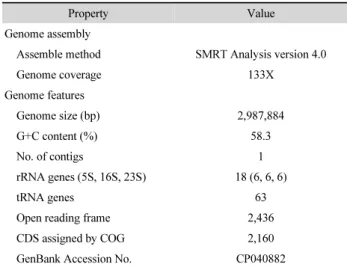
Table 1. General features of Sutterella sp. KGMB03119
Property Value
Genome assembly
Assemble method SMRT Analysis version 4.0
Genome coverage 133X
Genome features
Genome size (bp) 2,987,884
G+C content (%) 58.3
No. of contigs 1
rRNA genes (5S, 16S, 23S) 18 (6, 6, 6)
tRNA genes 63
Open reading frame 2,436
CDS assigned by COG 2,160
GenBank Accession No. CP040882
belongs to the order Burkholderiales in the class Betaproteo- bacteria. Based on the 16S rRNA gene sequence similarity and average nucleotide identity, strain KGMB03119 is most closely related to Sutterella wadsworthensis KCTC 15691
Twith the values of 96.9%.
The genus Sutterella was first isolated and proposed by Wexler et al. (1996). Members of the genus Sutterella are Gram- negative, non-spore forming, anaerobic or microaerophilic bacteria (Wexler et al., 1996; Greetham et al., 2004; Sakon et al., 2008). Sutterella genus was isolated from human and dog feces while S. wadsworthensis was isolated from patients with a variety of gastrointestinal infections (Wexler et al., 1996).
Here, we described the complete genome sequence and anno- tation of Sutterella sp. KGMB03119 isolated from healthy Korean feces.
We collected the fecal samples from the people who had not taken any medicine and had normal BMI (Body Mass Index) from Seoul National University Bundang Hospital for Korean gut microbiome bank, and strain KGMB30119 was isolated from one of the collected fecal samples. One gram of fecal sample suspended in oxygen free sterilized phosphate-buffered saline (PBS) was diluted using the PBS by decuple dilution up to 10
-6. The diluted fecal samples were spread and cultured on tryptic soy agar supplemented with 5% sheep blood (TSAB).
All procedures for the isolation of stain KGMB03119 were performed in anaerobic chamber (Coy Laboratory Products) containing 90% N
2, 5% H
2, and 5% CO
2.
For the whole genome sequencing of strain KGMB03119, the genomic DNA was extracted using a Wizard genomic DNA purification kit (Promega), a 10 kb Single-Molecule Real-Time (SMRT) bell library was prepared according to the manu- facturer’s instructions (Pacific Biosciences) without a non-size selection, and Pacific Biosciences Sequel was used with 2.0 sequencing chemistry and 600-minute movies. De novo genome of strain KGMB03119 was assembled by the Hierarchical Genome Assembly Process (HGAP4) pipeline in the SMRT Analysis version 4.0 using default parameters. Probable con- tamination in genome assembles was checked by the Contami- nation Estimator by 16S (ContEst16S) and CheckM tools (Parks et al., 2015; Lee et al., 2017). The coding DNA sequences (CDSs) and tRNAs were predicted using prodigal and tRNAscan- SE, respectively. The rRNAs and other non-coding RNAs were
searched by covariance model search with inference of Rfam 12.0. Each CDS was annotated through a homology search against Swiss-prot, EggNOG 4.5, SEED, and KEGG databases.
The genome statistics are described in Table 1. The complete genome of Sutterella sp. KGMB03119 consists of a single circular 2,987,884 bp chromosome with a G + C content of 58.30%. Furthermore, the genome contains 2,436 CDSs, 18 rRNAs (5S, 16S, 23S), and 63 tRNAs based on CLgenomics (Fig. 1). Total 2,160 genes were functionally allocated to cate- gories based on clusters of orthologous group (COG) assignments.
Previously it was reported that S. wadsworthensis was intermediately susceptible or resistant to some antibiotic agents.
For example, S. wadsworthensis was resistant to piperacillin, which is β-lactam antibiotic of the ureidopenicillin class (Molitoris et al., 1997). Interestingly, the genome sequence of Sutterella sp. KGMB03119 contains gene for β-lactamase.
Moreover, we found the genes for multidrug efflux transporter proteins such as multidrug resistance protein MdtA, MdtB, MdtC, MdtK, and probable multidrug resistance protein NorM which play a predominant role in the multidrug resistance of gram-negative bacteria (Nikaido, 2009); all these suggest that strain KGMB03119 possibly has the ability of the antibiotic resistance. In addition, all of three species in Sutterella genus possess 20% bile acid resistance activity (Wexler et al., 1996;
Greetham et al., 2004; Sakon et al., 2008). Same as the other
species, the genome of KGMB03119 revealed the presence of
ileal sodium/bile acid cotransporter, indicating that Sutterella
sp. KGMB03119 may also have the resistance to bile acid. All
Complete genome sequence of Sutterella sp. KGMB03119∙
67
Korean Journal of Microbiology, Vol. 56, No. 1
Fig. 1. Graphical circular map of Sutterella sp. KGMB03119. Marked characteristics are shown from the center to the outside: GC skew (red and green), G + C content (yellow and blue), CDSs on the reverse and forward strand (colored by COG categories) and RNA genes (rRNAs-red and tRNAs-blue).these predicted functions, however, need to be experimentally verified. Nevertheless, the complete genome sequence generated in this study will contribute to understanding the physiological functions of Sutterella sp. KGMB03119 in the gut.
Nucleotide sequence accession number
Sutterella sp. KGMB03119 has been deposited in the Korean Collection for Type Cultures under accession number KCTC 15823. The GenBank/EMBL/DDBJ accession number for the genome sequence of Sutterella sp. KGMB03119 is CP040882.
적 요
Sutterella 속 균주들은 사람과 개의 분변에서 분리된 것으 로 알려져 있다. 본 연구에서는 건강한 한국인 분변으로부터 Sutterella sp. KGMB03119 균주를 분리하였으며 PacBio Se- quel 플랫폼을 이용하여 Sutterella sp. KGMB03119 균주의 유 전체서열을 분석하였다. 유전체는 G + C 구성 비율이 58.3%이 고, 염색체의 크기는 2,987,884 bp이며, 2,436개의 유전자와 18개의 rRNA, 63개의 tRNA로 구성되어 있다. 또한, 유전체
분석결과를 토대로 다양한 항생제 내성 유전자와 담즙산 내성 관련 유전자를 가지고 있는 것을 발견하였다.
Acknowledgments
This work was supported by the Bio & Medical Technology Development program (Project No. NRF-2016M3A9F3947 962) of the National Research Foundation of Korea (NRF) funded by the Ministry of Science and ICT (MSIT) of the Republic of Korea and a grant from the Korea Research Institute of Bioscience & Biotechnology (KRIBB) Research initiative program.
References
Backhed F, Fraser CM, Ringel Y, Sanders ME, Sartor RB, Sherman PM, Versalovic J, Young V, and Finlay BB. 2012. Defining a healthy human gut microbiome: Current concepts, future direc- tions, and clinical applications. Cell Host Microbe 12, 611–622.
Bolan S, Seshadri B, Talley NJ, and Naidu R. 2016. Bio-banking gut microbiome samples. EMBO Rep. 17, 929–930.
Greetham HL, Collins MD, Gibson GR, Giffard C, Falsen E, and
68
∙Ryu et al.미생물학회지 제56권 제1호
Lawson PA. 2004. Sutterella stercoricanis sp. Nov., isolated from canine faeces. Int. J. Syst. Evol. Microbiol. 54, 1581–1584.
Lee I, Chalita M, Ha SM, Na SI, Yoon SH, and Chun J. 2017.
Contest16s: An algorithm that identifies contaminated proka- ryotic genomes using 16S RNA gene sequences. Int. J. Syst.
Evol. Microbiol. 67, 2053–2057.
Molitoris E, Wexler HM, and Finegold SM. 1997. Sources and antimicrobial susceptibilities of Campylobacter gracilis and Sutterella wadsworthensis. Clin. Infect. Dis. 25 Suppl 2, S264–
265.
Nicholson JK, Holmes E, Kinross J, Burcelin R, Gibson G, Jia W, and Pettersson S. 2012. Host-gut microbiota metabolic interactions.
Science 336, 1262–1267.
Nikaido H. 2009. Multidrug resistance in bacteria. Annu. Rev. Biochem.
78, 119–146.
Parks DH, Imelfort M, Skennerton CT, Hugenholtz P, and Tyson GW.
2015. CheckM: Assessing the quality of microbial genomes recovered from isolates, single cells, and metagenomes. Genome Res. 25, 1043–1055.
Sakon H, Nagai F, Morotomi M, and Tanaka R. 2008. Sutterella parvirubra sp. Nov. and Megamonas funiformis sp. Nov., isolated from human faeces. Int. J. Syst. Evol. Microbiol. 58, 970–975.
Wexler HM, Reeves D, Summanen PH, Molitoris E, McTeague M, Duncan J, Wilson KH, and Finegold SM. 1996. Sutterella wadsworthensis gen. Nov., sp. Nov., bile-resistant microaero- philic Campylobacter gracilis-like clinical isolates. Int. J. Syst.
Bacteriol. 46, 252–258.