Peribacillus sp. AGMB 02131 was isolated from the feces of a Korean cow. Here, we report the draft genome sequence of the strain AGMB 02131 based on Nova Seq TM 6000 sequencing system (Illumina). The genome comprises 70 contigs with a chromosome length of 4,038,965 bp and 38.5% GC content. The draft genome contains 3,806 protein-coding genes, 51 pseudo- genes, 112 RNA genes including 17 ribosomal RNA genes (7 5S rRNA, 7 16S rRNA, 3 23S rRNA), 90 transfer RNA (tRNA) genes, and 5 non-coding RNA (ncRNA) genes. Additionally, genes involved in the fatty acid metabolism (biosynthesis, elongation, and degradation) and bile acid biosynthesis (primary and secondary) were identified throughout the draft genome, which might be crucial for promoting gut epithelial lining to regulate the animal’s health and digestion. Moreover, insulin, antimicrobial, and antineoplastic drug resistance-related genes were also presented in this genome.
Keywords: Peribacillus, antineoplastic drug, BlastKOALA, draft genome sequence, cow feces
The genus Peribacillus was alienated from the genus Bacillus based on the phylogenomic and comparative genomic framework
(Patel and Gupta, 2020). Of the 13 acceptably published species of the genus Peribacillus, 9 were isolated from soil (Yumoto et al., 2004; Lim et al., 2007; Kuisiene et al., 2008; Zhang et al., 2011; Li et al., 2014; Feng et al., 2016; Liu et al., 2016; Ma et al., 2018), two were isolated from plant tissues (Zhang et al., 2012; Kampfer et al., 2015), and another two were untraceable sources (Priest et al., 1988). Members of this genus are generally reported to be facultatively anaerobic or aerobic, motile, and the culture temperature ranges from 3 to 45°C. The strain AGMB 02131 was isolated from the fecal samples of a Korean cow (6 months old and 158 kg) which was deposited from the National Institute of Animal Science of Korea using a standard dilution plating method on tryptic soy agar (BD Difco) supplemented with 5% sheep blood (Synergy Innovation) under the anaerobic conditions. Comparison of the 16S rRNA sequence showed the highest similarity to P. endoradicis DSM 28131 T (96.9%) and P. butanolivorans DSM 18926 T (96.6%). Based on the 16S rRNA similarity analyses, the strain AGMB 02131 was considered to be a novel member of the genus Peribacillus as the recognition threshold for novel species is 98.6% (Kim et al., 2014). In the present study, we present the draft genome sequence and annotation of the newly identified strain AGMB 02131.
Korean Journal of Microbiology (2021) Vol. 57, No. 1, pp. 66-68 pISSN 0440-2413
DOI https://doi.org/10.7845/kjm.2021.0119 eISSN 2383-9902
Copyright ⓒ 2021, The Microbiological Society of Korea
Draft genome sequence of Peribacillus sp. AGMB 02131 isolated from feces of a Korean cow
Lingmin Jiang 1 , Won Yong Jung 2 , Seung-Hwan Park 1 , Se Won Kang 1 , Mi-Kyung Lee 1 , Jung-Sook Lee 1 , Ju Huck Lee 1 , and Jiyoung Lee 1 *
1
Biological Resource Center, Korean Collection for Type Cultures (KCTC), Korea Research Institute of Bioscience and Biotechnology (KRIBB), Jeongeup 56212, Republic of Korea
2
Korean Bioinformation Center (KOBIC), Korea Research Institute of Bioscience and Biotechnology (KRIBB), Daejeon 34141, Republic of Korea
한우 분변에서 분리된 Peribacillus sp. AGMB 02131 균주의 유전체 염기 서열
지앙링민 1 ・ 정원용 2 ・ 박승환 1 ・ 강세원 1 ・ 이미경 1 ・ 이정숙 1 ・ 이주혁 1 ・ 이지영 1 *
1
한국생명공학연구원 생물자원센터,
2한국생명공학연구원 국가생명연구자원정보센터
(Received November 18, 2020; Revised February 23, 2021; Accepted March 4, 2021)
*For correspondence. E-mail: [email protected];
Tel.: +82-63-570-5651; Fax: +82-63-570-5609
Genome sequence of Peribacillus sp. AGMB 02131 ∙ 67
Korean Journal of Microbiology, Vol. 57, No. 1 The strain AGMB 02131 was cultured at 25°C for 3 days in
an anaerobic chamber (Coy Scientific) supplied with 86% N 2 , 7% CO 2 , and 7% H 2 . Using the phenol: chloroform: isoamy- lalcohol method, the genomic DNA was extracted from the third quadrant cells (Wilson et al., 1990), and the quantity and quality of genomic DNA were measured using PicoGreen and Nanodrop. The DNA library was constructed using the TruSeq Nano DNA kit (Illumina), and its quality was validated using the Agilent Technologies 2100 Bioanalyzer (Agilent Technologies).
The genome sequencing of the strain AGMB 02131 was performed using the NovaSeq TM 6000 sequencing system (Illumina). De novo assembly was performed using the St.
Petersburg genome assembler (SPAdes; V3.12.0). Genome annotation and functional characterization of the genome were performed using the NCBI Prokaryotic Genome Annotation Pipeline (PGAP) through the NCBI Genome submission portal (Genome submit at http://ncbi.nlm.nih.gov) (Tatusova et al., 2016). Gene functions were predicted using the cluster of orthologous groups (COG) database. Furthermore, metabolic pathway analysis was conducted using BlastKOALA based on the Kyoto Encyclopedia of Genes and Genomes (KEGG) pathway database (Kanehisa et al., 2016).
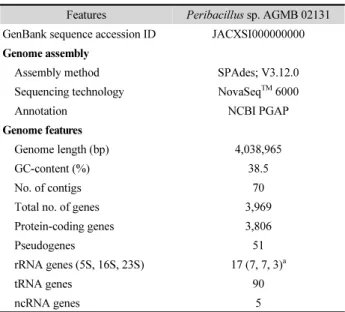
The draft genome of the strain AGMB02131 comprises 70 contigs with a chromosome length of 4,038,965 bp (N 50 value 90,803 bp) with 886X coverage, and 38.5% GC content. The
genome contains 3,806 protein-coding genes, 51 pseudogenes, 112 RNA genes, including 17 rRNA genes (7 5S ribosomal RNA, 7 16S ribosomal RNA, 3 23S ribosomal RNA), 90 transfer RNA (tRNA) genes, and 5 noncoding RNA (ncRNA) genes, as revealed through PGAP annotation (Table 1). COG analysis indicated that the majority of genes are related to amino acid transport and metabolism (8.3%), transcription (7.4%), and inorganic ion transport and metabolism (6.7%).
BlastKOALA analysis indicated that 2169 genes (57.1%) are related to KEGG pathways, and the annotated genes corresponded to 215 metabolic pathways. The predominance of amino acid and carbohydrate transport and metabolism including carbohydrate metabolism (central carbohydrate and another carbohydrate metabolism such as glyoxylate cycle), energy metabolism suggests that the strain has broad carbon metabolism abilities. Fatty acid biosynthesis/elongation/initiation, cofactors and vitamins (thiamine salvage, riboflavin biosynthesis, pyridoxal-P biosynthesis, pantothenate biosynthesis, menaquinone biosynthesis, molybdenum cofactor biosynthesis, and coenzyme A biosynthesis) are found to be complete. Genes involved in fatty acid (transcriptional regulator of fatty acids degradation, TetR/AcR family) and bile acid-related genes (TC.BASS family) might be crucial in promoting gut epithelial lining to regulate the animal’s health and digestion (Zhou et al., 2018; Ticho et al., 2020). Additionally, it also allows to detecting incomplete the KEGG modules for the insulin (AKT2, glmS), antimicrobial, including beta-lactam (mrcA, pbp1b, oppF, oppA, oppB, oppC, oppD, abcA, and naqZ), vancomycin (vanY, alr, ddl, murF, murG, and mraY), cationic antimicrobial peptide (amiA, amiC, and degP), and antineoplastic drug (copA, ctpA, folA, thyA, glyA, and purH) resistance genes in the genome. This draft genome sequence will provide the physiological functions and immune response regulation mechanisms of Peribacillus sp.
AGMB 02131 in the animal gut.
Nucleotide sequence accession numbers
The draft genome sequence and 16S rRNA gene sequence of Peribacillus sp. AGMB 02131 has been deposited to GenBank under the accession numbers JACXSI000000000 and MW009695, respectively. The strain is available at the Korean Collection for Type Cultures (KCTC 43221 T ) and the China Center for Type Culture Collection (CCTCC AB 2020077 T ).
Table 1. General features of Peribacillus sp. AGMB 02131
Features Peribacillus sp. AGMB 02131 GenBank sequence accession ID JACXSI000000000 Genome assembly
Assembly method SPAdes; V3.12.0
Sequencing technology NovaSeq
TM6000
Annotation NCBI PGAP
Genome features
Genome length (bp) 4,038,965
GC-content (%) 38.5
No. of contigs 70
Total no. of genes 3,969
Protein-coding genes 3,806
Pseudogenes 51
rRNA genes (5S, 16S, 23S) 17 (7, 7, 3)
atRNA genes 90
ncRNA genes 5
a
rRNA genes including 5, 1 (5S, 23S) complete rRNAs, and 2, 7, 2 (5S, 16S, 23S)
partial rRNAs.
68 ∙ Jiang et al.
미생물학회지 제57권 제1호
적 요
Peribacillus sp. AGMB 02131 균주는 한우 분변 샘플에서 분리 되었다. 본 연구에서 Nova SeqTM 6000 염기 서열 시스 템(Illumina) 분석을 기반으로 AGMB 02131 균주의 유전체 염기 서열을 보고한다. 유전체는 70개의 contig로 이루어져 있 고 염색체 길이는 4,038,965 bp이며 38.5 % GC 함량을 가지고 있다. 유전체에는 3,806개의 단백질 코딩 유전자, 51개의 위 유전자, 17개의 rRNA 유전자(7개의 5S 리보솜 RNA, 7개의 16S 리보솜 RNA, 3개의 23S 리보솜 RNA), 90개의 트랜스퍼 RNA (tRNA) 유전자, 5개의 비 코딩 RNA 유전자(ncRNA)로 이루어져 있다. 또한 유전체에는 장 상피 내벽을 촉진하여 동 물의 건강과 소화를 조절하는 지방산 대사(생합성, 사슬연장, 분해) 및 담즙산 생합성(1차 및 2차)에 관여하는 유전자가 확 인되었다. 그 외에도 인슐린 저항성, 항균성, 항종 양성 약물 저 항성 유전자가 유전체에서 확인되었다.
Acknowledgments
This research was supported through the Bio & Medical Technology Development Program of the National Research Foundation of Korea (NRF) funded by the Ministry of Science and ICT (MSIT) of the Republic of Korea (Project No. NRF- 2019M3A9F3065226) and a grant received from the Korea Research Institute of Bioscience & Biotechnology (KRIBB) research initiative program.
References