Korean Journal of Microbiology (2018) Vol. 54, No. 4, pp. 477-479 pISSN 0440-2413
DOI https://doi.org/10.7845/kjm.2018.8080 eISSN 2383-9902
Copyright ⓒ 2018, The Microbiological Society of Korea
Complete genome sequence of Lactobacillus koreensis 26-25, a ginsenoside converting bacterium, isolated from Korean kimchi
Ju-Hyeon Kim
1, Qing-Mei Liu
1,2, Sathiyaraj Srinivasan
3, Myung Kyum Kim
3, Sang Yong Kim
4, Ji-Hyang Wee
4, and Wan-Taek Im
1,2*
1
Department of Biotechnology, Hankyong National University, Anseong 17579, Republic of Korea
2
AceEMzyme Co., Ltd., Academic Industry Cooperation, Anseong 17579, Republic of Korea
3
Department of Bio & Environmental Technology, College of Natural Science, Seoul Women’s University, Seoul 01797, Republic of Korea
4
Department of Food Science & Bio Technology, Shinansan University, Ansan 15435, Republic of Korea
김치에서 분리한 진세노사이드 전환 능력이 있는 Lactobacillus koreensis 26-25의 유전체 서열 분석
김주현
1・ 류청매
1,2・ 스리니바산 사티야라지
3・ 김명겸
3・ 김상용
4・ 위지향
4・ 임완택
1,2*
1
국립한경대학교 농업생명과학대학 생명공학과,
2(주)에이스엠자임,
3서울여자대학교 자연과학대학 생명환경공학과,
4신안산대학교 식품생명과학과
(Received November 8, 2018; Revised December 12, 2018; Accepted December 13, 2018)
*For correspondence.
E-mail: [email protected];Tel.: +82-31-670-5335; Fax: +82-31-670-5339
A Gram-positive, rod-shaped, ivory colored, and motile, Lacto- bacillus koreensis 26-25 was isolated from Korean kimchi. Strain 26-25 showed the ability of conversion from major ginseno- sides into minor ginsenosides for which whole genome was sequenced. The whole genome sequence of Lactobacillus koreensis 26-25 consisted of one circular chromosome com- prised of 3,006,812 bp, with a DNA G + C content of 49.23%.
The whole genome analysis of strain 26-25 showed many glycosides hydrolase genes, which may contribute to identify the genes responsible for transformation of major ginsenosides into minor ginsenosides for its high pharmacological effects.
Keywords: Lactobacillus koreensis, complete genome, glycoside hydrolase, kimchi, PacBio RS II
Lactic acid bacteria are non-spore-forming, usually non-motile cocci, coccobacilli or rods that belong to the low GC branch of
the Gram-positive bacteria. These organisms lack catalase, need a fermentable carbohydrate for growth and produce lactic acid as the major or sole product of fermentation. Lactic acid bacteria are well known for their importance in the fermentation of food and food products (Antunes et al., 2002). The genus Lactobacillus which belongs to family Lactobacillaceae and phylum Firmicutes was first proposed by Beijerinck (1901) as given by Kandler and Weiss (1986).
During a positive activity screening for β-glucosidase, a Gram-positive, rod-shaped, and motile bacterium Lactobacillus koreensis 26-25 was isolated from Korean traditional food kimchi. The ginsenoside conversion ability test of the L. koreensis 26-25 was determined by the described method of Siddiqi et al.
(2017). Therefore, complete genome sequencing was applied to strain 26-25 for further genome base study. This strain is available from the host institute and Korean Agricultural Culture Collection (= KACC 92257P).
The genomic DNA of L. koreensis 26-25 was extracted and
478
∙ Kim et al.미생물학회지 제54권 제4호
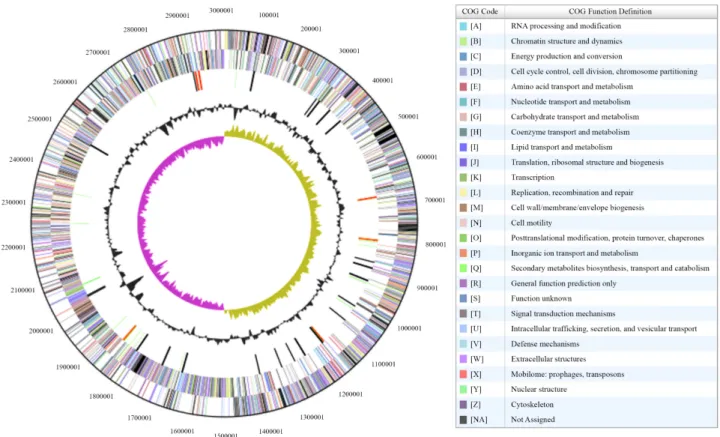
Fig. 1. Graphical map of the genome of Lactobacillus koreensis 26-25. The rings from the outside to the center show the following: genes on the forward strand (colored by COG category), genes on the reverse strand (colored by COG category), RNA genes (tRNAs, green; rRNAs, red; other RNAs, black), GC content, and GC skew.
Table 1. General features of Lactobacillus koreensis 26-25
Features Chromosome
Genome size (bp) 3,006,812
DNA coding region (bp) 2,445,840
G + C content (%) 49.23
Total genes 2,720
Pseudo genes 85
protein-coding genes 2,556
CRISPR arrays 2
Frameshifted genes 10
Number of rRNA genes (5S, 16S, 23S) 18 (6, 6, 6)
Number of tRNA genes 60
purified with the Genomic-tip system 100/G (QIAGEN). The genome was sequenced by using the Pacific Biosciences RSII Sequencing method manual. The general aspects of library construction and sequencing can be found at the JGI website (https://www.jgi.doe.gov). Sequence reads were assembled using PacBio SMRT Analysis (version 2.3.0) with default options. The genome sequence was annotated by using the NCBI Prokaryotic Genome Automatic Annotation Pipeline (PGAP, http://www.ncbi.nlm.nih.gov/books/NBK174280/). The rRNAs and tRNAs were predicted by using rRNAmmer and tRNAscan-SE, respectively.
The complete genome of L. koreensis 26-25 consists of a single circular chromosome of 3,006,812 bp, with 49.23% G + C content. Of the 2,720 predicted genes, 2,556 protein-coding genes, 18 rRNA genes (5S, 16S, and 23S), 60 tRNA genes, and 85 pseudogenes were also identified (Fig. 1). The majority of the protein-coding genes (96.04%) were assigned a putative function, while the remaining predicted genes were annotated as hypothetical or conserved hypothetical proteins. The genome
statistics are described in Table 1.
Analysis of the complete genome of L. koreensis 26-25
showed that it encodes glycosides and hydrolases, including 3
β-glucosidases, 5 α-glucosidases, 7 α-L-arabinofuranosidases,
and 2 β-xylosidases that may be responsible for its ability to
convert ginseng saponins (Siddiqi et al., 2017). In addition, the
Complete genome sequence of L. koreensis 26-25∙
479
Korean Journal of Microbiology, Vol. 54, No. 4 genome annotation also revealed other useful genes, pho-
sphohydrolase, alcohol dehydrogenase (ADH), permease related with exporter of polyketide antibiotics and sucrose phospho- transferase.
The availability of the complete genome sequence of L.
koreensis 26-25 will allow further functional and comparative genome analyses to better understand the genomic traits involved in the conversion of plant secondary metabolites, as described by Siddiqi et al. (2017).
Nucleotide sequence accession number
The complete genome sequence of Lactobacillus koreensis 26-25 has been deposited in DDBJ/EMBL/NCBI GenBank under accession number CP012033.
적 요
김치로부터 분리한 Lactobacillus koreensis 26-25 균주의 유전체서열을 분석하였다. 균주 26-25의 유전체는 G + C 비율 이 49.23%이며, 2,720개의 유전자와 2,556개의 단백질 코딩 유전자, 85개의 위유전자 그리고 78개의 RNA 유전자를 포함 한 단일 원형 염색체로 구성되었으면 그 크기는 3,006,812 bp 였다. 균주 26-25는 인삼사포닌의 당 분해에 관여하는 여러 타 입의 글라이코시다제 유전자를 가지고 있었다. 이러한 지놈 분석은 주요 진세노사이드가 우수한 약리학적 활성의 미량 진 세노사이드로 전환하는데 관여하는 유전자 특징을 이해하는 데 큰 기여가 되었다.
Acknowledgements
This research was supported by Basic Science Research Program through the National Research Foundation of Korea (NRF) funded by the Ministry of Education (2018R1D1A1 B07045774).
References
Antunes A, Rainey FA, Nobre MF, Schumann P, Ferreira AM, Ramos A, Santos H, and da Costa MS. 2002. Leuconostoc ficulneum sp.
nov., a novel lactic acid bacterium isolated from a ripe fig, and reclassification of Lactobacillus fructosus as Leuconostoc fructosum comb. nov. Int. J. Syst. Evol. Microbiol. 52, 647–655.
Beijerinck MW. 1901. Sur les ferments lactiques de l’industrie. Arch.
Ne’er. Sci. Exactes Natur. (Section 2) 6, 212–243.
Kandler O and Weiss N. 1986. Regular nonsporing Gram-positive rods, pp. 1208–1234. In Sneath PH, Mair N, Sharpe ME, and Holt JG. (eds.), Bergey’s manual of systematic bacteriology, vol 2, William and Wilkins, Baltimore, MD, USA.
Siddiqi MZ, Muhammad Shafi S, and Im WT. 2017. Complete genome sequencing of Arachidicoccus ginsenosidimutans sp. nov., and its application for production of minor ginsenosides by finding a novel ginsenoside-transforming β-glucosidase. RSC Adv. 7, 46745.