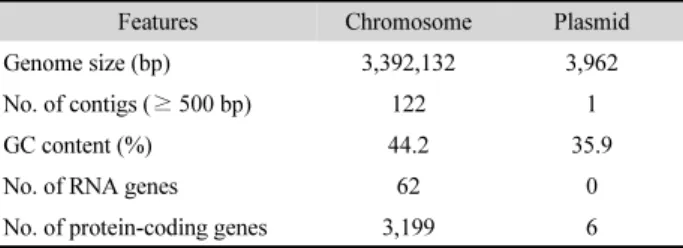
Lactiplantibacillus plantarum is a beneficial probiotic for humans and commonly used as a feed additive for animals. We sequenced the genome of Lpb. plantarum GD00040 isolated from Korean cucumber kimchi using the MGIseq system. The total length of the draft genome was 3,392,132 bp, and its G + C content was 44.2% in 122 contigs (length ≥ 500 bp).
Lactiplantibacillus plantarum contained a plasmid of length 3,962 bp, with G + C content of 35.9%.
Keywords: Lactiplantibacillus plantarum, genome sequencing, hybrid assembly, probiotics
Lactiplantibacillus spp. are Gram-positive aerotolerant anaerobic bacteria (Zheng et al., 2020). They are used as feed additives in the livestock industry (Jeong et al., 2017).
Lactiplantibacillus plantarum is generally found in numerous fermented vegetable foods, especially fermented kimchi (Garcia- Gonzalez et al., 2021). Previously, there is no Lpb. plantarum strains have been isolated from cucumber kimchi. Here, we isolated Lpb. plantarum GD00040 from Korean cucumber kimchi. A single colony of Lpb. plantarum GD00040 that was
cultured on de Man, Rogosa, and Sharpe agar (MRS, MB cell) was inoculated into the MRS broth and incubated at 37°C for 24 h. Cells were recovered by centrifugation at 13,000 × g for 1 min. The genomic DNA (gDNA) was extracted using the G-spin
TMFor Bacteria Genomic DNA Extraction Kit (iNtRON Biotechnology) and subjected to 16S ribosomal RNA sequencing using the 27F and 1492R primer sets (Weisburg et al., 1991) and identified using NCBI BLAST. A DNA library was prepared using the MGIEasy DNA Library Kit (MGI) according to the manufacturer’s instructions.
The fragmented gDNA size-selected by AMPure XP magnetic beads were end-repaired and a-tailed at 37°C for 30 min followed by 65°C for 15 min. The ends of the DNA fragments were ligated to the indexing adapter at 23°C for 60 min. After organizing the adapter-ligated DNA, PCR was performed to enrich the DNA fragments with adapter molecules. The thermocycling conditions were as follows: 95°C for 3 min;
seven cycles of 98°C for 20 sec, 60°C for 15 sec, and 72°C for 30 sec; and a final extension at 72°C for 10 min. The double- stranded DNA library was quantified using the QauntiFluor ONE dsDNA System (Promega). After construction of the library, the circularized product was purified at 37°C for 30 min and digested at 37°C for 30 min. To obtain a DNA nanoball
Korean Journal of Microbiology (2021) Vol. 57, No. 3, pp. 213-215 pISSN 0440-2413
DOI https://doi.org/10.7845/kjm.2021.1044 eISSN 2383-9902
Copyright ⓒ 2021, The Microbiological Society of Korea
Draft genome sequence of Lactiplantibacillus plantarum GD00040 isolated from Korean cucumber kimchi
Seojin Choi
1and Eun Bae Kim
1,2*
1
Department of Applied Animal Science, College of Animal Life Sciences, Kangwon National University, Chuncheon 24341, Republic of Korea
2
Institute of Animal Life Science, Kangwon National University, Chuncheon 24341, Republic of Korea
한국 오이김치에서 분리한 Lactiplantibacillus plantarum GD00040 (KCCM 43412) 유산균주의 유전체 분석
최서진
1・ 김은배
1,2*
1
강원대학교 동물응용과학과,
2강원대학교 동물생명과학연구소
(Received June 4, 2021; Revised August 9, 2021; Accepted August 17, 2021)
*For correspondence. E-mail: [email protected];
Tel.: +82-33-250-8642; Fax: +82-33-259-5574
214
∙ Choi and Kim미생물학회지 제57권 제3호
(DNB), the library was incubated at 30°C for 25 min using DNB enzyme. Finally, the library was quantified using the QuantiFluor ssDNA System (Promega). Sequencing of the prepared DNB was performed using the MGIseq system (MGI) with 150 bp paired-end reads. After sequencing, the adapted sequences were detached using an in-house Perl script code.
Before assembly, the sequences were filtered according to the following conditions: accuracy > 95%, cut-off < 64 bp and over 95 bp. In addition, paired-end reads were randomly selected to lower sequence depth using seqtk (number of reads: 16,934,989;
sequence depth: 776× changed from number of reads: 3,390,000:
sequence depth: 96×). Filtered paired-end reads were assembled de novo using SPAdes (version 3.15.1). Finally, the genome size of Lpb. plantarum GD00040 was determined to be 3,392,132 bp, which was assembled with 122 contigs (contig length ≥ 500 bp; G + C content, 44.2%) and a circular plasmid of size 3,962 bp (G + C content, 35.9%) (Table 1). A total of 3,199 coding sequences and 62 RNA genes were predicted using the Rapid Annotation Using Subsystems Technology web server (Aziz et al., 2008). Genes encoding bacteriocins (plantaricin J and pediocin) were predicted using the web server BAGEL4 (de Jong et al., 2006). Pediocin is an active peptide with a highly specific inhibitory activity against Listeria monocytogenes (Espitia et al., 2016). In addition, plantaricin J (encoded by plnJ) inhibits the growth of Escherichia coli (Pal and Srivastava, 2014). Further studies are needed to elucidate the antibacterial effects of these genes. No known antibiotic resistance genes were identified in the draft genome following analysis using the Comprehensive Antibiotic Resistance Database (McArthur et al., 2013). According to annotation results, there is a gene to product L-arabinose isomerase. L-Arabinose is a sugar in plant-specific. This isomerase catalyses the conversion of L-arabinose to L-ribulose (Kotake et al., 2016). The draft genome sequence of Lpb. plantarum GD00040 (KCCM 43412)
will enable a better understanding of Lpb. plantarum strains isolated from fermented kimchi.
Nucleotide sequence accession numbers
The draft genome sequence of Lpb. plantarum GD00040 (KCCM 43412) has been deposited in GenBank under accession number JAGJWY000000000. The Lpb. plantarum GD00040 (KCCM 43412) strain has been deposited in the Korea Culture Center of Microorganisms, Seoul, Korea under accession number KCCM 43412.
적 요
이 연구에서 사용한 Lactiplantibacillus plantarum GD00040 (KCCM 43412) 균주는 한국 전통 발효식품인 오이김치에서 분리되었다. 우리는 이 균주에 대하여 WGS를 진행하였다. 유 전체 초안의 크기는 3,392,132 bp, G + C 함량(%)는 44.2%이 고 500 bp 이상의 contig 122개로 조립되었다. 그리고 원형의 플라스미드 3,962 bp, G + C 함량(%)이 35.9%가 발견되었다.
유전체 초안에서 항균활성물질(Bacteriocin)인 Plantaricin과 Pediocin 유전자가 확인되었다. 또한 알려진 항생제 저항성 유 전자는 발견되지 않았다.
Acknowledgments
This study was supported by the National Research Foundation of Korea (NRF-2019R1A2C1009406) and 2018 Research Grant (PoINT) from Kangwon National University.
Conflict of Interest
The authors have no conflict of interest to report.
References
Aziz RK, Bartels D, Best AA, DeJongh M, Disz T, Edwards RA, Formsma K, Gerdes S, Glass EM, Kubal M, et al. 2008. The RAST server: rapid annotations using subsystems technology.
BMC Genomics 9, 75.
de Jong A, van Hijum SAFT, Bijlsma JJE, Kok J, and Kuipers OP.
Table 1. Overview for Lpb. plantarum GD00040 (KCCM 43412) and plasmid
Features Chromosome Plasmid
Genome size (bp) 3,392,132 3,962
No. of contigs (≥ 500 bp) 122 1
GC content (%) 44.2 35.9
No. of RNA genes 62 0
No. of protein-coding genes 3,199 6
Draft genome sequences of Lactiplantibacillus plantarum GD00040∙
215
Korean Journal of Microbiology, Vol. 57, No. 3
2006. BAGEL: a web-based bacteriocin genome mining tool.Nucleic Acids Res. 34, W273–W279.
Espitia PJP, Otoni CG, and Soares NFF. 2016. Pediocin applications in antimicrobial food packaging systems. In Barros-Velázquez, J.
(ed.). Antimicrobial Food Packaging, pp. 445–454. Academic Press, Cambridge, Massachusetts, USA.
Garcia-Gonzalez N, Battista N, Prete R, and Corsetti A. 2021. Health- promoting role of Lactiplantibacillus plantarum isolated from fermented foods. Microorganisms 9, 349.
Jeong YD, Kim DW, Min YJ, Yu DJ, Lee SH, Nam KT, Kim KH, and Kim YH. 2017. Effects of dietary supplementation of fermented milk on growth, intestinal microorganisms and fecal noxious gas emission in suckling pigs. Ann. Anim. Resour. Sci. 28, 116–121.
Kotake T, Yamanashi Y, Imaizumi C, and Tsumuraya Y. 2016.
Metabolism of L-arabinose in plants. J. Plant Res. 129, 781–792.
McArthur AG, Waglechner N, Nizam F, Yan A, Azad MA, Baylay AJ,
Bhullar K, Canova MJ, De Pascale G, Ejim L, et al. 2013. The comprehensive antibiotic resistance database. Antimicrob. Agents Chemother. 57, 3348–3357.
Pal G and Srivastava S. 2014. Inhibitory effect of plantaricin peptides (Pln E/F and J/K) against Escherichia coli. World J. Microbiol.
Biotechnol. 30, 2829–2837.
Weisburg WG, Barns SM, Pelletier DA, and Lane DJ. 1991. 16S ribosomal DNA amplification for phylogenetic study. J. Bacteriol.
173, 697–703.
Zheng J, Wittouck S, Salvetti E, Franz CMAP, Harris HMB, Mattarelli P, O’Toole PW, Pot B, Vandamme P, Walter J, et al. 2020. A taxonomic note on the genus Lactobacillus:
Description of 23 novel genera, emended description of the genus Lactobacillus Beijerinck 1901, and union of Lactobacillaceae and Leuconostocaceae. Int. J. Syst. Evol. Microbiol. 70, 2782–
2858.