Korean Journal of Microbiology (2019) Vol. 55, No. 3, pp. 283-285 pISSN 0440-2413
DOI https://doi.org/10.7845/kjm.2019.9090 eISSN 2383-9902
Copyright ⓒ 2019, The Microbiological Society of Korea
Draft genome sequence of Pelagicola sp. DSW4-44 isolated from
seawater
Ji-Sung Oh and Dong-Hyun Roh*
Department of Microbiology, Chungbuk National University, Cheongju 28644, Republic of Korea
해수에서 분리된 Pelagicola sp. DSW4-44의 초안 유전체 서열분석
오지성 ・ 노동현*충북대학교 자연과학대학 미생물학과
(Received August 12, 2019; Accepted August 18, 2019)
*For correspondence. E-mail: [email protected]; Tel.: +82-43-261-3368; Fax: +82-43-264-9600
The draft genome sequencing for Pelagicola sp. DSW4-44 (= KCTC 62762 = KCCM 43261), isolated from deep seawater of East Sea in Korea, was performed using Illumina HiSeq platform. As a result, the draft genome was comprised of a total length of approximately 4.85 Mbp with G + C content of 54.3%, and included a total of 4,566 protein-coding genes, 3 rRNA genes, 48 tRNA genes, 3 non-coding RNA genes, and 67 pseudo genes. In the draft genome, the strain DSW4-44 contained genes involved in the nitrogen metabolism of dissimilatory nitrate reduction to ammonium (DNRA) and denitrification, which were not found other strains in the genus Pelagicola.
Keywords: Pelagicola sp. DSW4-44, draft genome sequence, Illumina HiSeq
The family Rhodobacteraceae, belong to the order Rhodo-bacterales of the class Alphaproteobacteria, currently com-prises 161 genera (List of Prokaryotic Names with Standing in Nomenclature; http://www.bacterio.net). Members of the family Rhodobacteraceae are known to inhabit in various marine environments and participate in biogeochemical cycling of sulfur and carbon, and symbiosis with micro- and macro-organisms (Pujalte et al., 2014). The genus Pelagicola, belong
to the family Rhodobacteraceae, was first proposed by Kim et al. (2008), and includes 2 type species: P. litoralis (Kim et al., 2008) and P. litorisediminis (Park et al., 2013). To date, a total of 3 genomes of the genus Pelagicola were sequenced and annotated, and Pelagicola sp. LXJ1103 was reported that it contained genes for sulfur metabolism such as sulfate trans-porter, sulfate permease, sulfate adenylyltransferase, and pho-sphoadenosine phosphosulfate reductase (Zhao et al., 2018). In this report, we describe the draft genome sequence and anno-tation of Pelagicola sp. DSW4-44 isolated from East Sea of Korea.
The Pelagicola sp. DSW4-44 was isolated from deep seawater (depth of 200~500 m, 38° 21’ 25” N 128° 35’ 30” E), using a standard dilution plating method on marine agar 2216 (MA; Difco). Among the type strains of EzBioCloud server (https://www.ezbiocloud.net/), Pelagicola litoralis CL-ES2T had the closest 16S rRNA similarity (96.5%) to strain DSW4- 44. For the sequencing of the draft genome, the cells were incubated at 25°C in marine broth 2216 (MB; Difco) for 5 days and the genomic DNA was extracted using MagAttract® HMW DNA kit (Qiagen). The sequencing of the draft genome was performed on the Illumina Hiseq platform by Macrogen Inc. Quality checking of sequencing data was performed by FastQC (version 0.11.5) and the de novo assembly was performed by
284
∙ Oh and Roh미생물학회지 제55권 제3호
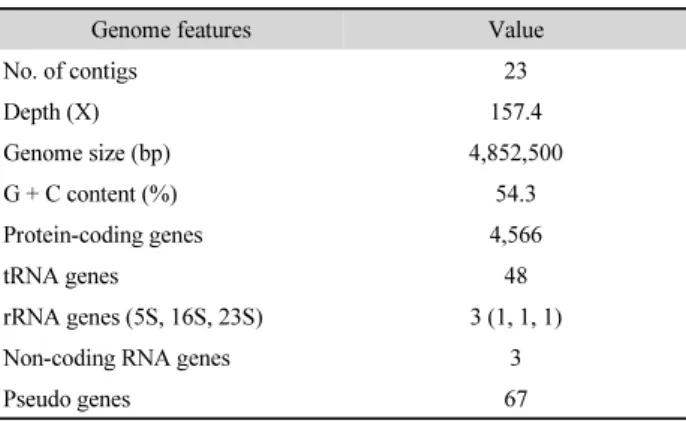
Table 1. Genome features of Pelagicola sp. DSW4-44 Genome features Value No. of contigs 23 Depth (X) 157.4 Genome size (bp) 4,852,500 G + C content (%) 54.3 Protein-coding genes 4,566 tRNA genes 48 rRNA genes (5S, 16S, 23S) 3 (1, 1, 1) Non-coding RNA genes 3 Pseudo genes 67
SPAdes (version 3.10.0). The potential contamination of the draft genome was assessed using ContEst16S (Lee et al., 2017). Genome annotation and functional characterization of genome were conducted by the NCBI Prokaryotic Genome Annotation Pipeline (PGAP) (http://www.ncbi.nlm.nih.gov/ genome/annotation_prok/) (Tatusova et al., 2016) and Blast-KOALA (Kanehisa et al., 2016).
The draft genome of Pelagicola sp. DSW4-44 consisted of 23 contigs with a total length of 4,852,500 bp and N50 size of 413,599 bp. The sequencing depth of coverage was 157.4 X and the genomic DNA G + C content was 54.3 mol%. A total of 4,566 protein coding genes, 3 rRNA genes (each 1 for 5S rRNA, 16S rRNA, and 23S rRNA), 48 tRNA genes, 3 non- coding RNA, and 67 pseudo genes were predicted (Table 1).
The genome sequence contained genes for sulfur metabolism. L-Cysteine S-thiosulfotransferase soxAX, S-sulfosulfanyl-L- cysteine sulfohydrolase soxB, sulfane dehydrogenase subunit soxC, S-disulfanyl-L-cysteine oxidoreductase soxD and sulfur- oxidizing protein soxYZ, involved in the oxidation of thio-sulfate to thio-sulfate by SOX system, were detected. Interestingly, the genome also contained genes for nitrogen metabolism, which were not found other strains in the genus Pelagicola. Periplasmic nitrate reductase napA and cytochrome c-type protein napB, involved in first common step of the dis-similatory nitrate reduction to ammonium (DNRA) and deni-trification genes for conversion of nitrate to nitrite, has been identified. For DNRA, nitrite reductase (NADH) large subunit nirB, nitrite reductase (NADH) small subunit nirD, related to second step (respiratory nitrite reduction to ammonium), were detected. Nitrite reductase (NO-forming) / hydroxylamine reductase nirS, nitric oxide reductase subunit B norB, nitric
oxide reductase subunit C norC and nitrous-oxide reductase nosZ were detected, which were related to denitrification of nitrate to nitrogen. These genes in the sulfur and nitrogen metabolism in Pelagicola sp. DSW4-44 are thought to play an important role in biogeochemical cycling.
Nucleotide sequence accession numbers
The strain Pelagicola sp. DSW4-44 is available at KCTC 62762 and KCCM 43261. The draft genome sequence is accessible in GenBank under the accession number VAUA 00000000. The version described in this paper is Version VAUA01000000.
적 요
이 연구에서는 Illumina Hiseq platform을 사용하여 동해 심 층 해양수로부터 분리된 Pelagicola sp. DSW4-44 (= KCTC 62762 = KCCM 43261)의 초안 유전체 염기서열 해독을 수행 하였다. 그 결과, 유전체는 대략 4.85 Mbp의 길이 및 54.3%의 G + C 함량으로 구성되었고, 전체 4,566개의 단백질 암호 유전 자, 3개의 rRNA 유전자, 48개의 tRNA 유전자, 3개의 non- coding RNA 유전자 및 67개의 위유전자(pseudo gene)가 확인 되었다. 초안 유전체에서 균주 DSW4-44는 Pelagicola 속의 다른 균주에서 발견되지 않는 이화적 질산염의 암모늄 환원과 탈질화의 질소대사 유전자를 가지고 있었다.
Acknowledgements
This research was supported by Basic Science Research Program through the National Research Foundation of Korea (NRF) funded by the Ministry of Education (NRF-2017R1D1 A3B04033871).
References
Kanehisa M, Sato Y, and Morishima K. 2016. BlastKOALA and GhostkOALA: KEGG tools for functional characterization of genome and metagenome sequences. J. Mol. Biol. 428, 726–731. Kim YG, Hwang CY, and Cho BC. 2008. Pelagicola litoralis gen.
Draft genome of Pelagicola sp. DSW4-44 ∙
285
Korean Journal of Microbiology, Vol. 55, No. 3 Evol. Microbiol. 58, 2102–2106.
Lee I, Chalita M, Ha SM, Na SI, Yoon SH, and Chun J. 2017. ContEst16S: An algorithm that identifies contaminated prokaryotic genomes using 16S RNA gene sequences. Int. J. Syst. Evol. Microbiol. 67, 2053–2057.
Park S, Jung YT, and Yoon JH. 2013. Pelagicola litorisediminis sp. nov., a novel alphaproteobacterium isolated from tidal flat sediment. Antonie van Leeuwenhoek 104, 103–110.
Pujalte MJ, Lucena T, Ruvira MA, Arahal DR, and Macián MC. 2014. The family Rhodobacteraceae, pp. 439–512. In Rosenberg E,
DeLong EF, Lory S, Stackebrandt E, and Thompson, F. (eds.), The prokaryotes: Alphaproteobacteria and betaproteobacteria, Springer Berlin Heidelberg, Berlin, Heidelberg.
Tatusova T, DiCuccio M, Badretdin A, Chetvernin V, Nawrocki EP, Zaslavsky L, Lomsadze A, Pruitt KD, Borodovsky M, and Ostell J. 2016. NCBI prokaryotic genome annotation pipeline. Nucleic Acids Res. 44, 6614–6624.
Zhao D, Li J, Lin S, Liang X, Lin X, and Sun X. 2018. Draft genome sequence of Pelagicola sp. strain LXJ1103, isolated from coastal surface seawater. Microbiol. Resour. Announc. 7, e00941-18.