Korean Journal of Microbiology (2018) Vol. 54, No. 4, pp. 456-459 pISSN 0440-2413
DOI https://doi.org/10.7845/kjm.2018.8070 eISSN 2383-9902
Copyright ⓒ 2018, The Microbiological Society of Korea
Draft genome sequence of Olsenella sp. KGMB 04489 isolated from healthy Korean human feces
Kook-Il Han
1, Se Won Kang
1, Ji-Sun Kim
1, Keun Chul Lee
1, Mi Kyung Eom
1, Min Kuk Suh
1, Seung-Hwan Park
1, Ju Huck Lee
1, Jam-Eon Park
1, Byeong Seob Oh
1, Seung Yeob Yu
1, Seung-Hyeon Choi
1, Dong Ho Lee
2, Hyuk Yoon
2, Byung-Yong Kim
3, Seung-Jo Yang
3, and Jung-Sook Lee
1,4*
1
Korean Collection for Type Cultures, Korea Research Institute of Bioscience and Biotechnology, Jeongeup 56212, Republic of Korea
2
Seoul National University Bundang Hospital, Seongnam 13620, Republic of Korea
3
ChunLab, Inc. Seoul 06725, Republic of Korea
4
University of Science and Technology (UST), Daejeon 34113, Republic of Korea
건강한 한국인 분변으로부터 분리된 Olsenella sp. KGMB 04489 균주의 유전체 염기서열 초안
한국일
1・ 강세원
1・ 김지선
1・ 이근철
1・ 엄미경
1・ 서민국
1・ 박승환
1・ 이주혁
1・ 박잠언
1・ 오병섭
1・ 유승엽
1・ 최승현
1・ 이동호
2・ 윤 혁
2・ 김병용
3・ 양승조
3・ 이정숙
1,4*
1
한국생명공학연구원 생물자원센터,
2분당서울대학교병원,
3천랩,
4과학기술연합대학원대학교
(Received September 19, 2018; Revised October 30, 2018; Accepted November 7, 2018)
*For correspondence.
E-mail: [email protected];Tel.: +82-63-570-5618; Fax: +82-63-570-5609
The genus of Olsenella has been isolated from vertebrate animal mouth, rumen, and feces. Olsenella sp. KGMB 04489 was isolated from fecal samples obtained from a healthy Korean. The whole-genome sequence of Olsenella sp. KGMB 04489 was analyzed using the PacBio Sequel platform. The genome comprises a 2,108,034 bp chromosome with a G + C content of 65.50%, 1,838 total genes, 13 rRNA genes, and 52 tRNA genes. Also, we found that strain KGMB 04489 had some genes for hydrolysis enzymes, and antibiotic biosynthesis and resistance in its genome based on the result of genome analysis.
Keywords: Olsenella sp. KGMB 04489, feces, PacBio Sequel
The human gut microbiome plays a very important role in health by helping control digestion and benefiting immune
system (Kau et al., 2011). The collection and storage of gut microbes along with their genetic and metabolic profiles are becoming increasingly important for therapeutic approaches to a wide range of diseases (Bolan et al., 2016). Therefore, the Korean gut microbiome bank is launched in 2016. Recently, a novel bacterial strain designated KGMB 04489 was isolated from fecal samples obtained from a healthy korean. On the basis of the phylogenetic, phenotypic and chemotaxonomic characteristics, strains KGMB 04489
T(= KCTC 15699
T= CCUG 72345
T) was found to belong to a novel species as a member of the genus Olsenella within the family Atopobiaceae of actinobacteria.
The genus Olsenella was first proposed by Dewhirst et al.
(2001). The reclassification of Atopobiaceae family (www.bacterio.
net/atopobiaceae.html) includes the genus Atopobium and
Olsenella (Gupta et al., 2013). Members of the genus Olsenella
are Gram-positive, non-spore-forming, obligate anaerobic, and
Draft genome sequence of Olsenella sp. KGMB 04489∙
457
Korean Journal of Microbiology, Vol. 54, No. 4
Table 1. General features of Olsenella sp. KGMB 04489Property Value
Genome assembly
Assemble method SMRT Analysis version 4.0
Genome coverage 357×
Genome features
Genome size (bp) 2,108,034
G + C content (%) 65.50
No. of contigs 6
rRNA genes (5S, 16S, 23S) 13 (4, 4, 5)
tRNA genes 52
Open reading frame 1,838
CDS assigned by COG 1,704
GenBank Accession No. QSNG00000000
non-motile bacteria (Dewhirst et al., 2001; Dewhirst and Wade, 2015; Li et al., 2015). The human oral cavity, bovine rumen, sheep rumen, pig jejunum, and pig feces of homoeothermic vertebrates are indicated as the habitats of Olsenella (Olsen et al., 1991;
Kraatz et al., 2011; Li et al., 2015). Here, we describe the draft genome sequence and annotation of Olsenella sp. KGMB 04489 isolated from healthy Korean human feces.
The Olsenella sp. KGMB 04489 was grown in mod-PYG (modified Peptone-Yeast extract with glucose) medium in anaerobic chamber (Coy Laboratory Products) containing 90%
N
2, 5% H
2, and 5% CO
2. The composition of mod-PYG agar was as follows: 5.0 g trypticase peptone, 5.0 g peptone, 10.0 g yeast extract, 5.0 g beef extract, 5.0 g glucose, 2.0 g K
2HPO
4, 1.0 ml Tween 80, 0.5 g cysteine-HCl × H
2O, 1.0 mg resazurin, 950.0 ml DW, 40.0 ml salt solution (per L: 0.25 g CaCl
2× 2H
2O, 0.5 g MgSO
4× 7H
2O, 1.0 g K
2HPO
4, 1.0 g KH
2PO
4, 10.0 g NaHCO
3, 2.0 g NaCl), 10.0 ml haemin solution (dissolve 50 mg haemin in 1 ml 1 N NaOH; make up to 100 ml with DW), 0.2 ml vitamin K
1solution (dissolve 0.1 ml of vitamin K
1in 20 ml 95% ethanol and filter sterilize), 20 g agar at pH 7.2.
The genomic DNA was extracted using a Wizard genomic DNA purification kit (Promega). Purified genomic DNA sheared to a size of 10 kb using a g-TUBE
TMdevice according to the manufacturer’s instructions (Covaris). Fragmented DNA quantity was analyzed by a Qubit 2.0 fluorometer with a Qubit dsDNA HS Assay Kit (Invitrogen) and size was measured by the Agilent 2100 Bioanalyzer with the DNA 12000 assay (Agilent). Single- Molecule Real-Time (SMRT) bell library was prepared according to the manufacturer’s instructions (Pacific Biosciences) without a non-size selection. Genome sequencing was performed using a Pacific Biosciences Sequel (Pacific Biosciences) with 2.0 sequencing chemistry and 600 min movies.
De novo genome assembly was performed with the Hierarchical Genome Assembly Process (HGAP4) pipeline in the SMRT Analysis version 4.0 using default parameters. Potential con- tamination in genome assembles was checked by the Con- tamination Estimator by 16S (ContEst16S) and CheckM tools (Parks et al., 2015; Lee et al., 2017). The coding DNA sequences (CDSs) and tRNAs were predicted using prodigal and tRNAscan-SE, respectively. The CRISPRs were searched using PILER-CR, CRISPR Recognition Tool (CRT), rRNAs, and other non-coding RNAs were searched by covariance model
search with inference of Rfam 12.0. The annotation of each CDS was made by homology search against Swiss-prot, EggNOG 4.5, SEED, and KEGG databases.
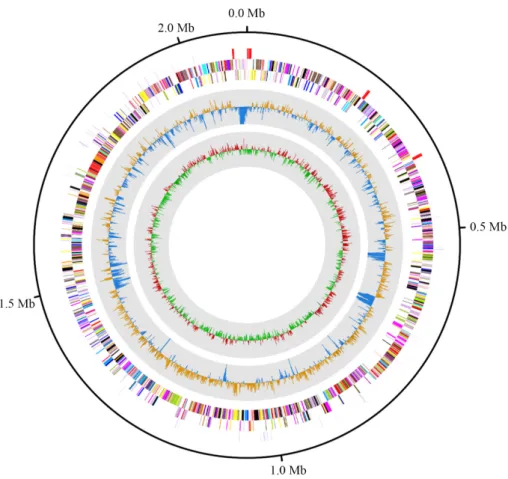
The genome statistics are showed in Table 1. The draft genome of Olsenella sp. KGMB 04489 is composed of a 2,108,034 bp chromosome with a G + C content of 65.5%. The genome contains 1,838 CDSs, 13 rRNAs (5S, 16S, 23S), and 52 tRNAs (Fig. 1). A total of 1,704 genes were functionally assigned to categories based on clusters of orthologous group (COG) assignments.
We found that various genes involving in hydrolysis, and antibiotic biosynthesis and resistance were identified in the genome. The genome revealed the presence of β-glucosidases and chitinase, which involved in the degradation of cellulose and chitin, respectively. The genome sequence contained genes for antibiotic biosynthesis such as tetracenomycin polyketide synthesis O-methyltransferase TcmP tcmP/elmP and eryth- romycin 3''-O-methyltransferase eryG gene. Additionally, the genome had several antibiotic resistance genes, such as undecaprenyl-diphosphate phosphatase bacA, penicillin-binding protein 1A mrcA, macrolide export ATP-binding/permease protein MacB macB, dihydrofolate reductase folA, transcrip- tional regulatory protein, tetracycline resistance protein TetM from transposon TnFO1, penicillin-binding protein, and macro- lide efflux protein. The draft genome sequence of Olsenella sp.
KGMB 04489 will contribute to understanding the physiolo- gical functions of Olsenella sp. KGMB 04489 in the gut.
Based on the 16S rRNA gene sequence similarity and average
458
∙ Han et al.미생물학회지 제54권 제4호
Fig. 1. Graphical circular map of Olsenella sp. KGMB 04489. Marked characteristics are shown from outside to the center; coding DNA sequences (CDS) on forward strand, CDS on reverse strand, tRNA, rRNA, GC content, and GC skew.
nucleotide identity, the strain KGMB 04489 is most closely related to Olsenella scatoligenes SK9K4
Twith the values of 94.3%.
Nucleotide sequence accession number
Olsenella sp. KGMB 04489 has been deposited in the Korean Collection for Type Cultures under accession number KCTC 15699. The GenBank/EMBL/DDBJ accession number for the genome sequence of Olsenella sp. KGMB 04489 is QSNG00000000.
적 요
Olsenella 속 균주들은 척추동물의 구강, 반추위 및 분변 등 에서 분리된 것으로 알려져 있다. 본 연구에서는 건강한 한국 인 분변으로부터 Olsenella sp. KGMB 04489 균주를 분리하 였으며 PacBio Sequel 플랫폼을 이용하여 Olsenella sp. KGMB
04489 균주의 유전체서열을 분석하였다. 유전체는 G + C 구 성 비율이 65.5%이고, 1,838개의 유전자와 rRNA 13개, tRNA 52 개로 구성되었으며, 염색체의 크기는 2,108,034 bp였다. 또 한, 유전체 분석 결과를 통해 가수분해효소와 항생제 합성 및 내성과 관련된 다양한 유전자를 발견하였다.
Acknowledgements
This work was supported by the Bio & Medical Technology
Development program of the National Research Foundation of
Korea (NRF) funded by the Ministry of Science and ICT
(MSIT) of the Republic of Korea and a grant from the Korea
Research Institute of Bioscience & Biotechnology (KRIBB)
Research initiative program.
Draft genome sequence of Olsenella sp. KGMB 04489∙
459
Korean Journal of Microbiology, Vol. 54, No. 4
References
Bolan S, Seshadri B, Talley NJ, and Naidu R. 2016. Bio‐banking gut microbiome samples. EMBO Rep. 17, 929–930.
Dewhirst FE, Paster BJ, Tzellas N, Coleman B, Downes J, Spratt DA, and Wade WG. 2001. Characterization of novel human oral isolates and cloned 16S rDNA sequences that fall in the family Coriobacteriaceae: description of Olsenella gen. nov., reclassifi- cation of Lactobacillus uli as Olsenella uli comb. nov. and description of Olsenella profusa sp. nov. Int. J. Syst. Evol.
Microbiol. 51, 1797–1804.
Dewhirst FE and Wade WG. 2015. Olsenella. Bergey's manual of systematics of archaea and bacteria. John Wiley & Sons, Ltd.
Hoboken, N.J., USA.
Gupta RS, Chen WJ, Adeolu M, and Chai Y. 2013. Molecular signatures for the class Coriobacteriia and its different clades;
proposal for division of the class Coriobacteriia into the emended order Coriobacteriales, containing the emended family Corio- bacteriaceae and Atopobiaceae fam. nov., and Eggerthellales ord. nov., containing the family Eggerthellaceae fam. nov. Int. J.
Syst. Evol. Microbiol. 63, 3379–3397.
Kau AL, Ahern PP, Griffin NW, Goodman AL, and Gordon JI. 2011.
Human nutrition, the gut microbiome and the immune system.
Nature 474, 327–336.
Kraatz M, Wallace RJ, and Svensson L. 2011. Olsenella umbonata sp.
nov., a microaerotolerant anaerobic lactic acid bacterium from the sheep rumen and pig jejunum, and emended descriptions of Olsenella, Olsenella uli and Olsenella profusa. Int. J. Syst. Evol.
Microbiol. 61, 795–803.
Lee I, Chalita M, Ha SM, Na SI, Yoon SH, and Chun J. 2017.
ContEst16S: an algorithm that identifies contaminated prokaryotic genomes using 16S RNA gene sequences. Int. J. Syst. Evol.
Microbiol. 67, 2053–2057.
Li X, Jensen RL, Højberg O, Canibe N, and Jensen BB. 2015.
Olsenella scatoligenes sp. nov., a 3-methylindole- (skatole) and 4-methylphenol- (p-cresol) producing bacterium isolated from pig faeces. Int. J. Syst. Evol. Microbiol. 65, 1227–1233.
Olsen I, Johnson JL, Moore LV, and Moore WE. 1991. Lactobacillus uli sp. nov. and Lactobacillus rimae sp. nov. from the human gingival crevice and emended descriptions of Lactobacillus minutus and Streptococcus parvulus. Int. J. Syst. Bacteriol. 41, 261–266.
Parks DH, Imelfort M, Skennerton CT, Hugenholtz P, and Tyson GW.
2015. CheckM: assessing the quality of microbial genomes recovered from isolates, single cells, and metagenomes. Genome Res. 25, 1043–1055.