저작자표시-비영리-변경금지 2.0 대한민국 이용자는 아래의 조건을 따르는 경우에 한하여 자유롭게
l 이 저작물을 복제, 배포, 전송, 전시, 공연 및 방송할 수 있습니다. 다음과 같은 조건을 따라야 합니다:
l 귀하는, 이 저작물의 재이용이나 배포의 경우, 이 저작물에 적용된 이용허락조건 을 명확하게 나타내어야 합니다.
l 저작권자로부터 별도의 허가를 받으면 이러한 조건들은 적용되지 않습니다.
저작권법에 따른 이용자의 권리는 위의 내용에 의하여 영향을 받지 않습니다. 이것은 이용허락규약(Legal Code)을 이해하기 쉽게 요약한 것입니다.
Disclaimer
저작자표시. 귀하는 원저작자를 표시하여야 합니다.
비영리. 귀하는 이 저작물을 영리 목적으로 이용할 수 없습니다.
변경금지. 귀하는 이 저작물을 개작, 변형 또는 가공할 수 없습니다.
이학석사 학위논문
ALK와 mTOR 억제제인 alectinib와
everolimus 복합요법의 미분화 대세포 림프종 세포에 대한 증식억제
상승효과 분석
Synergistic effect of alectinib and everolimus on anaplastic large cell lymphoma cells via ALK-mTOR pathway
inhibition
2018년 8월
서울대학교 대학원
의과대학 협동과정 종양생물학 전공
김 동 찬
ALK와 mTOR 억제제인 alectinib와
everolimus 복합요법의 미분화 대세포 림프종 세포에 대한 증식억제
상승효과 분석
지도 교수 윤 성 수
이 논문을 이학석사 학위논문으로 제출함
2018년 08월
서울대학교 대학원
의과대학 협동과정 종양생물학 전공
김 동 찬
김동찬의 이학석사 학위논문을 인준함 2018년 08월
위 원 장 (인) 부위원장 (인) 위 원 (인)
Synergistic effect of alectinib and everolimus on anaplastic large cell lymphoma cells via ALK-mTOR pathway
inhibition
By Dongchan Kim
(Directed by Sung-Soo Yoon, M.D., Ph.D.)
A Thesis Submitted to the Department of Cancer Biology in partial fulfillment of the requirements for the Degree of Master of Science in Cancer Biology at Seoul National University College of Medicine
Aug 2018
Approved by Thesis Committee
Professor Chairman
Professor Vice chairman Professor
Abstract
Synergistic effect of alectinib and everolimus on anaplastic large cell lymphoma cells via ALK-mTOR
pathway inhibition
Dongchan Kim Department of Cancer Biology, College of Medicine The Graduate School Seoul Nationa l Universi ty
The purpose of this s tudy was to invest igate the synergistic effect of combina tion trea tment o f two drugs on ALK-posi tive cancer cel ls. The combinat ion trea t resulted in synergis tic e ffect in Karp as299 cells but no t in SU-DHL-1 cel ls. Viab il ity of K arpas299 cell was decreased to 26.4% (p<0.001) by combination treatment of alectin ib and everolimus compared with the s ingle drug treated groups (alect inib : 59.5% , e verolimus: 51.6%) , and the value of Combinat ion Index (CI) indica tin g synergism was 0 .316. Moreover, co mbination treat ment in Karpas299 augmented ALK-m TOR de-phosphorylation,
and cleavage of poly ADP ribose polymerase (PARP) molecules. Combinat ion treatmen t s ig nificant ly increased the numbers of Karpas299 cells arrested at subG1 (everolimus: p = 0.0096), and G0/G1 (alectinib: p = 0.0018; everoli mus: 0.0013). We furt her invest igated the biological di fferences between Karpa s299 and SU-DHL- 1, the expression pattern of ALK i soforms (ALK-20 1 and 203) was dif ferent bet ween t he two cel l lines.
Overall, Combinat ion treat ment w ith alec tinib and everolimus synergis tical ly reduce d cell surv ival , augmented inhib it ion of m TOR signa ling, and increased cell cycle a rrest in Karpas299 but not in SU-DHL1 cel ls.
This se t o f results can suggest that the possibi li ty o f a novel combinat ion treat ment fo r ALK -positive lymphom a patients. I t also provides an approach to developing new therapies.
---- --- --- --- --- --- --- -- ---- --- --- -- Keywords: Anaplastic large cel l lymph oma (ALCL),
Anaplastic lymphoma kinase ( ALK), A lectin ib, TOR
Serine-Threonine Kinases, mTOR, Ev erolimus , Tyros ine Kinase Inh ibitors (T KI) , Combinat ion treatment , Drug synergism
Student Number: 2016-25164
Contents
Abstract
………
..04Contents
………
..06Introduction
………..07
Material and methods
………
10Results
……….17
Discussion
………
..26Figure legend
………
..……….29Figures and table
………
..………
.32References……….39
List of tables and figures
………
44List of Abbreviations
………
46Abstract in Korean
………
.47Introduction
Anaplastic Lymphoma K inase (ALK) i s an oncogene found in various cancers inc luding ly mphoma, lung cancer , an d leukemia.1 ALK is not expressed in most normal cel ls, but is overexpressed in cancer ce lls due to various underlying genetic aberrat ions.2 An aplastic large cel l lymphoma (ALCL) is dependent on constitut ive ALK signaling result ing from the chromo somal translocat ion t(2;5)(p23;q35) leading to NPM/ ALK fusion.3 , 4 In non- small cel l lung cancer (NSCLC), AL K can fuse with EML4, KIF5B, EIF2AK , PPM1B, or PRKAR1A .5
With the development o f specif ic in hibitors , ALK has become even more important c li nically . The f irst generation inhibi tor crizo tinib showe d dramat ic success in lung cancer and lymphoma wi th response rate s reaching 65% in lung cancer6 and 90% in lymphoma.6 However, pr imary and secondary resistance to crizot ini b has been discovered7 and next generation ALK inhib itors are being developed.8 A lthough more potent in ter ms of ALK inh ibi tion, even second and th i rd generation ALK
inhibi tors inc luding a lectin ib,8 ceri ti nib,9 and lora tinib1 0 cannot complete ly contro l ALK-dr iv en cancers. Hence, optimiza tion of drug st rategies is n ecessary to inhibi t ALK oncogenesis
The activa tion of ALK fusion pro tein s and downstream signaling molecules resul ts in vario us abnormali ties i n cell funct ion.1 1 The ALK signa ling pathway inc ludes phosphatidylinosito l 3 -kinase (PI 3K), ext racellu la r signal-regula ted kinase (ERK) of MAP kinase signalin g (MAPK), phospholipase Cγ (PLCγ ), Janus k inase- signal transducer and act ivator of t ranscription (J AK– STAT) , and mam mal ian target of r apamycin (mTOR) . Hence, these pathways are emerg i ng as therapeut ic targets for AL K-driven cancers.1 2 - 1 4 Among the molecules in these pathways, m TOR is a crucia l oncogenic protein . Ras-ERK signa li ng involves m TOR, and other signals involve P I3K- Akt signal ing, which is directly associated with m TOR.1 5 m TOR regulates ribosomal p rotein S6 kinase (p70S6K ) and S6 ribosoma l protein (S6RP) and inact ivates the e ukaryotic in it iation factor 4E-bind ing protein 1(EIF4EBP1). As a result ,
mTOR regulates the generation of ribosomes, pro tei n synthesis, and cancer ce ll survival .4 , 1 4 , 1 6
Summarizing the above, we hypot hesized that the simultaneous regula tion o f ALK and the ALK- mediated mTOR pathway m ight resu lt in sy nergism and could indicate a novel therapeut ic s trate gy in ALK-dr iven cancer.1 4 In fac t, si mi lar strateg ies already have been reported as successfu l against canc ers associated w ith other oncogenic mutations in EGFR,1 7 and MET,1 8 wh ich provided the biolog ical rat ionale for our hypothesis. In this study, we investiga ted whether the combina tion of the second generation ALK inh ibitor alectin ib and mTOR inhibi tor everoli mus was synergist i c in ALK -posit ive ALCL cell lines.
Material and Method
Cell l ines and culture
We used four cell lines in this stud y. The NPM- ALK- positive ALCL cel l lines used were Karpas299 (Sigma- Aldrich , St. Louis , MO, USA) and SU-DHL-1 (ATCC , Manassas, VA, US A); the EML4-A LK-posit ive NSCLC cell line was NCI -H2228 (A TCC); an d the aggressive T - cell lymphoma cel l line Jurkat was used as an ALK- negative contro l (DSMZ, ACC-282, Deutsche Sammlung von Mikroorganismen und Ze llkul turen GmbH, Braunschweig, Germany). Karpas299 cells were cul tured in RPMI-1640 mediu m supplem ented wi th 20 % inactivated feta l bovine serum (FBS) and 1%
penicil lin/s treptomycin (GIBCO, Gran d Island , NY, USA) . The rema ining cell lines were culture d in RPMI-1640, 10 % FBS, and 1% pen ici ll in/streptomyc in. A ll cel l l ines were incubated at 37°C in a 5% CO2 incubator. NCI -H2228 cells were washed w ith DPBS and detached from the culture vessel using 0.25% trypsin-E DTA (GIBCO).
Reagents and antibodies
The AL K inhib itors cri zotin ib (PF-02341066) and alectin ib (CH542480), and the mTOR i nhibitor everol imus (RAD001) were purchased from Selleck Chemica ls (Houston, TX, USA). Ant ibodies used in i mmunoblot were:
phospho-ALK (Tyr1282/Tyr1283), phospho-A K T (Ser473, Thr308), A KT , phospho-mTOR (Ser2481), phospho-mTOR (Ser2448), mTOR, phospho-p70S6K (Thr389), p70S6K, phospho-4E-BP1 (Thr37/46), and 4E-BP1 (Cell Signaling Technology ( Beverly, MA, USA).
The cleaved Poly ADP ribose p olymerase (PARP) antibody was purchased from BD Pharmingen (San Jose, CA, US A). GAPDH (sc-25778), and horseradish peroxidase (HRP)-conjugated anti -mouse and anti- rabbit ant ibodies were obtained from Santa Cruz Biotechnology (Dallas, TX, USA) .
Cell viability assay
ALK-posit ive ALCLs and NSCLC cel ls were used a t 24 hours after subculture. The NSCLC cells (NCI -H2228)
were washed once wi th DPBS and detached from th e culture vessel . Ha rvested cel ls were counted and seeded into 96- wel l p lates and then incubat ed at 37°C for 24 hours. Al l cel l lines were treated in dividually wi th the indicated concentra tions (0, 10 , 1 00, 1000 nM) of crizotin ib, a lectin ib, and everoli mus for 24, 48, 72, 96, 120 hours. Karpas299 cells were tr eated with alect ini b and everoli mus mixed at f ixed ra tios a nd incubated for 72 hours. DMSO was used as the vehi cle control for a ll experiments. A fter incubation , cell via bili ty was assessed using a CCK-8 kit (Doj indo Molec ular Technologies , Kumamoto, Japan) . The CCK-8 sol ution (10 μ l) was added to each wel l and incubated f or 2 hours. Optica l density (O.D.) was measured at 450 nm using a microplate reader (Becton Dickinson Labware, Le Pont de Claix, France).
Western blot analysis
The ALK-posi tive ALCL cell l ine, K arpas299, was used at 24 hours after subculture . Cells were harvested and
seeded into 6-we ll plates and then incubated at 37°C for 24 hours . In sing le treat experime nt, Karpas299 cel ls were treated w ith cr izotin ib, a lectin ib , or everoli mus in a dose escalat ion manner . For com bination treat ment, alectin ib and everoli mus were mixe d at a fixed rat io (alectin ib: everol imus = 5:1 , based on result of the ce l l viabil ity assay). DMSO was used as the control for a ll experiments. Af ter 5 hours of incubation, ce lls wer e lysed in lys is buffe r (50 mM Tr is-HC l [pH 7 .5], 150 m M NaCl, 1% Tr iton X-100, 5 mM EDT A, 0 .5 mM Na3VO4, 50 mM NaF , 1 mM PMSF, and protea se inhib itor cockta il [Thermo Scient if ic, Rockford, IL, USA ]) for 1 hour on ice.
Cell debr is was re moved by cent rifuga tion a t 16000xg for 15 min at 4°C. The pro tein concentr ation in cell lysates was determined using the Micro BCA ™ Protein Assay Kit (Thermo Scienti fic , Rockford, IL, US A). An equa l amount of protein for each sample was sepa rated by 6% or 8%
SDS-polyacrylamide gel electrophor esis (PAGE) then transferred onto PVDF membranes (EMD Mill ipore , Biller ica, MA , USA). Af ter b locking wi th 5% sk im mi lk for 1 hour in TBS-T (0.1% Tween 2 0 in Tris-bu ffered
saline [ TBS]), membranes were incubated wi th pr imar y antibodies and then wi th the respecti ve HRP-conjugated secondary antibodies: Peroxidase-co njugated Af fin ipure Goat Ant i-Rabbit IgG (111-035-003), Anti -Mouse IgG (115-035-003) (Jackson ImmunoResearch Laboratories, West Grove, PA, USA) . Blots were developed with A WEST-ZOL (plus) Western Blot Detection System (iNtRON B iotechnology, Gyeonggi-do, Korea) and signals were detected wi th X-Ray Film Blue from AGFA (Septestraat, Mortsel , Belg ium).
Cell cycle arrest assay
To determine ce ll cycle d istr ibuti on, samples were stained w ith propid ium iodide (PI; BD Pharmingen, Sa n Jose, CA, USA) and analyzed b y flo w cytome try.
Karpas299 cells were harvested a t 24 hours afte r subculture. Cells were seeded in to 6-we ll pla tes and then incubated at 37°C for 24 hours. Cells were treated with alect inib in the absence or pres ence of everol imus ; DMSO was used as the control for all experiments. A fte r
72 hours, cel ls were collec ted, wash ed w ith DPBS, and fixed with 70% ethanol. Fixed cel ls were incubated w it h DPBS containing 42 µg/ml PI, 140 ng/ml RNase (Invitrogen, Carlsbad, C A, USA) , a nd 0.1% of bovine serum albumin (MP Biomedica ls, Irvine, CA , USA).
Stained cel ls were analyzed using the FACS Canto II (BD Biosciences, San Jose, CA, USA)
RNA sequencing data analysis
We obtained public ly avai lable RNA sequence data, the Sequence Read Archive (SRA), fro m The Nat ional Center for Biotechnology Infor mat ion and a ligned the genome with the Spliced Transcr ipts A lignm ent to a Reference (STAR) tool.1 9 T ranscript quant ifica t ion was per formed using an analysis tool , RNA -Seq by Expectation- Maximiza tion (RSEM), to compare protein expressio n levels. Expression of ALK and i ts iso forms was analyzed and compared.
Statistical analysis
All data were analyzed us ing GraphPad Prism v.5.0 0 (GraphPad Software Inc. , San Dieg o, CA, USA) . The Combination Index (CI) was assess ed using CalcuSyn software version 2.11 (B iosoft, Cambr idge, UK) us ing the median-effect methods described by Chou and Talalay .2 0 The CI indica tes whether the combin ative ef fect of two drugs is synergis tic (CI < 1), addi tive (CI = 1) , or antagonistic (CI > 1) compared to treatment w ith the individual drugs. A ll of quant ifica tion data are presented as means ±SD. Student’ s t -test (u npaired, t wo ta iled ) and analysis of variance (A NOVA, single factor) were employed for b inary and mult iple compar isons , respectively. Stat ist ical s ignif icance was defined as a p <
0.05.
Result
ALK inhibitors selectively reduced survival of ALK- positive cancer cell lines.
We evaluated the suscept ibi li ty of ALK -posit ive ce l l lines to ALK o r m TOR inhibi tors. To determine whether ALK inhib itors were more ef fectiv e in ALK-pos itive cells compared to ALK-negat ive T-c ell lymphoma cel ls, the Jurkat cell l ine was used as a negative control . Cells were t reated with an ALK inhibi tor (c rizotin ib, alec tin ib) , or m TOR inhib itor (everol imus). These three inhib itors were used at increasing concentrat io ns and for var ious durations to dete rmine opt imal t reat ment condi tions. As shown as Figure 1A, ALK +/- cel ls were treated wi th alectin ib at the indicated concentrati ons and survival o f ALK-posit ive cel ls was s igni ficant ly decreased to 28.0%, 31.6%, 44.8% 103.2% for Karpas299, SU-DHL-1, NCI- H2228 and Jurkat cel ls, respect ively (p<0.001) compared to DMSO control. Ho wever, at 1000 nM alect inib, survival of ALK+/ - ce ll lines was decreased t o the same level . In Figure 1B, the ef fect of the oth er ALK inhibi tor,
crizotin ib, was tested against the c ell lines . Al though crizotin ib was sl ightly less ef fectiv e than alect inib in reducing viabil ity of Karpas299 (34.4%), SU-DHL-1 (37.7%), and NCI- H2228 (53.6%), J urkat (96.62%) cell lines (p<0.001), crizot inib also sho wed ALK-se lective cytotoxicity in ALK-pos itive ce ll line s. In Figure 1C, al l cell l ines were treated w ith everol i mus under the same conditions as the previous experi ment. Survival o f Karpas299, SU-DHL-1 , NCI- H2228, and Jurkat cel ls started to decrease at 10 nM. At 1 00 nM, everolimus inhibi ted ALK -posit ive and -nega tive cel l surv ival . These results indica ted that ALK inhi bitors had selective toxicity to ward ALK-posi tive cel l s, and the mTOR inhibi tor everol imus had no ALK-depe ndent toxici ty.
Alectinib and everolimus inhibited oncogenic signaling in ALK-positive ALCL cells.
Each of these inhibitors was desi gned to inhibit a different target . Thus, we conf irm ed whether those target mo lecules were speci fica lly inhib ited by their
target inhib itor . The Karpas299 cel l line was used as a representative cel l l ine because it sh owed the strongest inhibi tor suscept ibi lity . For th is experiment , the concentration o f alect inib ranged fro m 0 to 100 nM , and everolimus ranged from 0 to 10 n M. In Figure 2A , a t a n early t ime point of treat ment, phos phorylation o f ALK was completely inhibi ted by alectinib in a dose- dependent manner. Phosphorylation of mTOR and its downstream mo lecules (p70S6K, 4EBP1) was sl ightl y decreased by alectinib (lef t panel). However , phosphorylation and de-phosphoryl ation of Akt was irregular ly increased and decreased. Everolimus never influenced the phosphorylat ion of AL K. Ho wever, m TOR, p70S6K, and 4EBP1 were compl etely blocked by everolimus even at a lo w c oncentration. Akt phosphorylation was induced consist ently (r ight panel) . In Figure 2B, at a late t ime point , phosphorylation o f AL K was suppressed by alectin ib (le ft panel) and ALK - related m TOR phosphorylation was w eakly inhib ited, but the inh ibit ion of Akt phosphorylat io n was st il l in f lux.
This resul t ind icated tha t ALK inhib it ion by alect inib did
not completely suppress ALK- dependent mTOR expression. Thus , we hypothesized th at adding an m TOR inhibi tor to a lect inib might have a s ynergistic effect o n inhibi tion of ALK signal ing through m TOR signaling.
Synergistic activity of alectinib and everolimus treatment occurred at specific ratios.
We investigated whether alect inib had a synergistic effect when co mbined wi th evero lim us for trea tment o f ALK-posit ive ALCL l ines. The two in hibitors were m ixed in var ious rat ios and added to ALK -positive ALCL cel ls ; cell survival was assessed by cytoto xicity assay and CI values were calcula ted using the eq uation of Chou and Talalay20. The three CI values for reference are CI < 1 ,
= 1 , and > 1 to indicate synergism , additive effect , and antagonism (Supplementary 1) , resp ectively. Karpas299 and SU-DHL-1 cel ls were treated and viabi li ty was assessed; CI values, dose-effec t cur ves, median-e ffect plots, and Fa-CI p lots were ca lc ulated and dra wn (Supplementary 2). The combinat i on of two drugs
appeared to be most ly synergis tic in the Karpas299 ce l l line, whereas synergism occurred in the SU-DHL-1 cell line only at a rat io o f 5:1 (Table 1) . The results were also analyzed by heatmap on R to confirm the discrepancy in drug suscept ibil ity between Karpas299 and SU-DHL-1 (Figure 3). These results suggested tha t true synergism bet ween the t wo drugs was observed only in Karpas299 cel ls, even a t a low dose of alec tinib (below 50 nM) .
Alectinib combined with everolimus had a synergistic effect on inhibition of cell proliferation.
Based on the CI results of the var ious rat ios, the bes t ratio was chosen for addit ional studie s. We confir med the ratios at low enough concentration s to exclude any toxicity associa ted wi th alect inib. Moreover, by referrin g to “ c lin ical meaning” used for p atients wi th ALK- driven cancer, the a lect inib conc entration mus t be minim ized to be comparable to th e Cmax values o f alectin ib in cl inical tr ials .2 1 ALK -positive ALCL cell s
were treated wi th alec tin ib in the abs ence or presence of everolimus a t a 5:1 (a lectin ib: everolimus) rat io usin g the same trea tment and incubation c onditions as in the above experiment. In Figure 4A , th e alectinib 10 nM- everolimus 2 nM group showed the greatest synergist ic effect. The combinat ion of both in hibitors ef fective ly reduced cell v iabi lity to 26.4% (co mpared to a lectin ib alone, decreased to 42.7%, compared to everoli mus alone , 49.2%, p<0.001), respective ly. Moreo ver, the CI value of the combina tion was 0.316, wh ich was belo w the 0 .85 value that indicates strong syner gism (Figure 4B).
However, SU-DHL-1 cel ls were not only less sensit ive to each drug alone, but they a lso we re not sensitive to the combinat ion treat ment (Figure 4C, 4D). The resu lt s of sta tis tical ana lysis and CI va lues part ial ly supported our hypothesis that alect inib and ev erolimus acted in a complementary manner on the inhib ition of ALCL cell lines.
Effect of alectinib on cell signaling pathways was enhanced by combination with everolimus.
We evaluated the correla tion bet we en the synergist ic effect and ALK -rela ted signal ing changes associated with oncogenesis by western b lot ana lysis. Based on the results o f the s ingle trea tment experi ment, two inhibi tors at the lowest concentrations (alect ini b: 10nM; everol imus : 2nM) were used in Karpas299 cel ls. In Figure 5 A, alectin ib effect ively suppressed phosphorylation of ALK , but not Akt (Serine473, Threoni ne308). Next, w e investigated mTOR and P ARP which are associated wi th the cel l cycle , in order to ident ify the signaling molecules that were a ffected by inhibi tors. The de-phosphorylation of mTOR and PARP cleavage were augmented by combination t reat compared w ith s ing le treat groups , the inhibi tion of phosphorylation of p70S6K, 4EBP1 showed the same tendency as the resul ts above (Figure 5B) . Although there was no synergism in combination trea t , these phenomena were seen as additive effec t on th e inhibi tion of some molecules . Th is re sult could not ful ly explain the synergis m observed in t he cytotoxic ity test
shown above. However , the accumul ation o f augmented effect in intrace llu lar signal ing pa thways may have contributed to the toxici ty on cancer c ell physio logy.
Combination treatment with alectinib and everolimus induced subG1 and G0/G1 cell cycle arrest in Karpas299 cells.
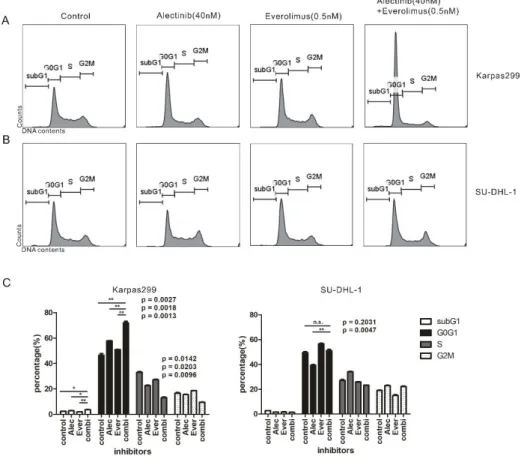
After we determ ined the correlat ion of drug synergism with the changes in cel l cycle, we demonstrated th e synergistic ef fect o f the combinat io n treatment on cel l cycle progression. Karpas299 and SU -DHL-1 cel ls were treated wi th the drug combinat ion. Inhibitor -treated ce ll s were stained w ith PI, and ana lyzed by flow cytome try. In Karpas299 cells, the percentage of c ells at G0/G1 cycle was increased to 72.9% by combinat i on treat , compared to control or single treat groups (control: 45.6%;
alectin ib: 58.1% ; everol imus: 50.9%, p= 0.0027, 0.0018 , 0.0013) (Figure 6A , 6C), the p ercentage of cells arrested at subG1 cyc le showed the same tendency as G0/G1 (combination treat : 3.63%; control: 2.45% ;
alectin ib: 2 .93; everol imus: 1.94; p = 0.0142, 0.0283, 0.0096). As expected, subG1 and G0/ G1 cell cycle a rrest was augmented by the combination treatment only in Karpas299 cells. On the other hand, SU-DHL-1 cells were not affec ted by the comb ination treat ment.
(combination: 51.25% ; contro l: 49.6 %; a lect inib: 39.3% ; p= 0.2031, 0.0047) (Figure 6B, 6C). The DNA content at each phase of the cel l cyc le was s t atist ical ly analyzed . When combined treat ment, alect ini b and everolimus inhibi ted simu ltaneously in the same cell cycle (subG1 and G0/G1) in Karpas299 cel ls. How ever, in SU-DHL- 1 cell, a lectin ib increased the DNA cont ent in S phase, but not G0/G1 (supplementary data 4). The above resu lt s indicate that the argument effec t of combination trea t only appears in the karpas299 cell line because both drugs inhib it the subG1, G0/G1 cel l cycle at the same time .
Discussion
In our study, alect inib combined w ith everoli mus effective ly reduced cell surv ival a nd augmented the inhibi tory ef fect of each drug on cel l s ignal ing and cell cycle progression. Despite the synerg ism on suppressive effect we have confi rmed was c lear, s ome results requi re further explanat ion.
In protein prof il ing experiments , the tendency of Ak t dephosphorylation was not in fl uenced by any concentration of a lectin ib (Figure 2A l eft, 2B le ft) . m TOR feedback loop cou ld expla in this ph enomenon. p70S6K, which was effect ively inh ibited by in hibitors suppresses the act ivation of PI3K. PI3K usual ly phosphorylates Akt in direct and indirect ways (th rough rapamycin- insensitive companion o f mTOR, RICT OR).2 2 - 2 5 And MET signaling sa lvage probably rescues Akt f rom inhibi tion.
Unlike c rizot inib , alec tinib is a sele ctive ALK inh ibitor that does no t a ffect MET. The act ivati on of ME T resu lt i n phosphorylation of Akt .2 6
In our comb ination treat ment experi m ent, we calcu lated the CI values to determ ine whet her there was a synergistic ef fect in ALK-posi t ive ALCL lines . Interesting ly, only in Karpas299 cel l s, the CI value was less than 1 and the Fa value ex ceeded 0.5 at low concentrations to be c linica lly applica ble.[21] In the SU- DHL-1 cell l ine, CI values of the combination t reatment at a rat io o f 5 :1 seemed to be syn ergistic (Tab le 1) . However, we excluded those CI valu es for which the Fa values did no t tend to a lso increa se as the dose of inhibi tor increased (Supplemen tary 2 ). In this way, we were able to conc lude that the effect of the comb inatio n treatment on SU-DHL-1 was not syn ergistic , nor was i t antagonistic . To determ ine why the combinatio n treatment had such d iffe rent ef fects i n the two ce ll l ines, further study was indicated.
To investigate the selective synergi sm between tw o cell lines , we exam ined the dif ferences in gene expression between t wo cel l lines by using a publ icl y available RNA sequence data. Specif i cally, we evaluated the expression rate of ALK , ALK -rela ted genes and their
isoforms. The expression level of ALK-201 isofor m (ENST00000389048.7), which has tyrosine kinase domain, accounts for 82.99%, 56.53 % of the tota l ALK expression in the Karpas299, SU-D HL-1, respectively . Contrary to ALK-201, the expression of ALK -203 isoform (ENST00000453137.1), w hich has pro tein kinase-like domain s im ilar to P I3Ks, accounts for 8.45% , 37.6% (Karpas299, SU-DHL-1) (Sup plementary da ta 5) . These di fferences can potent ial ly be a ssociated w ith drug responsiveness and synergism of com bination therapy.
Taken together these resu lts, we c onfirmed tha t the synergistic ef fect was seen in cert ain cell l ine. Thi s phenomenon suggests that even cel l l ines w ith sa me mutations can not al ways be ex pected to have a synergism of combinat ion treat , and t he combination treat should be considered in var ious situat ions that a re actually used in cl inical s tudies. Furt hermore, the deeper molecular and bio logic considera tions are also needed for successful drug combination therapy at the clin ica l treatment level .
Figure legend
Figure 1. Evaluation of cyto toxici ty of ALK inhib itor and mTOR inhib itor in ALK posi tive / negative cancer cell lines . ALK -posit ive/negative cell s were t reated with inhib itors a t the indica ted doses and survival was measured using a cytotox icity te st. Results o f (A) alectin ib, (B) crizot inib , (C) evero lim us treatment of ALK-posit ive/negat ive cel l l ines fo r 7 2 hours.
Figure 2. Identification of cel lular sign al changes by drugs in AL K-posit ive cel l line . The i nhibit ion of ce ll signaling by inhib itor treatmen t was c onfirmed by western blot analysis . Karpas299 cell was treated with alect inib or everol imus for (A) 5 h, (B) 24 h.
showing the phosphorylat ion of ALK , Akt (ser ine 473, threonine 308), m TOR (serine 2481, s erine 2448), p70S6K, p-4EBP1 and GAPDH.
Figure 3. The heatmap analys is of the combined treatment effects of both drugs. To de termine the
optimum co mbinat ion rat ios of alect ini b and
everolimus that wou ld result in syner gism, Ka rpas299, SU-DHL-1 were treated with two -dr ug combinations for 72h.
Figure 4. Analysis of the synergis tic e ffect o f combination o f AL K inh ibito r and m TOR inhibi tor.
Effect of alect inib and everoli mus at a 5:1 rat io on survival of ALK -posit ive ALCL cel l li nes. (A) Karpas299 and (C) SU-DHL-1 ce lls were treated with alect inib and/or everol imus at a 5 :1 rat io to assess cell surv ival and (B), (D) CI v alues
corresponding to values in ( A).
Figure 5. Identif ication o f cel lular sign al changes by synergistic comb ination of ALK inhibi t or and mTOR inhibi tor. Ef fect o f comb ination treat on the
phosphorylation of ce ll signal ing mo le cules.
Karpas299 cells were t reated w ith 40 nM alect inib and 0.5 nM everol imus for 24 h and w as analyzed by western blot . (A) ALK ( NPM-AL K) a nd Akt. (B)
mTOR, p70S6K, 4EBP1, PARP. A = a lectinib ; E=
everolimus.
Figure 6. Determination of cel l cycle i nhibit ion by combination therapy of ALK inhibi tor and mTOR inhibi tor. Ef fect o f a lectin ib and evero limus on cel l cycle. Te mporal tracking o f the cell c ycle was
demonstrated by propid ium iodide (PI ) DNA s taining and flow cytometry . ( A), (C) Karpas2 99 and (B), (C) SU-DHL-1 cells were treated wi th al ectinib wi th or without everoli mus for 72 h . PI s tain ed cells were analyzed by flo w cytomet ry (BD Calib ur).
Table 1. Average values of Combinat io n Index at various combined ra tios .
Figures and Table
Figure 1. Evaluation of cyto toxici ty of ALK inhib itor and mTOR inhib itor in ALK posi tive / negative cancer cell lines .
Figure 2. Identification of cel lular sign al changes by drugs in AL K-posit ive cel l line .
Figure 3. The heatmap analys is of the combined treatment effects of both drugs.
Figure 4. Analysis of the synergis tic e ffect o f combination o f AL K inh ibito r and m TOR inhibi tor.
Figure 5. Identif ication o f cel lular sign al changes by synergistic comb ination of ALK inhibi t or and mTOR inhibi tor.
Figure 6. Determination of cel l cycle i nhibit ion by combination therapy of ALK inhibi tor and mTOR inhibi tor.
Table 1. Average values of Combinat io n Index at various combined ra tios .
Combi A: B = alect inib : evero limus ; E D: Effective dose
Reference
1. Lin JJ, Riely GJ, Shaw AT. Targeting ALK: Precision Medicine Takes on Drug Resistance. Cancer Discov.
2017;7(2):137-155.
2. Mosse YP. Anaplastic Lymphoma Kinase as a Cancer Target in Pediatric Malignancies. Clin Cancer Res.
2016;22(3):546-552.
3. Hapgood G, Savage KJ. The biology and management of systemic anaplastic large cell lymphoma. Blood.
2015;126(1):17-25.
4. Isozaki H, Ichihara E, Takigawa N, et al. Non-Small Cell Lung Cancer Cells Acquire Resistance to the ALK Inhibitor Alectinib by Activating Alternative Receptor Tyrosine Kinases. Cancer Res. 2016;76(6):1506-1516.
5. Ali SM, Yao M, Yao J, et al. Comprehensive genomic profiling of different subtypes of nasopharyngeal carcinoma reveals similarities and differences to guide targeted therapy. Cancer. 2017;123(18):3628-3637.
6. Gambacorti Passerini C, Farina F, Stasia A, et al.
Crizotinib in advanced, chemoresistant anaplastic lymphoma kinase-positive lymphoma patients. J Natl Cancer Inst. 2014;106(2):djt378.
7. Dagogo-Jack I, Shaw AT. Crizotinib resistance:
implications for therapeutic strategies. Ann Oncol.
2016;27 Suppl 3:iii42-iii50.
8. Ou SH, Ahn JS, De Petris L, et al. Alectinib in Crizotinib- Refractory ALK-Rearranged Non-Small-Cell Lung Cancer: A Phase II Global Study. J Clin Oncol.
2016;34(7):661-668.
9. Shaw AT, Kim DW, Mehra R, et al. Ceritinib in ALK- rearranged non-small-cell lung cancer. N Engl J Med.
2014;370(13):1189-1197.
10. Shaw AT, Friboulet L, Leshchiner I, et al. Resensitization to Crizotinib by the Lorlatinib ALK Resistance Mutation L1198F. N Engl J Med. 2016;374(1):54-61.
11. Wu J, Savooji J, Liu D. Second- and third-generation ALK inhibitors for non-small cell lung cancer. J Hematol Oncol. 2016;9:19.
12. Chiarle R, Voena C, Ambrogio C, Piva R, Inghirami G.
The anaplastic lymphoma kinase in the pathogenesis of cancer. Nat Rev Cancer. 2008;8(1):11-23.
13. Marzec M, Kasprzycka M, Liu X, et al. Oncogenic tyrosine kinase NPM/ALK induces activation of the
rapamycin-sensitive mTOR signaling pathway. Oncogene.
2007;26(38):5606-5614.
14. Vega F, Medeiros LJ, Leventaki V, et al. Activation of mammalian target of rapamycin signaling pathway contributes to tumor cell survival in anaplastic lymphoma kinase-positive anaplastic large cell lymphoma. Cancer Res. 2006;66(13):6589-6597.
15. Steelman LS, Abrams SL, Whelan J, et al. Contributions of the Raf/MEK/ERK, PI3K/PTEN/Akt/mTOR and Jak/STAT pathways to leukemia. Leukemia.
2008;22(4):686-707.
16. Intlekofer AM, Younes A. Precision therapy for lymphoma--current state and future directions. Nat Rev Clin Oncol. 2014;11(10):585-596.
17. Dong S, Zhang XC, Cheng H, et al. Everolimus synergizes with gefitinib in non-small-cell lung cancer cell lines resistant to epidermal growth factor receptor tyrosine kinase inhibitors. Cancer Chemother Pharmacol.
2012;70(5):707-716.
18. Kanteti R, Dhanasingh I, Kawada I, et al. MET and PI3K/mTOR as a potential combinatorial therapeutic
target in malignant pleural mesothelioma. PLoS One.
2014;9(9):e105919.
19. Dobin A, Davis CA, Schlesinger F, et al. STAR: ultrafast universal RNA-seq aligner. Bioinformatics.
2013;29(1):15-21.
20. Chou TC. Drug combination studies and their synergy quantification using the Chou-Talalay method. Cancer Res. 2010;70(2):440-446.
21. Seto T, Kiura K, Nishio M, et al. CH5424802 (RO5424802) for patients with ALK-rearranged advanced non-small-cell lung cancer (AF-001JP study): a single-arm, open-label, phase 1-2 study.
Lancet Oncol. 2013;14(7):590-598.
22. Sabatini DM. mTOR and cancer: insights into a complex relationship. Nat Rev Cancer. 2006;6(9):729-734.
23. Laplante M, Sabatini DM. mTOR signaling at a glance. J Cell Sci. 2009;122(Pt 20):3589-3594.
24. Peterson TR, Laplante M, Thoreen CC, et al. DEPTOR is an mTOR inhibitor frequently overexpressed in multiple myeloma cells and required for their survival. Cell.
2009;137(5):873-886.
25. Wang L, Harris TE, Roth RA, Lawrence JC, Jr. PRAS40 regulates mTORC1 kinase activity by functioning as a direct inhibitor of substrate binding. J Biol Chem.
2007;282(27):20036-20044.
26. Kogita A, Togashi Y, Hayashi H, et al. Activated MET acts as a salvage signal after treatment with alectinib, a selective ALK inhibitor, in ALK-positive non-small cell lung cancer. Int J Oncol. 2015;46(3):1025-1030.
List of figures and tables
Figure 1. Evaluation of cytotoxicity of ALK inhibitor and mTOR inhibitor in ALK
positive/ negative cancer cell lines
………..32
Figure 2. Identification of cellular signal changes by drugs in ALK-positive cell
line
………
33
Figure 3. The heatmap analysis of the combined treatment effects of both drugs
………
34
Figure 4. Analysis of the synergistic effect of combination of ALK inhibitor and mTOR inhibitor
………
..35
Figure 5. Identification of cellular signal changes by synergistic combination of ALK inhibitor and mTOR
inhibitor
……….36
Figure 6. Determination of cell cycle
inhibition by combination therapy of ALK inhibitor and mTOR
inhibitor
……….37
Table 1. Average values of Combination Index at various combined
ratios
……….38
List of abbreviations
ALCL: Anaplastic large cell lymphoma ALK: Anaplastic lymphoma kinase
mTOR: Mammalian target of rapamycin IC50: Inhibitory concentration 50
CI: Combination index
Fa: Function of affected fraction
국 문 초 록
이 연구의 목적은 두 약물의 ALK 양성 암세포에 대한 조합처리 용법의 상승 효과를 확인하는 데있다. 조합처리 요법은 ALK 양성 림프종 세포주인 Karpas299 세포주에서 상승 효과를 나타냈지만 같은 ALK 양성 세포주인 SU-DHL-1 세포에서는 상승 효과를
나타내지 않았다. Karpas299 세포의 생존율은 단독 처리군
(alectinib: 59.5%, everolimus: 51.6%)과 비교하여 alectinib과 everolimus의 병용 요법으로 26.4% (p<0.001)로 나타났으며, 상승 효과지표인 combination index(CI)는 0.316이었다. 또한, Karpas299의 조합 치료는 ALK-mTOR의 탈 인산화와 poly ADP ribose polymerase (PARP) cleavage를 증가시켰다. 조합처리 요법은 subG1 기에서 (everolimus: p = 0.0096), G0 / G1 (alectinib: p = 0.0018, everolimus: 0.0013) 세포성장주기가
차단된 Karpas299의 수를 유의하게 증가시켰다. 우리는
Karpas299와 SU-DHL-1의 생물학적 차이를 더 조사하였으며, ALK 이형체(ALK-201, 203)의 발현 양상이 다르게 나타나는 것을 확인했다. 전반적으로 alectinib과 everolimus의 조합처리는 Karpas299의 세포의 약물에 대한 감수성과 mTOR 신호 전달 억제 그리고 세포성장주기를 효과적으로 억제했지만 SU-DHL1 세포에서는 억제하지 못했다. 이 결과는 ALK 양성 림프종 환자에
치료법 개발에 대한 접근법을 제시한다.
--- 주 요 어 : 미 분 화 대 세 포 림 프 종 , 미 분 화 림 프 종 ,
인 산 화 효 소 , A lectin ib, 포 유 류 라 파 마 이 신 표 적 ,
Everolimus, 타 이 로 신 인 산 화 효 소 억 제 제 , 약 제 조 합 처 리 , 약 물 조 합 처 리
학 번 : 2016-25164