Kor. J. Pharmacogn.
44(2) : 161∼ 167 (2013)
중국 약용식물 추출물의 알도즈 환원 효소 억제 효능 검색 (VII)
이윤미1·김영숙1·김주환2·김진숙1*
1한국한의학연구원 한약연구본부 한의신약연구그룹, 2가천대학교 생명과학과
Screening of Chinese Herbal Medicines with Inhibitory Effect on Aldose Reductase (VII)
Yun Mi Lee1, Young Sook Kim1, Joo Hwan Kim2, and Jin Sook Kim1*
1Korean Medicine-Based Herbal Drug Research Group, Herbal Medicine Research Division, Korea Institute of Oriental Medicine, 1672 Yuseongdae-ro, Yuseong-gu, Daejeon 305-811, Korea
2Department of Life Science, Gachon University, Seongnam, Kyonggi-do 461-701, Korea
Abstracts − Aldose reductase (AR) has been shown to play an important role in the development of the diabetic complications.
To discover novel treatments for diabetic complications from natural sources, 59 Chinese herbal medicines have been inves- tigated for inhibitory activities on AR. Among them, 10 herbal medicines, Catalpa fargesii (stem and leaf), Saussurea Lan- iceps(whole plant), Alnus nepalensis(stem and leaf), Swertia macrosperma (whole plant), Woodfordia fruticosa (stem and leaf), Elsholtzia bodinieri (whole plant), Elsholtzia fruticosa (whole plant), Rosa multiflora (fruit), Nardostachys chinensis (whole plant), Eurya groffii (stem and leaf) exhibited a significant inhibitory activity compared with 3,3-tetramethyleneglutaric acid (TMG) as positive control. Particularly, 4 herbal medicines, C. fargesii (stem and leaf), S. Laniceps (whole plant), A. nepalensis (stem and leaf), S. macrosperma (whole plant) showed two times more potent inhibitory activity than TMG (5.37µg/ml).
Key words − Aldose reductase inhibitor, Diabetic complications, Chinese herbal medicines
고혈당이 지속되면 혈액내의 포도당이 원활하게 대사되 지 못하고 세포안에서 알도즈 환원 효소(Aldose reductase) 에 의해 솔비톨이라는 알코올당으로 전환되는데, 대사분해 가 느리기 때문에 체내에 오랫동안 머무르면서 세포손상, 최종당화산물 생성 촉진, 대사과정의 변이 등을 일으켜 당 뇨성 망막증(Diabetic retinopathy), 신경증(D. neuropathy), 신증(D. nephropathy) 등의 당뇨합병증 유발 원인이 된다.1-3) 이러한 당뇨합병증 예방 및 치료를 위해 알도즈 환원 효소 의 억제제 개발을 위한 연구가 많이 진행되고 있으며, 최근 에는 천연물에서 분리한 독성이 없고 우수한 효능을 가진 물질을 개발하고자 많은 연구들이 진행되고 있다.4,5) 본 연 구팀도 in vitro와 in vivo에서 생약 추출물 및 생약에서 분 리한 단일 화합물의 알도즈 환원 효소 활성 억제 효능을 확 인하였다.6-16) 본 연구에서는 지난 보고에11-16) 이어 중국에 서 자생 또는 재배되는 59종의 생약을 in vitro에서 알도즈 환원 효소 억제 효능을 검색하여 그 결과를 보고하고자 한다.
재료 및 방법
실험재료 − 본 실험에 사용된 중국산 약용식물들(Table I) 은 가천대학교 생명과학과 김주환 교수팀에 의해 중국에서 채집되었으며, 동정을 거친 후 실험에 사용하였다. 증거표 본은 한국한의학연구원 한약연구본부 한의신약연구그룹 표 본실에 보관 중이다.
시약 및 기기 − Sodium phosphate monobasic, potassium phosphate dibasic, lithium sulfate, imidazole, NADP, NADPH, DL-glyceraldehyde, 3,3-tetramethyleneglutaric acid, 2-mercaptoethanol, Bovine Serum Albumin 등은 Sigma사 (St. Louis, MO, USA)의 제품을 사용하였으며, 용매는 대정 화금(한국) 제품을 사용하였다. 형광 분석을 위해 Spectrofluo- rometric detector(Synergy HT Bio-TEK, USA)를 사용하였다.
추출 및 시료조제 − 시료를 분쇄한 후 300 g을 칭량하여 2배 용적의 무수 에탄올을 넣고 실온에서 3회 추출하였다.
여과 후 40oC 이하의 수욕상에서 감압농축하고, 다시 동결 건조기에서 건조하였다. 추출물은 실험 직전에 감압 하에서
*교신저자(E-mail):[email protected] (Tel): +82-42-868-9465
In vitro에서 알도즈 환원 효소 억제 실험 − Sprague- Dawley rat(250~280 g)의 수정체로부터 알도즈 환원 효소를 Dufrane17) 방법으로 분리하였다. 135 mM Na, K-phosphate buffer(pH 7.0)와 10 mM 2-mercaptoethanol을 적출한 수정 체와 함께 분쇄하였다. 14,000 rpm에서 30 분간 원심 분리 한 다음 상층액을 0.2 µm의 filter로 여과하였다. 효소의 단 백질은 bovine serum albumin을 표준으로 이용하여 Bradford18) 방법으로 정량하였다. 135 mM Na, K-phosphate buffer(pH 7.0), 100 mM lithium sulfate, 0.03 mM NADPH, 0.04 mM DL-glyceraldehyde와 100 µg/ml 효소 혼합액에 0.1% DMSO에 녹인 시료를 가하여 최종용액을 1 ml로 한 뒤 37에서 10분간 반응시켰다. 이때 공시료는 0.04 mM DL- glyceraldehyde를 첨가하지 않았으며, 표준액은 135 mM Na,
을 첨가하여 반응을 종료시킨 뒤, 10 smM imidazole이 첨 가된 6 M NaOH 1 ml을 가하여 60oC에서 10분간 반응시 켜 NADPH가 NADP로 전환되는 것을 Spectrofluorometric detector(Ex. 360 nm, Em. 460 nm)로 측정하였다. 모든 시료 는 triplicate로 수행하여 IC50 값으로 나타냈다. 알도즈 환원 효소 억제제로 알려진 3,3-tetramethyleneglutaric acid(TMG)19) 를 양성 대조군으로 택하여 효능을 비교하였다.
결과 및 고찰
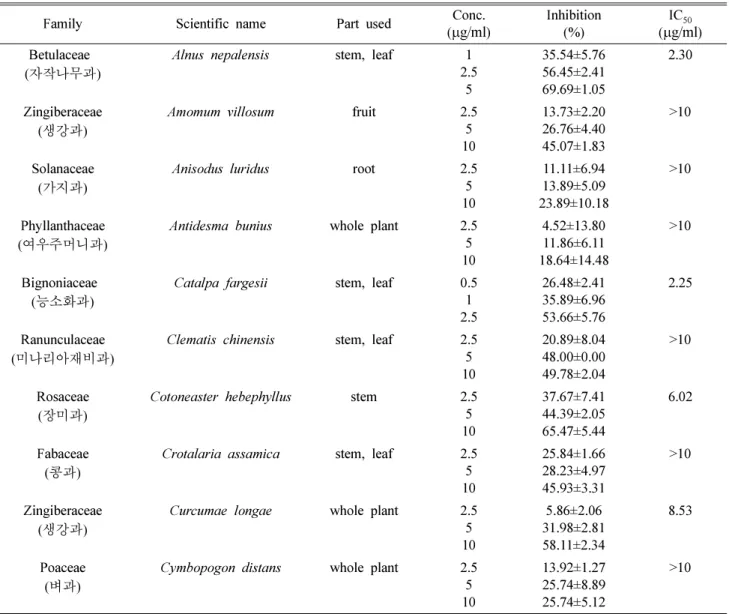
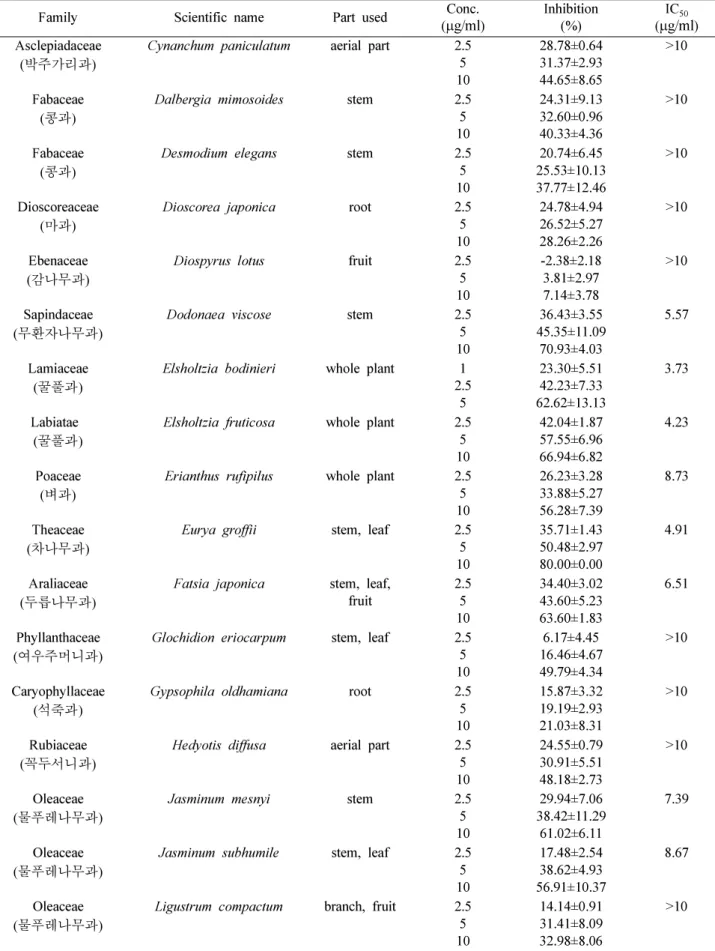
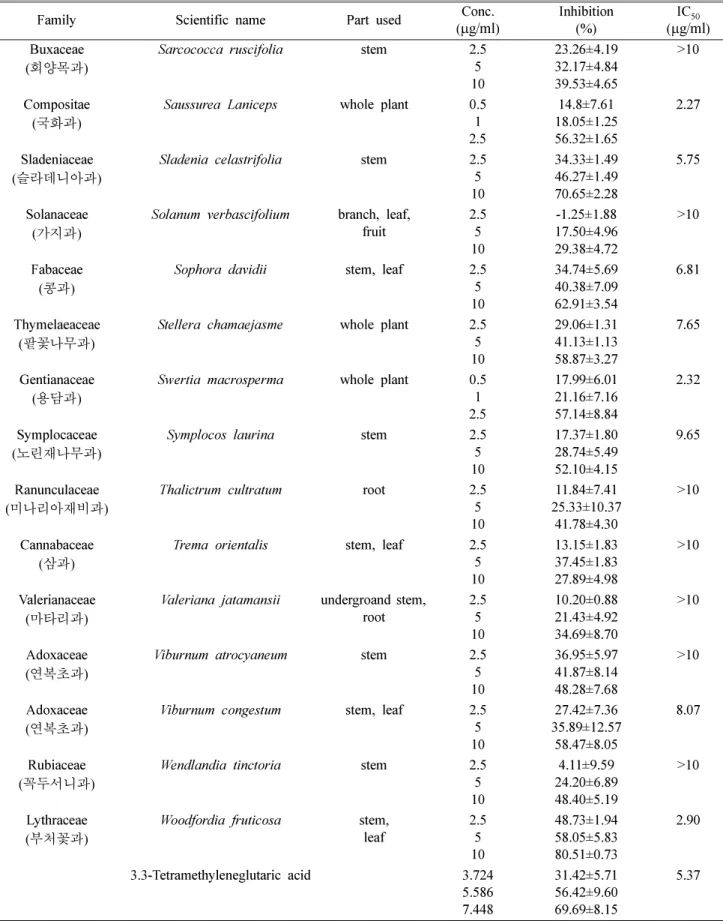
천연물로부터 알도즈 환원효소 억제 약물을 검색하기 위 해 중국산 59종의 에탄올 추출물을 이용해 효능을 검색하 여 Table I과 같은 결과를 얻었다.
Table I. Inhibitory effect of extracts from Chinese herbal medicines on the activities of aldose reductase
Family Scientific name Part used Conc.
(µg/ml) Inhibition (%)
IC50 (µg/ml) Betulaceae
(자작나무과)
Alnus nepalensis stem, leaf 1 2.5
5
35.54±5.76 56.45±2.41 69.69±1.05
2.30
Zingiberaceae (생강과)
Amomum villosum fruit 2.5
5 10
13.73±2.20 26.76±4.40 45.07±1.83
>10
Solanaceae (가지과)
Anisodus luridus root 2.5
5 10
11.11±6.94 13.89±5.09 23.89±10.18
>10
Phyllanthaceae (여우주머니과)
Antidesma bunius whole plant 2.5 5 10
4.52±13.80 11.86±6.11 18.64±14.48
>10
Bignoniaceae (능소화과)
Catalpa fargesii stem, leaf 0.5 1 2.5
26.48±2.41 35.89±6.96 53.66±5.76
2.25
Ranunculaceae (미나리아재비과)
Clematis chinensis stem, leaf 2.5 5 10
20.89±8.04 48.00±0.00 49.78±2.04
>10
Rosaceae (장미과)
Cotoneaster hebephyllus stem 2.5 5 10
37.67±7.41 44.39±2.05 65.47±5.44
6.02
Fabaceae (콩과)
Crotalaria assamica stem, leaf 2.5 5 10
25.84±1.66 28.23±4.97 45.93±3.31
>10
Zingiberaceae (생강과)
Curcumae longae whole plant 2.5 5 10
5.86±2.06 31.98±2.81 58.11±2.34
8.53
Poaceae (벼과)
Cymbopogon distans whole plant 2.5 5 10
13.92±1.27 25.74±8.89 25.74±5.12
>10
Table I. Continued
Family Scientific name Part used Conc.
(µg/ml) Inhibition (%)
IC50 (µg/ml) Asclepiadaceae
(박주가리과)
Cynanchum paniculatum aerial part 2.5 5 10
28.78±0.64 31.37±2.93 44.65±8.65
>10
Fabaceae (콩과)
Dalbergia mimosoides stem 2.5
5 10
24.31±9.13 32.60±0.96 40.33±4.36
>10
Fabaceae (콩과)
Desmodium elegans stem 2.5
5 10
20.74±6.45 25.53±10.13 37.77±12.46
>10
Dioscoreaceae (마과)
Dioscorea japonica root 2.5
5 10
24.78±4.94 26.52±5.27 28.26±2.26
>10
Ebenaceae (감나무과)
Diospyrus lotus fruit 2.5
5 10
-2.38±2.18 3.81±2.97 7.14±3.78
>10
Sapindaceae (무환자나무과)
Dodonaea viscose stem 2.5
5 10
36.43±3.55 45.35±11.09
70.93±4.03
5.57
Lamiaceae (꿀풀과)
Elsholtzia bodinieri whole plant 1 2.5
5
23.30±5.51 42.23±7.33 62.62±13.13
3.73
Labiatae (꿀풀과)
Elsholtzia fruticosa whole plant 2.5 5 10
42.04±1.87 57.55±6.96 66.94±6.82
4.23
Poaceae (벼과)
Erianthus rufipilus whole plant 2.5 5 10
26.23±3.28 33.88±5.27 56.28±7.39
8.73
Theaceae (차나무과)
Eurya groffii stem, leaf 2.5 5 10
35.71±1.43 50.48±2.97 80.00±0.00
4.91
Araliaceae (두릅나무과)
Fatsia japonica stem, leaf, fruit
2.5 5 10
34.40±3.02 43.60±5.23 63.60±1.83
6.51
Phyllanthaceae (여우주머니과)
Glochidion eriocarpum stem, leaf 2.5 5 10
6.17±4.45 16.46±4.67 49.79±4.34
>10
Caryophyllaceae (석죽과)
Gypsophila oldhamiana root 2.5
5 10
15.87±3.32 19.19±2.93 21.03±8.31
>10
Rubiaceae (꼭두서니과)
Hedyotis diffusa aerial part 2.5 5 10
24.55±0.79 30.91±5.51 48.18±2.73
>10
Oleaceae (물푸레나무과)
Jasminum mesnyi stem 2.5
5 10
29.94±7.06 38.42±11.29
61.02±6.11
7.39
Oleaceae (물푸레나무과)
Jasminum subhumile stem, leaf 2.5 5 10
17.48±2.54 38.62±4.93 56.91±10.37
8.67
Oleaceae (물푸레나무과)
Ligustrum compactum branch, fruit 2.5 5
14.14±0.91 31.41±8.09
>10
Primulaceae (앵초과)
Lysimachia clethroides whole plant 2.5 5 10
20.18±5.60 30.04±5.86 56.50±4.11
8.80
Musaceae (파초과)
Musella lasiocarpa whole plant 2.5 5 10
17.41±6.33 27.68±5.84 37.50±6.04
>10
Rubiaceae (꼭두서니과)
Mussaenda pubescens stem, leaf 2.5 5 10
26.46±7.10 42.41±1.78 58.37±4.72
7.69
Valerianaceae (마타리과)
Nardostachys chinensis whole plant 1 2.5
5
18.98±4.24 29.63±3.50 51.39±0.00
4.88
Poaceae (벼과)
Neyraudia neyraudiana whole plant 2.5 5 10
28.57±1.55 37.50±2.79 70.54±1.34
6.61
Oleaceae (물푸레나무과)
Olea yunnanensis stem 2.5
5 10
18.65±2.37 20.73±3.11 28.50±8.23
>10
Buxaceae (회양목과)
Pachysandra axillaris whole plant 2.5 5 10
-12.24±2.34 -6.12±10.19 -0.51±1.77
>10
Rubiaceae (꼭두서니과)
Paederia scandens whole plant 2.5 5 10
9.86±6.14 11.27±3.73 34.74±9.38
>10
Piperaceae (후추과)
Piper nigrum fruit 2.5
5 10
26.54±2.24 29.77±4.98 45.63±5.14
>10
Ruscaceae (백합과)
Polygonatum cirrhifolium bulbs 2.5 5 10
12.10±3.08 22.78±2.47 12.10±13.35
>10
Polyporaceae (구멍장이버섯과)
Poria cocos sclerotium 2.5
5 10
18.55±3.15 25.09±3.33 27.27±2.75
>10
Fagaceae (참나무과)
Quercus aquifolioides stem 2.5 5 10
27.50±5.27 43.50±7.70 60.50±7.40
7.38
Fagaceae (참나무과)
Quercus franchetii stem 2.5
5 10
24.45±8.52 35.81±5.71 41.05±5.24
>10
Fagaceae (참나무과)
Quercus schottkyana stem 2.5
5 10
5.52±2.87 29.83±6.28 59.12±0.96
8.48
Rosaceae (장미과)
Rosa multiflora fruit 1
2.5 5
30.82±2.48 39.67±2.84 52.46±3.16
4.53
Rhamnaceae (갈매나무과)
Sageretia thea stem 2.5
5 10
25.52±2.61 33.05±9.25 50.63±3.16
9.93
Umbelliferae (산형과)
Saposhnikovia divaricata root 2.5 5 10
6.53±1.19 3.44±4.17 16.49±3.09
>10
Table I. Continued
Family Scientific name Part used Conc.
(µg/ml) Inhibition (%)
IC50 (µg/ml) Buxaceae
(회양목과)
Sarcococca ruscifolia stem 2.5
5 10
23.26±4.19 32.17±4.84 39.53±4.65
>10
Compositae (국화과)
Saussurea Laniceps whole plant 0.5 1 2.5
14.8±7.61 18.05±1.25 56.32±1.65
2.27
Sladeniaceae (슬라데니아과)
Sladenia celastrifolia stem 2.5 5 10
34.33±1.49 46.27±1.49 70.65±2.28
5.75
Solanaceae (가지과)
Solanum verbascifolium branch, leaf, fruit
2.5 5 10
-1.25±1.88 17.50±4.96 29.38±4.72
>10
Fabaceae (콩과)
Sophora davidii stem, leaf 2.5 5 10
34.74±5.69 40.38±7.09 62.91±3.54
6.81
Thymelaeaceae (팥꽃나무과)
Stellera chamaejasme whole plant 2.5 5 10
29.06±1.31 41.13±1.13 58.87±3.27
7.65
Gentianaceae (용담과)
Swertia macrosperma whole plant 0.5 1 2.5
17.99±6.01 21.16±7.16 57.14±8.84
2.32
Symplocaceae (노린재나무과)
Symplocos laurina stem 2.5
5 10
17.37±1.80 28.74±5.49 52.10±4.15
9.65
Ranunculaceae (미나리아재비과)
Thalictrum cultratum root 2.5
5 10
11.84±7.41 25.33±10.37
41.78±4.30
>10
Cannabaceae (삼과)
Trema orientalis stem, leaf 2.5 5 10
13.15±1.83 37.45±1.83 27.89±4.98
>10
Valerianaceae (마타리과)
Valeriana jatamansii undergroand stem, root
2.5 5 10
10.20±0.88 21.43±4.92 34.69±8.70
>10
Adoxaceae (연복초과)
Viburnum atrocyaneum stem 2.5
5 10
36.95±5.97 41.87±8.14 48.28±7.68
>10
Adoxaceae (연복초과)
Viburnum congestum stem, leaf 2.5 5 10
27.42±7.36 35.89±12.57
58.47±8.05
8.07
Rubiaceae (꼭두서니과)
Wendlandia tinctoria stem 2.5
5 10
4.11±9.59 24.20±6.89 48.40±5.19
>10
Lythraceae (부처꽃과)
Woodfordia fruticosa stem, leaf
2.5 5 10
48.73±1.94 58.05±5.83 80.51±0.73
2.90
3.3-Tetramethyleneglutaric acid 3.724 5.586 7.448
31.42±5.71 56.42±9.60 69.69±8.15
5.37
IC50 values were calculated from the dose inhibition curve.
a
을 판단하였다. 이 중 Catalpa fargesii의 줄기, 잎(2.25 µg/ml), Saussurea Laniceps의 전초(2.27 µg/ml), Alnus nepalensis의 줄기, 잎(2.30 µg/ml), Swertia macrosperma의 전초(2.32 µg/
ml), Woodfordia fruticosa의 줄기, 잎(2.90 µg/ml), Elsholtzia bodinieri의 전초(3.73 µg/ml), Elsholtzia fruticosa의 전초 (4.23µg/ml), Rosa multiflora의 열매(4.53 µg/ml), Nardo- stachys chinensis의 전초(4.88µg/ml), Eurya groffii의 줄기, 잎(4.91 µg/ml)의 10종 추출물은 TMG 보다 우수한 효능이 있음을 알 수 있었다. 국화과의 S. Laniceps의 추출물은 동 물모델에서 항염증, 항진통 효능을 나타내며,20) 수용성과 에 탄올 추출 방법에 따른 성분의 비교와 동물모델에서 항염, 항진통효능, in vitro에서 항산화 효능의 비교 연구도 보고 되었다.21) 자작나무과의 A. nepalensis의 잎에서 분리한 단 일 화합물질인 platyphyllenone, alusenone, hirustenone, hirsutanonol의 살사상충 효능에 관한 연구가 보고되었다.22) 용담과의 S. macrosperma 성분연구와23) B형 간염 바이러스 억제효능 연구가 보고되었다.24) 부처꽃과의 W. fruticosa는 잎에서 분리한 woodfruticosin의 DNA topoisomerase II 억 제와25) 꽃추출물에서 1형 당뇨동물모델에서 혈당강하, 인슐 린수치 증가, 지질과산화 억제 등의 효능을 나타내었다.26) 꿀풀과의 E. bodinieri는 기침, 두통, 인두염, 해열, 감염 등 에 주로 사용된 중국 전통 약초로 flavonoid glycosides, triterpene glycosides 등의 성분을 함유하고 있다.27)장미과 의 R. multiflora는 추출물의 항염작용과28) lignans, triterpenes phenolic compounds 등의 성분연구가 보고되었다.29) 마타리 과의 N. chinensis 는 뿌리와 근경의 메탄올 추출물에서 분 리한 nardosinone, desoxo-narchinol A 등 5종의 단일물질이 lipopolysaccharides로 유도된 RAW 264.7에서 nitric oxide 억제효능을 나타내었다.30) 차나무과의 E. groffii는 본 연구 팀 결과 줄기, 잎에서 당뇨합병증의 또 다른 원인 중 하나 인 최종당화산물 억제효능이 우수하여31) in vivo 실험을 통 한 효능 확인이 필요하다고 사료된다. 꿀풀과의 E. fruticosa 와 능소화과의 C. fargesii는 효능 및 성분에 관한 연구가 진 행된바 없으며, 위 10종 모두 알도즈 환원 효소 억제 효능 에 관해 보고된 바 없었다. 본 연구 결과는 안전하고 우수 한 알도즈 환원 효소 억제제 후보 물질 발굴을 위한 기초자 료로 활용될 수 있을 뿐만 아니라, 당뇨합병증 예방 및 치 료제 개발에 이용될 수 있을 것으로 사료된다.
결 론
59종의 중국산 약용식물 에탄올 추출물을 in vitro에서 알 도즈 환원 효소 억제활성 검색하였다. 그 결과 10종의 추출 물이 양성대조군인 TMG보다 효능이 있음을 확인하였고,
사 사
본 연구는 한국한의학연구원 기관고유사업비(K12040, K13040)로 수행되었으며 이에 감사드립니다.
인용문헌
1. Vinson, J. A. and Howard III, T. B. (1996) Inhibition of pro- tein glycation and advanced glycation end products by ascor- bic acid and other vitamins and nutrients. J. Nutr. Biochem. 7:
659-663.
2. Collins, J. B. and Corder, C. N. (1977) Aldose reductase and sorbitol dehydrogenase distribution in substrctures of normal and diabetic rats lens. Invest. Ophthamol. Visual Sci. 16: 242- 243.
3. Dvonik, D., Gabbay, K. H. and Kinoshita, J. H. (1973) Polyol accumulation in galactosemic and diabetic rats. Science 182:
1146-1148.
4. Lee, Y. S., Kim, S. H., Jung, S. H., Kim, J. K., Pan, C. H. and Lim, S. S. (2010) Aldose reductase inhibitory compounds from Glycyrrhiza uralensis. Biol. Pharm. Bull. 33: 917-921.
5. Fatmawati, S., Kurashiki, K., Takeno, S., Kim, Y. U., Shimizu, K., Sato, M., Imaizumi, K., Takahashi, K., Kamiya, S., Kaneko, S. and Kondo, R. (2009) The inhibitory effect on aldose reductase by an extract of Ganoderma lucidum. Phy- tother. Res. 23: 28-32.
6. Jang, D. S., Yoo, N. H., Kim, N. H., Lee, Y. M., Kim, C. S., Kim, J. Kim, J. H. and Kim, J. S. (2010) 3,5-Di-O-caffeoyl- epi-quinic acid from the leaves and stems of Erigeron annuus inhibits protein glycation, aldose reductase and cataracto- genesis. Biol. Pharm. Bull. 33: 329-333.
7. Yoo, N. H., Jang, D. S., Yoo, J. L., Lee, Y. M., Kim. Y. S., Cho, J. H. and Kim, J. S. (2008) Erigeroflavanone, a fla- vanone derivative from the flowers of Erigeron annuus with protein glycation and aldose reductase inhibitory activity. J.
Nat. Prod. 71: 713-715.
8. Kim, J. M., Jang, D. S., Lee, Y. M., Yoo, J. L., Kim. Y. S., Kim, J. H and Kim, J. S. (2008) Aldose reductase and protein glycation inhibitory principles from the whole plant of Duch- esnea chrysantha. Chem. Biodivers. 5: 352-356.
9. Yoo, N. H., Jang, D. S., Lee, Y. M., Jeong, I. H., Cho, J. H., Kim, J. H. and Kim, J. S. (2010) Anthraquinones from the roots of Knoxia valerianoides inhibit the formation of advanced glycation end products and rat lens aldose reduc- tase in vitro. Arch. Pharm. Res. 33: 209-214.
10. Kim, C. S., Kim, J., Jeong, I. H., Kim, Y. S., Lee, J., Jang, D.
S. and Kim, J. S. (2009) Slow development of diabetic cat- aract in streptozotocin-induced diabetic rats via inhibition of
aldose reductase activity and sorbitol accumulation by use of Aster koraiensis extract. Kor. J. Pharmacogn. 40: 339-344.
11. Lee, Y. M., Kim, N. H., Kim, J. M., Kim, Y. S., Jang, D. S., Kim, J. H., Bae, K. H. and Kim, J. S. (2008) Screening of inhibitory effect on aldose reductase of Korean herbal med- icines and preventive effect of Catalpa bignonioides against xylose-induced lens opacity (I). Kor. J. Pharmacogn. 39:
165-173.
12. Lee, Y. M., Kim, J. M., Kim, Y. S., Jang, D. S., Kim, J. H., Bae, K. H. and Kim, J. S. (2008) Screening of inhibitory effect on aldose reductase of Vietnam herbal medicines (II).
Kor. J. Pharmacogn. 39: 324-329.
13. Lee, Y. M., Kim, J. M., Kim, Y. S., Jang, D. S., Kim, J. H., Bae, K. H. and Kim, J. S. (2009) Screening of Chinese herbal medicines with inhibitory effect on aldose reductase (III).
Kor. J. Pharmacogn. 40: 394-399.
14. Lee, Y. M., Kim, Y. S., Bae, K. H., Kim, J. H. and Kim, J. S.
(2010) Screening of Chinese herbal medicines with inhibitory effect on aldose reductase (IV) Kor. J. Pharmacogn. 41: 289- 296.
15. Lee, Y. M., Kim, Y. S., Kim, J. H. and Kim, J. S. (2011) Screening of Chinese herbal medicines with inhibitory effect on aldose reductase. (V) Kor. J. Pharmacogn. 42: 187-194.
16. Lee, Y. M., Kim, Y. S., Kim, J. H. and Kim, J. S. (2011) Screening of Korean herbal medicines with inhibitory effect on aldose reductase. (VI) Kor. J. Pharmacogn. 42: 161-168.
17. Dufrane, S. P., Malaisse, W. J. and Sener, A. (1984) A micromethod for the assay of aldose reductase, its application to pancreatic islets. Biochem. Med. 32: 99-105.
18. Bradford, M. (1976) A rapid and sensitive method for the quantitation of microgram quantities of protein utilizing the principle of protein-dye binding. Anal. Biochem. 72: 248-254.
19. Kinoshita, J. H., Dvornik, D., Kraml, M. and Gabbay, K. H.
(1968) The effect of an aldose reductase inhibitor on the galactose-exposed rabbit lens. Biochim. Biophys. Acta. 24:
472-475.
20. Yi, T., Zhao, Z. Z., Yu, Z. L. and Chen, H. B. (2010) Com- parison of the anti-inflammatory and anti-nociceptive effects of three medicinal plants known as “Snow Lotus” herb in tra- ditional Uighur and Tibetan medicines. J. Ethnopharmacol.
128: 405-411.
21. Yi, T., Lo, H., Zhao, Z., Yu., Z, Yang, Z. and Chen, H. (2012) Comparison of the chemical composition and pharmaco- logical effects of the aqueous and ethanolic extracts from a Tibetan “Snow Lotus” (Saussurea laniceps) herb. Molecules.
17: 7183-7194.
22. Yadav, D., Singh, S. C., Verma, R. K., Saxena, K., Verma, R.,
Murthy, P. K. and Gupta, M. M. (2013) Antifilarial dia- rylheptanoids from Alnus nepalensis leaves growing in high altitude areas of Uttarakhand, India. Phytomedicine 20: 124- 132.
23. Wang, H., Geng, C., Zhang, X., Ma, Y., Jiang, Z. and Chen, J. (2010) Chemical constituents of Swertia macrosperma.
Zhongguo Zhong Yao Za Zhi. 35: 3161-3164.
24. Wang, H. L., He, K., Geng, C. A., Zhang, X. M., Ma, Y. B., Luo, J. and Chen, J. J. (2012) Gentiocrucines A-E, five unusual lactonic enamino Ketones from Swertia mac- rosperma and Swertia angustifolia. Planta Med. 78: 1867- 1872.
25. Kadota, S., Takamori, Y., Nyein, K. N., Kikuchi, T., Tanaka, K. and Ekimoto, H. (1990) Constituents of the leaves of Woodfordia fruticosa Kurz. I. Isolation, structure, and proton and carbon-13 nuclear magnetic resonance signal assign- ments of woodfruticosin (woodfordin C), an inhibitor of deoxyribonucleic acid topoisomerase II. Chem. Pharm. Bull.
38: 2687-2697.
26. Verma, N., Amresh, G., Sahu, P. K., Rao, Ch. V. and Singh, A. P. (2012) Antihyperglycemic activity of Woodfordia fru- ticosa (Kurz) flowers extracts in glucose metabolism and lipid peroxidation in streptozotocin-induced diabetic rats.
Indian J. Exp. Biol. 50:351-358.
27. Li, R. T., Li, J. T., Wang, J. K., Han, Q. B., Zhu, Z. Y. and Sun, H. D.(2008) Three new flavonoid glycosides isolated from Elsholtzia bodinieri. Chem. Pharm. Bull. 56:592-594.
28. Zhang, G. Q., Huang, X. D., Wang, H., Leung, A. K., Chan, C. L., Fong, D. W. and Yu, Z. L. (2008) Anti-inflammatory and analgesic effects of the ethanol extract of Rosa multiflora Thunb. hips. J. Ethnopharmacol. 118: 290-294.
29. Park, K. H., Kim, S. K., Choi, S. E., Kwon, J. H., Oh, M. H.
and Lee, M. W. (2010) Three new stereoisomers of con- densed tannins from the roots of Rosa multiflora. Chem.
Pharm. Bull. 58: 1227-1231.
30. Hwang, J. S., Lee, S. A., Hong, S. S., Han, X. H., Lee, C., Lee, D., Lee, C. K., Hong. J. T., Kim, Y., Lee, M. K. and Hwang, B. Y. (2012) Inhibitory constituents of Nardostachys chinensis on nitric oxide production in RAW 264.7 mac- rophages. Bioorg. Med. Chem. Lett. 22: 706-708.
31. Lee, Y. M., Kim, Y. S., Kim, J. H. and Kim, J. S. (2011) Screening of herbal medicines from China with inhibitory activity on advanced glycation end products (AGEs) for- mation (VI). Kor. J. Pharmacogn. 42: 161-168.
(2013. 3. 6 접수; 2013. 3. 22 심사; 2013. 4. 9 게재확정)