44(3) : 298∼ 304 (2013)
298
한국약용식물의 최종당화산물 생성저해활성 검색 (IX)
이윤미1·김영숙1·김주환2·김진숙1*
1한국한의학연구원 한약연구본부 한의신약개발그룹, 2가천대학교 생명과학과
Screening of Korean Herbal Medicines with Inhibitory Activity on Advanced Glycation End Products Formation (IX)
Yun Mi Lee1, Young Sook Kim1, Joo Hwan Kim2 and Jin Sook Kim1*
1Korean Medicine-Based Herbal Drug Development Group, Herbal Medicine Research Division, Korea Institute of Oriental Medicine, 1672 Yuseongdae-ro, Yuseong-gu, Daejeon 305-811, Korea
2Department of Life Science, Gachon University, Seongnam, Kyonggi-do 461-701, Korea
Abstracts − In this study, 64 Korean herbal medicines have been investigated with an in vitro evaluation systems using gly- cation end products (AGEs) formation inhibitory activity. Of these, 30 herbal medicines (IC50<50µg/ml) were found to have significant AGEs formation inhibitory activity. Of these, four herbal medicines (IC50<5µg/ml) were found to have significant AGEs formation inhibitory activity. Particularly, Cornus controversa (branches and leaves), Acer ginnala (stems and leaves), Platycarya strobilacea (flowers) and Picrasma quassioides (stems), showed more potent inhibitory activity (approximately 17- 27 fold) than the positive control aminoguanidine (IC50=77.04µg/ml).
Key words − Advanced glycation end products (AGEs), diabetic complications, Korean herbal medicines
만성의 고혈당 상태에서 단백질과 비효소적 당화 반응에 의해 생성되는 최종당화산물은 혈당이 정상으로 회복되어 도 분해가 되지 않고 단백질과 교차결합(AGEs-protein cross- link)하여 혈액이나 여러 조직 내 단백질 또는 지질과 반응 하여 각 장기에 축적되어 당뇨병성 신증, 망막증, 신경증, 백내장 등과 같은 당뇨합병증으로 진행된다. 따라서 최종당 화산물의 생성을 저해하거나, 이미 생성된 최종당화산물의 조직 내 교차결합을 억제하여 당뇨합병증을 예방하거나 치 료하기 위해 많은 연구들이 진행되고 있다.1-6) 본 연구팀에 서도 in vitro와 in vivo에서 추출물과 추출물에서 분리한 단 일화합물의 최종당화산물의 생성을 저해와 당뇨 동물 모델 에서 당뇨병성 합병증 진행을 지연시키는 효능을 확인할 수
있었다.7-18) 본 연구는 지난 보고에 이어,19-26) 한국에서 자생
하는 약용식물 64종의 에탄올 추출물을 대상으로 최종당화 산물 생성 저해 활성을 in vitro에서 검색하였다.
재료 및 방법
실험재료 − 본 실험에 사용된 약용 식물(Table I)들은 한
국에서 채취되어, 가천대학교 생명과학과 김주환 교수의 감 정을 거친 후 실험 재료로 사용되었다. 사용한 실험 재료의 증거표본은 한국한의학연구원 한약연구본부 한의신약개발 그룹 당뇨합병증 연구팀에 보관 중이다.
추출 및 시료조제 − 분쇄한 시료 200 g에 1 L의 에탄올을 넣고 실온상태에서 3일간 3회 추출하였다. 이를 여과하여 40oC의 수욕 상에서 감압농축을 실시한 후, 동결 건조기에 서 건조하였다. 추출물은 실험 수행 전에 감압 하에서 P2O5 를 이용하여 24시간 이상 재 건조한 후 DMSO(Sigma, St.
Louis, MO, USA)에 용해시켜 stock solution을 조제하였으 며 최종 DMSO의 농도가 0.2%가 되도록 15% TWEEN 80(Sigma, St. Louis, MO, USA)용액으로 희석하여 사용하 였다. 추출에 이용한 에탄올 및 그 외 시약은 1급 및 특급 시약을 사용하였다.
In vitro에서 최종당화산물 생성저해 실험 − Vinson과 Howard27)의 방법을 변형하여 실험을 실시하였다. 본 실험 에서는 50 mM phosphate buffer(pH 7.4)에 용해시킨 10 mg/
ml의 우혈청 알부민(bovine serum albumin, Sigma) 0.7 ml 과 0.2 M의 fructose와 glucose 0.1 ml을 여러 농도의 추출 물 0.2 ml과 함께 혼합하여 1 ml이 되도록 처리하였다. 이를 37oC에서 14일 동안 당화 반응시켰다. 이 때 50 mM
*교신저자(E-mail):[email protected] (Tel): +82-42-868-9465
안 박테리아의 생성을 방지하였다. 양성 대조군으로 추출물 대신 최종당화산물 생성저해제인 aminoguanidine을 사용하 였다. 배양 후에는 spectrofluorometric detector(Bio-TEK, Synergy HT, USA)를 이용하여 형광도를 측정하였다(Ex : 350, Em : 450 nm). 모든 시료는 triplicate로 수행하여 IC50 값으로 계산되었다.
결과 및 고찰
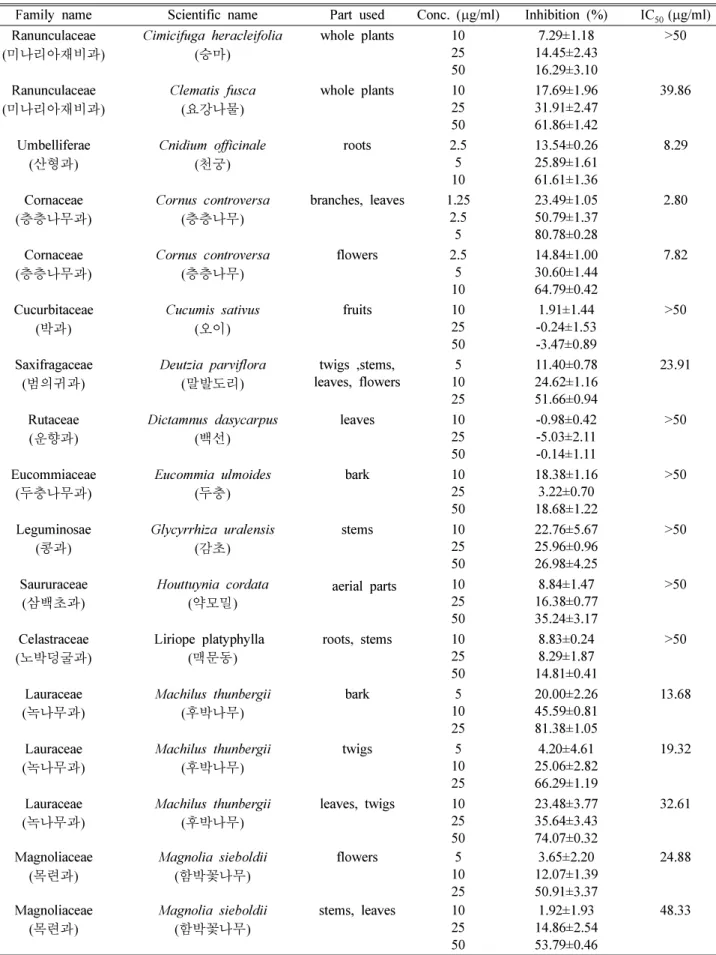
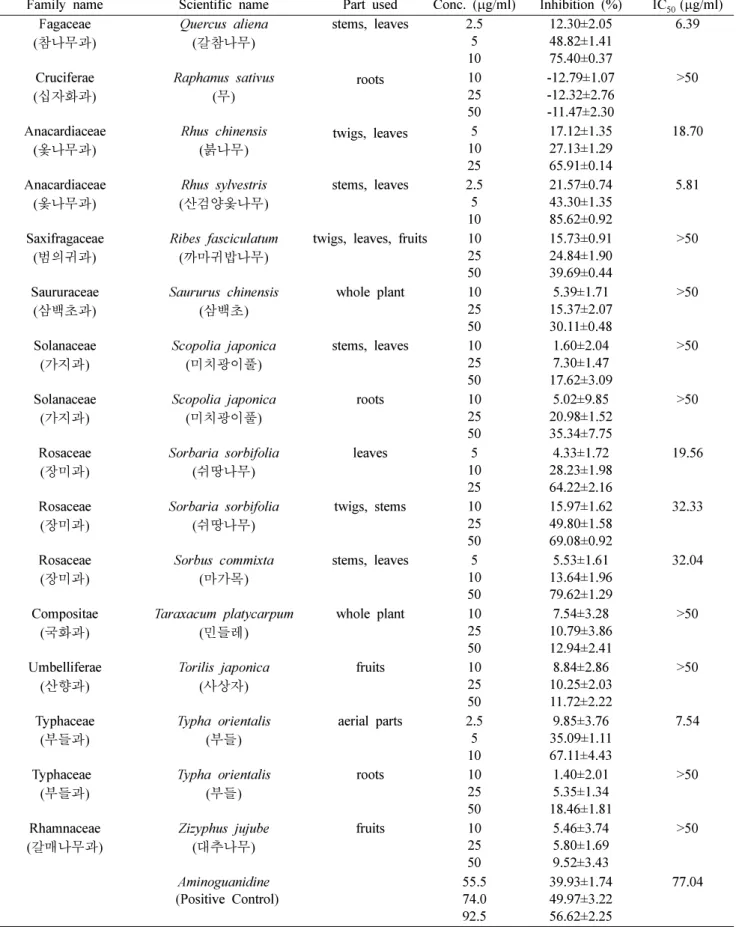
천연물로부터 최종당화산물 생성 억제 약물을 검색하기 위해 한국산 64종의 에탄올 추출물을 이용해 효능을 검색 하여 Table I과 같은 결과를 얻었다. 양성 대조 약물인
다. Table I에서 보여 주는 것과 같이 30종의 식물 추출물50
에서 IC50<50µg/ml로 최종당화산물 생성 저해 효능을 보였 고 그 중 Cornus controversa 줄기와 잎(2.80 µg/ml), Acer ginnala 줄기와 잎(3.34 µg/ml), Platycarya strobilacea 꽃 (3.67µg/ml), Picrasma quassioides 잎(4.36 µg/ml) 4종 식물 추출물에서 IC50<5µg/ml로 탁월한 최종당화산물 생성 저해 효능을 보였다. Celtis sinensis의 잎(31.23 µg/ml), 줄기와 소 지(<50 µg/ml), Picrasma quassioides 잎(4.36 µg/ml), 열매 (21.01µg/ml), 소지와 줄기(<50 µg/ml), Prunus persica 줄 기와 잎(21.18 µg/ml), 열매(<50 µg/ml), Typha orientalis 지 상부(7.54 µg/ml), 뿌리(<50 µg/ml) 경우 부위별로 최종당화 Table I. Inhibitory activity of the ethanol extracts of the herbal medicines on AGEs formation in vitro
Family name Scientific name Part used Conc. (µg/ml) Inhibition (%) IC50 (µg/ml) Aceraceae
(단풍나무과)
Acer ginnala (신나무)
stems, leaves 1.25 2.5
5
18.46±2.31 42.60±0.87 71.54±1.45
3.34
Aceraceae (단풍나무과)
Acer tegmentosum (산겨릅나무)
leaves 2.5
5 10
5.38±5.25 30.40±1.79 59.95±1.38
8.39
Rosaceae (장미과)
Agrimonia pilosa (짚신나물)
whole plants 2.5 5 10
11.28±2.66 17.48±2.54 96.24±0.65
6.52
Alismataceae (택사과)
Alisma canaliculatum (택사)
aerial parts 10 25 50
4.24±8.19 2.44±3.38 7.61±2.82
>50
Alismataceae (택사과)
Alisma canaliculatum (택사)
roots 10
25 50
2.02±1.32 8.88±2.17 6.35±2.58
>50
Boraginaceae (지치과)
Argusia sibirica (모래지치)
whole plants 10 25 50
3.93±3.93 40.09±1.39 64.18±1.22
37.92
Compositae (국화과)
Artemisia princeps
(애엽) aerial parts 10
25 50
13.10±6.48 24.92±0.46 40.39±2.22
>50
Compositae (국화과)
Artemisia scoparia
(비쑥) aerial parts 10
25 50
13.11±1.43 23.44±2.02 43.58±2.33
>50
Leguminosae (콩과)
Astragalus membranaceus (황기)
roots 10
25 50
8.80±1.65 14.85±3.05 21.34±3.72
>50
Crudiferae (십자화과)
Brassica juncea (갓)
leaves 10
25 50
1.24±3.20 -1.24±3.26 -2.70±2.05
>50
Ulmaceae (느릅나무과)
Celtis sinensis (팽나무)
leaves 10
25 50
22.26±0.96 44.70±0.80 72.31±0.56
31.23
Ulmaceae (느릅나무과)
Celtis sinensis (팽나무)
stems, twigs 10 25 50
15.28±0.61 27.04±3.16 43.11±1.39
>50
Table I. Continued
Family name Scientific name Part used Conc. (µg/ml) Inhibition (%) IC50 (µg/ml) Ranunculaceae
(미나리아재비과)
Cimicifuga heracleifolia (승마)
whole plants 10 25 50
7.29±1.18 14.45±2.43 16.29±3.10
>50
Ranunculaceae (미나리아재비과)
Clematis fusca (요강나물)
whole plants 10 25 50
17.69±1.96 31.91±2.47 61.86±1.42
39.86
Umbelliferae (산형과)
Cnidium officinale (천궁)
roots 2.5
5 10
13.54±0.26 25.89±1.61 61.61±1.36
8.29
Cornaceae (층층나무과)
Cornus controversa (층층나무)
branches, leaves 1.25 2.5
5
23.49±1.05 50.79±1.37 80.78±0.28
2.80
Cornaceae (층층나무과)
Cornus controversa (층층나무)
flowers 2.5
5 10
14.84±1.00 30.60±1.44 64.79±0.42
7.82
Cucurbitaceae (박과)
Cucumis sativus (오이)
fruits 10
25 50
1.91±1.44 -0.24±1.53 -3.47±0.89
>50
Saxifragaceae (범의귀과)
Deutzia parviflora (말발도리)
twigs ,stems, leaves, flowers
5 10 25
11.40±0.78 24.62±1.16 51.66±0.94
23.91
Rutaceae (운향과)
Dictamnus dasycarpus (백선)
leaves 10
25 50
-0.98±0.42 -5.03±2.11 -0.14±1.11
>50
Eucommiaceae (두충나무과)
Eucommia ulmoides (두충)
bark 10
25 50
18.38±1.16 3.22±0.70 18.68±1.22
>50
Leguminosae (콩과)
Glycyrrhiza uralensis (감초)
stems 10
25 50
22.76±5.67 25.96±0.96 26.98±4.25
>50
Saururaceae (삼백초과)
Houttuynia cordata
(약모밀) aerial parts 10
25 50
8.84±1.47 16.38±0.77 35.24±3.17
>50
Celastraceae (노박덩굴과)
Liriope platyphylla (맥문동)
roots, stems 10 25 50
8.83±0.24 8.29±1.87 14.81±0.41
>50
Lauraceae (녹나무과)
Machilus thunbergii (후박나무)
bark 5
10 25
20.00±2.26 45.59±0.81 81.38±1.05
13.68
Lauraceae (녹나무과)
Machilus thunbergii (후박나무)
twigs 5
10 25
4.20±4.61 25.06±2.82 66.29±1.19
19.32
Lauraceae (녹나무과)
Machilus thunbergii (후박나무)
leaves, twigs 10 25 50
23.48±3.77 35.64±3.43 74.07±0.32
32.61
Magnoliaceae (목련과)
Magnolia sieboldii (함박꽃나무)
flowers 5
10 25
3.65±2.20 12.07±1.39 50.91±3.37
24.88
Magnoliaceae (목련과)
Magnolia sieboldii (함박꽃나무)
stems, leaves 10 25 50
1.92±1.93 14.86±2.54 53.79±0.46
48.33
50
Liliaceae (백합과)
Maianthemum dilatatum (큰두루미꽃)
whole plants 10 25 50
2.06±3.96 6.87±1.45 11.30±3.79
>50
Sabiaceae (나도밤나무과)
Meliosma oldhamii (합다리나무)
leaves 2.5
5 10
12.73±1.26 34.53±1.37 66.23±0.29
7.57
Ranunculaceae (미나리아재비과)
Paeonia lactiflora (작약)
roots 2.5
5 10
16.95±3.08 44.63±4.44 81.45±0.67
6.10
Leguminosae (콩과)
Phaseolus angularis (팥)
fruits 10
25 50
2.03±3.85 5.81±5.25 5.17±3.08
>50
Leguminosae (콩과)
Phaseolus radiates (녹두)
fruits 10
25 50
11.25±2.75 9.88±3.51 9.13±2.73
>50
Simaroubaceae (소태나무과)
Picrasma quassioides (소태나무)
leaves 1.25
2.5 5
10.04±3.17 26.56±1.98 58.06±2.07
4.36
Simaroubaceae (소태나무과)
Picrasma quassioides (소태나무)
fruits 5
10 25
8.57±1.59 22.95±1.15 59.90±0.16
21.01
Simaroubaceae (소태나무과)
Picrasma quassioides (소태나무)
twigs, stems 10 25 50
-4.72±2.99 7.25±0.37 22.15±4.59
>50
Juglandaceae (가래나무과)
Platycarya strobilacea (굴피나무)
flowers 1.25
2.5 5
16.57±2.42 36.50±2.29 66.78±1.83
3.67
Juglandaceae (가래나무과)
Platycarya strobilacea (굴피나무)
leaves 2.5
5 10
23.39±1.98 43.80±1.37 71.65±2.14
6.43
Juglandaceae (가래나무과)
Platycarya strobilacea (굴피나무)
twigs, stems 2.5 5 10
22.98±1.32 44.30±3.43 67.81±1.52
6.69
Polygonaceae (마디풀과)
Pleuropterus multiflorus (하수오)
roots 10
25 50
1.86±3.02 5.38±0.95 6.79±1.94
>50
Liliaceae (백합과)
Polygonatum odoratum (둥굴레)
roots 10
25 50
15.49±2.03 20.69±0.95 27.64±0.44
>50
Polygonaceae (마디풀과)
Polygonum aviculare (마디풀)
aerial parts 10 25 50
4.56±1.35 16.59±0.19 38.70±2.09
>50
Rosaceae (장미과)
Prunus persica (복사나무)
stems, leaves 5 10 25
5.35±3.09 17.69±8.08 60.83±1.76
21.18
Rosaceae (장미과)
Prunus persica (복사나무)
fruits 10
25 50
-7.38±2.38 -0.91±1.40 1.00±2.65
>50
Rosaceae (장미과)
Prunus serrulata (잔털벚나무)
stems, leaves 2.5 5 10
6.42±3.68 15.71±1.46 49.60±1.48
10.25
Table I. Continued
Family name Scientific name Part used Conc. (µg/ml) Inhibition (%) IC50 (µg/ml) Fagaceae
(참나무과)
Quercus aliena (갈참나무)
stems, leaves 2.5 5 10
12.30±2.05 48.82±1.41 75.40±0.37
6.39
Cruciferae (십자화과)
Raphanus sativus
(무) roots 10
25 50
-12.79±1.07 -12.32±2.76 -11.47±2.30
>50
Anacardiaceae (옻나무과)
Rhus chinensis
(붉나무) twigs, leaves 5
10 25
17.12±1.35 27.13±1.29 65.91±0.14
18.70
Anacardiaceae (옻나무과)
Rhus sylvestris (산검양옻나무)
stems, leaves 2.5 5 10
21.57±0.74 43.30±1.35 85.62±0.92
5.81
Saxifragaceae (범의귀과)
Ribes fasciculatum (까마귀밥나무)
twigs, leaves, fruits 10 25 50
15.73±0.91 24.84±1.90 39.69±0.44
>50
Saururaceae (삼백초과)
Saururus chinensis (삼백초)
whole plant 10 25 50
5.39±1.71 15.37±2.07 30.11±0.48
>50
Solanaceae (가지과)
Scopolia japonica (미치광이풀)
stems, leaves 10 25 50
1.60±2.04 7.30±1.47 17.62±3.09
>50
Solanaceae (가지과)
Scopolia japonica (미치광이풀)
roots 10
25 50
5.02±9.85 20.98±1.52 35.34±7.75
>50
Rosaceae (장미과)
Sorbaria sorbifolia (쉬땅나무)
leaves 5
10 25
4.33±1.72 28.23±1.98 64.22±2.16
19.56
Rosaceae (장미과)
Sorbaria sorbifolia (쉬땅나무)
twigs, stems 10 25 50
15.97±1.62 49.80±1.58 69.08±0.92
32.33
Rosaceae (장미과)
Sorbus commixta (마가목)
stems, leaves 5 10 50
5.53±1.61 13.64±1.96 79.62±1.29
32.04
Compositae (국화과)
Taraxacum platycarpum (민들레)
whole plant 10 25 50
7.54±3.28 10.79±3.86 12.94±2.41
>50
Umbelliferae (산향과)
Torilis japonica (사상자)
fruits 10
25 50
8.84±2.86 10.25±2.03 11.72±2.22
>50
Typhaceae (부들과)
Typha orientalis (부들)
aerial parts 2.5 5 10
9.85±3.76 35.09±1.11 67.11±4.43
7.54
Typhaceae (부들과)
Typha orientalis (부들)
roots 10
25 50
1.40±2.01 5.35±1.34 18.46±1.81
>50
Rhamnaceae (갈매나무과)
Zizyphus jujube (대추나무)
fruits 10
25 50
5.46±3.74 5.80±1.69 9.52±3.43
>50
Aminoguanidine (Positive Control)
55.5 74.0 92.5
39.93±1.74 49.97±3.22 56.62±2.25
77.04
IC50 values were calculated from the dose inhibition curve
thunbergii 나무껍질(13.68 µg/ml), 소지(19.32 µg/ml), 잎과 소지(32.61 µg/ml), Magnolia sieboldii 꽃(24.88 µg/ml), 줄 기와 잎(48.33 µg/ml), Platycarya strobilacea 꽃(3.67 µg/ml), 잎(6.43 µg/ml), 소지와 줄기(6.69 µg/ml)는 부위별로 약간의 차이는 있지만 최종당화산물 생성 저해 효능을 지니고 있음 을 확인할 수 있었다. 층층나무과의 Cornus controversa는 한국과 중국에서 열매를 수렴, 강장제로 사용되어 왔으며,28) 잎에서 phenolic compound인 (-)-2,3-digalloyl-4-(E)-caffeoyl- L-threonic acid와 (-)-2-galloyl-4-(E)-caffeoyl-L-threonic acid 성분 분리와 열매에 함유된 anthocyanins의 항산화 효능이 보고되었다.29,30)단풍나무과의 Acer ginnala는 중국의 전통차 로 사용되고 있으며, 잎에서 분리한 methyl gallate, quercetin- 3-O-α-rhamnopyranoside, 2,6-bis(3,4,5- trihydroxybenzoyl)- aceritol의 항산화 효능이 보고되었고,31) 잎에서 알도즈 환원 효소 억제 효능을 나타내었다.32) 가래나무과 Platycarya strobilacea는 줄기 추출물에서 항산화 효능을 지닌 catechin 외 다량의 polyphenols을 함유하고 있으며, TNF-alpha에 의 한 NF-κB 활성화를 억제해 염증성 장 질환을 예방하는 효 능이 보고되었다.33) 소태나무과의 Picrasma quassioides 중 국에서 만성 소화불량, 위장염, 습진 등에 쓰인 전통약재로 항진균, 항바이러스 항궤양 등의 효능이 보고된 4-methoxy- 5-hydroxycanthin-6-one과 4,5-dimethoxycanthin-6-one 등의 화합물을 함유하고 있다.34,35)또한 뿌리에서 분리한 β- Carboline alkaloids가 항염증 작용을 나타내었다.36) 위 언급 된 4종의 약용식물은 양성 대조 약물 보다 17-27배 이상 최 종당화산물 생성 억제 효능이 우수한 것으로 확인되었으므 로, in vivo효능 확인이 필요하다고 사료된다. 본 연구 결과 는 한국산 약용식물로부터 안전하고 효능이 좋은 최종당화 산물 생성 저해제 후보를 발굴하기 위한 기초 자료로 활용 될 수 있으며, 만성 당뇨에 의한 합병증 치료제 개발의 기 반을 구축하는데 기여할 수 있을 것이다.
결 론
기원이 확인된 한국산 약용식물 64종의 에탄올 추출물이 in vitro에서 최종당화산물 생성저해 효능이 검색되었다. 그 결과 30종이 양성대조군인 aminoguanidine보다 우수한 효 능이 있음을 확인하였고, 그 중 C. controversa(가지, 잎), A.
ginnala(줄기, 잎), P. strobilacea(꽃), P. quassioides(줄기) 등 4종의 추출물은 양성대조군(aminoguanidine) 보다 17-27배 억제 효능이 우수한 것으로 나타났다.
사 사
본 연구는 한국한의학연구원 기관고유사업(K12040,
인용문헌
1. Huebschmann, A. G., Vlassara, H., Regensteiner, J. G. and Reusch, J. (2006) Diabetes and advanced glycoxidation end products. Diabetes care 29:1420-1432.
2. Yokozawa, T., Nakagawa, T. and Terasawa, K. (2001) Effects of oriental medicines on the production of advanced gly- cation endproducts. J. trad. Med. 18:107-112.
3. Rahbar, S. and Figarola, J. L. (2003) Novel inhibitors of advenced glycation endproducts. Arch. Biochem. Biophys.
419: 63-79.
4. Wilkinson-Berka, J. L., Kelly, D. J., Koerner, S. M., Jaworski, K., Davis B., Thallas, V. and Cooper, M. E. (2002) ALT-946 and aminoguanidine, inhibitors of advanced glycation, improve severe nephropathy in the diabetic transgenic (mREN-2) 27 rat. Diabetes 51: 3283-3289.
5. Peppa, M., Brem, H., Cai, W., Zhang, J. G., Basgen, J., Li, Z., Vlassara, H. and Uribarri, J. (2006) Prevention and reversal of diabetic nephropathy in db/db mice treated with alage- brium (ALT-711). Am. J. Nephrol. 26: 430-436.
6. Yang, S., Litchfield, J. E. and Baynes, J. W. (2003) AGE breakers cleave model compounds, but do not break maillard crosslinks in skin and tail collagen from diabetic rats. Arch.
Biochem. Biophys. 412: 42-46.
7. Jang, D. S., Kim, J. M., Lee, Y. M., Kim, Y. S., Kim. J. H. and Kim, J. S. (2006) Puerariafuran, a new inhibitor of advanced glycation end products (AGEs) isolated from the roots of Pueraria lobata. Chem. Pharm. Bull. 54: 1315-1317.
8. Jang, D. S., Lee, Y. M., Jeong, I. H. and Kim, J. S. (2010) Constituents of the flowers of Platycodon grandiflorum with inhibitory activity on advanced glycation end products and rat lens aldose reductase in vitro. Arch. Pharm. Res. 33: 875-880.
9. Jang, D. S., Lee, G. Y., Lee, Y. M., Kim, Y. S., Sun, H., Kim, D. H. and Kim, J. S. (2009) Flavan-3-ols having a gamma- lactam from the roots of Actinidia arguta inhibit the for- mation of advanced glycation end products in vitro. Chem.
Pharm. Bull. 57: 397-400.
10. Jang, D. S., Yoo, N. H., Kim, N. H., Lee, Y. M., Kim, C. S., Kim, J. Kim, J. H. and Kim, J. S. (2010) 3,5-Di-O-caffeoyl- epi-quinic acid from the leaves and stems of Erigeron annuus inhibits protein glycation, aldose reductase and cataracto- genesis. Biol. Pharm. Bull. 33: 329-333.
11. Kim, J. M., Jang, D. S., Lee, Y. M., Yoo, J. L., Kim. Y. S., Kim, J. H. and Kim, J. S. (2008) Aldose reductase and pro- tein glycation inhibitory principles from the whole plant of Duchesnea chrysantha. Chem. Biodivers. 5: 352-356.
12. Yoo, N. H., Jang, D. S., Lee, Y. M., Jeong, I. H., Cho, J. H., Kim, J. H. and Kim, J. S. (2010) Anthraquinones from the roots of Knoxia valerianoides inhibit the formation of advanced glycation end products and rat lens aldose reduc- tase in vitro. Arch. Pharm. Res. 33: 209-214.
13. Lee, G. Y., Jang, D. S., Lee, Y. M., Kim, J. M. and Kim, J. S.
(2006) Naphthopyrone glucosides from the seeds of Cassia tora with inhibitory activity on advanced glycation end prod- ucts (AGEs) formation. Arch. Pharm. Res. 29: 587-590.
14. Lee, J., Jang, D. S., Kim, N. H., Lee, Y. M., Kim, J. and Kim, J. S. (2011) Galloyl glucoses from the seeds of Cornus offi- cinalis with inhibitory activity against protein glycation, aldose reductase, and cataractogenesis ex vivo. Biol. Pharm.
Bull. 34: 443-446.
15. Sohn, E. J., Kim, Y. S., Kim, C. S., Lee, Y. M. and Kim, J.
S. (2009) KIOM-79 prevents apoptotic cell death and AGEs accumulation in retinas of diabetic db/db mice. J. Ethnop- harmacol. 121: 171-174.
16. Kim, Y. S., Lee, Y. M., Kim, C. S., Sohn, E. J., Jang, D. S.
and Kim, J. S. (2006) Inhibitory effect of KIOM, a new herbal prescription, on AGEs formation and expression of type IV collagen and TGF-β1 in STZ-induced diabetic rats.
Kor. J. Pharmacogn. 37: 103-109.
17. Kim, Y. S., Kim, J., Kim, C. S., Sohn, E. J., Lee, Y.M., Jeong, I. H., Kim, H., Jang, D. S. and Kim, J. S. (2009) KIOM-79, an inhibitor of AGEs–protein cross-linking, prevents pro- gression of nephropathy in Zucker diabetic fatty rats. Evid.
Based Complement. Alternat. Med. 2009 Jul 15. [Epub ahead of print]
18. Sohn, E., Kim, J., Jeong, I. H., Kim, C. S., Kim, Y. S. and Kim, J. S. (2011) Combination of medicinal herbs KIOM-79 reduces advanced glycation end product accumulation and the expression of inflammatory factors in the aorta of Zucker diabetic fatty rats. Evid. Based Complement. Alternat. Med.
2011:784136. Epub 2011 Feb 15.
19. Jang, D. S., Lee, Y. M., Kim, Y. S. and Kim, J. S. (2006) Screening of Korean traditional herbal medicines with inhib- itory activity on advanced glycation end products (AGEs) formation. Kor. J. Pharmacogn. 37: 48-52.
20. Lee, Y. M., Kim, Y. S., Kim, J. M., Jang, D. S., Kim, J. H., Yoo, J. L. and Kim, J. S. (2008) Screening of Korean herbal medicines with inhibitory activity on advanced glycation end products (AGEs) formation (II). Kor. J. Pharmacogn. 39:
223-227.
21. Jeong, I. H., Kim, J. M., Jang, D. S., Kim, J. H., Cho, J. H.
and Kim, J. S. (2009) Screening of Korean herbal medicines with inhibitory activity on advanced glycation end products (AGEs) formation (III). Kor. J. Pharmacogn. 40: 382-387.
22. Kim, J. M., Kim, Y. S., Kim, J. H., Yoo, J. L. and Kim, J. S.
(2009) Screening of herbal medicines from China and Viet- nam with inhibitory activity on advanced glycation end prod- ucts (AGEs) formation (IV). Kor. J. Pharmacogn. 40: 388- 393.
23. Kim, Y. S., Choi, S. H., Kim, J. H. and Kim, J. S. (2011) Screening of herbal medicines from China with inhibitory activity on advanced glycation end products (AGEs) for- mation (V) Kor. J. Pharmacogn. 42: 46-53.
24. Lee, Y. M., Kim, Y. S., Kim, J. H. and Kim, J. S. (2011)
Screening of herbal medicines from China with inhibitory activity on advanced glycation end products (AGEs) for- mation (VI) Kor. J. Pharmacogn. 42: 161-168.
25. Choi, S. J., Kim, Y. S., Song, Y. J., Lee, Y. M., Kim, J. H. and Kim, J. S. (2012) Screening of Korean herbal medicines with inhibitory activity on advanced glycation end products for- mation (VII). Kor. J. Pharmacogn. 43: 345-351
26. Choi, S. J., Song, Y. J., Kim, Y. S., Kim, J. H., Hang, S., Bach, T. T and Kim., J. S. (2012) Screening of herbal med- icines from China and Vietnam with inhibitory activity on advanced glycation end products (AGEs) formation (VIII).
Kor. J. Pharmacogn. 43: 338-344
27. Vinson, J.A. and Howard, III T.B. (1996) Inhibition of protein glycation and advanced glycation endproducts by ascorbic acid and other vitamins and nutrients. J. Nutr. Biochem. 7:
659-663.
28. Jang, H. M., Hwang, B. Y., Kim, M. S, Lee, D. H. Kang, S.
J., Ro, J. S. and Lee, K. S. (1998) Chemical components from the stems bark of Cornus controversa HEMSL. Kor. J. Phar- macogn. 29: 225-230.
29. Seeram, N. P., Schutzki, R., Chandra, A. and Nair, M. G.
(2002) Characterization, quantification, and bioactivities of anthocyanins in Cornus species. J. Agric. Food Chem. 50:
2519-2523.
30. Lee, D., Kang, S. J., Lee, S. H., Ro, J., Lee, K. and Kinghorn, A. D. (2000) Phenolic compounds from the leaves of Cornus controversa. Phytochemistry 53: 405-407.
31. Lu, R. L., Hu, F. L. and Xia, T. (2010) Activity-guided iso- lation and identification of radical scavenging components in Gao-Cha tea. J. Food Sci. 75: 239-243.
32. Kim, H. Y. and Oh, J. H. (1999) Screening of Korean forest plants for rat lens aldose reductase inhibition. Biosci .Bio- technol. Biochem. 63: 184-188.
33. Babu, D., Lee, J. S., Park, S. Y., Thapa, D., Choi, M. K., Kim, A. R., Park, Y. J. and Kim, J. A. (2008) Involvement of NF- kappaB in the inhibitory actions of Platycarya strobilacea on the TNF-alpha-induced monocyte adhesion to colon epithe- lial cells and chemokine expression. Arch. Pharm. Res. 31:
727-735.
34. Sung, Y., Koike, K., Nikaido, T., Ohmoto, T. and Sankawa, U. (1984) Inhibitors of cyclic AMP phosphodiesterase in Picrasma quassioides Bennet, and inhibitory activities of related beta-carboline alkaloids. Chem. Pharm. Bull. 32:
1872-1877.
35. Ohmoto, T., Sung, Y., Koike, K. and Nikaido, T. (1985) Effect of alkaloids of simaroubaceous plants on the local blood flow rate. Shoyakugaku Zasshi 39: 28-34.
36. Zhao, F., Gao, Z., Jiao, W., Chen, L. and Yao, X. (2012) In vitro anti-inflammatory effects of beta-carboline alkaloids, isolated from Picrasma quassioides, through inhibition of the iNOS pathway. Planta Med. 78: 1906-1911.
(2013. 8. 1 접수; 2013. 8. 14 심사; 2013. 8. 30 게재확정)