39(4) : 324 329 (2008)
324
베트남 약용식물 추출물의 알도즈 환원 효소 억제 효능 검색(II)
이윤미·김종민·김영숙·장대식·김주환1·배기환2·김진숙
*
한국한의학연구원 한약제제연구부
,
1대전대학교생명과학부,
2충남대학교 약학대학Screening of Inhibitory Effect on Aldose Reductase of Vietnam Herbal Medicines (II)
Yun Mi Lee, Jong Min Kim, Young Sook Kim, Dae Sik Jang, Joo Hwan Kim
1, Ki Hwan Bae
2and Jin Sook Kim
*Department of Herbal Pharmaceutical Development, Korea Institute of Oriental Medicine, Daejeon 305-811, Korea
1
Department of Life Science, Daejeon University, Daejeon 300-716, Korea
2
College of Pharmacy, Chungnam National University, Daejeon 305-764, Korea
Abstracts −
Aldose reductase (AR), the key enzyme in the polyol pathway, plays an important role in the pathogenesis of dia- betic complications such as cataract formation. AR inhibitors (ARI) can prevent or reverse early abnormalities in diabetic com- plications. However, none of ARI has achieved worldwide use because of limited efficacy or undesirable side effects. Therefore, evaluating natural sources for ARI potential may lead to the development of safer and more effective agents against diabetic complications. 49 Vietnam herbal medicines have been investigated with an in vitro evaluation system using aldose reductase inhibitory activities. Of these, 7 herbal medicines, Artemisia annua (leaf, stem) , Duranta repens (leaf, stem), Excoecaria cochinchinensis (aerial part), Flueggea virosa (leaf, stem), Khaya senegalensis (leaf), Polygonum orientale (aerial part), Tox- icodendron succedanea (leaf, stem) exhibited a significant inhibitory activity against aldose reductase. Particularly, Duranta repens (leaf, stem) and Toxicodendron succedanea (leaf, stem) showed two times more potent inhibitory activity than the pos- itive control, 3.3-tetramethyleneglutaric acid (TMG).
Key words −
Diabetic complications, Aldose reductase inhibitor, Vietnam herbal medicines
당뇨합병증의발병기전은폴리올
(polyol)
경로증가,
최종당화산물
(advanced glycation end products, AGEs)
의생성증가및
protein kinase C
활성화등으로병리생리학적으로조직을손상시켜
,
당뇨성망막증,
신증,
신경증,
백내장등을유발한다
.
1)알도즈환원효소
(aldose reductase)
는폴리올경로의첫번째효소로만성의고혈당상태에서는과도하게활성화되 어포도당을소비톨로환원시킨다
.
소비톨은일반적으로세포막을통과하지못해세포내에축적이되고
,
세포내삼투압및대사과정의변이와세포막의안정성을감소시켜당 뇨합병증을야기한다
.
2)또한소비톨은소비톨탈수소효소에의해서과당으로전환되고
,
이로인해당화가진행되어최종당화산물의생성증가로당뇨합병증을가속화시킨다
.
2-4)현재당뇨합병증예방및치료를위해알도즈환원효소억
제제가주목을받고있으며
,
지금까지개발된알도즈환원효소억제제들은대부분이합성물질로임상실험에서효능 이낮거나부작용으로사용되지못하였다
.
따라서최근에는천연물로부터알도즈환원효소억제물질을개발하고자많
은연구들이진행되고있다
.
5,6)본연구에서는지난보고에이어7)
,
약용식물자원이풍부한베트남에서자생하는식물
49
종의에탄올추출물의알도즈환원효소억제효능을
in vitro
에서검색하여그결과 를보고하고자한다.
재료 및 방법
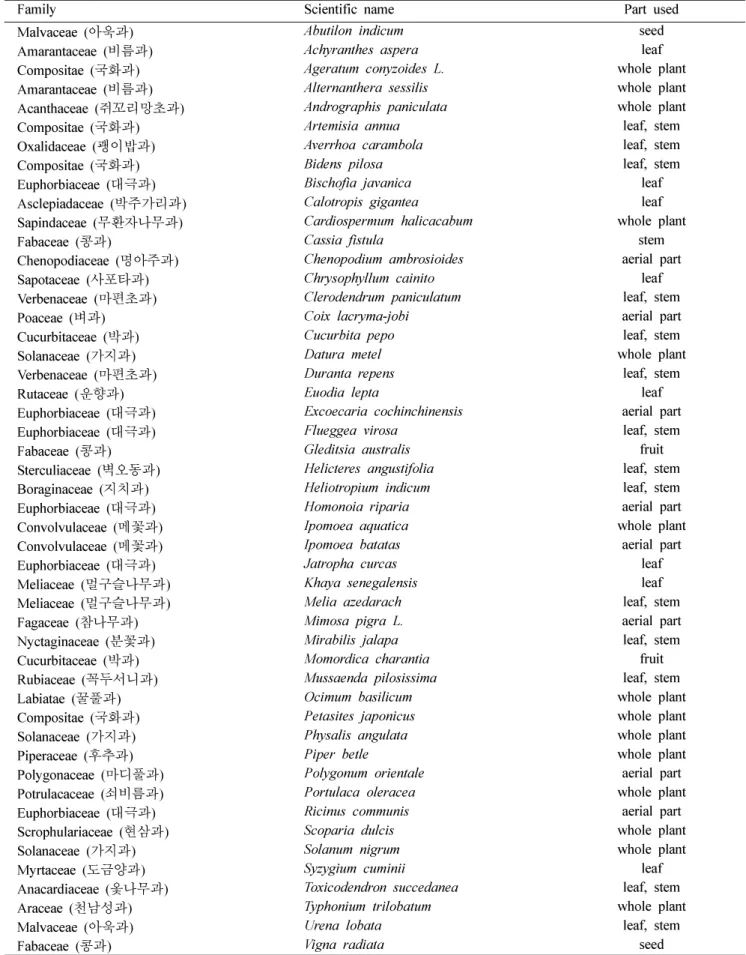
실험재료 − 본실험에사용된베트남산약용식물
(Table
1.)
들은2004~2007
년대전대학교생명과학부김주환교수팀에의해베트남에서채집
,
동정되었다.
증거표본은한국한의학연구원한약제제연구부식물표본실에보관중이다
.
*교신저자(E-mail):[email protected] (Tel):042-868-9465
Table I.
List of Vietnam Herbal Medicines tested
Family Scientific name Part used
Malvaceae (
아욱과) Abutilon indicum seed
Amarantaceae (
비름과) Achyranthes aspera leaf
Compositae (
국화과) Ageratum conyzoides L. whole plant
Amarantaceae (
비름과) Alternanthera sessilis whole plant
Acanthaceae (
쥐꼬리망초과) Andrographis paniculata whole plant
Compositae (
국화과) Artemisia annua leaf, stem
Oxalidaceae (
괭이밥과) Averrhoa carambola leaf, stem
Compositae (
국화과) Bidens pilosa leaf, stem
Euphorbiaceae (
대극과) Bischofia javanica leaf
Asclepiadaceae (
박주가리과) Calotropis gigantea leaf
Sapindaceae (
무환자나무과) Cardiospermum halicacabum whole plant
Fabaceae (
콩과) Cassia fistula stem
Chenopodiaceae (
명아주과) Chenopodium ambrosioides aerial part
Sapotaceae (
사포타과) Chrysophyllum cainito leaf
Verbenaceae (
마편초과) Clerodendrum paniculatum leaf, stem
Poaceae (
벼과) Coix lacryma-jobi aerial part
Cucurbitaceae (
박과) Cucurbita pepo leaf, stem
Solanaceae (
가지과) Datura metel whole plant
Verbenaceae (
마편초과) Duranta repens leaf, stem
Rutaceae (
운향과) Euodia lepta leaf
Euphorbiaceae (
대극과) Excoecaria cochinchinensis aerial part
Euphorbiaceae (
대극과) Flueggea virosa leaf, stem
Fabaceae (
콩과) Gleditsia australis fruit
Sterculiaceae (
벽오동과) Helicteres angustifolia leaf, stem
Boraginaceae (
지치과) Heliotropium indicum leaf, stem
Euphorbiaceae (
대극과) Homonoia riparia aerial part
Convolvulaceae (
메꽃과) Ipomoea aquatica whole plant
Convolvulaceae (
메꽃과) Ipomoea batatas aerial part
Euphorbiaceae (
대극과) Jatropha curcas leaf
Meliaceae (
멀구슬나무과) Khaya senegalensis leaf
Meliaceae (
멀구슬나무과) Melia azedarach leaf, stem
Fagaceae (
참나무과) Mimosa pigra L. aerial part
Nyctaginaceae (
분꽃과) Mirabilis jalapa leaf, stem
Cucurbitaceae (
박과) Momordica charantia fruit
Rubiaceae (
꼭두서니과) Mussaenda pilosissima leaf, stem
Labiatae (
꿀풀과) Ocimum basilicum whole plant
Compositae (
국화과) Petasites japonicus whole plant
Solanaceae (
가지과) Physalis angulata whole plant
Piperaceae (
후추과) Piper betle whole plant
Polygonaceae (
마디풀과) Polygonum orientale aerial part
Potrulacaceae (
쇠비름과) Portulaca oleracea whole plant
Euphorbiaceae (
대극과) Ricinus communis aerial part
Scrophulariaceae (
현삼과) Scoparia dulcis whole plant
Solanaceae (
가지과) Solanum nigrum whole plant
Myrtaceae (
도금양과) Syzygium cuminii leaf
Anacardiaceae (
옻나무과) Toxicodendron succedanea leaf, stem
Araceae (
천남성과) Typhonium trilobatum whole plant
Malvaceae (
아욱과) Urena lobata leaf, stem
Fabaceae (
콩과) Vigna radiata seed
Table II.
Inhibitory activity of Vietnam herbal medicines on aldose reductase in vitro .
Scientific name Conc.
(
µg/ml) Inhibition
(%) IC
50(
µg/ml)
Abutilon indicum 10
20 30
20.15±1.53 40.05±1.85
60.69±5.96 24.79 Achyranthes aspera 40 44.22±1.73 >40 Ageratum conyzoides L. 15
20 30
37.6±5.74 55.59±2.87
91.20±1.89 18.45 Alternanthera sessilis 2.5
10 5
10.42±9.96 33.24±4.71
80.0±3.81 6.78 Andrographis paniculata 5
10 20
32.58±8.12 43.23±3.91
51.94±5.83 17.69
Artemisia annua 1
2.5 5
8.99±6.14 38.85±8.24 75.54±2.72 3.37
Averrhoa carambola 5
10 20
30.86±8.30 36.42±8.09
63.89±2.45 14.43
Bidens pilosa 5
10 20
45.23±1.62 62.19±3.24 74.91±4.78 5.93 Bischofia javanica 2.5
10 5
31.29±4.71 48.98±1.77 77.55±5.68 5.41 Calotropis gigantea 10
30 40
34.3±1.67 47.36±6.03
55.07±6.32 33.15 Cardiospermum
halicacabum 2.5
10 5
21.51±1.94 37.15±5.10 52.79±3.78 9.03
Cassia fistula 30
35 40
46.18±3.03 57.63±9.78
79.77±11.7 31.67 Chenopodium ambrosioides 20
30 40
36.13±3.85 53.36±4.54
62.18±7.67 29.59 Chrysophyllum cainito 20
30 40
48.9±7.05 65.75±7.88
80.66±8.3 20.49 Clerodendrum paniculatum 5
10 20
47.22±5.24 62.5±4.54
79.51±8.42 5.41
Coix lacryma-jobi 1
10 5
5.85±2.77 26.77±5.93 52.92±6.05 9.44
Cucurbita pepo 40 14.24±2.80 >40
Datura metel 20
30 40
27.01±9.47 39.81±8.33
67.77±4.57 32.52
Duranta repens 0.5
2.5 1
27.3±0.92 37.42±4.01
58.9±2.81 1.90
Table II.
Continued
Scientific name Conc.
(
µg/ml) Inhibition
(%) IC
50(
µg/ml)
Euodia lepta 5
10 20
23.18±7.05 41.78±6.91
58.49±7.77 15.59 Excoecaria cochinchinensis 2.5
10 5
37.0±7.44 53.14±6.36 75.56±2.05 4.80
Flueggea virosa 2.5
10 5
39.09±2.57 51.44±1.89
74.9±3.97 4.75 Gleditsia australis 2.5
10 5
26.45±6.98 44.19±6.80 79.35±1.48 5.83 Helicteres angustifolia 5
10 30
22.03±2.19 36.52±3.14
77.68±9.62 17.11 Heliotropium indicum 40 36.53±5.67 >40
Homonoia riparia 2.5
10 5
22.84±4.60 44.29±7.54 63.79±2.932 7.05
Ipomoea aquatica 10
20 30
28.03±4.33 52.49±4.85
70.07±3.77 19.91
Ipomoea batatas 2.5
10 5
24.15±6.96 30.19±6.585
63.04±2.51 7.85
Jatropha curcas 10
20 30
43.52±2.88 57.48±3.50
78.07±2.64 14.39 Khaya senegalensis 1
2.5 5
32.1±7.12 45.39±3.89 55.35±2.56 3.85
Melia azedarach 20
30 40
27.42±3.63 51.61±3.20
80.65±7.55 28.79
Mimosa pigra L. 5
10 15
44.30±7.91 58.23±7.91 70.89±5.80 7.06 Mirabilis jalapa 40 41.23±8.32 >40 Momordica charantia 40 27.59±0.80 >40 Mussaenda pilosissima 2.5
10 5
22.74±8.22 46.03±1.26 66.30±7.53 6.73
Ocimum basilicum 2.5
10 5
7.19±6.11 23.35±3.74
60.18±7.20 16.15 Petasites japonicus 5
10 20
39.26±2.57 56.30±6.70 94.81±9.25 8.05 Physalis angulata 40 43.97±1.90 >40
Piper betle 10
20 30
39.91±4.83 55.96±3.64
65.6±5.50 17.03
시약 및 기기 −
Sodium phosphate monobasic, potassium phosphate dibasic, lithium sulfate, imidazole, NADP, NADPH, DL-glyceraldehyde, 3.3-tetramethyleneglutaric acid, 2-mercaptoethanol, Bovine Serum Albumin
등은Sigma
사(St. Louis, MO, USA)
의제품을사용하였으며,
용매는대정화금
(
한국)
제품을 사용하였다.
형광 분석을 위해Spectrofluorometric detector (Synergy HT Bio-TEK, USA)
를사용하였다
.
추출 및 시료조제 −시료를분쇄한후
300 g
을칭량하여2
배용적의100%
에탄올을넣고실온에서3
회추출하였다.
여과후
40
oC
이하의수욕상에서감압농축하고,
다시동결건조기에서건조하였다
.
추출물은실험직전에감압하에서P
2O
5를이용하여12
시간이상재건조한후DMSO
에용해하고
3
차증류수로희석하였다.
In vitro에서 알도즈 환원 효소 억제 실험 −
Sprague- Dawley rat (250~280 g)
의수정체로부터알도즈환원효소를
Dufrane
8) 방법으로 분리하였다. 135 mM Na, K- phosphate buffer (pH 7.0)
와10 mM 2-mercaptoethanol
을적출한수정체와함께분쇄하였다
. 14,000 rpm
에서30
분간원심분리한다음 상층액을
0.2
µm
의filter
로여과하였다.
효소의단백질은
bovine serum albumin
을표준으로이용하여
Lowry
9)방법으로정량하였다. 135 mM Na, K-phosphate buffer (pH 7.0), 100 mM lithium sulfate, 0.03 mM NADPH, 0.04 mM DL-glyceraldehyde
와100
µg/ml
효소혼합액에
0.1% DMSO
에녹인시료를가하여최종용액을1 ml
로한뒤37
oC
에서10
분간반응시켰다.
이때 공시료는
0.04 mM DL-glyceraldehyde
를첨가하지않았으며,
표준액은
135 mM Na, K-phosphate buffer (pH 7.0), 100 mM lithium sulfate
에50
µl NADP (0.2~5
µM)
를 사용하였다. 0.3 ml
의0.5 N HCl
을 첨가하여반응을 종료시킨뒤, 10 mM imidazole
이첨가된6 M NaOH 1 ml
을가하여60
oC
에서
10
분간반응시켜NADPH
가NADP
로전환되는것을Spectrofluorometric detector
로(Ex. 360 nm, Em. 460 nm)
측정하였다
.
모든시료는triplicate
로수행하여IC
50 값으로 나타냈다.
알도즈환원효소억제제로알려진TMG
10)를양성대조군으로택하여효능을비교하였다
. 결과 및 고찰
당뇨합병증의주요원인중하나인폴리올경로의알도즈 환원효소의억제가당뇨합병증치료및예방에중요한역 할을한다
.
11) 지금까지개발된알도즈환원효소억제제들인
zopolrestat, ponalrestat, sorbinil, tolrestat, fidarestat, ranireatat
와epalrestat
등이여러동물실험에서 당뇨합병증을예방
,
지연시킨다는보고가있다.
12-16)그러나임상에서zopolrestat
와ponalrestat
은효능이낮았고, sorbinil
의과민반응과
tolrestat
의간기능장애와같은부작용으로개발과정에서중단되었다
.
17,18) 현재일본과미국에서는ranireatat
와fidarestat
의임상실험이진행되고있다.
15)Epalrestat (ONO- 2235, Kinedak; Ono Pharmaceutical Co., Ltd., Chuo-ku, Osaka, Japan)
는미국식품의약국(FDA)
에는승인되지않았다
.
19,20) 그러나유일하게일본에서1992
년에승인되어시판중이며
,
20)당뇨성신경증환자에게3
년이상장기투약한결과일부에서나타나는간기능장애와오심등의부작용이나 타났지만
,
대부분환자에서는우수한효능을나타내었다.
15)또한당뇨성백내장과신증의예방및지연효과에관한연 구도보고되었다
.
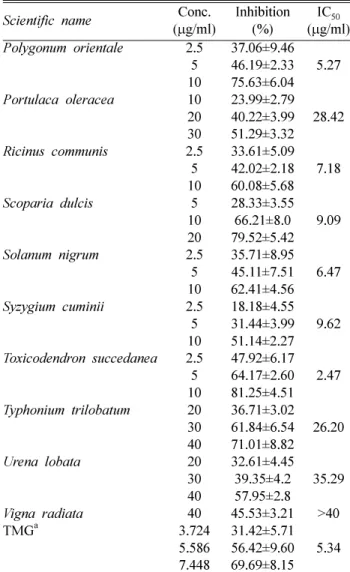
16,21)본연구는알도즈환원효소억제후보물질을선별하기위해베트남약용식물
49
종의에탄올추Table II.
Continued
Scientific name Conc.
(
µg/ml) Inhibition
(%) IC
50(
µg/ml) Polygonum orientale 2.5
10 5
37.06±9.46 46.19±2.33 75.63±6.04 5.27 Portulaca oleracea 10
20 30
23.99±2.79 40.22±3.99 51.29±3.32 28.42
Ricinus communis 2.5
10 5
33.61±5.09 42.02±2.18 60.08±5.68 7.18
Scoparia dulcis 5
10 20
28.33±3.55 66.21±8.0 79.52±5.42 9.09
Solanum nigrum 2.5
10 5
35.71±8.95 45.11±7.51 62.41±4.56 6.47
Syzygium cuminii 2.5
10 5
18.18±4.55 31.44±3.99 51.14±2.27 9.62 Toxicodendron succedanea 2.5
10 5
47.92±6.17 64.17±2.60 81.25±4.51 2.47 Typhonium trilobatum 20
30 40
36.71±3.02 61.84±6.54 71.01±8.82 26.20
Urena lobata 20
30 40
32.61±4.45 39.35±4.2
57.95±2.8 35.29
Vigna radiata 40 45.53±3.21 >40
TMG
a3.724
5.586 7.448
31.42±5.71 56.42±9.60 69.69±8.15 5.34 Inhibitory activity was expressed as mean±S.D. of triplicate experiments. IC
50values were calculated from the dose inhibition curve.
a
TMG (3.3-Tetramethyleneglutaric acid) was used as positive
control.
출물을이용해
Table 2
와같은결과를얻었다.
양성대조군인
TMG
의IC
50 값(5.34
µg/ml)
을기준으로알도즈환원효소억제효능을판단하였으며
, Artemisia annua
의 잎
,
줄기(3.37
µg/ml), Duranta repens
의 잎,
줄기(1.9
µg/ml), Excoecaria cochinchinensis
의 지상부(4.8
µg/
ml), Flueggea virosa
의 잎,
줄기(4.75
µg/ml), Khaya senegalensis
의 잎(3.85
µg/ml), Polygonum orientale
의 지 상부(5.27
µg/ml), Toxicodendron succedanea
의 잎,
줄기(2.47
µg/ml)
의효능이우수하였다. Artemisia annua
의주성 분으로는coumarin, terpenes, flavonoids
22)등으로이중quinic acid
가 항산화,
간보호 효능이지닌다고보고되었다.
23-25)Duranta repens
와Toxicodendron succedanea
는항산화활성이 있으며
,
26-27)Duranta repens
의flavonoid
성분들은 α-
glucosidase
억제활성 효능이 보고되었다.
28)Excoecaria cochinchinensis
는diterpenoids,
29)megastigmane glucosides
30)의성분을함유하고있으며
,
베트남에서전통적으로소양증,
설사종기치료에사용되었다
.
31)Flueggea virosa
는항말라리 아효능이보고되었으며,
32,33)Khaya senegalensis
는항암,
34)항원충작용
,
항균 작용35)이있다. Polygonum orientale
은 항균,
항바이러스,
항진균활성36)이있음이확인되었다.
지금까지 보고된 천연물에서 분리한 단일화합물의 경우
flavonoid
와phenol
화합물들이우수한알도즈환원효소억제효능을지닌다
.
5,6,37) 그러나위의결과에서활성을나타낸식물들이알도즈환원효소억제활성을가지는유효성 분에대한연구가아직까지이뤄지지않아이에대한구체 적인연구가필요하다고사료된다
.
본연구결과는안전하고우수한알도즈환원효소억제효능을가지는선도화합 물의발굴을위한기초자료로활용될수있을뿐만아니라
,
당뇨합병증예방및치료제개발에이용될수있을것이다
.
결 론
49
종의베트남산생약추출물중에서7
종의추출물이in
vitro
에서알도즈환원효소억제활성을나타내었다. Artemisia annua
의잎,
줄기, Duranta repens
의잎,
줄기, Excoecaria cochinchinensis
의 지상부, Flueggea virosa
의 잎,
줄기, Khaya senegalensis
의 잎, Polygonum orientale
의 지상부, Toxicodendron succedanea
의잎,
줄기가양성대조군인3.3- tetramethyleneglutaric acid (TMG)
보다효능이있음을확인하였고
,
그 중Duranta repens
의 잎,
줄기, Toxicodendron succedanea
의잎,
줄기2
종은양성대조군보다2
배이상우수한효능을나타내었다
.
사 사
본연구는한국한의학연구원일반사업비
(L07010, L08010),
와지식경제부지정대전대학교난치성면역질환의동서생 명의학연구센터의지원으로수행되었으며이에감사드립 니다
.
인용문헌
1. Kyseloa, A., Stefek, M. and Bauer, V. (2004) Pharmaco- logical prevention of diabetic cataract. J. Diabetes Complicat.
18
: 129-140.
2. Vinson, J. A. and Howard III, T. B. (1996) Inhibition of pro- tein glycation and advanced glycation end products by ascor- bic acid and other vitamins and nutrients. J. Nutr. Biochem.
7: 659-663.
3. Collins, J. B. and Corder, C. N. (1977) Aldose reductase and sor- bitol dehydrogenase distribution in substrctures of normal and diabetic rats lens. Invest. Ophthamol. Visual Sci.
16: 242-243.
4. Dvonik, D., Gabbay, K. H. and Kinoshita, J. H. (1973) Polyol accumulation in galactosemic and diabetic rats. Science
182: 1146-1148.
5. Jesús Ángel, de la F. and Sonia, M. (2003) Aldose reductase inhibitors from natural sources. Nat. Prod. Rep.
20:243-251.
6. Kawanishi, K., Ueda, H. and Moriyasu, M. (2003) Aldose reductase inhibitors from the nature. Current Medicinal Chemistry
10: 1353-1374.
7. Lee, Y. M., Kim, N. H., Kim, J. M., Kim, Y. S., Jang, D. S., Kim, J. H., Bae, K. H. and Kim, J. S. (2008) Screening of Inhibitory Effect on Aldose Reductase of Korean Herbal Medicines and Preventive Effect of Catalpa bignonioides against Xylose-induced Lens Opacity (). Kor. J. Pharmacogn .
39
: 165-173.
8. Dufrane, S. P., Malaisse, W. J. and Sener, A. (1984) A micromethod for the assay of aldose reductase, its application to pancreatic islets. Biochem. Med .
32: 99-105.
9. Lowry, O. H., Rosebrough, N. J., Farr, A. L. and Radall, R.
J. (1951) Protein measurement with the Folin phenol reagent.
J. Biol. Chem.
193: 265-275.
10. Kinoshita, J. H., Dvornik, D., Kraml, M. and Gabbay, K. H.
(1968) The effect of an aldose reductase inhibitor on the galactose-exposed rabbit lens. Biochim. Biophys. Acta .
24: 472-475.
11. Kaul, D. L. and Ramarao, P. (2001) The role of aldose reduc- tase inhibitors in diabetic complications: recent trends. Meth- ods Find Exp. Clin. Pharmacol.
23: 465-475.
12. Matsumoto, T., Ono, Y., Kurono, M., Kuromiya, A., Naka- mura, K. and Bril, V. (2008) Ranirestat (AS-3201), a potent aldose reductase inhibitor, reduces sorbitol levels and improves motor nerve conduction velocity in streptozotocin- diabetic rats. J. Pharmacol. Sci.
107: 231-237.
13. Sun, W., Oates, P. J., Coutcher, J. B., Gerhardinger, C. and
Lorenzi, M. (2006) A selective aldose reductase inhibitor of
a new structural class prevents or reverses early retinal abnor-
malities in experimental diabetic retinopathy. Diabetes
55: 2757-2762.
14. Drel, V. R., Pacher, P., Ali, T. K., Shin, J., Julius, U., El- Remessy, A. B. and Obrosova, I. G. (2008) Aldose reductase inhibitor fidarestat counteracts diabetes-associated cataract formation, retinal oxidative-nitrosative stress, glial activation, and apoptosis. Int. J. Mol. Med.
21: 667-676.
15. Hotta , N., Akanuma , Y., Kawamori , R., Matsuoka, K., Oka, Y., Shichiri , M., Toyota , T., Nakashima , M., Yoshimura, I., Sakamoto, N. and Shigeta, Y. (2006) Long-term clinical effects of epalrestat, an aldose reductase inhibitor, on diabetic peripheral neuropathy. Diabetes Care
29: 1538-1544.
16. Constantino, L., Rastelli, G., Vianello, P., Cignarella, G. and Barlocco, D. (1999) Diabetes complications and their poten- tial prevention: aldose reductase inhibition and other approaches. Medical Research Reviews
19: 3-23.
17. Ziegler, D. (2004) Polyneuropathy in the diabetic patient- update on pathogenesis and management. Nephrol. Dial.
Transplant.
19: 2170-2175.
18. Chalk, C., Benstead, T. J. and Moore, F. (2007) Aldose reduc- tase inhibitors for the treatment of diabetic polyneuropathy.
Cochrane Database Syst. Rev. 4:CD004572
19. Ono Pharmaceutical Co, Ltd. (2005) Kinedak (epalrestat) package insert. Chuo-ku, Osaka, Japan.
20. Ramirez, M. A. and Borja, N. L. (2008) Epalrestat: an aldose reductase inhibitor for the treatment of diabetic neuropathy.
Pharmacotherapy .
28: 646-655.
21. Iso, K., Tada, H., Kuboki, K. and Inokuchi, T. (2001) Long- term effect of epalrestat, an aldose reductase inhibitor, on the development of incipient diabetic nephropathy in type 2 dia- betic patients. J. Diabetes Complicat.
15: 241-244.
22. Yang, Y., Zhang, J. and Chen, Y. T. (2003) The extraction and isolation handbook of natural product constituents, 439.
China Press of Traditional Chinese Medicine.
23. Kim, H. J and Lee, Y. S. (2005) Identification of new dicaf- feoylquinic acids from Chrysanthemum morifolium and their antioxidant activities
.Planta Med .
71:871-876.
24. Huang, T. M., Na, M. K., Thuong, P. T., Su, N. D., Sok, D. E., Song, K. S., Seong, Y. H., and Bae, K. H. (2006) Antioxidant activity of caffeoyl quinic acid derivatives from the roots of Dipsacus asper Wall. J. Ethnopharmacol.
108: 188-192.
25. Xiang, T., Xiong, Q. B., Ketut, A., Tezuka, Y., Nagaoka, T.
Wu, L. J. and Kadota, S. (2001) Studies on the hepatocyte protective activity and the structure-activity relationships of quinic acid and caffeic acid derivatives from the flower buds
of Lonicera bournei. Planta Med.
67: 322-325.
26. Shahat, A. A., Nazif, N. M., Abousetta, L. M., Ibrahim, N. A., Cos, P., Miert, S. V., Pieters, L. and Vlietinck, A. J. (2005) Phytochemical investigation and antioxidant activity of Duranta repens. Phytother. Res.
19:1071-1073.
27. Wu, P. L., Lin, S. B., Huang, C. P. and Chiou, R. Y. Y. (2002) Antioxidative and cytotoxic compounds extracted from the Sap of Rhus Succedanea. J. Nat. Prod .
65: 1719-1721.
28. Iqbal, K., Malik, A., Mukhtar, N., Anis, I., Khan, S. N. and Choudhary, M. I. (2004) a-Glucosidase inhibitory constitu- ents from Duranta repens. Chem. Pharm. Bull .
52: 785-789.
29. Yang, J. H, Luo, S. D., Zhao, J. F., Wang, Y. S., Huang, R., Zhang, H. B. and Li, L. (2005) Three new highly oxygenated diterpenoids from Excoecaria cochinchinensis Lour. Helvet- ica Chimica Acta .
88: 968-973.
30. Giang, P. M., Son, P. T., Matsunami, K. and Otsuka, H.
(2005) New megastigmane glucosides from Excoecaria cochinchinensis LOUR. var . cochinchinensis . Chem. Pharm.
Bull .
53: 1600-1603.
31. Do, T. L. (1991) Vietnamese Medicinal Plants and Herbal Remedies. Science and Technology, Hanoi, 555-556.
32. Kaou, A. M., Mahiou-Leddet, V., Hutter, S., Aïnouddine, S., Hassani, S., Yahaya, I., Azas, N. and Ollivier, E. (2008) Anti- malarial activity of crude extracts from nine African medic- inal plants. J. Ethnopharmacol .
116:74-83.
33. Muthaura, C. N., Rukunga, G. M., Chhabra, S. C., Omar, S.
A., Guantai, A. N., Gathirwa, J. W., Tolo, F. M., Mwitari, P.
G., Keter, L. K., Kirira, P. G., Kimani, C. W., Mungai, G. M.
and Njagi, E. N. (2007) Antimalarial activity of some plants traditionally used in treatment of malaria in Kwale district of Kenya. J. Ethnopharmacol .
112: 545-551.
34. Zhang, H., Wang, X., Chen, F., Androulakis, X. M. and War- govich, M. J. (2007) Anticancer activity of limonoid from Khaya senegalensis. Phytother Res .
21: 731-734.
35. Kayser, O. and Abreu, P. M. (2001) Antileishmania and immunostimulating activities of two dimeric proanthocya- nidins from Khaya senegalensis . Pharm. Biol.
39: 284-288.
36. Huang, K. C. and Williams, W. M. (1998) The Pharmacology of Chinese Herbs. 404, CRC Press.
37. Hisashi, M., Toshio, M., Iwao, T. and Masayuki, Y. (2002) Structural requirements of flavonoids and related compounds for aldose reductase inhibitory activity. Chem. Pharm. Bull .
50
: 788-795.
(2008년 9월 11일 접수)