Kor. J. Pharmacogn.
42(2) : 187∼ 194 (2011)
187
중국 약용식물 추출물의 알도즈 환원 효소 억제 효능 검색 (V)
이윤미·김영숙·김주환1*·김진숙*
한국한의학연구원 한의융합연구본부 당뇨합병증연구센터, 1경원대학교 생명과학과
Screening of Chinese Herbal Medicines with Inhibitory Effect on Aldose Reductase (V)
Yun Mi Lee, Young Sook Kim, Joo Hwan Kim1* and Jin Sook Kim*
Diabetic Complications Research Center, Division of Traditional Korean Medicine (TKM) Integrated Research, Korea Institute of Oriental Medicine, Daejeon 305-811, Korea,
1Department of Life Science, Kyungwon University, Seongnam, Kyonggi-do 461-701, Korea
Abstracts − Aldose reductase (AR), the key enzyme in the polyol pathway, plays an important role in the development of the diabetic complications. None of Aldose reductase Inhibitor (ARI) has achieved worldwide use because of limited efficacy or undesirable side effects. Therefore, evaluating natural sources for ARI potential may lead to the development of safer and more effective agents against diabetic complications. Fifty two Chinese herbal medicines have been investigated for inhibitory activ- ities on AR. Among them, twelve herbal medicines, Artemisia anomala (aerial part), Centella asiatica (aerial part), Scutellaria baicalensis (root), Senecio chrysanthermoides (whole plant), Gleditsia japonica (twig), Zizyphus jujube (twig, leaf), Citrus aurantium (fruit), Hydnocarpus anthelmintica (fruit), Potaninia mongolica (aerial part), Tribulus terrestris (fruit), Artemisia api- acea (aerial part) and Eclipta prostrate (aerial part) exhibited a significant inhibitory activity against AR. Particularly, Artemisia anomala, Centella asiatica and Scutellaria baicalensis showed four times more potent inhibitory activity than the positive con- trol, 3,3-tetramethyleneglutaric acid (TMG).
Key words − Aldose reductase inhibitor, Diabetic complications, Chinese herbal medicines
만성의 고혈당 상태에서는 알도즈 환원 효소 (Aldose reductase)는 과도하게 활성화되어 포도당을 소비톨로 환원 시켜 당뇨성 망막증 (Diabetic retinopathy), 신경증 (D.
neuropathy), 신증 (D. nephropathy) 등의 당뇨합병증을 유 발시킨다.1-3) 당뇨합병증 예방 및 치료를 위해 알도즈 환원 효소나 세포내 소비톨 축적을 억제시키는 약물의 개발하고 자 많은 연구들이 진행중이다. 지금까지 개발된 sorbinil, tolrestat,4) fidarestat,5) zopolrestat,6) ponalrestat7) 등의 알도즈 환원 효소 억제제들은 합성물질로 동물실험과 임상실험에 서 효능이 보고되었으나 낮은 효능 또는 부작용으로 인해 개발 과정에서 중단되었다. 현재 ranireatat는 미국에서 임상 3상 실험 중이며,5) epalrestat (ONO-2235, Kinedak; Ono Pharmaceutical Co., Ltd., Chuo-ku, Osaka, Japan)는 일본에
서 당뇨성 신경증 치료에 사용되고 있으나5,8) 아직까지 미
국 식품의약국 (FDA)에 허가된 의약품은 없다. 최근에는 천 연물에서 분리한 독성이 없고 우수한 효능을 가진 알도즈 환원 효소 억제 물질을 개발하고자 많은 연구들이 진행되 고 있다.9,10) 본 연구팀 역시 여러 종의 한약재 추출물 및 한 약재에서 분리한 단일 화합물이 in vitro에서 알도즈 환원 효소 활성을 저해함을 확인하였다.11-18) 또한 벌개미취 추출 물의 알도즈 환원 효소 활성 억제와 제 1형 당뇨 쥐에서 수 정체의 변성과 혼탁도 지연 및 소비톨 축적을 감소시켜 수
정체 섬유세포의 부종, 균질화와 공포변성을 지연하였다.19)
본 연구에서는 천연물로부터 당뇨 합병증의 진행을 억제하 는 약물 검색을 위해, 중국에서 자생 또는 재배되는 52종의 한약재 (생약)을 in vitro에서 알도즈 환원 효소 억제 효능을 검색하여 그 결과를 보고하고자 한다.
*교신저자(E-mail):[email protected], [email protected] (Tel): +82-42-868-9465, +82-31-750-8827
실험재료 − 본 실험에 사용된 중국산 약용식물 (Table I) 들은 2006~2007년 경원대학교 생명과학과 김주환 교수팀 에 의해 채집되었으며, 동정을 거친 후 실험에 사용하였다.
증거표본은 한국한의학연구원 한의융합연구본부 당뇨합병 증연구센터 표본실에 보관 중이다.
시약 및 기기 − Sodium phosphate monobasic, potassium phosphate dibasic, lithium sulfate, imidazole, NADP, NADPH, DL-glyceraldehyde, 3,3-tetramethyleneglutaric acid, 2-mercaptoethanol, Bovine Serum Albumin 등은 Sigma사 (St. Louis, MO, USA)의 제품을 사용하였으며, 용매는 대정 화금 (한국) 제품을 사용하였다. 형광 분석을 위해 Spectrofluorometric detector (Synergy HT Bio-TEK, USA) 를 사용하였다.
추출 및 시료조제 − 시료를 분쇄한 후 300 g을 칭량하여 2배 용적의 무수 에탄올을 넣고 실온에서 3회 추출하였다.
여과 후 40oC 이하의 수욕상에서 감압농축하고, 다시 동결 건조기에서 건조하였다. 추출물은 실험 직전에 감압 하에서 P2O5를 이용하여 12시간 이상 재 건조한 후 DMSO에 용해 하고 3차 증류수로 희석하였다.
In vitro에서 알도즈 환원 효소 억제 실험 − Sprague- Dawley rat (250~280 g)의 수정체로부터 알도즈 환원 효소를 Dufrane20) 방법으로 분리하였다. 135 mM Na, K-phosphate buffer (pH 7.0)와 10 mM 2-mercaptoethanol을 적출한 수정
한 다음 상층액을 0.2 µm의 filter로 여과하였다. 효소의 단 백질은 bovine serum albumin을 표준으로 이용하여 Bradford21) 방법으로 정량하였다. 135 mM Na, K-phosphate buffer (pH 7.0), 100 mM lithium sulfate, 0.03 mM NADPH, 0.04 mM DL-glyceraldehyde와 100 µg/ml 효소 혼합액에 0.1% DMSO에 녹인 시료를 가하여 최종용액을 1 ml로 한 뒤 37oC에서 10분간 반응시켰다. 이때 공시료는 0.04 mM DL-glyceraldehyde를 첨가하지 않았으며, 표준액은 135 mM Na, K-phosphate buffer (pH 7.0), 100 mM lithium sulfate 에 50 µl NADP (0.2~5 µM)를 사용하였다. 0.3 ml의 0.5 N HCl을 첨가하여 반응을 종료시킨 뒤, 10 mM imidazole이 첨가된 6 M NaOH 1 ml을 가하여 60oC에서 10분간 반응시 켜 NADPH가 NADP로 전환되는 것을 Spectrofluorometric detector로 (Ex. 360 nm, Em. 460 nm) 측정하였다. 모든 시 료는 triplicate로 수행하여 IC50 값으로 나타냈다. 알도즈 환 원 효소 억제제로 알려진 3,3-tetramethyleneglutaric acid (TMG)22)를 양성 대조군으로 택하여 효능을 비교하였다.
결과 및 고찰
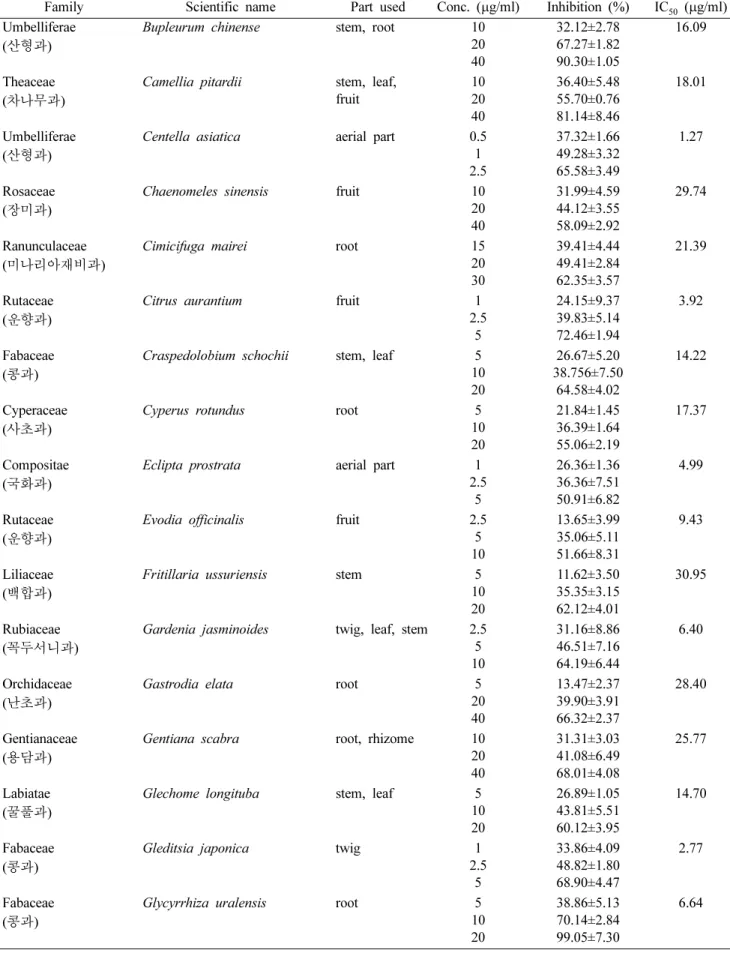
천연물로부터 알도즈 환원효소 억제 약물을 검색하기 위 해 중국산 52종의 에탄올 추출물을 이용해 효능을 검색하 여 Table I과 같은 결과를 얻었다.
양성대조군인 TMG의 IC50 값 (5.34 µg/ml)을 기준으로 알 Table I. Inhibitory effect of extracts from herbal medicines on the activities of aldose reductase
Family Scientific name Part used Conc. (µg/ml) Inhibition (%) IC50 (µg/ml) Araliaceae
(두릅나무과)
Acanthopanax sessiliflorum root 5
20 40
-2.15±4.06 2.15±2.46 19.89±0.93
>40
Ranunculaceae (미나리아재비과)
Aconitum carmichaeli root 5
20 40
32.90±7.82 51.61±3.87 70.97±5.12
19.98
Ranunculaceae (미나리아재비과)
Aconitum ciliare root 5
10 20
29.54±3.85 40.57±4.81 56.23±3.85
16.29
Labiatae (꿀풀과)
Agastache rugosa aerial part 2.5
5 10
21.28±8.50 36.17±2.21 53.19±4.48
9.31
Compositae (국화과)
Artemisia anomala aerial part 1
2.5 5
44.09±4.47 64.57±2.36 72.83±3.54
1.18
Compositae (국화과)
Artemisia apiacea aerial part 1
2.5 5
19.34±5.14 30.86±6.87 53.91±0.71
4.59
Compositae (국화과)
Artemisia argyi aerial part 5
10 20
20.67±4.22 37.99±3.35 49.16±4.22
>20
Table I. Continued
Family Scientific name Part used Conc. (µg/ml) Inhibition (%) IC50 (µg/ml) Umbelliferae
(산형과)
Bupleurum chinense stem, root 10
20 40
32.12±2.78 67.27±1.82 90.30±1.05
16.09
Theaceae (차나무과)
Camellia pitardii stem, leaf, fruit
10 20 40
36.40±5.48 55.70±0.76 81.14±8.46
18.01
Umbelliferae (산형과)
Centella asiatica aerial part 0.5
1 2.5
37.32±1.66 49.28±3.32 65.58±3.49
1.27
Rosaceae (장미과)
Chaenomeles sinensis fruit 10
20 40
31.99±4.59 44.12±3.55 58.09±2.92
29.74
Ranunculaceae (미나리아재비과)
Cimicifuga mairei root 15
20 30
39.41±4.44 49.41±2.84 62.35±3.57
21.39
Rutaceae (운향과)
Citrus aurantium fruit 1
2.5 5
24.15±9.37 39.83±5.14 72.46±1.94
3.92
Fabaceae (콩과)
Craspedolobium schochii stem, leaf 5 10 20
26.67±5.20 38.756±7.50
64.58±4.02
14.22
Cyperaceae (사초과)
Cyperus rotundus root 5
10 20
21.84±1.45 36.39±1.64 55.06±2.19
17.37
Compositae (국화과)
Eclipta prostrata aerial part 1
2.5 5
26.36±1.36 36.36±7.51 50.91±6.82
4.99
Rutaceae (운향과)
Evodia officinalis fruit 2.5
5 10
13.65±3.99 35.06±5.11 51.66±8.31
9.43
Liliaceae (백합과)
Fritillaria ussuriensis stem 5
10 20
11.62±3.50 35.35±3.15 62.12±4.01
30.95
Rubiaceae (꼭두서니과)
Gardenia jasminoides twig, leaf, stem 2.5 5 10
31.16±8.86 46.51±7.16 64.19±6.44
6.40
Orchidaceae (난초과)
Gastrodia elata root 5
20 40
13.47±2.37 39.90±3.91 66.32±2.37
28.40
Gentianaceae (용담과)
Gentiana scabra root, rhizome 10
20 40
31.31±3.03 41.08±6.49 68.01±4.08
25.77
Labiatae (꿀풀과)
Glechome longituba stem, leaf 5
10 20
26.89±1.05 43.81±5.51 60.12±3.95
14.70
Fabaceae (콩과)
Gleditsia japonica twig 1
2.5 5
33.86±4.09 48.82±1.80 68.90±4.47
2.77
Fabaceae (콩과)
Glycyrrhiza uralensis root 5
10 20
38.86±5.13 70.14±2.84 99.05±7.30
6.64
µg/ml) 50 µg/ml) Poaceae
(화본과)
Hordeum vulgare fruit 5
10 40
29.00±2.29 41.01±1.73 65.10±2.29
23.60
Flacourtiaceae (산유자나무과)
Hydnocarpus anthelmintica fruit 1
2.5 5
25.91±4.79 36.36±5.16 58.18±3.15
4.04
Hamamelidaceae (조롱나무과)
Liquidambabar formosana fruit 5
10 20
19.16±5.90 31.03±7.18 45.59±2.65
>20
Schizaeaceae (실고사리과)
Lygodium japonicum aerial part 10
20 40
33.10±2.77 39.02±2.63 63.07±4.35
28.35
Lauraceae (녹나무과)
Machilus yunanensis stem, leaf 10
20 40
50.00±2.34 58.67±7.01 89.80±1.77
11.40
Cucurbitaceae (박과)
Malus pumila fruit 2.5
5 10
22.83±3.26 38.77±3.82 53.99±0.63
8.74
Fabaceae (콩과)
Nogra guangxiensis root 10
20 40
26.58±1.98 34.49±1.90 52.22±2.19
37.82
Araliaceae (두릅나무과)
Nothopanax delavayi stem, leaf 5
10 20
24.22±4.11 42.15±12.83
53.81±9.16
17.53
Ranunculaceae (미나리아재비과)
Paeonia japonica root 10
20 30
39.01±2.05 51.57±2.69 64.57±3.39
18.66
Labiatae (꿀풀과)
Perilla frutescens stem 5
20 40
38.64±4.51 61.36±4.29 93.18±1.70
12.44
Campanulaceae (초롱꽃과)
Platycodon grandiflorum root 5
20 40
30.56±2.41 44.44±6.05 52.78±1.39
33.56
Polygalaceae (원지과)
Polygala sibirica root, rhizome 10 20 40
24.91±1.63 38.43±6.78 56.94±4.44
33.03
Rosaceae (장미과)
Potaninia mongolica aerial part 1
2.5 5
24.74±1.81 40.77±2.18 55.40±2.18
4.13
Rosaceae (장미과)
Prunus mume fruit 5
10 40
-5.62±3.51 15.17±5.92 26.40±4.24
>40
Rosaceae (장미과)
Prunus mume stem 10
20 40
40.13±1.96 50.16±4.70 72.10±1.09
19.36
Polygonaceae (마디풀과)
Reynoutria elliptica rhizome 2.5
5 10
41.7±4.86 48.58±9.43 61.94±3.06
5.56
Scrophulariaceae (현삼과)
Scrophularia buergeriana root 5
20 40
-8.48±4.58 18.79±11.83
32.12±6.39
>40
도즈 환원 효소 억제 효능을 판단하였으며, Artemisia anomala의 지상부 (1.18 µg/ml), Centella asiatica의 지상부 (1.27µg/ml), Scutellaria baicalensis의 뿌리 (1.33 µg/ml), Senecio chrysanthermoides의 전초 (2.37 µg/ml), Gleditsia japonica의 소지 (2.77 µg/ml), Zizyphus jujube의 소지, 잎 (3.49µg/ml), Citrus aurantium의 열매 (3.92 µg/ml), Hydno- carpus anthelmintica의 열매 (4.04 µg/ml), Potaninia mongolica 의 지상부 (4.13 µg/ml), Tribulus terrestris의 열매 (4.53 µg/
ml), Artemisia apiacea의 지상부 (4.59 µg/ml), Eclipta prostrate 의 지상부 (4.99 µg/ml) 가 우수한 효능을 지닌 것으로 확인
되었다. Artemisia anomala와 Artemisia apiacea는 flavonoid 등의 성분을 함유하고 항산화 효능이 있으며,23-26) Centella asiatica는 당뇨환자의 상처 치료 효능과 낭포 황반 부종에 효능을 나타내었다.27,28) Scutellaria baicalensis는 중국에서 오랫동안 제 2형 당뇨환자의 당대사를 조절하는 복합제제 에 포함된 한약재로 사용되고 있으며, 항염, 항암 등에 효 능이 보고되었다.29-31) 또한, Scutellaria baicalensis의 ethylacetate와butanol 층에서 얻은 분획물은 in vitro에서 AR 억제 효능을 보였고, 활성물질인 baicalin과 wogonin-7-O- glucuronide은 galactose에 의해 유도된 쥐에서 백내장이 억 Table I. Continued
Family Scientific name Part used Conc. (µg/ml) Inhibition (%) IC50 (µg/ml) Labiatae
(꿀풀과)
Scutellaria baicalensis root 1
2.5 5
44.03±3.11 66.26±7.94 86.42±4.28
1.33
Compositae (국화과)
Senecio chrysanthermoides whole plant 1 2.5
5
38.05±8.16 55.22±6.73 65.32±3.25
2.37
Compositae (국화과)
Siegesbeckia pubescens aerial part 10 20 40
48.96±5.92 54.69±4.13 61.46±3.25
10.90
Caryophyllaceae (석죽과)
Silene gracilicaulis whole plant 10 20 40
30.52±3.54 46.95±9.06 65.26±14.11
28.44
Liliaceae (백합과) Smilax china twig, leaf 5
10 20
42.17±3.63 50.48±2.0 66.13±1.11
9.67
Stemonaceae (백부과)
Stemona japonica root 5
10 20
24.03±6.48 32.16±2.12 52.30±1.06
18.98
Zygophyllaceae (남가새과)
Tribulus terrestris fruit 1
2.5 5
33.46±2.97 44.09±2.97 51.18±3.80
4.53
Cucurbitaceae Trichosanthes kirilowii root 5
10 20
39.67±4.73 53.33±3.21 70.33±1.15
9.31
Compositae (국화과)
Xanthium sibiricum fruit 5
7.5 10
30.38±2.53 42.62±10.91
58.65±0.73
8.54
Zingiberaceae (생강과)
Zingiber officinale root 5
20 40
22.12±3.86 38.05±1.77 56.05±4.18
33.88
Rhamnaceae (갈매나무과)
Zizyphus jujuba twig, leaf 1
2.5 5
19.47±2.38 38.93±8.12 68.32±4.77
3.49
TMGa 3.72
4.66 5.59
20.92±6.52 35.15±6.91 56.90±4.41
5.34
IC
50values were calculated from the dose inhibition curve.
a
TMG (3,3-Tetramethyleneglutaric acid) was used as positive control.
인하였다. 는 전초의 성분 연구 와 지상부에서 eudesmanolide 계열의 신물질이 분리되었으
며,33,34) Lithospermum erythrorhizon은 뿌리 성분 연구와 아토
피 피부염의 효능 연구가 보고되었다.35,36) Gleditsia japonica 와 Zizyphus jujube는 항산화 효능을 가지고 있으며, Zizyphus jujube는 항비만, 항염 작용 등이 보고되었다.37-40) Citrus aurantium은 당뇨 mouse에서 간의 항산화와 조직 내 지방 감소 효능이 있으며,41,42) Hydnocarpus anthelmintica는 seed oil의 지방산에 관한 연구가 보고되었다.43) Tribulus terrestris 는 STZ로 유도된 쥐에서 혈당강하, 지질 및 산화스트레스 감소 효능을 나타내었으며,44,45) Eclipta prostrate는 살초력 과 Essential oil 성분에 관한 연구가 보고되었다.46,47) Potaninia mongolica에 관한 연구, 보고는 이뤄지지 않았으 며, 위 12종 모두 알도즈 환원 효소 억제 효능에 관한 보고 는 없었다. 본 연구 결과는 안전하고 우수한 알도즈 환원 효 소 억제제 후보 물질 발굴을 위한 기초자료로 활용될 수 있 을 뿐만 아니라, 당뇨합병증 예방 및 치료제 개발에 이용될 수 있을 것으로 사료된다.
결 론
52종의 중국산 약용식물 에탄올 추출물을 in vitro에서 알 도즈 환원 효소 억제활성 검색하였다. 그 결과 12종의 추출 물이 양성대조군인 TMG보다 효능이 있음을 확인하였고, 그 중 Artemisia anomala의 지상부, Centella asiatica의 지 상부, Scutellaria baicalensis의 뿌리 3종은 양성대조군보다 4배 이상의 우수한 효능을 나타내었다.
사 사
본 연구는 한국한의학연구원 기관고유사업비 (K10040)로 수행되었으며 이에 감사드립니다.
인용문헌
1. Vinson, J. A. and Howard III, T. B. (1996) Inhibition of pro- tein glycation and advanced glycation end products by ascor- bic acid and other vitamins and nutrients. J. Nutr. Biochem. 7:
659-663.
2. Collins, J. B. and Corder, C. N. (1977) Aldose reductase and sorbitol dehydrogenase distribution in substrctures of normal and diabetic rats lens. Invest. Ophthamol. Visual Sci. 16: 242- 243.
3. Dvonik, D., Gabbay, K. H. and Kinoshita, J. H. (1973) Polyol accumulation in galactosemic and diabetic rats. Science 182:
1146-1148.
tial prevention: aldose reductase inhibition and other approaches. Med. Res. Rev. 19: 3-23.
5. Schemmel, K. E., Padiyara, R. S. and D'Souza, J. J. (2010) Aldose reductase inhibitors in the treatment of diabetic peripheral neuropathy: a review. J. Diabetes Complicat. 24:
354-360.
6. Beyer-Mears, A., Mistry, K., Diecke, F. P. and Cruz, E. (1996) Zopolrestat prevention of proteinuria, albuminuria and cat- aractogenesis in diabetes mellitus. Pharmacology 52: 292- 302.
7. Faes, T. J., Yff, G.A., DeWeerdt, O., Lanting, P., Heimans, J.
J. and Bertelsmann, F.W. (1993) Treatment of diabetic auto- nomic neuropathy with an aldose reductase inhibitor. J. Neu- rol. 240: 156-160.
8. Kawai, T., Takei, I., Tokui, M., Funae, O., Miyamoto, K., Tabata, M., Hirata, T., Saruta, T., Shimada, A. and Itoh, H.
(2010) Effects of epalrestat, an aldose reductase inhibitor, on diabetic peripheral neuropathy in patients with type 2 dia- betes, in relation to suppression of N(ε)-carboxymethyl lysine. J. Diabetes Complicat. 24: 424-432.
9. Lee, Y. S., Kim, S. H., Jung, S. H., Kim, J. K., Pan, C. H. and Lim, S. S. (2010) Aldose reductase inhibitory compounds from Glycyrrhiza uralensis. Biol. Pharm. Bull. 33: 917-921.
10. Fatmawati, S., Kurashiki, K., Takeno, S., Kim, Y. U., Shimizu, K., Sato, M., Imaizumi, K., Takahashi, K., Kamiya, S., Kaneko, S. and Kondo, R. (2009) The inhibitory effect on aldose reductase by an extract of Ganoderma lucidum. Phy- tother. Res. 23: 28-32.
11. Jang, D. S., Yoo, N. H., Kim, N. H., Lee, Y. M., Kim, C. S., Kim, J. Kim, J. H. and Kim, J. S. (2010) 3,5-Di-O-caffeoyl- epi-quinic acid from the leaves and stems of Erigeron annuus inhibits protein glycation, aldose reductase and cataracto- genesis. Biol. Pharm. Bull. 33: 329-333.
12. Yoo, N. H., Jang, D. S., Yoo, J. L., Lee, Y. M., Kim. Y. S., Cho, J. H. and Kim, J. S. (2008) Erigeroflavanone, a fla- vanone derivative from the flowers of Erigeron annuus with protein glycation and aldose reductase inhibitory activity. J.
Nat. Prod. 71: 713-715.
13. Kim, J. M., Jang, D. S., Lee, Y. M., Yoo, J. L., Kim. Y. S., Kim, J. H and Kim, J. S. (2008) Aldose reductase and protein glycation inhibitory principles from the whole plant of Duch- esnea chrysantha. Chem. Biodivers. 5: 352-356.
14. Yoo, N. H., Jang, D. S., Lee, Y. M., Jeong, I. H., Cho, J. H., Kim, J. H. and Kim, J. S. (2010) Anthraquinones from the roots of Knoxia valerianoides inhibit the formation of advanced glycation end products and rat lens aldose reduc- tase in vitro. Arch. Pharm. Res. 33: 209-214.
15. Lee, Y. M., Kim, N. H., Kim, J. M., Kim, Y. S., Jang, D. S., Kim, J. H., Bae, K. H. and Kim, J. S. (2008) Screening of inhibitory effect on aldose reductase of Korean herbal med-
icines and preventive effect of Catalpa bignonioides against xylose-induced lens opacity (I). Kor. J. Pharmacogn. 39:
165-173.
16. Lee, Y. M., Kim, J. M., Kim, Y. S., Jang, D. S., Kim, J. H., Bae, K. H. and Kim, J. S. (2008) Screening of inhibitory effect on aldose reductase of Vietnam herbal medicines (II).
Kor. J. Pharmacogn. 39: 324-329.
17. Lee, Y. M., Kim, J. M., Kim, Y. S., Jang, D. S., Kim, J. H., Bae, K. H. and Kim, J. S. (2009) Screening of Chinese herbal medicines with inhibitory effect on aldose reductase (III).
Kor. J. Pharmacogn. 40: 394-399.
18. Lee, Y. M., Kim, Y. S., Bae, K. H., Kim, J. H. and Kim, J. S.
(2010) Screening of Chinese herbal medicines with inhibitory effect on aldose reductase (IV) Kor. J. Pharmacogn. 41: 289- 296.
19. Kim, C. S., Kim, J., Jeong, I. H., Kim, Y. S., Lee, J., Jang, D.
S. and Kim, J. S. (2009) Slow development of diabetic cat- aract in streptozotocin-induced diabetic rats via inhibition of aldose reductase activity and sorbitol accumulation by use of Aster koraiensis extract. Kor. J. Pharmacogn. 40: 339-344.
20. Dufrane, S. P., Malaisse, W. J. and Sener, A. (1984) A micromethod for the assay of aldose reductase, its application to pancreatic islets. Biochem. Med. 32: 99-105.
21. Bradford, M. (1976) A rapid and sensitive method for the quantitation of microgram quantities of protein utilizing the principle of protein-dye binding. Anal. Biochem. 72: 248-254.
22. Kinoshita, J. H., Dvornik, D., Kraml, M. and Gabbay, K. H.
(1968) The effect of an aldose reductase inhibitor on the galactose-exposed rabbit lens. Biochim. Biophys. Acta. 24:
472-475.
23. Wen, J., Shi, H., Xu, Z., Chang, H., Jia, C., Zan, K., Jiang, Y and Tu, P. (2010) Dimeric guaianolides and sesquiterpenoids from Artemisia anomala. J. Nat. Prod. 73: 67-70.
24. Liao, H., Banbury, L. K. and Leach, D. N. (2008) Antioxidant activity of 45 Chinese herbs and the relationship with their TCM characteristics. Evid. Based Complement. Alternat.
Med. 5: 429-434.
25. Kim, K. S., Lee, S., Lee, Y. S., Jung, S. H., Park, Y., Shin, K.
H. and Kim, B. K. (2003) Anti-oxidant activities of the extracts from the herbs of Artemisia apiacea. J. Ethnop- harmacol. 85: 69-72.
26. Lee, S., Kim, K. S., Jang, J. M., Park, Y., Kim, Y. B. and Kim, B. K. (2002) Phytochemical constituents from the herba of Artemisia apiacea. Arch. Pharm. Res. 25: 285-288.
27. Paocharoen, V. (2010) The efficacy and side effects of oral Centella asiatica extract for wound healing promotion in dia- betic wound patients. J. Med. Assoc. Thai. 93: 166-170.
28. Forte, R., Cennamo, G., Finelli ,M. L., Bonavolonta, P., Crec- chio, G. D. and Greco, G. M. (2011) Combination of fla- vonoids with Centella asiatica and Melilotus for diabetic cystoid macular edema without macular thickening. J. Ocul.
Pharmacol. Ther. Feb 12. [Epub ahead of print]
29. Zhen, Z., Chang, B., Li, M., Lian, F.M., Chen, L., Dong , L., Wang, J., Yu, B., Liu, W.K., Li, X.Y., Qin, P.J., Zhang, J.H.
and Tong, X.L. (2011) Anti-diabetic effects of a coptis chin- ensis containing new traditional chinese medicine formula in type 2 diabetic rats. Am. J. Chin. Med. 39: 53-63.
30. Kim, E. H., Shim, B., Kang, S., Jeong, G., Lee, J.S., Yu, Y. B.
and Chun, M. (2009) Anti-inflammatory effects of Scutel- laria baicalensis extract via suppression of immune modulators and MAP kinase signaling molecules. J. Ethnopharmacol. 126:
320-331.
31. Park, K. I., Park, H. S., Kang, S.R., Nagappan, A., Lee, D. H., Kim, J. A., Han, D. Y. and Kim, G. S. (2011) Korean Scutel- laria baicalensis water extract inhibits cell cycle G1/S tran- sition by suppressing cyclin D1 expression and matrix- metalloproteinase-2 activity in human lung cancer cells. J.
Ethnopharmacol. 133: 634-641.
32. Shin, K. H., Chae, Y. J., Chung, M. S. and Lee, H.J. (1991) Effect of flavonoids from Scutellariae radix on cataract for- mation and polyol accumulation in rat lens. Kor. J. Phar- macogn. 25: 41-46.
33. Mengi, N., Taneja, S. C., Mahajan, V. P. and Mathela, C. S.
(1991) Eudesmanolides from Senecio chrysanthemoides.
Phytochem. 30: 2329-2330.
34. Lin, S., Zhanf, Z., Shen, Y., Li, H., Shan, L., Liu, R., Xu, X.
and Zhanf, W. (2010) Ethyl acetate-soluble chemical con- stituents from whole plants of Senecio chrysanthemoides.
Zhongguo Zhong Yao Za Zhi. 35: 1137-1141.
35. Ito, Y., Onobori, K., Yamazaki, T. and Kawamura, Y. (2011) Tigloylshikonin, a new minor Shikonin derivative, from the roots and the commercial root extract of lithospermum eryth- rorhizon. Chem. Pharm. Bull. 59: 117-119.
36. Lee, J. H., Jung, K.M., Bae, I.H., Cho, S., Seo, D.B., Lee, S.J., Park, Y.H. and Lim, K.M. (2009) Anti-inflammatory and barrier protecting effect of Lithospermum erythrorhizon extracts in chronic oxazolone-induced murine atopic der- matitis. J. Dermatol. Sci. 56: 64-66.
37. Kim, B.J., Kim, J.H., Kim, H.P. and Heo, M.Y. (1997) Bio- logical screening of 100 plant extracts for cosmetic use (II):
anti-oxidative activity and free radical scavenging activity.
Int. J. Cosmet. Sci. 19: 299-307.
38. Al-Reza, S.M., Yoon, J.I., Kim, H.J., Kim, J.S. and Kang, S.
C. (2010) Anti-inflammatory activity of seed essential oil from Zizyphus jujuba. Food Chem. Toxicol. 48: 639-643.
39. Zhang, H., Jiang, L., Ye, S., Ye, Y. and Ren, F. (2010) Sys- tematic evaluation of antioxidant capacities of the ethanolic extract of different tissues of jujube (Ziziphus jujuba Mill.) from China. Food Chem. Toxicol. 48: 1461-1465.
40. Kubota, H., Morii, R., Kojima-Yuasa, A., Huang, X., Yano, Y.
and Matsui-Yuasa, I. (2009) Effect of Zizyphus jujuba extract on the inhibition of adipogenesis in 3T3-L1 preadipocytes.
Am. J. Chin. Med. 37: 597-608.
41. Jiao, S., Huang, C., Wang, H. and Yu, S. (2007) Effects of
689-692.
42. Campbell, J. I., Mortensen, A. and Mølgaard, P. (2006) Tissue lipid lowering-effect of a traditional Nigerian anti-diabetic infusion of Rauwolfia vomitoria foilage and Citrus aurantium fruit. J. Ethnopharmacol. 104: 379-386.
43. Christie, W. W., Brechany, E. Y. and Shukla, V. K. (1989) Analysis of seed oils containing cyclopentenyl fatty acids by combined chromatographic procedures. Lipids. 24: 116-120.
44. El-Tantawy, W. H. and Hassanin, L.A. (2007) Hypoglycemic and hypolipidemic effects of alcoholic extract of Tribulus ala- tus in streptozotocin-induced diabetic rats: a comparative study with T. terrestris (Caltrop). Indian J. Exp. Biol. 45: 785- 790.
N. Y. Acad. Sci. 1084: 391-401.
46. Chen, C. N., Chen, Q., Liu, Y.C., Zhu, X.L., Niu, C.W., Xi, Z. and Yang, G.F. (2010) Syntheses and herbicidal activity of new triazolopyrimidine-2-sulfonamides as acetohydroxyacid synthase inhibitor. Bioorg. Med. Chem. 18: 4897-4904.
47. Ogunbinu, A. O., Flamini, G., Cioni, P. L., Ogunwande, I. A.
and Okeniyi, S. O. (2009) Essential oil constituents of Eclipta prostrata (L.) L. and Vernonia amygdalina Delile. Nat. Prod.
Commun. 4: 421-424.
(2011. 4. 14 접수; 2011. 6. 3 심사; 2011. 6. 7 게재확정)