44(2) : 168∼ 175 (2013)
168
한국 약용식물 추출물의 알도즈 환원 효소 억제 효능 검색 (VIII)
이윤미1·김영숙1·김주환2·김진숙1*
1한국한의학연구원 한약연구본부 한의신약연구그룹, 2가천대학교 생명과학과
Screening of Korean Herbal Medicines with Inhibitory Effect on Aldose Reductase (VIII)
Yun Mi Lee1, Young Sook Kim1, Joo Hwan Kim2, and Jin Sook Kim1*
1Korean Medicine-Based Herbal Drug Research Group, Herbal Medicine Research Division, Korea Institute of Oriental Medicine, 1672 Yuseongdae-ro, Yuseong-gu, Daejeon 305-811, Korea
2Department of Life Science, Gachon University, Seongnam, Kyonggi-do 461-701, Korea
Abstracts − Aldose reductase (AR) plays a central role in the development of the diabetic complications. Eighty one Korean herbal medicines have been investigated for inhibitory activities on AR. Among them, fourteen herbal medicines exhibited a significant inhibitory activity compared with 3,3-tetramethyleneglutaric acid (TMG) as positive control. Particularly, Xanthium strumarium (fruit, whole plant), Ilex cornuta (stem and leaf), Vitex rotundifolia(stem), Sophora flavescens (whole plant), Platy- carya stobilacea (flower) showed two times more potent inhibitory activity than 3,3-tetramethyleneglutaric acid (TMG).
Key words − Aldose reductase inhibitor, Diabetic complications, Korean herbal medicines
당뇨합병증 예방 및 치료를 중요한 역할을 하는 알도즈 환원 효소(aldose reductase)의 억제제 개발을 위한 연구가
활발히 이뤄지고 있다.1)여러 동물실험과 임상실험 결과에
서 알도즈 환원효소 억제가 당뇨합병증을 예방한다는 보고 가 있으나 아직까지 미 식품의약국(FDA)에 승인된 약물은 없다.2-6)
본 연구에서는 지난 보고에7-12) 이어 한국에서 자생 또는 재배되는 81종의 한약재(생약)을 in vitro에서 알도즈 환원 효소 억제 효능을 검색하여 후보물질을 선별하고자 한다.
재료 및 방법
실험재료 − 본 실험에 사용된 한국산 약용식물들(Table I) 은 가천대학교 생명과학과 김주환 교수팀에 의해 국내에서 채집되었으며, 동정을 거친 후 실험에 사용하였다. 증거표 본은 한국한의학연구원 한약연구본부 한의신약연구그룹 표 본실에 보관 중이다.
시약 및 기기 − Sodium phosphate monobasic, potassium phosphate dibasic, lithium sulfate, imidazole, NADP,
NADPH, DL-glyceraldehyde, 3,3-tetramethyleneglutaric acid, 2-mercaptoethanol, Bovine Serum Albumin 등은 Sigma사 (St. Louis, MO, USA)의 제품을 사용하였으며, 용매는 대정 화금(한국) 제품을 사용하였다. 형광 분석을 위해 Spectro- fluorometric detector(Synergy HT Bio-TEK, USA)를 사용 하였다.
추출 및 시료조제 − 시료를 분쇄한 후 300 g을 칭량하여 2배 용적의 무수 에탄올을 넣고 실온에서 3회 추출하였다.
여과 후 40oC 이하의 수욕상에서 감압농축하고, 다시 동결 건조기에서 건조하였다. 추출물은 실험 직전에 감압 하에서 P2O5를 이용하여 12시간 이상 재 건조한 후 DMSO에 용해 하고 3차 증류수로 희석하였다.
In vitro에서 알도즈 환원 효소 억제 실험−Sprague- Dawley rat(250~280 g)의 수정체로부터 알도즈 환원 효소를 Dufrane13) 방법으로 분리하였다. 135 mM Na, K-phosphate buffer(pH 7.0)와 10 mM 2-mercaptoethanol을 적출한 수정 체와 함께 분쇄하였다. 14,000 rpm에서 30분간 원심 분리 한 다음 상층액을 0.2 µm의 filter로 여과하였다. 효소의 단 백질은 bovine serum albumin을 표준으로 이용하여 Bradford14)방법으로 정량하였다. 135 mM Na, K-phosphate buffer(pH 7.0), 100 mM lithium sulfate, 0.03 mM NADPH,
*교신저자(E-mail):[email protected] (Tel):+82-42-868-9465
뒤 37C에서 10분간 반응시켰다. 이때 공시료는 0.04 mM DL-glyceraldehyde를 첨가하지 않았으며, 표준액은 135 mM Na, K-phosphate buffer(pH 7.0), 100 mM lithium sulfate에 50 µl NADP(0.2~5 µgM)를 사용하였다. 0.3 ml의 0.5 N HCl을 첨가하여 반응을 종료시킨 뒤, 10 mM imidazole이 첨가된 6 M NaOH 1 ml을 가하여 60oC에서 10분간 반응시 켜 NADPH가 NADP로 전환되는 것을 Spectrofluorometric detector로(Ex. 360 nm, Em. 460 nm) 측정하였다. 모든 시 료는 triplicate로 수행하여 IC50 값으로 나타냈다. 알도즈 환 원 효소 억제제로 알려진 3,3-tetramethyleneglutaric acid (TMG)15)를 양성 대조군으로 택하여 효능을 비교하였다.
결과 및 고찰
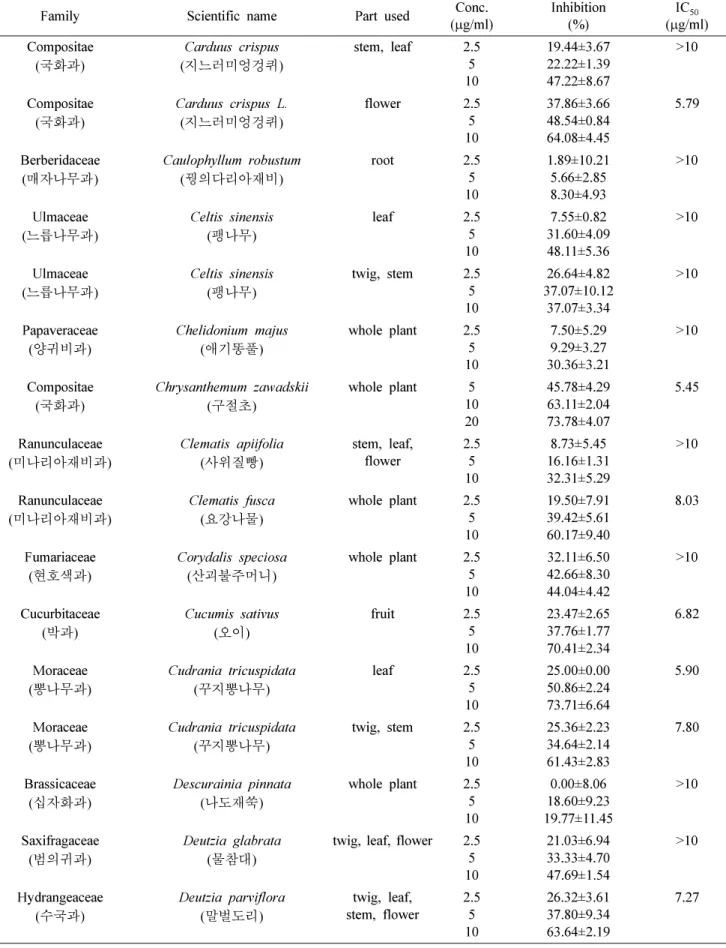
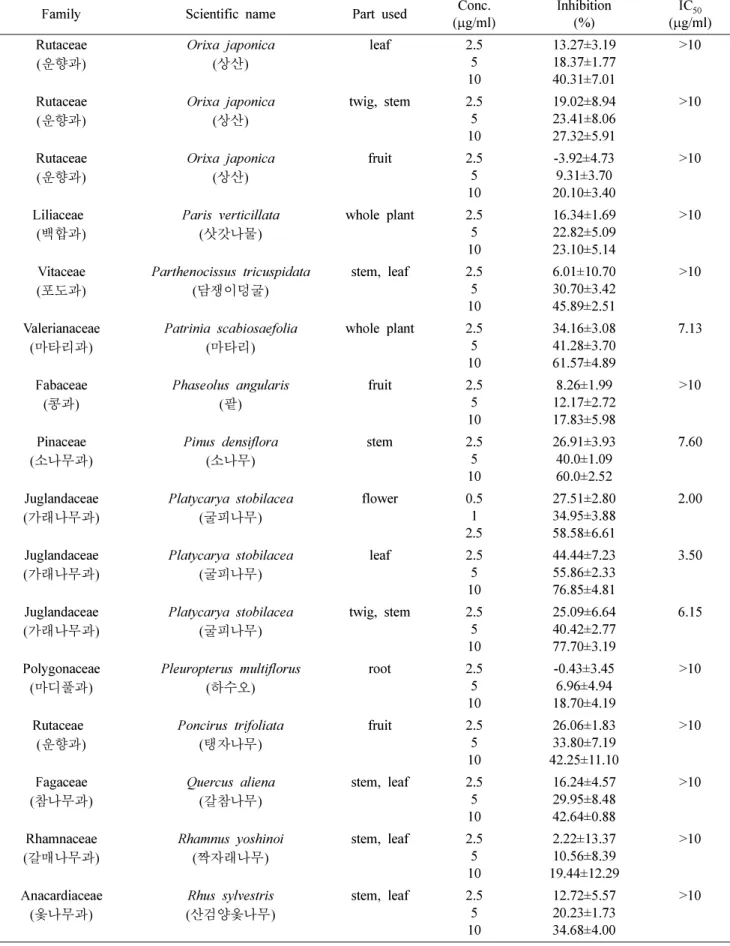
천연물로부터 알도즈 환원효소 억제 약물을 검색하기 위 해 한국산 81종의 에탄올 추출물을 이용해 효능을 검색하 여 Table I과 같은 결과를 얻었다.
여주는 것과 같이 14종의 추출물에서 알도즈 환원효소 억 제 효능을 보였다. 이 중 Xanthium strumarium(도꼬마리)의 열매(0.27 µg/ml), 전초(0.97 µg/ml), Ilex cornuta (호랑가시 나무)의 줄기, 잎(수나무-0.48 µg/ml, 암나무-1.43 µg/ml), Vitex rotundifolia(순비기나무)의 줄기(1.24 µg/ml), Sophora flavescens(고삼)의 전초(1.38µg/ml), Platycarya stobilacea (굴피나무)의 꽃(2.00 µg/ml)의 7종 추출물은 TMG 보다 2 배 이상의 우수한 효능이 있음을 알 수 있었다.
국화과의 X. strumarium의 열매와 전초 모두 알도즈 환원 효소 억제 효능을 나타내었고, 뿌리, 잎 열매 각각 에탄올 추출물의 분획 중 효능이 좋은 분획의 동물 모델에서 항종 양 활성에 관한 보고가 있다.16) 또한 열매에 함유된 caffeic acid는 1형과 2형 당뇨 동물모델에서 모두 혈당감소 효능을 나타내었다.17) 암수딴그루의 감탕나무과 I. cornuta는 암, 수 나무에서 모두 알도즈 환원효소 억제 효능을 보였으나 수나 무가 3배 이상 효능이 우수하였다. 잎에서 분리한 triterpenoids 성분과 phenolic 화합물들의 항산화 효능이 보고되었다.18,19) Table I. Inhibitory effect of extracts from Korean herbal medicines on the activities of aldose reductase
Family Scientific name Part used Conc.
(µg/ml)
Inhibition (%)
IC50 (µg/ml) Aceraceae
(단풍나무과)
Acer tegmentosum (산겨릅나무)
twig 1
5 10
8.02±4.79 49.00±4.41 65.90±3.02
6.79
Umbelliferae (산형과)
Angelica gigas (참당귀)
root 2.5
5 10
23.15±8.49 42.28±2.67 68.83±4.38
6.68
Compositae (국화과)
Arctium lappa (우엉)
root 2.5
5 10
29.08±3.53 33.67±3.19 51.02±4.05
9.89
Caryophyllaceae (석죽과)
Arenaria serpyllifolia (벼룩이자리)
whole plant 2.5 5 10
12.64±4.38 45.13±4.38 48.38±2.25
>10
Boraginaceae (지치과)
Argusia sibirica (모래지치)
whole plant 2.5 5 10
16.30±6.12 27.04±10.32
48.15±9.71
>10
Compositae (국화과)
Artemisia scoparia (비쑥)
aerial part 2.5 5 10
45.98±3.45 54.79±1.76 66.28±1.76
3.56
Aristolochiac (쥐방울덩굴과)
Asarum sieboldii (족도리)
root 2.5
5 10
31.31±0.87 38.38±5.32 47.47±6.31
>10
Aristolochiac (쥐방울덩굴과)
Asarum sieboldii (족도리)
stem, leaf 2.5 5 10
23.25±6.08 28.51±4.02 43.42±5.74
>10
Cruciferae (십자화과)
Barbarea orthoceras (나도냉이)
whole plant 2.5 5 10
9.73±6.14 9.19±4.29 36.76±4.29
>10
Table I. Continued
Family Scientific name Part used Conc.
(µg/ml) Inhibition (%)
IC50 (µg/ml) Compositae
(국화과)
Carduus crispus (지느러미엉겅퀴)
stem, leaf 2.5 5 10
19.44±3.67 22.22±1.39 47.22±8.67
>10
Compositae (국화과)
Carduus crispus L.
(지느러미엉겅퀴)
flower 2.5
5 10
37.86±3.66 48.54±0.84 64.08±4.45
5.79
Berberidaceae (매자나무과)
Caulophyllum robustum (꿩의다리아재비)
root 2.5
5 10
1.89±10.21 5.66±2.85 8.30±4.93
>10
Ulmaceae (느릅나무과)
Celtis sinensis (팽나무)
leaf 2.5
5 10
7.55±0.82 31.60±4.09 48.11±5.36
>10
Ulmaceae (느릅나무과)
Celtis sinensis (팽나무)
twig, stem 2.5 5 10
26.64±4.82 37.07±10.12
37.07±3.34
>10
Papaveraceae (양귀비과)
Chelidonium majus (애기똥풀)
whole plant 2.5 5 10
7.50±5.29 9.29±3.27 30.36±3.21
>10
Compositae (국화과)
Chrysanthemum zawadskii (구절초)
whole plant 5 10 20
45.78±4.29 63.11±2.04 73.78±4.07
5.45
Ranunculaceae (미나리아재비과)
Clematis apiifolia (사위질빵)
stem, leaf, flower
2.5 5 10
8.73±5.45 16.16±1.31 32.31±5.29
>10
Ranunculaceae (미나리아재비과)
Clematis fusca (요강나물)
whole plant 2.5 5 10
19.50±7.91 39.42±5.61 60.17±9.40
8.03
Fumariaceae (현호색과)
Corydalis speciosa (산괴불주머니)
whole plant 2.5 5 10
32.11±6.50 42.66±8.30 44.04±4.42
>10
Cucurbitaceae (박과)
Cucumis sativus (오이)
fruit 2.5
5 10
23.47±2.65 37.76±1.77 70.41±2.34
6.82
Moraceae (뽕나무과)
Cudrania tricuspidata (꾸지뽕나무)
leaf 2.5
5 10
25.00±0.00 50.86±2.24 73.71±6.64
5.90
Moraceae (뽕나무과)
Cudrania tricuspidata (꾸지뽕나무)
twig, stem 2.5 5 10
25.36±2.23 34.64±2.14 61.43±2.83
7.80
Brassicaceae (십자화과)
Descurainia pinnata (나도재쑥)
whole plant 2.5 5 10
0.00±8.06 18.60±9.23 19.77±11.45
>10
Saxifragaceae (범의귀과)
Deutzia glabrata (물참대)
twig, leaf, flower 2.5 5 10
21.03±6.94 33.33±4.70 47.69±1.54
>10
Hydrangeaceae (수국과)
Deutzia parviflora (말벌도리)
twig, leaf, stem, flower
2.5 5 10
26.32±3.61 37.80±9.34 63.64±2.19
7.27
Ebenaceae (감나무과)
Diospyros kaki (감나무)
fruit 2.5
5 10
11.18±1.08 23.60±6.45 42.86±4.30
>10
Celastraceae (노박덩굴과)
Euonymus alatus (회잎나무)
root, twig, leaf 2.5 5 10
30.34±4.05 38.95±4.25 55.06±4.49
8.48
Celastraceae (노박덩굴과)
Euonymus alatus (화살나무)
stem 2.5
5 10
22.92±5.67 32.56±4.71 50.17±2.64
9.88
Celastraceae (노박넝굴과)
Euonymus oxyphyllus (참회나무)
twig 2.5
5 10
-14.57±5.41 0.79±5.15 1.19±5.46
>10
Scrophulariaceae (현삼과)
Glycyrrhiza pallidiflora (토현삼)
root 2.5
10 20
41.67±4.17 97.69±3.50 140.28±1.39
3.06
Ulmaceae (느릅나무과)
Hemiptelea davidii (시무나무)
twig, stem, leaf 2.5 5 10
3.93±3.09 19.64±1.07 21.43±5.29
>10
Aquifoliaceae (감탕나무과)
Ilex cornuta (호랑가시나무-수)
stem, leaf 0.1 0.25
0.5
35.59±5.60 42.71±2.35 50.51±6.77
0.48
Aquifoliaceae (감탕나무과)
Ilex cornuta (호랑가시나무-암)
stem, leaf 0.5 1 2.5
23.76±9.44 49.83±8.06 70.30±8.91
1.43
Fabaceae (콩과)
Indigofera kirilowii (땅비싸리)
twig, leaf, flower
2.5 5 10
25.72±2.79 39.02±2.00 49.71±4.59
>10
Leguminosae (콩과)
Lespedeza bicolor (싸리)
stem, leaf 2.5 5 10
-9.29±19.00 0.55±3.41 42.08±5.01
>10
Liliaceae (백합과)
Liriope platyphylla (맥문동)
stem, root 2.5 5 10
24.57±4.62 38.23±5.25 60.75±2.96
7.67
Lauraceae (녹나무과)
Machilus thunbergii (후박나무)
leaf, twig 2.5 5 10
24.29±2.23 38.21±5.90 57.14±2.14
8.31
Lauraceae (녹나무과)
Machilus thunbergii (후박나무)
bark 2.5
5 10
5.80±2.26 14.86±3.49 16.30±10.48
>10
Liliaceae (백합과)
Maianthemum dilatatum (큰두루미꽃)
whole plant 2.5 5 10
11.15±4.68 28.38±7.61 41.89±6.52
>10
Sabiaceae (나도밤나무과)
Meliosma oldhamii (합다리나무)
twig 2.5 5 10
19.42±5.10 22.61±3.48 39.13±6.09
>10
Sabiaceae (나도밤나무과)
Meliosma oldhamii (합다리나무)
leaf 2.5 5 10
17.89±4.85 20.23±6.24 34.31±0.51
>10
Table I. Continued
Family Scientific name Part used Conc.
(µg/ml)
Inhibition (%)
IC50 (µg/ml) Rutaceae
(운향과)
Orixa japonica (상산)
leaf 2.5
5 10
13.27±3.19 18.37±1.77 40.31±7.01
>10
Rutaceae (운향과)
Orixa japonica (상산)
twig, stem 2.5 5 10
19.02±8.94 23.41±8.06 27.32±5.91
>10
Rutaceae (운향과)
Orixa japonica (상산)
fruit 2.5
5 10
-3.92±4.73 9.31±3.70 20.10±3.40
>10
Liliaceae (백합과)
Paris verticillata (삿갓나물)
whole plant 2.5 5 10
16.34±1.69 22.82±5.09 23.10±5.14
>10
Vitaceae (포도과)
Parthenocissus tricuspidata (담쟁이덩굴)
stem, leaf 2.5 5 10
6.01±10.70 30.70±3.42 45.89±2.51
>10
Valerianaceae (마타리과)
Patrinia scabiosaefolia (마타리)
whole plant 2.5 5 10
34.16±3.08 41.28±3.70 61.57±4.89
7.13
Fabaceae (콩과)
Phaseolus angularis (팥)
fruit 2.5
5 10
8.26±1.99 12.17±2.72 17.83±5.98
>10
Pinaceae (소나무과)
Pinus densiflora (소나무)
stem 2.5
5 10
26.91±3.93 40.0±1.09 60.0±2.52
7.60
Juglandaceae (가래나무과)
Platycarya stobilacea (굴피나무)
flower 0.5
1 2.5
27.51±2.80 34.95±3.88 58.58±6.61
2.00
Juglandaceae (가래나무과)
Platycarya stobilacea (굴피나무)
leaf 2.5
5 10
44.44±7.23 55.86±2.33 76.85±4.81
3.50
Juglandaceae (가래나무과)
Platycarya stobilacea (굴피나무)
twig, stem 2.5 5 10
25.09±6.64 40.42±2.77 77.70±3.19
6.15
Polygonaceae (마디풀과)
Pleuropterus multiflorus (하수오)
root 2.5
5 10
-0.43±3.45 6.96±4.94 18.70±4.19
>10
Rutaceae (운향과)
Poncirus trifoliata (탱자나무)
fruit 2.5 5 10
26.06±1.83 33.80±7.19 42.25±11.10
>10
Fagaceae (참나무과)
Quercus aliena (갈참나무)
stem, leaf 2.5 5 10
16.24±4.57 29.95±8.48 42.64±0.88
>10
Rhamnaceae (갈매나무과)
Rhamnus yoshinoi (짝자래나무)
stem, leaf 2.5 5 10
2.22±13.37 10.56±8.39 19.44±12.29
>10
Anacardiaceae (옻나무과)
Rhus sylvestris (산검양옻나무)
stem, leaf 2.5 5 10
12.72±5.57 20.23±1.73 34.68±4.00
>10
Saxifragaceae (범의귀과)
Ribes fasciculatum (까마귀밥나무)
twig, leaf, fruit 1 2.5
5
18.80±2.50 30.00±5.54 58.40±5.92
4.28
Solanaceae (가지과)
Scopolia japonica (미치괭이풀)
stem, leaf 2.5 5 10
6.06±1.50 27.71±2.70 38.53±6.14
>10
Solanaceae (가지과)
Scopolia japonica (미치광이풀)
root 2.5
5 10
19.42±12.58 30.58±5.40 34.30±5.68
>10
Leguminosae (콩과)
Sophora flavescens (고삼)
whole plant 0.5 1 2.5
25.89±5.46 46.10±2.68 75.53±5.92
1.38
Rosaceae (장미과)
Sorbaria sorbifolia (쉬땅나무)
leaf 1 2.5
5
16.67±5.88 23.70±3.90 54.44±6.94
4.77
Rosaceae (장미과)
Sorbaria sorbifolia (쉬땅나무)
twig, stem 2.5 5 10
12.26±2.79 18.39±3.91 27.10±3.11
>10
Rosaceae (장미과)
Sorbus alnifolia (팥배나무)
twig, leaf 1 5 10
16.72±3.62 46.49±2.09 56.19±3.23
7.72
Styracaceae (때죽나무과)
Styrax japonica (때죽나무)
flower 2.5
5 10
17.05±7.87 24.43±3.94 36.36±11.35
>10
Styracaceae (때죽나무과)
Styrax japonica (때죽나무)
stem, leaf 2.5 5 10
1.19±4.29 3.97±4.18 15.48±7.43
>10
Chenopodiaceae (명아주과)
Suaeda maritima (해홍나물)
whole plant 2.5 5 10
4.45±4.48 3.08±1.57 16.78±1.03
>10
Compositae (국화과)
Taraxacum officinale (서양민들레)
whole plant 2.5 5 10
37.10±5.44 49.47±2.67 73.14±4.41
5.16
Brassicaceae (십자화과)
Thlaspi arvense (말냉이)
whole plant 2.5 5 10
8.58±0.65 33.21±5.52 36.19±11.69
>10
Tiliaceae (피나무과)
Tilia amurensis (피나무)
stem, leaf
2.5 5 10
9.96±5.03 29.88±10.88
46.89±1.90
>10
Tiliaceae (피나무과)
Tilia mandshurica (찰피나무)
leaf 2.5
5 10
15.38±6.83 28.51±3.13 44.80±6.12
>10
Tiliaceae (피나무과)
Tilia mandshurica (찰피나무)
twig, stem 2.5 5 10
14.69±2.46 21.80±4.27 38.86±6.52
>10
Tiliaceae (피나무과)
Tilia mandshurica (찰피나무)
flower, leaf 2.5 5 10
9.47±1.43 15.64±4.99 32.92±5.14
>10
마편초과의 Vitex rotundifolia는 소지, 잎의 알도즈 환원효소 의 효능이 보고되었고,7) 본 연구 결과 줄기 역시 동일한 효 능이 확인되었다. V. rotundifolia에 함유된 vitexicarpin는 항 염, 항종양, 항진통 효능을 지녔으며, 혈관 내피세포에서 혈 관 염증을 억제한다는 보고가 있다.20) 콩과의 S. flavescens 에서 분리한 flavonoids들의 최종당화산물, 알도즈 환원효소 억제 효능을 나타내었다.21) 가래나무과의 Platycarya stobil- acea 는 ent-eudesmane sesquiterpenoids 성분을 함유하며,22) 줄기 추출물에서는 항산화 효능을 나타내는 polyphenol 이 다량 함유되어 있으며 대장 상피세포에서 TNF-α에 의해 활 성화된 NF-κB를 억제한다.23)꽃과 잎에서는 각각 알도즈 환원효소 억제 효능이 나타났으나, 소지, 줄기 추출물에서 는 효능이 나타나지 않아 부위별 효능차이를 보였다. 본 연 구 결과는 안전하고 우수한 알도즈 환원 효소 억제제 후보 물질 발굴을 위한 기초자료로 활용될 수 있을 뿐만 아니라, 당뇨합병증 예방 및 치료제 개발에 이용될 수 있을 것으로
사료된다.
결 론
81종의 한국산 약용식물 에탄올 추출물을 in vitro에서 알 도즈 환원 효소 억제활성 검색하였다. 그 결과 14종의 추출 물이 양성대조군인 TMG보다 효능이 있음을 확인하였고, 그 중 X. strumarium의 열매, 전초, I. cornuta의 암, 수나무 의 줄기와 잎, V. rotundifolia의 줄기, S. flavescens의 전초, P. stobilacea의 꽃의 7종 추출물은 양성대조군보다 2배 이 상의 우수한 효능이 있음을 알 수 있었다.
사 사
본 연구는 한국한의학연구원 기관고유사업비(K12040, K13040)로 수행되었으며 이에 감사드립니다.
Table I. Continued
Family Scientific name Part used Conc.
(µg/ml)
Inhibition (%)
IC50 (µg/ml) Typhaceae
(부들과)
Typha orientalis (부들)
aerial part 2.5 5 10
16.47±2.0 34.97±5.27 35.84±7.41
>10
Typhaceae (부들과)
Typha orientalis (부들)
root 2.5 5 10
2.45±6.89 8.56±2.31 17.74±5.38
>10
Fabaceae (콩과)
Vicia villosa (벳지)
whole plant 2.5 5 10
4.50±13.54 18.47±4.75 42.34±3.12
>10
Verbenaceae (마편초과)
Vitex rotundifolia (순비기나무)
stem 0.5
1 2.5
38.16±4.41 43.11±3.41 73.85±0.61
1.24
Compositae (국화과)
Xanthium strumarium (도꼬마리)
fruit 0.1
0.25 0.5
34.57±3.59 44.24±1.93 75.46±2.23
0.27
Compositae (국화과)
Xanthium strumarium (도꼬마리)
whole plant 0.25 0.5
1
36.1±6.59 39.71±1.65 50.90±1.25
0.97
Rutaceae (운향과)
Zanthoxylum piperitum (초피나무)
twig, leaf 1 2.5
5
29.63±1.70 48.52±8.49 64.07±2.31
3.15
Gramineae (벼과)
Zea mays (옥수수)
fruit 2.5 5 10
15.81±5.12 22.26±3.91 30.65±6.30
>10
3.3-Tetramethyleneglutaric acid 3.724 5.586
7.448
31.42±5.71 56.42±9.60 69.69±8.15
5.37
IC50 values were calculated from the dose inhibition curve.
a TMG (3,3-Tetramethyleneglutaric acid) was used as positive control.
aldose reductase inhibitor in diabetic neuropathy. Diabetes 30: 459-464.
2. Shi, X., Liao, S., Mi, H., Guo, C., Qi, D., Li, F., Zhang, C. and Yang, Z. (2012) Hesperidin prevents retinal and plasma abnormalities in streptozotocin-induced diabetic rats. Mol- ecules 17: 12868-12881.
3. Chalk, C., Benstead, T. J. and Moore, F. (2007) Aldose reduc- tase inhibitors for the treatment of diabetic polyneuropathy.
Cochrane Database Syst. Rev. 4: CD004572.
4. Hotta, N., Akanuma, Y., Kawamori, R., Matsuoka, K., Oka, Y., Shichiri, M., Toyota, T., Nakashima, M., Yoshimura, I., Sakamoto, N. and Shigeta, Y. (2006) Long-term clinical effects of epalrestat, an aldose reductase inhibitor, on diabetic peripheral neuropathy. Diabetes Care 29: 1538-1544.
5. Ziegler, D. (2004) Polyneuropathy in the diabetic patient- update on pathogenesis and management. Nephrol. Dial.
Transplant 19: 2170-2175.
6. Ramirez, M. A. and Borja, N. L. (2008) Epalrestat: an aldose reductase inhibitor for the treatment of diabetic neuropathy.
Pharmacotherapy 28: 646-655.
7. Lee, Y. M., Kim, N. H., Kim, J. M., Kim, Y. S., Jang, D. S., Kim, J. H., Bae, K. H. and Kim, J. S. (2008) Screening of inhibitory effect on aldose reductase of Korean herbal med- icines and preventive effect of Catalpa bignonioides against xylose-induced lens opacity (I). Kor. J. Pharmacogn. 39:
165-173.
8. Lee, Y. M., Kim, J. M., Kim, Y. S., Jang, D. S., Kim, J. H., Bae, K. H. and Kim, J. S. (2008) Screening of inhibitory effect on aldose reductase of Vietnam herbal medicines (II).
Kor. J. Pharmacogn. 39: 324-329.
9. Lee, Y. M., Kim, J. M., Kim, Y. S., Jang, D. S., Kim, J. H., Bae, K. H. and Kim, J. S. (2009) Screening of Chinese herbal medicines with inhibitory effect on aldose reductase (III).
Kor. J. Pharmacogn. 40: 394-399.
10. Lee, Y. M., Kim, Y. S., Bae, K. H., Kim, J. H. and Kim, J. S.
(2010) Screening of Chinese herbal medicines with inhibitory effect on aldose reductase (IV) Kor. J. Pharmacogn. 41: 289- 296.
11. Lee, Y. M., Kim, Y. S., Kim, J. H. and Kim, J. S. (2011) Screening of Chinese herbal medicines with inhibitory effect on aldose reductase. (V) Kor. J. Pharmacogn. 42: 187-194.
12. Lee, Y. M., Kim, Y. S., Kim, J. H. and Kim, J. S. (2011) Screening of Korean herbal medicines with inhibitory effect on aldose reductase. (VI) Kor. J. Pharmacogn. 42: 161-168.
13. Dufrane, S. P., Malaisse, W. J. and Sener, A. (1984) A
quantitation of microgram quantities of protein utilizing the principle of protein-dye binding. Anal. Biochem. 72: 248-254.
15. Kinoshita, J. H., Dvornik, D., Kraml, M. and Gabbay, K. H.
(1968) The effect of an aldose reductase inhibitor on the galactose-exposed rabbit lens. Biochim. Biophys. Acta. 24:
472-475.
16. Aranjani, J. M., Manuel, A., Mallikarjuna Rao, C., Udupa, N., Rao, J. V., Joy, A. M., Gandhi, P. and Radhakrishnan, E. K.
(2013) Preliminary evaluation of in vitro cytotoxicity and in vivo antitumor activity of Xanthium strumarium in Trans- plantable Tumors in Mice. Am. J. Chin. Med. 41: 145-162.
17. Hsu, F. L., Chen, Y. C. and Cheng, J. T. (2000) Caffeic acid as active principle from the fruit of Xanthium strumarium to lower plasma glucose in diabetic rats. Planta Med. 66: 228- 230.
18. Zhu, F., Cai, Y. Z., Sun, M., Ke, J., Lu, D. and Corke, H.
(2009) Comparison of major phenolic constituents and in vitro antioxidant activity of diverse Kudingcha genotypes from Ilex kudingcha, Ilex cornuta, and Ligustrum robustum.
J. Agric. Food Chem. 57: 6082-6089.
19. Yao, Z., Li, J., Zhou, S., Zhang, Y. and Tu, P. (2009) Trit- erpenoids from leaves of Ilex cornuta. Zhongguo Zhong Yao Za Zhi 34: 999-1001.
20. Lee, S. M., Lee, Y. J., Kim, Y. C., Kim, J. S., Kang, D. G. and Lee, H. S. (2012) Vascular protective role of vitexicarpin iso- lated from Vitex rotundifolia in human umbilical vein endot- helial cells. Inflammation. 35: 584-593.
21. Jung, H. A., Yoon, N. Y., Kang, S. S., Kim, Y. S. and Choi, J. S. (2008) Inhibitory activities of prenylated flavonoids from Sophora flavescens against aldose reductase and gen- eration of advanced glycation endproducts. J. Pharm. Phar- macol. 60: 1227-1236.
22. Maeda, H., Kakoki, N., Ayabe, M., Koga, Y., Oribe, T., Mat- suo, Y., Tanaka, T. and Kouno, I. (2011) ent-Eudesmane ses- quiterpenoids, galloyl esters of the oak lactone precursor, and a 3-O-methylellagic acid glycoside from the wood of Platy- carya strobilacea. Phytochemistry 72: 796-803.
23. Babu, D., Lee, J. S., Park, S. Y., Thapa, D., Choi, M. K., Kim, A. R., Park, Y. J. and Kim, J. A. (2008) Involvement of NF- kappaB in the inhibitory actions of Platycarya strobilacea on the TNF-alpha-induced monocyte adhesion to colon epithe- lial cells and chemokine expression. Arch. Pharm. Res. 31:
727-735.
(2013. 3. 6 접수; 2013. 3. 22 심사; 2013. 4. 9 게재확정)