Kor. J. Pharmacogn.
44(3) : 305∼ 311 (2013)
305
중국 약용식물의 최종당화산물 생성저해활성 검색 (X)
김영숙1·이윤미1·김주환2·김진숙1
∗
1한국한의학연구원 한약연구본부 한의신약개발그룹, 2가천대학교 생명과학과
Screening of Herbal Medicines from China with Inhibitory Activity on Advanced Glycation End Products (AGEs) Formation (X)
Young Sook Kim1, Yun Mi Lee1, Joo Hwan Kim2 and Jin Sook Kim1
*
1Korean Medicine-Based Herbal Drug Development Group, Herbal Medicine Research Division, Korea Institute of Oriental Medicine, 1672 Yuseongdae-ro, Yuseong-gu, Daejeon, 305-811, Korea,
2Department of Life Science, Gachon University, Seongnam, Kyonggi-do 461-701, Korea,
Abstracts − Advanced glycation end products (AGEs) have been postulated to play a central role in the development of dia- betic complications. A variety of different agents that inhibit AGEs have been under investigation. In this study, 54 herbal med- icines from China have been investigated with an in vitro evaluation system using AGEs formation inhibitory activity. Of these, 6 herbal medicines (IC50<5µg/ml) were found to have significant AGEs formation inhibitory activity. Particularly, herbal med- icines Punica granatum (peels), Terminalia chebula (fruits), Rheum palmatum (roots), Oxyria digyna (stems and leaves), Ani- sodus luridus (roots) and Quercus schottkyana(stems and leaves) showed more potent inhibitory activity (approximately 9-43 fold) than the positive control aminoguanidine (IC50=77.04µg/ml).
Key words − Advanced glycation end products (AGEs), diabetic complications, Chinese herbal medicines
최종당화산물은 신장, 망막 등 조직내 단백질과 반응하여 각 장기에 축적되어 당뇨병성 신증(Diabetic nephropathy), 망막증(D. retinopathy), 백내장(D. cataract) 등의 당뇨합병 증으로 진행된다. 최근 천연물을 이용하여 최종당화산물 생 성 억제하거나 이미 생성된 최종당화산물의 조직 내 교차 결합(AGEs-protein cross-link)을 억제하는 약물을 개발하려 는 연구가 활발히 이루어지고 있다.1-7) 본 연구에서는 지난 보고에 이어,8-15)중국에서 자생하는 약용식물 54종의 에탄 올 추출물을 대상으로 최종당화산물 생성 저해 활성을 in vitro에서 검색하여, 후보물질을 선별하고자 하였다.
재료 및 방법
실험재료 − 본 실험에 사용된 약용 식물(Table I)들은 2007 년-2009년 중국의 운남성, 장시성, 티벳 지역에서 채취되어, 가천대학교 생명과학과 김주환 교수의 감정을 거친 후 실 험 재료로 사용되었다. 사용한 실험 재료의 증거표본은 한
국한의학연구원 한약연구본부 한의신약개발그룹 당뇨합병 증 연구팀에 보관 중이다.
추출 및 시료조제 − 분쇄 또는 절단한 시료 200 g에 2 L 의 에탄올을 넣고 실온상태에서 3일간 3회 추출하였다. 이 를 여과하여 40oC의 수욕 상에서 감압농축을 실시한 후, 동 결 건조기에서 건조하였다. 추출물은 효능 스크리닝 실험 수행 전에 감압 하에서 P2O5를 이용하여 24시간 이상 재건 조한 후 DMSO(Sigma, St. Louis, MO, USA)에 용해시켜 stock solution을 조제하였으며 최종 DMSO의 농도가 0.2%
가 되도록 15% TWEEN 80(Sigma, St. Louis, MO, USA) 용액으로 희석하여 사용하였다. 추출에 이용한 에탄올 및 그 외 시약은 1급 및 특급시약을 사용하였다.
In vitro에서 최종당화산물 생성저해 실험 − Vinson과 Howard16)의 방법을 변형하여 실험을 실시하였다. 본 실험 에서는 50 mM phosphate buffer(pH 7.4)에 용해시킨 10 mg/
ml의 우혈청 알부민(bovine serum albumin, Sigma) 0.7 ml 과 0.2 M의 fructose와 glucose 0.1 ml을 여러 농도의 추출 물0.2 ml과 함께 혼합하여 1 ml이 되도록 처리하였다. 이를 37oC에서 14일 동안 당화 반응시켰다. 이 때 50 mM phosphate buffer에 0.02% sodium azide를 넣어 반응기간 동
*교신저자(E-mail):[email protected] (Tel): +82-42-868-9465
대신 최종당화산물 생성저해제인 aminoguanidine을 사용하 였다. 배양 후에는 spectrofluorometric detector(Bio-TEK, Synergy HT, USA)를 이용하여 형광도를 측정하였다(Ex : 350, Em : 450 nm). 모든 시료는 triplicate로 수행하여 IC50 값으로 계산되었다.
결과 및 고찰
천연물로부터 당뇨 합병증의 진행을 억제하는 약물 검색 을 위해, 중국에서 사용되는 약용식물 54종의 에탄올 추출 물을 이용하여 최종당화산물 생성 저해 효능을 검색하였다.
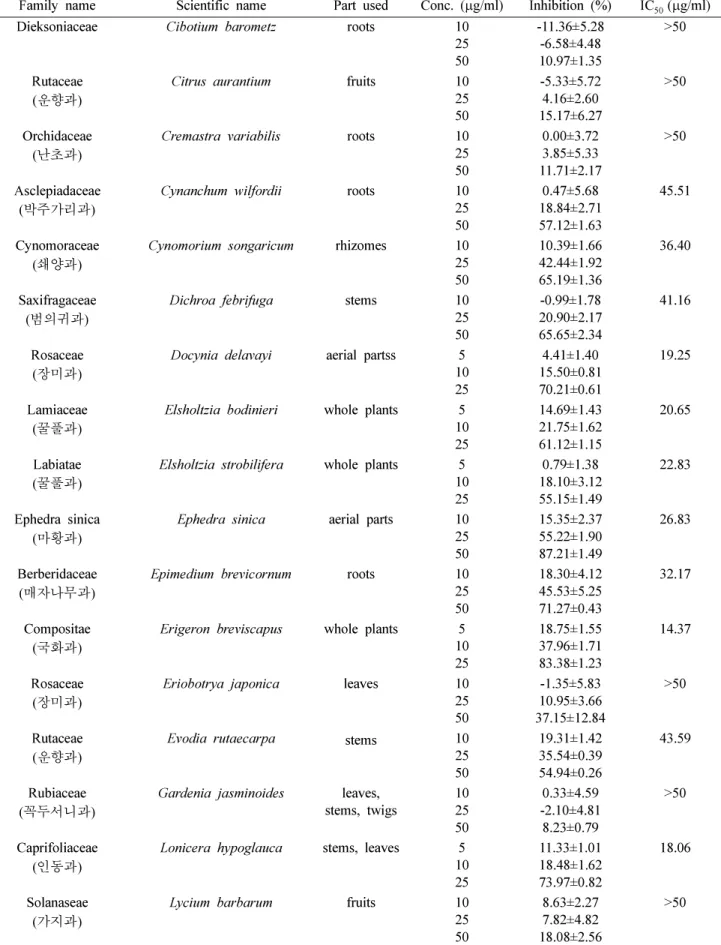
양성 대조 약물인 aminoguanidine의 IC50 값(77.04 µg/ml)을 근거로 하여, 추출물의 IC50 값이50µg/ml이하 이면 효능이 있다고 판단하였다. Table I에서 보여 주는 것과 같이 28종 의 식물 추출물에서 IC50<50µg/ml로 최종당화산물 생성 저 해 효능을 보였고, 그 중에서 Punica granatum의 과피(1.79 µg/ml), Terminalia chebula의 열매(2.79 µg/ml), Rheum palmatum의 뿌리(7.06 µg/ml), Oxyria digyna의 줄기, 잎 (7.61µg/ml), Anisodus luridus의 뿌리(7.98 µg/ml), Quercus schottkyana의 줄기, 잎(8.22 µg/ml) 6종은 IC50가 10 µg/ml
수 있었다.
석류나무과의 석류로 알려져 있는 Punica granatum는 중 국 전통의학에서 과피가 수렴제, 항염증제로 사용되며, 외 상성 출혈, 궤양 및 감염, 설사와 이질 등의 소화기관 장애 의 치료에 사용되었으며,17-19) Ellagic acid와 ellagitannins의 혈관이완, 항염, 항암효능이 있다.20) 사군자과 Terminalia chebula의 열매는 고대부터 다양한 질병의 치료에 사용되어 온 전통의약품으로 많은 연구가 보고되어 있다. tannins, polyphenols, terpenes, anthocyanins, flavonoids, alkaloids and glycosides 등 다양한 생리 활성 물질을 함유하고 있으 며, 수렴, 지혈, 만성후두염, 피부질환, 기침, 신경과민 등에 사용되었다. 또한 추출물은 항암활성, 항당뇨, 항돌연변이활 성, 간보호 효능, 항균작용, 항진균, 항염, 충치 예방 등의 다양한 생리활성을 가지고 있다.21-27) 마디풀과 Rheum palmatum 뿌리에서 phenolic glucosides, anthraquinone glycosides 등의 성분을 함유하고 있으며, emodin과 rhein 은 iNOS inhibitors로 항염증 효능을 가진다.28-30) 가지과 Anisodus luridus 뿌리에서 분리한 alkaloid의 연구가 보고되었다.31) 마 디풀과의 Oxyria digyna와 참나무과 Quercus schottkyana는 생리활성 물질 성분이나 효능 연구가 보고되지 않았으며,
Table I. Inhibitory activity of ethanol extracts of the herbal medicines and aminoguanidine on AGEs formation in vitro Family name Scientific name Part used Conc. (µg/ml) Inhibition (%) IC50 (µg/ml) Ranunculaceae
(미나리아재비과)
Aconitum carmichaeli roots 10
25 50
-2.99±6.07 -6.62±1.56 0.45±1.88
>50
Liliaceae (백합과)
Allium bakeri roots 10
25 50
-3.07±4.23 -5.79±0.50 -3.22±3.08
>50
Vitaceae (포도과)
Ampelopsis japonica stems 10
25 50
7.47±3.70 50.03±0.62 80.52±1.24
30.59
Solanaceae (가지과)
Anisodus luridus roots 2.5
5 10
16.06±1.98 37.47±1.19 60.12±2.68
7.98
Liliaceae (백합과)
Asparagus cochinchinensis aerial parts 10 25 50
18.43±5.48 29.57±3.28 39.31±3.67
>50
Rhamnaceae (갈매나무과)
Berchemia floribunda stems, leaves 5 10 25
16.65±2.36 42.77±2.50 82.29±0.42
14.22
Umbelliferae (미나리과)
Centella asiatica aerial parts 10 25 50
-0.58±1.38 15.42±1.76 55.58±0.14
46.97
Compositae (국화과)
Chrysanthemum morifolium flowers 10 25 50
-18.69±2.71 -15.31±0.58 -7.53±2.63
>50
Table I. Continued
Family name Scientific name Part used Conc. (µg/ml) Inhibition (%) IC50 (µg/ml)
Dieksoniaceae Cibotium barometz roots 10
25 50
-11.36±5.28 -6.58±4.48 10.97±1.35
>50
Rutaceae (운향과)
Citrus aurantium fruits 10
25 50
-5.33±5.72 4.16±2.60 15.17±6.27
>50
Orchidaceae (난초과)
Cremastra variabilis roots 10 25 50
0.00±3.72 3.85±5.33 11.71±2.17
>50
Asclepiadaceae (박주가리과)
Cynanchum wilfordii roots 10
25 50
0.47±5.68 18.84±2.71 57.12±1.63
45.51
Cynomoraceae (쇄양과)
Cynomorium songaricum rhizomes 10 25 50
10.39±1.66 42.44±1.92 65.19±1.36
36.40
Saxifragaceae (범의귀과)
Dichroa febrifuga stems 10
25 50
-0.99±1.78 20.90±2.17 65.65±2.34
41.16
Rosaceae (장미과)
Docynia delavayi aerial partss 5 10 25
4.41±1.40 15.50±0.81 70.21±0.61
19.25
Lamiaceae (꿀풀과)
Elsholtzia bodinieri whole plants 5 10 25
14.69±1.43 21.75±1.62 61.12±1.15
20.65
Labiatae (꿀풀과)
Elsholtzia strobilifera whole plants 5 10 25
0.79±1.38 18.10±3.12 55.15±1.49
22.83
Ephedra sinica (마황과)
Ephedra sinica aerial parts 10 25 50
15.35±2.37 55.22±1.90 87.21±1.49
26.83
Berberidaceae (매자나무과)
Epimedium brevicornum roots 10
25 50
18.30±4.12 45.53±5.25 71.27±0.43
32.17
Compositae (국화과)
Erigeron breviscapus whole plants 5 10 25
18.75±1.55 37.96±1.71 83.38±1.23
14.37
Rosaceae (장미과)
Eriobotrya japonica leaves 10 25 50
-1.35±5.83 10.95±3.66 37.15±12.84
>50
Rutaceae (운향과)
Evodia rutaecarpa stems 10
25 50
19.31±1.42 35.54±0.39 54.94±0.26
43.59
Rubiaceae (꼭두서니과)
Gardenia jasminoides leaves, stems, twigs
10 25 50
0.33±4.59 -2.10±4.81 8.23±0.79
>50
Caprifoliaceae (인동과)
Lonicera hypoglauca stems, leaves 5 10 25
11.33±1.01 18.48±1.62 73.97±0.82
18.06
Solanaseae (가지과)
Lycium barbarum fruits 10
25 50
8.63±2.27 7.82±4.82 18.08±2.56
>50
µg/ml) 50 µg/ml) Labiatae
(꿀풀과)
Lycopus coreanus aerial parts 10 25 50
9.81±1.68 14.07±0.79 17.13±2.37
>50
Schizaeaceae (실고사리과)
Lygodium japonicum aerial parts 10 25 50
23.59±2.81 34.57±2.34 40.55±2.12
>50
Magnoliaceae (목련과)
Michelia alba flowers 5
10 25
12.88±8.27 42.47±5.57 82.53±0.62
14.42
Rubiaceae (꼭두서니과)
Morinda officinalis roots 10
25 50
-14.33±5.29 11.98±4.40 -6.02±1.45
>50
Polygonaceae (마디풀과)
Oxyria digyna stems, leaves 2.5 5 10
15.12±3.37 34.52±0.89 65.43±3.62
7.61
Solanaceae (가지과)
Physalis alkekengi fruits 10
25 50
-12.14±6.65 -5.32±1.09
2.34±4.69
>50
Phytolaccaceae (자리공과)
Phytolacca acinosa roots 10
25 50
-0.78±3.46 1.35±1.51 3.56±1.40
>50
Piperaceae (후추과)
Piper longum fruits 10
25 50
18.79±0.51 37.06±1.68 52.46±1.92
45.38
Piperaceae (후추과)
Piper nigrum fruits 10
25 50
29.37±1.04 47.95±0.97 63.02±1.58
32.32
Codonopsis lanceolata (도라지과)
Platycodon grandiflorum roots 10 25 50
4.48±1.07 1.68±0.84 9.02±1.30
>50
Polyporaceae (구멍장이버섯과)
Poria cocos drusen 10
25 50
-0.30±3.44 1.74±4.44 8.26±5.08
>50
Rosaceae (장미과)
Potaninia mongolica aerial parts 10 25 50
26.89±1.09 36.44±1.58 46.87±1.37
>50
Rosaceae (장미과)
Prunus mume stems 10
25 50
20.32±0.42 40.78±5.34 77.93±5.65
30.97
Leguminosae (콩과)
Pterocarpus santalinus stems 5 10 25
10.27±5.18 32.77±2.56 66.71±0.11
19.49
Punicaceae (석류나무과)
Punica granatum peel 0.5
1.25 2.5
13.28±2.95 29.17±1.60 73.28±0.94
1.79
Fagaceae (참나무과)
Quercus schottkyana stems, leaves 2.5 5 10
7.78±4.33 25.15±1.89 63.54±1.72
8.22
Polygonaceae (마디풀과)
Rheum palmatum roots 2.5
5 10
11.39±2.31 37.53±4.94 71.94±3.40
7.06
위 언급된 6종의 최종당화산물 생성 억제 효능 및 효능을 나타내는 유효 성분에 관한 연구 및 전임상 실험을 통해 in vivo효능 확인이 필요하다고 사료된다. 본 연구 결과는 중국 산 약용 식물로부터 안전하고 효능이 좋은 최종당화산물 생 성 저해제 후보를 발굴하기 위한 기초 자료로 활용될 수 있 으며, 당뇨에 의해 나타나는 합병증 치료제 개발의 기반을 구축하는데 기여할 수 있을 것이다.
결 론
기원이 확인된 중국산 약용식물 54종의 에탄올 추출물이 in vitro에서 최종당화산물 생성저해 효능이 검색되었다. 그 결과 28종이 양성대조군인 aminoguanidine보다 우수한 효능 이 있음을 확인하였고, 그 중 P. granatum(과피), T. chebula (열매), R. palmatum(뿌리), O. digyna(줄기, 잎) , A. luridus Table I. Continued
Family name Scientific name Part used Conc. (µg/ml) Inhibition (%) IC50 (µg/ml) Liliaceae
(백합과)
Smilax china twigs, leaves 10 25 50
19.40±2.71 30.26±2.06 61.59±3.43
>50
Fabaceae (콩과)
Sophora davidii stems, leaves 10 25 50
10.29±0.35 25.39±3.42 39.16±1.06
>50
Leguminosae (콩과)
Sophora japonica fruits 10
25 50
-4.94±3.23 5.09±0.72 27.69±2.92
>50
Fabaceae (콩과)
Sophora subprostrata roots, rhizome
10 25 50
-6.27±1.19 -1.90±1.85 9.61±4.12
>50
Combretaceae (사군자과)
Terminalia chebula fruits 1.25 2.5
5
22.93±2.21 50.69±2.09 82.41±0.83
2.79
Apocynaceae (협죽도과)
Trachelospermum jasminoides whole plants 10 25 50
0.55±3.30 10.81±1.06 26.45±0.21
>50
Leguminosae (콩과)
Trigonella foenum fruits 10
25 50
-4.46±0.19 -3.55±4.44 0.13±3.26
>50
Rubiaceae (꼭두서니과)
Uncaria sinensis stems 5
10 25
17.72±0.69 34.21±0.82 64.29±1.18
18.34
Adoxaceae (연복초과)
Viburnum congestum stems, leaves 5 10 25
7.06±0.00 28.97±2.06 72.55±0.48
17.66
Compositae (국화과)
Xanthium sibiricum fruits 10
25 50
-7.01±1.61 -4.07±1.62 -4.61±2.14
>50
Zingiberaceae (생강과)
Zingiber officinale roots 10
25 50
12.47±1.90 19.30±2.00 27.88±1.62
>50
Rhamnaceae (갈매나무과)
Zizyphus jujuba twigs, leaves 10 25 50
24.43±2.04 36.36±1.66 50.11±2.13
48.98
Aminoguanidine (Positive Control)
55.5 74 92.5
39.93±1.74 49.97±3.22 56.62±2.25
77.04
IC50 values were calculated from the dose inhibition curve.
조군(aminoguanidine) 보다 9-43배 억제 효능이 우수한 것 으로 나타났다.
사 사
본 연구는 한국한의학연구원 기관고유사업(K12040, K13040)의 지원으로 수행되었으며 이에 감사드립니다.
인용문헌
1. Brownlee, M. (2005) The Pathobiology of diabetic compli- cations: A unifying mechanism. Diabetes 54: 1615-1625.
2. Larkins, R. G. and Dunlop, M. E. (1992) The link between hyperglycaemia and diabetic nephropathy. Diabetologia 35:
499-504.
3. Ahmed, N. (2005) Advanced glycation endproducts-role in pathology of diabetic complications. Diabetes Res. Clin.
Pract. 67: 3-21.
4. Huebschmann, A.G., Vlassara, H., Regensteiner, J. G. and Reusch, J. (2006) Diabetes and advanced glycoxidation end products. Diabetes care 29: 1420-1432.
5. Yokozawa, T., Nakagawa, T. and Terasawa, K. (2001) Effects of oriental medicines on the production of advanced gly- cation endproducts. J. trad. Med. 18: 107-112.
6. Jang, D. S., Kim, J. M., Lee, Y. M., Kim, Y. S., Kim. J.-H.
and Kim, J. S. (2006) Puerariafuran, a new inhibitor of advanced glycation end products (AGEs) isolated from the roots of Pueraria lobata. Chem. Pharm. Bull. 54: 1315-1317.
7. Yang, S., Litchfield, J. E. and Baynes, J. W. (2003) AGE breakers cleave model compounds, but do not break maillard crosslinks in skin and tail collagen from diabetic rats. Arch.
Biochem. Biophys. 412: 42-46.
8. Jang, D. S., Lee, Y. M., Kim, Y. S. and Kim, J. S. (2006) Screening of Korean traditional herbal medicines with inhib- itory activity on advanced glycation end products (AGEs) formation. Kor. J. Pharmacogn. 37: 48-52.
9. Lee, Y. M., Kim, Y. S., Kim, J. M., Jang, D. S., Kim, J. H., Yoo, J. L. and Kim, J. S. (2008) Screening of Korean herbal medicines with inhibitory activity on advanced glycation end products (AGEs) formation (II). Kor. J. Pharmacogn. 39:
223-227.
10. Jeong, I. H., Kim, J. M., Jang, D. S., Kim, J. H., Cho, J. H.
and Kim, J. S. (2009) Screening of Korean herbal medicines with iInhibitory activity on advanced glycation end products (AGEs) formation (III). Kor. J. Pharmacogn. 40: 382-387.
11. Kim, J. M., Kim, Y. S., Kim, J. H., Yoo, J. L. and Kim, J. S.
(2009) Screening of herbal medicines from China and Viet- nam with inhibitory activity on advanced glycation end prod- ucts (AGEs) formation (IV). Kor. J. Pharmacogn. 40: 388- 393.
activity on advanced glycation end products (AGEs) for- mation (V) Kor. J. Pharmacogn. 42: 46-53.
13. Lee, Y. M., Kim, Y. S., Kim, J. H. and Kim, J. S. (2011) Screening of herbal medicines from China with inhibitory activity on advanced glycation end products (AGEs) for- mation (VI) Kor. J. Pharmacogn. 42: 161-168.
14. Choi, S. J., Kim, Y. S., Song, Y. J., Lee, Y. M., Kim, J. H. and Ki., J. S. (2012) Screening of Korean Herbal Medicines with Inhibitory Activity on Advanced Glycation End Products Formation (VII). Kor. J. Pharmacogn. 43: 345-351.
15. Choi, S. J., Song, Y. J., Kim, Y. S., Kim, J. H., Sun Hang, Tran The Bach and Kim., J. S. (2012) Screening of Herbal Medicines from China and Vietnam with Inhibitory Activity on Advanced Glycation End Products (AGEs) Formation (VIII). Kor. J. Pharmacogn. 43: 338-344.
16. Vinson, J. A. and Howard, III T. B. (1996) Inhibition of pro- tein glycation and advanced glycation endproducts by ascor- bic acid and other vitamins and nutrients. J. Nutr. Biochem. 7:
659-663.
17. National Pharmacopoeia Committee, (2010) Pharmacopoeia of People's Republic of China, Part 1, 87. Chemical Industry Press, Beijing
18. Sudheesh, S., Vijayalakshmi, N. R. (2005) Flavonoides from Punica granatum-potential antiperoxidative agents. Fitoter- apia 76: 181-186.
19. Caceres, L., Giron, M.,. Alverado, S. R. and Torres, M.F.
(1987) Screening of antimicrobial activity of plants popularly used in Guatemala for treatment of dermatomucosal diseases.
J. Ethnopharmacol. 20: 223-237.
20. Usta, C., Ozdemir, S., Schiariti, M. and Puddu, P. E. (2013) The pharmacological use of ellagic acid-rich pomegranate fruit. Int. J. Food Sci .Nutr. 2013 May 24. [Epub ahead of print]
21.Kirtikar, K. R., Basu, B. D. and Terminalia, chebula. (1935) In: Indian Medicinal Plants. Kirtikar KR, Basu BD (eds). 2nd ed. Vol. 1, 1020- 1023. Lalit Mohan Basu Publications, Alla- habad, India. (밑줄 부분 표기확인 요망)
22. Saleem, A., Husheem, M., Harkonen, P. and Pihlaja, K.
(2002) Inhbition of cancer cell growth by crude extract and the phenolics of Terminalia chebula Retz. fruit. J. Ethnop- harmacol. 81: 327-336.
23. Senthilkumar, G. P. and Subramanian, S. P. (2008) Bio- chemical studies on the effect of Terminalia chebula on the levels of glycoproteins in streptozotocin-induced experimen- tal diabetes in rats. J. Appl. Biomed. 6: 105-115.
24. Kaur, S., Arora, S., Kaur, K. and Kumar, S. (2002) The in vitro antimutagenic activity of Triphala-an Indian herbal drug. Food Chem. Toxicol. 40: 527-534.
25. Malekzadeh, F., Ehsanifar, H., Shahamat, M., Levin, M. and Colwell, R. R. (2001) Antibacterial activity of black
myrobalan (Terminalia chebula Retz) against Helicobacter pylori. Int. J. Antimicrob. Ag. 18: 85-88.
26. Jagtap, A. G. and Karkera, S. G. (1999) Potential aqueous extract of Terminalia Chebula as an anticaries agent. J. Eth- nopharmocol. 68: 299-306.
27. Anwesa Bag, Subir Kumar Bhattacharyya, and Rabi Ranjan Chattopadhyay (2013) The development of Terminalia che- bula Retz. (Combretaceae) in clinical research. Asian Pac. J.
Trop. Biomed. 3: 244-252.
28. Wang, Z. W., Wang, J. S., Luo, J., Wei, D. D. and Kong, L.
Y. (2012) Three new phenolic glucosides from the roots of Rheum palmatum. Chem. Pharm. Bull. 60: 241-245.
29. Zhang, C., Li, L., Xiao, Y. Q., Tian, G. F., Chen, D. D., Wang, Y., Li, Y. T. and Huang, W. Q. (2010) Two new anthraquinone glycosides from the roots of Rheum palmatum. J. Asian Nat.
Prod. Res. 12: 1026-1032.
30. Wang, C. C., Huang, Y. J., Chen, L. G., Lee, L. T. and Yang, L. L. (2002) Inducible nitric oxide synthase inhibitors of Chi- nese herbs III. Rheum palmatum. Planta Med. 68: 869-874.
31. Vysotskaia, N. B. (1956) Pharmacological study of an alka- loid extracted from the roots of Anisodus luridus (Himalayan Scopolia)]. Farmakol Toksikol. 19: 52-53.
(2013. 8. 1 접수; 2013. 8. 6 심사; 2013. 8. 14 게재확정)