45(4) : 354∼ 358 (2014)
354
한국 약용식물 추출물의 알도즈 환원 효소 억제 효능 검색(IX)
최소진1·김영숙1·김주환2·김진숙1*
1한국한의학연구원 한약연구본부 한의신약연구그룹, 2가천대학교 생명과학과
Screening of Korean Herbal Medicines with Inhibitory Effect on Aldose Reductase (IX)
So-Jin Choi1, Young Sook Kim1, Joo Hwan Kim2, and Jin Sook Kim1
*
1Korean Medicine-Based Herbal Drug Research Group, Herbal Medicine Research Division, Korea Institute of Oriental Medicine, Daejeon 305-811, Korea
2Department of Life Science, Gachon University, Seongnam 461-701, Korea
Abstract − Aldose reductase (AR) has been demonstrated to play important role in the development of the diabetic com- plications such as diabetic retinopathy, diabetic neuropathy and diabetic nephropathy. To discover novel treatments for diabetic complications from natural sources, 69 Korean herbal medicines have been investigated for inhibitory activities on AR. Among them, 7 herbal medicines, Eleutherococcus sessiliflorus (stems), Artemisia japonica (whole plants), Wisteria floribunda (leaves), Eurya japonica (stems, twigs and leaves, leaves), Ampelopsis brevipedunculata (stems) exhibited a significant inhib- itory activity compared with 3,3-tetramethyleneglutaric acid as positive control.
Key words− Aldose reductase inhibitor, Diabetic complications, Korean herbal medicines
당뇨병의 발병 기전으로는 polyol pathway flux의 증가, 최종당화산물(advanced glycation end products, AGEs)의 생 성 및 protein kinase C 활성화 등이 알려져 있다. 그 중 polyol pathway의 첫번째 효소인 aldose reductase는 만성의 고혈당 상태에서 활성화되어 혈액의 포도당 대사분해가 원 활하지 못하게 되고, 세포막을 통과하지 못해 세포 내에 축 적이 되는 솔비톨로 환원되어 세포에 손상을 입혀 당뇨성 망막증(Diabetic retinopathy), 신경증(D. neuropathy), 신증 (D. nephropathy)등의 당뇨합병증의 원인이 된다.1-3) 이러한 당뇨합병증의 예방 및 치료를 위해 독성이나 부작용이 없 는 우수한 효능을 가진 천연물을 발굴하기 위한 많은 연구 들이 진행되고 있다.4,5) 본 연구팀에서도 여러 종의 한약재 추출물에서 알도즈 환원 효소 억제 효능을 확인 하였고,6-13) 특히 벌개미취 추출물이 제 1형 당뇨 쥐 모델에서 알도즈 환원 효소 활성과 솔비톨 축적을 억제하여 당뇨병성 백내 장 발병 지연 효과를 나타냈다.14) 본 연구는 한국에서 자생 또는 재배되는 69종의 생약을 in vitro에서 알도즈 환원 효 소 억제 효능을 검색하여 그 결과를 보고하고자 한다.
재료 및 방법
실험재료 − 본 실험에 사용된 한국산 약용식물들(Table I) 은 가천대학교 김주환 교수팀에 의해 국내에서 채집되었으 며, 동정을 거친 후 실험에 사용하였다. 증거표본은 한국한 의학연구원 한약연구본부 한의신약연구그룹 표본실에 보관 중이다.
추출 및 시료조제 − 분쇄한 시료 200 g에 2 L의 에탄올을 넣고 실온상태에서 3일간 3회 추출하였다. 이를 여과하여 40oC의 수욕 상에서 감압농축을 실시한 후, 동결 건조기에 서 건조하였다. 추출물은 실험 수행 전에 감압 하에서 P2O5 를 이용하여 24시간 이상 재건조한 후 DMSO(Sigma, St.
Louis, MO, USA)에 용해시켜 stock solution을 조제하였으 며 최종 DMSO의 농도가 0.2%가 되도록 15% TWEEN 80(Sigma, St. Louis, MO, USA)용액으로 희석하여 사용하 였다. 추출에 이용한 에탄올 및 그 외 시약은 1급 및 특급 시약을 사용하였다.
In vitro에서 알도즈 환원 효소 억제 실험 − Sprague- Dawley rat(250-280 g)의 수정체로부터 aldose reductase를 Dufrane15)방법으로 분리하였다. 150 mM sodium phosphate buffer(pH 6.2)와 10 mM 2-mercaptoethanol을 적출한 수정체
*교신저자(E-mail):[email protected] (Tel): +82-42-868-9465
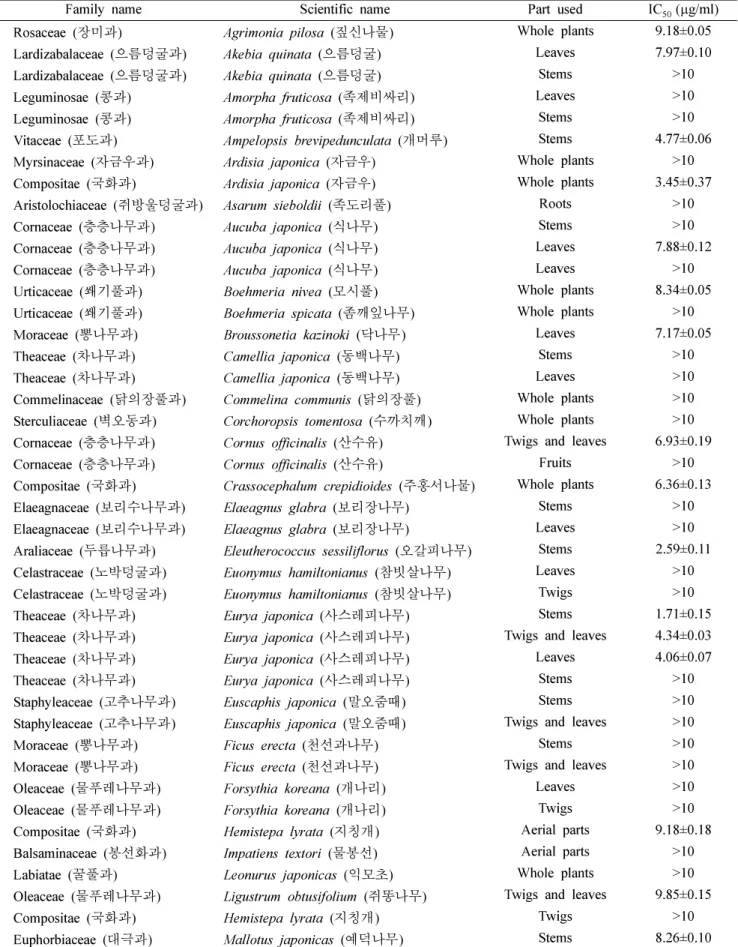
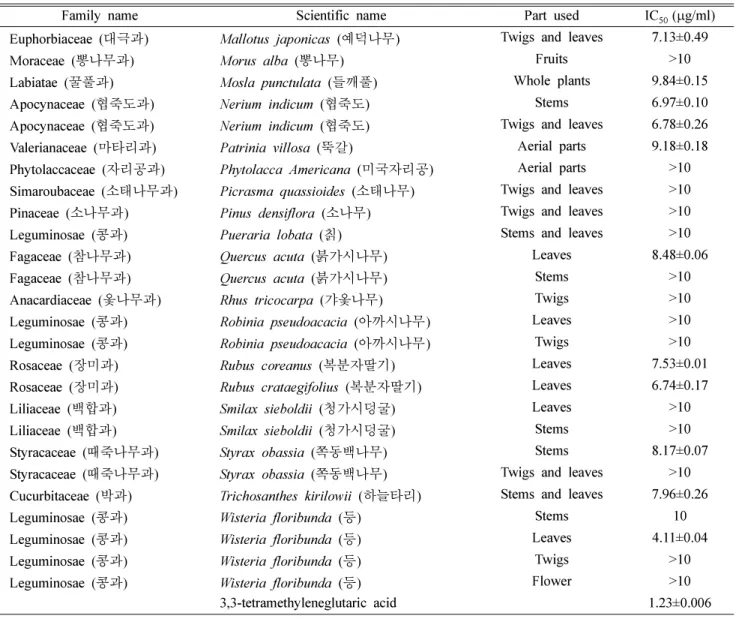
Table I. Inhibitory effect of extracts from Korean herbal medicines on the activities of aldose reductase
Family name Scientific name Part used IC50 (µg/ml)
Rosaceae (장미과) Agrimonia pilosa (짚신나물) Whole plants 9.18±0.05
Lardizabalaceae (으름덩굴과) Akebia quinata (으름덩굴) Leaves 7.97±0.10
Lardizabalaceae (으름덩굴과) Akebia quinata (으름덩굴) Stems >10
Leguminosae (콩과) Amorpha fruticosa (족제비싸리) Leaves >10
Leguminosae (콩과) Amorpha fruticosa (족제비싸리) Stems >10
Vitaceae (포도과) Ampelopsis brevipedunculata (개머루) Stems 4.77±0.06
Myrsinaceae (자금우과) Ardisia japonica (자금우) Whole plants >10
Compositae (국화과) Ardisia japonica (자금우) Whole plants 3.45±0.37
Aristolochiaceae (쥐방울덩굴과) Asarum sieboldii (족도리풀) Roots >10
Cornaceae (층층나무과) Aucuba japonica (식나무) Stems >10
Cornaceae (층층나무과) Aucuba japonica (식나무) Leaves 7.88±0.12
Cornaceae (층층나무과) Aucuba japonica (식나무) Leaves >10
Urticaceae (쐐기풀과) Boehmeria nivea (모시풀) Whole plants 8.34±0.05
Urticaceae (쐐기풀과) Boehmeria spicata (좀깨잎나무) Whole plants >10
Moraceae (뽕나무과) Broussonetia kazinoki (닥나무) Leaves 7.17±0.05
Theaceae (차나무과) Camellia japonica (동백나무) Stems >10
Theaceae (차나무과) Camellia japonica (동백나무) Leaves >10
Commelinaceae (닭의장풀과) Commelina communis (닭의장풀) Whole plants >10 Sterculiaceae (벽오동과) Corchoropsis tomentosa (수까치깨) Whole plants >10 Cornaceae (층층나무과) Cornus officinalis (산수유) Twigs and leaves 6.93±0.19
Cornaceae (층층나무과) Cornus officinalis (산수유) Fruits >10
Compositae (국화과) Crassocephalum crepidioides (주홍서나물) Whole plants 6.36±0.13
Elaeagnaceae (보리수나무과) Elaeagnus glabra (보리장나무) Stems >10
Elaeagnaceae (보리수나무과) Elaeagnus glabra (보리장나무) Leaves >10
Araliaceae (두릅나무과) Eleutherococcus sessiliflorus (오갈피나무) Stems 2.59±0.11 Celastraceae (노박덩굴과) Euonymus hamiltonianus (참빗살나무) Leaves >10 Celastraceae (노박덩굴과) Euonymus hamiltonianus (참빗살나무) Twigs >10
Theaceae (차나무과) Eurya japonica (사스레피나무) Stems 1.71±0.15
Theaceae (차나무과) Eurya japonica (사스레피나무) Twigs and leaves 4.34±0.03
Theaceae (차나무과) Eurya japonica (사스레피나무) Leaves 4.06±0.07
Theaceae (차나무과) Eurya japonica (사스레피나무) Stems >10
Staphyleaceae (고추나무과) Euscaphis japonica (말오줌때) Stems >10
Staphyleaceae (고추나무과) Euscaphis japonica (말오줌때) Twigs and leaves >10
Moraceae (뽕나무과) Ficus erecta (천선과나무) Stems >10
Moraceae (뽕나무과) Ficus erecta (천선과나무) Twigs and leaves >10
Oleaceae (물푸레나무과) Forsythia koreana (개나리) Leaves >10
Oleaceae (물푸레나무과) Forsythia koreana (개나리) Twigs >10
Compositae (국화과) Hemistepa lyrata (지칭개) Aerial parts 9.18±0.18
Balsaminaceae (봉선화과) Impatiens textori (물봉선) Aerial parts >10
Labiatae (꿀풀과) Leonurus japonicas (익모초) Whole plants >10
Oleaceae (물푸레나무과) Ligustrum obtusifolium (쥐똥나무) Twigs and leaves 9.85±0.15
Compositae (국화과) Hemistepa lyrata (지칭개) Twigs >10
Euphorbiaceae (대극과) Mallotus japonicas (예덕나무) Stems 8.26±0.10
와 함께 분쇄하여 14,000 rpm에서 30분 간 원심 분리한 다 음 상층액을 0.22 µm의 filter로 여과하였다. 효소의 단백질 은 bovine serum albumin을 표준으로 이용하여 Bradford16) 방법으로 정량하였다. 150 mM sodium phoshate buffer(pH 6.2), 0.15 mM NADPH, 10 mM DL-glyceraldehyde와 700 µg/ml 효소 혼합액에 0.5% DMSO에 녹인 시료를 가하여 최 종용액을 1 ml로 한 뒤 37oC에서 10분간 반응시켰다. 이때 시료의 IC50값을 구하기 위해 0.5, 1, 2.5, 5, 10 µg/ml의 5개 농도에서 실험하였으며, 공시료는 10 mM DL-glyceraldehyde 를 첨가하지 않았다. 표준액은 시료 대신 0.5% DMSO가 들 어가도록 하였다. 0.15 ml의 0.5 N HCl을 첨가하여 반응을 종료시킨 뒤, 10 mM imidazole이 첨가된 6 M NaOH 0.5 ml 을 가하여 60oC에서 15분간 반응시켜 NADPH가 NADP로 전환되는 것을 Spectrofluorometric detector로 (Ex. 360 nm,
Em. 460 nm) 측정하였다. 모든 시료는 triplicate로 수행하여 IC50값으로 나타냈다. Aldose reductase inhibitor로 알려진 3,3-tetramethyleneglutaric acid17)를 양성대조군으로 택하여 효능을 비교하였다.
결과 및 고찰
천연물로부터 알도즈 환원효소 억제 약물을 검색하기 위 해 한국산 69종의 에탄올 추출물을 이용해 효능을 검색하 여 Table I과 같은 결과를 얻었다.
Table I에서 보여주는 것과 같이 양성대조군인 3,3-tetra- methyleneglutaric acid의 IC50 값(1.23±0.01 µg/ml)을 기준 으로 알도즈 환원 효소 억제 효능을 판단하였다. 이 중 Eleu- therococcus sessiliflorus의 줄기(2.59±0.11 µg/ml), Artemisia Table I. Continued
Family name Scientific name Part used IC50 (µg/ml)
Euphorbiaceae (대극과) Mallotus japonicas (예덕나무) Twigs and leaves 7.13±0.49
Moraceae (뽕나무과) Morus alba (뽕나무) Fruits >10
Labiatae (꿀풀과) Mosla punctulata (들깨풀) Whole plants 9.84±0.15
Apocynaceae (협죽도과) Nerium indicum (협죽도) Stems 6.97±0.10
Apocynaceae (협죽도과) Nerium indicum (협죽도) Twigs and leaves 6.78±0.26 Valerianaceae (마타리과) Patrinia villosa (뚝갈) Aerial parts 9.18±0.18 Phytolaccaceae (자리공과) Phytolacca Americana (미국자리공) Aerial parts >10 Simaroubaceae (소태나무과) Picrasma quassioides (소태나무) Twigs and leaves >10
Pinaceae (소나무과) Pinus densiflora (소나무) Twigs and leaves >10
Leguminosae (콩과) Pueraria lobata (칡) Stems and leaves >10
Fagaceae (참나무과) Quercus acuta (붉가시나무) Leaves 8.48±0.06
Fagaceae (참나무과) Quercus acuta (붉가시나무) Stems >10
Anacardiaceae (옻나무과) Rhus tricocarpa (갸옻나무) Twigs >10
Leguminosae (콩과) Robinia pseudoacacia (아까시나무) Leaves >10
Leguminosae (콩과) Robinia pseudoacacia (아까시나무) Twigs >10
Rosaceae (장미과) Rubus coreanus (복분자딸기) Leaves 7.53±0.01
Rosaceae (장미과) Rubus crataegifolius (복분자딸기) Leaves 6.74±0.17
Liliaceae (백합과) Smilax sieboldii (청가시덩굴) Leaves >10
Liliaceae (백합과) Smilax sieboldii (청가시덩굴) Stems >10
Styracaceae (때죽나무과) Styrax obassia (쪽동백나무) Stems 8.17±0.07
Styracaceae (때죽나무과) Styrax obassia (쪽동백나무) Twigs and leaves >10 Cucurbitaceae (박과) Trichosanthes kirilowii (하늘타리) Stems and leaves 7.96±0.26
Leguminosae (콩과) Wisteria floribunda (등) Stems 10
Leguminosae (콩과) Wisteria floribunda (등) Leaves 4.11±0.04
Leguminosae (콩과) Wisteria floribunda (등) Twigs >10
Leguminosae (콩과) Wisteria floribunda (등) Flower >10
3,3-tetramethyleneglutaric acid 1.23±0.006
IC50 values were calculated from the dose inhibition curve.
japonica의 전초(3.45±0.37 µg/ml), Wisteria floribunda의 잎 (4.11±0.04µg/ml), Eurya japonica의 줄기(1.71±0.15 µg/ml) 와 가지와 잎(4.34±0.03 µg/ml), 잎(4.06±0.07 µg/ml), Am- pelopsis brevipedunculata의 줄기(4.77±0.06 µg/ml)의 7종이 IC50< 5µg/ml으로 효능이 가장 뛰어났다. 두릎나무과의 E.
sessiliflorus의 잎은 α-glucosidase와 α-amylase 활성 저해 효 과를 통한 혈당강하 효과, streptozotocin(STZ)으로 당뇨를 유도한 모델에서 혈당 감소와 혈중 콜레스테롤의 함량 감소 의 효과를 보여 혈당강하 및 당뇨대사 이상으로 인한 지질 대사의 개선에 효과적인 것으로 보고되었다.18) 열매로부터 분리한 페놀 화합물이 항산화 활성을 나타내며,19)농약의 일 종인 dieldrin에 의해 DNA와 세포가 손상되는 것을 억제시 킨다고 보고되었다.20) 또한 HepG2 간암세포의 증식과 DNA 합성을 억제하여 항암효과가 있다고 보고되었다.21) 항염증 사이토카인을 촉진시켜 항허혈 효과가 있다고 보고되었고,22) 신경병리성 통증 모델에서 E. sessiliflorus가 진통효과가 보 고되었다.23) 국화과의 A. japonica에서 분리한 물질들은 항 산화활성이 있다고 보고되었다.24)콩과의 W. floribunda의 꽃 은 항산화 효과가 있으며,25) 과일 껍질은 platelet-derived growth factor(PDGF)유도된 vascular smooth muscle cell
(VSMC)의 생존을 억제해 폐쇄성혈관질환을 완화효과를 나
타내었다.26) 또한 CD44 발현을 억제하고 GTP-RhoA 활성 을 촉진시켜 B16F1 흑색종 암세포의 활성을 억제시킨 연구 가 보고되었다.27) 차나무과의 E. japonica의 잎은 phenol과 flavonoid 성분을 함유하고 있으며 이러한 성분들이 항산화 효과를 나타내는 것으로 보고되었다.28) 또한 본 연구팀의 연 구 결과 E. japonica의 줄기가 최종당화산물의 생성을 저해 한다는 보고에 뒷받침되어 당뇨합병증의 예방에 효과가 있 다고 보고되었다.29) 포도과의 A. brevipedunculata의 줄기와 뿌리는 산화스트레스를 억제하여 항산화 효과가 있다고 보 고되었다.30) 또한 A. brevipedunculata의 줄기가 최종당화산 물의 생성을 저해에 뛰어날 효능이 있는 것으로 본 연구팀 의 보고에 나타났다.31)최근 reactive oxygen species(ROS) 가 당뇨병의 발병 및 합병증 발생에 중요한 요인 중 하나로 여겨지고 있다.32)폴리올 경로의 알도즈 환원 효소가 ROS 를 생성에 관여하여 산화 스트레스를 유발하는데 위 9종의 추출물들이 ROS 생성을 억제한다는 연구가 많이 보고 된 것으로 보아 당뇨합병증의 예방 및 치료에 도움이 되는 것 으로 사료된다. 본 연구 결과는 안전하고 우수한 알도즈 환 원 효소 억제제 후보 물질 발굴을 위한 기초자료로 활용될 수 있을 뿐만 아니라, 당뇨합병증 예방 및 치료제 개발에 이 용될 수 있을 것으로 사료된다.
결 론
69종의 한국산 약용식물 에탄올 추출물을 in vitro에서 알
도즈 환원 효소 억제활성 검색하였다. 그 결과 E. sessiliflorus 의 줄기, A. japonica의 전초, W. floribunda의 잎, E. japonica 의 줄기, 가지와 잎, 잎, A. brevipedunculata의 줄기 7종이 IC50<5µg/ml으로 뛰어난 알도즈 환원 효소 활성 억제 효능 을 나타냈다.
사 사
본 연구는 한국한의학연구원 기관고유사업(K13040, K14040)의 지원으로 수행되었으며 이에 감사드립니다.
인용문헌
1. Kyseloa, A., Stefek, M. and Bauer, V. (2004) Pharmaco- logical prevention of diabetic cataract. J. Diabet. Compli- cations 18: 129-140.
2. Greene, D. A., Lattimer, S. A., and Sima, A. F. (1987) Sor- bitol, phosphoinositides and sodium-potassium-ATPase in the pathogenesis of diabetic complication. New. Eng. J. Med.
316: 599-606.
3. Maccari, R., Ottana, R., Curinga, C., Vigorita, M. G., Rakow- itz, D., Steindl, T. and Langer, T. (2005) Structure-activity relationships and molecular modeling of 5-arylidene-2,4-thi- azolidinediones active as aldose reductase inhibitors. Bioorg.
Med. Chem. 13: 2809-2823.
4. Kim, H. M., Han, S., Choi, K., Hu, J. J., Park, K. W., Cho, E. J., Lee, S. H. (2012) Aldose reductase inhibitory activity of the methanol extracts from Korean fork plants. CNU J. Agric.
Sci. 39:169-175.
5. Lee, Y. S., Kim, S. H., Jung, S. H., Kim, J. K., Pan, C. H. and Lim, S. S. (2010) Aldose reductase inhibitory compounds from Glycyrrhiza uralensis. Biol. Pharm. Bull. 33: 917-921.
6. Lee, Y. M., Kim, N. H., Kim, J. M., Kim, Y. S., Jang, D. S., Kim, J. H., Bae, K. H. and Kim, J. S. (2008) Screening of inhibitory effect on aldose reductase of Korean herbal med- icines and preventive effect of Catalpa bignonioides against xylose-induced lens opacity (I). Kor. J. Pharmacogn. 39:165- 173.
7. Lee, Y. M., Kim, J. M., Kim, Y. S., Jang, D. S., Kim, J. H., Bae, K. H. and Kim, J. S. (2008) Screening of inhibitory effect on aldose reductase of Vietnam herbal medicines (II).
Kor. J. Pharmacogn. 39: 324-329.
8. Lee, Y. M., Kim, J. M., Kim, Y. S., Jang, D. S., Kim, J. H., Bae, K. H. and Kim, J. S. (2009) Screening of Chinese herbal medicines with inhibitory effect on aldose reductase (III).
Kor. J. Pharmacogn. 40: 394-399.
9. Lee, Y. M., Kim, Y. S., Bae, K. H., Kim, J. H. and Kim, J. S.
(2010) Screening of Chinese herbal medicines with inhibitory effect on aldose reductase (IV). Kor. J. Pharmacogn. 41: 289- 296.
10. Lee, Y. M., Kim, Y. S., Kim, J. H. and Kim, J. S. (2011) Screening of Chinese herbal medicines with inhibitory effect on aldose reductase. (V). Kor. J. Pharmacogn. 42: 187-194.
11. Lee, Y. M., Kim, Y. S., Kim, J. H. and Kim, J. S. (2011) Screening of Korean herbal medicines with inhibitory effect on aldose reductase. (VI). Kor. J. Pharmacogn. 42: 161-168.
12. Lee, Y. M., Kim, Y. S., Kim, J. H. and Kim, J. S. (2013) Screening of Chinese herbal medicines with inhibitory effect on aldose reductase (VII). Kor. J. Pharmacogn. 44: 161-167.
13. Lee, Y. M., Kim, Y. S., Kim, J. H. and Kim, J. S. (2013) Screening of Korean herbal medicines with inhibitory effect on aldose Reductase (VIII). Kor. J. Pharmacogn. 44: 168- 175.
14. Kim, C. S., Kim, J., Jeong, I. H., Kim, Y. S., Lee, J., Jang, D.
S. and Kim, J. S. (2009) Slow development of diabetic cat- aract in streptozotocin-induced diabetic rats via inhibition of aldose reductase activity and sorbitol accumulation by use of Aster koraiensis extract. Kor. J. Pharmacogn. 40: 339-344.
15. Dufrane, S. P., Malaisse, W. J. and Sener, A. (1984) A micromethod for the assay of aldose reductase, its application to pancreatic islets. Biochem. Med. 32: 99-105.
16. Bradford, M. (1976) A rapid and sensitive method for the quantitation of microgram quantities of protein utilizing the principle of protein-dye binding. Anal. Biochem. 72: 248-254.
17. Kinoshita, J. H., Dvornik, D., Kraml, M. and Gabbay, K. H.
(1968) The effect of an aldose reductase inhibitor on the galactose-exposed rabbit lens. Biochim. Biophys. Acta. 24:
472-475.
18. Lim, S. H., Park, Y. H., Kwon, C. J., Ham, H. J., Jeong, H.
N., Kim, K. H., and Ahn, Y. S. (2010) Anti-diabetic and hypoglycemic effect of Eleutherococcus spp. J. Korean Soc.
Food Sci. Nutr. 39: 1761-1768.
19. In, S. J., Lee, D. Y., Seo, K. H., Nam, T. G., Kim, D. O., Kim, G. S.,. Noh, H. J., Kim, G. W., Seo, W. D., Kang, H. C. and Baek, N. I. (2012) Anti-oxidant activity of phenolic com- pound isolated from the fruits of Acanthopanax sessiliflorus Seeman. J. Appl. Chem. 55: 217-220.
20. Ryu, A. R., Kim, J. H. and Lee, M. Y. (2012) Suppressive effect of Acanthopanax sessiliflorus extract on the DNA and cell damage by dieldrin. J. Med. Crop Sci. 20: 245-250.
21. Lee, J. H., Kim, Y. C. and Woo, H. J. (1999) Study of the anti-cancer effect of Acanthopanax sessiliflorus. J. Korean Oriental Med. 20: 54-65.
22. Yun, Y. D., Choi, C. H., Baek, J. U., Kim, H. W., Youn, D.
H., Kim, K. Y., Nam, K. W., Kim, G. Y. and Jeong, H. W.
(2007) Effects of Acanthopanasis cortex roots 50% ethyl alcohol extract on the cerebral hemodynamics and cytokine production in cerebral ischemic rats. Korean J. Oriental Physiology & Pathology. 21: 891-897.
23. Kim, J. H., Jang, G. T. and Kang, M. S. (2007) The effect of Acanthopanax sessiliflorus using the model of neuropathic pain and formalin-induced pain. J. Korean Oriental Med. 28:
261-272.
24. Kwon, C. W. and Lee, K. R. (2001) Phytochemical con- stituents of Artemsia japonica spp. littoricola. Arch. Pharm.
Res. 24: 194-197.
25. Oh, W. G., Jang, I. C., Jeon, G. I., park, E. J., Park, H. R. and Lee, S. C. (2008) Antioxidative activity of extracts from Wist- eria floribunda flowers. J. Korean Soc. Food Sci. Nutr. 37:
677-683.
26. Tai, B. H., Trung, T. N., Nhiem, N. X., Ha, D. T., Phuong, T.
T., Thu, N. B., Loung, H. V. and Kim, Y. H. (2011) Chemical components from the fruit peels of Wisteria floribunda and their effects of rat aortic vascular smooth muscle cells. Bull.
Korean. Chem. Soc. 32: 2079-2082.
27. Heo, J. C., Park, J. Y., Lee, J. M. Kwon, T. K., Kim, S. U., Chung, S. K. and Lee, S. H. (2005) Wisteria floribunda gall extract inhibits cell migration in mouse B16F1 melanoma cells regulating CD44 expression and GTP-RhoA activity. J.
Ethnopharmacol. 102: 10-14.
28. Rosalind, TH., Dutta, B. K. and Paul, S. B. (2013) Evaluation in in vitro antioxidant activity, estimation of total phenolic and flavonoid content of leaf extract of Eurya japonica thunb.
Asian J. Pharm. & clin. Res. 6: 152-155.
29. Choi, S. J., Kim, Y. S., Song, Y. J., Lee, Y. M., Kim, J. H. and Kim J. S. (2012) Screening of Korean herbal medicines with inhibitory Activity on advanced glycation end products for- mation (VII). Kor. J. Pharmacogn. 43: 345-351.
30. Wu, M. J., Yen, J. H., Wang, L. and Weng C. Y. (2004) Anti- oxidant activity of porcelainberry (Ampelopsis brevipedun- culata(Maxim.) Trautv.). Am. J. Chin. Med. 32: 681.
31. Choi, S. J., Kim, Y. S., Song, Y. J., Lee, Y. M., Kim, J. H. and Kim J. S. (2013) Screening of Korean herbal medicines with inhibitory activity on advanced glycation end products for- mation (XI). Kor. J. Pharmacogn. 44: 372-378.
32. Kim, S. S. and Son, S. M. (2008) Oxidative Stress and Cell Dysfunction in Diabetes: Role of ROS Produced by Mito- chondria and NAD(P)H Oxidase. Korean Diabetes J. 32:
389-398.
(2014. 9. 30 접수; 2014. 10. 24 심사; 2014. 11. 12 게재확정)