40(4) : 394 399 (2009)
394
중국 약용식물 추출물의 알도즈 환원 효소 억제 효능 검색 (III)
이윤미·김종민·김영숙·장대식·김주환1·배기환2·김진숙
*
한국한의학연구원한의융합연구본부당뇨합병증연구센터
,
1경원대학교생명과학과,
2충남대학교약학대학Screening of Chinese Herbal Medicines with Inhibitory Effect on Aldose Reductase (III)
Yun Mi Lee, Jong Min Kim, Young Sook Kim, Dae Sik Jang, Joo Hwan Kim
1, Ki Hwan Bae
2and Jin Sook Kim
*Diabetic Complications Research Center, Division of Traditional Korean Medicine (TKM) Integrated Research, Korea Institute of Oriental Medicine, Daejeon 305-811, Korea
1
Department of Life Science, Kyungwon University, Seongnam, Kyonggi-do 461-701, Korea
2
College of Pharmacy, Chungnam National University, Daejeon 305-764, Korea
Abstracts
– Aldose reductase (AR) is a critical enzyme in the development of the diabetic complications. AR, the first enzyme in the polyol pathway, catalyzes the reduction of the aldehyde form of glucose to sorbitol with concomitant conversion of NADPH to NADP
+. None of aldose reductase inhibitor (ARI) has achieved worldwide use because of limited efficacy or unde- sirable side effects. Therefore, evaluating natural sources for ARI potential may lead to the development of safer and more effective agents against diabetic complications. Forty eight Chinese herbal medicines have been investigated for inhibitory activities on AR. Among them, seven herbal medicines, Buddleja officinalis (whole plant), Lonicera japonica (leaf and flower), Polygonum aviculare (aerial part), Polygonum aviculare (whole plant), Salvia miltiorrhiza (root), Schisandra chinensis (stem), and Zanthoxylum armatum (leaf and stem) exhibited a significant inhibitory activity against AR. Particularly, L. japonica and P. aviculare showed two times more potent inhibitory activity than the positive control, 3,3-tetramethyleneglutaric acid (TMG).
Key words
– Diabetic complications, Aldose reductase inhibitor, Chinese herbal medicines
알도즈환원효소
(aldose reductase)
는aldo-keto reductase
의일종으로당뇨성망막증
,
신증,
신경증,
백내장등의당뇨합병증발병에중요한역할을한다
.
만성의고혈당상태에서는
polyol
경로의첫번째효소인알도즈환원효소가NADPH
를조효소로이용하여포도당을솔비톨로전환시킨다
.
이과정에서세포막을통과하지못하는솔비톨로인해세포내삼투압이증가하여
myo-inositol
이감소하여대사과정의 변이가발생하고
, Na
+/K
+-ATPase
활성이저하되며NADH/NAD
+증가와NADPH
감소로세포의redox potential
이변화되어세포손상이나타나당뇨합병증을유발한다
.
1-3)지금까지개발된알도즈환원효소억제제들인
sorbinil,
4,7)fidarestat,
5)epalrestat, zopolrestat, ponalrestat,
6)tolrestat
7)과ranireatat
8)등이동물실험에서당뇨합병증으로의진행을예방하거나지연시킨다고알려져있다
.
그러나임상실험에서낮은효능또는부작용으로인해개발과정에서중단되었 고
,
현재ranireatat
와fidarestat
이 임상실험 중이며6,9,10)epalrestat (ONO-2235, Kinedak; Ono Pharmaceutical Co., Ltd., Chuo-ku, Osaka, Japan)
는일본에서시판중이다.
11)본연구에서는지난보고에이어
,
12,13)중국에서자생하는48
종의약용식물에탄올추출물에대해
in vitro
에서알도즈환원효소억제효능을검색하였기에그결과를보고하고자한다
. 재료 및 방법
실험재료 − 본실험에사용된중국산약용식물
(Table I)
들은
2004~2007
년경원대학교생명과학과김주환교수팀에의해중국에서채집
,
동정되었다.
증거표본은한국한의학연구원한의융합연구본부당뇨합병증연구센터식물표본 실에보관중이다
.
*교신저자(E-mail):[email protected] (Tel):+82-42-868-9465
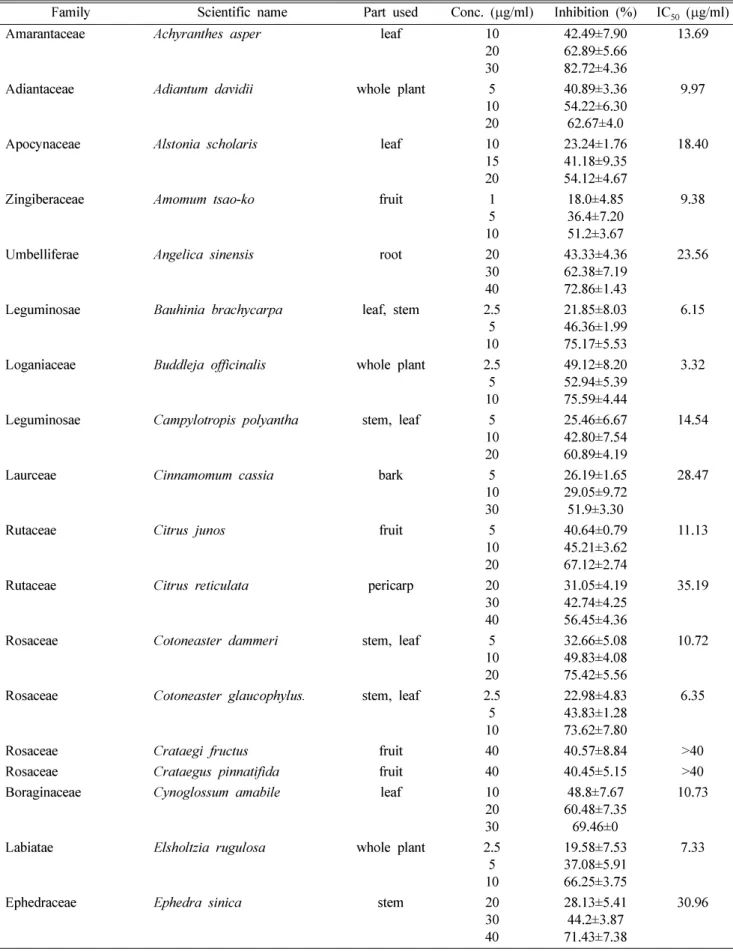
Table I.
Inhibitory effect of extracts from herbal medicines on aldose reductase
Family Scientific name Part used Conc. (
µg/ml) Inhibition (%) IC
50(
µg/ml)
Amarantaceae Achyranthes asper leaf 10
30 20
42.49±7.90 62.89±5.66 82.72±4.36
13.69
Adiantaceae Adiantum davidii whole plant 5
20 10
40.89±3.36 54.22±6.30 62.67±4.0
9.97
Apocynaceae Alstonia scholaris leaf 10
20 15
23.24±1.76 41.18±9.35 54.12±4.67
18.40
Zingiberaceae Amomum tsao-ko fruit 1
10 5
18.0±4.85 36.4±7.20 51.2±3.67
9.38
Umbelliferae Angelica sinensis root 20
40 30
43.33±4.36 62.38±7.19 72.86±1.43
23.56
Leguminosae Bauhinia brachycarpa leaf, stem 2.5
10 5
21.85±8.03 46.36±1.99 75.17±5.53
6.15
Loganiaceae Buddleja officinalis whole plant 2.5
10 5
49.12±8.20 52.94±5.39 75.59±4.44
3.32
Leguminosae Campylotropis polyantha stem, leaf 5
20 10
25.46±6.67 42.80±7.54 60.89±4.19
14.54
Laurceae Cinnamomum cassia bark 5
30 10
26.19±1.65 29.05±9.72 51.9±3.30
28.47
Rutaceae Citrus junos fruit 5
20 10
40.64±0.79 45.21±3.62 67.12±2.74
11.13
Rutaceae Citrus reticulata pericarp 20
40 30
31.05±4.19 42.74±4.25 56.45±4.36
35.19
Rosaceae Cotoneaster dammeri stem, leaf 5
20 10
32.66±5.08 49.83±4.08 75.42±5.56
10.72
Rosaceae Cotoneaster glaucophylus. stem, leaf 2.5
10 5
22.98±4.83 43.83±1.28 73.62±7.80
6.35
Rosaceae Crataegi fructus fruit 40 40.57±8.84 >40
Rosaceae Crataegus pinnatifida fruit 40 40.45±5.15 >40
Boraginaceae Cynoglossum amabile leaf 10
30 20
48.8±7.67 60.48±7.35
69.46±0
10.73
Labiatae Elsholtzia rugulosa whole plant 2.5
10 5
19.58±7.53 37.08±5.91 66.25±3.75
7.33
Ephedraceae Ephedra sinica stem 20
40 30
28.13±5.41 44.2±3.87 71.43±7.38
30.96
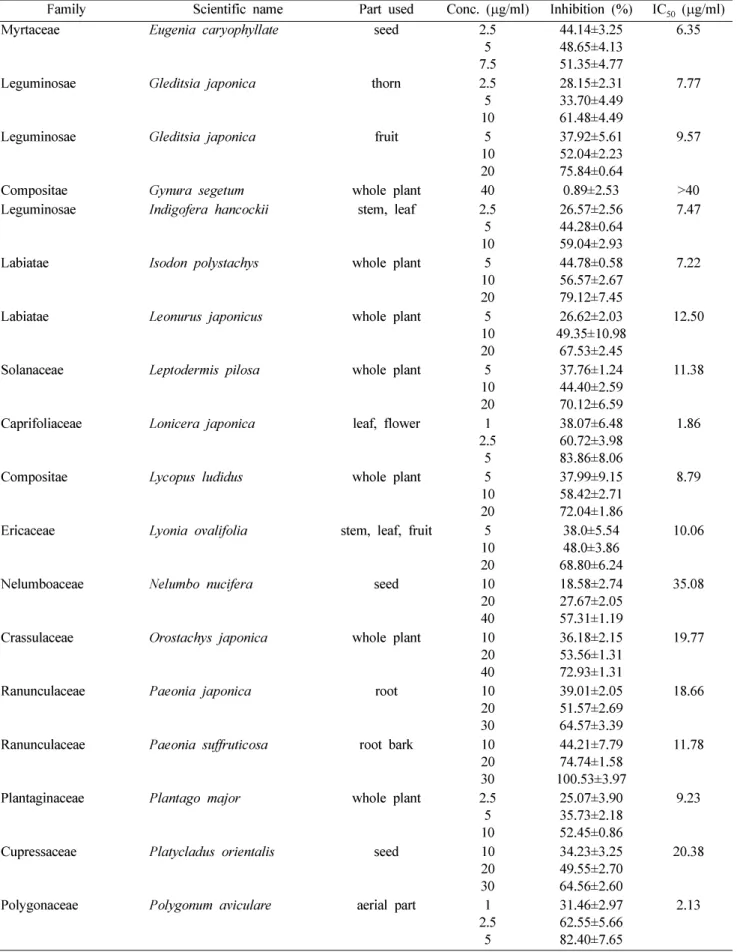
Table I.
Continued
Family Scientific name Part used Conc. (
µg/ml) Inhibition (%) IC
50(
µg/ml)
Myrtaceae Eugenia caryophyllate seed 2.5
7.5 5
44.14±3.25 48.65±4.13 51.35±4.77
6.35
Leguminosae Gleditsia japonica thorn 2.5
10 5
28.15±2.31 33.70±4.49 61.48±4.49
7.77
Leguminosae Gleditsia japonica fruit 5
20 10
37.92±5.61 52.04±2.23 75.84±0.64
9.57
Compositae Gynura segetum whole plant 40 0.89±2.53 >40
Leguminosae Indigofera hancockii stem, leaf 2.5
10 5
26.57±2.56 44.28±0.64 59.04±2.93
7.47
Labiatae Isodon polystachys whole plant 5
20 10
44.78±0.58 56.57±2.67 79.12±7.45
7.22
Labiatae Leonurus japonicus whole plant 5
20 10
26.62±2.03 49.35±10.98
67.53±2.45
12.50
Solanaceae Leptodermis pilosa whole plant 5
20 10
37.76±1.24 44.40±2.59 70.12±6.59
11.38
Caprifoliaceae Lonicera japonica leaf, flower 1
2.5 5
38.07±6.48 60.72±3.98 83.86±8.06
1.86
Compositae Lycopus ludidus whole plant 5
20 10
37.99±9.15 58.42±2.71 72.04±1.86
8.79
Ericaceae Lyonia ovalifolia stem, leaf, fruit 5
20 10
38.0±5.54 48.0±3.86 68.80±6.24
10.06
Nelumboaceae Nelumbo nucifera seed 10
40 20
18.58±2.74 27.67±2.05 57.31±1.19
35.08
Crassulaceae Orostachys japonica whole plant 10
40 20
36.18±2.15 53.56±1.31 72.93±1.31
19.77
Ranunculaceae Paeonia japonica root 10
30 20
39.01±2.05 51.57±2.69 64.57±3.39
18.66
Ranunculaceae Paeonia suffruticosa root bark 10
30 20
44.21±7.79 74.74±1.58 100.53±3.97
11.78
Plantaginaceae Plantago major whole plant 2.5
10 5
25.07±3.90 35.73±2.18 52.45±0.86
9.23
Cupressaceae Platycladus orientalis seed 10
30 20
34.23±3.25 49.55±2.70 64.56±2.60
20.38
Polygonaceae Polygonum aviculare aerial part 1
2.5 5
31.46±2.97 62.55±5.66 82.40±7.65
2.13
시약 및 기기 −
Sodium phosphate monobasic, potassium phosphate dibasic, lithium sulfate, imidazole, NADP, NADPH, DL-glyceraldehyde, 3,3-tetramethyleneglutaric acid, 2-mercaptoethanol, Bovine Serum Albumin
등은Sigma
사(St. Louis, MO, USA)
의제품을사용하였으며,
용매는대정화금
(
한국)
제품을사용하였다.
형광분석을위해Spectrofluorometric detector (Synergy HT Bio-TEK, USA)
를사용하였다
.
추출 및 시료조제 − 시료를분쇄한후
300 g
을칭량하여2
배용적의100%
에탄올을넣고실온에서3
회추출하였다.
여과후
40
oC
이하의수욕상에서감압농축하고,
다시동결건조기에서건조하였다
.
추출물은실험직전에감압하에서P
2O
5를이용하여12
시간이상재건조한후DMSO
에용해하고
3
차증류수로희석하였다.
In vitro에서 알도즈 환원 효소 억제 실험 −
Sprague- Dawley rat (250~280 g)
의수정체로부터알도즈환원효소를
Dufrane
14) 방법으로 분리하였다. 135 mM Na, K- phosphate buffer (pH 7.0)
와10 mM 2-mercaptoethanol
을적출한수정체와함께분쇄하였다
. 14,000 rpm
에서30
분간원심분리한다음상층액을
0.2
µm
의filter
로여과하였다
.
효소의단백질은bovine serum albumin
을표준으로이용하여
Bradford
15)방법으로정량하였다. 135 mM Na, K-
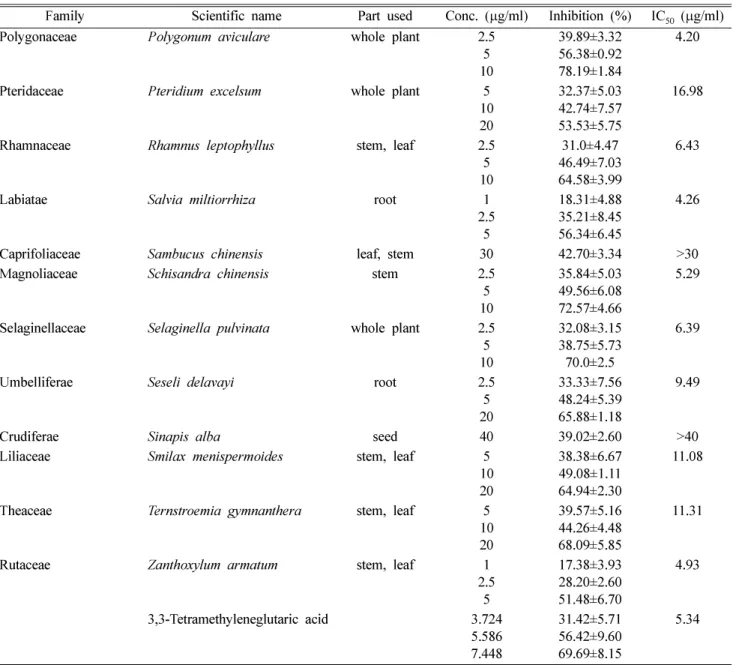
Table I.
Continued
Family Scientific name Part used Conc. (
µg/ml) Inhibition (%) IC
50(
µg/ml)
Polygonaceae Polygonum aviculare whole plant 2.5
10 5
39.89±3.32 56.38±0.92 78.19±1.84
4.20
Pteridaceae Pteridium excelsum whole plant 5
20 10
32.37±5.03 42.74±7.57 53.53±5.75
16.98
Rhamnaceae Rhamnus leptophyllus stem, leaf 2.5
10 5
31.0±4.47 46.49±7.03 64.58±3.99
6.43
Labiatae Salvia miltiorrhiza root 1
2.5 5
18.31±4.88 35.21±8.45 56.34±6.45
4.26
Caprifoliaceae Sambucus chinensis leaf, stem 30 42.70±3.34 >30
Magnoliaceae Schisandra chinensis stem 2.5
10 5
35.84±5.03 49.56±6.08 72.57±4.66
5.29
Selaginellaceae Selaginella pulvinata whole plant 2.5
10 5
32.08±3.15 38.75±5.73 70.0±2.5
6.39
Umbelliferae Seseli delavayi root 2.5
20 5
33.33±7.56 48.24±5.39 65.88±1.18
9.49
Crudiferae Sinapis alba seed 40 39.02±2.60 >40
Liliaceae Smilax menispermoides stem, leaf 5
20 10
38.38±6.67 49.08±1.11 64.94±2.30
11.08
Theaceae Ternstroemia gymnanthera stem, leaf 5
20 10
39.57±5.16 44.26±4.48 68.09±5.85
11.31
Rutaceae Zanthoxylum armatum stem, leaf 1
2.5 5
17.38±3.93 28.20±2.60 51.48±6.70
4.93
3,3-Tetramethyleneglutaric acid 3.724
5.586 7.448
31.42±5.71 56.42±9.60 69.69±8.15
5.34
Inhibitory activity was expressed as mean±S.D. of triplicate experiments. IC
50values were calculated from the dose inhibition curve.
a
TMG (3,3-Tetramethyleneglutaric acid) was used as positive control.
phosphate buffer (pH 7.0), 100 mM lithium sulfate, 0.03mM NADPH, 0.04 mM DL-glyceraldehyde
와100
µg/ml
효소혼합액에
0.1% DMSO
에녹인시료를가하여최종용액을1 ml
로한뒤37
oC
에서10
분간반응시켰다.
이때공시료는0.04 mM DL-glyceraldehyde
를첨가하지않았으며,
표준액은
135 mM Na, K-phosphate buffer (pH 7.0), 100 mM lithium sulfate
에50
µl NADP (0.2~5
µM)
를 사용하였다. 0.3 ml
의0.5 N HCl
을첨가하여반응을종료시킨뒤, 10 mM imidazole
이첨가된6 M NaOH 1 ml
을가하여60
oC
에서10
분간 반응시켜
NADPH
가NADP
로 전환되는 것을Spectrofluorometric detector
로(Ex. 360 nm, Em. 460 nm)
측정하였다
.
모든시료는triplicate
로수행하여IC
50 값으로나타냈다
.
알도즈 환원 효소 억제제로 알려진3,3-
tetramethyleneglutaric acid (TMG)
16)를양성대조군으로 택하여효능을비교하였다
.
결과 및 고찰
당뇨합병증치료및예방을위해알도즈환원효소억제 물질개발을위해많은연구가진행되고있다
.
17) 이미여러동물실험과임상실험결과에서알도즈환원효소억제가당 뇨합병증을예방한다는보고가있으나
,
18)아직까지미식품의약국
(FDA)
에승인된약물은없다.
11)지금까지한국산,
베트남산약용식물추출물에서알도즈환원효소억제물질을 찾고자하는연구가진행되었고
,
12,13)중국산의경우는스크리닝보다는이미선별된약용식물의성분들에서억제효 능연구가진행되었다
.
19,20)본연구에서는많은알도즈환원효소억제후보물질군을선별하고자
,
중국산약용식물48
종의에탄올추출물을이용해효능을검색하여Table I
과같은결과를얻었다
.
양성대조군인
TMG
의IC
50 값(5.34
µg/ml)
을기준으로알도즈 환원 효소 억제 효능을 판단하였으며
, Buddleja officinalis
의전초(3.32
µg/ml), Lonicera japonica
의잎·꽃(1.86
µg/ml), Polygonum aviculare
의 지상부(2.13
µg/ml),
전초
(4.20
µg/ml), Salvia miltiorrhiza
의뿌리(4.26
µg/ml), Schisandra chinensis
의 줄기(5.29
µg/ml), Zanthoxylum armatum
의잎·줄기(4.93
µg/ml)
의효능이우수하였다. B.
officinalis
의꽃은한국과중국에서혈관질환,
당뇨,
뇌경색,
두통
,
신경계질환에 사용되고 있으며21,22)terpenoid, flavonoid, phenylethanoid
및saponin
성분을 가지고 있다
.
22,23)70%
메탄올꽃추출물과꽃에서분리한Luteolin
과apigenin
그리고이들의배당체들의알도즈환원효소억제효능24)이보고되었으며
,
본연구결과에서는B. officinalis
의 전초효능이3.32
µg/ml
로확인되었다.
지난보고에12)L.
japonica
전초의IC
50값이2.34
µg/ml
로나타났으나본연구결과잎·꽃이
1.86
µg/ml
로효능이더우수한것으로나타났다
.
이는부위나산지,
채집시기25)에따른성분차이의결과라생각되어진다
. P. aviculare
는항산화효능26)이 있으며,
지질과산화억제및간보호효과27)와혈관긴장완화효능28)이보고되었다
. S. miltiorrhiza
.는심혈관계질환29)과 항산화효능30)이보고되었으며, S. chinensis
는항산화활성 과항돌연변이활성,
31,32)Z. armatum
는모기살충효능33)이 보고되었다.
위결과에서B. officinalis
를제외한나머지식 물들이알도즈환원효소억제활성이나,
유효성분에대한보고가이뤄지지않아이에대한구체적인연구가필요하 다고사료된다
.
본연구결과는안전하고우수한알도즈환원효소억제효능을가지는선도화합물의발굴을위한기 초자료로활용될수있을뿐만아니라
,
당뇨합병증예방및치료제개발에이용될수있을것이다
.
결 론
48
종의중국산약용식물에탄올추출물을in vitro
에서알도즈환원효소억제활성검색하였다
.
그결과7
종의추출물이 양성대조군인
TMG
보다효능이있음을확인하였고,
그중
L. japonica
의잎·꽃, P. aviculare
의지상부2
종은양성대조군보다
2-3
배우수한효능을나타내었다.
사 사
본연구는한국한의학연구원일반및기관고유사업비
(L08010, K09030)
로수행되었으며이에감사드립니다. 인용문헌
1
.Kyseloa, A., Stefek, M. and Bauer, V. (2004) Pharmaco- logical prevention of diabetic cataract. J. Diabetes Complicat.
18
: 129-140.
2
.Greene, D. A., Lattimer, S. A., and Sima, A. F. (1987) Sor- bitol, phosphoinositides and sodium-potassium-ATPase in the pathogenesis of diabetic complication. New. Eng. J. Med.
316
: 599-606.
3. Maccari, R., Ottana, R., Curinga, C., Vigorita, M. G., Rakow- itz, D., Steindl, T. and Langer, T. (2005) Structure-activity relationships and molecular modeling of 5-arylidene-2,4-thi- azolidinediones active as aldosse reductase inhibitors. Bioorg.
Med. Chem.
13: 2809-2823.
4. Sun, W., Oates, P. J., Coutcher, J. B., Gerhardinger, C. and Lorenzi, M. (2006) A selective aldose reductase inhibitor of a new structural class prevents or reverses early retinal abnor- malities in experimental diabetic retinopathy. Diabetes
55: 2757-2762.
5. Drel, V. R., Pacher, P., Ali, T. K., Shin, J., Julius, U., El-
Remessy, A. B. and Obrosova, I. G. (2008) Aldose reductase
inhibitor fidarestat counteracts diabetes-associated cataract formation, retinal oxidative-nitrosative stress, glial activation, and apoptosis. Int. J. Mol. Med.
21: 667-676.
6. Hotta, N., Akanuma, Y., Kawamori, R., Matsuoka, K., Oka, Y., Shichiri, M., Toyota, T., Nakashima, M., Yoshimura, I., Sakamoto, N. and Shigeta, Y. (2006) Long-term clinical effects of epalrestat, an aldose reductase inhibitor, on diabetic peripheral neuropathy. Diabetes Care
29: 1538-1544.
7. Constantino, L., Rastelli, G., Vianello, P., Cignarella, G. and Barlocco, D. (1999) Diabetes complications and their poten- tial prevention: aldose reductase inhibition and other approaches. Medical Research Reviews
19: 3-23.
8. Matsumoto, T., Ono, Y., Kurono, M., Kuromiya, A., Naka- mura, K. and Bril, V. (2008) Ranirestat (AS-3201), a potent aldose reductase inhibitor, reduces sorbitol levels and improves motor nerve conduction velocity in streptozotocin- diabetic rats. J. Pharmacol. Sci.
107: 231-237.
9. Ziegler, D. (2004) Polyneuropathy in the diabetic patient- update on pathogenesis and management. Nephrol. Dial.
Transplant.
19: 2170-2175.
10. Chalk, C., Benstead, T. J. and Moore, F. (2007) Aldose reduc- tase inhibitors for the treatment of diabetic polyneuropathy.
Cochrane Database Syst. Rev. 4:CD004572
11. Ramirez, M. A. and Borja, N. L. (2008) Epalrestat: an aldose reductase inhibitor for the treatment of diabetic neuropathy.
Pharmacotherapy .
28: 646-655.
12. Lee, Y. M., Kim, N. H., Kim, J. M., Kim, Y. S., Jang, D. S., Kim, J. H., Bae, K. H. and Kim, J. S. (2008) Screening of inhibitory effect on aldose reductase of Korean herbal med- icines and preventive effect of Catalpa bignonioides against xylose-induced lens opacity (I). Kor. J. Pharmacogn .
39: 165-173.
13. Lee, Y. M., Kim, J. M., Kim, Y. S., Jang, D. S., Kim, J. H., Bae, K. H. and Kim, J. S. (2008) Screening of inhibitory effect on aldose reductase of Vietnam herbal medicines (II).
Kor. J. Pharmacogn .
39: 324-329.
14. Dufrane, S. P., Malaisse, W. J. and Sener, A. (1984) A micromethod for the assay of aldose reductase, its application to pancreatic islets. Biochem. Med .
32: 99-105.
15. Bradford, M. (1976) A rapid and sensitive method for the quantitation of microgram quantities of protein utilizing the principle of protein-dye binding. Anal. Biochem .
72: 248-254.
16. Kinoshita, J. H., Dvornik, D., Kraml, M. and Gabbay, K. H.
(1968) The effect of an aldose reductase inhibitor on the galactose-exposed rabbit lens. Biochim. Biophys. Acta .
24: 472-475.
17. Handelsman, D. J. and Turtle, J. R. (1981) Clinical trial of an aldose reductase inhibitor in diabetic neuropathy. Diabetes.
30
: 459-464.
18. David, R. T., Elizabeth, J. S. and Lara, T. D. (1994) Aldose reductase inhibitors and their potential for the treatment of diabetic complications. Trends Pharmacol. Sci.
15: 293-297.
19. Xu, Z., Yang, H., Zhou, M., Feng, Y. and Jia, W. (2009) Inhibitory effect of total lignan from Fructus Arctii on aldose reductase. Phytother Res. Apr 16. [Epub ahead of print]
20. Feng, C. G., Zhang, L. X. and Liu, X. (2005) Progress in research of aldose reductase inhibitors in traditional medic- inal herbs. Zhongguo Zhong Yao Za Zhi.
30: 1496-1500.
21. Hur, J. (1983) Tongeuibokam, 744. Namsadang, Seoul 22. Piao, M. S., Kim, M. R., Lee, D. G., Park, Y., Hahm, K. S.,
Moon, Y. H. and Woo, E. R. (2003) Antioxidative constit- uents from Buddleja officinalis . Arch. Pharm. Res .
26: 453–
23. Guo, H., Koike, K., Li, W., Satou, T., Guo, D and Nikaido, T. 457.
(2004) Saponins from the flower buds of Buddleja officinalis.
J. Nat. Prod.
67: 10-13.
24. Matsuda, H., Cai, H., Kubo, M., Tosa, H. and Iinuma, M.
(1995) Study on anti-cataract drugs from natural sources. II.
Effects of buddlejae flos on in vitro aldose reductase activity.
Biol. Pharm. Bull
. 18: 463-466.
25. Son, K. H., Kim, J. S., Kang, S. S., Kim, H. P. and Chang, H.
W. (1994) Isolation of Flavonoids from Lonicera japonica . Kor. J. Pharmacogn.
25: 24-27.
26. Hsu, C. Y. (2006) Antioxidant activity of extract from Polygonum aviculare L. Biol. Res.
39: 281-288.
27. Lee, C. G., Kim, N. J., Hong, N. D. and Kwon, C. H. (1994) Anti - lipid peroxidation and liver protective effects of Polygonum aviculare L. Kor. J. Pharmacogn.
25: 59-69.
28. Yin, M. H., Kang, D. G., Choi, D. H., Kwon, T. O. and Lee, H. S. (2005) Screening of vasorelaxant activity of some medicinal plants used in Oriental medicines. J. Ethnophar- macol.
99: 113-117.
29. Chan, P., Liu, I. M., Li, Y. X., Yu, W. J. and Cheng, J. T.
(2009) Antihypertension induced by tanshinone IIA isolated from the roots of Salvia Miltiorrhiza . eCAM. 2009 Jun 19.
[Epub ahead of print]
30. Fu, X., Tian, H., Sheng, Z. and Wang, D. (1992) Multiple organ injuries after abdominal high energy wounding in ani- mals and the protective effect of antioxidants. Chin. Med. Sci.
J.
7: 86-91.
31. Jeong, J. B. and Jeong, H. J. (2009) Schisandra Chinensis Inhibits oxidative DNA damage and lipid peroxidation via antioxidant activity. Korean J. Plant Res.
22: 195-202.
32. Jeon, Y. H., Kil, J. H., Lim, S. M., Kim, M. H. and Kim, M.
R. (2008) Analysis of antioxidative activity and antimu- tagenic effect of ethanol extract from Schizandra chinensis Baillon. J. East Asian Soc. Dietary Life
18: 746-752.
33. Tiwary , M., Naik, S. N., Tewary, D. K., Mittal, P. K. and Yadav, S. (2007) Chemical composition and larvicidal activ- ities of the essential oil of Zanthoxylum armatum DC (Ruta- ceae) against three mosquito vectors. J. Vector Borne Dis.
44: 198-204.
(2009년 9월 21일 접수)