Kor. J. Pharmacogn.
44(4) : 372∼ 378 (2013)
372
한국약용식물의 최종당화산물 생성저해활성 검색 (XI)
최소진1·김영숙1·송유진1·김주환2·김진숙1*
1한국한의학연구원 한약연구본부 한의신약개발그룹, 2가천대학교 생명과학과
Screening of Korean Herbal Medicines with Inhibitory Activity on Advanced Glycation End Products Formation (XI)
So Jin Choi1, Young Sook Kim1, Yoo Jin Song1, Joo Hwan Kim2, and Jin Sook Kim1*
1Korean Medicine-Based Herbal Drug Development Group, Herbal Medicine Research Division, Korea Institute of Oriental Medicine, Daejeon 305-811, Korea
2Department of Life Science, Gachon University, Seongnam 461-701, Korea
Abstract − In this study, the inhibitory effect on advanced glycation end products (AGEs) formation of 43 Korean herbal med- icines has been evaluated. Among them, 16 Korean herbal medicines were showed to have significant effect (IC50; <50µg/ml) compared to positive reference, aminoguandine (IC50: 76.47±4.81µg/ml). Especially, five herbal medicines, Rubus coreanus (leaves, IC50: 4.49±0.03µg/ml), Rubus coreanus (twigs, IC50: 3.80±0.34µg/ml), Ampleopsis brevipedunculata (stems, IC50: 7.43±0.09µg/ml), Lindera erythrocarpa (leave, IC50: 8.14±0.20µg/ml), and Lindera erythrocarpa (stems, IC50: 3.69±0.14µg/
ml) showed more potent inhibitory activity (approximately 9-20 fold) than the positive control aminoguanidine.
Key words − Advanced glycation end products (AGEs), Diabetic complications, Korean herbal medicines
당뇨합병증의 원인으로는 최종당화산물 (advanced glycation end products, AGEs)의 생성, polyol pathway flux의 증가 및 protein kinase C 활성화 등이 주요 발병기 전으로 알려져 있다.1-3) 그 중 최종당화산물은 비가역적 산 물로 생성된 최종당화산물은 혈당이 정상으로 회복되어도 분해가 되지 않고 혈액 단백질이나 여러 조직에 축적되어 당뇨 합병증을 가속화한다.4-7) 따라서 생체 내에서 최종당화 산물의 생성을 저해하거나 이미 생성된 최종당화산물의 단 백질과의 교차결합을 억제 또는 절단하여 당뇨합병증을 예 방하거나 치료하기 위해 많은 연구들이 진행되고 있다.8-11) 기존 연구에서 한국, 중국, 베트남산 천연물의 에탄올 추출 물에서 최종당화산물 생성 저해효능이 있는 후보군을 발굴 하였으며,12-19) 1형과 2형 당뇨 동물모델에서 최종당화산물 저해에 따른 합병증 특히 망막증과20) 신증이21,22) 억제됨을 확인하였다. 본 연구에서는 기존에 보고된 바 없는 한국에 서 자생하는 약용식물 43종의 에탄올 추출물에서 최종당화 산물 생성 저해 활성을 in vitro에서 검색하였다.
재료 및 방법
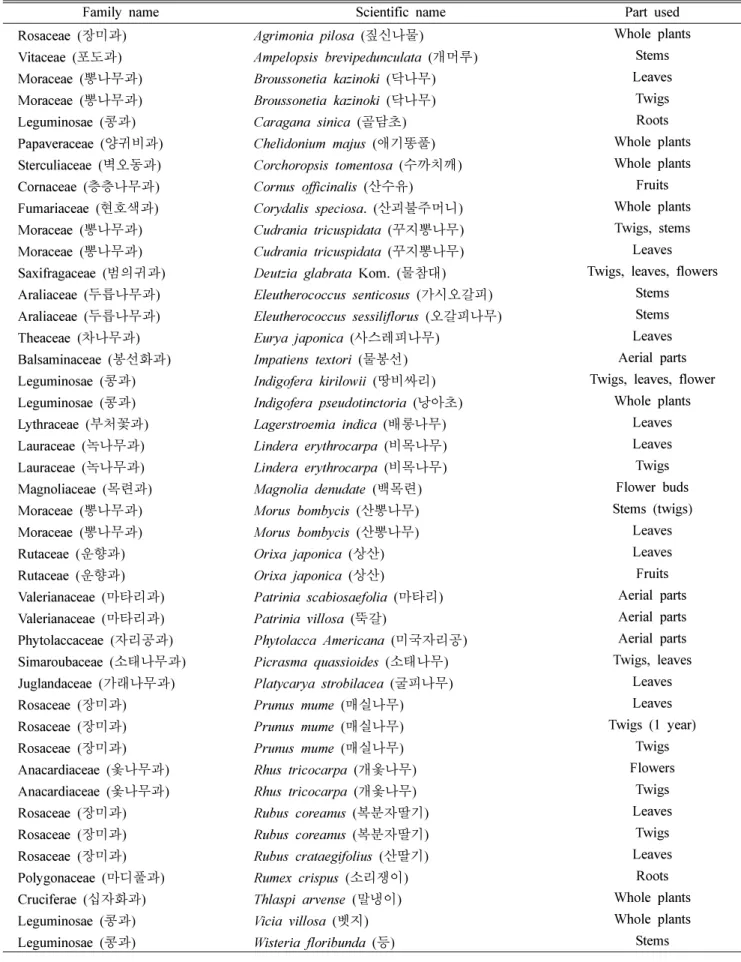
실험재료 − 약용식물은 2009월 4월부터 10월 그리고 2010 년 1월부터 2011년 7월까지 전국에서 채취되어, 가천대학 교 생명과학과 김주환 교수의 감정을 거친 후 실험 재료로 사용되었다(Table I). 사용한 실험 재료의 증거표본은 한국 한의학연구원 한약연구본부 한의신약개발그룹 당뇨합병증 연구팀 표본실에 보관중이다.
추출 및 시료조제 − 분쇄한 시료 200 g에 2 L의 에탄올을 넣고 실온상태에서 3일간 3회 추출하였다. 이를 여과하여 40oC의 수욕 상에서 감압농축을 실시한 후, 동결 건조기에 서 건조하였다. 추출물은 실험 수행 전에 감압 하에서 P2O2 를 이용하여 24시간 이상 재건조한 후 DMSO(Sigma, St.
Louis, MO, USA)에 용해시켜 stock solution을 조제하였으 며 최종 DMSO의 농도가 0.2%가 되도록 15% TWEEN 80(Sigma, St. Louis, MO, USA)용액으로 희석하여 사용하 였다. 추출에 이용한 에탄올 및 그 외 시약은 1급 및 특급 시약을 사용하였다.
In vitro에서 최종당화산물 생성저해 실험 – Vinson과 Howard23)의 방법을 변형하여 실험을 실시하였다. 본 실험
*교신저자(E-mail):[email protected] (Tel): +82-42-868-9465
Table I. List of the ethanol extracts of the herbal medicines
Family name Scientific name Part used
Rosaceae (장미과) Agrimonia pilosa (짚신나물) Whole plants
Vitaceae (포도과) Ampelopsis brevipedunculata (개머루) Stems
Moraceae (뽕나무과) Broussonetia kazinoki (닥나무) Leaves
Moraceae (뽕나무과) Broussonetia kazinoki (닥나무) Twigs
Leguminosae (콩과) Caragana sinica (골담초) Roots
Papaveraceae (양귀비과) Chelidonium majus (애기똥풀) Whole plants
Sterculiaceae (벽오동과) Corchoropsis tomentosa (수까치깨) Whole plants
Cornaceae (층층나무과) Cornus officinalis (산수유) Fruits
Fumariaceae (현호색과) Corydalis speciosa. (산괴불주머니) Whole plants
Moraceae (뽕나무과) Cudrania tricuspidata (꾸지뽕나무) Twigs, stems
Moraceae (뽕나무과) Cudrania tricuspidata (꾸지뽕나무) Leaves
Saxifragaceae (범의귀과) Deutzia glabrata Kom. (물참대) Twigs, leaves, flowers Araliaceae (두릅나무과) Eleutherococcus senticosus (가시오갈피) Stems Araliaceae (두릅나무과) Eleutherococcus sessiliflorus (오갈피나무) Stems
Theaceae (차나무과) Eurya japonica (사스레피나무) Leaves
Balsaminaceae (봉선화과) Impatiens textori (물봉선) Aerial parts
Leguminosae (콩과) Indigofera kirilowii (땅비싸리) Twigs, leaves, flower Leguminosae (콩과) Indigofera pseudotinctoria (낭아초) Whole plants
Lythraceae (부처꽃과) Lagerstroemia indica (배롱나무) Leaves
Lauraceae (녹나무과) Lindera erythrocarpa (비목나무) Leaves
Lauraceae (녹나무과) Lindera erythrocarpa (비목나무) Twigs
Magnoliaceae (목련과) Magnolia denudate (백목련) Flower buds
Moraceae (뽕나무과) Morus bombycis (산뽕나무) Stems (twigs)
Moraceae (뽕나무과) Morus bombycis (산뽕나무) Leaves
Rutaceae (운향과) Orixa japonica (상산) Leaves
Rutaceae (운향과) Orixa japonica (상산) Fruits
Valerianaceae (마타리과) Patrinia scabiosaefolia (마타리) Aerial parts
Valerianaceae (마타리과) Patrinia villosa (뚝갈) Aerial parts
Phytolaccaceae (자리공과) Phytolacca Americana (미국자리공) Aerial parts Simaroubaceae (소태나무과) Picrasma quassioides (소태나무) Twigs, leaves
Juglandaceae (가래나무과) Platycarya strobilacea (굴피나무) Leaves
Rosaceae (장미과) Prunus mume (매실나무) Leaves
Rosaceae (장미과) Prunus mume (매실나무) Twigs (1 year)
Rosaceae (장미과) Prunus mume (매실나무) Twigs
Anacardiaceae (옻나무과) Rhus tricocarpa (개옻나무) Flowers
Anacardiaceae (옻나무과) Rhus tricocarpa (개옻나무) Twigs
Rosaceae (장미과) Rubus coreanus (복분자딸기) Leaves
Rosaceae (장미과) Rubus coreanus (복분자딸기) Twigs
Rosaceae (장미과) Rubus crataegifolius (산딸기) Leaves
Polygonaceae (마디풀과) Rumex crispus (소리쟁이) Roots
Cruciferae (십자화과) Thlaspi arvense (말냉이) Whole plants
Leguminosae (콩과) Vicia villosa (벳지) Whole plants
Leguminosae (콩과) Wisteria floribunda (등) Stems
에서는 10 mg/ml의 우혈청 알부민(bovine serum albumin, Sigma)을 0.2 M phosphate buffer(pH 7.4)에 용해시키고, 0.2 M의 fructose와 glucose를 처리하였다. 이 때 0.2 M phosphate buffer에 0.02% sodium azide를 넣어 반응기간 동 안 박테리아의 생성을 방지하였다. 이 반응액에 추출물 또는 최종당화산물 생성저해제인 aminoguanidine을 넣은 후 37oC 에서 7일 동안 반응시켰다. 배양 후에는 spectrofluorometric detector(Bio-TEK, Synergy HT, USA)를 이용하여 형광도를 측정하였다(Ex: 350, Em: 450 nm). IC50값은 n=3으로 하여 계산되었다.
결과 및 고찰
최근 청년 당뇨 환자의 증가와 함께 평균 수명이 연장 됨 에 따라 당뇨환자의 합병증 문제가 심각하게 대두되고 있 다. 만성당뇨로 인한 망막증, 실명, 신경병증, 족부궤양, 신
증 및 신장 이식 등 국가재정뿐만 아니라 환자 및 가족의 삶의 질을 매우 부정적인 영향을 끼치고 있다. 그러나 아직 당뇨완치제도 개발이 안되었으며 합병증 약 개발 또한 요 원한 상태이다.24,25) 따라서 최근에는 천연물을 이용하여 당 뇨 합병증의 요인 중의 하나인 최종당화산물의 생성을 억 제하는 약물의 검색을 위해 많은 연구들이 진행되고 있다.
한국산 생약을 대표적인 최종당화산물의 억제제인 aminoguanidine26,27)은 독성 문제가 제기되어 임상 3상에서 중단되었다. 본 연구팀은 최종당화산물 생성을 강력하게 억 제하는 천연물 소재를 발굴하기 위하여 많은 천연소재들의 효능을 검색 발표하였다.12-19)
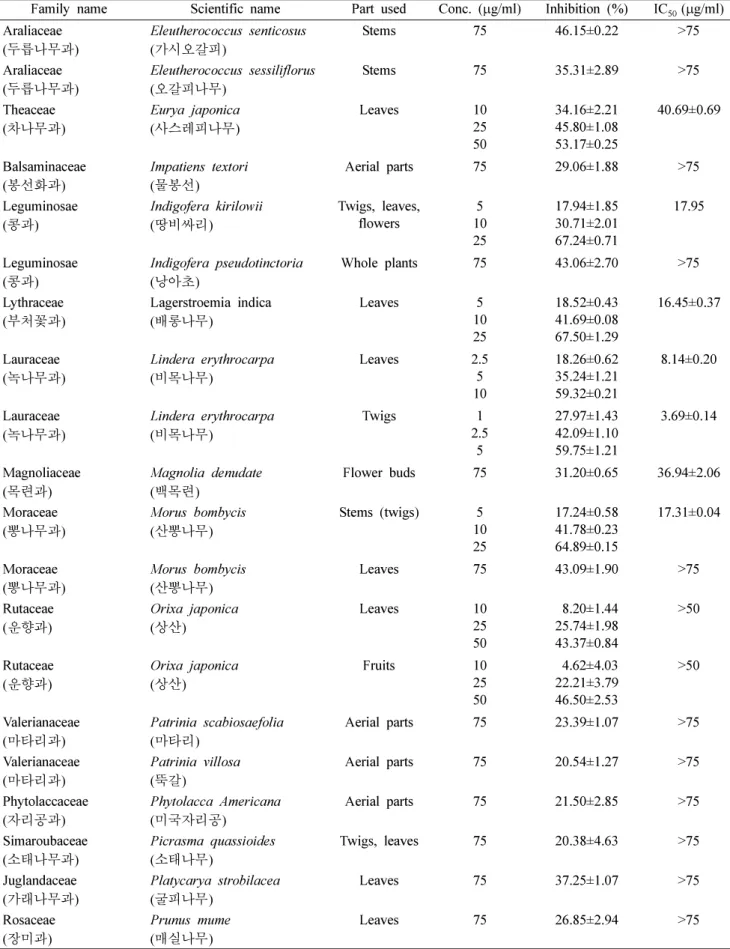
본 연구에서도 국내에서 자생하는 약용식물 43종의 에탄 올 추출물을 이용하여 최종당화산물 생성 저해 효능을 측 정하였다. 양성 대조 약물인 aminoguanidine의 IC50값 (76.47±4.81µg/ml)을 근거로 하여, 추출물이 IC50<50µg/ml 이면 효능이 있다고 판단하였다. Table II에서 보여 주는 것 Table II. Inhibitory activity of the ethanol extracts of the herbal medicines on AGEs formation in vitro
Family name Scientific name Part used Conc. (µg/ml) Inhibition (%) IC50 (µg/ml) Rosaceae
(장미과)
Agrimonia pilosa (짚신나물)
Whole plants 5 10 25
25.53±0.30 40.03±0.61 60.29±0.62
18.22±0.27
Vitaceae (포도과)
Ampelopsis brevipedunculata (개머루)
Stems 2.5
5 10
9.22±0.83 30.63±0.44 70.93±0.96
7.43±0.09
Moraceae (뽕나무과)
Broussonetia kazinoki (닥나무)
Leaves 75 41.98±0.78 >75
Moraceae (뽕나무과)
Broussonetia kazinoki (닥나무)
Twigs 75 44.30±1.54 >75
Leguminosae (콩과)
Caragana sinica (골담초)
Roots 75 16.16±2.51 >75
Papaveraceae (양귀비과)
Chelidonium majus (애기똥풀)
Whole plants 10 25 50
-3.59±2.64 2.03±4.11 3.28±3.79
>50
Sterculiaceae (벽오동과)
Corchoropsis tomentosa (수까치깨)
Whole plants 75 33.27±3.95 >75
Cornaceae (층층나무과)
Cornus officinalis (산수유)
Fruits 75 15.83±1.13 >75
Fumariaceae (현호색과)
Corydalis speciosa.
(산괴불주머니)
Whole plants 10 25 50
12.21±3.25 14.43±4.97 28.43±1.50
>50
Moraceae (뽕나무과)
Cudrania tricuspidata (꾸지뽕나무)
Twigs, stems 10 25 50
15.17±1.19 34.66±0.54 60.86±1.72
39.92
Moraceae (뽕나무과)
Cudrania tricuspidata (꾸지뽕나무)
Leaves 10
25 50
18.04±1.24 32.50±3.37 49.10±0.47
>50
Saxifragaceae (범의귀과)
Deutzia glabrata Kom.
(물참대)
Twigs, leaves, flowers
10 25 50
20.39±1.59 37.53±2.51 58.98±1.89
39.92
Table II. Continued
Family name Scientific name Part used Conc. (µg/ml) Inhibition (%) IC50 (µg/ml) Araliaceae
(두릅나무과)
Eleutherococcus senticosus (가시오갈피)
Stems 75 46.15±0.22 >75
Araliaceae (두릅나무과)
Eleutherococcus sessiliflorus (오갈피나무)
Stems 75 35.31±2.89 >75
Theaceae (차나무과)
Eurya japonica (사스레피나무)
Leaves 10
25 50
34.16±2.21 45.80±1.08 53.17±0.25
40.69±0.69
Balsaminaceae (봉선화과)
Impatiens textori (물봉선)
Aerial parts 75 29.06±1.88 >75
Leguminosae (콩과)
Indigofera kirilowii (땅비싸리)
Twigs, leaves, flowers
5 10 25
17.94±1.85 30.71±2.01 67.24±0.71
17.95
Leguminosae (콩과)
Indigofera pseudotinctoria (낭아초)
Whole plants 75 43.06±2.70 >75
Lythraceae (부처꽃과)
Lagerstroemia indica (배롱나무)
Leaves 5
10 25
18.52±0.43 41.69±0.08 67.50±1.29
16.45±0.37
Lauraceae (녹나무과)
Lindera erythrocarpa (비목나무)
Leaves 2.5
5 10
18.26±0.62 35.24±1.21 59.32±0.21
8.14±0.20
Lauraceae (녹나무과)
Lindera erythrocarpa (비목나무)
Twigs 1
2.5 5
27.97±1.43 42.09±1.10 59.75±1.21
3.69±0.14
Magnoliaceae (목련과)
Magnolia denudate (백목련)
Flower buds 75 31.20±0.65 36.94±2.06 Moraceae
(뽕나무과)
Morus bombycis (산뽕나무)
Stems (twigs) 5 10 25
17.24±0.58 41.78±0.23 64.89±0.15
17.31±0.04
Moraceae (뽕나무과)
Morus bombycis (산뽕나무)
Leaves 75 43.09±1.90 >75
Rutaceae (운향과)
Orixa japonica (상산)
Leaves 10
25 50
8.20±1.44 25.74±1.98 43.37±0.84
>50
Rutaceae (운향과)
Orixa japonica (상산)
Fruits 10
25 50
4.62±4.03 22.21±3.79 46.50±2.53
>50
Valerianaceae (마타리과)
Patrinia scabiosaefolia (마타리)
Aerial parts 75 23.39±1.07 >75
Valerianaceae (마타리과)
Patrinia villosa (뚝갈)
Aerial parts 75 20.54±1.27 >75
Phytolaccaceae (자리공과)
Phytolacca Americana (미국자리공)
Aerial parts 75 21.50±2.85 >75
Simaroubaceae (소태나무과)
Picrasma quassioides (소태나무)
Twigs, leaves 75 20.38±4.63 >75 Juglandaceae
(가래나무과)
Platycarya strobilacea (굴피나무)
Leaves 75 37.25±1.07 >75
Rosaceae (장미과)
Prunus mume (매실나무)
Leaves 75 26.85±2.94 >75
과 같이 16종의 식물 추출물에서 IC50<50µg/ml로 최종당화 산물 생성 저해 효능을 보였고, 그 중에서 5종의 추출물 Rubus coreanus의 잎(4.49±0.03 µg/ml)과 가지(3.80±0.34 µg/
ml), Ampleopsis brevipedunculata의 줄기(7.43±0.09 µg/ml), Lindera erythrocarpa의 잎(8.14±0.20 µg/ml)과 줄기(3.69±
0.14µg/ml)은 IC50가 10 µg/ml이하로 aminoguanidine보다 약 9-20배 이상의 우수한 효능이 있음을 알 수 있었다.
장미과의 R. coreanus(복분자딸기)의 열매는 tumor necrosis factor-a(TNF-a), interleukin 6(IL-6) 분비를 억제하고, nitric oxide(NO)의 생산 감소와 inducible nitric oxide synthases (iNOS), cyclooxygenase-2(COX-2)와 같은 염증유발 단백질 의 발현을 억제하여 항알레르기, 항염 작용을 한다고 보고
되었고,28,29)열매, 잎, 뿌리의 추출물의 항산화, 미백, 주름
개선 효과가 보고되었다.30) R. coreanus의 물 추출물, 에탄 올 추출물은 돌연변이 억제 효과가 뛰어나고, Hep3B와 Hela
cell의 성장을 억제한다고 보고되었다.31) R. coreanus의 줄 기와 잎에서 분리한 tannins가 항산화작용을 한다고 보고되 었다.32)포도과에 속하는 A. brevipedunculata(개머루)는 메 탄올 추출물이 환원력이 강하고, 리놀산 과산화와 플라스미 드 DNA 산화를 억제시키고,33) 2,2-diphenyl-1-picrylhydrazyl (DPPH) 라디칼에 대한 산화능이 강해 항산화 효과가 있으 며, 암세포에 대한 증식 억제효과를 나타낸다고 보고되었 다.34) 마우스에서 사염화탄소에 의해 유도된 간독성을 억제 시켜 간 기능을 회복시켜 주는 효과가 있다고 보고되었다.35) 또한 병원성 미생물에 대해 항균작용을 한다고 보고되었다.36) 녹나무과인 L. erythrocarpa(비목나무)가 사람면역결핍바이 러스 타입 1(HIV-1) 단백질 분해효소에 대해 억제효과를 가 지는 것으로 보고되었다.37)또한 lipopolysaccharide(LPS)로 유도된 대식세포에서 NO, iNOS와 COX-2을 억제하여 항 염작용을 한다고 보고되었다.38) 일본에서는 위장약과 신경 Table II. Continued
Family name Scientific name Part used Conc. (µg/ml) Inhibition (%) IC50 (µg/ml) Rosaceae
(장미과)
Prunus mume (매실나무)
Twigs (1 year) 10 25 50
28.49±0.65 48.96±0.96 62.22±0.48
32.57±0.37
Rosaceae (장미과)
Prunus mume (매실나무)
Twigs 5
10 25
16.39±0.45 45.76±0.88 65.77±0.20
16.67±0.19
Anacardiaceae (옻나무과)
Rhus tricocarpa (개옻나무)
Flowers 75 46.62±0.74 >75
Anacardiaceae (옻나무과)
Rhus tricocarpa (개옻나무)
Twigs 75 39.42±1.39 >75
Rosaceae (장미과)
Rubus coreanus (복분자딸기)
Leaves 1
2.5 5
10.51±1.96 23.91±0.61 56.98±0.37
4.49±0.03
Rosaceae (장미과)
Rubus coreanus (복분자딸기)
Twigs 1
2.5 5
32.28±1.86 47.16±4.25 55.13±2.04
3.80±0.34
Rosaceae (장미과)
Rubus crataegifolius (산딸기)
Leaves 75 41.37±1.12 >75
Polygonaceae (마디풀과)
Rumex crispus (소리쟁이)
Roots 10
25 50
20.22±0.31 44.97±2.20 83.23±1.03
28.67
Cruciferae (십자화과)
Thlaspi arvense L.
(말냉이)
Whole plants 10 25 50
3.41±0.61 8.77±2.39 19.25±0.74
>50
Leguminosae (콩과)
Vicia villosa Roth (벳지)
Whole plants 10 25 50
-2.45±1.43 4.67±1.07 14.57±0.36
>50
Leguminosae (콩과)
Wisteria floribunda (등)
Stems 75 24.89±3.13 >75
Aminoguanidine 76.47±4.81
IC50 values were calculated from the dose inhibition curve.
통의 진통제로 사용되고 있으며,39) L. erythrocarpa의 잎은 항균활성을 한다고 보고되었다.40) 또한 산화스트레스가 유 도된 H9c2의 apoptosis를 억제하여 항산화 작용을 한다고 보고되었다.41)
위 언급된 5종의 약용 식물은 최종당화산물 생성 억제 효 능이 보고된 바 없으며, 양성 대조 약물 보다 9-20배 이상 최종당화산물 생성 억제 효능이 우수한 것으로 확인되었으 므로, 전임상 실험을 통해 in vivo효능 확인이 필요하다고 생각된다. 본 연구 결과는 국내 약용식물로부터 안전하고 효능이 좋은 최종당화산물 생성 저해제 후보를 발굴하기 위 한 기초 자료로 활용될 수 있으며, 당뇨에 의해 나타나는 합 병증 치료제 개발의 기반을 구축하는데 기여할 수 있을 것 이다.
결 론
기원이 확인된 국내산 약용식물 43종의 에탄올 추출물이 in vitro에서 최종당화산물 생성저해 효능이 검색되었다. 그 결과 16종이 양성대조군인 aminoguanidine 보다 우수한 효 능이 있음을 확인하였고, 특히 복분자딸기의 잎(IC50: 4.49±0.03µg/ml)과 가(IC50: 3.80±0.34µg/ml), 개머루 줄기 (IC50: 7.43±0.09µg/ml), 비목나무 잎(IC50: 8.14±0.20µg/ml) 과 줄기(IC50: 3.69±0.14µg/ml) 등 5종의 추출물은 양성대 조군(aminoguanidine: IC50: 76.47±4.81µg/ml) 보다 9-20배 억제 효능이 우수하므로 당뇨합병증 예방 및 치료제로 개 발될 가능성이 있다.
사 사
본 연구는 한국한의학연구원 기관고유사업(K12040, K13040)의 지원으로 수행되었으며 이에 감사드립니다.
인용문헌
1. Sakurai, T. and Tsuchiya, S. (1988) Superoxide production from nonenzymatically glycated protein. FEBS Lett. 236:
406-410.
2. Shinohara, R., Mano, T., Nagasaka, A., Sawai, Y., Uchimura, K., Hayashi, R., Hayakawa, N., Nagata, M., Makino, M., Kakizawa, H., Itoh, Y., Nakai, A. and Itoh, M. (1998) Effects of thyroid hormone on the sorbitol pathway in streptozotocin- induced diabetic rats. Biochim. Biophys. Acta 1425: 577-586.
3. Bucala, R., Cerami, A. and Vlassara, H. (1995) Advanced glycosylation end products in diabetic complications. Dia- betes Rev. 3: 258-268.
4. Larkins, R. G. and Dunlop, M. E. (1992) The link between hyperglycaemia and diabetic nephropathy. Diabetologia 35:
499-504.
5. Ahmed, N. (2005) Advanced glycation endproducts-role in pathology of diabetic complications. Diabetes Res. Clin.
Pract. 67: 3-21.
6. Yokozaw, T., Nakagawa, T. and Terasawa, K. (2001) Effects of oriental medicines on the production of advanced gly- cation endproducts. J. Trad. Med. 18: 107-112.
7. Huebschmann, A. G., Vlassara, H., Regensteiner, J. G. and Reusch, J. (2006) Diabetes and advanced glycoxidation end products. Diabetes Care 29: 1420-1432.
8. Rahbar, S. and Figarola, J. L. (2003) Novel inhibitors of advenced glycation endproducts. Arch. Biochem. Biophys.
419: 63-79.
9. Wilkinson-Berka, J. L., Kelly, D. J., Koerner, S. M., Jaworski, K., Davis B., Thallas, V. and Cooper, M. E. (2002) ALT-946 and aminoguanidine, inhibitors of advanced glycation, improve severe nephropathy in the diabetic transgenic (mREN-2) 27 rat. Diabetes 51: 3283-3289.
10. Peppa, M., Brem, H., Cai, W., Zhang, J. G., Basgen, J., Li, Z., Vlassara, H. and Uribarri, J. (2006) Prevention and reversal of diabetic nephropathy in db/db mice treated with alage- brium (ALT-711). Am. J. Nephrol. 26: 430-436.
11. Yang, S., Litchfield, J. E. and Baynes, J. W. (2003) AGE breakers cleave model compounds, but do not break maillard crosslinks in skin and tail collagen from diabetic rats. Arch.
Biochem. Biophys. 412: 42-46.
12. Jang, D. S., Lee, Y. M., Kim, Y. S. and Kim, J. S. (2006) Screening of Korean traditional herbal medicines with inhib- itory activity on advanced glycation end products (AGEs) formation. Kor. J. Pharmacogn. 37: 48-52.
13. Lee, Y. M., Kim, Y. S., Kim, J. M., Jang, D. S., Kim, J. W., Yoo, J. L. and Kim, J. S. (2008) Screening of Korean herbal medicines with inhibitory activity on advanced glycation end products (AGEs) formation (II). Kor. J. Pharmacogn. 39:
223-227.
14. Jeong, I. H., Kim, J. M., Jang, D. S., Kim, J. H., Cho, J. H.
and Kim, J. S. (2009) Screening of Korean herbal medicines with inhibitory activity on advanced glycation end products (AGEs) formation (III). Kor. J. Pharmacogn. 40: 382-387.
15. Kim, J. M., Kim, Y. S., Kim, J. H., Yoo, J. M. amd Kim, J.
S. (2009) Screening of herbal medicines from China and Vietnam with inhibitory activity on advanced glycation end products (AGEs) formation (IV). Kor. J. Pharmacogn. 40:
388-393.
16. Kim, Y. S., Choi, S. H. Kim, J. H. and Kim, J. S. (2011) Screening of herbal medicines from China with inhibitory activity on advanced glycation end products (AGEs) for- mation (V). Kor. J. Pharmacogn. 42: 46-53.
17. Lee, Y. M., Kim, Y. S., Kim, J. H. and Kim, J. S. (2011) Screening of herbal medicines from China with inhibitory activity on advanced glycation end products (AGEs) for- mation (VI). Kor. J. Pharmacogn. 42: 161-168.
18. Choi, S. J., Kim, Y. S., Song, Y. J., Lee, Y. M., Kim, J. H. and
Kim J. S. (2012) Screening of Korean herbal medicines with inhibitory Activity on advanced glycation end products for- mation (VII). Kor. J. Pharmacogn. 43: 345-351.
19. Choi, S. J., Song, Y. J., Kim, Y. S., Kim, J. H., Hang, S., Bach, T.T. and Kim J. S. (2012) Screening of herbal med- icines from China and Vietnam with inhibitory activity on advanced glycation end products (AGEs) formation (VIII).
Kor. J. Pharmacogn.43: 338-344.
20. Sohn, E. J., Kim, Y. S., Kim, C. S., Lee, Y. M. and Kim, J.
S. (2009) KIOM-79 prevents apoptotic cell death and AGEs accumulation in retinas of diabetic db/db mice. J. Ethnop- harmacol. 121: 171-174.
21. Kim, Y. S., Lee, Y. M., Kim, C. S., Sohn, E. J., Jang, D. S.
and Kim, J. S. (2006) Inhibitory effect of KIOM-79, a new herbal prescription, on AGEs formation and expression of type IV collagen and TGF-β1 in STZ-induced diabetic rats.
Kor. J. Pharmacogn. 37: 103-109.
22. Kim, Y. S., Kim, J., Kim, C. S., Sohn, E. J., Lee, Y. M., Jeong, I. H., Kim, H., Jang, D. S. and Kim, J. S. (2009) KIOM-79, an inhibitor of AGEs-protein cross-linking, prevents pro- gression of nephropathy in Zucker diabetic fatty rats. Evid.
Based Complement. Alternat. Med. 2009 Jul 15. [Epub ahead of print]
23. Vinson, J.A., and Howard, III T.B. (1996) Inhibition of pro- tein glycation and advanced glycation endproducts by ascor- bic acid and other vitamins and nutrients. J. Nutr. Biochem. 7:
659-663.
24. Strowig, S. and Raskin, P. (1992) Glycemic control and dia- betic complications. Diabetes Care 15: 1126-1140.
25. Yki-Jarvinen, H. (1990) Acute and chronic effects of hyper- glycemia on glucose metabolism. Diabetologia 33: 579-585.
26. Edelstein, D. and Brownlee, M. (1992) Mechanistic studies of advanced glycosylation end product inhibition by ami- noguanidine. Diabetes 41: 26-29.
27. Soulis, T., Cooper, M. E., Bucala, R. and Jerums, G. (1996) Effects of aminoguanidine in preventing experimental dia- betic nephropathy are related to the duration of treatment.
Kidney Int. 50: 627-634.
28. Shin, T. Y., Shin, H. Y., Kim, S. H., Kim, D. K., Chae, B. S., Oh, C. H., Cho, M. G., Oh, S. H., Kim, J. H., Lee, T. K. and Park, J. S. (2006) Rubus coreanus unripe fruits inhibits immediate-type allergic reaction and inflammatory cytokine secretion. Nat. Prod. Sci. 12: 144-149.
29. Park, J. H., Oh, S. M., Lim, S. S., Lee, Y. S., Shin, H. K., Oh, Y. S., Choe, N. H., Park Yoon, J. H. and Kim J. K. (2006) Induction of heme oxygenase-1 mediates the anti-inflam-
matory effects of the ethanol extract of Rubus coreanus in murine macrophages. BBRC. 351: 146-152.
30. Park, C. M., Jeong, M. S., Yang, D. Y. and Choi, J. W. (2007) The study on the effect of Rubus coreanus miquel extract as a cosmetic ingredient. J. Soc. Cosmet. Scientist. Korea. 33:
41-45.
31. Jeon, Y. H., Choi, S. W. and Kim, M. R. (2009) Antimu- tagenic and cytotoxic activity of ethanol and water extracts from Rubus coreanum. Korean J. Food Cookey Sci. 25: 379- 386.
32. Kim, K. H., Lee, Y. A., Kim, J. S., Lee, D. I., Choi, Y. W., Kim H. H. and Lee. M. W. (2000) Antioxidant activity of tan- nins from Rubus coreanus. Kor. J. Pharmacogn.44: 354-357.
33. Wu, M. J., Yen, J. H., Wang, L. and Weng, C. Y. (2004) Anti- oxidant activity of porcelainberry (Ampelopsis brevipedun- culata(Maxim.) Trautv.). Am. J. Chin. Med. 32: 681-693.
34. Rhim, T. J. and Choi, M. Y. (2010) The antioxidative effects of Ampelopsis brevipedunculata extracts. Korean. J. Plant.
Res. 25: 445-450.
35. Yabe, N. and Matsui, H. (2000) Ampelopsis brevipedunculata (Vitaceae) extract inhibits a progression of carbon tetrachlo- ride-induced hepatic injury in the mice. Phytomedicine. 7:
493-498.
36. Choi, M. Y. and Rhim, T. J. (2010) Antimicrobal effect of Ampelopsis brevipedunculata extracts on food spoilage or foodhome disease microorganism. Korean. J. Plant. Res.23:
430-435.
37. Park, J. C. (2003) Inhibitory effects of Korean plant resources on human immunodeficiency virus type 1 protease activity.
OPEM. 3: 1-7.
38. Wang, S. Y., Lan, X. Y., Xiao, J. H., Yang, J. C., Kao, Y. T.
and Chang, S. T. (2008) Antiinflammatory activity of Lindera erythrocarpa fruits. Phytother. Res. 22: 213-216.
39. Liu, S. Y., Hisada, S. and Inagaki, I. (1973) Terpenes of Lin- dera erythrocarpa. Phytother. Res.12: 233.
40. Choi, Y. H., Kwon, S. Y., Kim, J. H., Baek, N.I., Choi, G. J., Cho, K.Y. and Lee, B. M. (2003) Isolation of antifungal active compounds from the leaves of Lindera erythrocarpa.
J. Korean Soc. Agric. Chem. Biotechnol. 46: 150-153.
41. Kim, J. A., Jung, Y. S., Kim, M. Y., Yang, S. Y., Lee, S. H.
and Kim, Y. H. (2011) Protective effect of components iso- lated from Lindera erythrocarpa against oxidative stress- induced apoptosis of H9c2 cardiomyocytes. Phytother. Res.
25: 1612-1617.
(2013. 9. 12 접수; 2013. 10. 18 심사; 2013. 11. 6 게재확정)