Kor. J. Pharmacogn.
42(4) : 371∼ 378 (2011)
371
한국산 약용식물 추출물의 알도즈 환원 효소 억제 효능 검색 (VI)
이윤미·김영숙·김주환1*·김진숙*
한국한의학연구원 한의융합연구본부 당뇨합병증연구센터, 1경원대학교 생명과학과
Screening of Korean Herbal Medicines with Inhibitory Effect on Aldose Reductase (VI)
Yun Mi Lee, Young Sook Kim, Joo Hwan Kim1* and Jin Sook Kim*
Diabetic Complications Research Center, Division of Traditional Korean Medicine (TKM) Integrated Research, Korea Institute of Oriental Medicine, Daejeon 305-811, Korea
1Department of Life Science, Kyungwon University, Seongnam, Kyonggi-do 461-701, Korea
Abstract − Aldose reductase (AR) has been implicated in the development of the diabetic complications. To discover novel treatments for diabetic complications from natural sources, 65 Korean herbal medicines have been investigated for inhibitory activities on AR. Of these, 23 herbal medicines exhibited a significant inhibitory activity compared with 3,3-tetrameth- yleneglutaric acid (TMG). Particularly, 8 herbal medicines, Acer tataricum (twig, stem and leaf), Acer tataricum (fruit), Rhodo- dendron schlippenbachii (twig, stem and leaf), Weigela subsessilis (twig, stem and leaf), Acer mono (branch and leaf), Ailanthus altissima (twig, stem and leaf), Lindera obtusiloba (branch and leaf), Solidago serotina (whole plant) showed three times more potent inhibitory activity than the positive control, TMG..
Key words – Aldose reductase inhibitor, Diabetic complications, herbal medicines
알도즈 환원 효소 (aldose reductase, AR)는 폴리올 경로의 중요한 효소 중 하나로 인슐린 비의존성 조직인 안구 (렌즈, 망막), 신장, 신경조직에 분포하며,1) 고혈당 상태에서 포도 당을 소비톨로 환원시킨다. 이 소비톨은 최종당화산물 (advanced glycation end products, AGEs) 생성을 촉진시키 고 세포 내에 축적되어 삼투압 증가와 대사과정의 변이 및 세포 손상을 일으켜 당뇨성 망막증 (Diabetic retinopathy), 백내장 (D. cataract), 신경증 (D. neuropathy), 신증 (D.
nephropathy) 등의 당뇨합병증을 유발시킨다.2-4) 따라서 당뇨 합병증의 예방 및 치료제 개발을 위해 천연물로부터 독성 이 없고 우수한 효능을 지닌 알도즈 환원 효소 억제 약물을 찾고자 하는 연구가 진행중이다.5,6)본 연구팀에서도 여러 종의 한약재 추출물 및 한약재에서 분리한 단일 화합물이 in vitro에서 알도즈 환원 효소 활성을 저해함을 확인하였
다.7-14) 산수유 씨, 목련 꽃봉우리, 개망초 잎줄기에서 각각
분리한 1,2,3,6-tetra-O-galloyl-b -D-glucose,12) Scopoletin,13) 3,5-Di-O-caffeoyl-epi-quinic acid14) 는 ex vivo에서 수정체
혼탁 예방 효능을 나타내었다. 벌개미취 추출물이 제 1형 당뇨 쥐 모델에서 알도즈 환원 효소 활성과 소비톨 축적을 억제하여 당뇨병성 백내장 발병 지연 효과를 나타내었다.15) 또한 Chlorogenic acid는 백내장 동물모델에서, KIOM-79는 제 2형 동물 모델에서 각각 알도즈 환원 효소 활성과 당뇨 병성 백내장 발병이 억제됨을 보고하였다.16,17) 본 연구에서 는 지난 보고에 이어7-11) 한국에서 자생 또는 재배되는 65 종의 한약재 (생약) 추출물을 in vitro에서 알도즈 환원 효소 억제 효능을 검색하여 그 결과를 보고하고자 한다.
재료 및 방법
실험재료 − 본 실험에 사용된 한국산 약용식물 (Table I) 들은 2005~2008년 경원대학교 생명과학과 김주환 교수팀 에 의해 한국에서 채집되었으며, 동정을 거친 후 실험에 사 용하였다. 증거표본은 한국한의학연구원 한의융합연구본부 당뇨합병증연구센터 표본실에 보관 중이다.
시약 및 기기 − Sodium phosphate monobasic, potassium phosphate dibasic, lithium sulfate, imidazole, NADP,
*교신저자(E-mail):[email protected], [email protected] (Tel): +82-42-868-9465, +82-31-750-8827
(St. Louis, MO, USA)의 제품을 사용하였으며, 용매는 대 정화금 (한국) 제품을 사용하였다. 형광 분석을 위해 Spectrofluorometric detector (Synergy HT Bio-TEK, USA) 를 사용하였다.
추출 및 시료조제 − 시료를 분쇄한 후 300 g을 칭량하 여 3 L의 무수 에탄올을 넣고 실온에서 3일간 3회 추출하 였다. 이를 여과하여 40oC 이하의 수욕 상에서 감압농축하 고, 다시 동결건조기에서 건조하였다. 추출물은 실험 직전 에 감압 하에서 P2O5를 이용하여 12시간 이상 재 건조한 후 DMSO에 용해하여 저장용액을 조제하였으며 DMSO의 최종농도가 0.1%가 되도록 3차 증류수로 희석하여 사용하 였다.
In vitro에서 알도즈 환원 효소 억제 실험 – Sprague- Dawley rat (250~280 g)의 수정체로부터 알도즈 환원 효소 를 Dufrane18) 방법으로 분리하였다. 135 mM Na, K- phosphate buffer (pH 7.0)와 10 mM 2-mercaptoethanol을 적출한 수정체와 함께 분쇄하였다. 14,000 rpm에서 30 분 간 원심 분리한 다음 상층액을 0.2 µm의 filter로 여과하였 다. 효소의 단백질은 bovine serum albumin을 표준으로 이 용하여 Bradford19)방법으로 정량하였다. 135 mM Na, K-
효소 혼합액에 0.1% DMSO에 녹인 시료를 가하여 최종용 액을 1 ml로 한 뒤 37oC에서 10분간 반응시켰다. 이때 공 시료는 0.04 mM DL-glyceraldehyde를 첨가하지 않았으며, 표준액은 135 mM Na, K-phosphate buffer (pH 7.0), 100 mM lithium sulfate에 50 µl NADP (0.2~5 µM)를 사용하였 다. 0.3 ml의 0.5 N HCl을 첨가하여 반응을 종료시킨 뒤, 10 mM imidazole이 첨가된 6 M NaOH 1 ml을 가하여 60oC에서 10분간 반응시켜 NADPH가 NADP로 전환되는 것을 Spectrofluorometric detector로 (Ex. 360 nm, Em.
460 nm) 측정하였다. 모든 시료는 triplicate로 수행하여 IC50 값으로 나타냈다. 알도즈 환원 효소 억제제로 알려진 3,3- tetramethyleneglutaric acid (TMG)20)를 양성 대조군으로 택 하여 효능을 비교하였다.
결과 및 고찰
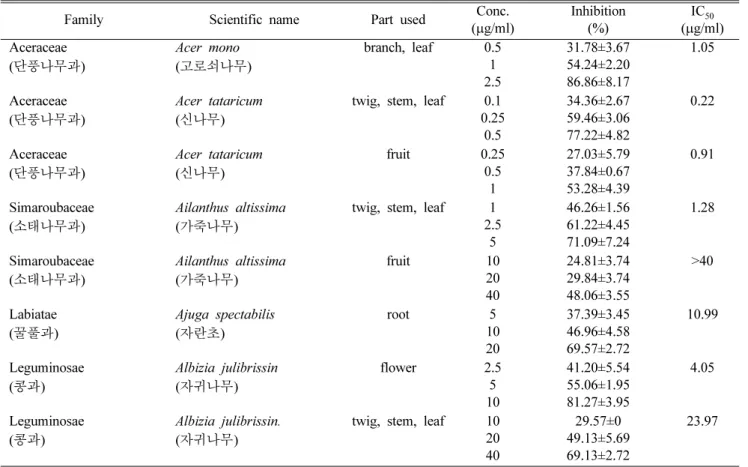
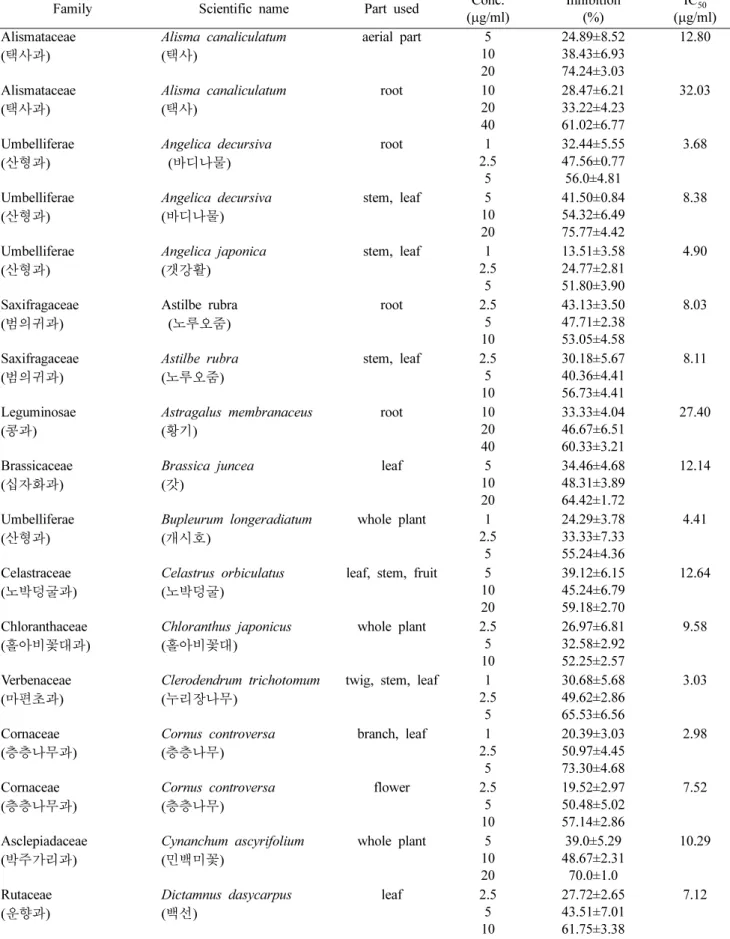
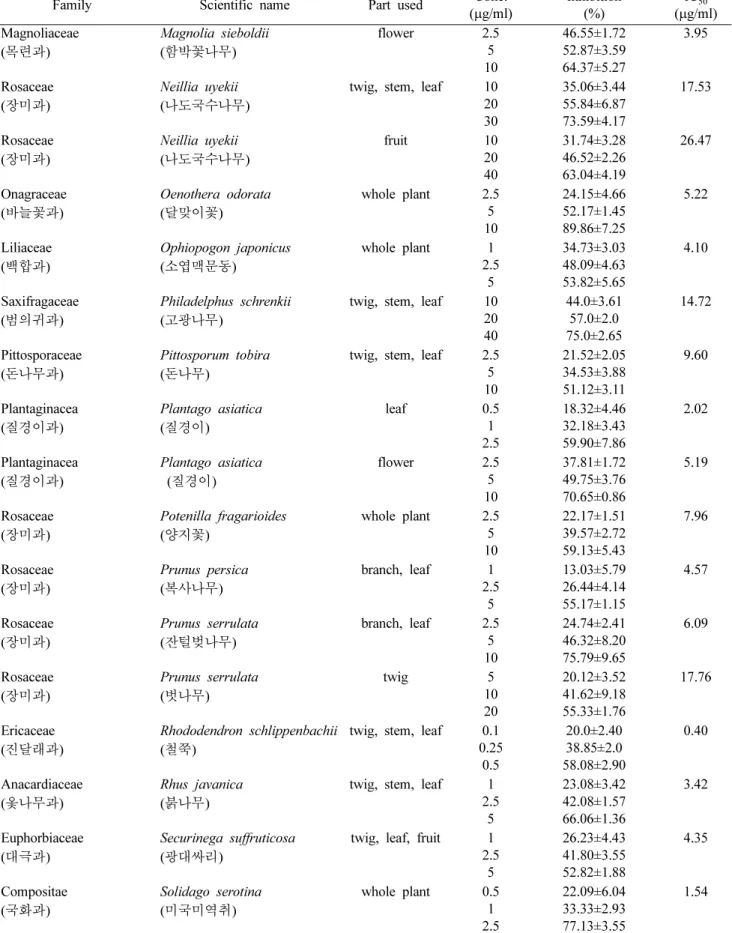
본 연구에서는 천연물로부터 당뇨 합병증의 진행을 억제 하는 약물 검색을 위해, 한국산 52종의 약용식물에서 추출 한 65종 에탄올 추출물을 이용해 알도즈 환원 효소 억제 효 능을 검색하여 Table I과 같은 결과를 얻었다.
Table I. Inhibitory effect of extracts from herbal medicines on the activities of aldose reductase
Family Scientific name Part used Conc.
(µg/ml)
Inhibition (%)
IC50 (µg/ml) Aceraceae
(단풍나무과)
Acer mono (고로쇠나무)
branch, leaf 0.5 1 2.5
31.78±3.67 54.24±2.20 86.86±8.17
1.05
Aceraceae (단풍나무과)
Acer tataricum (신나무)
twig, stem, leaf 0.1 0.25
0.5
34.36±2.67 59.46±3.06 77.22±4.82
0.22
Aceraceae (단풍나무과)
Acer tataricum (신나무)
fruit 0.25
0.5 1
27.03±5.79 37.84±0.67 53.28±4.39
0.91
Simaroubaceae (소태나무과)
Ailanthus altissima (가죽나무)
twig, stem, leaf 1 2.5
5
46.26±1.56 61.22±4.45 71.09±7.24
1.28
Simaroubaceae (소태나무과)
Ailanthus altissima (가죽나무)
fruit 10 20 40
24.81±3.74 29.84±3.74 48.06±3.55
>40
Labiatae (꿀풀과)
Ajuga spectabilis (자란초)
root 5
10 20
37.39±3.45 46.96±4.58 69.57±2.72
10.99
Leguminosae (콩과)
Albizia julibrissin (자귀나무)
flower 2.5
5 10
41.20±5.54 55.06±1.95 81.27±3.95
4.05
Leguminosae (콩과)
Albizia julibrissin.
(자귀나무)
twig, stem, leaf 10 20 40
29.57±0 49.13±5.69 69.13±2.72
23.97
Table I. Continued
Family Scientific name Part used Conc.
(µg/ml) Inhibition (%)
IC50 (µg/ml) Alismataceae
(택사과)
Alisma canaliculatum (택사)
aerial part 5 10 20
24.89±8.52 38.43±6.93 74.24±3.03
12.80
Alismataceae (택사과)
Alisma canaliculatum (택사)
root 10
20 40
28.47±6.21 33.22±4.23 61.02±6.77
32.03
Umbelliferae (산형과)
Angelica decursiva (바디나물)
root 1
2.5 5
32.44±5.55 47.56±0.77 56.0±4.81
3.68
Umbelliferae (산형과)
Angelica decursiva (바디나물)
stem, leaf 5 10 20
41.50±0.84 54.32±6.49 75.77±4.42
8.38
Umbelliferae (산형과)
Angelica japonica (갯강활)
stem, leaf 1 2.5
5
13.51±3.58 24.77±2.81 51.80±3.90
4.90
Saxifragaceae (범의귀과)
Astilbe rubra (노루오줌)
root 2.5
5 10
43.13±3.50 47.71±2.38 53.05±4.58
8.03
Saxifragaceae (범의귀과)
Astilbe rubra (노루오줌)
stem, leaf 2.5 5 10
30.18±5.67 40.36±4.41 56.73±4.41
8.11
Leguminosae (콩과)
Astragalus membranaceus (황기)
root 10
20 40
33.33±4.04 46.67±6.51 60.33±3.21
27.40
Brassicaceae (십자화과)
Brassica juncea (갓)
leaf 5
10 20
34.46±4.68 48.31±3.89 64.42±1.72
12.14
Umbelliferae (산형과)
Bupleurum longeradiatum (개시호)
whole plant 1 2.5
5
24.29±3.78 33.33±7.33 55.24±4.36
4.41
Celastraceae (노박덩굴과)
Celastrus orbiculatus (노박덩굴)
leaf, stem, fruit 5 10 20
39.12±6.15 45.24±6.79 59.18±2.70
12.64
Chloranthaceae (홀아비꽃대과)
Chloranthus japonicus (홀아비꽃대)
whole plant 2.5 5 10
26.97±6.81 32.58±2.92 52.25±2.57
9.58
Verbenaceae (마편초과)
Clerodendrum trichotomum (누리장나무)
twig, stem, leaf 1 2.5
5
30.68±5.68 49.62±2.86 65.53±6.56
3.03
Cornaceae (층층나무과)
Cornus controversa (층층나무)
branch, leaf 1 2.5
5
20.39±3.03 50.97±4.45 73.30±4.68
2.98
Cornaceae (층층나무과)
Cornus controversa (층층나무)
flower 2.5
5 10
19.52±2.97 50.48±5.02 57.14±2.86
7.52
Asclepiadaceae (박주가리과)
Cynanchum ascyrifolium (민백미꽃)
whole plant 5 10 20
39.0±5.29 48.67±2.31
70.0±1.0
10.29
Rutaceae (운향과)
Dictamnus dasycarpus (백선)
leaf 2.5
5 10
27.72±2.65 43.51±7.01 61.75±3.38
7.12
Rutaceae (운향과)
Dictamnus dasycarpus (백선)
root 5
10 20
21.92±1.42 29.59±4.05 55.34±6.64
18.24
Eucommiaceae (두충과)
Eucommia ulmoides (두충)
twig, stem, leaf 5 10 20
35.93±6.32 42.96±6.12 61.48±2.31
13.26
Celastraceae (노박덩굴과)
Euonymus bungeana (좀참빗살나무)
twig, stem, leaf 5 10 20
24.18±2.56 27.46±5.63 55.74±5.36
18.23
Celastraceae (노박덩굴과)
Euonymus macroptera (나래회나무)
twig, stem, leaf 5 20 40
34.08±2.33 47.98±0.78 65.47±5.09
22.85
Euphorbiaceae (대극과)
Euphorbia helioscopia (등대풀)
whole plant 5 10 20
41.44±6.39 56.31±1.56 81.53±3.40
7.82
Staphyleaceae (고추나무과)
Euscaphis japonica (말오줌때)
twig 10
20 40
24.87±3.52 41.62±9.18 55.33±1.76
33.09
Gentianaceae (용담과)
Gentiana squarrosa (구슬붕이)
whole plant 2.5 5 10
44.19±1.40 59.53±6.39 76.28±1.40
3.40
Rosaceae (장미과)
Geum aleppicum (큰뱀무)
whole plant 5 10 20
47.31±5.20 55.38±5.45 84.62±3.71
6.42
Ranunculaceae (미나리아재비과)
Hepatica maxima (섬노루귀)
whole plant 10 20 40
41.99±4.04 51.96±2.82 68.68±0.62
18.51
Hypericaceae (물레나물과)
Hypericum ascyron (물레나물)
whole plant 2.5 5 10
25.11±3.39 34.98±5.09 61.43±6.90
7.91
Gramineae (벼과)
Imperata cylindrica (띠)
whole plant 2.5 5 10
26.12±3.74 33.06±0.71 61.22±1.87
7.89
Leguminosae (콩과)
Lespedeza cuneata (비수리)
root 5
10 20
36.56±1.08 48.39±7.53 61.29±5.99
12.38
Leguminosae (콩과)
Lespedeza cuneata (비수리)
aerial part 5 10 20
9.62±5.75 36.82±5.07 60.67±5.66
16.20
Lauraceae (녹나무과)
Lindera obtusiloba (생강나무)
branch, leaf 0.5 1 2.5
26.32±5.55 46.32±8.79 66.84±2.73
1.50
Solanaceae (가지과)
Lycium chinense (구기자나무)
stem, leaf 5 10 20
45.74±1.06 52.13±1.06 69.15±2.81
8.08
Solanaceae (가지과)
Lycium chinense (구기자나무)
root 5
10 20
40.43±1.84 45.39±2.21 62.77±1.06
11.98
Magnoliaceae (목련과)
Magnolia sieboldii (함박꽃나무)
branch, leaf 2.5 5 10
24.42±6.13 34.30±5.04 59.30±2.66
8.05
Table I. Continued
Family Scientific name Part used Conc.
(µg/ml) Inhibition (%)
IC50 (µg/ml) Magnoliaceae
(목련과)
Magnolia sieboldii (함박꽃나무)
flower 2.5
5 10
46.55±1.72 52.87±3.59 64.37±5.27
3.95
Rosaceae (장미과)
Neillia uyekii (나도국수나무)
twig, stem, leaf 10 20 30
35.06±3.44 55.84±6.87 73.59±4.17
17.53
Rosaceae (장미과)
Neillia uyekii (나도국수나무)
fruit 10
20 40
31.74±3.28 46.52±2.26 63.04±4.19
26.47
Onagraceae (바늘꽃과)
Oenothera odorata (달맞이꽃)
whole plant 2.5 5 10
24.15±4.66 52.17±1.45 89.86±7.25
5.22
Liliaceae (백합과)
Ophiopogon japonicus (소엽맥문동)
whole plant 1 2.5
5
34.73±3.03 48.09±4.63 53.82±5.65
4.10
Saxifragaceae (범의귀과)
Philadelphus schrenkii (고광나무)
twig, stem, leaf 10 20 40
44.0±3.61 57.0±2.0 75.0±2.65
14.72
Pittosporaceae (돈나무과)
Pittosporum tobira (돈나무)
twig, stem, leaf 2.5 5 10
21.52±2.05 34.53±3.88 51.12±3.11
9.60
Plantaginacea (질경이과)
Plantago asiatica (질경이)
leaf 0.5
1 2.5
18.32±4.46 32.18±3.43 59.90±7.86
2.02
Plantaginacea (질경이과)
Plantago asiatica (질경이)
flower 2.5
5 10
37.81±1.72 49.75±3.76 70.65±0.86
5.19
Rosaceae (장미과)
Potenilla fragarioides (양지꽃)
whole plant 2.5 5 10
22.17±1.51 39.57±2.72 59.13±5.43
7.96
Rosaceae (장미과)
Prunus persica (복사나무)
branch, leaf 1 2.5
5
13.03±5.79 26.44±4.14 55.17±1.15
4.57
Rosaceae (장미과)
Prunus serrulata (잔털벚나무)
branch, leaf 2.5 5 10
24.74±2.41 46.32±8.20 75.79±9.65
6.09
Rosaceae (장미과)
Prunus serrulata (벗나무)
twig 5
10 20
20.12±3.52 41.62±9.18 55.33±1.76
17.76
Ericaceae (진달래과)
Rhododendron schlippenbachii (철쭉)
twig, stem, leaf 0.1 0.25
0.5
20.0±2.40 38.85±2.0 58.08±2.90
0.40
Anacardiaceae (옻나무과)
Rhus javanica (붉나무)
twig, stem, leaf 1 2.5
5
23.08±3.42 42.08±1.57 66.06±1.36
3.42
Euphorbiaceae (대극과)
Securinega suffruticosa (광대싸리)
twig, leaf, fruit 1 2.5
5
26.23±4.43 41.80±3.55 52.82±1.88
4.35
Compositae (국화과)
Solidago serotina (미국미역취)
whole plant 0.5 1 2.5
22.09±6.04 33.33±2.93 77.13±3.55
1.54
양성대조군인 TMG의 IC50값 (5.37 µg/ml)을 기준으로 효능을 판단하였으며, 23종의 추출물이 알도즈 환원 효소 억제 효능이 우수하였다. 그 중 신나무 (Acer tataricum)의 소지·줄기·잎 (0.22 µg/ml), 열매 (0.91 µg/ml), 철쭉 (Rhododendron schlippenbachii)의 소지·줄기·잎 (0.40 µg/
ml), 병꽃나무 (Weigela subsessilis)의 소지·줄기·잎 (0.71µg/ml), 고로쇠나무 (Acer mono)의 가지·잎 (1.05 µg/
ml), 가죽나무 (Ailanthus altissima)의 소지·줄기·잎 (1.28µg/ml), 생강나무 (Lindera obtusiloba)의 가지·잎 (1.50µg/ml), 미국미역취 (Solidago serotina)의 전초 (1.54 µg/ml) 8종은 TMG에 비해 3배 이상 효능이 우수하였다.
병꽃나무의 잎에서 분리한 단일 화합물이 세포의 glucose uptake 활성과21) 인슐린의 반응을 저해하여 인슐린 저항성 을 일으키는 PTP1B를 억제하는 효능이 있었다.22)고로쇠 나무에서 분리한 Stilbene Glycosides가 쥐의 간세포에서 산 화적 스트레스를 억제하여 간세포를 보호하는 효과가 보고 되었다.23) 가죽나무의 잎·가지 추출물은 항염작용이 있으 며,24) 생강나무는 한국에서 전통적으로 염증과 혈액순환에 사용된 약재로25) 지방세포형성 억제와 항염 효능이 보고되 었다.26)
이 외에도 효능이 나타난 질경이 (Plantago asiatica)는 항산화 효능이,27) 자귀나무 (Albizia julibrissin), 개시호
(Bupleurum longeradiatum), 층층나무 (Cornus controversa), 붉나무 (Rhus javanica) 4종은 성분연구가 보고되었다.28-31) 누리장나무 (Clerodendrum trichotomum), 소엽맥문동 (Oph- iopogon japonicas), 광대싸리 (Securinega suffruticosa), 함 박꽃나무 (Magnolia sieboldii)는 단일물질과 추출물이 항염 효능을 나타냈으며,32-35) 바디나물 (Angelica decursiva)과 갯 강활 (Angelica japonica)에서는 면역독성 효능이 있었다.36) 달맞이꽃 (Oenothera odorata)과 복사나무 (Prunus persica) 는 각각 혈관이완효과37)와 항알레르기성 염증효능이38) 보고 되었다. 구슬붕이 (Gentiana squarrosa), 신나무, 철쭉, 미국 미역취 4종의 식물에 관한 연구 보고는 아직까지 없으며, 위 23종 모두 알도즈 환원 효소 억제 효능에 관해 보고된 바 없었다.
가죽나무의 열매, 자귀나무의 줄기·잎·소지, 바디나물 의 줄기·잎, 층층나무의 꽃, 함박꽃나무의 가지·잎의 경 우 위에서 효능이 나타난 부위와는 다르게 효능이 나타나 지 않아 부위에 따른 효능 차이가 있음을 알 수 있었다.
본 연구 결과는 동물 실험을 통해 in vivo 효능 확인이 필 요하며, 당뇨합병증 예방 및 치료제 개발에 있어 안전하고 우수한 알도즈 환원 효소 억제제 후보 물질 발굴을 위한 기 초자료로 활용될 수 있을 것으로 사료된다.
Rosaceae (장미과)
Spiraea blumei (산조팝나무)
leaf, twig 2.5 5 10
21.82±1.67 38.55±2.27 53.09±5.77
9.11
Rosaceae (장미과)
Stephanandra incisa (국수나무)
twig, stem, leaf 10 20 40
45.09±3.51 54.55±7.01 68.73±4.54
15.22
Compositae (국화과)
Taraxacum platycarpum (민들레)
whole plant 10 20 40
32.07±3.64 46.06±1.34 72.59±3.64
23.18
Loranthaceae (겨우살이과)
Viscum album (겨우살이)
whole 5
10 20
24.75±3.81 41.92±4.37 59.60±5.32
15.19
Caprifoliaceae (인동과)
Weigela subsessilis (병꽃나무)
twig, stem, leaf 0.5 1 2.5
46.52±3.45 54.78±7.18 76.52±5.22
0.71
Rutaceae (운향과)
Zanthoxylum schinifolium (산초나무)
twig, stem, leaf 5 10 20
40.15±3.47 44.70±3.99 68.18±5.21
11.14
TMGa 3.72
5.59 7.45
31.42±5.71 56.42±9.60 69.69±8.15
5.37
IC
50values were calculated from the dose inhibition curve.
a
TMG (3,3-Tetramethyleneglutaric acid) was used as positive control.
결 론
65종의 한국산 약용식물 에탄올 추출물을 in vitro에서 알 도즈 환원 효소 억제활성 검색하였다. 그 결과 23종의 추출 물이 양성대조군인 TMG보다 효능이 있음을 확인하였고, 그 중 신나무의 소지·줄기·잎과 열매, 철쭉의 소지·줄 기·잎, 병꽃나무의 소지·줄기·잎, 고로쇠나무의 가지·
잎, 가죽나무의 소지·줄기·잎, 생강나무의 소지·잎, 미 국미역취의 전초 8종은 양성 대조군보다 3배 이상의 우수 한 효능을 나타내었다.
사 사
본 연구는 한국한의학연구원 기관고유사업비 (K11040)로 수행되었으며 이에 감사드립니다.
인용문헌
1. Shan, V. O., Dorin, R. I., Sun, Y., Braun, M. and Zager, P. G.
(1997) Aldose reductase gene expression is increased in dia- betic nephropathy. J. Clin. Endocrinol. Metab. 82: 2294- 2298.
2. Collins, J. G. and Corder, C. N. (1977) Aldose reductase and sorbitol dehydrogenase distribution in substructures of nor- mal and diabetic rat lens. Invest. Ophthamol. Visual Sci. 16:
242-243.
3. Dvonik, D., Gabbay, K. H. and Kinoshita, J. H. (1973) Polyol accumulation in galactosemic and diabetic rats. Science 182:
1146-1148.
4. Vinson, J. A. and Howard , T. B. (1996) Inhibition of protein glycation and advanced glycation end products by ascorbic acid and other vitamins and nutrients. J. Nutr. Biochem. 7:
659-663.
5. Lee, Y. S., Kim, S. H., Jung, S. H., Kim, J. K., Pan, C. H. and Lim, S. S. (2010) Aldose reductase inhibitory compounds from Glycyrrhiza uralensis. Biol. Pharm. Bull. 33: 917-921.
6. Fatmawati, S., Kurashiki, K., Takeno, S., Kim, Y. U., Shimizu, K., Sato, M., Imaizumi, K., Takahashi, K., Kamiya, S., Kaneko, S. and Kondo, R. (2009) The inhibitory effect on aldose reductase by an extract of Ganoderma lucidum. Phy- tother. Res. 23: 28-32.
7. Lee, Y. M., Kim, N. H., Kim, J. M., Kim, Y. S., Jang, D. S., Kim, J. H., Bae, K. H. and Kim, J. S. (2008) Screening of inhibitory effect on aldose reductase of Korean herbal med- icines and preventive effect of Catalpa bignonioides against xylose-induced lens opacity (I). Kor. J. Pharmacogn. 39:
165-173.
8. Lee, Y. M., Kim, J. M., Kim, Y. S., Jang, D. S., Kim, J. H., Bae, K. H. and Kim, J. S. (2008) Screening of inhibitory effect on aldose reductase of Vietnam herbal medicines (II).
Kor. J. Pharmacogn. 39: 324-329.
9. Lee, Y. M., Kim, J. M., Kim, Y. S., Jang, D. S., Kim, J. H., Bae, K. H. and Kim, J. S. (2009) Screening of Chinese herbal medicines with inhibitory effect on aldose reductase (III).
Kor. J. Pharmacogn. 40: 394-399.
10. Lee, Y. M., Kim, Y. S., Bae, K. H., Kim, J. H. and Kim, J. S.
(2010) Screening of Chinese herbal medicines with inhibitory effect on aldose reductase (IV). Kor. J. Pharmacogn. 41: 289- 296.
11. Lee, Y. M., Kim, Y. S., Kim, J. H. and Kim, J. S. (2011) Screening of Chinese herbal medicines with inhibitory effect on aldose reductase (V). Kor. J. Pharmacogn. 42: 187-194.
12. Lee, J., Jang, D. S., Kim, N. H., Lee, Y. M., Kim, J. and Kim, J. S. (2011) Galloyl glucoses from the seeds of Cornus offi- cinalis with inhibitory activity against protein glycation, aldose reductase, and cataractogenesis ex vivo. Biol. Pharm.
Bull. 34: 443-446.
13. Lee, J., Kim, N. H., Nam, J. W., Lee, Y. M., Jang, D. S., Kim, Y. S., Nam, S. H., Seo, E. K., Yang, M. S. and Kim, J. S.
(2010) Scopoletin from the flower buds of Magnolia fargesii inhibits protein glycation, aldose reductase, and cataracto- genesis ex vivo. Arch. Pharm. Res. 33: 1317-1323.
14. Jang, D. S., Yoo, N. H., Kim, N. H., Lee, Y. M., Kim, C. S., Kim, J., Kim, J. H., and Kim, J. S. (2010) 3,5-Di-O-caffeoyl- epi-quinic acid from the leaves and stems of Erigeron annuus inhibits protein glycation, aldose reductase, and cataracto- genesis. Biol. Pharm. Bull. 33: 329-333.
15. Kim, C. S., Kim, J., Jeong, I. H., Kim, Y. S., Lee, J., Jang, D.
S. and Kim, J. S. (2009) Slow development of diabetic cat- aract in streptozotocin-induced diabetic rats via inhibition of aldose reductase activity and sorbitol accumulation by use of Aster koraiensis extract. Kor. J. Pharmacogn. 40: 339-344.
16. Kim, C. S., Kim, J., Lee, Y.M., Sohn, E., Jo, K. and Kim, J.
S. (2011) Inhibitory effects of chlorogenic acid on aldose reductase activity in vitro and cataractogenesis in galactose- fed rats. Arch. Pharm. Res. 34: 847-852.
17. Kim, J., Kim, C. S., Sohn, E., Lee, Y. M. and Kim, J. S.
(2011) KIOM-79 inhibits aldose reductase activity and cat- aractogenesis in Zucker diabetic fatty rats. J Pharm Phar- macol. 63: 1301-1038.
18. Dufrane, S. P., Malaisse, W. J. and Sener, A. (1984) A micromethod for the assay of aldose reductase, its application to pancreatic islets. Biochem. Med. 32: 99-105.
19. Bradford, M. (1976) A rapid and sensitive method for the quantitation of microgram quantities of protein utilizing the principle of protein-dye binding. Anal. Biochem. 72: 248-254.
20. Kinoshita, J. H., Dvornik, D., Kraml, M. and Gabbay, K. H.
(1968) The effect of an aldose reductase inhibitor on the galactose-exposed rabbit lens. Biochim. Biophys. Acta. 24:
472-475.
21. Lee, M. S. and Thuong, P. T. (2010) Stimulation of glucose uptake by triterpenoids from Weigela subsessilis. Phytother
1B inhibitory activity of 24-norursane triterpenes isolated from Weigela subsessilis. Phytother Res. 24: 1716-1719.
23. Yang, H., Lee, M. K. and Kim, Y. C. (2005) Protective activ- ities of stilbene glycosides from Acer mono leaves against H2O2-induced oxidative damage in primary cultured rat hepatocytes. J. Agric. Food Chem. 53: 4182-4186.
24. Jin, M. H., Yook, J., Lee, E., Lin, C. X., Quan, Z., Son, K. H., Bae, K. H., Kim, H. P., Kang, S. S. and Chang, H. W. (2006) Anti-inflammatory activity of Ailanthus altissima in oval- bumin-induced lung inflammation. Biol. Pharm. Bull. 29:
884-888.
25. Yook, C. and Lindera obtusiloba. (1989) Medical Plants of Korea. 184 Jinmyeong Publishing Co. Seoul
26. Freise, C., Erben, U., Neuman, U., Kim, K., Zeitz, M., Soma- sundaram, R. and Ruehl, M. (2010) An active extract of Lin- dera obtusiloba inhibits adipogenesis via sustained Wnt signaling and exerts anti-inflammatory effects in the 3T3-L1 preadipocytes. J. Nutr. Biochem. 21: 1170-1177.
27. Ye, C. L., Hu, W. L. and Dai, D. H.(2011) Extraction of polysaccharides and the antioxidant activity from the seeds of Plantago asiatica L. Int. J. Biol. Macromol. 2011 Jun 2.
[Epub ahead of print]
28. Zheng, L., Zheng, J., Zhang, Q., Wang, B., Zhao, Y. and Wu, L. (2010) Three new oleanane triterpenoid saponins acety- lated with monoterpenoid acid from Albizia julibrissin. Fitot- erapia. 81: 859-863.
29. Chio, J. S. and Woo, W. S. (1989) Phenolic Compounds of the roots of Bupleurum longeradiatum. Arch. Pharm. Res. 12:
226-228.
30. Vareed, S. K., Reddy, M. K., Schutzki, R. E. and Nair, M. G.
(2006) Anthocyanins in Cornus alternifolia, Cornus con- troversa, Cornus kousa and Cornus florida fruits with health benefits. Life Sci. 78: 777-784.
31. Wu, Y. B., Kuo, Y. H. and Ouyang, M. A. (2010) Novel 4-(2- methylphenyl)-flavan, rhusjavanins A and B, from the roots of Rhus semialata. Nat. Prod. Res. 24: 1643-1647.
LPS-stimulated RAW 264.7 macrophages by suppressing NF-kappaB activation. Arch. Pharm. Res. 30: 755-760.
33. Hung, T. M., Thu, C. V., Dat, N. T., Ryoo, S. W., Lee, J. H., Kim, J. C., Na, M., Jung, H. J., Bae. K, and Min, B. S. (2010) Homoisoflavonoid derivatives from the roots of Ophiopogon japonicus and their in vitro anti-inflammation activity.
Bioorg. Med. Chem. Lett. 20: 2412-2416.
34. Yang, E. J., Yim, E. Y., Song, G., Kim, G. O. and Hyun, C. G.
(2009) Inhibition of nitric oxide production in lipopolysac- charide-activated RAW 264.7 macrophages by Jeju plant extracts. Interdiscip Toxicol. 2: 245-249.
35. Choi, J., Shin, K. M., Park, H. J., Jung, H. J., Kim, H. J., Lee, Y. S., Rew, J. H. and Lee, K. T. (2004) Anti-inflammatory and antinociceptive effects of sinapyl alcohol and its glu- coside syringin. Planta. Med. 70: 1027-1032.
36. Chung, I. M., Kim, E. H., Lee, J. H., Lee, Y. C. and Moon, H. I. (2011) Immunotoxicity activity from various essential oils of Angelica genus from South Korea against Aedes aegypti L. Immunopharmacol. Immunotoxicol. 2011 Apr 20.
[Epub ahead of print]
37. Kim, H. Y., Oh, H., Li, X., Cho, K. W., Kang, D.G. and Lee, H. S. (2011) Ethanol extract of seeds of Oenothera odorata induces vasorelaxation via endothelium-dependent NO- cGMP signaling through activation of Akt-eNOS-sGC path- way. J. Ethnopharmacol. 133: 315-323.
38. Shin, T. Y., Park, S. B., Yoo, J. S., Kim, I. K., Lee, H. S., Kwon, T.K., Kim, M. K., Kim, J. C. and Kim, S. H. (2010) Anti-allergic inflammatory activity of the fruit of Prunus per- sica: role of calcium and NF-kappaB. Food Chem. Toxicol.
48: 2797-2802.
(2011. 10. 19 접수; 2011. 11. 28 심사; 2011. 12. 5 게재확정)