Kor. J. Pharmacogn.
43(4) : 345∼ 351 (2012) 단 보
345
한국약용식물의 최종당화산물 생성저해활성 검색(VII)
최소진1·김영숙1·송유진1·이윤미1·김주환2·김진숙1*
1한국한의학연구원 한약연구본부 한의신약연구그룹, 2가천대학교 생명과학과
Screening of Korean Herbal Medicines with Inhibitory Activity on Advanced Glycation End Products Formation (VII)
So-Jin Choi1, Young Sook Kim1, Yoo Jin Song1, Yun Mi Lee1, Joo Hwan Kim2 and Jin Sook Kim1*
1Korean Medicine-Based Herbal Drug Research Group, Herbal Medicine Research Division, Korea Institute of Oriental Medicine, 1672Yuseongdae-ro, Yuseong-gu, Daejeon, 305-811, Korea
2Department of Life Science, Gachon University, Seongnam, Kyonggi-do 461-701, Korea
Abstracts − In this study, 49 Korean herbal medicines have been investigated with an in vitro evaluation system using glycation end products (AGEs) formation inhibitory activity. Of these, 18 herbal medicines (IC50<50µg/ml) were found to have sig- nificant AGEs formation inhibitory activity. Of these, five herbal medicines (IC50<10µg/ml) were found to have significant AGEs formation inhibitory activity. Particularly, Mallotus japonicus (twigs and leaves), Rhus javanica (twigs and leaves), Boe- hmeria nivea (whole plants), Quercus acuta (stems), and Eurya japonica (stems) showed more potent inhibitory activity (approximately 9-37 fold) than the positive control aminoguanidine (IC50=76.47µg/ml).
Key words − Advanced glycation end products (AGEs), Diabetic complications, Korean herbal medicines
당뇨합병증은 당뇨병성 망막증, 신증, 신경병증과 같은 미 세혈관 합병증과 뇌혈관, 관상동맥, 말초혈관 질환과 같은 대혈관 합병증으로 나눌 수 있다.1,2) 당뇨합병증의 원인으로 는 최종당화산물(advanced glycation end products, AGEs) 의 생성, polyol pathway flux의 증가 및 protein kinase C 활성화 등이 주요 발병기전으로 알려져 있다.3-5) 최종당화산 물은 만성적인 고혈당과 혈액과 조직 내 단백질의 아미노 산과 결합하여 Schiff base가 생성되고, 시간이 지나면서 비 효소적 반응(non-enzymatic glycation)으로 Amadori adduct 가 형성된다. 이 반응은 지속적으로 진행되어 비가역적인 산물인 최종당화산물이 생성된다. 일단 생성된 최종당화산 물은 혈당이 정상으로 회복되어도 분해가 되지 않고 단백질 과 교차결합(AGEs-protein cross-link)하여 혈액 단백질이나 여러 조직에 축적되어 당뇨 합병증을 가속화하게 된다.6-9) 따라서 생체 내에서 최종당화산물의 생성을 저해하거나 이 미 생성된 최종당화산물의 단백질과의 교차결합을 억제하 여 당뇨합병증을 예방하거나 치료하기 위해 많은 연구들이
진행되고 있다.10-13) 본 연구팀에서도 in vitro검색을 통하여 여러 종의 단일 한약재 추출물이 최종당화산물의 생성을 저 해하는 것을 확인 하였다.14-15) 특히, 선별된 추출물은 1형과 제2형 당뇨 동물 모델에서 당뇨병성 신증의 치료효과가 있 으며, 당뇨병성 망막증의 진행을 지연시키는 효능을 확인할 수 있었다.16-18) 본 연구는 지난 보고에 이어,19-24) 한국에서 자생하는 약용식물 49종의 에탄올 추출물을 대상으로 최종 당화산물 생성 저해 활성을 in vitro에서 검색하였다.
재료 및 방법
실험재료 − 약용식물은 2010월 6월부터 11월 그리고 2011 년 6월부터 7월까지 전국에서 채취되어, 가천대학교 생명과 학과 김주환 교수의 감정을 거친 후 실험 재료로 사용되었 다(Table I). 사용한 실험 재료의 증거표본은 한국한의학연 구원 한약연구본부 한의신약연구그룹 당뇨합병증 연구팀 표 본실에 보관중이다.
추출 및 시료조제 − 분쇄한 시료 200 g에 2 L의 에탄올을 넣고 실온상태에서 3일간 3회 추출하였다. 이를 여과하여 40oC의 수욕 상에서 감압농축을 실시한 후, 동결 건조기에
*교신저자(E-mail):[email protected] (Tel): +82-42-868-9465
서 건조하였다. 추출물은 실험 수행 전에 감압 하에서 P2O2 를 이용하여 24시간 이상 재건조한 후 DMSO (Sigma, St.
Louis, MO, USA)에 용해시켜 stock solution을 조제하였으 며 최종 DMSO의 농도가 0.2%가 되도록 15% TWEEN 80 (Sigma, St. Louis, MO, USA)용액으로 희석하여 사용하였 다. 추출에 이용한 에탄올 및 그 외 시약은 1급 및 특급시 약을 사용하였다.
In vitro에서 최종당화산물 생성저해 실험 − Vinson과 Howard25)의 방법을 변형하여 실험을 실시하였다. 본 실험 에서는 10 mg/ml의 우혈청 알부민(bovine serum albumin, Sigma)을 0.2 M phosphate buffer (pH 7.4)에 용해시키고, 0.2 M의 fructose와 glucose를 처리하였다. 이 때 0.2 M phosphate buffer에 0.02% sodium azide를 넣어 반응기간 동 안 박테리아의 생성을 방지하였다. 이 반응액에 추출물 또 는 최종당화산물 생성저해제인 aminoguanidine을 넣은 후 37oC에서 7일 동안 반응시켰다. 배양 후에는 spectrofluoro- metric detector (Bio-TEK, Synergy HT, USA)를 이용하여 형광도를 측정하였다(Ex:350, Em:450 nm). IC50값은 n=3으 로 하여 계산되었다.
결과 및 고찰
최근 당뇨병의 치료방법이 발달됨에 따라 당뇨병 환자의 평균 수명이 연장 되고 급성 대사성 합병증으로 인한 사망
률이 급격하게 감소되고는 있지만, 당뇨병성 만성 합병증 의 발생이 증가함으로 인해 당뇨합병증은 당뇨병 치료 그 자체보다 더 큰 문제점으로 지적되고 있다. 26, 27) 현재까지 알려져 있는 당뇨합병증의 여러 가지 원인 중 하나인 최종 당화산물 생성 증가는 신장, 안구, 뇌혈관 세포손상을 유발 하여 당뇨합병증 기전을 가속화하게 됨에 따라, 최종당화 산물 생성 억제제가 당뇨합병증 예방 및 치료제로 가능성 이 제시되었다. 대표적인 최종당화산물의 억제제인 aminoguanidine28, 29)은 독성 문제가 제기되어 독성이 없는 안전한 천연물의 검색을 위해 많은 연구들이 진행되고 있다.
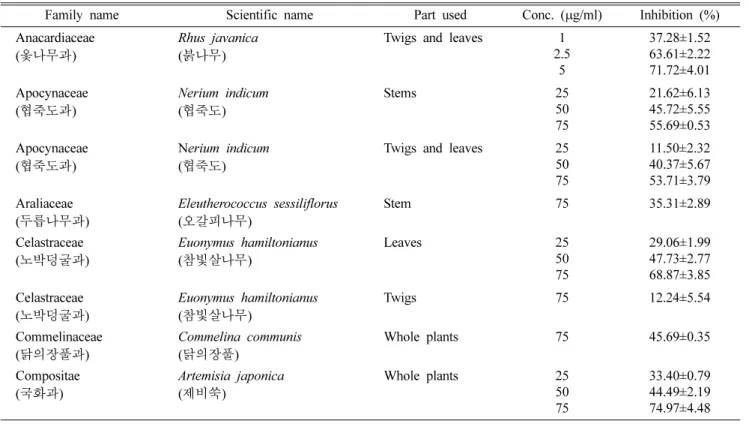
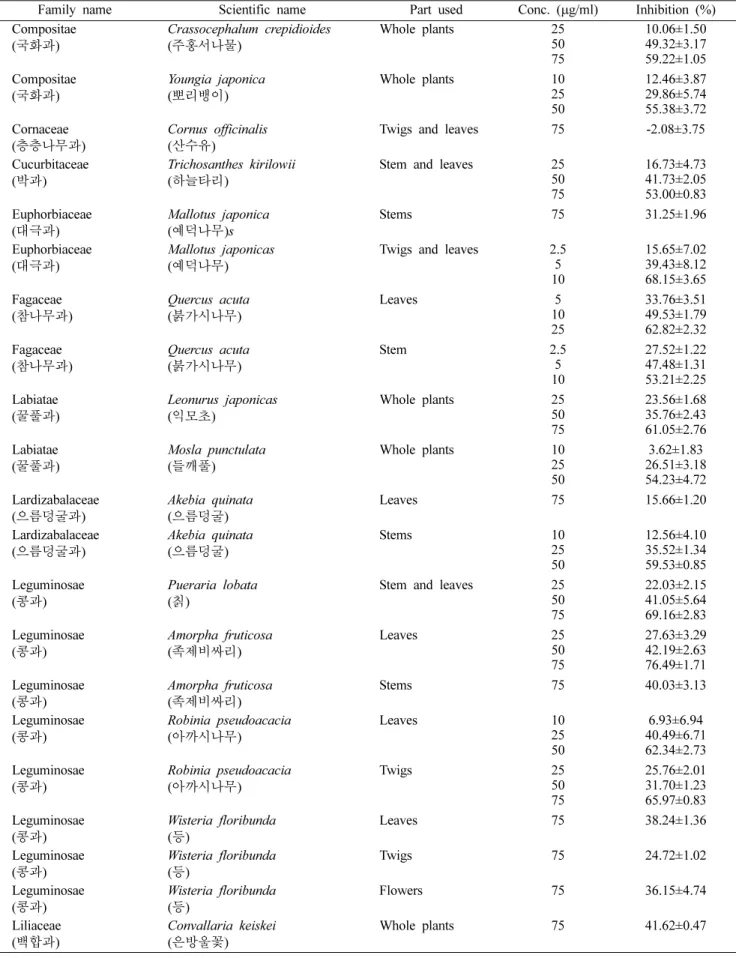
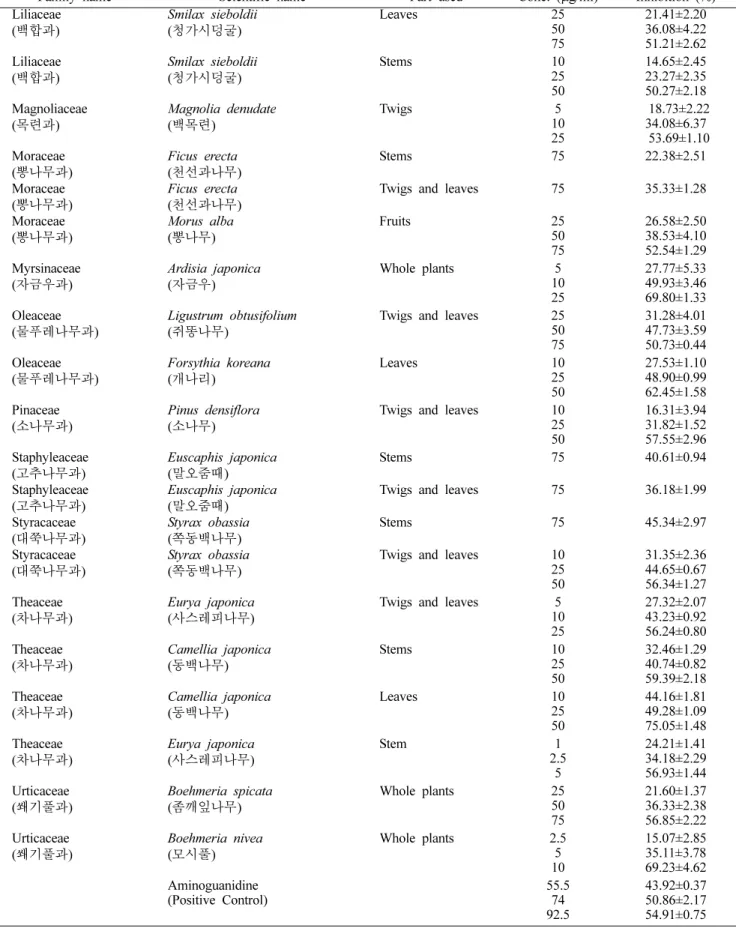
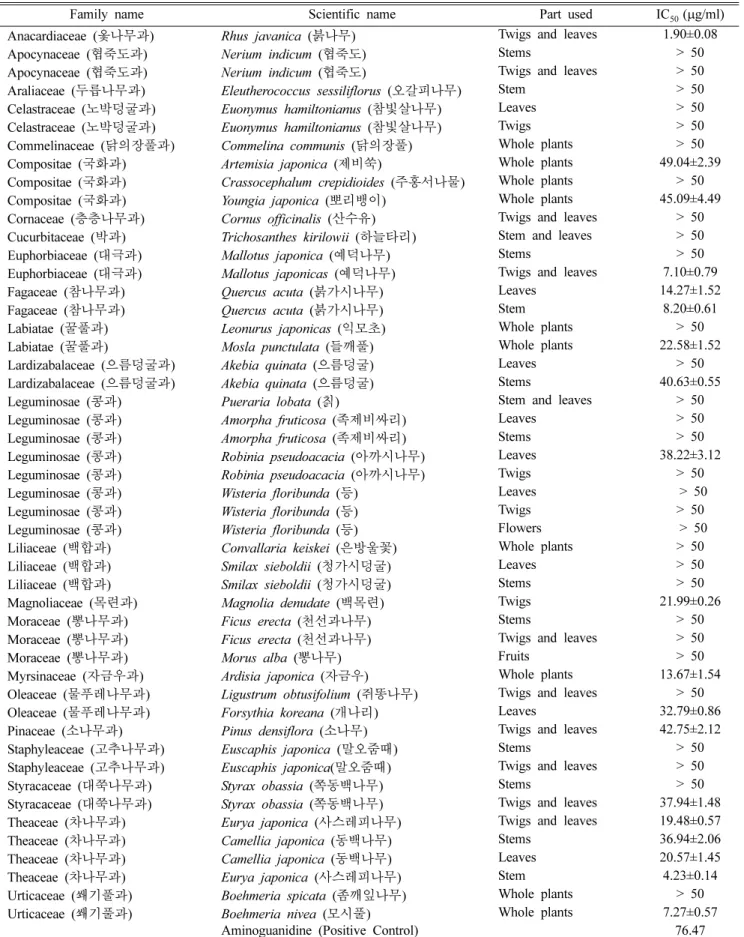
본 연구에서도 천연물로부터 당뇨합병증의 진행을 억제 하는 약물 검색을 위해, 국내에서 자생하는 약용식물 49종 의 에탄올 추출물을 이용하여 최종당화산물 생성 저해 효 능을 7일간 반응시킨 후 측정하였다. 양성 대조 약물인 aminoguanidine의 IC50값(76.47 µg/ml)을 근거로 하여, 추출 물이 IC50<50µg/ml이면 효능이 있다고 판단하였다. Table I 에서 보여 주는 것과 같이 18종의 식물 추출물에서 IC50<50µg/ml로 최종당화산물 생성 저해 효능을 보였고, 그 중에서 5종의 추출물 Mallotus japonicus의 가지, 잎(7.10 µg/
ml), Rhus javanica의 가지, 잎(1.90 µg/ml), Boehmeria nivea 의 전초(7.27 µg/ml), Quercus acuta의 줄기(8.20 µg/ml), Eurya japonica의 줄기(4.23 µg/ml)은 IC50가 10 µg/ml이하 로 aminoguanidine보다 약 9-37배 이상의 우수한 효능이 있 음을 알 수 있었다.
Table I. Inhibitory activity of the ethanol extracts of the herbal medicines on AGEs formation in vitro
Family name Scientific name Part used Conc. (µg/ml) Inhibition (%) Anacardiaceae
(옻나무과)
Rhus javanica (붉나무)
Twigs and leaves 1 2.5
5
37.28±1.52 63.61±2.22 71.72±4.01 Apocynaceae
(협죽도과)
Nerium indicum (협죽도)
Stems 25
50 75
21.62±6.13 45.72±5.55 55.69±0.53 Apocynaceae
(협죽도과)
Nerium indicum (협죽도)
Twigs and leaves 25 50 75
11.50±2.32 40.37±5.67 53.71±3.79 Araliaceae
(두릅나무과)
Eleutherococcus sessiliflorus (오갈피나무)
Stem 75 35.31±2.89
Celastraceae (노박덩굴과)
Euonymus hamiltonianus (참빛살나무)
Leaves 25
50 75
29.06±1.99 47.73±2.77 68.87±3.85 Celastraceae
(노박덩굴과)
Euonymus hamiltonianus (참빛살나무)
Twigs 75 12.24±5.54
Commelinaceae (닭의장풀과)
Commelina communis (닭의장풀)
Whole plants 75 45.69±0.35
Compositae (국화과)
Artemisia japonica (제비쑥)
Whole plants 25
50 75
33.40±0.79 44.49±2.19 74.97±4.48
Table I. Continued
Family name Scientific name Part used Conc. (µg/ml) Inhibition (%) Compositae
(국화과)
Crassocephalum crepidioides (주홍서나물)
Whole plants 25
50 75
10.06±1.50 49.32±3.17 59.22±1.05 Compositae
(국화과)
Youngia japonica (뽀리뱅이)
Whole plants 10
25 50
12.46±3.87 29.86±5.74 55.38±3.72 Cornaceae
(층층나무과)
Cornus officinalis (산수유)
Twigs and leaves 75 -2.08±3.75
Cucurbitaceae (박과)
Trichosanthes kirilowii (하늘타리)
Stem and leaves 25 50 75
16.73±4.73 41.73±2.05 53.00±0.83 Euphorbiaceae
(대극과)
Mallotus japonica (예덕나무)s
Stems 75 31.25±1.96
Euphorbiaceae (대극과)
Mallotus japonicas (예덕나무)
Twigs and leaves 2.5 5 10
15.65±7.02 39.43±8.12 68.15±3.65 Fagaceae
(참나무과)
Quercus acuta (붉가시나무)
Leaves 5
10 25
33.76±3.51 49.53±1.79 62.82±2.32 Fagaceae
(참나무과)
Quercus acuta (붉가시나무)
Stem 2.5
5 10
27.52±1.22 47.48±1.31 53.21±2.25 Labiatae
(꿀풀과)
Leonurus japonicas (익모초)
Whole plants 25
50 75
23.56±1.68 35.76±2.43 61.05±2.76 Labiatae
(꿀풀과)
Mosla punctulata (들깨풀)
Whole plants 10
25 50
3.62±1.83 26.51±3.18 54.23±4.72 Lardizabalaceae
(으름덩굴과)
Akebia quinata (으름덩굴)
Leaves 75 15.66±1.20
Lardizabalaceae (으름덩굴과)
Akebia quinata (으름덩굴)
Stems 10
25 50
12.56±4.10 35.52±1.34 59.53±0.85 Leguminosae
(콩과)
Pueraria lobata (칡)
Stem and leaves 25 50 75
22.03±2.15 41.05±5.64 69.16±2.83 Leguminosae
(콩과)
Amorpha fruticosa (족제비싸리)
Leaves 25
50 75
27.63±3.29 42.19±2.63 76.49±1.71 Leguminosae
(콩과)
Amorpha fruticosa (족제비싸리)
Stems 75 40.03±3.13
Leguminosae (콩과)
Robinia pseudoacacia (아까시나무)
Leaves 10
25 50
6.93±6.94 40.49±6.71 62.34±2.73 Leguminosae
(콩과)
Robinia pseudoacacia (아까시나무)
Twigs 25
50 75
25.76±2.01 31.70±1.23 65.97±0.83 Leguminosae
(콩과)
Wisteria floribunda (등)
Leaves 75 38.24±1.36
Leguminosae (콩과)
Wisteria floribunda (등)
Twigs 75 24.72±1.02
Leguminosae (콩과)
Wisteria floribunda (등)
Flowers 75 36.15±4.74
Liliaceae (백합과)
Convallaria keiskei (은방울꽃)
Whole plants 75 41.62±0.47
Table I. Continued
Family name Scientific name Part used Conc. (µg/ml) Inhibition (%) Liliaceae
(백합과)
Smilax sieboldii (청가시덩굴)
Leaves 25
50 75
21.41±2.20 36.08±4.22 51.21±2.62 Liliaceae
(백합과)
Smilax sieboldii (청가시덩굴)
Stems 10
25 50
14.65±2.45 23.27±2.35 50.27±2.18 Magnoliaceae
(목련과)
Magnolia denudate (백목련)
Twigs 5
10 25
18.73±2.22 34.08±6.37 53.69±1.10 Moraceae
(뽕나무과)
Ficus erecta (천선과나무)
Stems 75 22.38±2.51
Moraceae (뽕나무과)
Ficus erecta (천선과나무)
Twigs and leaves 75 35.33±1.28
Moraceae (뽕나무과)
Morus alba (뽕나무)
Fruits 25
50 75
26.58±2.50 38.53±4.10 52.54±1.29 Myrsinaceae
(자금우과)
Ardisia japonica (자금우)
Whole plants 5
10 25
27.77±5.33 49.93±3.46 69.80±1.33 Oleaceae
(물푸레나무과)
Ligustrum obtusifolium (쥐똥나무)
Twigs and leaves 25 50 75
31.28±4.01 47.73±3.59 50.73±0.44 Oleaceae
(물푸레나무과)
Forsythia koreana (개나리)
Leaves 10
25 50
27.53±1.10 48.90±0.99 62.45±1.58 Pinaceae
(소나무과)
Pinus densiflora (소나무)
Twigs and leaves 10 25 50
16.31±3.94 31.82±1.52 57.55±2.96 Staphyleaceae
(고추나무과)
Euscaphis japonica (말오줌때)
Stems 75 40.61±0.94
Staphyleaceae (고추나무과)
Euscaphis japonica (말오줌때)
Twigs and leaves 75 36.18±1.99
Styracaceae (대쭉나무과)
Styrax obassia (쪽동백나무)
Stems 75 45.34±2.97
Styracaceae (대쭉나무과)
Styrax obassia (쪽동백나무)
Twigs and leaves 10 25 50
31.35±2.36 44.65±0.67 56.34±1.27 Theaceae
(차나무과)
Eurya japonica (사스레피나무)
Twigs and leaves 5 10 25
27.32±2.07 43.23±0.92 56.24±0.80 Theaceae
(차나무과)
Camellia japonica (동백나무)
Stems 10
25 50
32.46±1.29 40.74±0.82 59.39±2.18 Theaceae
(차나무과)
Camellia japonica (동백나무)
Leaves 10
25 50
44.16±1.81 49.28±1.09 75.05±1.48 Theaceae
(차나무과)
Eurya japonica (사스레피나무)
Stem 1
2.5 5
24.21±1.41 34.18±2.29 56.93±1.44 Urticaceae
(쐐기풀과)
Boehmeria spicata (좀깨잎나무)
Whole plants 25
50 75
21.60±1.37 36.33±2.38 56.85±2.22 Urticaceae
(쐐기풀과)
Boehmeria nivea (모시풀)
Whole plants 2.5
5 10
15.07±2.85 35.11±3.78 69.23±4.62 Aminoguanidine
(Positive Control)
55.5 74 92.5
43.92±0.37 50.86±2.17 54.91±0.75 IC50 values were calculated from the dose inhibition curve.
Table II. IC50 values of the herbal medicines on AGEs formation in vitro
Family name Scientific name Part used IC50 (µg/ml)
Anacardiaceae (옻나무과) Rhus javanica (붉나무) Twigs and leaves 1.90±0.08
Apocynaceae (협죽도과) Nerium indicum (협죽도) Stems > 50
Apocynaceae (협죽도과) Nerium indicum (협죽도) Twigs and leaves > 50
Araliaceae (두릅나무과) Eleutherococcus sessiliflorus (오갈피나무) Stem > 50 Celastraceae (노박덩굴과) Euonymus hamiltonianus (참빛살나무) Leaves > 50
Celastraceae (노박덩굴과) Euonymus hamiltonianus (참빛살나무) Twigs > 50
Commelinaceae (닭의장풀과) Commelina communis (닭의장풀) Whole plants > 50
Compositae (국화과) Artemisia japonica (제비쑥) Whole plants 49.04±2.39
Compositae (국화과) Crassocephalum crepidioides (주홍서나물) Whole plants > 50
Compositae (국화과) Youngia japonica (뽀리뱅이) Whole plants 45.09±4.49
Cornaceae (층층나무과) Cornus officinalis (산수유) Twigs and leaves > 50 Cucurbitaceae (박과) Trichosanthes kirilowii (하늘타리) Stem and leaves > 50
Euphorbiaceae (대극과) Mallotus japonica (예덕나무) Stems > 50
Euphorbiaceae (대극과) Mallotus japonicas (예덕나무) Twigs and leaves 7.10±0.79
Fagaceae (참나무과) Quercus acuta (붉가시나무) Leaves 14.27±1.52
Fagaceae (참나무과) Quercus acuta (붉가시나무) Stem 8.20±0.61
Labiatae (꿀풀과) Leonurus japonicas (익모초) Whole plants > 50
Labiatae (꿀풀과) Mosla punctulata (들깨풀) Whole plants 22.58±1.52
Lardizabalaceae (으름덩굴과) Akebia quinata (으름덩굴) Leaves > 50
Lardizabalaceae (으름덩굴과) Akebia quinata (으름덩굴) Stems 40.63±0.55
Leguminosae (콩과) Pueraria lobata (칡) Stem and leaves > 50
Leguminosae (콩과) Amorpha fruticosa (족제비싸리) Leaves > 50
Leguminosae (콩과) Amorpha fruticosa (족제비싸리) Stems > 50
Leguminosae (콩과) Robinia pseudoacacia (아까시나무) Leaves 38.22±3.12
Leguminosae (콩과) Robinia pseudoacacia (아까시나무) Twigs > 50
Leguminosae (콩과) Wisteria floribunda (등) Leaves > 50
Leguminosae (콩과) Wisteria floribunda (등) Twigs > 50
Leguminosae (콩과) Wisteria floribunda (등) Flowers > 50
Liliaceae (백합과) Convallaria keiskei (은방울꽃) Whole plants > 50
Liliaceae (백합과) Smilax sieboldii (청가시덩굴) Leaves > 50
Liliaceae (백합과) Smilax sieboldii (청가시덩굴) Stems > 50
Magnoliaceae (목련과) Magnolia denudate (백목련) Twigs 21.99±0.26
Moraceae (뽕나무과) Ficus erecta (천선과나무) Stems > 50
Moraceae (뽕나무과) Ficus erecta (천선과나무) Twigs and leaves > 50
Moraceae (뽕나무과) Morus alba (뽕나무) Fruits > 50
Myrsinaceae (자금우과) Ardisia japonica (자금우) Whole plants 13.67±1.54
Oleaceae (물푸레나무과) Ligustrum obtusifolium (쥐똥나무) Twigs and leaves > 50
Oleaceae (물푸레나무과) Forsythia koreana (개나리) Leaves 32.79±0.86
Pinaceae (소나무과) Pinus densiflora (소나무) Twigs and leaves 42.75±2.12
Staphyleaceae (고추나무과) Euscaphis japonica (말오줌때) Stems > 50
Staphyleaceae (고추나무과) Euscaphis japonica(말오줌때) Twigs and leaves > 50
Styracaceae (대쭉나무과) Styrax obassia (쪽동백나무) Stems > 50
Styracaceae (대쭉나무과) Styrax obassia (쪽동백나무) Twigs and leaves 37.94±1.48 Theaceae (차나무과) Eurya japonica (사스레피나무) Twigs and leaves 19.48±0.57
Theaceae (차나무과) Camellia japonica (동백나무) Stems 36.94±2.06
Theaceae (차나무과) Camellia japonica (동백나무) Leaves 20.57±1.45
Theaceae (차나무과) Eurya japonica (사스레피나무) Stem 4.23±0.14
Urticaceae (쐐기풀과) Boehmeria spicata (좀깨잎나무) Whole plants > 50
Urticaceae (쐐기풀과) Boehmeria nivea (모시풀) Whole plants 7.27±0.57
Aminoguanidine (Positive Control) 76.47
IC50 values were calculated from the dose inhibition curve.
대극과의 M. japonicas (예덕나무)는 수피가 활성산소를 억제하여 노화방지 활성이 보고되었다.30-32) 옻나무과의 R.
javanica (붉나무)는 한방에서 이질, 설사 등의 수삽약으로 사용하고 있는 식물로서 항산화 작용이 보고되었다.33,34) 쐐 기풀과의 B. nivea (모시풀) 잎에는 비타민, 무기질, poly- phenol 등 다양한 생리활성 성분이 함유되어 있어 free radical 소거 활성을 보여 항산화, 항암, 항균 작용이 보고되었다.35-37) 참나무과의 Q. acuta (붉가시나무)는 polyphenol 화합물과 flavonoid 함량이 높아 항산화, 항염 효과 그리고 혈액암 세 포주인 HL-60 세포의 증식 억제에도 효과가 있다고 보고되 었다.38)차나무과에 속하는 E. japonica (사스레피나무)는 본 연구팀의 연구 결과 사스레피나무의 가지와 잎이 알도즈 환 원효소를 억제하여 당뇨성 백내장을 예방한다는 보고에 뒷 받침되어 당뇨합병증의 예방에 효과가 있다고 보고되었다.39) 위 언급된 5종의 약용 식물은 양성 대조 약물 보다 9-37 배 이상 최종당화산물 생성 억제 효능이 우수한 것으로 확 인되었으므로, 전임상 실험을 통해 in vivo효능 확인이 필요 하다고 생각된다. 본 연구 결과는 국내 약용식물로부터 안 전하고 효능이 좋은 최종당화산물 생성 저해제 후보를 발 굴하기 위한 기초 자료로 활용될 수 있으며, 당뇨에 의해 나 타나는 합병증 치료제 개발의 기반을 구축하는데 기여할 수 있을 것이다.
결 론
기원이 확인된 국내산 약용식물 49종의 에탄올 추출물이 in vitro에서 최종당화산물 생성저해 효능이 검색되었다. 그 결과 18종이 양성대조군인 aminoguanidine보다 우수한 효 능이 있음을 확인하였고, 그 중 M. japonicus (가지, 잎), R.
javanica (가지, 잎), B. nivea (전초), Q. acuta (줄기), E.
japonica (줄기) 등 5종의 추출물은 양성대조군(amino- guanidine) 보다 9-37배 억제 효능이 우수한 것으로 나타났다.
사 사
본 연구는 한국한의학연구원 기관고유사업(K11040, K12040)의 지원으로 수행되었으며 이에 감사드립니다.
인용문헌
1. Pipie, A. and Vanheyninger, R. (1964) Effect of diabetes on the content of sorbitol, glucose, fructose and inositol in the human lens. Exp. Eye Res. 3: 124-131.
2. Heath, H. and Hamlett, Y. C. (1976) The sorbitol pathway:
effect of streptozotocin induced diabetes and the feeding of a sucrose rich diet on glucose, sorbitol and fructose in the retina blood and liver of rats. Diabetoloqia 12: 43-46.
3. Sakurai, T. and Tsuchiya, S. (1988) Superoxide production from nonenzymatically glycated protein. FEBS Lett. 236:
406-410.
4. Shinohara, R., Mano, T., Nagasaka, A., Sawai, Y., Uchimura, K., Hayashi, R., Hayakawa, N., Nagata, M., Makino, M., Kakizawa, H., Itoh, Y., Nakai, A. and Itoh, M. (1998) Effects of thyroid hormone on the sorbitol pathway in streptozotocin- induced diabetic rats. Biochim. Biophys. Acta 1425: 577-586.
5. Bucala, R., Cerami, A. and Vlassara, H. (1995) Advanced glycosylation end products in diabetic complications. Dia- betes Rev. 3: 258-268.
6. Larkins, R. G. and Dunlop, M. E. (1992) The link between hyperglycaemia and diabetic nephropathy. Diabetologia 35:
499-504.
7. Ahmed, N. (2005) Advanced glycation endproducts-role in pathology of diabetic complications. Diabetes Res. Clin.
Pract. 67: 3-21.
8. Yokozaw, T., Nakagawa, T. and Terasawa, K. (2001) Effects of oriental medicines on the production of advanced gly- cation endproducts. J. Trad. Med. 18: 107-112.
9. Huebschmann, A. G., Vlassara, H., Regensteiner, J. G. and Reusch, J. (2006) Diabetes and advanced glycoxidation end products. Diabetes Care 29: 1420-1432.
10. Rahbar, S. and Figarola, J. L. (2003) Novel inhibitors of advenced glycation endproducts. Arch. Biochem. Biophys.
419: 63-79.
11. Wilkinson-Berka, J. L., Kelly, D. J., Koerner, S. M., Jaworski, K., Davis B., Thallas, V. and Cooper, M. E. (2002) ALT-946 and aminoguanidine, inhibitors of advanced glycation, improve severe nephropathy in the diabetic transgenic (mREN-2) 27 rat. Diabetes 51: 3283-3289.
12. Peppa, M., Brem, H., Cai, W., Zhang, J. G., Basgen, J., Li, Z., Vlassara, H. and Uribarri, J. (2006) Prevention and reversal of diabetic nephropathy in db/db mice treated with alage- brium (ALT-711). Am. J. Nephrol. 26: 430-436.
13. Yang, S., Litchfield, J. E. and Baynes, J. W. (2003) AGE breakers cleave model compounds, but do not break maillard crosslinks in skin and tail collagen from diabetic rats. Arch.
Biochem. Biophys. 412: 42-46.
14. Kim, C. S., Jang, D. S., Kim, J. H., Lee, G. Y., Lee, Y. M., Kim, Y. S. and Kim, J. S. (2008) Inhibitory effects of the seeds of Cornus officinalis on AGEs formation and AGEs- induced protein cross-linking. Kor. J. Pharmacogn. 39: 249- 254.
15. Lee, G. Y., Jang, D. S., Lee, Y. M., Kim, Y. S. and Kim, J. S.
(2008) Constituents of the seeds of Cornus officinalis with inhibitory activity on the formation of advanced glycation end products (AGEs). J. Korean Soc. Appl. Biol. Chem. 51:
316-320.
16. Kim, Y. S., Lee, Y. M., Kim, C. S., Sohn, E. J., Jang, D. S.
and Kim, J. S. (2006) Inhibitory effect of KIOM, a new herbal prescription, on AGEs formation and expression of
type IV collagen and TGF-β1 in STZ-induced diabetic rats.
Kor. J. Pharmacogn. 37: 103-109.
17. Jung, D. H., Kim, Y. S. and Kim, J. S. (2009) KIOM-79 pre- vents S100b-induced TGF-β1 and fibronectin expression in mouse mesangial cells. J. Ethnopharmacol. 125: 374-379.
18. Sohn, E. J., Kim, Y. S., Kim, C. S., Lee, Y. M. and Kim, J.
S. (2009) KIOM-79 prevents apoptotic cell death and AGEs accumulation in retinas of diabetic db/db mice. J. Ethnop- harmacol. 121: 171-174.
19. Jang, D. S., Lee, Y. M., Kim, Y. S. and Kim, J. S. (2006) Screening of Korean traditional herbal medicines with inhib- itory activity on advanced glycation end products (AGEs) formation. Kor. J. Pharmacogn. 37: 48-52.
20. Lee, Y. M., Kim, Y. S., Kim, J. M., Jang, D. S., Kim, J. W., Yoo, J. L. and Kim, J. S. (2008) Screening of Korean herbal medicines with inhibitory activity on advanced glycation end products (AGEs) formation (II). Kor. J. Pharmacogn. 39:
223-227.
21. Jeong, I. H., Kim, J. M., Jang, D. S., Kim, J. H., Cho, J. H.
and Kim, J. S. (2009) Screening of Korean herbal medicines with inhibitory activity on advanced glycation end products (AGEs) formation (III). Kor. J. Pharmacogn. 40: 382-387.
22. Kim, J. M., Kim, Y. S., Kim, J. H., Yoo, J. M. amd Kim, J.
S. (2009) Screening of herbal medicines from China and Vietnam with inhibitory activity on advanced glycation end products (AGEs) formation (IV). Kor. J. Pharmacogn. 40:
388-393.
23. Kim, Y. S., Choi, S. H. Kim, J. H. and Kim, J. S. (2011) Screening of herbal medicines from China with inhibitory activity on advanced glycation end products (AGEs) for- mation (V). Kor. J. Pharmacogn. 42: 46-53.
24. Lee, Y. M., Kim, Y. S., Kim, J. H. and Kim, J. S. (2011) Screening of herbal medicines from China with inhibitory activity on advanced glycation end products (AGEs) for- mation (VI). Kor. J. Pharmacogn. 42: 161-168.
25. Vinson, J. A. and Howard, T. B. (1996) Inhibition of protein glycation and advanced glycation endproducts by ascorbic acid and other vitamins and nutrients. J. Nutr. Biochem.
7:659-663.
26. Strowig, S. and Raskin, P. (1992) Glycemic control and dia- betic complications. Diabetes Care 15: 1126-1140.
27. Yki-Jarvinen, H. (1990) Acute and chronic effects of hyper- glycemia on glucose metabolism. Diabetologia 33: 579-585.
28. Edelstein, D. and Brownlee, M. (1992) Mechanistic studies of advanced glycosylation end product inhibition by ami- noguanidine. Diabetes 41: 26-29.
29. Soulis, T., Cooper, M. E., Bucala, R. and Jerums, G. (1996) Effects of aminoguanidine in preventing experimental dia- betic nephropathy are related to the duration of treatment.
Kidney Int. 50: 627-634.
30. Ahn, Y. S., Shin, D. H. and Kim, Y. S. (2000) Inhibitory effect of major food components on the activity of antimicrobial active substance from n-hexane fraction of Mallotus japoni- cus Muell on Listeria monocytogenes. Kor. J. Food Sci. Tech- nol. 32: 469-476.
31. Ahn, Y. S., Shin, D. H., Baek, N. I., Seong, R. S. and Woo, G. J. (2001) Isolation and identification of antimicrobial active substance from Mallotus japonicus Muell on Listeria monocytogenes. Kor. J. Food Sci. Technol. 33: 271-277.
32. Lee, K. T., Lee, J. N., Ahn, G. W., Jeong, J. H. and Jo, B. K.
(2004) The study on the anti-aging effects of Mallotus japoni- cus bark extracts. J. Soc. Cosmet. Scientists Kroea 30: 445- 448.
33. Choi, U., Shin, D. H., Chang, Y. S. and Shin, J. I. (1992) Anti- oxidant activity of ethanol extract from Rhus javanica Linne on edible oil. Kor. J. Food Sci. Technol. 24: 320-325.
34. Oh, J. Y., Choi, U., Kim, Y. S. and Shin, D. H. (2003) Iso- lation and identification of antioxidant components from bark of Rhus javanica Linne. Kor. J. Food Sci. Technol. 35: 726- 732.
35. Lee, Y. R., Nho, J. W., Hwang, I. G., Kim, Y. J., Lee, Y. J. and Jeong, H. S. (2009) Chemical composition and antioxidant activity of Ramie leaf (Boehmeria nivea L.). Food Sci. Bio- technol. 8: 1096-1099.
36. Nho, J. W., Hwang, I. G., Kim, H. Y., Lee, Y. R., Woo, K. S.
and Hwang, B. Y. (2010) Free radical scavenging, angio- tensin -converting enzyme (ACE) inhibitory, and in vitro anti- cancer activity of Ramie (Boehmeria nivea) leaves extracts.
Food Sci. Biotechnol. 19: 383-390.
37. Moon, Y. G. and Heo, M. S. (2007) Screening of antioxidant and antibacterial activity from methanol extracts of indig- enous plants, Jeju-island. Kor. J. Biotechnol. 22: 78-83.
38. Kim, M. B., Hyun, S. H., Kang, M. A., Ko, Y. H. and Lim, S. B. (2008) Integral antioxidative capacity of extracts by pressurized organic solvent from natural plants in Jeju. J.
Korean Soc. Food Sci. Nutr. 37: 1491-1496.
39. Lee, Y. M., Kim, N. H., Kim, J. M., Kim, Y. S. and Kim, J.
S. (2008) Screening in inhibitory effect on aldose reductase of Korean herbal medicines and preventive effect of Catalpa bignonioides against xylose-induced lens opacity (²). Kor. J.
Phamacogn. 39: 165-173.
(2012. 9. 24 접수; 2012. 10. 31 심사; 2012. 12. 7 게재확정)