http://dx.doi.org/10.12925/jkocs.2016.33.2.342
Study on Physiologically Active Compounds and Antioxidant Activity of Korean Yam ( Dioscorea batatas D
ECNE.)
Yishan Duan1․Gyeong-Hwuii Kim2․Han-Soo Kim1,✝
1Department of Food Science and Technology, Pusan National University, Miryang 50463, Korea
2Department of Biological Science and Technology, Yonsei University, Seoul 03722, Korea (Received May 1, 2016; Revised June 19, 2016; Accepted June 22, 2016)
Abstract : The bioactive compound and antioxidant property of Korean yam (Dioscorea batatas DECNE.) were studied using in vitro methods. Yam available in Korea was analyzed for lycopene, chlorophyll a, b, tannin, phytic acid and total saponin contents. 70% Methanol, 70% ethanol and chloroform–methanol mixture (CM, 2:1, v/v) were used to extract yam. Then the antioxidant activity evaluated through ferrous ion chelating activity, β-carotene bleaching method, lipid peroxidation inhibition and nitric oxide (NO) radical scavenging activity. 70% Methanol extract showed the highest ferrous ion chelating activity and NO radical scavenging activity. And CM extract was the most effective in inhibition of linoleic acid peroxidation evaluated by β-carotene bleaching assay and lipid peroxidation inhibition assay. Based on the results obtained, yam is a potential active ingredient that could be applied in antioxidation as well as bio-health functional food to take a good part in prevention of human diseases and aging.
Keywords : yam (Dioscorea batatas DECNE.), bioactive compounds, NO radical, metal chelating, lipid peroxidation inhibition
1. Introduction
Oxygen free radicals or, more generally, reactive oxygen species (ROS), as well as reactive nitrogen species (RNS) are products of normal cellular metabolism [1]. Reactive oxygen species including free radicals such as superoxide anion radicals, hydroxyl radicals, singlet oxygen and non-free radical species such as hydrogen peroxide, which are various forms of active oxygen and usually generated
✝Corresponding author
(E-mail: [email protected])
by oxidation product of biological reactions or exogenous factors [2]. Nitric oxide (NO•) is an abundant reactive radical, which is generated in biological tissues by specific nitric oxide synthases (NOSs). In the presence of oxygen or superoxide, NO• forms RNS such as nitrite (NO2−) and peroxynitrite anion (ONOO−), which are potent oxidising agents that can cause DNA fragmentation and lipid oxidation [3]. The imbalance between ROS and antioxidant defense mechanisms brings about oxidative modification in cellular membrane or intracellular molecules. The excess ROS can damage cellular lipids, proteins or DNA and further cause cancer,
aging, atherosclerosis, coronary heart diseases and neurodegenerative diseases [1,4,5].
Yam (Dioscorea batatas DECNE.) belongs to the Dioscoreaceae family [6] and usually serves as the crucial staple food [7] as well as traditional medicine ingredient in many parts of world. Previous studies have conclusively conducted glycoprotein has been demonstrated to have an antioxidative potential as one of natural antioxidants as well as a property of anti- inflammatory [8,9]. Kim et al [10] found yam extract had beneficial effects on early-stage obesity-induced insulin resistance.
Dioscin is a steroidal saponin of yam which can be hydrolyzed to form diosgenin [11]. In addition, diosgenin of yam can be changed into dehydroepiandrosterone on some degree, which showed antioxidative activity against lipid peroxidation and lowered serum cholesterol and phospholipids levels as well as increased high density lipoprotein level in elderly people [12].
In this study, bioactive compounds in yam were determined. Additionally, antioxidant activity of yam extracts by 70% methanol, 70% ethanol and chloroform–methanol mixture (CM, 2:1, v/v) were investigated and compared in vitro methods.
2. Materials and Methods
2.1. Materials
Yam (Dioscorea batatas DECNE.) was purchased from Andong (Korea), which was seeded in March or April and harvested in the end of October or December. The fresh yam was washed, sliced (thickness, 0.4–0.6 cm) and dried in the hot air for 18–24 h at 60–70℃.
Then the dried chips were smashed (150-mesh) into raw yam meals (RY).
2.2. Preparation of yam extracts
Yam meals and extraction solvents including 70% methanol, 70% ethanol and chloroform–
methanol mixture (CM, 2:1, v/v) were mixed
in a ratio of 1:10 and kept in the dark about 3 h, and then used the Advantec No. 1 filter paper (Tokyo, Japan) to filter. The process of extraction was repeated 3 times. The filtrate was evaporated by rotary vacuum evaporator (EYELA, N-N series, Tokyo, Japan) until the solvents were completely removed. The various extraction yields of RY by 70% methanol, 70% ethanol and CM were 25.32%, 19.24%
and 2.31%. The yam extracts were collected and sealed in brown reagent bottles and frozen at –80℃ until required for further analyses.
2.3. Active compounds determination
2.3.1. Lycopene and chlorophyll a, b contents determination
The contents of lycopene and chlorophyll a, b were determined by the method of Nagata and Yamashita [13]. The results were expressed as mg per 100 g of dry weight (mg/100g DW). The lycopene and chlorophyll a, b contents were calculated by the following equation;
Lycopene (mg/100 mL) =
–0.0458A663 + 2.04A645 + 0.372A505 – 0.0806A453
Chlorophyll a (mg/100 mL) = 0.999A663 – 0.0989A645
Chlorophyll b (mg/100 mL) = –0.0328A663 + 1.77A645
A453, A505, A645 and A663 were the absorbance at 453 nm, 505 nm, 645 nm and 663 nm.
2.3.2. Tannin content determination
The tannin content assay was determined according to the method of Price and Butler [14]. Catechin was used to calculate standard curve. Results were expressed as mg of catechin equivalents per g of dry weight (mg CE/ g DW).
2.3.3. Phytic acid content determination The phytic acid content determination was carried out as described by Wu, Zhao, and Tian [15]. Phytic acid sodium salt hydrate was
used as standard to make the calibration curve. The results were expressed as mg per g of dry weight (mg/g DW).
2.3.4. Total saponin content determination The total saponin extraction and assessment procedures were performed by modifying the method of Xu and Chang [16]. The results were expressed as mg of saponin equivalent per g of yam on a dry weight (mg/g DW) basis from a standard curve of different concentrations of crude saponin.
2.4. Antioxidant activity determiantion
2.4.1. Ferrous ion chelating activity determination
The chelating of ferrous ion by yam extracts was estimated by the method of Hsu et al [17]. 1 mL of yam extract at different concentrations, 0.05 mL of 2 mM FeCl2·4H2O, 0.1 mL of 5 mM ferrozine and 3 mL of ethanol were mixed. After 10 min of incubation at room temperature, the absorbance of Fe2+–ferrozine complex was measured at 562 nm. The chelating activity of yam extract for Fe2+ was calculated as follows:
Ferrous ion chelating activity (%) =
Where As and Ac are the absorbance of sample and control.
2.4.2. β-carotene bleaching assay
The antioxidant activity of different extract was evaluated according to the β-carotene bleaching method following the method of Elzaawely et al [18]. In brief, a solution of β -carotene was prepared by dissolving 1 mg of β-carotene in 10 mL of chloroform. One milliliter of this solution was then added to a round-bottomed flask containing a mixture of 20 mg linoleic acid and 200 mg Tween 40.
After the chloroform was removed under vacuum using a rotary evaporator at 40℃,
100 mL of aerated distilled water were added to the flask with vigorous shaking. The emulsion obtained was freshly prepared before experiment. An aliquot (4.0 mL) of the β -carotene – linoleic acid emulsion was mixed with 0.4 mL of sample extracts, positive control standards (BHA). Then the mixture was incubated at 50℃ for 120 min.
Absorbance readings were performed immediately (t = 0 min) and after 120 min of incubation at 470 nm with. Antioxidant activity (AOA) was calculated using the following formula:
A0 and A′0 are the initial absorbance of sample and control, whereas A120 and A′120
are the absorbance of sample and control after 120 min.
2.4.3. Lipid peroxidation inhibition determination
The lipid peroxidation inhibition activity of the yam extracts was measured in a linoleic acid emulsion system according to the method of Je et al [19]. Briefly, 1 mL of sample solution was added to a reaction mixture of in a screw cap vial. Each reaction mixture consisted of 2 mL of 2.51% linoleic acid in ethanol and 10 mL of phosphate buffer (pH 7.0). Then the total volume was adjusted to 20 mL with distilled water. The mixture was incubated at 40℃ in the dark, and the degree of oxidation was evaluated by measuring the ferric thiocyanate (FTC) method. The mixture solution (100 µL) was mixed with 3.7 mL of 75% ethanol, 0.1 mL of 30% ammonium thiocyanate and 0.1 mL of 0.02 M of ferrous chloride solution in 3.5% HCl. After 3 min, the thiocyanate value was measured by reading the absorbance at 500 nm following color development with FeCl2 and thiocyanate at different intervals during the incubation period at 40℃. The inhibition activity can be expressed by the following equation
Lipid peroxidation inhibition activity (%) =
Where As and Ac are the absorbance of sample and control.
2.4.4. NO radical scavenging activity determination
Nitric oxide scavenging activity was measured by the method of Sahoo et al [20].
Nitric oxide was generated from sodium nitroferricyanide dihydrate and measured by the Griess reagent. 2 mL of sodium nitroferricyanide dihydrate (10 mmol/L) in 0.2 M PBS (phosphate buffered saline, pH 7.4) was mixed with 3 mL of different concentrations of extract and incubated at 2 5℃ for 150 min. After incubation period, 1mL of sulfanilamide (1% sulfanilamide in 2%
H3PO4) was added to the 1 mL of reaction mixture. After 10 min of incubation, 1 mL of 0.1% N-(1- Naphthyl) ethylenediamine dihydro- chloride was added, vortexed and incubated for 30 min at 25℃. The absorbance of the chromophore formed was read at 540 nm. In this assay, trolox was used as positive control compound. The scavenging activity was calculated using the following formula:
NO radical scavenging activity (%) =
Where Ac is the absorbance of the control (without sample extract), and As is the absorbance in the presence of sample extract.
2.5. Statistical analysis
The experimental data in triplicate were subjected to analysis of variance (ANOVA) and expressed as mean±SD (n=3). ANOVA was performed by using the one-way analysis of variance procedures. Duncan’s multiple- range test was used to analysis the significant difference of means, and p<0.05 was considered to be statistically significant for all statistic procedures. IBM SPSS statistic 21 program was used for data analysis.
3. Results and Discussion
3.1. Bioactive compounds
3.1.1. Lycopene and chlorophyll a, b contents
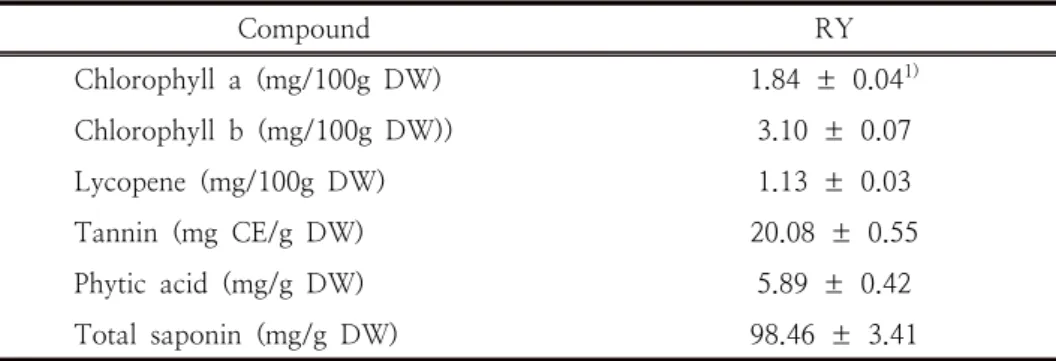
Adelusi and Lawanson [21] reported that the carotenes and xanthophylls of yam had been extracted and quantified already. Table 1 showed lycopene and chlorophyll a, b contents in RY were 1.13±0.03, 1.84±0.04 and 3.10±0.07 mg/100 g DW, respectively. The amount of chlorophyll b in RY was significantly higher than contents of chlorophyll a and lycopene. The chlorophyll a content was found to be the lowest in RY.
3.1.2. Tannin content
Tannins are one of the polyphenolic physiological activity substances with various molecular weights and a variable complexity, which are rich in fruits, legume seeds, cereal grains and different beverages such as red wine, tea, cocoa and cider [22,23]. And tannins also have beneficial on cancer and cardiovascular diseases [22]. The tannin content of RY were 20.08±0.55 mg CE/g DW (Table 1).
3.1.3. Phytic acid content
Recently, phytic acid has been accepted for various possible benefits to human health, which acts as an antioxidant, an anti- inflammatory selective inhibitor, an energy store, and a regulator of vesicular via binding to various proteins. Phytic acid can be precipitated with an acid iron-Ш-solution of known iron content and decrease in iron in the supernatant is a measure of phytic acid content [15]. Phytic acid in RY was determined to be 5.89±0.42 mg/g DW, which was significantly lower than the reported value in coarse bran (53.85 mg/g) [22].
Compound RY
Chlorophyll a (mg/100g DW) 1.84 ± 0.041)
Chlorophyll b (mg/100g DW)) 3.10 ± 0.07
Lycopene (mg/100g DW) 1.13 ± 0.03
Tannin (mg CE/g DW) 20.08 ± 0.55
Phytic acid (mg/g DW) 5.89 ± 0.42
Total saponin (mg/g DW) 98.46 ± 3.41
1)The values are means±SD (n=3). Values with the different letters in the same column are significantly different (p<0.05) by Duncan’s multiple range tests.
Table 1. Bioactive compound composition in raw yam (Dioscorea batatas DECNE.)
3.1.4. Total saponin content
Saponins are glycosidic compounds composed of a steroid or triterpenoid sapogenin nucleus with one or more carbohydrate branches. Saponins possess a bitter taste and have effects on affecting the immune system, helping protect the human body against cancer, lowering cholesterol levels, decreasing blood lipids and reducing the blood glucose response [24]. From the results shown in Table 1, the total saponin content of RY was 98.46±3.41 mg/g.
3.2. Antioxidant activity
3.2.1. Ferrous ion chelating activity
The ferrous state of iron is known as the most important lipid oxidation pro-oxidant, which can accelerate lipid oxidation by breaking down hydrogen and lipid peroxides to reactive free radicals via the Fenton reaction (Fe2+ + H2O2 → Fe3+ + OH− + OH•). As ferrozine can quantitatively form complexes with Fe2+, the metal chelating activity of sample was measured by a decrease in the red color of the ferrous-ferrozine complex [25].
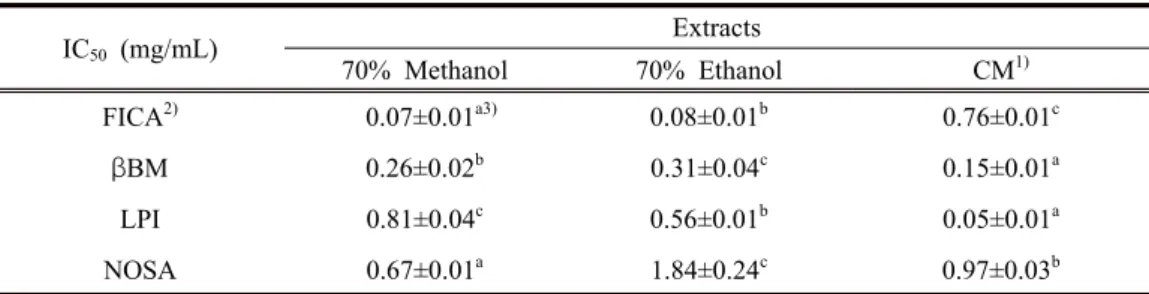
Fig. 1 showed the chelating activity of various extracts (70% methanol, 70% ethanol and CM extracts) on ferrous ion was marked and concentration related (0.4 mg/mL, 0.7 mg/mL and 1.0mg/mL). From the IC50 values given in
Fig. 1. Ferrous ion chelating activity of various extracts from raw yam (Dioscorea batatas DECNE.)
1)The values are means±SD (n=3). Bars with the different letters are significantly different (p<0.05) by Duncan’s multiple range tests.
2)CM: chloroform–methanol mixture (2:1, v/v) extract.
3)EDTA: ethylenediaminetetraacetic acid disodium salt dihydrate.
Table 2, 70% methanol extract chelated more iron than other extracts, although both extracts were less efficient than commercial chelator EDTA. Ferrous ion chelating abilities of various fractions from RY decreased in the following order: 70% methanol extract (IC50=0.07±0.01 mg/mL), 70% ethanol extract ((IC50=0.08±0.01 mg/mL) and CM extract
IC50 (mg/mL) Extracts
70% Methanol 70% Ethanol CM1)
FICA2) 0.07±0.01a3) 0.08±0.01b 0.76±0.01c
βBM 0.26±0.02b 0.31±0.04c 0.15±0.01a
LPI 0.81±0.04c 0.56±0.01b 0.05±0.01a
NOSA 0.67±0.01a 1.84±0.24c 0.97±0.03b
1)CM: chloroform–methanol mixture (CM, 2:1, v/v) extract.
2)Ferrous ion chelating activity (FICA), β-carotene bleaching assay (βBA), lipid peroxidation inhibition (LPI) and nitric oxide radical scavenging activity (NOSA).
3)The values are means±SD (n=3). Values with the different letters in the same column are significantly different (p<0.05) by Duncan’s multiple range tests.
Table 2. IC50 values of various extracts from raw yam (Dioscorea batatas DECNE.) in different antioxidant activity assays
(IC50=0.76±0.02 mg/mL), respectively. Metal chelating capacity was significant because they reduced the concentration of the catalysing transition metal in lipid peroxidation [26]. It was reported that chelating agents, which form σ-bonds with a metal, are effective as secondary antioxidants science they reduce the redox potential thereby stabilising the oxidised form of the metal ion [27]. The data obtained from Fig. 2 revealed that the all extracts of RY and TTY demonstrated an effective capacity for iron binding, suggesting that its action as peroxidation protector may be related to its iron binding capacity.
3.2.2. β-carotene bleaching assay
The antioxidant activities of RY and TTY extracts at 0.4 mg/mL to 1.0 mg/mL concentrations were compared with BHA measured by the bleaching of β-carotene were presented in Fig. 2. The highly unsaturated β-carotene molecules in this system can be attacked by free radicals generating from the oxidation of linoleic acid, and as a consequence, the characteristic orange color disappears. The presence of antioxidant can avoid the destruction of the β-carotene
Fig. 2. Antioxidant activity of various extracts from raw yam (Dioscorea batatas DECNE.) by using β-carotene bleaching method.
1)The values are means±SD (n=3). Bars with the different letters are significantly different (p<0.05) by Duncan’s multiple range tests.
2)CM: chloroform–methanol mixture (2:1, v/v) extract.
3) BHA: butylated hydroxyanisole.
by neutralizing the free radicals formed in the system to keep the orange color [18]. As depicted in Fig. 2, the results exhibited concentration-dependent antioxidant activity by β-carotene bleaching method in all the tested
concentrations of various extracts. The antioxidant activity of various extracts was found to decrease in the following order: CM extract (IC50 = 0.15±0.01 mg/mL), 70%
methanol extract (IC50 = 0.26±0.02 mg/mL) and 70% ethanol extract (IC50 = 0.31±0.04 mg/mL). Although BHA always showed the most effective antioxidant activity, CM extract displayed stronger antioxidant activity compared with other extracts. It was probable that the antioxidative components in extracts can reduce the extent of β-carotene destruction by neutralizing the linoleate free radical and other free radicals in this system.
And our results were in accordance with Farombi, Britton and Emerole [28], who also found the yam showed antioxidant activity by using β-carotene bleaching method.
3.2.3. Lipid peroxidation inhibition
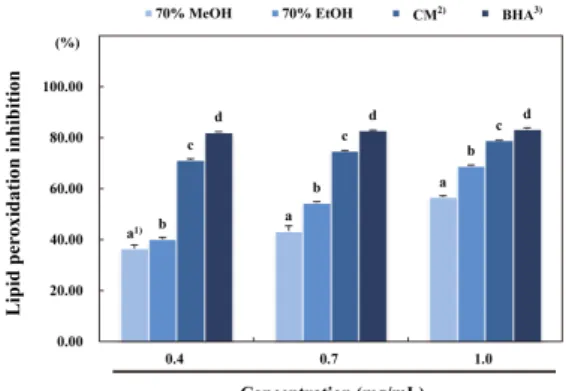
Linoleic acid is a polyunsaturated fatty acid, which is vulnerable to attack by reactive oxygen species. As a result, lipid peroxides such as malondialdehyde (MDA) and 4-hydroxynonenal (HNE) are generated. In this model system, these peroxides can oxidize Fe2+ to Fe3+, then forms complexes with thiocyanate ion which have maximum of absorption at 500 nm [29]. Fig. 3 described the inhibition of linoleic acid peroxidation by various extracts from RY. All extracts effectively inhibited the linoleic peroxidation in a concentration- dependent manner. BHA significantly inhibited lipid peroxidation in linoleic acid emulsion system and the activity was higher than that of RY extracts. IC50
value of CM extract was found to be 0.05±0.01 mg/mL, which was the most effective in inhibition of linoleic acid peroxidation. However, 70% Methanol extract (IC50=0.81±0.04 mg/mL) showed the lowest antioxidant activity. Moreover, these results implied those antioxidants from RY were probable to be effective as chain breaking molecules.
Fig. 3. Antioxidant activity of various extracts from raw yam (Dioscorea batatas DECNE.) determined as inhibition of linoleic acid oxidation.
1)The values are means±SD (n=3). Bars with the different letters are significantly different (p<0.05) by Duncan’s multiple range tests.
2)CM: chloroform–methanol mixture (2:1, v/v) extract.
3) BHA: butylated hydroxyanisole.
3.2.4. NO radical scavenging activity
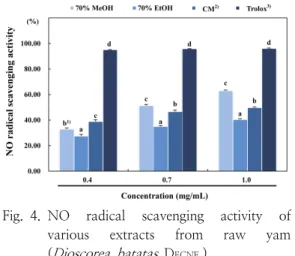
Nitrite oxide (NO) is very reactive which implicated in inflammation, cancer and other pathological conditions. NO interacts with oxygen to produce nitric ions that can be estimated by using Griess reagent. Scavengers of nitric oxide compete with oxygen leading to reduced production of nitric oxide [20]. NO radical scavenging activities of various fractions obtained from RY and TTY by using different extraction solvents were presented in Fig. 4 and Table 2. With the increase of concentration, the NO radical scavenging activity increased. 70% Methanol extract exhibited the maximum activity of 63.20±0.31% at 1.0 mg/mL, where trolox at the same concentration showed 96.25±0.19%
inhibition. Antioxidant activities of various extracts against NO radical decreased in the following order: 70% methanol extract (IC50=0.67±0.01 mg/mL), CM extract (IC50=0.97±0.03 mg/mL) and 70% ethanol extract (IC50=1.84±0.24 mg/mL), respectively.
Yam extracts might possess the property to
counteract the effect of NO formation and in turn might be of considerable interest in preventing the ill effects of excessive NO generation in the human body. And the scavenging activity was likely to contribute to retard the chain of reactions initiated by excess generation of NO that were detrimental to the human health [30].
Fig. 4. NO radical scavenging activity of various extracts from raw yam (Dioscorea batatas DECNE.).
1)The values are means±SD (n=3). Bars with the different letters are significantly different (p<0.05) by Duncan’s multiple range tests.
2)CM: chloroform–methanol mixture (2:1, v/v) extract.
3)Trolox: (±)-6-hydroxy-2,5,7,8- tetramethylchromane-2carboxylic acid.
4. Conclusions
Yam (Dioscorea batatas DECNE.) available in Korea was analyzed for lycopene, chlorophyll a, b, tannin, phytic acid and total saponin contents. 70% Methanol, 70% ethanol and chloroform–methanol mixture (CM, 2:1, v/v) were used to extract yam. Then the antioxidant activity evaluated through ferrous ion chelating activity, β-carotene bleaching method, lipid peroxidation inhibition and nitric oxide (NO) radical scavenging activity. 70%
Methanol extract showed the highest ferrous ion chelating activity and NO radical
scavenging activity. And CM extract was the most effective in inhibition of linoleic acid peroxidation evaluated by β-carotene bleaching assay and lipid peroxidation inhibition assay. Based on the results obtained, yam is a potential active ingredient that could be applied in antioxidation as well as bio-health functional food to take a good part in prevention of human diseases and aging.
References
1. M. Valko, D. Leibfritz, J. Moncol, M. T.
D. Cronin, M, Mazur, J. Telser, Free radicals and antioxidants in normal physiological functions and human disease, Int. J. Biochem. Cell Biol., 39, 44 (2007).
2. M. Oktay, İ. Gülçin, Ӧ. İ. Küfrevioğlu, Determination of in vitro antioxidant activity of fennel (Foeniculum vulgare) seed extracts, LWT-Food Sci. Technol., 36, 263 (2003).
3. A. C. Carr, M. R. McCall, B. Frei, Oxidation of LDL by myeloperoxidase and reactive nitrogen species, Arteriosclerosis Thrombo. Vascu. Biol., 20, 1716 (2000).
4. T. Finkel, N. J. Holbrook, Oxidants, oxidative stress and the biology of aging, Nature, 408, 239 (2000).
5. L. Migliore, F. Coppedè, Genetic and environmental factors in cancer and neurodegenerative diseases, Mutation Res., 512, 135 (2002).
6. J. T. Lin, D. J. Yang, Determination of steroidal saponins in different organs of yam (Dioscorea pseudojaponica Yamamoto), Food Chem., 108, 1068 (2008).
7. C. S. Hariprakash, B. Nambisan, Carbohydrate metabolism during dormancy and sprouting in yam (Dioscorea) tubers:
changes in carbohydrate constituents in yam (Dioscorea) tubers during dormancy and sprouting, J. Agric. Food Chem., 44, 3066 (1996).
8. P. S. Oh, K. T. Lim, Plant glycoprotein modulates the expression of interleukin-1 β via inhibition of MAP kinase in HMC-1 cells, Biosci. Biotechnol. Biochem., 72, 2133 (2008).
9. P. S. Oh, K. T. Lim, Antioxidant activity of Dioscorea batatas Decne glycoprotein, European Food Res. Technol., 226, 507 (2008).
10. S. Y. Kim, H. J. Jwa, Y. Yanagawa, T. S.
Park, Extract from Dioscorea batatas ameliorates insulin resistance in mice fed a high-fat diet, J. Med. Food, 15, 527 (2012).
11. W. G. Taylor, J. L. Elder, P. R. Chang, K. W. Richards, Micro- determination of diosgenin from fenugreek (Trigonella foenum- graecum) seeds, J. Agric. Food Chem., 48, 5206 (2000).
12. M. Araghiniknam, S. Chung, T.
Nelson-White, C. Eskelson, R. R. Waston, Antioxidant activity of dioscorea and dehydroepiandrosterone (DHEA) in older humans, Life Sci., 59, 147 (1996).
13. M. Nagata, I. Yamashita, Simple method for simultaneous determination of chlorophyll and carotenoids in tomato fruit, Japanese Soc. Food Sci. Technol., 39, 925 (1992).
14. M. L. Price, L. G. Butler, Rapid visual estimation and spectrophotometric determination of tannin content of sorghum grain, J. Agric. Food Chem., 25, 1268 (1977).
15. P. Wu, T. Zhao, J. C. Tian, Phytic acid contents of wheat flours from different mill streams, Agric. Sci. China, 9, 1684 (2010).
16. B. Xu, S. K. C. Chang, Phytochemical profiles and health-promoting effects of cool-season food legumes as influenced by thermal processing, J. Agric. Food Chem., 57, 10718 (2009).
17. C. L. Hsu, W. Chen, Y. M. Weng, C. Y.
Tseng, Chemical composition, physical properties, and antioxidant activities of
yam flours as affected by different drying methods, Food Chem., 83, 85 (2003).
18. A. A. Elzaawely, T. D. Xuan, S. Tawata, Antioxidation and anti- bacterial activities of Rumex japonicus HOUUT. aerial parts, Biolo. Pharmac., 28, 2225 (2005).
19. J. Y. Je, Z. J. Qian, H. G. Byun, S. K.
Kim, Purification and characterization of an antioxidant peptide obtained from tuna backbone protein by enzymatic hydrolysis, Proc. Biochem., 42, 840 (2007).
20. S. Sahoo, G. Ghosh, D. Das, S. Nayak, Phytochemical investigation and in vitro antioxidant activity of an indigenous medicinal plant Alpinia nigra B.L. Burtt, Asian Pacific J. Trop. Biomed., 3, 871 (2013).
21. A. A. Adelusi, A. O. Lawanson, Disease- induced changes in carotenoid content of edible yams (Dioscorea spp.) infected by Botryodiplodia theobrornae and Aspergillus niger, Mycopathologia, 98, 49 (1987).
22. C. S. Buelga, A. Scalbert, Proanthocyanidins and tannin-like compounds-nature, occurrence, dietary intake and effects on nutrition and health, J. Sci. Food Agric., 80, 1094 (2000).
23. H. P. S. Makkar, Effects and fate of tannins in ruminant animals, adaptation to tannins, and strategies to overcome detrimental effects of feeding tannin-rich feeds, Small Ruminant Res., 49, 241 (2003).
24. L. R. Lai, S. C. Hsieh, H. Y. Huang, C.
C. Chou, Effect of lactic fermentation on the total phenolic, saponin and phytic acid contents as well as anti-colon cancer cell proliferation activity of soymilk, J. Biosci.
Bioeng., 115, 552 (2013).
25. İ. Gülçin, Antioxidant activity of caffeic acid (3,4-dihydroxycinnamic acid), Toxicol., 217, 213 (2006).
26. P. D. Duh, Y. Y. Tu, G. C. Yen, Antioxidant activity of water extract of Harng Jyur (Chrysanthemum morifolium Ramat), LWT- Food Sci. Technol., 32,
269 (1999).
27. M. H. Gordon, The mechanism of antioxidant action in vitro. In B. J. F.
Hudson (ed.), Food antioxidants, London, New York, p. 1 (1990).
28. E. O. Farombi, G. Britton, G. O. Emerole, Evaluation of the antioxidant activity and partial characterisation of extracts from browned yam flour diet, Food Res. Int., 33, 493 (2000).
29. B. Sultana, F. Anwar, R. Przybylski, Antioxidant potential of corncob extracts for stabilization of corn oil subjected to microwave heating, Food Chem., 104, 997 (2007).
30. A. Kumaran, R. J. Karunakaran, In vitro antioxidant activities of methanol extracts of five Phyllanthus species from India, LWT-Food Sci. Technol., 40, 344 (2007).