Printed in the Republic of Korea
http://dx.doi.org/10.5012/jkcs.2012.56.3.334
Synthesis and Biological Studies of Novel Biphenyl-3,5-dihydro-2 H- thiazolopyrimidines Derivatives
S. Maddila, G. L. V. Damu†, E. O. Oseghe, O. A. Abafe, C. Venakata Rao†, and P. Lavanya†,* School of Chemistry, University of KwaZulu-Natal, Durban 4000, South Africa
†Department of Chemistry, Sri Venkateswara University, Tirupati - 517502, India.
*E-mail: [email protected] (Received March 13, 2012; Accepted May 4, 2012)
ABSTRACT. A new series of ethyl 2-(4-substitutedbenzylidene)-5-(3'-(ethoxycarbonyl)biphenyl-4-yl)-7-methyl-3-oxo-3,5- dihydro-2H-thiazolo[3,2-a]pyrimidine-6-carboxylate derivatives (8a-j) were synthesized. The newly synthesized compounds were characterized by IR, 1H NMR, 13C NMR, LCMS mass and C, H, N analyses. All newly synthesized compounds were screened for their In vitro antioxidant activity (Scavenging of hydrogen peroxide, Scavenging of nitric oxide radical, and Lipid peroxidation inhibitory activity), antibacterial (Escheria coli, Pseudonmonas aeruginosa (gram-negative bacteria), Bacillus sub- tillis, Staphylococcus aureus (gram-positive bacteria)) and antifungal (Candida albicans Aspergillus niger) studies.
Key words: Biphenyl-3,5-dihydro-2H-thiazolopyrimidines derivatives, Antioxidant activity, Antibacterial, Antifungal activities
INTRODUCTION
Heterocycles are ubiquitous to among pharmaceutical compounds.1-3 Pyrimidine moiety is an important class of N-containing heterocycles widely used as key building blocks for pharmaceutical agents. It exhibits a wide spec- trum of pharmacophore activities, as it can act as bacte- ricidal, fungicidal4,5 analgesic,6 antihypertensive7 and anti-tumor agents.8 Among the substituted pyrimidines, thiouracils are well known for anti-inflammatory and viru- cidal agents.9 Also, preclinical data from literature survey indicate continuing research in polysubstituted pyrimi- dine as potential anti-tumor agents.10-12 The biological and synthetic significance places this scaffold at a prestigious position in medicinal chemistry research.
The 3,4-dihydropyrimidin-2(1H)-ones have recently emerged as important target molecules due to their the- rapeutic and pharmacological properties13 such as antivi- ral,14 antimitotic,15 anticarcinogenic,16 antihypertensive17,18 and noteworthy, as calcium channel modulators.19,20 Addi- tionally, their particular structure has been found in nat- ural marine alkaloid batzelladine A and B which are the first low molecular weight natural products reported in the literature to inhibit the binding of HIV gp-120 to CD4 cells, so disclosing a new field towards the development of AIDS therapy.21 Thiazoles and their derivatives are also found to be associated with various biological activities such as antibacterial, antifungal and anti-inflammatory.22-25 In recent past we have reported thiosubstituted pyrimi-
dines which exhibited good biological activity.5 Prompted by the chemotherapeutic importance of pyrimidine deri- vatives and in a view to synthesize bioactive molecules,26 it was contemplated to synthesize a series of novel fused pyrimidine derivatives possessing 4-biphenyl moiety and study their biological properties.
In continued quest of new anti oxidant activity and anti- microbial agents, we designed and synthesized novel biphenyl-3,5-dihydro-2H-thiazolopyrimidines derivatives.
Structures of the products were characterized by IR, 1H- NMR, 13C NMR, LC-MS mass spectrometry and elemen- tal analysis. Results of biological activities indicate that some compounds possess potential antioxidant and anti- microbial activity.
RESULTS AND DISCUSSION Chemistry
The synthesis of ethyl 2-(4-substitutedbenzylidene)-5- (3'-(ethoxycarbonyl)biphenyl-4-yl)-7-methyl-3-oxo-3,5- dihydro-2H-thiazolo[3,2-a]pyrimidine-6-carboxylate deri- vatives (8a-j) was achieved through the versatile and effi- cient synthetic route outlined in Scheme 1. The desired compounds were synthesized as follows. Initially, when 3-bromobenzoic acid (1) was treated with 4-formylphe- nylboronic (2) acid in the presence of cesium carbonate and bis(triphenylphosphine)palladium(II) chloride, it afforded the corresponding 4'-Formyl-biphenyl-3-carboxylic acid (3). The compound (3) was reacted with ethyl acetoace-
tate (4), thiourea (5) in ethanol and a few drops of HCl to obtained 4-(3'-ethoxycarbonyl-biphenyl-4-yl)-6-methyl- 2-thioxo-1,2,3,4-tetrahydro-pyrimidine-5-carboxylic acid ethyl ester (6).27 Finally, ethyl 2-(4-substitutedbenzylidene)-5- (3'-(ethoxycarbonyl)biphenyl-4-yl)-7-methyl-3-oxo-3,5- dihydro-2H-thiazolo[3,2-a]pyrimidine-6-carboxylate deri- vatives (8a-j) were synthesized by the reaction of (6), sub- stituted benzaldehydes (7) and chloro acetic acid in the presence of sodium acetate.
All the synthesized compounds were obtained in good to high yields. Products were purified and characterized by various spectroscopic techniques. The IR spectra of compounds (6a-j) showed characteristic absorption bands at 2981-2969 cm-1, 1721-1706 cm-1, 1632-1606, and 1568- 1525 cm-1 corresponding to the C-Hstr, C=Ostr, C=Nstr, and C=Cstr functions in the structures. Similarly the 1H NMR spectra showed peaks due to in the range of δ 1.10-1.48 for OCH2-(CH3)2, δ 2.30-2.39 for Ar-CH3, δ 4.05-4.45 for -OCH2CH3, δ 6.18-6.24 for -CH and δ 6.60-8.75 for
=CH & Ar-H. The mass spectrum of all the compounds showed molecular ion peak at M+H, at M+2H corre- sponding to its molecular formula, which confirmed its chemical structure. The IR, 1H NMR, 13C NMR, LCMS mass spectra and elemental analysis showed the struc- ture of various novel ethyl 2-(4-substitutedbenzylidene)- 5-(3'-(ethoxycarbonyl)biphenyl-4-yl)-7-methyl-3-oxo- 3,5-dihydro-2H-thiazolo[3,2-a]pyrimidine-6-carboxy- late derivatives (8a-j).
PHARMACOLOGICAL ASSAY Antioxidant Activity
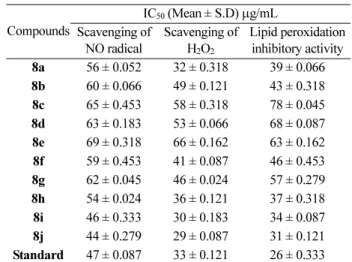
All the synthesized compounds 8a-j were screened for their in vitro antioxidant activity by various methods such as scavenging of hydrogen peroxide, scavenging of nitric oxide radical, and lipid peroxidation inhibitory activity. In vitro antioxidant activity of synthesized compound is summarized in Table 1.
The investigation of antioxidant screening revealed that some of the tested compounds showed moderate to good antioxidant activity. The novel biphenyl-3,5-dihydro-2H- thiazolopyrimidines derivatives (8a-j) showed more promising antioxidant activity as compared to that of stan- dard, ascorbic acid. This could be due the availability of free thiazolopyrimidine group. In scavenging of nitric oxide radical techniques, compounds 8j and 8i showed low IC50 value than the standard. While, 8j, 8i and 8a have shown more potent activity in scavenging of hydrogen peroxide. This may be due to additional aliphatic group present on benzene ring in the structure. All the compounds showed higher IC50 value than the standard by lipid per- oxidation inhibitory activity. Derivatives with aliphatic group on benzene ring having good antioxidant activity compared with the other compounds in their series. 8h, 8a, 8f, 8b, 8g and 8d exhibited moderate to good anti- oxidant activity.
Antimicrobial Activity
The antimicrobial activities of the compounds (8a-j) were tested against Escheria coli, Pseudonmonas aerugi- nosa (gram-negative bacteria), Bacillus subtillis and Sta-
Reagents and conditions: (i) Pd(PPh3)2Cl2, Cs2CO3, Dioxane, reflux, 10h; (ii) HCl, reflux, 16h; (iii) ClCH2COOH, AcONa, Ac2O/AcOH, reflux, 2h.
Scheme 1. Synthetic pathway for compound 8 a-j.
Table 1. Antioxidant activity (IC50 values) of compounds (8a-j)
Compounds
IC50 (Mean ± S.D) µg/mL Scavenging of
NO radical
Scavenging of H2O2
Lipid peroxidation inhibitory activity 8a 56 ± 0.052 32 ± 0.318 39 ± 0.066 8b 60 ± 0.066 49 ± 0.121 43 ± 0.318 8c 65 ± 0.453 58 ± 0.318 78 ± 0.045 8d 63 ± 0.183 53 ± 0.066 68 ± 0.087 8e 69 ± 0.318 66 ± 0.162 63 ± 0.162 8f 59 ± 0.453 41 ± 0.087 46 ± 0.453 8g 62 ± 0.045 46 ± 0.024 57 ± 0.279 8h 54 ± 0.024 36 ± 0.121 37 ± 0.318 8i 46 ± 0.333 30 ± 0.183 34 ± 0.087 8j 44 ± 0.279 29 ± 0.087 31 ± 0.121 Standard 47 ± 0.087 33 ± 0.121 26 ± 0.333 S.D.=standard deviation (Average of three determination); Stan-
dard=Ascorbic acid.
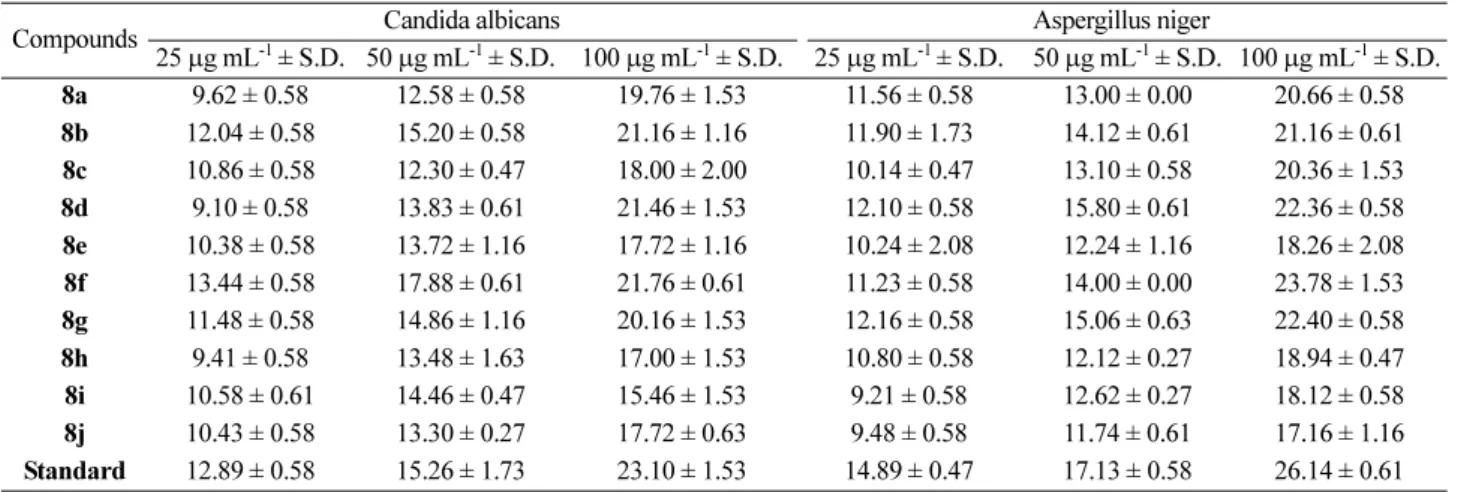
phylococcus aureus (gram-positive bacteria) and two fungi Candida albicans and Aspergillus niger and the results were reported as zone of inhibition. The results of preliminary antifungal testing of the compounds 8a-j are shown in Table 2. All the compounds exhibited moderate to good antifungal activity. Compound 8f exhibited potent activity against C. albicans and compounds 8f and 8g
exhibited good activity than the standard. The compounds 8f, 8g, 8d, 8a, and 8b exhibited moderate to good activity against A. niger.
The results of preliminary antibacterial testing of com- pounds (8a-j) are shown in Table 3. The results revealed that, all the novel biphenyl-3,5-dihydro-2H-thiazolopyri- midines derivatives (8a-j) were showing good to potent Table 2. Antifungal activities of compoundsa (8a-j)
Compounds Candida albicans Aspergillus niger
25 µg mL-1 ± S.D. 50 µg mL-1 ± S.D. 100 µg mL-1 ± S.D. 25 µg mL-1 ± S.D. 50 µg mL-1 ± S.D. 100 µg mL-1 ± S.D.
8a 9.62 ± 0.58 12.58 ± 0.58 19.76 ± 1.53 11.56 ± 0.58 13.00 ± 0.00 20.66 ± 0.58 8b 12.04 ± 0.58 15.20 ± 0.58 21.16 ± 1.16 11.90 ± 1.73 14.12 ± 0.61 21.16 ± 0.61 8c 10.86 ± 0.58 12.30 ± 0.47 18.00 ± 2.00 10.14 ± 0.47 13.10 ± 0.58 20.36 ± 1.53 8d 9.10 ± 0.58 13.83 ± 0.61 21.46 ± 1.53 12.10 ± 0.58 15.80 ± 0.61 22.36 ± 0.58 8e 10.38 ± 0.58 13.72 ± 1.16 17.72 ± 1.16 10.24 ± 2.08 12.24 ± 1.16 18.26 ± 2.08 8f 13.44 ± 0.58 17.88 ± 0.61 21.76 ± 0.61 11.23 ± 0.58 14.00 ± 0.00 23.78 ± 1.53 8g 11.48 ± 0.58 14.86 ± 1.16 20.16 ± 1.53 12.16 ± 0.58 15.06 ± 0.63 22.40 ± 0.58 8h 9.41 ± 0.58 13.48 ± 1.63 17.00 ± 1.53 10.80 ± 0.58 12.12 ± 0.27 18.94 ± 0.47 8i 10.58 ± 0.61 14.46 ± 0.47 15.46 ± 1.53 9.21 ± 0.58 12.62 ± 0.27 18.12 ± 0.58 8j 10.43 ± 0.58 13.30 ± 0.27 17.72 ± 0.63 9.48 ± 0.58 11.74 ± 0.61 17.16 ± 1.16 Standard 12.89 ± 0.58 15.26 ± 1.73 23.10 ± 1.53 14.89 ± 0.47 17.13 ± 0.58 26.14 ± 0.61 S.D.=standard deviation; Standard=Amphotericin-B; aZone of inhibition.
Table 3. Antibacterial activity of the compoundsa (8a-j)
Compounds Escheria coli Pseudomonas aeruginosa
25 µg mL-1 ± S.D. 50 µg mL-1 ± S.D. 100 µg mL-1 ± S.D. 25 µg mL-1 ± S.D. 50 µg mL-1 ± S.D. 100 µg mL-1 ± S.D.
8a 10.48 ± 0.47 14.72 ± 0.58 17.39 ± 1.16 8.21 ± 2.09 10.23 ± 0.58 16.12 ± 1.73 8b 15.10 ± 2.09 22.28 ± 1.16 27.49 ± 0.47 12.67 ± 0.26 16.06 ± 0.45 26.25 ± 0.61 8c 12.96 ± 0.17 14.18 ± 0.45 18.04 ± 1.16 9.19 ± 1.16 12.12 ± 2.09 19.85 ± 0.26 8d 12.54 ± 1.71 13.12 ± 0.58 16.11 ± 1.16 9.67 ± 1.53 12.72 ± 0.58 18.82 ± 1.73 8e 11.10 ± 0.58 10.18 ± 0.47 14.03 ± 0.17 8.29 ± 1.16 11.92 ± 0.26 16.73 ± 0.58 8f 14.72 ± 0.45 19.48 ± 1.71 25.02 ± 1.16 11.79 ± 0.61 17.02 ± 2.09 25.67 ± 0.26 8g 13.16 ± 0.61 20.48 ± 0.58 26.90 ± 1.16 12.15 ± 1.16 16.31 ± 0.58 23.88 ± 1.73 8h 10.26 ± 0.26 12.36 ± 0.47 16.18 ± 0.61 9.90 ± 1.16 12.26 ± 0.58 17.42 ± 0.58 8i 13.48 ± 0.58 17.27 ± 0.58 24.42 ± 1.16 10.16 ± 0.17 15.00 ± 2.09 21.12 ± 0.58 8j 13.12 ± 0.47 16.00 ± 0.58 22.90 ± 1.16 10.28 ± 1.16 12.82 ± 0.58 20.33 ± 1.73 Standard 15.78 ± 0.17 21.10 ± 1.16 28.71 ± 0.58 13.36 ± 1.53 18.70 ± 0.45 30.33 ± 0.61
Compounds Bacillus subtilis Staphylococcus aureus
25 µg mL-1 ± S.D. 50 µg mL-1 ± S.D. 100 µg mL-1 ± S.D. 25 µg mL-1 ± S.D. 50 µg mL-1 ± S.D. 100 µg mL-1 ± S.D.
8a 10.19 ± 1.16 14.04 ± 0.58 18.14 ± 1.16 10.12 ± 0.37 15.05 ± 0.26 18.65 ± 1.53 8b 14.78 ± 1.53 19.26 ± 0.58 28.00 ± 1.16 15.76 ± 2.09 20.84 ± 0.45 26.67 ± 1.16 8c 12.92 ± 1.16 14.11 ± 1.16 18.30 ± 1.53 10.92 ± 0.45 14.10 ± 1.16 17.71 ± 1.53 8d 12.88 ± 1.16 15.05 ± 0.58 18.67 ± 0.61 11.82 ± 0.17 12.18 ± 1.71 16.49 ± 0.61 8e 11.21 ± 1.53 14.82 ± 0.47 20.90 ± 0.47 10.12 ± 0.58 13.48 ± 0.58 16.52 ± 0.58 8f 14.18 ± 2.09 16.71 ± 1.16 25.39 ± 1.53 13.07 ± 0.63 17.06 ± 1.16 22.00 ± 0.47 8g 13.42 ± 1.16 17.16 ± 0.58 26.18 ± 2.00 14.60 ± 2.09 18.26 ± 0.61 24.32 ± 0.58 8h 11.62 ± 1.53 15.10 ± 0.45 19.25 ± 1.61 10.33 ± 0.58 14.10 ± 0.58 18.67 ± 0.17 8i 13.92 ± 1.16 14.23 ± 1.16 23.06 ± 1.53 12.33 ± 0.61 17.38 ± 1.16 22.82 ± 0.47 8j 14.42 ± 1.16 15.10 ± 2.09 21.80 ± 0.61 12.67 ± 0.71 16.12 ± 0.45 20.30 ± 0.17 Standard 15.14 ± 0.78 20.23 ± 0.47 31.82 ± 1.53 15.39 ± 0.58 22.41 ± 2.09 29.48 ± 0.17 S.D.=standard deviation; Standard=Streptomycin; aZone of inhibition
antibacterial activity against all the tested strains of bac- teria. While the entire derivatives showed moderate to potent activity against Bacillus subtilis. Amongst all the derivatives in series i.e. (8a-j), the halogenated and amino derivatives exhibited potent antibacterial activity. As compare to standard streptomycin, compounds 8b, 8f and 8g exhibited good to potent activity against all the tested strains. While compounds 8i, 8j, 8c, 8d, 8e and 8h were moderately active. The other compounds were weakly active against the tested organism.
EXPERIMENTAL
All reagents and solvents were purchased and used without further purification. Melting points were deter- mined on a Fisher-Johns melting point apparatus were uncorrected. Crude products were purified by column chromatography on silica gel of 60-120 mesh. IR spectra were obtained on a Perkin Elmer BX serried FT-IR 5000 spectrometer using KBr pellet. NMR spectra were recorded on a varian 300 MHz spectrometer for 1H NMR. The 13C NMR spectra were recorded on JEOL. The chemical shifts were reported as ppm down field using TMS as an internal stan- dard. LCMS Mass spectra were recorded on a MASPEC low resolution mass spectrometer operating at 70 eV.
General procedure for the preparation of 4'-Formyl- biphenyl-3-carboxylic acid (3)
To a stirred solution of 3-bromobenzoic acid (1 mmol) in dioxane : water (20 mL, 4:1) was added cesium car- bonate (1.5 mmol) followed by addition of 4-formylphe- nylboronic acid (1.1 mmol) and the resulting solution was stirred and degassed under nitrogen for 30 min. Bis(triphe- nylphosphine) palladium(II) chloride (1.5 mmol) was added and the reaction mixture was stirred at reflux tem- perature for 8 h. After completion (monitored by TLC), solvent was removed under reduced pressure and diluted with water. The aqueous phase was acidified by dilute HCl and then extracted with ethyl acetate (100 mL). The combined organic layers were dried (Na2SO4) and con- centrated under reduced pressure. The crude compound was purified by column chromatography to afford the 4'- Formyl-biphenyl-3-carboxylic acid (3) as pale yellow solid, 65% yield. 1H NMR (300 MHz, DMSO-d6) 7.48-8.50 (m, Ar-H, 8H), 10.20 (s, 1H), 13.10 (s, 1H, COOH); Mass (m/
z): 227 (M+H, 100%).
General procedure for the preparation of 4-(3'-Ethoxy- carbonyl-biphenyl-4-yl)-6-methyl-2-thioxo-1,2,3,4-tet- rahydro-pyrimidine-5-carboxylic acid ethyl ester (6)
To a stirred solution of ethyl acetoacetate (4) (1 mmol),
biaryl aldehyde (1.1 mmol) and thiourea (2 mmol) in etha- nol were added in the given order. It was followed by addi- tion of catalytic amount of HCl. The resulting solution was stirred at reflux for 12 h. After completion, solvent was removed under reduced pressure and the residue obtained was extracted with ethyl acetate. The combined organic layers were dried (Na2SO4) and concentrated under reduced pressure. The crude compound was purified by column chromatography to afford the 4-(3'-Ethoxycarbonyl- biphenyl-4-yl)-6-methyl-2-thioxo-1,2,3,4-tetrahydro-pyri- midine-5-carboxylic acid ethyl ester (6) as solid.
Yellow solid, 50% yield; M.p. 141-142oC; 1H NMR (300 MHz, DMSO-d6) δ 1.15 (t, 6H), 2.35 (s, 3H), 4.10 (q, 4H), 5.20 (s, 1H), 7.10-8.60 (m, Ar-H, 8H), 8.95 (s, 2H);
Mass (m/z): 425 (M+H, 100%); Anal. Calcd. for C23H24N2O4S:
C, 65.07; H, 5.70; N, 6.60. Found: C, 64.84; H, 5.67; N, 6.66.
General procedure for the preparation of ethyl 2-(4- substitutedbenzylidene)-5-(3'-(ethoxycarbonyl)biphe- nyl-4-yl)-7-methyl-3-oxo-3,5-dihydro-2H-thiazolo[3,2- a]pyrimidine-6-carboxylate (8a-j)
An ice cold solution of cyclic compound of 4-(3'-Ethox- ycarbonyl-biphenyl-4-yl)-6-methyl-2-thioxo-1,2,3,4-tet- rahydro-pyrimidine-5-carboxylic acid ethyl ester (6) (1 mmol) in DMF (4 vol), potassium carbonate (1.5 mmol) and substituted benzyl halides (1.3 mmol) was taken in a 1 liter round bottomed flask equipped with magnetic stirrer and stirred for 1 hour. The residual portion was poured on to crushed ice, neutralized with dilute acid and the product obtained ethyl 2-(substitutedbenzylthio)-4-(3'-(ethoxy- carbonyl)biphenyl-4-yl)-6-methyl-1,4-dihydropyrimidine- 5-carboxylate derivatives (8a-j) was collected by filtration.
Ethyl 2-benzylidene-5-(3'-(ethoxycarbonyl)biphenyl-4- yl)-7-methyl-3-oxo-3,5-dihydro-2H-thiazolo[3,2-a]pyrimi- dine-6-carboxylate (8a)
Yield: 78%; mp 258-259oC; IR (KBr) υ 2976 (C-H), 1710 (C=O), 1606 (C=N), 1541 (C=C), cm-1; 1H NMR (300 MHz, DMSO-d6) δ 1.19 (t, 6H, OCH2CH3), 2.35 (s, 3H, ArCH3), 4.05 (q, 4H, OCH2CH3), 6.18 (s, 1H, -CH), 7.20-8.55 (m, 14H, =CH & Ar-H); 13C NMR (DMSO-d6, δ, ppm) 13.6, 13.9, 19.8, 54.8, 62.5, 63.2, 114.5, 121.3, 124.7, 125.2, 126.1, 126.5, 127.0, 127.6, 127.9, 128.2, 129.3, 130.9, 133.6, 137.4, 139.2, 141.1, 141.9, 154.8, 162.3, 166.6, 167.4, 171.2; LCMS: (m/z) 553 [M+H].
Anal. Calcd. for C32H28N2O5S: C, 69.55; H, 5.11; N, 5.08.
Found: C, 69.59; H, 5.17; N, 5.01.
Ethyl 2-(4-bromobenzylidene)-5-(3'-(ethoxycarbonyl) biphenyl-4-yl)-7-methyl-3-oxo-3,5-dihydro-2H-thiazolo [3,2-a]pyrimidine-6-carboxylate (8b)
Yield: 88%; mp 203-205oC; IR (KBr) υ 2974 (C-H),
1708 (C=O), 1613 (C=N), 1528 (C=C), 754 (C-Br) cm-1;
1H NMR (300 MHz, DMSO-d6) δ 1.20 (t, 6H, OCH2CH3), 2.39 (s, 3H, ArCH3), 4.10 (q, 4H, OCH2CH3), 6.23 (s, 1H, -CH), 7.10-8.60 (m, 13H, =CH & Ar-H); LCMS: (m/z) 632 [M+2H]. Anal. Calcd. for C32H27BrN2O5S: C, 80.85;
H, 4.32; N, 4.44. Found: C, 80.76; H, 4.37; N, 4.39.
Ethyl 2-(4-ethylbenzylidene)-5-(3'-(ethoxycarbonyl) biphenyl-4-yl)-7-methyl-3-oxo-3,5-dihydro-2H-thia- zolo[3,2-a]pyrimidine-6-carboxylate (8c)
Yield: 56%; mp 198-200oC; IR (KBr) υ 2969 (C-H), 1711 (C=O), 1609 (C=N), 1546 (C=C) cm-1; 1H NMR (300 MHz, DMSO-d6) δ 1.15 (t, 9H, OCH2CH3 & -ArCH2CH3 ), 2.34 (s, 3H, ArCH3), 2.40 (q, 2H, -ArCH2CH3), 4.10 (q, 4H, OCH2CH3), 6.20 (s, 1H, -CH), 6.75-8.55 (m, 13H,
=CH & Ar-H); LCMS: (m/z) 581 [M+H]. Anal. Calcd. for C34H32N2O5S: C, 70.32; H, 5.55; N, 4.82. Found: C, 70.36;
H, 5.48; N, 4.85.
Ethyl 2-(4-methylbenzylidene)-5-(3'-(ethoxycarbonyl) biphenyl-4-yl)-7-methyl-3-oxo-3,5-dihydro-2H-thia- zolo[3,2-a]pyrimidine-6-carboxylate (8d)
Yield: 87%; mp 235oC; IR (KBr) υ 2976 (C-H), 1710 (C=O), 1617 (C=N), 1544 (C=C) cm-1; 1H NMR (300 MHz, DMSO-d6) δ 1.15 (t, 6H, OCH2CH3), 2.30 (s, 6H, ArCH3), 4.10 (q, 4H, OCH2CH3), 6.18 (s, 1H, -CH), 6.90-8.55 (m, 13H, =CH & Ar-H); 13C NMR (DMSO-d6, δ, ppm) 13.7, 13.9, 19.9, 24.3, 55.1, 61.8, 63.2, 113.2, 121.3, 124.8, 125.6, 126.2, 126.4, 127.1, 127.7, 128.3, 129.1, 130.6, 131.3, 136.8, 137.2, 139.5, 141.6, 141.8, 154.9, 162.3, 166.5, 167.4, 171.2; LCMS: (m/z) 567 [M+H]. Anal. Calcd. for C33H30N2O5S: C, 69.94; H, 5.34; N, 4.94. Found: C, 70.01;
H, 5.39; N, 4.87.
Ethyl 2-(4-methoxybenzylidene)-5-(3'-(ethoxycarbo- nyl)biphenyl-4-yl)-7-methyl-3-oxo-3,5-dihydro-2H- thiazolo[3,2-a]pyrimidine-6-carboxylate (8e)
Yield: 82%; mp 265-266oC; IR (KBr) υ 2980 (C-H), 1706 (C=O), 1606 (C=N), 1568 (C=C) cm-1; 1H NMR (300 MHz, DMSO-d6) δ 1.10 (t, 6H, OCH2CH3), 2.38 (s, 3H, ArCH3), 3.78 (s, 3H, OCH3), 4.15 (q, 4H, OCH2CH3), 6.28 (s, 1H, -CH), 6.60-8.75 (m, 13H, =CH & Ar-H); 13C NMR (DMSO-d6, δ, ppm) 13.8, 14.2, 21.2, 54.8, 55.3, 62.7, 63.5, 115.2, 123.1, 124.4, 125.8, 126.0, 126.3, 127.8, 128.6, 129.6, 130.0, 131.1, 131.8, 137.9, 141.0, 141.9, 142.6, 154.6, 160.2, 162.6, 166.5, 167.6, 171.3; LCMS:
(m/z) 583 [M+H]. Anal. Calcd. for C33H30N2O6S: C, 68.02;
H, 5.19; N, 4.82. Found: C, 67.95; H, 5.24; N, 4.79.
Ethyl 2-(4-(dimethylamino)benzylidene)-5-(3'-(etho- xycarbonyl)biphenyl-4-yl)-7-methyl-3-oxo-3,5-dihydro- 2H-thiazolo[3,2-a]pyrimidine-6-carboxylate (8f)
Yield: 92%; mp 210-212oC; IR (KBr) υ 2973 (C-H),
1718 (C=O), 1610 (C=N), 1538 (C=C) cm-1; 1H NMR (300 MHz, DMSO-d6) δ 1.10 (t, 6H, OCH2CH3), 2.39 (s, 3H, ArCH3), 2.84 (s, 6H, -N(CH3)2), 4.10 (q, 4H, OCH2CH3), 6.24 (s, 1H, -CH), 6.65-8.65 (m, 13H, =CH & Ar-H); LCMS:
(m/z) 596 [M+H]. Anal. Calcd. for C34H33N3O5S: C, 68.55; H, 5.58; N, 7.05. Found: C, 68.61; H, 5.60; N, 6.98.
Ethyl 2-(4-chlorobenzylidene)-5-(3'-(ethoxycarbonyl) biphenyl-4-yl)-7-methyl-3-oxo-3,5-dihydro-2H-thia- zolo[3,2-a]pyrimidine-6-carboxylate (8g)
Yield: 77%; mp 244-246oC; IR (KBr) υ 2981 (C-H), 1721 (C=O), 1628 (C=N), 1552 (C=C), 823 (C-Cl) cm-1;
1H NMR (300 MHz, DMSO-d6) δ 1.15 (t, 6H, OCH2CH3), 2.38 (s, 3H, ArCH3), 4.15 (q, 4H, OCH2CH3), 6.24 (s, 1H, -CH), 7.10-8.60 (m, 13H, =CH & Ar-H); LCMS: (m/z) 587 [M+H]. Anal. Calcd. for C32H27ClN2O5S: C, 65.48; H, 4.65;
N, 4.78. Found: C, 65.55; H, 4.59; N, 4.82.
Ethyl 2-(4-isopropylbenzylidene)-5-(3'-(ethoxycarbo- nyl)biphenyl-4-yl)-7-methyl-3-oxo-3,5-dihydro-2H- thiazolo[3,2-a]pyrimidine-6-carboxylate (8h)
Yield: 88%; mp 187-189oC; IR (KBr) υ 2972 (C-H), 1714 (C=O), 1618 (C=N), 1528 (C=C), cm-1; 1H NMR (300 MHz, DMSO-d6) δ 0.95-1.35 (m, 12H, OCH2CH3), 2.33 (s, 3H, ArCH3), 2.60 (m, 1H, -ArCH(CH3)2), 4.10 (q, 4H, OCH2CH3), 6.20 (s, 1H, -CH), 7.15-8.65 (m, 13H, =CH & Ar-H);
LCMS: (m/z) 595 [M+H]. Anal. Calcd. for C35H34N2O5S:
C, 70.68; H, 5.76; N, 4.73. Found: C, 70.73; H, 5.68; N, 4.69.
Ethyl 2-(4-tert-butylbenzylidene)-5-(3'-(ethoxycarbo- nyl)biphenyl-4-yl)-7-methyl-3-oxo-3,5-dihydro-2H- thiazolo[3,2-a]pyrimidine-6-carboxylate (8i)
Yield: 74%; mp 211-212oC; IR (KBr) υ 2974 (C-H), 1713 (C=O), 1616 (C=N), 1538 (C=C) cm-1; 1H NMR (300 MHz, DMSO-d6) δ 1.10-1.48 (m, 15H, OCH2CH3 &
-ArC(CH3)3), 2.35 (s, 3H, ArCH3), 4.10 (q, 4H, OCH2CH3), 6.22 (s, 1H, -CH), 7.10-8.55 (m, 13H, =CH & Ar-H); LCMS:
(m/z) 609 [M+H]. Anal. Calcd. for C36H36N2O5S: C, 71.04; H, 5.97; N, 4.60. Found: C, 70.97; H, 6.02; N, 4.57.
Ethyl 2-(4-nitrobenzylidene)-5-(3'-(ethoxycarbonyl) biphenyl-4-yl)-7-methyl-3-oxo-3,5-dihydro-2H-thiazolo [3,2-a]pyrimidine-6-carboxylate (8j)
Yield: 69%; mp 219-220oC; IR (KBr) υ 2980 (C-H), 1720 (C=O), 1632 (C=N), 1555 (C=C) cm-1; 1H NMR (300 MHz, DMSO-d6) δ 1.18 (t, 6H, OCH2CH3), 2.39 (s, 3H, ArCH3), 4.10 (q, 4H, OCH2CH3), 6.28 (s, 1H, -CH), 7.10-8.65 (m, 13H, CH & Ar-H); 13C NMR (DMSO-d6, δ, ppm) 13.6, 14.1, 21.3, 54.8, 63.1, 63.9, 115.2, 121.4, 123.8, 124.8, 125.4, 126.1, 127.4, 128.3, 128.9, 130.9, 131.7, 138.2, 140.8, 141.2, 141.9, 142.0, 148.5, 154.7, 162.4, 166.6, 167.7, 171.4;
LCMS: (m/z) 598 [M+H]. Anal. Calcd. for C32H27N3O7S: C, 64.31; H, 4.55; N, 7.02. Found: C, 64.42; H, 4.61; N, 6.95.
PHARMACOLOGICAL SCREENING Antioxidant Screening (in vitro)
Hydrogen Peroxide Scavenging Activity:
A solution of hydrogen peroxide (20 mM) was pre- pared in phosphate buffer saline (pH 7.4). Various con- centrations (12.5, 25, 50, 100 µg/mL) of 1 mL of the test samples or standard, ascorbic acid28 in methanol were added to 2 mL of hydrogen peroxide solution in phos- phate buffer saline. The absorbance was measured at 230 nm after 10 min.29
Nitric Oxide Scavenging Activity:
The reaction mixture (6 mL) containing sodium nitro- prusside (10 µM, 4 mL), phosphate buffer saline (pH 7.4, 1 mL) and test samples or standard, ascorbic acid solution in dimethyl sulphoxide (1 mL) at various concentrations (12.5, 25, 50, 100 µg/mL) was incubated at 25oC for 150 min. After incubation, 0.5 mL of reaction mixture con- taining nitrite ion was removed, 1 mL of sulphanillic acid reagent was added to this, mixed well and allowed to stand for 5 min for completion of diazotization. Then, 1 mL of naphthyl ethylene diamine dihydrochloride was added, mixed and allowed to stand for 30 min in diffused light. A pink colored chromophore was formed. The absorbance was measured at 640 nm.30
Lipid Peroxidation Inhibitory Activity:
Egg lecithin (3 µg/mL phosphate buffer, pH 7.4) was sonicated in an ultrasonic sonicator for 10 min to ensure proper liposome formation. Test samples or standard, ascorbic acid (100 mL) of different concentrations (12.5, 25, 50, 100 µg/mL) were added to liposome mixture (1 mL); the control was without test sample. Lipid peroxi- dation was induced by adding ferric chloride (10 mL, 400 mM) and L-ascorbic acid (10 mL, 200 µM). After incu- bation for 1 h at 37oC the reaction was stopped by adding hydrochloric acid (2 mL, 0.25 N) containing trichloro- acetic acid (150 µg/mL), thiobarbituric acid (3.75 mg/mL) and butylated hydroxy anisole (0.50 µg/mL). The reac- tion mixture was subsequently boiled for 15 min, cooled, centrifuged at 1000 rpm for 15 min and the absorbance of the supernatant was measured at 532 nm.31
For all the above antioxidant methods, experiments were done in triplicate and average is taken, the % inhibition at different concentration was calculated by the following formula
% Inhibition=[1-(Vt/Vc)]×100
Where, Vt mean absorption of test compound, Vc mean absorption of control.
The IC50 value was derived from the % inhibition at di- fferent concentration.
Antimicrobial Activity:
Applying the agar plate diffusion technique all of the newly synthesized compounds were screened in vitro for antibacterial activity against E. coli, P. aeruginosa (Gram- negative), S. aureus, B. subtilis (Gram-positive) at 25, 50 and 100 µg/mL concentrations, respectively. Streptomy- cin (binds to the 16SrRNA of the bacterial ribosome, interfering with the binding of formylmethionyl-tRNA to the 30S subunit therefore prevents initiation of protein synthesis and leads to death of microbial cell) was chosen as a standard drug.32 Streptomycin is an antibiotic that inhibits both gram-positive and gram-negative bacteria, and is therefore a useful broad spectrum antibiotic. Simi- larly, the antifungal screening of the compounds was carried out in vitro by paper disc method against two fungi A.
niger and C. albicans by using Amphotericin-B (binds to plasma membrane sterols like ergosterol. The fungi cells have large amount of ergosterol in plasma membrane. The ergosterol facilitates the attachment of amphotericin B, which act as ionophores and cause leakage of cations like K+) as a standard.33,34
CONCLUSION
In conclusion, we have described simple and efficient protocol for the synthesis of novel biphenyl-3,5-dihy- dro-2H-thiazolopyrimidines derivatives (8a-j) with good yields. All the synthesized compounds have been investigated for their anti-oxidant, antibacterial and anti- fungal activities. With our newly synthesized com- pounds, it is evident that 8j and 8i have highest anti- oxidant activity; 8b, 8f and 8g have antibacterial activity;
and 8f has antifungal activity. Accordingly, these novel class of biphenyl-3,5-dihydro-2H-thiazolopyrimidines derivatives reported from our laboratory emerge as a valuable lead series with great potential to be used as anti-oxidant activity, antibacterial and antifungal agents, and as promising candidates for further efficacy evalu- ation.
Acknowledgements. The authors are thankful to the authorities of the School of Chemistry, University of KwaZulu-Natal, Westville campus, Durban, South Africa and Department of Chemistry, Sri Venkateswara Uni- versity, Tirupati, India for the facilities and financial support.
REFERENCES
1. Eicher, T.; Hauptmann, S. The Chemistry of Heterocycles, 2nd ed.; Wiley-VCH: Weinheim, 2003.
2. Suresh, M.; Jonnalagadda, S. B.; Rao, C. V. Oriental. J.
Chem. 2011, 27, 127.
3. Suresh, M.; Lavanya, P.; Rao, C. V. Arabian. J. Chem.
2011. DOI: 10.1016/j.arabjc.2011.02.004.
4. El-Gazzar, A. R. B. A.; Hafez, H. N. Acta Chim. Slov.
2008, 55, 359.
5. Suresh, M.; Jonnalagadda, S. B. Arch. Pharm. Chem. Life Sci. 2011. (In Press)
6. Regnier, G.; Canevar, L.; Le, R. J.; Douarec, J. C.; Hal- stop, S.; Daussy, J. J. Med. Chem. 1972, 15, 295.
7. Winter, C. A.; Fisley, E. A. R.; Nuss, G. W. Proc. Soc.
Exp. Biol. Med. 1962, 111, 544.
8. Suguira, K.; Schmid, A. F.; Schmid, M. M.; Brown, F. G.
Cancer Chemother. Rep. Part. 1973, 23(1), 231.
9. Mojtahedi, M. M.; Saidi, M. R.; Shirzi, J. S.; Bolourtch- ian, M. Syn. Commun. 2002, 32, 851.
10. Maquoi, E.; Sounni, N. E.; Devy, L.; Olivier, F.; Fran- kenne, F.; Krell, H-W.; Grams, F.; Foidart, J-M.; Noel, A.
Clin. Cancer Res. 2004, 10, 4038.
11. Huang, M.; Wang, Y.; Collins, M.; Mitchell, B. S.; Graves, L. M. Mol. Pharmacol. 2002, 62, 463.
12. Von Bubnoff, N.; Darren, R.; Veach, W.; Miller, T.; Li, W.; Sanger, J.; Peschel, C.; Bornmann, W. G.; Clarkson, B.; Duyster, J. Cancer Res. 2003, 63, 6395.
13. Kappe, C. O. Eur. J. Med. Chem. 2000, 35, 1043.
14. Hurst, E. W.; Hull, R. J. Med. Pharm. Chem. 1961, 3, 215.
15. Mayer, T. U.; Kapoor, T. M.; Haggarty, S. J.; King, R. W.;
Schreiber, S. I.; Mitchison, T. J. Science. 1999, 286, 971.
16. Kato, T. Jpn. Kokai Tokkyo Koho 1984, 974, 59190.
17. Atwal, K. S.; Swanson, B. N.; Unger, S. E.; Floyd, D. M.;
Moreland, S.; Hedberg, A.; OReilly, B. C. J. Med. Chem.
1991, 34, 806.
18. Rovnyak, G. C.; Atwal, K. S.; Hedberg, A.; Kimball, S.
D.; Moreland, S.; Gougoutas, J. Z.; OReilly, B. C.; Schwartz, J.; Malley, M. F. J. Med. Chem. 1992, 35, 3254.
19. Kappe, C. O. Molecules 1998, 3, 1.
20. Jauk, B.; Pernat, T.; Kappe, C. O. Molecules 2000, 5, 227.
21. Patil, A. D.; et al. J. Org. Chem. 1995, 60, 1182.
22. Hans, N. Swiss Patent 592103, 1977; Chem. Abstr. 1978, 88, 22886.
23. Wilson, K. N.; Utig, C. R.; Subhasinghe, N.; Hoffmann, J. B.; Rudolph, N. J.; Soll, R.; Molloy, C. J.; Bone, R.;
Green, D. Bioorg. Med. Chem. Lett. 2001, 11, 915.
24. Berlin, K. D.; Herd, M. D. Proc. Okla. Acad. Sci. 1991, 71, 29.
25. Holla, B. S.; Malini, K. V.; Rao, B. S.; Sarojini, B. K.;
Kumari, N. S. Eur. J. Med. Chem. 2003, 38, 313.
26. Holla, B. S.; Mahalinga, M.; Ashok, M.; Karegoudar, P.
Phosphorus, Sulfur Silicon Relat. Elem. 2006, 181, 1427.
27. Rahul, R. N.; Shinde, D. B. J. Heterocyclic Chem. 2010, 47, 33.
28. Ismaili, L.; Nadaradjane, A.; Nicod, L.; Guyon, C.; Xicluna, A.; Robert, J.; Refouvelet, B. Eur. J. Med. Chem. 2008, 43, 1270.
29. Jayaprakasha, G. K.; Jaganmohan, R. L.; Sakariah, K. K.
Bioorg. Med. Chem. 2004, 12, 5141.
30. Marcocci, L.; Packer, L.; Droy-lefaix, M. T.; Sekaki, A.;
Gondes-albert, M. Methods Enzymol. 1994, 234, 462.
31. Duh, P. D.; Yen, G. H. Food. Chem. 1997, 60, 639.
32. Bakavoli, M.; Bagherzadeh, G.; Vaseghifar, M.; Shiri, A.;
Pordel, M.; Mashreghi, M.; Pordeli, P.; Araghi, M. Eur. J.
Med. Chem. 2010, 45, 647.
33. Rang, H. P.; Dale, M. M.; Ritter, J. M.; Moore, P. K.
Pharmacology, 3rd ed.; Churchill Livingstone: New York, 2003.
34. Yakaiah, T.; Lingaiah, B. V. P.; Narsaiah, B.; Pranay Kumar, K.; Murthy, U. S. N. Eur. J. Med. Chem. 2008, 43, 341.