• 검색 결과가 없습니다.

Effects of Thermal Treatment on Antioxidant Activity in Yam (Dioscorea batatas DECNE.)

N/A
N/A
Protected

Academic year: 2021

Share "Effects of Thermal Treatment on Antioxidant Activity in Yam (Dioscorea batatas DECNE.)"

Copied!
9
0
0

로드 중.... (전체 텍스트 보기)

전체 글

(1)

ISSN 2288-1069 (Online)

http://dx.doi.org/10.12925/jkocs.2015.32.1.127

Effects of Thermal Treatment on Antioxidant Activity in Yam ( Dioscorea batatas DECNE . )

Han-Soo Kim

a

⋅ Yishan Duan

a

⋅ Jae-Young Ryu

b

Sang-Woo Kim

c

⋅ Seong-Ho Jang

d

a

Department of Food Science and Technology, Pusan National University, Miryang 627-706, Korea

b

Department of Urban Enviromental Engineering, Kyungnam University, Changwon 631-701, Korea

4)

East Sea

c

Fisheries Research Institute, NFRDI, Gangneung, 210-861, Korea

d

Department of Bioenviromental Energy, Pusan National University, Miryang 627-706, Korea (Received February 5, 2015; Revised February 13, 2015; Accepted March 25, 2015)

Abstract : The aim of this study was to investigate the antioxidant activity of thermal treatment yam ( Dioscorea batatas DECNE

.

) in Korea. Thermal treatment yam was extracted by different solvents including 70% methanol, 70% ethanol and chloroform–methanol mixture (CM, 2:1, v/v).

Then color property, total phenol content and antioxidant activity were analyzed. Yam possessed high L* value and H

°

value, which were 54.92±2.18 and 73.20±0.77, respectively. Thermal treatment yam exhibited great antioxidant activity evaluated by ABTS [2,2′

-azino-bis(3-ethylbenzothiazoline-6-sulfonic acid) diammonium salt] radical scavenging activity, DPPH (2,2-diphenyl-1-picrylhydrazyl) radical scavenging activity, reducing power, and ferric reducing antioxidant power. Total phenol contents of various extracts from thermal treatment yam increased in the following order: 70% methanol extract (63.53±0.33 mg CAE/g), 70% ethanol extract (69.47±1.00 mg CAE/g) and CM extract (97.49±0.66 mg CAE/g), respectively. The same trend was also could be found in antioxidant activity assays except for reducing power assay.

These results implied that these extracts from thermal treatment yam might be useful to take a good part in prevention of human diseases and aging.

Keywords : yam (Dioscorea batatas DECNE.), thermal treatment, color values, total phenol, antioxidant activities

1. Introduction

Yam ( Dioscorea batatas DECNE.) is the perennial trailing herb and belongs to the Dioscoreaceae family [14]. Yam is mainly composed of starch (75.6–84.3%) with small



Corresponding author (E-mail: [email protected])

amounts of crude protein, crude fat, crude fiber and crude ash, whose contents are in the range of 6.7–7.9%, 1.0–1.2%, 1.2–1.8%, 2.8–

3.8%, respectively. Furthermore, yam tubers

also contain vitamin C (13.0–24.7 mg/100 g

dry weight), minerals (K, Na, P, Ca, Mg, Cu,

Fe, Mn, Zn) [21], organic acids (succinic acid,

citric acid, malic acid, oxalic acid) [3],

steroidal saponins [14], musin (glycoprotein)

(2)

(2.11 g/100 g dry weight) [22] and dioscorins [8]. Due to its component characteristics, yam is usually served as the crucial staple food as well as traditional medicine ingredient to treat asthma, abscesses, chronic diarrhea and ulcers in many parts of world [10, 11].

Polyphenols as the products of the secondary metabolism of plants are widely distributed in fruits, vegetables, cereals, legumes and nuts.

Traditionally, because of the adverse effect of tannins, polyphenols have been considered to be anti-nutrients. However, recent interest in food phenolics has increased greatly, owing to the influences in sensory and nutritional qualities of plant foods and their biological activities. Such as their antioxidant capacity (free radical scavenging and metal chelating activities) and possible beneficial applications in human health (treatment and prevention of cancer, cardiovascular disease, and other pathologies) have been approved. The antioxidant activity of phenolic compound is mainly due to its chemical structure characteristic with one or more sugar residues linked to hydroxyl groups, although direct linkages of the sugar unit to an aromatic carbon atom also exist. And the hydroxyl groups display their reducing properties by acting as hydrogen donators and singlet oxygen quenchers [6, 12]. As reported previously, wild yam tubers of Nepal contain polyphenols and show antioxidant activity evaluated by reducing power, ferrous chelating capacity and DPPH radical scavenging activity [3].

In the present study, the total phenol contents and antioxidant activities of thermal treatment yam extracts by 70% methanol, 70%

ethanol and chloroform–methanol mixture (CM, 2:1, v/v) were determined and compared in vitro .

2. Materials and Methods

2.1. Materials and chemicals

Yam ( Dioscorea batatas DECNE

.

) was purchased from Andong (Korea), which was seeded in March or April and harvested in the end of October or December. The fresh yam was processed in a procedure of washing, slicing (thickness, 0.4–0.6 cm), steaming (80–9 0℃, 24 h), drying (hot air, 60–70℃, 18–24 h) and smashing (150-mesh) into thermal treatment yam meals (TTY, commonly called black yam).

2.2. Preparation of yam extracts

Yam meals and extraction solvents including 70% methanol, 70% ethanol and chloroform–

methanol mixture (CM, 2:1, v/v) were mixed in a ratio of 1:10 and kept in the dark about 3 h, and then used the Advantec No. 1 filter paper (Tokyo, Japan) to filter. The process of extraction was repeated 3 times. The filtrate was evaporated by rotary vacuum evaporator (EYELA, N-N series, Tokyo, Japan) until the solvents were completely removed. The yam extracts were collected and sealed in brown reagent bottles and frozen at –80℃ until required for further analyses.

2.3. Measurement of total phenol contents (TPC)

In brief, samples (0.5 mL) were mixed with 2.4 mL of distilled water, 2 mL of 2% sodium carbonate (w/v) and 0.1 mL Folin–Ciocalteau’s phenol reagent in the test tubes. Then the mixture was incubated in the temperature for 60 min. The absorbance of the reaction mixture was measured at 700 nm using uv/vis-spectrophotometer (Specord 200, Analytikjena, Jena, Germany). Caffeic acid was used as a standard for the calibration curve.

Total phenol contents were expressed as mg of caffeic acid equivalents per g of extracts (mg CAE/ g) [19].

2.4. ABTS radical scavenging assay

ABTS radical scavenging activity was

evaluated according to the method of Sun,

(3)

Hayakawa, Ogawa, and Izumori [18]. The mixture of 30 mL of 7 mM ABTS and 528 µ L of 140 mM potassium persulfate was stored at room temperature in the dark for 16 h to get the green–blue free radical ABTS˙

+

. Then the solution was diluted with ethanol until the absorbance was 0.7 ± 0.02 at 734 nm. Samples (0.1 mL) were mixed with 2.9 mL of ABTS working solution. After 6 min of reaction, the absorbance was taken at 734 nm.

BHA was used as positive control. The percentage of ABTS radical scavenging effect was calculated as follow:

ABTS radical scavenging effect (%) = [1 – ( A

s

/ A

c

)] 100 where A

s

is the absorbance in the presence of sample or BHA, and A

c

is the absorbance of control reaction.

2.5. DPPH radical scavenging assay DPPH radical scavenging activity was measured according to the method of Blois and Duan [1, 7]. Samples (1 mL) of yam extraction were mixed with 0.2 mM DPPH (1.5 mL) and then vigorously shaken. The mixture solution was stood in the dark for 30 min at 37℃ water bath. BHA was used as positive control. Then the absorbance of the reaction mixture was read with spectrophotometer at 517 nm. The percentage inhibition of DPPH radical scavenging activity was calculated based on the control reading using the following calculation:

DPPH radical scavenging activity (%) = [1 – ( A

s

/ A

c

)] 100 where A

s

is the absorbance in the presence of sample or BHA, and A

c

is the absorbance of control reaction.

2.6. Reducing power assay

The reducing power of yam was determined according to the method of Barros et al. [4].

1.5 mL of phosphate buffer (0.2 M, pH 6.6), 1.5 mL of sample and 1.5 mL of potassium ferricyanide (1%, w/v) were mixed in test tubes, incubated at 50℃ water bath for 20

min. An aliquot of 1.5 mL trichloroacetic acid (10%, w/v) was added to the mixture, which was centrifuged at 3,000 rpm for 10 min. And then the supernatant (1 mL) was mixed with 3 mL of distilled water and 0.3 mL of ferric chloride (0.1%, w/v). BHA was used for the positive control. The absorbance was measured at 700 nm after 10 min of reaction at room temperature.

2.7. Ferric reducing antioxidant power (FRAP) assay

The working FRAP reagent was prepared by mixing 10 mL of 0.3 M sodium acetate buffer (pH 3.6), 1 mL of 10 mM TPTZ in 40 mM hydrochloride acid and 1 mL of 20 mM ferric chloride. The freshly prepared FRAP reagent (1.5 mL) was incubated at 37℃ water bath for 10 min, at the same time, A

reagent blank

was read. Then sample (150 µL) was added to the FRAP reagent. The reaction mixture was incubated at 37℃ water bath for 4 min; the absorbance was read at 593 nm ( A

sample

). The mixture of sodium acetate buffer (1.5 mL) and sample (150 µL) was used as sample blank.

BHT was used as the positive control. And the difference between A

sample

, A

sample blank

and A

reagent blank

was used to calculate the FRAP values. Aqueous solution of FeSO

4

·7H

2

O were used for calibration curve and final results were expressed as µM Fe

[2].

2.8. Color assessment

Color determination was performed by using

colorimeter (CR-400, Minolta Co., Osaka,

Japan) and described the color values in CIE

L

*

a

*

b

*

color system. The instrument was

standardized each time with a white ( L

*

=

97.79, a

*

= –0.38, b

*

= 2.05) tile. The L

*

value is the lightness (dark–light) and

correspond to black ( L

*

= 0) and white (( L

*

=

100). A positive a

*

value represent redness and

negative one is greenness. A positive b

*

value

corresponds to yellowness and negative one is

blueness. C

*

for the metric chroma and H

o

for

the hue angle were calculated by the

(4)

transformation of a

*

and b

*

the following equations:

C

*

= ( a

*2

+ b

*2

)

1/2

H

o

= tan

-1

( b

*

/ a

*

) ( a

*

> 0, b

*

> 0) H

o

= 180

0

+ tan

-1

( b

*

/ a

*

) ( a

*

< 0, b

*

> 0) 2.9. Statistical analysis

The experimental data in triplicate were subjected to analysis of variance (ANOVA) and expressed as mean±standard deviation ( n =3). Analyses of variance were performed by using the one-way analysis of variance procedures. Duncan’s multiple-range test was used to analysis the significant difference of means, and p <0.05 was considered to be statistically significant for all statistic procedures. IBM SPSS statistic 21 program was used for data analysis.

3. Results and discussion

3.1. Yields

The various extraction yields of thermal treatment yam (TTY) by 70% methanol, 70%

ethanol and chloroform–methanol (CM, 2:1, v/v) were shown in Table 1. The extraction yield of TTY by 70% methanol exhibited the maximum value (15.89%), CM was found to be the lowest (0.93%). Additionally, the extraction yield of TTY by 70% ethanol was found to be 11.89%.

3.2. Total phenol contents (TPC)

Natural polyphenols include catechin, epicatechin, epigallocatechin, epicatechin gallate, epigallocatechin gallate, rutin, caffeic acid, gallic acid and so on [17]. As the phenolic structure of hydroxyl substituent on the aromatic ring, phenolics can behave as antioxidants [16]. Total phenol contents were determined by according to the colorimetric Folin–Ciocalteau method with caffeic acid as a stand compound (y=2.4819x+0.0133, R

2

=0.9997). The total phenol contents of various extracts (70% methanol, 70% ethanol

and CM extracts) were showed in Table 1.

Total phenol contents of various extracts from TTY decreased in the order: CM extract (97.49±0.66 mg CAE/g), 70% ethanol extract (69.47±1.00 mg CAE/g) and 70% methanol extract (63.53±0.33 mg CAE/g), respectively.

According to the report of Velioglu, Mazza, Gao, and Oomah [20], there was a positively and highly significant relationship between total phenolics and antioxidant activity. That is to say CM extract might possess higher antioxidant activity than that of 70% methanol and 70% ethanol extracts. These results implied that solvent concentration and solvent type would influence the extraction of phenolics presented in thermal treatment yam [15].

3.3. ABTS radical scavenging activity The radical–cation ABTS˙

+

is produced by the oxidation of ABTS. In the absence of antioxidants, ABTS is rather stable, but it reacts actively with an H-atom donor (i.e.

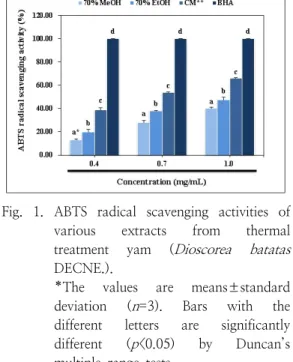
phenolics). Therefore, the blue/green chromophore would discolor gradually or be converted into a non-colored form of ABTS up to the antioxidant capacity of antioxidants [17]. Fig. 1 showed the inhibitory effect of various extracts (70% methanol, 70% ethanol and CM extracts) on ABTS radical. The ABTS radical scavenging activity was marked and concentration-related (0.4 mg/mL, 0.7 mg/mL and 1.0 mg/mL). The ABTS radical scavenging activity of different fractions from TTY increased in the following order: 70%

methanol extract (IC

50

=1.28±0.01 mg/mL),

70% ethanol extract (IC

50

=1.05±0.06 mg/mL)

and CM extract (IC

50

=0.60±0.02 mg/mL),

respectively. The CM extract exhibited

significantly higher scavenging activity against

ABTS radical compared with 70% methanol

and 70% ethanol extracts. In our anticipation,

a positive correlation between scavenging

activities of various extracts against ABTS

radical and their amounts of total phenol

contents was found. This result was in

(5)

70% methanol 70% ethanol CM**

Extraction yields (%) 15.89 11.89 0.93

Total phenol content (mg GAE/g) 63.53±0.33

a*

69.47±1.00

b

97.49±0.66

c

ABTS (IC

50

, mg/mL) 1.28±0.01

c

1.05±0.06

b

0.60±0.02

a

DPPH (IC

50

, mg/mL) 0.56±0.00

c

0.52±0.01

b

0.43±0.00

a

*The values are means±standard deviation ( n =3). Values with the different letters in the same row are significantly different ( p <0.05) by Duncan’s multiple range tests.

**CM: chloroform–methanol mixture (2:1, v/v).

Table 1. Extraction yields, total phenol contents and IC50 values in the antioxidant activity evaluation assays of thermal treatment yam ( Dioscorea batatas DECNE.)

accordance with the finding of Velioglu, Mazza, Gao, and Oomah [20].

Fig. 1. ABTS radical scavenging activities of various extracts from thermal treatment yam ( Dioscorea batatas DECNE.).

*The values are means±standard deviation ( n =3). Bars with the different letters are significantly different ( p <0.05) by Duncan’s multiple range tests.

**CM: chloroform–methanol mixture (2:1, v/v).

3.4. DPPH radical scavenging activity DPPH is a stable free radical and can be scavenged by antioxidants through donating hydrogen. The discoloration from purple to yellow induces the absorbance of reaction

mixture decreases at 517 nm [13]. Various fractions obtained from TTY by using different extraction solvents indicated different DPPH scavenging capacity (Fig. 2 and Table 1). The DPPH radical scavenging abilities of various extracts increased with increasing concentrations. All extracts exhibited excellent

Fig. 2. DPPH radical scavenging activities of various extracts from thermal treatment yam ( Dioscorea batatas DECNE.).

*The values are means±standard deviation ( n =3). Bars with the different letters are significantly different ( p <0.05) by Duncan’s multiple range tests.

**CM: chloroform–methanol mixture

(2:1, v/v).

(6)

DPPH radical scavenging ability even if their effects were lower than that of BHA. Results showed that CM extract (IC

50

=0.71±0.00 mg/mL) and 70% methanol extract (IC

50

=1.34±0.02 mg/mL) possessed the highest and lowest activity upon the elimination of DPPH radical, respectively. From the results exhibited in Table 1 and Fig. 2, DPPH radical scavenging activities correlated well with total phenol contents. This founding was in keeping with the results of Hsu et al. [9]. The strong scavenging capacities of the extracts on DPPH radical were most likely on account of the hydrogen donating ability of the phenolic compounds presented in the extracts.

3.5. Reducing power

In the presence of reductants (i.e.

antioxidants), the Fe

3+

/ferricyanide complex was reduced to its ferrous form. As a consequence, the color of the test solution changed from yellow to different shades of green and blue, up to the antioxidant ability.

Hence, the reducing power can be indicated by the number of the Fe

2+

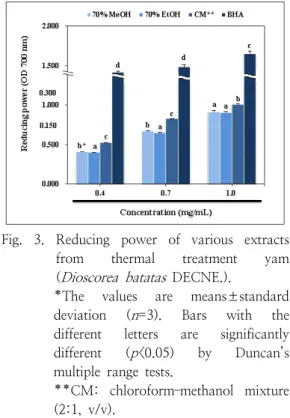
complex, which was monitored through measuring the formation of Perl’s Prussian blue at 700 nm [4]. The reducing power of various extracts at varying concentrations was measured and the results were depicted in Fig. 3. The reducing power of various extratcs and reference compound BHA steadily increased with the increasing concentrations up to 1 mg/mL.

BHA showed significantly higher reducing power than various extracts from TTY.

Significant difference between 70% methanol extract and 70% ethanol extract could not be found at a concentration of 1.0 mg/mL.

However, CM extract showed significantly higher reducing power value than the other extravts. In contrast to our anticipation, the reducing power and total phenol content didn’t exit a significant correlation. And our results were confirmed by the report of Bhandari and Kawabata [3], who found total phenol content had no significant correlation with antioxidant

activity. We guessed not only total phenol content but also some nonphenolic compounds might affect the antioxidant activity of yam.

Fig. 3. Reducing power of various extracts from thermal treatment yam ( Dioscorea batatas DECNE.).

*The values are means±standard deviation ( n =3). Bars with the different letters are significantly different ( p <0.05) by Duncan’s multiple range tests.

**CM: chloroform–methanol mixture (2:1, v/v).

3.6. Ferric reducing antioxidant power (FRAP)

Antioxidant activities of various fractions

from TTY was estimated from their ability to

reduce the ferric-tripyridyltriazine (Fe

-TPTZ)

complex to ferrous-tripyridyltriazine (Fe

-TPTZ) at low pH, forming an intense blue

color with an absorption maximum at 593 nm

develops [2]. The antioxidant activities through

the ferric reducing antioxidant power model

system of TTY extracts at 0.4 to 1.0 mg/mL

concentrations compared with BHT were

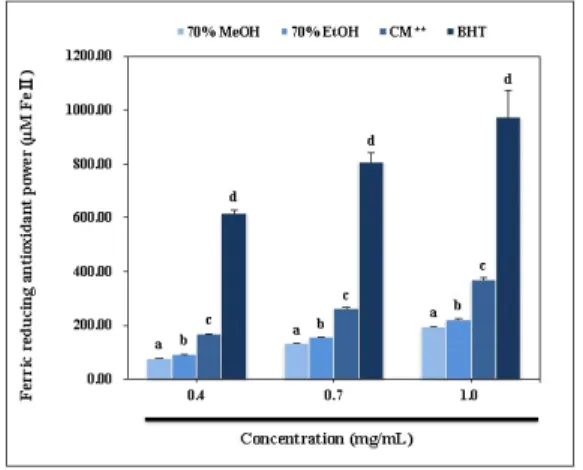
presented in the Fig. 4. The results revealed

concentration-dependent ferric reducing

antioxidant activities in all the tested

concentrations of various extracts. At a

concentration of 1.0 mg/mL, the FRAP values

of various extracts increased in the following

(7)

L

*

a

*

b

*

C

*

H

°

TTY 54.92±2.18

a*

6.81±0.35

b

22.57±0.12

b

23.58±0.19

b

73.20±0.77

a

*The values are means±standard deviation ( n =3). Values with the different letters in the same row are significantly different ( p <0.05) by Duncan’s multiple range tests.

Table 2. Color properties ( L

*

, a

*

, b

*

, C

*

and H

o

) of thermal treatment yam ( Dioscorea batatas DECNE.)

Fig. 4. Ferric reducing antioxidant power of various extracts from thermal treatment yam ( Dioscorea batatas DECNE.).

*The values are means±standard deviation ( n =3). Bars with the different letters are significantly different ( p <0.05) by Duncan’s multiple range tests.

**CM: chloroform–methanol mixture (2:1, v/v).

order: 70% methanol extract (194.68±0.73 µ M Fe

), 70% ethanol extract (222.30±1.93 µ M Fe

) and CM extract (369.76±7.80 µM Fe

), respectively. The CM extract showed pronounced ferric reducing antioxidant power values compared with other extracts although lower than that of BHT. Significant differences in ferric reducing antioxidant power values between various extracts could be found.

Similar to the results obtained from DPPH radical and ABTS radical scavenging activity, correlation between FRAP values and total

phenol contents could also be observed from our research. This significant correlation was in accordance with the data reported by Wojdylo et al. [23], who found total phenol content strongly correlated with antioxidant activity evaluated by FRAP assay in herbs.

3.7. Color property

The color values was measured as L

*

, a

*

, b

*

values and found 54.92±2.18, 6.81±0.35 and 22.57±0.12, respectively (Table 2). C

*

value and H

o

value were calculated as 23.58±0.19 and 73.20±0.77, respectively. The L

*

and H

o

values were significantly higher than the other values. And the yellowness–blueness ( b

*

) value was similar to C

*

value.

4. Conclusions

Thermal treatment yam was extracted by different solvents including 70% methanol, 70% ethanol and chloroform–methanol mixture (CM, 2:1, v/v). Total phenol contents of various extracts from thermal treatment yam increased in the following order: 70%

methanol extract (63.53±0.33 mg CAE/g), 70% ethanol extract (69.47±1.00 mg CAE/g) and CM extract (97.49±0.66 mg CAE/g), respectively. CM exhibited the highest efficacy in extracting antioxidants from thermal treatment yam, as evaluated by ABTS [2,2′

-azino-bis(3-ethylbenzothiazoline-6-sulfonic

acid) diammonium salt] radical scavenging

activity, DPPH (2,2-diphenyl-1-picrylhydrazyl)

radical scavenging activity, reducing power,

(8)

and ferric reducing antioxidant power.

References

1. M. S. Blois, Antioxidant determinations by the use of a stable free radical, Nature , 181, 1199 (1958).

2. I. F. F. Benzie, J. J. Strain, The ferric reducing ability of plasma (FRAP) as a measure of “antioxidant power”: the FRAP assay, Anal. Biochem. , 239, 70 (1996).

3. M. R. Bhandari, J. Kawabata, Organic acid, phenolic content and antioxidant activity of wild yam ( Dioscorea spp.) tubers of Nepal, Food Chem. , 88, 163 (2004).

4. L. Barros, M. J. Ferreira, B. Queirós, Isabel C. F. R. Ferreira, P. Baptista, Total phenols, ascorbic acid, β-carotene and lycopene in Portuguese wild edible mushrooms and their antioxidant activities, Food Chem. , 103, 413 (2007).

5. J. Bertoncelj, U. Doberšek, M. Jamnik, T.

Golob, Evaluation of the phenolic content, antioxidant activity and colour of Slovenian honey, Food Chem. , 105, 822 (2007).

6. L. Bravo, Polyphenols: chemistry, dietary sources, metabolism, and nutritional significance, Nutritional review , 56, 317 (1998).

7. Y. S. Duan, M. A. Kim, J. H. Seong, H.

S. Chung, H. S. Kim, Antioxidative activities of various solvent extracts from haw ( Crataegus pinnatifida Bunge), Korean J. Food Preserv. , 21, 246 (2014).

8. W. C. Hou, H. J. Chen, Y. H. Lin, Dioscorins, the major tuber storage proteins of yam ( Dioscorea batatas Decne), with dehydroascorbate reductase and monodehydroascorbate reductase activities, Plant Sci. , 149, 151 (1999).

9. C. L. Hsu, W. Chen, Y. M. Weng, C. Y.

Tseng, Chemical composition, physical properties, and antioxidant activities of yam flours as affected by different drying

methods, Food Chem. , 83, 85 (2003).

10. C. S. Hariprakash, B. Nambisan, Carbohydrate metabolism during dormancy and sprouting in yam ( Dioscorea ) tubers:

changes in carbohydrate constituents in yam ( Dioscorea ) tubers during dormancy and sprouting, J. Agric. Food Chem. , 44, 3066 (1996).

11. S. Y. Kim, H. J. Jwa, Y. Yanagawa, T. S.

Park, Extract from Dioscorea batatas ameliorates insulin resistance in mice fed a high-fat diet, J. Med. Food , 15, 527 (2012).

12. C. Kaur, H. C. Kapoor, Antioxidants in fruits and vegetables–the millennium's health, Inter. J. Food Sci. Technol. , 36, 703 (2001).

13. L. S. Lai, S. T. Chou, W. W. Chao, Studies on the antioxidative activities of hsian-tsao ( Mesona procumbens Hemsl) leaf gum, J Agric. Food Chem. , 49, 963 (2001).

14. J. T. Lin, D. J. Yang, Determination of steroidal saponins in different organs of yam ( Dioscorea pseudojaponica Yamamoto), Food Chem. , 108, 1068 (2008).

15. B. B. Li, B. Smith, M. M. Hossain, Extraction of phenolics from citrus peels I.

solvent extraction method, Separa. Puri.

Technol. , 48, 182 (2006).

16. R. J. Robbins, Phenolic acids in foods: an overview of analytical methodology, J.

Agricul. Food Chem. , 51, 2866 (2003).

17. V. Roginsky, E. A. Lissi, Review of methods to determine chain-breaking antioxidant activity in food, Food Chem. , 92, 235 (2005).

18. Y. X. Sun, S. Hayakawa, M. Ogawa, K.

Izumori, Antioxidant properties of custard pudding dessert containing rare hexose, D-psicose, Food Control , 18, 220 (2005).

19. M. Shaghaghi, J. L. Manzoori, A. Jouyban,

Determinations of total phenols in tea

infusions, tomato and apple juice by

terbium sensitized fluorescence method as

(9)

an alternative approach to the Folin–

Ciocalteau spectrophotometric method, Food Chem. , 108, 695 (2007).

20. Y. S. Velioglu, G. Mazza, L. Gao, B. D.

Oomah, Antioxidant activity and total phenolics in selected fruits, vegetables, and grain products, J. Agric. Food Chem. , 46, 4113 (1998).

21. J. P. D. Wanasundera, G. Ravindran, Nutritional assessment of yam ( Dioscorea alata ) tubers, Plant Foods for Human Nutr. , 46, 33 (1994).

22. J. P. D. Wanasundera, G. Ravindran, Effects of cooking on the nutrient and antinutrient contents of yam tubers ( Dioscorea alata and Dioscorea esculenta ), Food Chem. , 45, 247 (1992).

23. A. Wojdylo, J. Oszmiański, R. Czemerys,

Antioxidant activity and phenolic

compounds in 32 selected herbs, Food

Chem. , 105, 940 (2007).

수치

Fig.  1.  ABTS  radical  scavenging  activities  of  various  extracts  from  thermal  treatment  yam  ( Dioscorea  batatas  DECNE.).
Fig.  3.  Reducing  power  of  various  extracts  from  thermal  treatment  yam  ( Dioscorea  batatas  DECNE.).
Table  2.  Color  properties  ( L * ,  a * ,  b * ,  C *   and  H o )  of  thermal  treatment  yam  ( Dioscorea  batatas  DECNE.)

참조

관련 문서

Effects of phase I periodontal treatment on gingival crevicular fluid levels of matrix metalloproteinase-3 and tissue inhibitor of metalloproteinase-1.

3) When investigating effects of sports club activity on university life satisfaction and self-efficacy, social satisfaction of club activity affected influences positively

종합적인 결과 노루궁뎅이버섯 분말 에탄올 추출물의 총 polyphenol 함량과 DPPH radical 소거능, ABTS radical 소거능은 건조 방법에 따 른 유의적인 차이가

Effects of Mother's Types of Language Control and Rearing Attitudes on Young Children's Social Ability...

The purpose of study are analyzing the effects of dance majors' self-management on dance performance ability, self-efficacy and concentration, In the future,

In chlorination, the transition state resembles the reactant (small radical character), therefore the tertiary radical is slightly more stable than the primary one. In

DPPH radical scavenging activity of Yanggaeng added with different levels of Molokhia( Corchorus olitorius L.) powder.. Bars with different letters

In conclusion, the result that the walk-using safety educational activities designed for young children had effects on their safety problem solving ability