Original Article: Food Science/Microbiology
Effect of Fermentation on the Antioxidant Activity of Rice Bran by Monascus pilosus KCCM60084
Jinhua Cheng · Bong-Keun Choi · Seung Hwan Yang* · Joo-Won Suh*
Received: 13 November 2015 / Accepted: 21 December 2015 / Published Online: 31 March 2016
© The Korean Society for Applied Biological Chemistry 2016
Abstract In this study, we optimized fermentation conditions for the solid state fermentation of rice bran with Monascus pilosus KCCM60084, and the antioxidant activities were investigated.
Optimal fermentation conditions were determined by the production of Monacolin K, a functional secondary metabolites with cholesterol lowering activity. The highest Monacolin K production were 2.88 mg/g observed on day 10 with 45% moisture content in the substrate when inoculated with 5% inoculum (w/w). Reducing power, iron chelating activity and ABTS+ radical scavenging activity were significantly enhanced after fermentation by 60, 80, and 38% respectively. Furthermore, the content of total flavonoid were found to be increased by 4.58 fold. Based on these results, Monascus-fermented rice bran showed strong possibility to be used as a natural antioxidant agent due to its enhanced antioxidant activity.
Keywords Antioxidant · Monacolin K · Monascus pilosus · Rice bran · Solid state fermentation
Introduction
Rice bran, which constitutes about 10% of the weight of whole rice, is a byproduct in rice milling process. It is composed of pericarp, aleurone, subaleurone, seed coat, and nucellus, along with germ and a small portion of endosperm (Salunkhe et al., 1992; Hargrove, 1994; Hu et al., 1996). Although varies in cultivars, rice bran generally contains 12–22% oil, 11–17% protein, 6–14%
fiber, 10–15% moisture, and 8–17% ash, along with many functional compounds including phenolic acids, flavonoids, anthocyanins, tocopherols, -oryzanol and phytic acid etc. (Goufo and Trindade, 2014; Sharif et al., 2014).
In spite of its high neutraceutical content, rice bran is being used mostly in oil manufacturing, production of fertilizers, animal feed and the cosmetic industry. The greatest restriction to the use of rice bran as a food ingredient is its instability during storage.
Upon milling, the oil is exposed to lipases, causing rapid breakdown to free fatty acids, at 5–7% of the weight of oil per day. Hence, due to the naturally occurring enzymatic activity and subsequent hydrolytic rancidity, it is necessary to stabilize the rice bran by suitable techniques for controlling these undesirable reactions. Moreover, phenolic acids, which are considered as the major compounds for antioxidant activity in rice bran, are bound through an ester linkage to the cell wall (Faulds et al., 1999), and cannot be absorbed directly by humans.
The fungi of the genera Monascus, have been used for food fermentation especially to make red yeast rice in Eastern Asia for several centuries. Monascus-fermented products are developed as popular functional foods for the prevention of cardiovascular disease due to the production of Monacolin K, a cholesterol lowering agent (Endo, 1979). Furthermore, Monascus species were reported to produce diverse secondary metabolites with biological functions, including a group of pigments (monascin and ankaflavin), hypotensive agent (γ-aminobutyric acid), anti- inflammatory compounds (Monasnicotinates), antioxidant compounds including dimerumic acid and antibacterial compounds (Wong and Bau, 1977; Aniya et al., 2000; Chuang et al., 2011; Wu et al., 2011; Lee and Pan, 2012). In recent studies, other food materials J. Cheng · J.-W. Suh
Division of Bioscience and Bioinformatics, College of Natural Science, Myongji University, Cheoin-gu, Yongin, Gyeonggi, 449-728, Republic of Korea
B.-K. Choi
NutraPham Tech, Giheung-gu, Yongin, Gyeonggi 446-916, Republic of Korea
S. H. Yang · J.-W. Suh
Center for Nutraceutical and Pharmaceutical Materials, Myongji University, Cheoin-gu, Yongin, Gyeonggi, 449-728, Republic of Korea S. H. Yang
Interdisciplinary Program of Biomodulation, Myongji University, Yongin, Gyeonggi, 449-728, Republic of Korea
*Corresponding authors (S. H. Yang: [email protected];
J.-W. Suh: [email protected])
This is an Open Access article distributed under the terms of the Creative Commons Attribution Non-Commercial License (http://creativecommons.
org/licenses/by-nc/3.0/) which permits unrestricted non-commercial use, distribution, and reproduction in any medium, provided the original work is properly cited.
(i.e. soybean and dioscorea) have also been fermented with Monascus, and the level of monacolin K and the antioxidant capacities were highly increased (Chiang et al., 2011; Pyo and Seong, 2009). However, despite reports on the health benefits of rice bran, the fermentation by Monascus on rice bran have not been studied yet.
Fermentation is a simple technique for the long-term storage of food, and production of bioactive compounds. Particularly, solid state fermentation by yeast and fungus is traditionally used for diary food preparation in East Asia. Recently, many studies have been carried out to increase the utilization of rice bran for functional use through solid state fermentation. Rice bran fermented with Rizhopus oryzae enhanced the antioxidant activity and the content of phenolic acid, especially ferulic acid (Schmidt et al., 2014).
Moreover, fermentation with Saccharomyces boulardii generates novel metabolite profiles, and renders a novel bioactivity that can reduce the growth of human B lymphomas (Ryan et al., 2011).
Here, we investigated and report the optimized conditions for fermentation of rice bran with Monascus pilosus, the conversion of polyphenol composition, and their antioxidant activity.
Materials and Methods
Solid state fermentation of rice bran with Monascus pilosus.
Rice bran was purchased at the local market in Yongin City, Korea, and stored at −20oC before use. Monascus pilosus was obtained from the Korean Culture Center of Microorganisms. The moisture content of rice bran was adjusted to 35, 40, 45 and 50%
by adding water and mixed thoroughly; it was determined by a moisture content meter. One hundred gram of rice bran was put in a 1000 mL Erlenmeyer flask and autoclaved at 121oC for 20 min.
The fungus was cultivated on potato dextrose agar at 25oC for 72 h. An agar block (1×1 cm) with mycelium was cut and inoculated into Mizutani medium (Kim et al., 2010) and cultivated for 48 h. The mycelium was then homogenized in a Waring blender and inoculated into rice bran at inoculation ratio of 1, 2, 5, and 10% (v/v) respectively. The fungus was cultivated at 25oC for 10 days, harvested and dried at 50oC for 18 h.
Preparation of crude extract. Non-fermented rice bran (RB) and Monascus-fermented rice bran (MRB) were dried at 50oC for 18 h, and ground to powder. Each 1 g of powder was extracted with 10 mL of 70% ethanol at room temperature, with occasional shaking for 24 h. The suspension was then centrifuged at 6,500 rpm for 15 min, and the supernatant was filtered through 0.2µm polytetrafluoroethylene filter before analysis.
Determination of monacolin K in fermentation products.
Standard Monacolin K was purchased from sigma (St. Louis, MO, USA), and the acid form of Monacolin K was made according to Friedrich et al. (1995). Content of monacolin K in fermented products was determined by using high performance liquid chromatography (HPLC). Analysis was performed using a YMC ODS column (250 mm×4.0 mm; 5 µm) connected to binary HPLC pump (Waters 1525) at a flow rate of 1.0 mL/min. The
mobile phase consisted of solvent A (0.5% trifluoroacetic acid in water) and B (100% acetonitrile). The linear gradient solvent system was programmed as follows: 0–15% B (45 min), 15–30%
B (15 min), 30–50% B (5 min), 50–100% B (5 min), and 100–0%
B (10 min). The photodiode array detector was set to 237 nm, and the injection volume of sample was 10µL. The content of monacolin K was expressed as µg of monacolin K per g of dry weight (dw).
Reducing power. Reducing power was determined according to the method of Oyaizu (1986). Each extract (2.5 mL) was mixed with 2.5 mL of 200 mM sodium phosphate buffer (pH 6.6) and 2.5 mL of 1% potassium ferricyanide, and the mixture was incubated at 50oC for 20 min. After cool down, 2.5 mL of 10%
trichloroacetic acid (w/v) was added, and the mixture was centrifuged at 6,500 rpm for 10 min. The upper layer (5 mL) was mixed with 5 mL of deionized water and 1mL of 0.1% ferric chloride, and the absorbance was measured at 700 nm against a blank. A higher absorbance indicates a higher reducing power.
Ascorbic acid was used as positive control.
Scavenging ability on DPPH• radicals. The scavenging activity of DPPH• (1,1-diphenyl-2-picryl-hydrazyl) free radical was determined by the method of Gyamfi et al. (1999). Each extract (50µL) was mixed with 200 µL of DPPH• methanolic solution (100µM). The mixture was shaken vigorously and left to stand for 30 min in the dark, and the absorbance was then measured at 517 nm against a blank. Ascorbic acid was used as a positive control. The scavenging activity was expressed by the following formula:
DPPH• scavenging activity =(1−As/A0)×100%,
where As is the absorbance of sample, A0 is the absorbance for blank.
ABTS+ radical cation scavenging assay. Determination of ABTS+ radical scavenging activity was modified from Re et al.
(1999). Briefly, ABTS+ was generated by oxidation of 7 mM ABTS+ with 2.45 mM potassium persulfate, and then stored in a dark place at room temperature for 12−16 h. The ABTS+ stock solution was then diluted with deionized water to OD734=0.7 before use. Each extract (20µL) was mixed with 1mL of ABTS+ solution. The mixture was shaken vigorously and left to stand for 3 min in the dark, and the absorbance was then measured at 734 nm against a blank. Ascorbic acid was used as a positive control.
The scavenging activity was expressed by the following formula:
ABTS+ scavenging activity =(1−As/A0)×100%,
where As is the absorbance of sample, A0 is the absorbance for blank.
Chelating ability on ferrous ions. Chelating ability was determined according to the method of Dinis et al. (1994). Since the antioxidant activity of rice bran was very high, the extract was diluted 10 fold in 70% ethanol before analysis. Each diluted extract (1 mL) was mixed with 3.7 mL methanol and 0.1 mL of 2 mM ferrous chloride. To initiate the reaction, 0.2 mL of 5 mM ferrozine was added to the mixture. After 10 min at room
temperature, the absorbance of the mixture was determined at 562 nm against a blank.
Determination of total phenolic content. The total phenolic content was determined using a modified Folin-Ciocalteu method with slight modification (Lee and Pan, 2012). Folin-Ciocalteu reagent was diluted 5 fold by adding deionized water. A 1 mL aliquot of the extract was mixed with 1 mL of diluted Folin- Ciocalteu reagent and 1 mL of 10% Na2CO3. The mixture was allowed to stand at room temperature for 1 h, and the absorbance was measured at 700 nm wavelength. The total phenolic content was expressed as mg gallic acid equivalent (GAE)/100 g of MRB.
The data presented is the average of three independent experiments.
Determination of total flavonoid content. Total flavonoid content was determined by the method of Cheng et al. (2015). A 1 mL aliquot of the extract was transferred into 10 mL test tube, then 0.1 mL of 10% aluminum nitrate, 0.1 mL of 1 M potassium acetate and 4.3 mL of ethanol were subsequently added (Cheng et al., 2015). The mixture was allowed to stand at room temperature for 40 min, and the absorbance was read at 415 nm. Catechin was used as a standard, and the total flavonoid content is expressed as mg of catechin equivalent (CE)/100 g of MRB.
Statistical analysis of data. All the experiments were performed at least three times. Significant differences in treatments were analyzed by SPSS ver. 22 (IBM SPSS statistics, New York, NY, USA) by one-way analysis of variance (ANOVA) for data comparison.
The Tukey’s test was used to compare means.
Results and Discussion
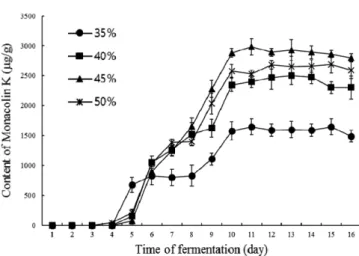
Optimization of fermentation condition by moisture content and inoculum size. The most important secondary metabolites produced by Monascus pilosus is Monacolin, a cholesterol- lowering agent, which acts as a potent competitive inhibitor of 3- hydroxy-3-methylglutaryl coenzyme A reductase (HMG-CoA reductase). To optimize the solid fermentation condition, rice bran was adjusted to different moisture contents, and the production of monacolin K was monitored during the fermentation time. It has been reported that suitable moisture content is important for the culture of Monascus species and the production of secondary metabolites. Excessively dry or wet conditions will inhibit the growth of Monascus species (Lee et al., 2006). Production of monacolin K started from day 3 of fermentation, and increased dramatically from day 5 (Fig. 1). After 10 days of fermentation, the content of monacolin K reached 1574, 2347, 2881 and 2579µg/
g dry weight for the moisture content of 35, 40, 45, and 50%
respectively. After that, the content of Monacolin K didn’t change too much, this may be due to the shortage of moisture in the substrate. Until now, rice is traditionally used as fermentation substrate, however the content of monacolin K is relatively low.
Recently, yam is concluded to be the best substrate for Monascus species to produce Monacolin K, the content of Monacolin K is 2.584 mg/g (Lee et al., 2006). Compared with yam, rice bran is much cheaper that make it more promising for industrial production.
Since the inoculum size plays a key role for production of secondary metabolites in solid fermentation, the effect of different inoculum sizes were investigated. Fermentation of rice bran by Monascus pilosus lead to the production of two forms of monacolin K: mevinolin and mevinolinic acid. After fermentation for 10 days, the 5% inoculum showed highest monacolin K production, reaching up to 2.881 mg/g of dry weight (Fig. 2).
Radical scavenging activity of fermented rice bran. Antioxidant activity is related with compounds capable of protecting a biological system against the potentially harmful effects of processes or reactions that cause excessive oxidation, involving reactive oxygen (and nitrogen) species (RONS). The most commonly used method for measuring the antioxidant activity are those involving chromogen compounds of a radical nature to simulate RONS. In this study, DPPH• and ABTS+ were used for the detection of hydrophobic and hydrophilic antioxidants respectively. DPPH• is a widely used stable organic radical that can be acquired directly by dissolving Fig. 1 Production of Monacolin K in different moisture content. Error bars indicate the standard deviation among the replications.
Fig. 2 Production of Monacolin K with different inoculation size after 10 days fermentation with M. pilosus. Error bars indicate the standard deviation among the replications. Data points indicated with different letters are significantly different from each other at p <0.05. MK:
mevinolin; MKA: mevinolinic acid.
in organic solvents. The antioxidants react with it and convert it from a violet coloured, stable-free radical, into a yellow coloured α,α-diphenil-β-picrylhydrazine. The discolouration of the reaction mixture can be quantified by measuring the absorbance at 517 nm,
which indicates the radical-scavenging ability of the antioxidant.
ABTS+ was generated by chemical reactions in aqueous solution (Arnao, 2000).
The DPPH• scavenging activity of MRB did not change significantly Fig. 3 Antioxidant activity of rice bran (RB) and Monascus-fermented rice bran (MRB). A: DPPH• radical scavenging activity, B: reducing power, C:
ABTS+ radical scavenging activity, D: Iron chelating activity. Error bar indicate the standard deviation (±SD) among the replicates. Data points indicated with different letters are significantly different from each other at p <0.05.
compared with unfermented RB (p >0.05) at all the concentrations (Fig. 3A), while the ABTS+ radical scavenging activity increased 20% after fermentation, at concentrations of 0.25, 0.5, and 1 mg/
mL (Fig. 3B). This result demonstrated that many water soluble antioxidant compounds were produced through fermentation.
Iron chelating ability of fermented rice bran. Another strategy to avoid ROS generation that is associated with redox active metal catalysis, involves chelating of the metal ions. Antioxidants inhibit the interaction between metal and lipids through formation of insoluble metal complexes with ferrous ion (Hsu et al., 2003).
Ferrous ions are one of the most effective pro-oxidants; their interaction with hydrogen peroxide in biological systems can lead to the formation of highly reactive hydroxyl radicals. Ferrozine is a ferroin compound that can quantitatively form stable magenta- coloured complexes with ferrous ions (Fe2+). In the presence of other chelating agents, the complex formation is disrupted and the colour of the complex decreases. Measurement of the rate of colour reduction therefore allows estimation of the chelating activity of the coexisting chelator.
In this study, the iron chelating capacity assay was used to evaluate the ability of MRB and RB to disrupt the formation of the complexes, or to prevent the interaction between metals and lipids. Ion chelating activity increased from 15 to 33% at the concentration of 0.25 mg/mL, and increased from 32% to 55% at the concentration 0.5 mg/mL (Fig. 3C). These results suggested many lipid antioxidants are generated through fermentation by Monascus species.
Reducing power of fermented rice bran. Reducing ability was determined by using ferric reducing antioxidant power (FRAP).
The FRAP method is based on the reduction of a ferroin analogue:
the Fe3+ complex of tripyridyltriazine Fe(TPTZ)3+ to the intensely blue-coloured Fe2+ complex Fe(TPTZ)2+ by antioxidants in acidic solution.
The absorbance at OD700 for RB is 0.25, 0.30, 0.37, and 0.51 at concentrations of 0.25, 0.5, 1, and 2 mg/mL respectively. However, the value for MRB is 0.29, 0.38, 0.53, and 0.82 at the same concentration. At the concentration of 2 mg/mL, the reducing power increased about 1.6 fold (Fig. 3D). It has been reported that Monascus fermented rice exhibits higher antioxidant activity including reducing power, DPPH• radical scavenging ability, and ferrous ions chelating ability (Yang et al., 2006). The enhanced antioxidant activity was attributed to the enhanced content of polyphenol and flavonoids. Furthermore, fermentation can produce many small peptides and some other secondary metabolites which are more sensitive in their reducing power and iron chelating activity. This may be the reason that iron chelating activity is more notable after fermentation, compared with radical scavenging activity. It is reported that the composition of adzuki bean have been changed after fermentation by Monascus pilosus; the content of crude protein and crude lipid increased 26 and 5% respectively (Cheng et al., 2015).
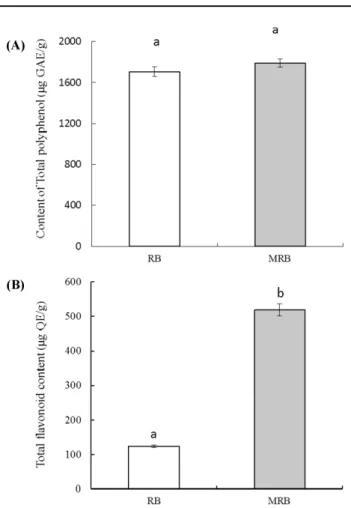
Content of total polyphenol and flavonoid. Total polyphenol contents in rice bran and fermented products are 1,706µg
GAE/g dry weight and 1,793µg GAE/g dry weight respectively, which shows no significant change after fermentation (p >0.05, Fig. 4A). In contrast, the content of total flavonoid increased remarkably from 123µg QE/g dry weight to 518 µg QE/g dry weight after fermentation (Fig. 4B). It has been recognized that the total phenolic content of plant extracts is associated with their antioxidant activities due to their redox properties, which allows them to act as reducing agents, hydrogen donors and singlet oxygen quenchers. The enhanced contents of flavonoids in the MRB may contribute to the antioxidant activity in MRB. In addition, the enhanced antioxidant activity may be due to some metabolites produced by Monascus species during fermentation. It is reported dimerumic acid was isolated from Moanscus anka, as strong antioxidant compounds having scavenging and iron chelating activity (Aniya et al., 2000). Furthermore, many secondary metabolites, such as pigments and polysaccharides (Wang et al., 2014), have also been reported to show antioxidant activity.
In conclusion, Monascus-fermented rice bran has strong potential to be developed as functional food by showing binary functional activities of cholesterol-lowering and enhanced antioxidant activity.
Fig. 4 The content of polyphenol and flavonoid of rice bran (RB) and Monascus-fermented rice bran (MRB). A: The contents of polyphenol components B: The content of flavonoid components. Data points indicated with different letters are significantly different from each other at p <0.05.
Acknowledgment This work was carried out with the support of
“Cooperative Research Program for Agriculture Science & Technology Development (Project No. PJ01132402)” Rural Development Administration, Republic of Korea.
References
Aniya Y, Ohtani II, Higa T, Miyagi C, Gibo H, Shimabukuro M et al. (2000) Dimerumic acid as an antioxidant of the mold, Monascus anka. Free Radic Biol Med 28, 999–1004.
Arnao MB (2000) Some methodological problems in the determination of antioxidant activity using chromogen radicals: a practical case. Trends Food Sci Technol 11, 419–21.
Cheng J, Lee SK, Palaniyandi SA, Suh JW, and Yang SH (2015) Effect of fermentation with Monascus pilosus on the antioxidant activities and phenolic acid contents of adzuki bean (Vigna angularis). J Coast Life Med 3, 276–83.
Chiang SS, Chang SP, and Pan TM (2011) Osteoprotective effect of Monascus-fermented dioscorea in ovariectomized rat model of postmenopausal osteoporosis. J Agric Food Chem 59, 9150–7.
Chuang CY, Shi YC, You HP, Lo YH, and Pan TM (2011) Antidepressant effect of GABA-Rich Monascus-Fermented product on forced swimming rat model. J Agric Food Chem 59, 3027–34.
Dinis TCP, Madeira VMC, and Almeida LM (1994) Action of phenolic derivatives (acetaminophen, salicylate, and 5-amino salicylate) as inhibitors of membrane lipid peroxidation and as peroxyl radical scavengers. Archivf Biochem Biophy 315, 161–9.
Endo A (1979) Monacolin K, a new hypocholesterolemic agent produced by Monascus species. J Antibiot 32, 852–4.
Faulds CB and Williamson G (1999) The role of hydroxycinnamates in the plant cell wall. J Sci Food Agr 79, 393–5.
Friedrich J, Zuzek M, Bencina M, Cimerman A, Strancar A, and Radez I (1995) High-performance liquid chromatographic analysis of mevinolin as mevinolinic acid in fermentation broths. J Chromatogr A 704, 363–7.
Goufo P and Trindade H (2014) Rice antioxidants: phenolic acids, flavonoids, anthocyanins, proanthocyanidins, tocopherols, tocotrienols, ã-oryzanol, and phytic acid. Food Sci Nutr 2, 75–104.
Gyamfi MA, Yonamine M, and Aniya Y (1999) Free-radical scavenging action of medicinal herbs from Ghana: Thonningia sanguinea on experimentally-induced liver injuries. Gen Pharmacol 32, 661–7.
Hargrove KL (1994) Processing and utilization of rice bran in the United States. In Rice Science and Technology, Marshall WE and Wadsworth JI, Marcel Dekker Inc., USA.
Hu W, Wells JH, Shin TS, and Godber JS (1996) Comparison of isopropanol and hexane for extraction of vitamin E and oryzanols from stabilized rice
bran. J Am Oil Chem Soci 73, 1653–6.
Kim JW, Lee SI, Kim SH, Lee YK, and Kin SD (2010) Antioxidative and antimicrobial activities of Monascus pilosus (Corn Silage Mold) mycelial extract and its culture filtrate. Korean J Food Preserv 17, 741–
51.
Lee CL and Pan TM (2012) Development of Monascus fermentation technology for high hypolipidemic effect. Appl Microbiol Biotechnol 94, 1449–59.
Lee CL, Wang JJ, Kuo SL, and Pan TM (2006) Monascus fermentation of dioscorea for increasing the production of cholesterol-lowering agent- monacolin K and antiinflammation agent-monascin. Appl Microbiol Biotechnol 72, 1254–62.
Oyaizu M (1986) Studies on product of browning reaction: antioxidative activities of products of browning reaction prepared from glucoseamine.
Jpn J Nutr 44, 307–15.
Pyo YH and Seong KS (2009) Hypolipidemic effects of Monascus-fermented soybean extracts in rats fed a high-fat and -cholesterol diet. J Agric Food Chem 57, 8617–22.
Re R, Pellegrini N, Proteggente A, Pannala A, Yang M, and Rice-Evans C (1999) Antioxidant activity applying an improved ABTS radical cation decolorization assay. Free Radic Biol Med 26, 1231–7.
Ryan EP, Heuberger AL, Weir TL, Barnett B, Broeckling CD, and Prenni JE (2011) Rice bran fermented with Saccharomyces boulardii generates novel metabolite profiles with bioactivity. J Agric Food Chem 59, 1862–
70.
Salunkhe DK, Chavan JK, Adsule RN, and Kadam SS (1992) Rice. In World Oilseeds: Chemistry, Technology and Utilization, Springer, Van Nostrand Reinhold, USA.
Schmidt CG, Gonçalves LM, Prietto L, Hackbart HS, and Furlong EB (2014) Antioxidant activity and enzyme inhibition of phenolic acids from fermented rice bran with fungus Rizhopus oryzae. Food Chem 146, 371–
7.
Sharif MK, Butt MS, Anjum FM, and Khan SH (2014) Rice bran: a novel functional ingredient. Crit Rev Food Sci Nutr 54, 807–16.
Wang P, Chen D, Jiang D, Dong X, Chen P, and Lin Y (2014) Alkali extraction and in vitro antioxidant activity of Monascus mycelium polysaccharides. J Food Sci Technol 51, 1251–9.
Wong HC and Bau YS (1977) Pigmentation and antibacterial activity of fast neutron- and X Ray-induced strains of Monascus purpureus. Went Plant Physiol 60, 578–81.
Wu MD, Cheng MJ, Yech YJ, Chen YL, Chen KP, Chen IS et al. (2011) Monasnicotinates A–D, four new pyridine alkaloids from the fungal strain Monascus pilosus BCRC 38093. Molecules 16, 4719–27.
Yang JH, Tseng YH, Lee YL, and Mau JL (2006) Antioxidant properties of methanolic extracts from monascal rice. LWT-Food Sci Technol 39, 740–
7.