• 검색 결과가 없습니다.

Evaluation of Antioxidative activity of Korean Yam (Dioscorea batatas DECNE.) by n-Butanol and Ethyl Acetate Extracts

N/A
N/A
Protected

Academic year: 2021

Share "Evaluation of Antioxidative activity of Korean Yam (Dioscorea batatas DECNE.) by n-Butanol and Ethyl Acetate Extracts"

Copied!
8
0
0

로드 중.... (전체 텍스트 보기)

전체 글

(1)

http://dx.doi.org/10.12925/jkocs.2015.32.2.312

Evaluation of Antioxidative activity of Korean Yam ( Dioscorea batatas D ECNE . ) by n -Butanol and Ethyl Acetate Extracts

Yishan Duan 1 ㆍHan-Soo Kim 1,† ㆍGyeong-Hwuii Kim 2

1 Department of Food Science and Technology, Pusan National University, Miryang 627-706, Korea

2 Department of Biomaterials Science and Engineering, Yonsei University, Seoul 120-749, Korea (Received May 31, 2015; Revised June 15, 2015; Accepted June 15, 2015)

Abstract : In this study, n -butanol and ethyl acetate extracts were prepared from raw yam ( Dioscorea batatas D ECNE. ). Their antioxidative potencies were investigated employing various in vitro methods, such as ferrous ion chelating, β-carotene bleaching assay, lipid peroxidation inhibition and nitric oxide (NO) radical scavenging and nitrite scavenging activity. The n -butanol fraction was assayed to possess stronger antioxidant activity by β-carotene bleaching assay, lipid peroxidation inhibition and NO radical scavenging activity. However, ethyl acetate extract was more effective in chelating ferrous ion and scavenging nitrite.

Based on the results obtained, yam is a potential active ingredient that could be applied in antioxidation as well as bio-health functional food to take a good part in prevention of human diseases and aging.

Keywords : yam (Dioscorea batatas D ECNE. ), metal chelating, lipid peroxidation inhibition, NO radical, nitrite

1. Introduction

Yam ( Dioscorea batatas D ECNE. ) belongs to the Dioscoreaceae family [18] and usually serves as the crucial staple food [10] as well as traditional medicine ingredient in many parts of world. Previous studies have conclusively conducted that dioscorins are the storage proteins of yam tubers, which not only exhibit dehydroascorbate reductase and monodehydroascorbate reductase activities but also reveal antioxidant activities [11,12]. And glycoprotein has been demonstrated to have an



Corresponding author

(E-mail: [email protected])

antioxidative potential as one of natural antioxidants as well as a property of anti-inflammatory [21,22]. Kim et al. [17]

found yam extract had beneficial effects on early-stage obesity-induced insulin resistance.

Dioscin is a steroidal saponin of yam which can be hydrolyzed to form diosgenin [4,26]. In addition, diosgenin of yam can be changed into dehydroepiandrosterone on some degree, which showed antioxidative activity against lipid peroxidation and lowered serum cholesterol and phospholipids levels as well as increased high density lipoprotein level in elderly people [1,19].

Oxygen free radicals or, more generally,

reactive oxygen species (ROS), as well as

(2)

reactive nitrogen species (RNS) are products of normal cellular metabolism [27]. The excess ROS can damage cellular lipids, proteins or DNA and further cause cancer, aging, atherosclerosis, coronary heart diseases and neurodegenerative diseases [6,7,13]. In the last decades, growing interests in the study of the antioxidant activity of foods and diets due to the known implications of oxygen free radicals in the progress and development of cardiovascular and neurodegenerative disease, aging and cancer are increasing [23].

In the present study, bioactive compounds in yam were determined. Additionally, antioxidant activity of yam extracts by 70% methanol, 70% ethanol and chloroform–methanol mixture (CM, 2:1, v/v) were investigated and compared in vitro methods.

2. Materials and Methods 2.1. Materials

Yam ( Dioscorea batatas D ECNE

.

) was purchased from Andong (Korea), which was seeded in March or April and harvested in the end of October or December. The fresh yam was washed, sliced (thickness, 0.4–0.6 cm) and dried in the hot air for 18–24 h at 60–70℃.

Then the dried chips were smashed (150-mesh) into raw yam meals (RY).

2.2. Preparation of yam extracts

Yam meals and extraction solvents including n -butanol and ethyl acetate were mixed in a ratio of 1:10 and kept in the dark about 3 h, and then used the Advantec No. 1 filter paper (Tokyo, Japan) to filter. The process of extraction was repeated 3 times. The filtrate was evaporated by rotary vacuum evaporator (EYELA, N-N series, Tokyo, Japan) until the solvents were completely removed. The various extraction yields of RY by n -butanol and ethyl acetate were 0.66% and 0.43%, respectively. The yam extracts were collected and sealed in brown reagent bottles and frozen

at –80℃ until required for further analyses.

2.3. Ferrous ion chelating activity determination

The chelating of ferrous ion by yam extracts was estimated by the method of Hsu et al.

[14]. 1 mL of yam extract at different concentrations, 0.05 mL of 2 mM FeCl 2 ·4H 2 O, 0.1 mL of 5 mM ferrozine and 3 mL of ethanol were mixed. After 10 min of incubation at room temperature, the absorbance of Fe 2+ – ferrozine complex was measured at 562 nm. The chelating activity of yam extract for Fe 2+ was calculated as follows:

Ferrous ion chelating activity (%) =    

 × 

Where A s and A c are the absorbance of sample and control.

2.4. β-carotene bleaching assay

The antioxidant activity of different extract was evaluated according to the β-carotene bleaching method following the method of Elzaawely et al. [5]. In brief, a solution of β -carotene was prepared by dissolving 1 mg of β-carotene in 10 mL of chloroform. One milliliter of this solution was then added to a round-bottomed flask containing a mixture of 20 mg linoleic acid and 200 mg Tween 40.

After the chloroform was removed under vacuum using a rotary evaporator at 40℃, 100 mL of aerated distilled water were added to the flask with vigorous shaking. The emulsion obtained was freshly prepared before experiment. An aliquot (4.0 mL) of the β -carotene–linoleic acid emulsion was mixed with 0.4 mL of sample extracts, positive control standards (BHA). Then the mixture was incubated at 50℃ for 120 min.

Absorbance readings were performed

immediately (t=0 min) and after 120 min of

incubation at 470 nm with. Antioxidant

activity (AOA) was calculated using the

following formula:

(3)

       ′   ′ 

  

 × 

A 0 and A′ 0 are the initial absorbance of sample and control, whereas A 120 and A′ 120

are the absorbance of sample and control after 120 min.

2.5. Lipid peroxidation inhibition determination

The lipid peroxidation inhibition activity of the yam extracts was measured in a linoleic acid emulsion system according to the method of Je et al. [17]. Briefly, each reaction mixture consisted of 1 mL of sample solution, 2 mL of 2.51% linoleic acid in ethanol and 10 mL of phosphate buffer (pH 7.0). Then the total volume was adjusted to 20 mL with distilled water. The mixture was incubated at 40℃ in the dark, and the degree of oxidation was evaluated by measuring the ferric thiocyanate (FTC) method. The mixture solution (100 µL) was mixed with 3.7 mL of 75% ethanol, 0.1 mL of 30% ammonium thiocyanate and 0.1 mL of 0.02 M of ferrous chloride solution in 3.5% HCl. After 3 min, the thiocyanate value was measured by reading the absorbance at 500 nm. The inhibition activity can be expressed by the following equation

Lipid peroxidation inhibition activity (%) =    

 × 

Where A s and A c are the absorbance of sample and control.

2.6. NO radical scavenging activity determination

Nitric oxide scavenging activity was measured by the method of Sahoo et al. [24].

2 mL of sodium nitroferricyanide dihydrate (10 mmol/L) was mixed with 3 mL of different concentrations of extract and incubated at 2 5℃ for 150 min. After incubation period, 1mL of sulfanilamide (1% sulfanilamide in 2%

H 3 PO 4 ) was added to the 1 mL of reaction mixture. After 10 min of incubation, 1 mL of

0.1% N-(1-Naphthyl) ethylenediamine dihydrochloride was added, vortexed and incubated for 30 min at 25℃. The absorbance of the chromophore formed was read at 540 nm. In this assay, trolox was used as positive control compound. The scavenging activity was calculated using the following formula:

NO radical scavenging activity (%) =    

 × 

Where A c is the absorbance of the control (without sample extract), and A s is the absorbance in the presence of sample extract.

2.7. Nitrite scavenging activity assay The nitrite scavenging activity was determined according to a method using Griess reagent [3]. 2 mL of each sample solution was added to 1 mL of 1 mM NaNO 2 and mixed.

Then the mixture was mixed with 6 mL of 0.2 M citrate buffer (pH 2.5). The reaction mixture was incubated in a water bath at 37

˚C for 60 min. 3 mL of 2% acetic acid and 0.4 mL of Griess reagent (1% sulfanilic acid in 30% acetic acid:1% 1-Naphthylamine in 30%

acetic acid, 1:1, v/v) were added to the 1 mL of reaction solution and then incubated at room temperature for 15 min. The absorbance of reaction solution was measured at 520 nm and nitrite scavenging activity was calculated by the following formula:

Nitrite scavenging activity (%) = =    

  

 × 

where A is the absorbance of the treated yam extract, B is the absorbance of the prepared sample solution, and C is the absorbance of 1 mM NaNO 2 .

2.8. Statistical analysis

The experimental data in triplicate were

subjected to analysis of variance (ANOVA)

and expressed as mean±SD ( n =3). ANOVA

was performed by using the one-way analysis

of variance procedures. Duncan’s multiple-

range test was used to analysis the significant

(4)

difference of means, and p <0.05 was considered to be statistically significant for all statistic procedures. IBM SPSS statistic 21 program was used for data analysis.

3. Results and Discussion 3.1. Ferrous ion chelating activity

The ferrous state of iron is known as the most important lipid oxidation pro-oxidant, which can accelerate lipid oxidation by breaking down hydrogen and lipid peroxides to reactive free radicals via the Fenton reaction (Fe 2+ + H 2 O 2 → Fe 3+ + OH + OH•). As ferrozine can quantitatively form complexes with Fe 2+ , the metal chelating activity of sample was measured by a decrease in the red color of the ferrous-ferrozine complex [8]. Fig.

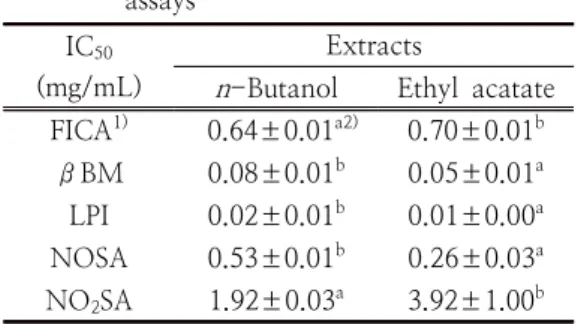
1 showed the chelating activity of various extracts ( n -butanol and ethyl acetate extracts) on ferrous ion was marked and concentration related (0.4 mg/mL, 0.7 mg/mL and 1.0mg/mL). From the IC 50 values given in

Fig. 1. Ferrous ion chelating activity of various extracts from raw yam ( Dioscorea batatas D ECNE. )

1) The values are means±SD ( n =3). Bars with the different letters are significantly different (p<0.05) by Duncan’s multiple range tests.

2) EDTA: ethylenediaminetetraacetic acid disodium salt dihydrate.

Table 1, n -butanol extract (IC 50 =0.64±0.01 mg/mL) chelated more iron than ethyl acetate extract (IC 50 =0.70±0.01 mg/mL), although they were less efficient than commercial chelator EDTA. It was reported that chelating agents, which form σ-bonds with a metal, are effective as secondary antioxidants science they reduce the redox potential thereby stabilising the oxidised form of the metal ion [9]. The data obtained from Fig. 1 revealed that the all extracts demonstrated an effective capacity for iron binding, suggesting that its action as peroxidation protector may be related to its iron binding capacity.

Table 1. IC 50 values of various extracts from raw yam ( Dioscorea batatas D ECNE. ) in different antioxidant activity assays

IC 50

(mg/mL)

Extracts

n -Butanol Ethyl acatate FICA 1) 0.64±0.01 a2) 0.70±0.01 b

βBM 0.08±0.01 b 0.05±0.01 a LPI 0.02±0.01 b 0.01±0.00 a NOSA 0.53±0.01 b 0.26±0.03 a NO 2 SA 1.92±0.03 a 3.92±1.00 b

1) Ferrous ion chelating activity (FICA), β -carotene bleaching assay (βBA), lipid peroxidation inhibition (LPI), nitric oxide radical scavenging activity (NOSA) and nitrite scavenging activity (NO 2 SA).

3) The values are means±SD ( n =3). Values with the different letters in the same column are significantly different (p<0.05) by Duncan’s multiple range tests.

3.2. β-carotene bleaching assay

The antioxidant activities of various extracts

at 0.4 mg/mL to 1.0 mg/mL concentrations

were compared with BHA measured by the

bleaching of β-carotene were presented in

Fig. 2. The highly unsaturated β-carotene

molecules in this system can be attacked by

free radicals generating from the oxidation of

(5)

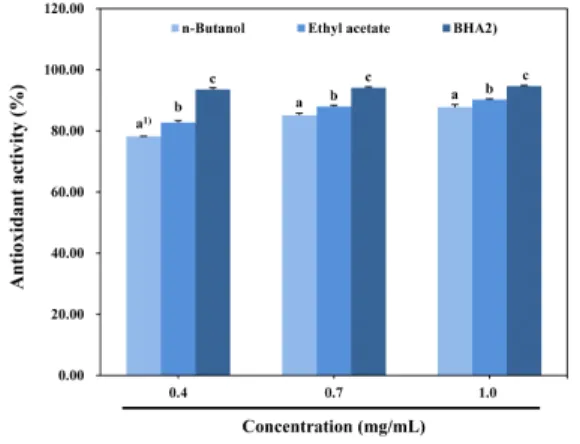
linoleic acid, and as a consequence, the characteristic orange color disappears. The presence of antioxidant can avoid the destruction of the β-carotene by neutralizing the free radicals formed in the system to keep the orange color [5]. As depicted in Fig. 2, the results exhibited concentration-dependent antioxidant activity by β-carotene bleaching method in all the tested concentrations of various extracts. The antioxidant activity of ethyl acetate extract (IC 50 =0.08±0.01 mg/mL) was found to be significantly stronger than n -butanol extract (IC 50 =0.05±0.01 mg/mL).

However, BHA always showed the most effective antioxidant activity in this assay.

From the results obtained, we suggested that the antioxidative components in extracts can reduce the extent of β-carotene destruction by neutralizing the linoleate free radical and other free radicals in this system. And our results were in accordance with Farombi, Britton and Emerole [7] who also found the yam showed antioxidant activity by using β -carotene bleaching method.

Fig. 2. Antioxidant activity of various extracts from raw yam ( Dioscorea batatas D ECNE. ) by using β-carotene bleaching method.

1) The values are means±SD ( n =3). Bars with the different letters are significantly different (p<0.05) by Duncan’s multiple range tests.

2) BHA: butylated hydroxyanisole.

3.3. Lipid peroxidation inhibition

Linoleic acid is a polyunsaturated fatty acid, which is vulnerable to attack by reactive oxygen species. As a result, lipid peroxides such as malondialdehyde (MDA) and 4-hydroxynonenal (HNE) are generated. In this model system, these peroxides can oxidize Fe 2+ to Fe 3+ , then forms complexes with thiocyanate ion which have maximum of absorption at 500 nm [25]. Fig. 3 described the inhibition of linoleic acid peroxidation by various extracts from RY. All extracts could effectively inhibit the linoleic peroxidation in a concentration-dependent manner. BHA significantly inhibited lipid peroxidation in linoleic acid emulsion system and the activity was higher than extracts. IC 50 values of ethyl acetate and n -butanol extracts were found to be 0.01±0.00 and 0.02±0.01 mg/mL, respectively. In this assay, a significant difference between n -butanol extract and ethyl acetate extract could not be found. Moreover, these results implied those antioxidants from RY were probable to be effective as chain breaking molecules.

Fig. 3. Antioxidant activity of various extracts from raw yam ( Dioscorea batatas D ECNE. ) determined as inhibition of linoleic acid oxidation.

1) The values are means±SD ( n =3). Bars with the different letters are significantly different (p<0.05) by Duncan’s multiple range tests.

2) BHA: butylated hydroxyanisole.

(6)

3.4. NO radical scavenging activity

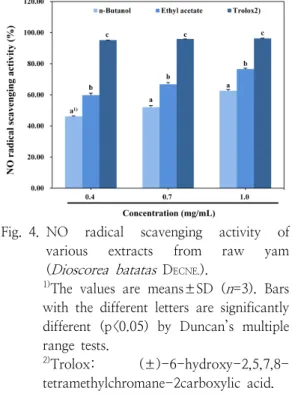
Nitrite oxide (NO) is very reactive which implicated in inflammation, cancer and other pathological conditions. NO interacts with oxygen to produce nitric ions that can be estimated by using Griess reagent. Scavengers of nitric oxide compete with oxygen leading to reduced production of nitric oxide [24]. NO radical scavenging activities of various fractions obtained from RY and TTY by using different extraction solvents were presented in Fig. 4 and Table 1. NO radical scavenging activities of various extracts increased with the increasing concentrations. Antioxidant activities against NO radical decreased in the following order: trolox, ethyl acetate extract and n-butanol extract, respectively. Ethyl acetate extract (IC 50 =0.26±0.03 mg/mL) was significantly more effective in scavenging NO radical than n-butanol extract (IC 50 =0.53±0.01 mg/mL). Yam extracts might possess the property to counteract the effect of NO formation and in turn might be of considerable interest in preventing the ill effects

Fig. 4. NO radical scavenging activity of various extracts from raw yam ( Dioscorea batatas D ECNE. ).

1) The values are means±SD ( n =3). Bars with the different letters are significantly different (p<0.05) by Duncan’s multiple range tests.

2) Trolox: (±)-6-hydroxy-2,5,7,8- tetramethylchromane-2carboxylic acid.

of excessive NO generation in the human body. And the scavenging activity was likely to contribute to retard the chain of reactions initiated by excess generation of NO that were detrimental to the human health [16].

3.5. Nitrite scavenging activity

Nitrite is toxic and is usually presented in large quantities in meat, leafy and root vegetables. The excessive consumption of nitrite could lead to oxidization of hemoglobin, which can arouse methemoglobinemia [2]. In the present study, we investigate the effect of different extracts from RY on nitrite scavenging activity varied from 0.4 mg/mL to 1.0 mg/mL at pH 2.5. Fig. 5 revealed all extracts exhibited a concentration-dependent anti-radical activity by inhibiting nitrite. The nitrite scavenging activity of extract increased with the increasing concentration, but lower than those of the positive control compounds ascorbic acid at the same concentration.

n -Butanol extract was able to inhibited more nitrite than that of ethyl acetate extract, which possessed IC 50 values of 1.92±0.3 and 3.92±1.00 mg/mL, respectively. In addition,

Fig. 5. Nitrite scavenging activity of various extracts from raw yam ( Dioscorea batatas D ECNE. ).

1) The values are means±SD ( n =3). Bars

with the different letters are significantly

different (p<0.05) by Duncan’s multiple

range tests.

(7)

n -butanol extract and ethyl acetate extract achieved 30.52±0.45% and 28.42±0.93%

inhibition at a concentration of 1.0 mg/mL.

Lee et al. [20] reported that the maximum scavenging percentage of aqueous extract from yam on nitrite was about 29.20% at 0.2 mg/mL. According to the results in the present study, it is suggested that various extracts from RY had a remarkable potency to scavenge nitrite.

4. Conclusion

Raw yam ( Dioscorea batatas D ECNE. ) was an important source of antioxidants. Antioxidant activities of extracts were dependent on concentrations. n -Butanol extract exhibited antioxidant activity as evidenced by its stronger lipid peroxidation inhibition and NO radical scavenging activity. On the contrary, ethyl acetate extract was more effective in chelating ferrous ion and scavenging nitrite.

Nevertheless, much research and many experiments still need to be carried out in order to obtain a better understanding of its activity.

References

1. M. Araghiniknam, S. Chung, T. Nelson- White, C. Eskelson, R. R. Waston, Antioxidant activity of dioscorea and dehydroepiandrosterone (DHEA) in older humans, Life Sci. , 59, 147 (1996).

2. D. B. Choi, K. A. Cho, M. S. Na, H. S.

Choi, Y. O. Kim, D. H. Lim, S. J. Cho, H. Cho, Effect of bamboo oil on antioxidative activity and nitrite scavenging activity, J. Indus. Engi. Chem. , 14, 765 (2008).

3. S. Y. Choi, M. J. Chung, W. D. Seo, J.

H. Shin, M. Y. Shon, N. J. Sung, Inhibitory effects of Orostachys japonicus extracts on the formation of

N -nitrosodimethylamine, J. Agric. Food Chem. , 54, 6075 (2006).

4. R. F. Dawson, Diosgenin production North America, Hort Technol. , 1, 22 (1991).

5. A. A. Elzaawely, T. D. Xuan, S. Tawata, Antioxidation and antibacterial activities of Rumex japonicus H OUUT . aerial parts, Biol.

Pharmac. , 28, 2225 (2005).

6. T. Finkel, N. J. Holbrook, Oxidants, oxidative stress and the biology of aging, Nature , 408, 239 (2000).

7. E. O. Farombi, G. Britton, G. O. Emerole, Evaluation of the antioxidant activity and partial characterisation of extracts from browned yam flour diet, Food Res. Int. , 33, 493 (2000).

8. İ. Gülçin, Antioxidant activity of caffeic acid (3,4-dihydroxycinnamic acid), Toxicology , 217, 213 (2006).

9. M. H. Gordon, The mechanism of antioxidant action in vitro. In B. J. F.

Hudson (Ed.), Food antioxidants (pp. 1–

18). London/New York: Elsevier (1990).

10. C. S. Hariprakash, B. Nambisan, Carbohydrate metabolism during dormancy and sprouting in yam ( Dioscorea ) tubers:

changes in carbohydrate constituents in yam ( Dioscorea ) tubers during dormancy and sprouting, J. Agric. Food Chem. , 44, 3066 (1996).

11. W. C. Hou, H. J. Chen, Y. H. Lin, Dioscorins, the major tuber storage proteins of yam ( Dioscorea batatas Decne), with dehydroascorbate reductase and monodehydroascorbate reductase activities, Plant Sci. , 149, 151 (1999).

12. W. C. Hou, M. H. Lee, H. J. Chen, W.

L. Liang, C. H. Han, Y. W. Liu, Y. W.

Lin, Antioxidant activities of dioscorin, the storage protein of yam ( Dioscorea batatas Decne) tuber, Food Chem. , 49, 4956 (2001).

13. D. Harrison, K. K. Griendling, U.

Landmesser, B. Hornig, H. Drexler, Role

of oxidative stress in atherosclerosis, The

American J. Cardiology ,91, 7 (2003).

(8)

14. C. L. Hsu, W. Chen, Y. M. Weng, C. Y.

Tseng, Chemical composition, physical properties, and antioxidant activities of yam flours as affected by different drying methods, Food Chem. , 83, 85 (2003).

15. J. Y. Je, Z. J. Qian, H. G. Byun, S. K.

Kim, Purification and characterization of an antioxidant peptide obtained from tuna backbone protein by enzymatic hydrolysis, Process Biochem. , 42, 840 (2007).

16. A. Kumaran, R. J. Karunakaran, In vitro antioxidant activities of methanol extracts of five Phyllanthus species from India, LWT-Food Sci. Technol. , 40, 344 (2007).

17. S. Y. Kim, H. J. Jwa, Y. Yanagawa, T. S.

Park, Extract from Dioscorea batatas ameliorates insulin resistance in mice fed a high-fat diet, J. Med. Food , 15, 527 (2012).

18. J. T. Lin, D. J. Yang, Determination of steroidal saponins in different organs of yam ( Dioscorea pseudojaponica Yamamoto), Food Chem. , 108, 1068 (2008).

19. Y. M. Liu, K. W. Lin, Antioxidative ability, dioscorin stability, and the quality of yam chips from various yam species as affected by processing method, J. Food Sci. , 74, 118 (2009).

20. M. H. Lee, M. S. Kim, L. G. Lee, H. G.

Shin, H. Y. Sohn, Evaluation of biological activity and characterization of taste and function-enhanced yam chips, Korean J.

Microbiol. Biotechnol. , 39, 153 (2011).

21. P. S. Oh, K. T. Lim, Plant glycoprotein modulates the expression of interleukin-1β via inhibition of MAP kinase in HMC-1 cells, Biosci. Biotechnol. Biochem. , 72, 2133 (2008).

22. P. S. Oh, K. T. Lim, Antioxidant activity of Dioscorea batatas Decne glycoprotein, European Food Res. Technol. , 226, 507 (2008).

23. S. Pastoriza, C. Delgado-Andrade, A.

Haro, J. A. Rufian-Henares, A physiologic approach to test the global antioxidant response of foods.The GAR method, Food Chem. , 129, 1926 (2011).

24. S. Sahoo, G. Ghosh, D. Das, S. Nayak, Phytochemical investigation and in vitro antioxidant activity of an indigenous medicinal plant Alpinia nigra B.L. Burtt, Asian Pacific J. Tropical Biomed. , 3, 871 (2013).

25. B. Sultana, F. Anwar, R. Przybylski, Antioxidant potential of corncob extracts for stabilization of corn oil subjected to microwave heating, Food Chem. , 104, 997 (2007).

26. W. G. Taylor, J. L. Elder, P. R. Chang, K. W. Richards, Microdetermination of diosgenin from fenugreek ( Trigonella foenum-graecum ) seeds, J. Agric. Food Chem. , 48, 5206 (2000).

27. M. Valko, D. Leibfritz, J. Moncol, M. T.

D. Cronin, M. Mazur, J. Telser, Free

radicals and antioxidants in normal

physiological functions and human disease,

Int. J. Biochem. Cell Biol. , 39, 44 (2007).

수치

Fig.  1.  Ferrous  ion  chelating  activity  of  various  extracts  from  raw  yam  ( Dioscorea  batatas  D ECNE
Fig.  2.  Antioxidant  activity  of  various  extracts  from  raw  yam  ( Dioscorea  batatas  D ECNE
Fig. 4. NO  radical  scavenging  activity  of  various  extracts  from  raw  yam  ( Dioscorea  batatas  D ECNE

참조

관련 문서

Finally, chapter 3 presents methods of education and those are classified the teaching methods for virtues of character, such as justice, temperance, and

Sex, parents' educational background, and the state of employment of mother were investigated as demographical variables to determine if there were

To measure antioxidant effects of the yuzu seed oil, DPPH radical scavenging and lipid peroxidation were investigated... DPPH radical scavenging

CMP characteristics such as the removal rate and WIWNU% were improved by the increase of CMP pressure; however, the electrical properties

As can be seen from examples of convergence with other fields already attempted in various fields of society and the integratio n of liberal arts and

Futhermore, if the consultation activity is performed through the development of various methods on the Gestalt Group Art Therapy in personal and

The structure and film optical properties were investigated by X-ray diffraction(XRD), the particle size and thickness were investigated by scanning

Comparison of cell attachment on the bone grafting materials synthesized as the defined mixing ratio of Hydroxyapatite (HA) and β-tricalcium phosphate (β-TCP) by DAPI staining