ORIGINAL ARTICLE
수박(
Citrullus vulgaris
L.) 외피의 항산화 활성 탐색Duan Yishan․김민아․김한수*․장성호1)․강동수2)
부산대학교 식품공학과, 1)부산대학교 바이오환경에너지학과, 2)전남대학교 식품공학·영양학부
Screening of Antioxidant Activity from Exocarp of Watermelon (Citrullus vulgaris L.)
Yishan Duan, Min-A Kim, Han-Soo Kim*, Seong-Ho Jang1), Dong-Soo Kang2) Department of Food Science & Technology, Pusan National University, Miryang 627-706, Korea
1)Department of Bioenviromental Energy, Pusan National University, Miryang 627-706, Korea
2)Division of Food Technology & Nutrition, Chonnam National University, Yeosu 550-749, Korea
Abstract
Watermelon (Citrullus vulgaris L.) is a summer fruit typical to help fatigue systemic absorption is getting better.
The goal of this study is to screen antioxidant activity to ensure the possibility as a functional material for exocarp of watermelon. Watermelon was extracted with 70% methanol, 70% ethanol, chloroform:methanol (CM, 2:1, v/v). Total phenol contents were 12.01 mg/g, 8.89 mg/g, 3.53 mg/g in the 70% methanol, 70% ethanol, CM, in that order, respectively.
Total flavonoid content, DPPH radical scavenging activity, ABTS radical scavenging activity, ferric reducing antioxidant power (FRAP), β-carotene bleaching assay were 70% methanol extract remarkably higher than the other extracts. And these results showed the same trend of total phenol content. From the above results shows that watermelon was effective on the antioxidative activity.
Key words : Citrullus vulgaris L., Exocarp, Antioxidative activity, Total phenol, Flavonoid
1. 서 론1)
최근 90% 이상의 많은 질병이 단백질, 핵산과 같은 생체 분자를 손상시키는 reactive oxygen species (ROS)와 관련이 있다고 알려지면서, 이러한 활성산소 를 제거하는 항산화 물질에 대한 연구가 활발하게 이 루어지고 있다(Yang 등, 2008). 식물 속에 함유되어 있는 생리활성물질은 여러 화학반응에서 cofactor, inhibitor 및 scavenger 등으로 작용 하여 항산화, 항암, 항염증과 같 은 활성을 나타낸다고 한다(Dillard와 German, 2000).
수박(Citrullus vulgaris L.)은 박목 박과의 쌍떡잎 식물로 체내에 흡수가 잘되는 대표적인 여름 과일이 다(Park과 Kim, 2010). 수박은 수분 함량이 높고 칼륨, 인, 마그네슘, 칼슘, 나트륨, 철분 등의 무기질을 비롯 하여 fructose, glucose, sucrose와 같은 유리당, citric acid, malic acid, succinic acid, fumaric acid 등의 유 기산을 함유하고 있다고 보고되어 있다(Hong 등, 2011). 수박에는 시트룰린(citrulline)이 함유되어 있 어 이뇨 작용이 있고, 칼륨의 함량이 높아 나트륨 배설 에 효과적이라고 알려져 있다(Sohn 등, 1996). 하지만
Received 10 February, 2014; Revised 11 March 2014;
Accepted 3 April, 2014
*Corresponding author : Han-Soo Kim, Department of Food Science
& Technology, Pusan National University, Miryang 627-706, Korea Phone: +82-55-350-5351
E-mail: [email protected]
ⓒ The Korean Environmental Sciences Society. All rights reserved.
This is an Open-Access article distributed under the terms of the Creative Commons Attribution Non-Commercial License (http://
creativecommons.org/licenses/by-nc/3.0) which permits unrestricted non-commercial use, distribution, and reproduction in any medium, provided the original work is properly cited.
생산이 여름에 집중되어 있고 저장성이 낮으며 껍질 과 같은 비가식 부위는 가공 공정 중 부산물로 버려지 기 때문에 새로운 가공 식품 개발이 요구되고 있다 (Kim 등, 1984). 한편, 수박의 저장 및 이용성을 높혀 식품 산업에 이용되기 위한 기술 개발의 하나로 수박 쥬스를 효모로 알콜 발효를 하였을 경우, 무기염류가 발효에 영향을 미치고 SO2 살균보다 고온 살균이 더 효과적이라고 보고되어 있다(Kim 등, 1984). 수박과 즙과 수박 와인의 경우, 수박 과즙에서 항산화 활성이 더 높았으며 발효 후에 기능성이 증진되지는 않았으 나 발효전과 비슷한 수준을 유지하여 수박은 발효주 산업에 활용될 수 있다는 보고도 있다(Park과 Kim, 2010). 또한, 품종에 따른 무기질 및 유리당과 같은 이 화학적 특성이나 저장 환경에 따른 수박 줄기의 색도, 수분 함량, 일반 세균수의 변화에 관한 연구(Hong 등, 2008; Park과 Kang, 2005) 등이 보고되어져 있으나 수박 외피와 관련된 연구는 미비한 실정이다.
따라서 본 연구에서는, 폐기물로 버려지는 수박 외 피를 이용하여 total phenol, flavonoid, DPPH와 같은 항산화 활성을 측정하고, 새로운 기능성 식품 소재로 서 활용 가능성을 확보하기 위해 실험을 수행하였다.
2. 재료 및 방법
2.1. 실험재료
실험에 사용된 시료는 경상남도 의령군에서 재배 된 수박을 부산광역시 엄궁 농산물 도매시장에서 구 매하였다. 외피를 분리하여 진공 동결건조(EYELA, FDU-2000, Rikakikai Co., Tokyo, Japan)시킨 후, 분 쇄(DCM-5500, Dae-Chang, Gyeonggido, Korea)하여 –80℃(SW-UF-400, Sam-Won Co., Busan, Korea)에 저장하며 실험에 사용하였다.
2.2. 시료의 추출
시료의 추출은 진공 동결된 건조 수박외피분말을 60 g 취하여 70% methanol, 70% ethanol, chloroform:
methanol (CM, 2:1, v/v) 용매를 10배 가하여(1:10, w/v) 24시간씩 2회 추출 한 뒤 여과(adventec, No.1) 하였다. 각 추출물을 rotary evaporator (EYELA, N-NW, Tokyo, Japan)를 이용해 40℃에서 감압 농축하여 -80℃
(SW-UF-400, Sam-Won Co., Busan, Korea)에 저장 하면서 시료로 사용하였다(Jang 등, 1996). 시료의 수 율은 추출 전 시료 중량에 대한 추출 후 건조 중량 백 분율로 나타내었다.
2.3. Total phenol 함량 측정
Total phenol 함량은 시료 0.4 ㎖에 DW 2 ㎖와 Folin-ciocalteus reagent 0.4 ㎖를 첨가하여 혼합하고 3분간 방치하였다. 반응액에 10% Na2CO3 0.4 ㎖를 가하고 실온에서 1시간동안 반응시킨 후 UV/VIS- spectrophotometer (Specord 200, Analytik-Jena, Germany)를 이용하여 700 nm에서 흡광도를 측정하 였다(Gutfinger, 1981). 표준물질로는 caffeic acid를 사용하였으며 시료 1 g당 caffeic acid mg으로 나타내 었다.
2.4. Total flavonoid 함량 측정
수박 외피의 total flavonoid 함량은 시료 1 ㎖에 10%
aluminum nitrate 0.5 ㎖, 1 M potassium acetate 0.5
㎖, 80% ethanol 1 ㎖를 혼합하여 실온에서 40분 방치 시킨 후 415 nm에서 흡광도를 측정하였다(Mello 등, 2010). 표준물질로는 quercetin을 사용하였으며 시료 1 g당 quercetin mg으로 환산하여 나타내었다.
2.5. DPPH radical scavenging activity 측정 DPPH (2,2-Diphenyl-1-picrylhydrazyl)는 시료 2 ㎖ 와 0.2 mM DPPH 2 ㎖를 혼합하여 37℃의 water bath 에서 30분 동안 반응시켰다. 반응액을 518 nm에서 흡 광도를 측정하여 다음의 식에 의해 나타내었다(Blois, 1958).
DPPH radical scavenging activity (%)
=
×
2.6. ABTS radical scavenging activity 측정
7 mM ABTS와 2.45 mM potassium persulfate를 2:1 (v/v)로 섞어 암소에서 12~16시간 동안 방치시켰 다. 반응액을 5 mM phosphate buffer (pH 7.4)와 혼합 하여 734 nm에서 흡광도가 0.7±0.02가 되도록 ABTS 용액을 제조하였다. 시료 200 ㎕와 ABTS 용액 2,800
㎕를 혼합하여 정확히 6분 후에 734 nm에서 흡광도를
측정하였으며, 다음의 식에 의해 radical 소거 활성을 나타내었다(Re 등, 1999).
ABTS radical scavenging activity (%)
=
×
2.7. Ferric reducing antioxidant power (FRAP) 측정 0.3 M sodium acetate buffer (pH 3.6), 10 mM 2,4,6-tripyridyl-S-triazine (TPTZ) solution 및 20 mM ferric chloride를 10:1:1 (v/v/v)의 비율로 혼합하고 3 7℃에서 10분간 방치시킨 후 FRAP reagent를 만들어 실험에 사용하였다. FRAP reagent 2 ㎖와 시료 0.2 ㎖ 를 혼합하여 37℃에서 30분간 방치한 후, 593 nm에서 흡광도를 측정하였다. 표준물질로는 ferrous sulfate를 사용하였으며 시료 1 g 당 mg Fe(II)으로 나타내었다 (Katalinic 등, 2005).
2.8. β-carotene bleaching activity 측정
β-carotene에서의 항산화 작용은 chloroform 10 ㎖ 에 β-carotene 1 mg을 용해하여 linoleic acid 20 mg 및 tween 40을 200 mg 첨가하였다. 혼합액을 40℃에서 감압진공농축기를 이용하여 chloroform을 제거한 후, DW 100 ㎖를 첨가하고 진탕하여 β-carotene emulsion 을 만들었다. β-carotene emulsion 3 ㎖와 시료 0.3 ㎖ 를 혼합하여 50℃에서 2시간 반응시킨 후 470 nm에 서 흡광도를 측정하였다(Jeong 등, 2008).
Antioxidant activity (%)
=
×
S0 : absorbance of sample after 0 min S120 : absorbance of sample after 120 min B0 : absorbance of blank after 0 min B120 : absorbance of blank after 120 min 2.9. 통계처리
통계처리는 측정한 분석치를 평균값과 표준편차로 계산하여 나타내었다. 군간의 차이는 one-way analysis of variance (ANOVA, IBM SPSS statistics ver. 21)로 분석한 후 p<0.05 수준에서 Duncan's multiple range test에 의하여 각 실험군 간의 유의성을 검증하였다.
3. 결과 및 고찰
3.1. 수율
수박 외피의 추출 용매별 수율은 Table 1과 같이, 70% methanol 추출물에서 18.53%, 70% ethanol 추 출물에서 15.13%로 나타나 70% methanol 및 70%
ethanol 추출물간에 유의적인 차이는 없었다. CM 추 출물에서 12.17%로 나타나 가장 낮은 수율을 보였다.
Table 1. Yield of various solvent extracts of watermelon (Citrullus vulgaris L.)
Solvent Yield (%)
70% methanol 18.53b*
70% ethanol 15.13b
CM** 12.17a
*The data are presented as means±SD of 3 times. Means with different letters are significantly different at p<0.05 by Duncan's multiple range test.
**CM; Chloroform:Methanol=2:1 (v/v).
3.2. Total phenol
수박 외피의 total phenol 함량은 Fig. 1에서와 같다.
70% methanol 추출물이 12.01±0.07 mg/g로 다른 추 출물에 비하여 유의적으로 가장 높은 함량을 보였다.
70% ethanol 추출물이 8.89±0.13 mg/g으로 두 번째 로 높은 함량을 나타내었으며, CM 추출물이 3.53±
0.07 mg/g으로 유의적으로 가장 낮은 함량을 보였다.
Fig. 1. Total phenol contents of various solvent extracts of watermelon (Citrullus vulgaris L.).
*The data are presented as means±SD of 3 times. Means with different letters are significantly different at p<0.05 by Duncan's multiple range test.
**CM; Chloroform:Methanol=2:1 (v/v).
Gallic acid를 표준물질로 하여 측정한 독수박의 total phenol 함량은 0.74%로 나타났다고 보고된 바 있다 (Kumar 등, 2008). 포도 껍질은 ellagic acid, myricetin, quercetin, kaempferol, resveratrol 등의 phenol 성분 을 함유하고 있다고 보고되어 있다(Pastrana-Bonilla 등, 2003). 따라서 본 실험결과, 수박 외피의 total phenol 함 량은 70% methanol 추출물에서 가장 높은 것으로 나 타났다.
3.3. Total flavonoid
수박 외피의 total flavonoid 함량은 Fig. 2와 같이, 70%
methanol 추출물에서 7.02± 0.29 mg/g, 70% ethanol 추 출물에서 6.38±0.15 mg/g, CM 추출물에서 5.64±0.04 mg/g으로 측정되어 유의성이 있는 것으로 나타났다.
Catechin을 표준물질로 하여 독수박의 total flavonoid 함량을 측정한 결과 0.13%로 나타났다고 한다(Kumar 등, 2008). 감귤류의 하나인 하귤 껍질은 9.22 mg/g의 total flavonoid 함량을 보였으며 naringin, hesperidin, poncirin 이 하귤 껍질의 주 flavonoid 성분이라고 보 고된 바 있다(Kim 등, 2013). 본 실험결과 70% methanol 추출물에서 유의적으로 높은 total flanovoid 함량을 보이는 것으로 측정되었다.
Fig. 2. Total flavonoid contents of various solvent extracts of watermelon (Citrullus vulgaris L.).
*The data are presented as means±SD of 3 times. Means with different letters are significantly different at p<0.05 by Duncan's multiple range test.
**CM; Chloroform:Methanol=2:1 (v/v).
3.4. DPPH radical scavenging activity
DPPH radical 소거 활성은 Fig. 3에서와 같다. 70%
methanol 추출물은 시료 농도 0.3 mg/㎖, 0.5 mg/㎖,
0.8 mg/㎖에서 각각 21.08±0.50%, 35.16±0.37%, 47.14±0.51%의 활성을 보였다. 70% ethanol 추출물 은 농도별로 17.21±0.17%, 27.91±0.76%, 38.53±0.60%
의 활성을 나타내었다. CM 추출물은 농도별로 11.57±
0.69%, 17.86±0.17%, 21.62±1.27%로 추출물 중에서 유의적으로 가장 낮은 활성을 보였다. 대조군인 ascorbic acid와 BHA는 0.01 mg/㎖ 농도에서 각각 42.76±
0.54%, 50.17±0.70%로 나타났다. 항산화 물질은 DPPH 의 radical을 소거시켜 특유의 보라색을 탈색시키는 것으로 알려져 있다(Lee 등, 2007). 독수박은 시료 농 도 2.5 mg/㎖에서 88%의 DPPH radical 소거활성을 나타내었다고 보고되어져 있다(Kumar 등, 2008). 본 실험결과 수박 외피의 DPPH radical 소거 활성은 total phenol 및 flavonoid 결과와 동일하게 70% methanol 추출물에서 가장 높은 것으로 확인되었다.
Fig. 3. DPPH radical scavenging activity of various solvent extracts of watermelon (Citrullus vulgaris L.).
*The data are presented as means±SD of 3 times. Means with different letters are significantly different at p<0.05 by Duncan's multiple range test.
**CM; Chloroform:Methanol=2:1 (v/v).
3.5. ABTS radical scavenging activity
수박 외피의 ABTS radical 소거활성은 Fig. 4에서 와 같다. 70% methanol 추출물은 시료 농도별로 각각 13.22±0.37%, 26.28±0.58%, 39.29±0.56%로 추출물 중 유의적으로 가장 높은 활성을 보였다. 70% ethanol 추출물은 농도별로 11.13±0.25%, 21.90±0.25%, 32.33±
0.37%를 나타내었고, CM 추출물은 농도별로 5.57±
0.16%, 10.76±0.09%, 15.90± 0.25%의 활성을 보였 다. 대조군인 ascorbic acid, BHA, trolox는 0.01 mg/
㎖ 농도에서 각각 20.18±0.32%, 20.07±0.32%, 19.20±
0.54%의 활성으로 측정되었다. ABTS는 양이온 radical의 소거활성을 확인 할 수 있고 trolox를 표준물 질로 하여 활성을 비교할 수 있다(Hwang 등, 2011;
Jung 등, 2010). 하귤 껍질의 ABTS radical 소거활성 은 시료의 농도가 증가 할수록 높아지는 경향이었고, radical을 50% 소거하는데 필요한 시료의 농도(IC50) 는 231 μg으로 측정되었다고 보고되어 있다(Kim 등, 2013). 본 실험결과, 수박 외피의 ABTS radical 소거 활성은 70% methanol, 70% ethanol, CM 추출물 순으 로 측정되었다.
Fig. 4. ABTS radical scavenging activity of various solvent extracts of watermelon (Citrullus vulgaris L.).
*The data are presented as means±SD of 3 times. Means with different letters are significantly different at p<0.05 by Duncan's multiple range test.
**CM; Chloroform:Methanol=2:1 (v/v).
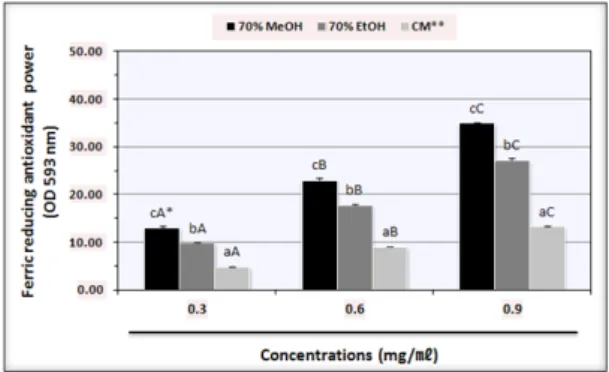
3.6. Ferric reducing antioxidant power (FRAP) FRAP 활성은 Fig. 5에서와 같이, 70% methanol 추 출물이 시료 농도별로 각각 12.95± 0.51 mg/g, 22.99±
0.55 mg/g, 34.98±0.14 mg/g로 나타나 추출물 중에서 유의적으로 가장 높은 활성을 보였다. 70% ethanol 추 출물은 농도별로 9.78±0.08 mg/g, 17.79±0.31 mg/g, 27.15±0.48 mg/g의 활성을 보였다. CM 추출물은 농 도별로 4.80±0.08 mg/g, 8.96 ±0.08 mg/g, 13.26±0.24 mg/g의 항산화 활성을 보였다. 대조군인 ascorbic acid와 BHA는 0.01 mg/㎖ 농도에서 각각 23.85±0.27 mg/g, 41.86±1.02 mg/g으로 나타났다. FRAP는 총항 산화능을 비교하는 방법이다(Jeon 등, 2011). 구아바 와 망고 껍질은 높은 FRAP 활성을 보였고 체리, 레몬,
파인애플 등도 다소 높은 FRAP 활성을 나타내었으나 금귤과 살구는 FRAP 활성이 없다고 보고된 바 있다 (Guo 등, 2003). 따라서 본 실험결과, 수박 외피의 FRAP 활성은 70% methanol, 70% ethanol, CM 추출 물 순으로 높은 것으로 나타났다.
Fig. 5. Ferric reducing antioxidant power of various solvent extracts of watermelon (Citrullus vulgaris L.).
*The data are presented as means±SD of 3 times. Means with different letters are significantly different at p<0.05 by Duncan's multiple range test.
**CM; Chloroform:Methanol=2:1 (v/v).
3.7. β-carotene bleaching activity
수박 외피의 추출 용매별 β-carotene에서의 항산화 작용은 Fig. 6에서와 같다. 70% methanol은 시료 농도 별로 61.55±0.45%, 73.60±0.78%, 78.19±1.21%로 추 출물 중에서 유의적으로 가장 높은 활성을 보였다. 70%
ethanol 추출물은 농도별로 59.12±0.61%, 70.58±0.59%, 74.54±0.64%의 활성을 나타내었다. CM 추출물은 시 료 농도별로 29.73± 1.34%, 40.05±1.52%, 48.56±0.97%
로 추출물 중에서 유의적으로 가장 낮은 활성을 보였 다. 대조군인 ascorbic acid, BHA는 0.01 mg/㎖ 농도 에서 각각 10.52±0.37%, 56.32±0.76%의 활성을 나타 내었다. 항산화제가 존재할 경우 free radical을 소거 시켜 β-carotene의 탈색을 저해한다고 알려져 있다 (Jayaprakasha 등, 2001). 자몽 및 오렌지 껍질의 β -carotene에서의 항산화 작용은 오렌지 껍질에서 더 높게 나타났으며, 과육 보다 껍질의 항산화 활성이 우 수한 것으로 보고된 바 있다(Goulas와 Manganaris, 2012). 본 실험결과 β-carotene에서의 항산화 작용은 70% methanol, 70% ethanol, CM 추출물 순으로 높았
으며, total phenol, flavonoid, DPPH 등의 실험결과와 동일한 경향을 나타내는 것으로 확인되었다.
Fig. 6. Antioxidant activity of various solvent extracts of watermelon (Citrullus vulgaris L.) by β-carotene bleaching assay.
*The data are presented as means±SD of 3 times. Means with different letters are significantly different at p<0.05 by Duncan's multiple range test.
**CM; Chloroform:Methanol=2:1 (v/v).
4. 결 론
상품성을 기대하기 힘든 수박 외피의 기능성 식품 소재로 활용 가능성을 검토하기 위하여 70% methanol, 70% ethanol, chloroform:methanol (CM, 2:1, v/v) 용 매로 추출하여 항산화 활성을 측정하였다. 수박 외피 의 항산화 활성은 시료 농도가 증가 할수록 높아지는 경향을 나타내었다. Total phenol 및 total flavonoid의 함량은 70% methanol, 70% ethanol, CM 추출물 순으 로 높게 나타났다. DPPH 및 ABTS radical 소거활성, FRAP (ferric reducing antioxidant power), β-carotene 에서의 항산화 활성 또한 70% methanol, 70% ethanol, CM 추출물 순으로 높게 나타나 total phenol 및 total flavonoid 함량과 동일한 경향을 보이는 것으로 측정 되었다. 따라서 본 실험결과, 수박 외피의 항산화 활성 은 total phenol 및 total flavonoid 함량의 영향을 받는 것으로 추정된다.
참 고 문 헌
Blois, M. S., 1958, Antioxidant determination by the use of a stable free radical, Nature, 26, 1198-1200.
Dillard, C. J., German, J. B., 2000, Phytochemicals:
nutraceuticals and human health, J. Sci. Food Agric., 80, 1744-1756.
Goulas, V., Manganaris, G. A., 2012, Exploring the phytochemical content and the antioxidant potential of Citrus fruits grown in cyprus, Food Chem., 131, 39-47.
Guo, C., Yang, J., Wei, J., Li, Y., Xu, J., Jiang, Y., 2003, Antioxidant activities of peel, pulp and seed fractions of common fruits as determined by FRAP assay, Nutr. Res., 23, 1719-1726.
Gutfinger, T., 1981, Polyphenols in olive oils, J. Am.
Oil Chem. Soc., 966-968.
Hong, S. P., Lim, J. Y., Jeong, E. J., Shin, D. H., 2008, Physicochemical properties of watermelon according to cultivars, Kor. J. Food Preserv., 15, 706-710.
Hwang, E. Y., Kim, D. H., Kim, H. J., Hwang, J. Y., Park, T. S., Lee, I. S., Son, J. H., 2011, Antioxidant activities and nitric oxide production of medicine plants in gyeongsangbukdo (Carthamus tinctorius seed, Cyperus rotundus, Schizonepeta tenuifolia, Polygonatum odoratum var. pluriflorum, Paeonia lactiflora), J. Appl. Biol. Chem., 54, 171-177.
Jang, E. H., Pyo, Y. H., Ahn, M. S., 1996, Antioxidant effect of omija (Schizandra chinesis Baillon) extracts, Kor. J. Soc. Food Sci., 12, 372-376.
Jayaprakasha, G. K., Singh, R. P., Sakariah, K. K., 2001, Antioxidant activity of grape seed (Vitis vinifera) extracts on peroxidation models in vitro, Food Chem., 73, 285-290.
Jeon, Y. H., Won, J. H., Kwon, J. E., Kim, M. R., 2011, Antioxidant activity and cytotoxic effect of an ethanol extract from seoritae, Kor. J. Food Cookery Sci., 27, 1-10.
Jeong, C. H., Choi, S. G., Heo, H. J., 2008, Analysis of nutritional compositions and antioxidative activities of Korean commercial blueberry and raspberry, J.
Kor. Soc. Food Sci. Nutr., 37, 1375-1381.
Jung, E. H., Hwang, I. K., Ha, T. Y., 2010, Properties and antioxidative activities of phenolic acid concentrates of rice bran, Kor. J. Food Sci. Technol., 42, 593-597.
Katalinic, V., Modun, D., Music, I., Boban, M., 2005, Gender differences in antioxidant capacity of rat tissues determined by 2,2'-azinobis (3-ethylbenzothiazoline 6-sulfonate; ABTS) and ferric reducing antioxidant
power (FRAP) assays, Comp. Biochem. Phys., 140, 47-52.
Kim, H. G., Jeong, S. W., Park, S. M. Lee J. E., Song, Y., Ok, S. Y., Cho, Y. A., Kim, G. S., Lee, W. S., Kim, J. H., Huh, M. R., Shin, S. C., 2013, Determination of flavonoids in the peel of citrus fruit (Citrus natsudaidai Hayata) using a HPLC-MS/MS: contribution to the overall antioxidant activity, J. Agri. Life Sci., 47, 39-49.
Kim, S. L., Kim, W. J., Lee, S. Y., Byun, S. M., 1984, Alcohol fermentation of korean watermelon juice, J.
Korean Agric. Chem. Soc., 27, 139-145.
Kumar, S., Kumar, D., Jusha, M., Saroha, K., Singh, N., Vashishta, B., 2008, Antioxidant and free radical scavenging potential of Citrullus colocynthis (L.) Schrad. methanolic fruit extract, Acta Pharm., 58, 215-220.
Lee, J. M., Chang, P. S., Lee, J. H., 2007, Comparison of oxidative stability for the thermally-oxidized vegetable oils using a DPPH method, Kor. J. Food Sci.
Technol., 39, 133-137.
Mello, B. C. B. S., Petrus, J. C. C., Hubinger, M. D., 2010, Concentration of flavonoids and phenolic compounds in aqueous and ethanolic propolis extracts through nanofiltration, J. Food Engineering, 96, 533-539.
Park, C. S., Kim, M. L., 2010, Preparation and characteri- zation of watermelon wine, Kor. J. Food Preserv., 17, 547-554
Park, S., Kang, S. C., 2005, Evaluation of physiological changes in watermelon stalk during storage under various conditions of treatments after harvesting, Korean J. Enviro. Agri., 24, 56-60.
Pastrana-Bonilla, E., Akoh, C. C., Sellappan, S., Krewer, G., 2003, Phenolic content and antioxidant capacity of muscadine grapes, J. Agric. Food Chem., 51, 5497-5503.
Re, R., Pellegrini, N., Proteggente, A., Pannala, A., Yang, M., Rice-Evans, C., 1999, Antioxidant activity applying an improved ABTS radical cation decolori- zation assay, Free Radic. Biol. Med., 26, 1231-1237.
Sohn, J. Y., Ban, S. C., Shin, J. S., Hong, S. H., 1996, Distribution of free sugars in the various portions of watermelon(Citullus vulgaris L.) and muskmelon (Cucumismelo var. reticulatus Naud.), Agric. Chem, Biotechnol., 39, 200-205.
Yang, R. L., Shi, Y. H., Hao, G., Li, W., Le, G. W., 2008, Increasing oxidative stress with progressive hyperlipidemia in human: relation between malondi- aldehyde and atherogenic index, J. Clin. Biochem.
Nutr., 43, 154-158.