http://dx.doi.org/10.12925/jkocs.2019.36.2.600
울금(
Curcuma longa
L.)의 생리활성 및 지질과산화 저해능에 미치는 영향오다영․김한수
✝부산대학교 식품공학과
(2019년 5월 1일 접수: 2019년 6월 25일 수정: 2019년 6월 26일 채택)
Effects of Turmeric ( Curcuma longa L.) Bioactivity Compounds and Lipid Peroxidation Inhibitory Action
Da-Young Oh․Han-Soo Kim✝
Department of Food Science and Technology, Pusan National University, Miryang 50463, Korea (Received May 1, 2019; Revised June 25, 2019; Accepted June 26, 2019)
요 약 : 울금(
Curcuma longa
L.)의 생리활성 및 지질과산화 저해능에 미치는 영향을 확인하고 기능 성 식품 소재로 활용 가치를 검토하기 위하여 연구를 수행하였다. 총 카로티노이드(total carotenoid) 함 량은 1.581±0.005 mg β-carotene equivalents (BCE)/g dry weight으로 관찰되었다. 70% 메탄올, chloroform:methanol (CM, 2:1, v/v), 에틸 아세테이트(ethyl acetate, EA) 3가지 용매를 사용한 추출 수율은 70% 메탄올(16.54%), CM (5.64%), EA (4.14%) 순으로 나타났다. 총 페놀 함량은 EA, CM 및 70% 메탄올에서 각각 106.287, 90.614 및 18.527 mg gallic acid equivalents (GAE)/g의 함량으로 나타났으며, 추출 용매 별 항산화능은 0.2, 0.4, 0.6, 0.8 mg/mL의 농도로 측정하였고, 양성대조구로 사 용된 BHA (butylated hydroxyanisole) 및 trolox 보다는 낮은 항산화능을 보였다. Nitric oxide (NO) 라디칼 소거능은 70% 메탄올에서 28.65~48.43%, CM 18.86~55.10%, EA에서 15.68~56.25%로 관찰 되었다. Nitrite (NO2) 소거능은 70% 메탄올, CM 및 EA 순으로 나타나 EA 추출물에서 유의적인 차이 를 보이며 강한 NO2 소거능을 나타내었다(p
<0.05). β-carotene 탈색 저해능은 70% 메탄올, CM 및 EA에서 각각 1.64~23.79%, 6.99~41.16% 및 10.20~48.52%로 관찰되었다. 한편, 지질과산화 저해능은 70% 메탄올, CM 및 EA 추출물에서 높게 측정되었다.이상의 결과로 미루어 볼 때, 울금은 기능성 식품 소재로서 활용 가치가 있을 것으로 판단된다.
주제어 : 울금(Curcuma longa L.), 항산화능, 총 카로티노이드, 총 페놀, 지질과산화 저해능
Abstract : The aim was to determine the physiological activity and antioxidant activity by lipid peroxidation inhibitory action of turmeric (
Curcuma longa
L.). Bioactive compound of total carotenoid 1.581±0.005 mg β-carotene equivalents (BCE)/g dry weight. Total phenol content was the highest in the ethyl acetate (EA) extract, followed by chloroform:methanol (CM, 2:1, v/v) and
✝
Corresponding author
(E-mail: [email protected])
70% methanol extracts. Antioxidant effects (nitrogen oxide radical scavenging activity, nitrite scavenging activity, β-carotene bleaching assay, and lipid peroxidation inhibition action) of 70%
methanol, CM, and EA extract of turmeric. Turmeric extracts yield were 70% methanol 16.54%, CM 5.64%, and EA 4.14%, respectively. Antioxidant activity of the samples exhibited a dose-dependent increase. However, in the current study, none of the samples evaluated showed activity as strong as the BHA (butylated hydroxyanisole) and trolox. Further, nitrite scavenging activity was the highest for the EA extract. As a result of this experiment, indicating their commercial value and potential applications in food and nutraceuticals.
Keywords : Turmeric (Curcuma longa L.), Antioxidant activity, Total carotenoid, Total phenol, Lipid peroxidation inhibitory action
1. 서 론
생강과(Zingiberaceae)에 속하는 울금(
Curcuma longa
L.)은 다년생 숙근성 초본식물로 아시아 등에서 자생하고 있다[1]. 오랫동안 한약재 및 향 신료로 이용하였고, 동양 사람들에게는 전염병 치 료 의약품으로 활용되어 왔다[2]. 또한, 울금의 주요 성분인 커큐민(curcumin)은 curcuminoid에 속하는 페놀 화합물로, demethoxycurcumin, bis-demethoxycurcumin, calebin 및 cyclocurcumin 등 여러 생리활성물질이 있는 것 으로 알려져 있다[3,4]. 자바 강황(Curcuma xanthorrhiza
)을 토끼에 섭취시켰을 때, 담즙 등 을 분변으로 배설을 증가시켜 지방 분해를 촉진 시키고, 지질성분을 조절하여 죽상동맥경화 및 심 혈관계질환 등을 예방할 수 있을 것으로 보고하 였다[5]. Polyphenol은 유리 라디칼(free radical) 소거능을 가지며 생리활성을 통해 건강에 유익한 효과를 주고, 산화적 스트레스와 밀접한 관련이 있는 것으로 보고되어 있다[6]. Ascorbic acid 및 tocopherol은 항산화성이 있는 수용성 및 지용성 비타민으로, 산화적 스트레스, 발암, DNA 손상 등을 예방하고[7,8], 대사 과정에서 생성된 유리 라디칼 등 활성산소종(reactive oxygen species, ROS)을 소거시켜 항산화력을 가진다고 한다[9].Butylated hydroxyanisole (BHA) 및 butylated hydroxytoluene (BHT)은 합성 산화제로 항산화 력이 우수하지만, 안전성 문제로 천연물에 존재하 는 항산화성 소재에 대한 관심이 높아지고 있다 [10]. 한편, 노화, 암 등 질병의 대부분은 ROS와 관련이 있다고 알려져 있고 ROS는 핵산, 단백질 등을 손상시켜 DNA 돌연변이와 산화적 스트레
스를 유발하고 여러 질병을 야기시키는 것으로 알려져 있다[11-13]. 베타카로틴 및 라이코펜 (lycopene)은 세포막을 산화적 손상으로부터 보호 해 주며, 고탄수화물 및 고지방 식이는 지방 생 성을 억제하여 복부 지방 감소와 지질성분 개선 으로 만성질환 예방 등에 효과가 있는 것으로 보 고하였다[14,15]. 특히, 베타카로틴(β-carotene) 은 일중항 산소(singlet oxygen)를 효율적으로 제 거하여 항산화능을 나타낸다고 하였다[16]. 따라 서 울금의 총 카로티노이드(total carotenoid) 함 량과 에틸 아세테이트(ethyl acetate, EA), 70%
메탄올 및 chloroform:methanol (CM, 2:1, v/v) 용매를 사용하여 추출한 후, 총 페놀(total phenol) 함량, 항산화능(antioxidant activity by β-carotene bleaching assay), 질소산화물 소거 능(nitric oxide radical scavenging activity 및 nitrite scavenging activity), 지질과산화 저해능 (lipid peroxidation inhibition action) 등을 측정 하여 비교 분석함으로서, 고부가가치의 식품 소재 및 천연 항산화제로서 활용 가능성을 증대시키고 자 본 실험을 행하였다.
2. 재료 및 방법
2.1. 실험 재료전남 진도영농조합법인(Jindo, Jeonnam, Korea) 에서 구입한 울금(
Curcuma longa
L.)은 진공동 결건조(EYELA, FDU-2000, Rikakikai Co., Tokyo, Japan)시킨 후, 분쇄기(HMF-3250S, Han-I1 Co., Seoul, Korea)로 마쇄하여 분말로 만든 다음, 울금 100 g에 70% 메탄올,chloroform:methanol (CM, 2:1, v/v), 에틸 아 세테이트(ethyl acetate, EA) 용매를 각 10배 가 하여(1:10, w/v) 24시간씩 2회 추출한 후 여과 (filter paper, Advantec, No.2, Tokyo, Japan)하 였다. 각 추출물은 진공회전농축기(Hei-VAP Advantage, Heidolph Co., Germany)를 이용하 여 40℃에서 감압 농축하여 용매를 완전히 제거 한 후, -80℃(DF-8514, Il-Shin BioBase Co., Daegu, Korea)에 저장하면서 본 실험에 사용하 였고, 시료의 수율은 추출 전 시료 중량에 대한 추출 후 건조 중량 백분율(%)로 70% 메탄올 (16.54%), CM (5.64%), EA (4.14%) 순으로 70% 메탄올 추출물에서 높게 나타났다.
2.2. 총 카로티노이드 함량 측정
총 카로티노이드(total carotenoid) 함량은 Machmudahd와 Goto의 방법[17]을 변형하여 측 정하였다. 울금 분말 0.5 g에 노르말 헥산:아세 톤:에탄올(v/v/v, 2:1:1) 10.0 mL를 혼합하여 4℃에서 24시간 반복 추출하여 3,000 rpm에 20 분간 원심분리하였다. 상등액 노르말 헥산층을 취 해 40℃ 이하에서 농축 한 후, 메탄올 10.0 mL 를 첨가하여 분광광도계(Specord 200 Plus, Analytikjena Co., Jena, Germany)를 이용하여 478 nm 흡광도에서 측정하였다. 표준물질로 β -carotene (Sigma-Aldrich, St. Louis, USA)을 사용하여 표준 검량 곡선을 작성하였고, 총 카로 티노이드 함량은 건조 시료 당 mg BCE (β -carotene equivalents)로 나타내었다.
2.3. 총 페놀 측정
울금의 총 페놀(total phenol) 함량은 folin- ciocalteu reagent (FCR) 방법[18]을 변형하여 측 정하였다. 시료 추출액 1.0 mL에 증류수 4.0 mL 을 넣고, FCR (Sigma-Aldrich, St. Louis, USA) 0.5 mL를 첨가한 후, 잘 교반하여 3분간 실온에 방치하였다. 10% sodium carbonate solution 0.5 mL를 가하여 실온에 1시간 동안 반응시켜 750 nm에서 흡광도를 측정하였다. 표준물질로는 gallic acid (Sigma-Aldrich, St. Louis, USA)를 사용하여 표준 검량 곡선을 작성하였고 시료 g 당 mg GAE (mg of gallic acid equivalents)로 나타내었다.
2.4. Nitric oxide (NO) 라디칼 소거능 측정 Nitric oxide (NO) 라디칼 소거능은 Rao의 방
법[19]에 준하여 측정하였다. 용매 별 추출물의 각 농도 1.0 mL에 10 mM sodium nitroferricyanide (III) dihydrate 및 0.2 M PBS (phosphate buffered saline, pH 7.4) 5.0 mL을 가하여 교반하였다. 25℃ 수조(water bath)에서 150분간 방치시킨 후 반응액을 조제하였다. 1%
sulfanilamine, 2% H3PO4 1.0 mL 및 0.1%
N-(1-Naphthyl) ethylenediamine dihydro- chloride 1.0 mL와 반응액 0.5 mL를 가하여 잘 혼합한 후 25℃ 수조에서 30분간 방치시켜 540 nm에서 흡광도를 측정하였다. NO 라디칼 소거 능은 다음의 식에 의해 백분율로 나타내었고, 활 성 비교를 위해 trolox (6-hydroxy-2,5,7,8- tetramethylchroman-2-carboxylic acid, Sigma- Aldrich, St. Louis, USA)를 사용하였다.
Nitric oxide (NO) radical scavenging activity (%)
= [1-(Sample OD540/Blank OD540)] × 100 %
2.5. Nitrite (NO2) 소거능 측정
울금의 nitrite (NO2) 소거능은 Kumaran과 Karunakaran의 방법[20]을 변형하여 측정하였다.
시료 1.0 mL와 1 mM sodium nitrite 1.0 mL 및 0.2 M citrate buffer (pH 2.5) 7.0 mL를 가 하여 교반한 후, 수조에 37℃로 1시간 반응시켰 다. 반응액 0.4 mL에 2% 초산 3.0 mL 및 griess reagent (1% sulfanilic acid:1%
1-naphthylamine, 1:1, v/v) 0.4 mL를 넣은 후 15분간 방치시켰다. 520 nm에서 흡광도를 측정 하였고 양성대조구로는 BHA (butylated hydroxyanisole, Sigma-Aldrich, St. Louis, USA) 를 사용하여 백분율로 표시하였다.
Nitrite (NO2) scavenging activity (%)
= [1-(Reacted sample OD520-Sample OD520/1 mM NaNO2 OD520)] × 100 %
2.6. β-carotene bleaching을 이용한 항산화능 측정
β-carotene 탈색을 이용한 항산화능은 Dawidowicz와 Olszowy의 방법[21]을 변형하여 측정하였다. β-carotene 1.0 mg 및 클로로폼 10.0 mL를 첨가하여 β-carotene 용액을 조제하 였고 조제된 β-carotene 용액 1.0 mL를 둥근 플라스크를 사용하여 linoleic acid 20.0 mg과
Assays
Total carotenoid
(mg BCE1)/g dry weight) 1.581±0.005
70% Methanol CM2) EA3)
Total phenol content (mg GAE4)/g) 18.527±0.134a5) 90.614±1.003b 106.287±1.008c
1)BCE: β
-
carotene equivalents. 2)CM: chloroform:methanol (2:1, v/v). 3)EA: ethyl acetate.4)GAE: gallic acid equivalents.
5)The values are means±standard deviation (
n
=3). Values with the different letters in the same row are significantly different (p
<0.05) by Duncan`s multiple range tests.Table 1. Contents of total carotenoid and total phenol in the bioactivity evaluation assays from turmeric (
Curcuma longa
L.)Tween 40 200.0 mg을 첨가하여 교반하였다. 남 아있는 클로로폼을 40℃의 진공회전농축기로 제 거한 후 증류수 100.0 mL를 넣고 혼합한 emulsion을 조제하였다. 시험관에 β-carotene- linoleic acid emulsion 4.0 mL와 농도 별 시료추 출물 0.08 mL를 가하여 교반하였고, 470 nm에 서 흡광도를 측정하였다(t=0 min). 50℃의 수조 에서 2시간 동안 방치시켜 470 nm에서 흡광도를 재 측정하였다(t=120 min). 이때 활성 비교를 위 해 BHA를 사용하였으며 항산화능은 아래 식을 사용하여 계산하였다
Antioxidant activity (%)
=
× 100 %
A
s = the absorbance in the presence of sample extract.A
b = the absorbance of the blank.2.7. 지질과산화 저해능 측정
지질과산화 저해능(lipid peroxidation inhibition action) 측정은 Siriwardhana 등의 방 법[22]에 준하여 측정하였다. 용매 별 각 시료 1.0 mL, 2.5% linoleic acid emulsion 2.0 mL 및 phosphate buffer (pH 7.0) 10.0 mL를 첨가 하여 교반한 후, 증류수 8.0 mL를 가하여 혼합하 였다. 빛을 차단한 40℃ 수조에 24시간 동안 혼 합액을 반응시킨 다음, 반응액 0.1 mL에 30%
ammonium thiocyanate 0.1 mL와 에탄올 3.7 mL 및 0.02 M ferrous chloride 0.1 mL를 가하 여 3분간 교반하여 산화 정도에 따른 흡광도를 500 nm에서 측정하였다. 활성 비교를 위해 BHA
를 사용하였으며, 아래의 식에 의하여 백분율(%) 로 계산하여 지질과산화 저해능을 나타내었다.
Lipid peroxidation inhibition action (%)
= [1-(Sample OD500/Blank OD500)] × 100 %
2.8. 통계 처리
3회 반복 측정하여, 평균값±표준편차 (
n
=3)로 나타내었다. 결과값 간의 유의성 검정은 일원분산 분석으로 분석한 후,p
<0.05 수준에서 Duncan's multiple range test에 의하여 실험군 간의 유의 적인 차이를 알아보았다. 울금의 각 농도 간의 결과값에 대한 IC50은 선형 회귀분석을 통하여 구하였고, 통계처리 프로그램은 IBM SPSS statistic ver. 22를 사용하였다.3. 결과 및 고찰
3.1. 총 카로티노이드 함량울금(
Curcuma longa
L.)의 총 카로티노이드 (total carotenoid) 함량은 Table 1과 같이, 1.581±0.005 mg β-carotene equivalents (BCE)/g dry weight으로 관찰되었다. 카로티노이 드는 항산화 작용과 생리적 활성으로 지질, 단백 질 및 DNA를 산화적 손상으로부터 보호하여, 질 환 등을 예방하는 것으로 보고되어 있다[16,23].3.2. 총 페놀 함량
용매 별 추출물의 총 페놀(total phenol) 함량 은 Table 1에 나타내었으며, EA 추출물에서 106.287±1.008 mg gallic acid equivalents (GAE)/g으로 높은 함량을 보였다. CM 추출물에
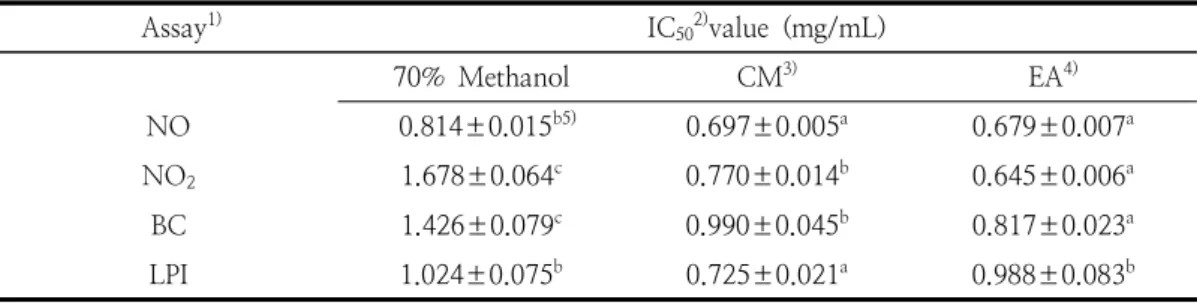
Assay1) IC502)value (mg/mL)
70% Methanol CM3) EA4)
NO 0.814±0.015b5) 0.697±0.005a 0.679±0.007a NO2 1.678±0.064c 0.770±0.014b 0.645±0.006a
BC 1.426±0.079c 0.990±0.045b 0.817±0.023a
LPI 1.024±0.075b 0.725±0.021a 0.988±0.083b
1)Nitric oxide (NO) radical scavenging activity, nitrite (NO2) scavenging activity, antioxidant activity by β-carotene (BC) bleaching assay and lipid peroxidation inhibition (LPI) action.
2)IC50: half-maximal inhibitory concentration. 3)CM: chloroform:methanol (2:1, v/v). 4)EA:
ethyl acetate.
5)The values are means±standard deviation (
n
=3). Values with the different letters in the same row are significantly different (p
<0.05) by Duncan`s multiple range tests.Table 2. IC50 values of NO radical scavenging activity, NO2 scavenging activity, antioxidant activity by BC bleaching assay and LPI action by turmeric (
Curcuma longa
L.)서는 90.614±1.003 mg GAE/g, 70% 메탄올 추 출물 18.527±0.134 mg GAE/g 함량으로 70%
메탄올 추출물에서 낮은 것으로 나타났다.
Mongkolsilp 등[24]에 의하면 울금 메탄올:증류 수(80:20, v/v) 추출물에서 총 페놀 함량은 1.22 mg GAE/100 mg 범위이며, Wojdylo 등[25]은 1.72 mg GAE/100 g dry weight으로 보고하였 고, 페놀 함유로 유리 라디칼 소거능을 갖는다고 하였다. 본 실험 결과, EA 추출물에서 CM 및 70% 메탄올 추출물 보다 높게 나타났으며, 이에 따른 생리활성 효과가 있을 것으로 판단된다.
3.3. Nitric oxide (NO) 라디칼 소거능
Nitric oxide (NO) 라디칼 소거능은 Fig. 1과 같으며, IC50을 구한 값은 Table 2에 나타내었다.
활성 비교를 위해 trolox를 사용하였고, 울금의 각 용매 별 0.2, 0.4, 0.6, 0.8 mg/mL의 농도에 서 NO 라디칼 소거능을 측정한 결과, 모든 농도 에서 농도 의존적으로 유의하게 증가되는 것으로 나타났다(
p
<0.05). 70% 메탄올 추출물에서 농도 별(0.2~0.8 mg/mL)로 28.65±1.35%, 36.57±1.17%, 44.29±0.42%, 48.43±0.62%, IC50
0.814±0.015 mg/mL, CM 추출물에서 각각 18.86±1.05%, 31.07±0.54%, 46.14±0.61%, 55.10±0.94%, IC50 0.697±0.005 mg/mL, EA 추출물은 15.68±0.58%, 29.38±0.89%, 48.27±
0.31%, 56.25±0.56%, IC50 0.679±0.007 mg/mL로 나타났다. 양성대조구인 trolox는
83.59±0.67%, 90.56±0.50%, 90.27±0.33%, 90.59±0.06%로 강력한 NO 라디칼 소거능이 관 찰되었다(
p
<0.05). NO는 nitric oxide synthase에 의해 형성이 되며[26,27], 생리적 농도가 증가되 면 세포와 조직에 손상을 주는 것으로 보고되어 있다[28].Fig. 1. Nitric oxide (NO) radical scavenging activity of various solvent extracts from turmeric (
Curcuma longa
L.).1)The values are means±standard deviation (
n
=3). Bars with the different letters are significantly different (p
<0.05) by Duncan’s multiple range tests. 2)CM: chloroform:methanol (2:1, v/v). 3)EA: ethyl acetate.
3.4. Nitrite (NO2) 소거능
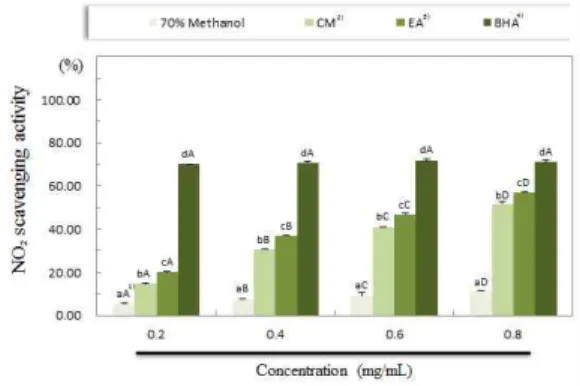
울금의 용매 별 nitrite (NO2) 소거능은 Fig. 2 에 나타내었으며, IC50을 구한 값은 Table 2와 같 다. 양성대조구로 BHA를 사용하였으며, 울금의 각 용매 별(0.2, 0.4, 0.6, 0.8 mg/mL) EA 추출 물에서 20.06±0.18%, 36.97±0.18%, 46.84±
0.61%, 56.82±0.35%, IC50 0.645±0.006 mg/mL, CM 추출물은 14.77±0.31%, 30.55±
0.18%, 41.04±0.00%, 51.73±1.06%, IC50
0.770±0.014 mg/mL, 70% 메탄올 추출물 5.40±0.47%, 7.64±0.18%, 9.27±1.33%, 11.41±0.31%, IC50 1.678±0.064 mg/mL로 관 찰되었다. BHA는 각 농도에서 70.06±0.00%, 70.88±0.77%, 71.59±1.10%, 71.08±0.98%로 강력한 NO2 소거능을 나타내었다. 아질산염은 유전성 변이를 유발하거나 세포 파괴를 일으키는 것으로 알려져 있다[29].
본 실험 결과 EA 추출물에서 CM 및 70% 메 탄올 추출물보다 NO2 소거능이 강한 것으로 관 찰되었다.
Fig. 2. Nitrite (NO2) scavenging activity of various solvent extracts from turmeric (
Curcuma longa
L.).1)The values are means±standard deviation (
n
=3). Bars with the different letters are significantly different (p
<0.05) by Duncan’s multiple range tests. 2)CM: chloroform:methanol (2:1, v/v). 3)EA: ethyl acetate. 4)BHA:butylated hydroxyanisole.
3.5. β-carotene bleaching을 이용한 항산화능
β-carotene 탈색을 이용한 항산화능은 Fig. 3
과 같으며, IC50을 구한 값은 Table 2에 나타내었 다. 양성대조구로 BHA를 사용하였으며, 울금의 농도 별(0.2~0.8 mg/mL) EA 추출물은 10.20±
0.44%, 24.17±1.44%, 39.58±2.41%, 48.52±
0.95%, IC50 0.817±0.023 mg/mL로, CM 추출 물에서 6.99±1.04%, 20.77±1.21%, 31.53±
2.38%, 41.16±1.85%, IC50 0.990±0.045 mg/mL, 70% 메탄올 추출물 1.64±0.50%, 8.24±1.50%, 15.42±2.45%, 23.79±1.37%, IC50 1.426±0.079 mg/mL로 나타났다. BHA는 각 농도에서 66.27±6.70%, 76.71±1.33%, 81.31±0.87%, 81.75±1.89%로 β-carotene 탈 색 저해능을 나타내었다. β-carotene/linoleic acid emulsion으로 생성된 과산화 라디칼(LOO
•)이 항산화 물질과 반응하여 β-carotene의 탈 색의 진행을 억제시켜, 470 nm 부근에서 흡광도 를 측정하는 것으로 알려져 있다[30].
Fig. 3. Antioxidant activity by β-carotene (BC) bleaching assay of various solvent extracts from turmeric (
Curcuma longa
L.).1)The values are means±standarddeviation (
n
=3). Bars with the different letters are significantly different (p
<0.05) by Duncan’s multiple range tests. 2)CM: chloroform:methanol (2:1, v/v). 3)EA: ethyl acetate. 4)BHA:butylated hydroxyanisole.
3.6. 지질과산화 저해능
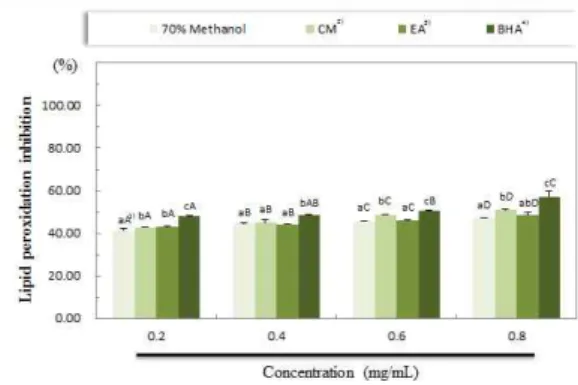
울금의 용매 별 추출물과 활성 비교를 위한 BHA의 지질과산화 저해능(lipid peroxidation inhibition action)은 Fig. 4와 같으며, IC50을 구 한 값은 Table 2에 타나내었다. 울금 추출물의
각 농도 0.2, 0.4, 0.6, 0.8 mg/mL에서 지질과산 화 저해능을 측정한 결과는 다음과 같다. 농도 별 EA 추출물에서 42.84±0.41%, 44.11±
0.07%, 46.04±0.27%, 48.55±1.11%, IC50
0.988±0.083 mg/mL, CM 추출물은 42.68±
0.33%, 45.04±1.08%, 48.67±0.12%, 50.87±
0.31%, IC50 0.725±0.021 mg/mL, 70% 메탄올 추출물 41.10±1.14%, 44.57±0.13%, 45.77±
0.00%, 47.47±0.07%, IC50 1.024±0.075 mg/mL로 나타났다. BHA는 각 농도에서 47.97±0.20%, 48.40±0.24%, 50.48±0.13%, 57.16±2.50%로 관찰되었다.
지질과산화는 지질 이중층 막의 구조를 변형시 켜, 세포의 기능에 영향을 주는 것으로 알려져 있고[31], 폴리 페놀이 갖는 항산화 성질이 지질 과산화 저해능에 작용되는 것으로 보고하였다 [32]. 본 실험 결과 울금의 EA, CM 및 70% 메 탄올 추출물 모두에서 높은 수준의 지질과산화 저해능이 관찰되어 천연 산화방지제로 가치가 있 을 것으로 생각된다.
Fig. 4. Lipid peroxidation inhibition (LPI) action of various solvent extracts from turmeric (
Curcuma longa
L.).1)The values are means±standard deviation (
n
=3). Bars with the different letters are significantly different (p
<0.05) by Duncan’s multiple range tests. 2)CM: chloroform:methanol (2:1, v/v). 3)EA: ethyl acetate. 4)BHA:butylated hydroxyanisole.
4. 결 론
70% 메탄올, chloroform:methanol (CM, 2:1, v/v) 및 ethyl acetate (EA) 3가지 용매를 사용하 여 울금(
Curcuma longa
L.)의 천연 항산화제로 서 이용 가능성을 검토한 결과, 총 카로티노이드 함량은 1.581±0.005 mg β-carotene equivalents (BCE)/g dry weight으로 관찰되었다.추출 수율의 결과는 70% 메탄올 16.54%, CM 5.64%, EA 4.14% 순으로 70% 메탄올 추출물에 서 높게 나타났으며, EA 추출물에서 낮은 수율을
확인하였다. 총 페놀 함량과 항산화능
(antioxidant activity by β-carotene bleaching assay), 질소산화물 소거능(nitric oxide radical scavenging activity 및 nitrite scavenging activity) 및 지질과산화 저해능(lipid peroxidation inhibition action) 측정은 추출 용 매 별 0.2, 0.4, 0.6, 0.8 mg/mL 농도로 분석하 였고, 농도가 증가할수록 항산화능, 질소산화물 소거능 및 지질과산화 저해능은 증가하는 것으로 나타났다. NO 라디칼 소거능은 EA 추출물에서 각 농도(0.2~0.8 mg/mL) 별 15.68~56.25%, CM 추출물은 18.86~55.10%, 70% 메탄올 추출 물이 28.65~48.43%로 관찰되었다. 0.2, 0.4 mg/mL농도를 제외한 농도에서 CM 및 EA 추출 물은 비교적 높은 NO 라디칼 소거능을 나타내었 다. NO2 소거능은 EA, CM 및 70% 메탄올 추 출물에서 각각 20.06~56.82%, 14.77~51.73%
및 5.40~11.41%로 나타났으며, EA 추출물에서 유의적인 차이를 보이며 높은 NO2 소거능을 보 였다(
p
<0.05). β-carotene 탈색을 이용한 항산화 능은 EA 추출물에서 10.20~48.52%로 나타났으 며, CM 추출물에서 6.99~41.16%, 70% 메탄올 추출물에서 1.64~23.79%로 확인되어 EA 추출물 의 CM 및 70% 메탄올 추출물 보다 β -carotene 탈색 저해능이 강한 것으로 확인되었 다(p
<0.05). 지질과산화 저해능은 EA 추출물에서 42.84~48.55%, CM 추출물이 42.68~50.87%, 70% 메탄올 추출물은 41.10~47.47%로 동정되 어 3가지 용매에서 지질과산화 저해능이 강한 것 으로 확인되었다. 이에 울금은 총 카로티노이드 함량이 높은 수준으로 확인 되었으며, 용매 별 추출물의 총 페놀 함량 및 항산화능이 우수한 것 으로 판단되어, 천연 항산화제로서 활용 가능성이 있을 것으로 생각된다.References
1. C. A. C. Araujo, L. L. Leon, “Biological activities of
Curcuma longa
L.”,Mem.
Inst. Oswaldo Cruz
, Vol.96, No.5 pp.723-728, (2001).
2. R. Mohebbati, A. Anaeigoudari, M. R.
Khazdair, “The effects of
Curcuma longa
and curcumin on reproductive systems”,Endocrine Regulations
, Vol.51, No.4 pp.220-228, (2017).
3. M. S. Kim, S. S. Chun, J. H. Choi,
“Effects of turmeric (
Curcuma longa
L.) on antioxidative systems and oxidative damage in rats fed a high fat and cholesterol diet”,J. Korean Soc. Food Sci.
Nutr
., Vol.42, No.4 pp. 570-576, (2013).4. I. Ali, A. Haque, K. Saleem, “Separation and identification of curcuminoids in turmeric powder by HPLC using phenyl column”,
Anal. Methods
, Vol.6, No.8 pp.2526-2536, (2014).
5. I. Wientarsih, S. Chakeredza, U. ter Meulen, “Influence of curcuma (
Curcuma xanthorrhiza
Roxb) on lipid metabolism in rabbits”,J. Sci. Food Agric
., Vol.82, No.15 pp. 1875-1880, (2002).6. E. Herrera, R. Jiménez, O. I. Aruoma, S.
Hercberg, I. Sánchez-García, C. Fraga,
“Aspects of antioxidant foods and supplements in health and disease”,
Nutr.
Rev
., Vol.67, No.s1 pp. S140-144, (2009).7. H. Y. Huang, K. J. Helzlsouer, L. J.
Appel, “The effects of vitamin C and vitamin E on oxidative DNA damage:
results from a randomized controlled trial”,
Cancer Epidemiol. Biomarkers Prev.
, Vol.9, No.7 pp. 647-652, (2000).8. A. Valavanidis, T. Vlachogianni, C.
Fiotakis, “8-hydroxy-2′-deoxyguanosine (8-OHdG): a critical biomarker of oxidative stress and carcinogenesis”,
J.
Environ. Sci. Health. Environ. Carcinog.
Ecotoxicol. Rev.
, Vol.27, No.2 pp.120-139, (2009).
9. O. Arrigoni, M. C. De Tullio, “Ascorbic acid: much more than just an antioxidant”,
Biochimica Biophysica Acta,
Vol.1569, No.1 pp. 1-9, (2002).10. A. Seifi-Jamadi, H. Kohram, A. Zareh- Shahne, P. Dehghanizadeh, E. Ahmad,
“Effect of various concentrations of butylated hydroxyanisole and butylated hydroxytoluene on freezing capacity of Turkman stallion sperm”,
Anim. Reprod.
Sci
., Vol.170, pp. 108-113, (2016).11. L. Shen, H. Y. Zhang, H. F. Ji, “A thermodynamic investigation of DPPH radical-scavenging mechanisms of folates”,
J. Mol. Struct. (THEOCHEM),
Vol.856, No.1-3 pp. 119-123, (2008).12. M. Valko, D. Leibfritz, J. Moncol, M. T.
Cronin, M. Mazur, J. Telser, “Free radicals and antioxidants in normal physiological functions and human disease”,
Int. J. Biochem
.Cell Biology.,
Vol.39, pp. 44-84, (2007).13. R. L. Yang, Y. H. Shi, G. Hao, W. Li, G.
W. Le, “Increasing oxidative stress with progressive hyperlipidemia in human:
relation between malondialdehyde and atherogenic index”,
J. Clin. Biochem
.Nutr
., Vol.43, No.3 pp. 154-158, (2008).14. H. Poudyal, S. Panchal, L. Brown,
“Comparison of purple carrot juice and β -carotene in a high-carbohydrate, high-fat diet-fed rat model of the metabolic syndrome”,
Br. J. Nutr
., Vol.104, No.9 pp.1322-1332, (2010).
15. H. S. Black, “Interaction of ascorbic acid and tocopherolon β-carotene modulated carcinogenesis”,
Hemoglobin
, Vol.34, No.3 pp. 284-290, (2010).16. F. Q. Schafer, H. P. Wang, E. E. Kelley, K. L. Cueno, S. M. Martin, G. R.
Buettner, “Comparing β-carotene, vitamin E and nitric oxide as membrane antioxidants”,
Biol. Chem
., Vol.383, No.3-4 pp. 671-681, (2002).17. S. Machmudah, M. Goto, “Methods for extraction and analysis of carotenoids”,
Natural products
, Springer Berlin Heidelberg, pp. 3367-3411, (2013).18. P. C. Wootton-Beard, A. Moran, L. Ryan,
“Stability of the total antioxidant capacity and total polyphenol content of 23 commercially available vegetable juices before and after
in vitro
digestion measured by FRAP, DPPH, ABTS and Folin–Ciocalteu methods”,Food Res.
Intern
., Vol.44, No.1 pp. 217-224, (2011).19. M. N. A. Rao, “Nitric oxide scavenging by curcuminoids”,
J. Pharm. Pharmacol
., Vol.49, No.1 pp. 105-107, (1997).20. A. Kumaran, R. J. Karunakaran, “Nitric oxide radical scavenging active components from
Phyllanthus emblica
L”,Plant Foods Hum. Nutr
., Vol.61, No.1 pp. 1-5, (2006).21. A. L. Dawidowicz, M. Olszowy, “Influence of some experimental variables and matrix components in the determination of antioxidant properties by β-carotene bleaching assay: experiments with BHT used as standard antioxidant”,
Eur. Food Res. Technol
., Vol.231, No.6 pp. 835-840, (2010).22. N. Siriwardhana, K. W. Lee, Y. J. Jeon, S.
H. Kim, J. W. Haw, “Antioxidant activity of Hizikia fusiformis on reactive oxygen species scavenging and lipid peroxidation inhibition”,
Food Sci. Technol. Int.
, Vol.9, No.5 pp. 339-346, (2003).23. F. Ahmed, K. Fanning, M. Netzel, P. M.
Schenk, “Induced carotenoid accumulation in
Dunaliella salina
andTetraselmis suecica
by plant hormones and UV-C radiation”,Appl. Microbiol. Biotechnol
., Vol.99, No.22 pp. 9407-9416, (2015).24. S. Mongkolsilp, I. Pongbupakit, N.
Sae-Lee, W. Sitthithaworn, “Radical scavenging activity and total phenolic content of medicinal plants used in primary health care”,
SWU. J. Pharm. Sci.,
Vol.9, No.1 pp. 32-35, (2004).25. A. Wojdylo, J. Oszmiański, R. Czemerys,
“Antioxidant activity and phenolic compounds in 32 selected herbs”,
Food Chem
., Vol.105, No.3 pp. 940-949, (2007).26. H. Rubbo, C. Batthyany, R. Radi, “Nitric oxide: oxygen radical interactions in atherosclerosis”,
Biol. Res.
, Vol.33, No.2 pp. 167-175, (2000).27. G. M. Rosen, P. Tsai, S. Pou, “Mechanism of free-radical generation by nitric oxide synthase”,
Chem. Rev
., Vol.102, No.4 pp.1191-1200, (2002).
28. Y. Sueishi, M. Hori, M. Kita, Y. Kotake,
“Nitric oxide (NO) scavenging capacity of natural antioxidants”,
Food Chem
., Vol.129, No.3 pp. 866-870, (2011).29. M. W. Byun, H. S. Yook, K. S. Kim, C.
K. Chung, “Effects of gamma- irradiation on physiological effectiveness of Korean medicinal herbs”,
Radiat. Physic. Chem
., Vol.54, No.3 pp. 291-300, (1999).30. A. L. Dawidowicz, M. Olszowy, “Influence of some experimental variables and matrix components in the determination of antioxidant properties by β-carotene bleaching assay: experiments with BHT used as standard antioxidant”,
Eur. Food Res. Technol
., Vol.231, No.6 pp. 835-840, (2010).31. P. Podloucká, K. Berka, G. Fabre, M.
Paloncýová, J. L. Duroux, M. Otyepka, P.
Trouillas, “Lipid bilayer membrane affinity rationalizes inhibition of lipid peroxidation by a natural lignan antioxidant”,
J. Physic.
Chem. B
, Vol.117, No.17 pp. 5043-5049, (2013).32. E. J. Cho, T. Yokozawa, D. Y. Rhyu, H.
Y. Kim, N. Shibahara, J. C. Park, “The inhibitory effects of 12 medicinal plants and their component compounds on lipid peroxidation”,