http://dx.doi.org/10.12925/jkocs.2015.32.2.302
Determination of Bioactive Compounds and Antioxidant Activity of Yam ( Dioscorea batatas DECNE . ) on Thermal Treatment
Yishan Duan
1ㆍGyeong-Hwuii Kim
2ㆍHan-Soo Kim
1,†1
Department of Food Science and Technology, Pusan National University, Miryang 627-706, Korea
2
Department of Biomaterials Science and Engineering, Yonsei University, Seoul 120-749, Korea (Received May 31, 2015; Revised June 15, 2015; Accepted June 15, 2015)
Abstract : To better investigate the antioxidative property of thermal treatment yam ( Dioscorea batatas DECNE.) in Korea, some established methods were used. 70% Methanol, 70% ethanol and chloroform–methanol (CM, 2:1, v/v) extracts were collected. 70% Methanol extract exhibited stronger antioxidative activity evaluated by ferrous ion chelating activity, NO radical scavenging activity and β-carotene bleaching assays. On the contrary, CM extract was the most effective in inhibiting linoleic acid peroxidation. Yam available in Korea was also analyzed for its bioactive compounds such as lycopene, chlorophyll a, b, tannin, phytic acid and total saponin contents.
Total saponin was abundant in thermal treatment, which determined to be 42.52±1.88 mg/g.
Based on the results obtained from this study, thermal treatment yam could be used as natural antioxidant source due to its high antioxidant activity and bioactive compound contents.
Keywords : thermal treatment yam (Dioscorea batatas DECNE.), bioactive compounds, NO radical, metal chelating, lipid peroxidation inhibition
1. Introduction
Reactive oxygen species including free radicals such as superoxide anion radicals, hydroxyl radicals, singlet oxygen and non-free radical species such as hydrogen peroxide, which are various forms of active oxygen and usually generated by oxidation product of biological reactions or exogenous factors [25].
The overproduction of ROS can damage cellular lipids, proteins or DNA and further cause cancer, aging, atherosclerosis, coronary heart diseases and neurodegenerative diseases
✝
Corresponding author
(E-mail: [email protected])
[11,20,31].
An increasingly important health problem in the world is the rising incidence of some diseases such as age-related neurodegenerative diseases, cardiovascular disease and cancer.
Fruit and vegetables contain not only essential nutrients needed for daily life but also a wide variety of bioactive compounds (antioxidant phytochemicals) for health promotion and disease prevention [18,26]. There are several previous studies have conducted that people who have diets rich in natural water-soluble antioxidants such as fresh fruits and vegetables can improve the antioxidant activity and reduce the risk of chronic diseases [3].
Currently, a very promising way to overcome
oxidative degradation is to increase the consumption of diets rich in fruit or vegetable.
Yam ( Dioscorea batatas DECNE.) belongs to the Dioscoreaceae family and usually serves as the crucial staple food as well as traditional medicine ingredient in many parts of world [8,11,19]. Previous studies have conclusively conducted that dioscorins are the storage proteins of yam tubers, which not only exhibit dehydroascorbate reductase and monodehydroascorbate reductase activities but also reveal antioxidant activities [9,10]. And glycoprotein has been demonstrated to have an antioxidative potential as one of natural antioxidants as well as a property of anti-inflammatory [23,24].
In this study, bioactive compounds in thermal treatment yam were determined.
Additionally, antioxidant activity of thermal treatment yam extracts by 70% methanol, 70%
ethanol and chloroform–methanol mixture (CM, 2:1, v/v) were investigated and compared in vitro methods.
2. Materials and Methods 2.1. Materials
Yam ( Dioscorea batatas DECNE
.) was purchased from Andong (Korea), which was seeded in March or April and harvested in the end of October or December. The fresh yam was processed in a procedure of washing, slicing (thickness, 0.4–0.6 cm), steaming (80–90℃, 24 h), drying (hot air, 60–70℃, 18–24 h) and smashing (150-mesh) into thermal treatment yammeals (TTY, commonly called black yam).
2.2. Preparation of yam extracts
Yam meals and extraction solvents including 70% methanol, 70% ethanol and chloroform–methanol mixture (CM, 2:1, v/v) were mixed in a ratio of 1:10 and kept in the dark about 3 h, and then used the Advantec
No. 1 filter paper (Tokyo, Japan) to filter.
The process of extraction was repeated 3 times. The filtrate was evaporated by rotary vacuum evaporator (EYELA, N-N series, Tokyo, Japan) until the solvents were completely removed. The various extraction yields of TTY by 70% methanol, 70% ethanol and CM were 15.89%, 11.89% and 0.93%, respectively. The yam extracts were collected and sealed in brown reagent bottles and frozen at –80℃ until required for further analyses.
2.3. Bioactive compounds determination 2.3.1. Lycopene and chlorophyll a, b contents determination
The contents of lycopene and chlorophyll a, b were determined by the method of Nagata and Yamashita [22]. The results were expressed as mg per 100 g of dry weight (mg/100g DW). The lycopene and chlorophyll a, b contents were calculated by the following equation;
Lycopene (mg/100 mL) =
–0.0458 A
663+2.04 A
645+0.372 A
505– 0.0806 A
453Chlorophyll a (mg/100 mL) = 0.999 A
663– 0.0989 A
645Chlorophyll b (mg/100 mL) = –0.0328 A
663+1.77 A
645A
453, A
505, A
645and A
663were the absorbance at 453 nm, 505 nm, 645 nm and 663nm.
2.3.2. Tannin content determination
The tannin content assay was determined according to the method of Price and Butler [27]. Catechin was used to calculate standard curve. Results were expressed as mg of catechin equivalents per g of dry weight (mg CE/ g DW).
2.3.3. Phytic acid content determination
The phytic acid content determination was
carried out as described by Wu, Zhao, and
Tian [32]. Phytic acid sodium salt hydrate was
used as standard to make the calibration
curve. The results were expressed as mg per g
of dry weight (mg/g DW).
2.3.4. Total saponin content determination The total saponin extraction and assessment procedures were performed by modifying the method of Xu and Chang [33]. The results were expressed as mg of saponin equivalent per g of yam on a dry weight (mg/g DW) basis from a standard curve of different concentrations of crude saponin.
2.4. Antioxidant activity determiantion 2.4.1. Ferrous ion chelating activity determination
1 mL of yam extract at different concentrations, 0.05 mL of 2 mM FeCl
2·4H
2O, 0.1 mL of 5 mM ferrozine and 3 mL of ethanol were mixed. After 10 min of incubation at room temperature, the absorbance of Fe
2+– ferrozine complex was measured at 562 nm. The chelating activity of yam extract for Fe
2+was calculated as follows:
Ferrous ion chelating activity (%) =
×
Where A
sand A
care the absorbance of sample and control [7].
2.4.2. NO radical scavenging activity determination
Nitric oxide scavenging activity was measured by the method of Duan and Sahoo et al. [4,28]. Nitric oxide was generated from sodium nitroferricyanide dihydrate and measured by the Griess reagent. 2 mL of sodium nitroferricyanide dihydrate (10 mmol/L) in 0.2 M PBS (phosphate buffered saline, pH 7.4) was mixed with 3 mL of different concentrations of extract and incubated at 25℃ for 150 min. After incubation period, 1mL of sulfanilamide (1%
sulfanilamide in 2% H
3PO
4) was added to the 1 mL of reaction mixture. After 10 min of incubation, 1 mL of 0.1% N-(1-Naphthyl)
ethylenediamine dihydrochloride was added, vortexed and incubated for 30 min at 25℃.
The absorbance of the chromophore formed was read at 540 nm. In this assay, trolox was used as positive control compound. The scavenging activity was calculated using the following formula:
NO radical scavenging activity (%) =
×
Where A
cis the absorbance of the control (without sample extract), and A
sis the absorbance in the presence of sample extract.
2.4.3. β-carotene bleaching assay
The antioxidant activity of different extract was evaluated according to the β-carotene bleaching method [5,14]. In brief, a solution of β-carotene was prepared by dissolving 1 mg of β-carotene in 10 mL of chloroform. One milliliter of this solution was then added to a round-bottomed flask containing a mixture of 20 mg linoleic acid and 200 mg Tween 40.
After the chloroform was removed under vacuum using a rotary evaporator at 40℃, 100 mL of distilled water were added to the flask with vigorous shaking. The emulsion obtained was freshly prepared before experiment. An aliquot (4.0 mL) of the β-carotene–linoleic acid emulsion was mixed with 0.4 mL of sample extracts, positive control standards (BHA). Then the mixture was incubated at 50℃ for 120 min.
Absorbance readings were performed immediately (t=0 min) and after 120 min of incubation at 470 nm with. Antioxidant activity (AOA) was calculated using the following formula:
′
′
×
A
0and A′
0are the initial absorbance of
sample and control, whereas A
120and A′
120are
the absorbance of sample and control after
120 min.
2.4.4. Lipid peroxidation inhibition determination
The lipid peroxidation inhibition activity of the yam extracts was measured in a linoleic acid emulsion system according to the method of Sultana, Anwar and Przybylski [30]. Briefly, 1 mL of sample solution was mixed with 2 mL of 2.51% linoleic acid in ethanol and 10 mL of phosphate buffer (pH 7.0). Then the total volume was adjusted to 20 mL with distilled water. The mixture was incubated at 40℃ in the dark, and the degree of oxidation was evaluated by measuring the ferric thiocyanate (FTC) method. The mixture solution (100 µL) was mixed with 3.7 mL of 75% ethanol, 0.1 mL of 30% ammonium thiocyanate and 0.1 mL of 0.02 M of ferrous chloride solution in 3.5% HCl. After 3 min, the absorbance was measured at 500 nm. The inhibition activity can be expressed by the following equation
Lipid peroxidation inhibition activity (%) =
×
Where A
sand A
care the absorbance of sample and control.
2.5. Statistical analysis
The experimental data in triplicate were subjected to analysis of variance (ANOVA) and expressed as mean±SD ( n =3). ANOVA was performed by using the one-way analysis of variance procedures. Duncan’s multiple-range test was used to analysis the significant difference of means, and p <0.05 was considered to be statistically significant for all statistic procedures. IBM SPSS statistic 21 program was used for data analysis.
3. Results and Discussion 3.1. Bioactive compounds
3.1.1. Lycopene and chlorophyll a, b contents
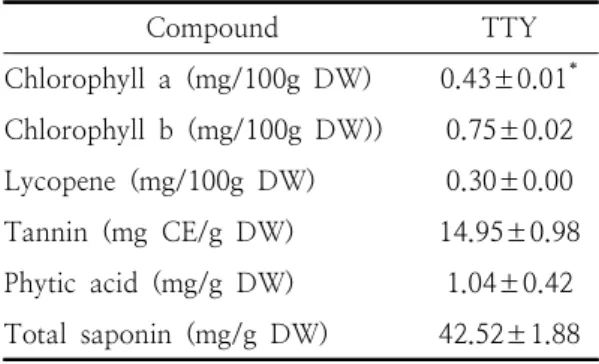
Table 1 showed lycopene and chlorophyll a, b contents in thermal treatment yam (TTY) were 0.30±0.00, 0.43±0.01 and 0.75±0.02 mg/100 g DW, respectively. The concentration of chlorophyll b in TTY was significantly higher than contents of chlorophyll a and lycopene. The lycopene from TTY was found to be the lowest. These results were significantly lower than the reported values from Sambucus nigra [17].
Table 1. Concentrations of bioactive compounds in thermal treatment yam ( Dioscorea batatas DECNE.)
Compound TTY
Chlorophyll a (mg/100g DW) 0.43±0.01
*Chlorophyll b (mg/100g DW)) 0.75±0.02 Lycopene (mg/100g DW) 0.30±0.00 Tannin (mg CE/g DW) 14.95±0.98 Phytic acid (mg/g DW) 1.04±0.42 Total saponin (mg/g DW) 42.52±1.88
*
The values are means±SD ( n =3). Values with the different letters in the same column are significantly different (p<0.05) by Duncan’s multiple range tests.
3.1.2. Tannin content
Tannins are one of the polyphenolic
physiological activity substances with various
molecular weights and a variable complexity,
which are rich in fruits, legume seeds, cereal
grains and different beverages such as red
wine, tea, cocoa and cider. And tannins also
have beneficial on cancer and cardiovascular
diseases [2,21]. The accumulation of tannin in
TTY were 14.95±0.98 mg CE/g DW (Table
1). Compared with the reported values for
yam beans, higher tannin contents were found
in TTY [29].
IC
50(mg/mL) Extracts
70% Methanol 70% Ethanol CM
*FICA
**0.09±0.01
a***0.12±0.02
b0.97±0.03
cNOSA 0.45±0.00
a0.46±0.02
a0.55±0.02
bβBM 0.07±0.01
a0.15±0.04
c0.14±0.01
bLPI 0.58±0.00
c0.50±0.01
b0.05±0.01
a*
CM: chloroform–methanol mixture (CM, 2:1, v/v) extract.
**
Ferrous ion chelating activity (FICA), nitric oxide radical scavenging activity (NOSA), β-carotene bleaching assay (βBA) and lipid peroxidation inhibition (LPI) assays.
***
The values are means±SD ( n =3). Values with the different letters in the same column are significantly different (p<0.05) by Duncan’s multiple range tests.
Table 2. IC
50values of various extracts from thermal treatment yam ( Dioscorea batatas DECNE.) in different antioxidant activity assays
3.1.3. Phytic acid content
Recently, phytic acid has been accepted for various possible benefits to human health, which acts as an antioxidant, an anti-inflammatory selective inhibitor, an energy store, and a regulator of vesicular via binding to various proteins. Phytic acid can be precipitated with an acid iron-Ш-solution of known iron content and decrease in iron in the supernatant is a measure of phytic acid content [32]. Phytic acid in TTY was determined to be 1.04±0.42 mg/g DW. Phytic acid content was found to be 82.0±2.0 mg/100 g in African yam beans hull, which was lower than that of TTY [1].
3.1.4. Total saponin content
Saponins are glycosidic compounds composed of a steroid or triterpenoid sapogenin nucleus with one or more carbohydrate branches. Saponins possess a bitter taste and have effects on affecting the immune system, helping protect the human body against cancer, lowering cholesterol levels, decreasing blood lipids and reducing the blood glucose response [16]. From the results shown in Table 1, the total saponin content of TTY was 42.52±1.88 mg/g. The concentration of total saponin in TTY was found to be
higher compared with soy bean (18.56±2.44 mg/g) [15].
3.2. Antioxidant activity
3.2.1. Ferrous ion chelating activity
The ferrous state of iron is known as the
most important lipid oxidation pro-oxidant,
which can accelerate lipid oxidation by
breaking down hydrogen and lipid peroxides
to reactive free radicals via the Fenton reaction
(Fe
2++ H
2O
2→ Fe
3++ OH
−+ OH•). As
ferrozine can quantitatively form complexes
with Fe
2+,themetalchelatingactivity of sample
was measured by a decrease in the red color
of the ferrous-ferrozine complex [7]. Fig. 1
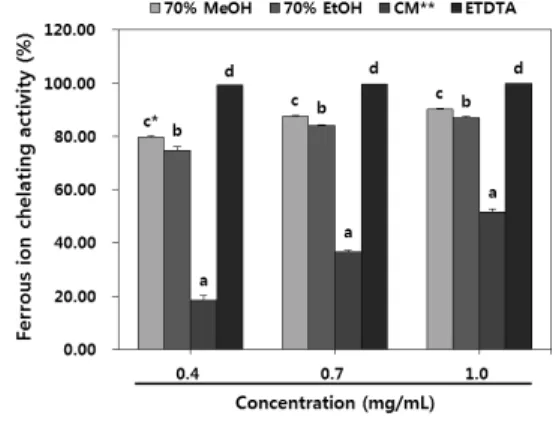
showed the chelating activity of various
extracts (70% methanol, 70% ethanol and CM
extracts) on ferrous ion was marked and
concentration related (0.4 mg/mL, 0.7 mg/mL
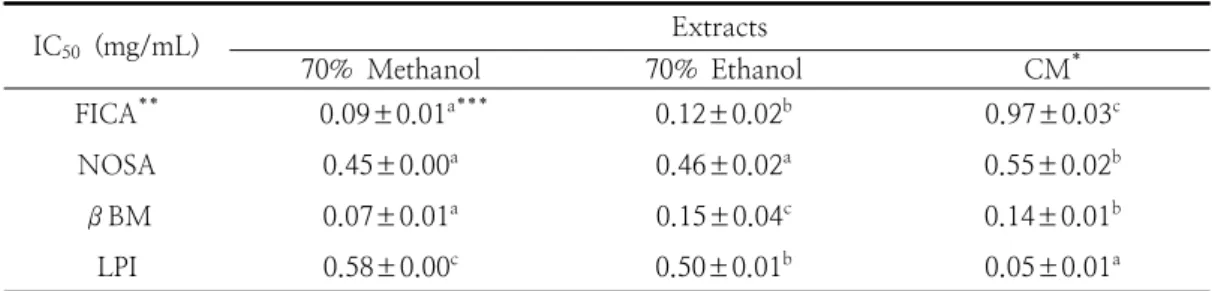
and 1.0mg/mL). From the IC
50valuesgivenin
Table 2, 70% methanol extract chelated more
iron than other extracts, although both
extracts were less efficient than commercial
chelator EDTA. Ferrous ion chelating abilities
of various fractions from TTY decreased in
the following order: 70% methanol extract
(IC
50=0.09±0.01 mg/mL), 70% ethanol extract
((IC
50=0.12±0.02 mg/mL) and CM extract
(IC
50=0.97±0.03 mg/mL), respectively. It was reported that chelating agents, which form σ-bonds with a metal, are effective as secondary antioxidants science they reduce the redox potential thereby stabilising the oxidised form of the metal ion [7]. The data obtained from Fig. 1 revealed that the all extracts exhibited an effective capacity for iron binding, suggesting that its action as peroxidation protector may be related to its iron binding capacity.
Fig. 1. Ferrous ion chelating activity of various extracts from thermal treatment yam ( Dioscorea batatas DECNE.)
*
The values are means±SD ( n =3). Bars with the different letters are significantly different (p<0.05) by Duncan’s multiple range tests.
**
CM: chloroform–methanol mixture (2:1, v/v) extract.
3.2.2. NO radical scavenging activity
Nitrite oxide (NO) is very reactive which implicated in inflammation, cancer and other pathological conditions. NO interacts with oxygen to produce nitric ions that can be estimated by using Griess reagent. Scavengers of nitric oxide compete with oxygen leading to reduced production of nitric oxide [28]. NO radical scavenging activities of various fractions obtained from RY and TTY by using different extraction solvents were presented in Fig. 2 and Table 2. With the increasing
concentration, the NO radical scavenging activity increased. Although 70% methanol extract (IC
50=0.45±0.00mg/mL)exhibited similar activity with 70% ethanol extract (IC
50=0.46±0.02mg/mL),theyalllowerthanthatofp ositivecompoundtrolox.However,NO radical scavenging activity of CM extract (IC
50=0.55±0.02mg/mL)wassignificantlylowertha nthem.Yam extracts might possess the property to counteract the effect of NO formation and in turn might be of considerable interest in preventing the ill effects of excessive NO generation in the human body. And the scavenging activity was likely to contribute to retard the chain of reactions initiated by excess generation of NO that were detrimental to the human health [12].
Fig. 2. NO radical scavenging activity of various extracts from thermal treatment yam ( Dioscorea batatas DECNE.).
*
The values are means±SD ( n =3). Bars with the different letters are significantly different (p<0.05) by Duncan’s multiple range tests.
**
CM: chloroform–methanol mixture (2:1, v/v) extract.
3.2.3. β-carotene bleaching assay
The antioxidant activities of RY and TTY
extracts at 0.4 mg/mL to 1.0 mg/mL
concentrations were compared with BHA
measured by the bleaching of β-carotene
were presented in Fig. 3. The highly
unsaturated β-carotene molecules in this system can be attacked by free radicals generating from the oxidation of linoleic acid, and as a consequence, the characteristic orange color disappears. The presence of antioxidant can avoid the destruction of the β-carotene by neutralizing the free radicals formed in the system to keep the orange color [5]. As depicted in Fig. 3, the results exhibited concentration-dependent antioxidant activity by β-carotene bleaching method in all the tested concentrations of various extracts. The antioxidant activity of various extracts was found to decrease in the following order: 70%
methanol extract (IC
50=0.07±0.01 mg/mL), CM extract (IC
50=0.14±0.01 mg/mL) and 70% ethanol extract (IC
50=0.15±0.04 mg/mL).
Fig. 3. Antioxidant activity of various extracts from thermal treatment yam ( Dioscorea batatas DECNE.) by using β-carotene bleaching method.
*
The values are means±SD ( n =3). Bars with the different letters are significantly different (p<0.05) by Duncan’s multiple range tests.
**
CM: chloroform–methanol mixture (2:1, v/v) extract.
Results showed BHA had stronger antioxidant activity than 70% methanol extract. It was probable that the antioxidative components in extracts can reduce the extent of β-carotene
destruction by neutralizing the linoleate free radical and other free radicals in this system.
And our results were in accordance with Farombi, Britton and Emerole [6], who also found the yam showed antioxidant activity by using β-carotene bleaching method.
3.2.4. Lipid peroxidation inhibition
Linoleic acid is a polyunsaturated fatty acid, which is vulnerable to attack by reactive oxygen species. As a result, lipid peroxides such as malondialdehyde (MDA) and 4-hydroxynonenal (HNE) are generated. In this model system, these peroxides can oxidize Fe
2+to Fe
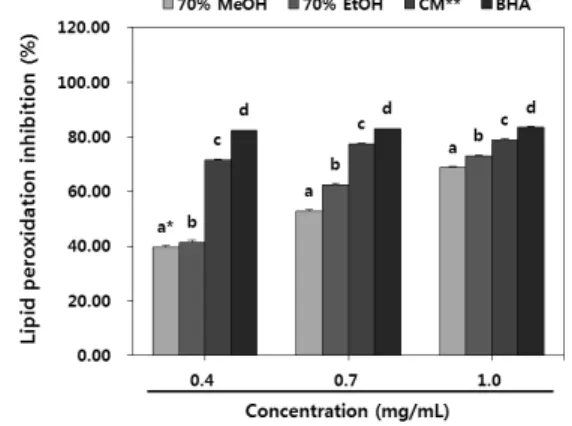
3+, then forms complexes with thiocyanate ion which have maximum of absorption at 500 nm [30]. Fig. 4 described the inhibition of linoleic acid peroxidation by various extracts from TTY. All extracts effectively inhibited the linoleic peroxidation in a concentration-dependent manner. BHA significantly inhibited lipid peroxidation in linoleic acid emulsion system and the activity
Fig. 4. Antioxidant activity of various extracts from thermal treatment yam ( Dioscorea batatas DECNE.) determined as inhibition of linoleic acid oxidation.
*
The values are means±SD ( n =3). Bars with the different letters are significantly different (p<0.05) by Duncan’s multiple range tests.
**