https://doi.org/10.9721/KJFST.2017.49.3.338
338
©The Korean Society of Food Science and Technology
Antioxidant activity of sesame cake extracts obtaining using
various ethanol extraction conditions
Kyoung Ah Lee, Keun Young Min, Na-Kyoung Lee, Kyung Hoon Chang1, Seong Jun Cho1, Won Dae Chung1, and Hyun-Dong Paik*
Department of Food Science and Biotechnology of Animal Resource, Konkuk University
1CJ CheilJedang Center
Abstract The antioxidant activities of sesame cake extracts prepared using ethanol and hot water were evaluated. Seventy percent-ethanol extracts yielded the highest total phenolic (96.56 mg/g extract) and flavonoid (8.35 mg/g extract) contents. In the β-carotene bleaching and ferric thiocyanate test, 30%-, 50%-, and 70%-ethanol extracts exhibited higher antioxidant activity than that exhibited by 90%-ethanol extracts. However, 90%-ethanol extracts showed greater antioxidant activities in phenyl-2-picryl-hydrazyl free radical scavenging test and thiobarbituric acid test using corn oil. The antioxidant activities of sesame cake extracts did not correlate with the total phenolic and flavonoid contents; however, the results suggest that oxidative stability may be improved by sesame cake extracts.
Keywords: sesame cake, antioxidant activity, phenolic, flavonoid, ethanol extraction
Introduction
Sesame (Sesamum indicum L.), a well-known oilseed crop, has for many centuries been used as a health food, because it is thought to increases energy and prevents ageing (1). Sesame oil shows remarkable stability despite being is highly unsaturated (2), and this is due to the presence of four endogenous antioxidants: sesamol, sesaminol, sesamin, and sesamoiln (2,3). Recent studies have revealed that sesame may have antioxidant activity and anticancer properties. For example, sesamin showed that in vivo hypocholesterolemic activity as well as suppressive activity against chemically induced cancer (4). Kang et al. (5) has been reported that sesamolin in rat liver is involved in the inhibition of lipid peroxidation.
Sesame cake is a by-product of the sesame seed industry for oil extraction. Dietary fiber and other beneficial ingredients are found in sesame seed cake (6) and sesame cake contains significant amounts of antioxidant phytochemicals, phenolic acids, and lignans with antioxidant properties (7,8). However, this by-product is generally discarded or used for animal feeding.
Synthetic antioxidants such as butylated hydroxyanisole (BHA), butylated hydroxytoluene (BHT), and tert-butyl hydroquinone (TBHQ) are widely used as food additives (9). These compounds have many advantages such as high performance, low cost, and wide availability (9,10). However, synthetic antioxidants may
cause health problems, including cancer and carcinogenesis (11). Consequently, there is a strong consumer demand for using natural products that contains safer and more effective natural antioxidants. Natural antioxidants such as flavonoids, tannins, phenolics, lignans, and terpenoids are found in various plants (fruits, leaves, seeds, and oils) (12). Many studies conducted on the effects of the lignan compounds of sesame extracts (sesamol, sesamin, and sesamolin) on antioxidant activity (13,14). However, few studies have been carried out on the phenolic compounds extracted from sesame cake. Therefore, this study evaluated the antioxidant potential of sesame cake extract for its use as a replacement of synthetic antioxidants using ethanolic and hot water extraction.
Materials and Methods
Materials
Sesame (Sesamum indicum L.) was harvested in Myanmar and the sesame cake was provided by CJ CheilJedang (Seoul, Korea). Sesame cakes were collected for extraction and dried in an oven (OF12GW, Jeio-Tech Co., Seoul, Korea) at 60°C for 10 h until a moisture content of 4-5% (w/w) was obtained.
Preparation of sesame cake extract
Sesame cakes were extracted with various concentrations of ethanol and hot water. Sesame cake (40 g) was mixed with 400 mL of ethanol (10, 30, 50, 70, and 90%, respectively) and heated for 3 h at 60oC in a water bath or placed in a 500 mL flask containing 400 mL of distilled water and heated for 3 h at 80oC in a water bath. After each extraction, the slurry was filtered through filter paper (Whatman No. 2) and the solid residue was extracted twice more under identical conditions. The solvent was evaporated using a rotary evaporator (EYELA N-*Corresponding author: Hyun-Dong Paik, Department of Food
Sci-ence and Biotechnology of Animal Resource, Konkuk University, Seoul 05029, Korea
Tel: +82-2-2049-6011 Fax: +82-2-455-0381 E-mail: [email protected]
Received December 12, 2016; revised January 13, 2017; accepted January 18, 2017
1000V, Tokyo, Japan). After evaporation, the extract was transferred to a freeze-drying tube and lyophilized. The extracts were weighed and stored at −20oC prior to analysis (15).
Determination of total phenolic and total flavonoid content The total phenolic content was determined using Folin-Ciocalteu reagent as described by Kevers et al. (16). The sesame cake extracts (0.1 mL) were mixed with 2 mL of 2% (w/w) sodium carbonate solution and 50% (v/v) Folin-Ciocalteu reagent. After 30 min at room temperature, absorbance was measured at 750 nm using a spectrophotometer (Optizen 2120 UV; Daejeon, Korea). A standard curve was prepared using different concentrations of gallic acid (Sigma Chemical Co., St. Louis, MO, USA) and the results were expressed as milligrams of gallic acid equivalent (GAE) per gram of extract (dry weight).
Total flavonoid content was determined by a colorimetric method described previously by Quettier-Deleu et al. (17). The extract solution (0.5 mL) was mixed with 1.5 mL of 95% ethanol in a test tube followed by the addition of 10% AlCl3 (0.1 mL) and 1 M potassium acetate (0.1 mL). After 3 min, 2.8 mL of distilled water was added. The mixture was mixed well by vortexing. After 30 min at room temperature, absorbance was measured at 415 nm. Quercetin (Sigma) as a standard reagent was used to construct the calibration curve and the results were expressed as mg of quercetin equivalent (QE) per gram of extract (dry weight).
DPPH free radical scavenging activity
Determination of the 1,1-diphenyl-2-picryl-hydrazyl (DPPH) (Sigma) radical scavenging activity of sesame cake extracts was based on the method of Singh et al. (18) as described previously. DPPH solution in ethanol (100μM) was prepared and 1 mL of this solution was added to 0.2 mL of various concentrations of sesame cake (0.5, 1, 2.5, and 5 mg/mL) and vortexed. Butylated hydroxytoluene (BHT, 0.1 mg/mL) was used as a positive control. After 20 min at room temperature, the absorbance was measured at 517 nm. The percentage inhibition was calculated as follows: DPPH free radical scavenging activity (%)=[1−(As/Ac)]×100, where, As and Ac was absorbance of the sesame cake extract and dimethyl sulfoxide (DMSO) (control), respectively.
β-Carotene bleaching assay
The inhibition of bleaching of a β-carotene-linoleic acid emulsion by the antioxidant activities of sesame cake extracts was determined by a slight modification of a method by Kassim et al. (19). β-Carotene (2 mg), linoleic acid (40 mg), and Tween 40 (200 mg) were dissolved in 10 mL of chloroform. The chloroform was removed by evaporator at 40oC, followed by the addition of distilled water (200 mL) and then shaken. This emulsion (4.8 mL) was mixed with each sesame cake extracts (2.5 mg/mL in DMSO) and BHT (0.1 mg/mL) as a control in a 15 mL conical tube. The mixture was incubated at 50°C in a water bath. Absorbance at 470 nm was measured immediately at 0 h and up to 8 h later. Antioxidant activity was calculated using the following
equation (20): Antioxidant activity (%)=[(β-carotene content after 8 h)/(initial β-carotene content)]×100.
Ferric thiocyanate (FTC) test
The antioxidant activity of the ethanol and hot water extracts of sesame cake were assayed using a linoleic acid system. The inhibition of oxidation was measured by the FTC method, described in detail by Li et al. (21). A solution (50μL) of each sesame cake extract at 0.5 mg/mL was mixed with 0.2 mL linoleic acid solution (25 mg/mL in ethanol), 0.4 mL phosphate buffer (40 mM, pH 7.0), and 0.2 mL distilled water in a 15 mL tube with a screw cap. There were then placed in darkness at 37oC to accelerate oxidation. The above mixture (0.1 mL) was added to 4 mL of 70% ethanol and 0.1 mL of 20 mM ferrous chloride in a 3.5% HCl solution. After 3 min, 0.1 mL of 30% ammonium thiocyanate was added to the mixture and then vortexed. The absorbance of the mixture was recorded at 24, 72, 120 h at 500 nm. Antioxidant activity was calculated using the following equation: Antioxidant activity (%)=[1−(As/Ac)]×100, where, As and Ac was absorbance of the sesame cake extract and DMSO (control), respectively.
Thiobarbituric acid (TBA) test
Lipid oxidation in corn oil was assessed using the 2-thiobarbituric acid (TBA) method of Ahn et al. (22) with some modifications. The corn oil (1.0 g) was mixed with 100 mL of Tris-malaeated buffer (pH 6.8) and 0.1 mL of Tween 20. The mixture was homogenized for 3 min using a Brinkaman Polytron (Ika ultra-turrax T25; Staufen, Germany). The corn oil homogenate (8 mL) was mixed with 0.2% ascorbic acid, 200 ppm FeCl3, and extract solution (0.5 mL), respectively. This mixture was incubated at 37oC in a water bath for 72 h. The reaction emulsion in the water bath (1 mL) was mixed with a solution of TBA (Tokyo Chemical Industry Co., Tokyo, Japan) and trichloroacetic acid (TCA) solution (20 mM TBA/15% TCA, 2 mL) and 50μL of 10% butylated hydroxyanisole in 90% ethanol. The mixture was vortexed before being incubated in a water bath at 90oC for 15 min to develop a red color. After cooling, the mixtures were centrifuged at 3,000×g for 15 min at 4oC. The absorbance of the resulting upper layer was read at 532 nm. Antioxidant activity was calculated using the following equation: Antioxidant activity (%)=[1−(As/Ac)]×100, where, As and Ac was absorbance of the sesame cake extract and DMSO (control), respectively.
Results and Discussion
Total phenolic and total flavonoid content of sesame cake extracts
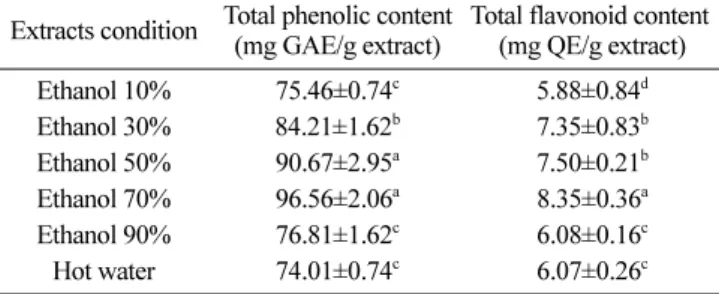
The total phenolic and total flavonoid contents of the sesame cake extracts produced by various concentrations of ethanol and hot water extraction are summarized in Table 1. The total phenolic content of 70% ethanol extracts (96.56 mg GAE/g extract) was the highest, followed by 50% ethanol extracts (90.67 mg GAE/g extract); however, the highest concentration of ethanol (90%) had lower phenolic content than concentrations of ethanol at 30,
50, and 70%. The pattern of results for total flavonoid content was similar to that for total phenolic content. Sesame cake extract produced by 70% ethanol extraction had the highest total flavonoid content (8.35 mg QE/g extract) and ethanol extraction at 90% had low values of total flavonoid content. The effects of hot water extraction were similar to that of ethanol extraction at 90%.
Antioxidant activities of sesame cake extracts
Since antioxidant compounds have different modes of action, various methods have been used to assess the antioxidant effects of sesame cake extracts (23). The antioxidant activities of sesame cake extracts were determined by DPPH free radical scavenging activity and β-carotene bleaching activity (Table 2). Among the extraction methods, ethanol extraction at 90% was the most efficient in improving DPPH free radical scavenging activity (64.93%). At the lower concentration (1 mg/mL in DMSO), there was no significant difference between ethanol 70% and ethanol 90% (data not shown). The lowest concentration of ethanol (10%) had a similar level of activity as that of the hot water extract.
During evaluation (8 h) of the inhibition rates of β-carotene consumption, the antioxidant activity of the sesame cake extracts ranged from 26.35 to 43.89% at 2.5 mg/mL of sesame cake extract. Antioxidant activities of ethanol extraction at 30 to 70% were not significantly. The 70% ethanol extraction showed slightly higher antioxidant activity than 30 and 50% ethanol extraction in DPPH free radical scavenging activity. The 90% ethanol extracts showed the lowest inhibition activity of oxidation in a β-carotene emulsion, and showed similar activity to the hot water extract. These results were consistent with the results for total phenolic and total flavonoid content.
The FTC method was used to determine the in vitro inhibition of linoleic acid peroxidation. During oxidation of linoleic acid, peroxides are formed and ferrous (Fe2+) ions are oxidized to ferric (Fe3+) ions. The ferric ions form red complexes with thiocyanate. As the absorbance increases, the formation of peroxides increases and the oxidation of linoleic acid progresses (24). The antioxidant effect of each sesame cake extract during 120 h incubation at 37oC is shown in Fig. 1. The sesame cake extracts reduced the formation of peroxide during linoleic acid oxidation in comparison with a negative control (DMSO). The absorbance of DMSO (without extracts) treatment increased to 1.07 at 120 h (data not shown), whereas most extracts showed a significantly lower absorbance than the negative control. The Table 1. Total phenolic and flavonoid content of sesame cake
extracts
Extracts condition Total phenolic content (mg GAE/g extract)
Total flavonoid content (mg QE/g extract) Ethanol 10% 75.46±0.74c 5.88±0.84d Ethanol 30% 84.21±1.62b 7.35±0.83b Ethanol 50% 90.67±2.95a 7.50±0.21b Ethanol 70% 96.56±2.06a 8.35±0.36a Ethanol 90% 76.81±1.62c 6.08±0.16c Hot water 74.01±0.74c 6.07±0.26c
Values are mean±standard deviation (SD).
a-dDifferent letters within a column are significantly different by
two-way analysis of variance (p<0.05).
Table 2. Antioxidant activities of sesame cake extracts1)
Extracts condition
DPPH free radical scavenging activity
(%)
Inhibition of β-carotene and linoleic acid
oxidation (%) BHT 78.50±0.07e 72.85±0.10d Ethanol 10% 46.77±2.08a 33.01±1.70b Ethanol 30% 55.04±2.81bc 41.82±2.57c Ethanol 50% 53.52±1.06b 42.88±1.81c Ethanol 70% 59.28±1.03c 43.89±2.29c Ethanol 90% 64.93±0.51d 28.73±2.18a Hot water 46.88±2.16a 26.35±1.94a 1)The concentration of extracts was adjusted at 2.5 mg/mL in DMSO.
Values are mean±standard deviation (SD).
a-dDifferent letters within a column are significantly different by
two-way analysis of variance (p<0.05).
Fig. 1. Antioxidant activity of sesame cake extracts determined by the ferric thiocyanate method. The concentration of sesame cake extracts was adjusted to 0.5 mg/mL. Each extracts are represented by 10% ethanol extracts (□), 30% ethanol extracts (▤), 50% ethanol extracts (■), 70% ethanol extracts (▨), 90% ethanol extracts (■), and hot water extracts (▥). a-cDifferent letters within a column are significantly different by two-way analysis of variance (p<0.05).
antioxidant effect of ethanol extracts at 30, 50, and 70% was 88.80, 88.75, and 83.28%, respectively. Extraction at 90% had slightly lower activity (80.43%) and both the 10% ethanol extract and the hot water extract exhibited less than 80% activity. Consequently, these results clearly indicate that the sesame cake extracts produced by ethanol extraction at 30, 50, and 70% exhibited more effective and powerful antioxidant activity than at other concentrations.
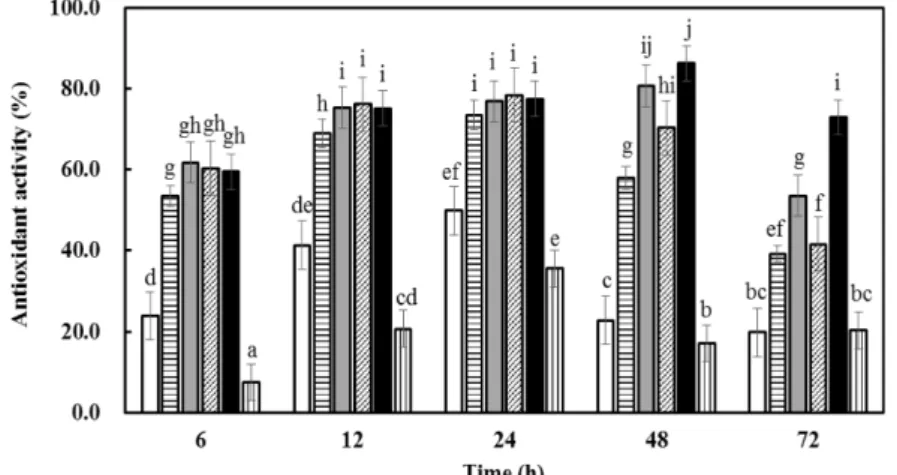
The analysis of variance indicated that the TBA values were significantly affected by the sesame cake extracts treatments (Fig. 2). Higher absorbance values indicate increased formation of malonaldehyde in oil emulsion. Among the extracts, 10% ethanol extraction and hot water extraction showed lower inhibition activity of lipid peroxidation than other extraction methods. Ethanol extraction at 90% exhibited strong antioxidant activity in TBA assays (72.95%). Inhibition activities (%) of sesame cake extracts by ethanol extraction at 30, 50, and 70% were 39.26, 53.56, and 41.61%, respectively. Ethanol extraction at 90% showed higher activity using the TBA method than ethanol extraction at 50 and 70%, in contrast to our results from the β-carotene bleaching assay and FTC test. These results may be due to the fact that different phenolic compounds have different responses in antioxidant activity assays. Kähkönen et al. (25) previously reported that the molecular antioxidant response of phenolic compounds depended on their chemical structure. Therefore, the antioxidant activity of a natural plant extract cannot be predicted on the basis of its total phenolic content.
Conclusion
Fifty and seventy percent of ethanol extracts of sesame cake extracts was the higher total phenolic, flavonoid content contents, and antioxidant activity by β-carotene bleaching and a FTC test. Antioxidant activity using DPPH free radical scavenging activity and TBA test was higher at 90% ethanol extracts. Therefore,
the results of the present study suggest that antioxidant activity of sesame cake extracts was different as ethanol extraction condition and mode of antioxidant. Further studies are demanded to demonstrate the same activities in vivo systems and purification of extracts.
Acknowledgments
This work was supported by the Korea Institute of Planning and Evaluation for Technology in Food, Agriculture, Forestry and Fisheries (IPET) through the Technology Commercialization Support Program, funded by the Ministry of Agriculture, Food and Rural Affairs (MAFRA) (810008-03-3-SB330) and CJ CheilJedang Corporation. We would also like to thank the students and staffs of the feeds and foods nutrition research center (FFNRC) for assisting in samples analyses.
References
1. Namiki M. The chemistry and physical functions of sesame. Food Rev. Int. 11: 281-329 (1995)
2. Suja KP, Jayalekshmy A, Arumughan C. Antioxidant activity of sesame cake extract. Food Chem. 91: 213-219 (2005)
3. Suja KP, Jayalekshmy A, Arumughan C. In vitro studies on anti-oxidant activity of lignans isolated from sesame cake extract. J. Food Sci. Agr. 85: 1779-1783 (2005)
4. Yamashita K, Lizuka Y, Imai T, Namiki M. Sesame seed and its lignans produce marked enhancement of vitamin E activity in rats fed a low α-tocopherol diet. Lipids 30: 1019-1025 (1995)
5. Kang MH, Naito M, Tsujihara N, Osawa T. Sesamolin inhibits lipid peroxidation in rat liver and kidney. J. Nutr. 128:1018-1022 (1988)
6. Elleuch M, Besbes S, Roiseux O, Blecker C, Attia H. Quality characteristics of sesame seeds and by-products. Food Chem. 103: 641-650 (2007)
7. Suja KP, Abraham JT, Thamizh SN, Jayalekshmy A, Arumughan C. Antioxidant efficacy of sesame cake extract in vegetable oil protection. Food Chem. 84: 393-400 (2004)
8. Obeidata BS, Abdullaha AY, Mahmouda KZ, Awawdehb MS, Al-beitawi NZ, Al-Lataifeha FA. Effects of feeding sesame cake on growth performance, nutrient digestibility, and carcass
characteris-Fig. 2. Antioxidant activity of sesame cake extracts determined by the TBA method. The concentrations of sesame cake extracts were adjusted to 2.5 mg/mL. Each extracts are represented by 10% ethanol extracts (□), 30% ethanol extracts (▤), 50% ethanol extracts (■), 70% ethanol extracts (▨), 90% ethanol extracts (■), and hot water extracts (▥). a-jDifferent letters within a column are significantly different by two-way analysis of variance (p<0.05).
tics of Awassi lambs. Small Ruminant Res. 84: 393-400 (2004) 9. Mohdaly AAA, Smetanska I, Ramadan MF, Sarhan MA,
Mah-moud A. Antioxidant potential of sesame (Sesamum indicum) cake extract in stabilization of sunflower and soybean oils. Ind. Crop. Prod. 34: 952-959 (2011)
10. Bandyopadhyay M, Chakraborty R, Raychaudhuri U. Antioxidant activity of natural plant sources in dairy dessert (Sandesh) under thermal treatment. LWT-Food Sci. Technol. 41: 816-825 (2008) 11. Prior RL. Absorption and metabolism of anthocyanins: potential
health effects. pp. 51-60. In: Phytochemicals: Mechanisms of Action. Meskin M, Bidlack WR, Davies AJ, Lewis DS, Randolph RK (Eds.), CRC Press, Boca Raton, FL, USA (2004)
12. Jeong SM, Kim SY, Kim DR, Nam KC, Ahn DU, Lee SC. Effect of seed roasting conditions on the antioxidant activity of defatted sesame meal extracts. Food Chem. Toxicol. 69: 377-381 (2004)
13. Lee JY, Lee YS, Choe EN. Effects of sesamol, sesamin, and ses-amolin extracted from roasted sesame oil on the thermal oxida-tion of methyl linoleate. LWT-Food Sci. Technol. 41: 1871-1875 (2008)
14. Liu B, Guo X, Zhu K, Liu Y. Nutritional evaluation and antioxi-dant activity of sesame sprouts. Food Chem. 129: 799-803 (2011) 15. Hassas-Roudsari M, Chang PR, Pegg RB, Tyler RT. Antioxidant
capacity of bioactives extracted from canola meal by subcritical water, ethanolic and hot water extraction. Food Chem. 114: 717-726 (2009)
16. Kevers C, Falkowski M, Tabart J, Defraigne JO, Dommes J, Pin-cemail J. Evolution of antioxidant capacity during storage of selected fruits and vegetables. J. Agr. Food Chem. 55: 8596-8603 (2007)
17. Quettier-Deleu C, Gressier B, Vasseur J, Dine T, Brunet C, Luy-ckx M, Cazin M, Cazin J-C, Bailleul F, Trotin F. Phenolic
com-pounds and antioxidant activities of buckwheat (Fagopyrum esculentum Moench) hulls and flour. J. Ethnopharmacol. 72: 35-42 (2000)
18. Singh RP, Chidambara Murthy KN, Jayaprakash GK. Studies on antioxidant activity of pomegranate peel and seed extracts using in vitro models. J. Agr. Food Chem. 50: 86-89 (2002)
19. Kassim NK, Rahmani M, Ismail A, Sukari MA, Lian Ee GC, Nasir NM, Awang K. Antioxidant activity-guided separation of coumarins and lignan from Melicope glabra (Rutaceae). Food Chem. 139: 87-92 (2013)
20. Kato S, Aoshima H, Saitoh Y, Miwa N. Highly hydroxylated or gamma-cyclodextrin-bicapped water-soluble derivative of fullerene: the antioxidant ability assessed by electron spin resonance method and beta-carotene bleaching assay. Bioorg. Med. Chem. Lett. 19: 5293-5296 (2009)
21. Li F, Wang F, Yu F, Fang Y, Xin Z, Yang F, Xu J, Zhao L, Hu Q. In vitro antioxidant and anticancer activities of ethanolic extract of selenium-enriched green tea. Food Chem. 111: 165-170 (2008)
22. Ahn DU, Olson DG, Lee JI, Jo C, Chen X, Wu C. Packaging and irradiation effects on lipid oxidation and volatiles in pork patties. J. Food Sci. 63: 15-19 (1998)
23. Frankel EN, Meyer AS. The problems of one-dimensional meth-ods to evaluate multifunctional food and biological antioxidants. J. Sci. Food Agr. 80: 1925-1941 (2000)
24. Jayaprakasha GK, Singh RP, Sakariah KK. Antioxidant activity of grape seed (Vitis vinifera) extracts on peroxidation models in vitro. Food Chem. 73: 285-290 (2000)
25. Kähkönen MP, Hopia AI, Vuorela HJ, Rauha JP, Pihlaja K, Kujala TS, Heinonen M. Antioxidant activity of plant extracts containing phenolic compounds. J. Agr. Food Chem. 47: 3954-3962 (1999)