1386
ⓒ The Korean Society of Food Science and Technology
Purification, Chemical Composition, and
in vitro
Antioxidant Activity
of Two Protein-bound Polysaccharides from Rapeseed Meal
Hanju Sun*, Shaotong Jiang, Mingyang Zi1, and Ding QiSchool of Biotechnology and Food Engineering, Hefei University of Technology, Hefei 230-009, PR China
1Department of Food Science and Technology, South China University of Technology, Guangzhou 610-640, PR China
Abstract Crude polysaccharides from rapeseed meal (PRM) were extracted with 0.3% NaOH aqueous solution, followed by
further purifications and 2 fractions, namely PRM1 and PRM2, were separated with a DEAE-cellulose DE-52 column. Their primary compositions were analysed and antioxidant activity was determined, including scavenging activity toward superoxide anion radicals, hydroxyl radicals, and nitric oxide radicals, reducing power, and inhibitory effects against the microsomal lipid peroxidation, compared to that of L-ascorbic acid. The results indicated that PRM1 and PRM2 exhibited not only good
reducing power and inhibitory effects on the microsomal lipid peroxidation, but also strong scavenging activity toward superoxide anion radicals, nitric oxide radicals, and hydroxyl radicals. In addition, positive correlations were also observed between the superoxide anion radical scavenging activity and the protein contents of the polysaccharides, and the reducing power and the sulfate contents. These findings thus clearly suggest the polysaccharides possess direct and potent antioxidant activity.
Keywords: polysaccharide, rapeseed meal, in vitro, antioxidant, activity
Introduction
Polysaccharides are very important macromolecular substances and have been isolated from animals, microorganisms, and especially plants by extraction over the past decades (1). Because polysaccharides have many promising properties like hydrophilicity and multichairality, they are used to control the behavior and stabilities of food products, as emulsifiers, stabilizers, and food coating materials (2). In addition, polysaccharides have many kinds of biological activity, such as enhancing immunity, oxidation, anti-cancer, anti-rheumatism, and prevention of acquired immune deficiency syndrome (AIDS) (3). Thus, polysaccharides are used in modern medicine as important components of therapeutic drugs and skin care products (4). Over the last few years, recognized and assimilated in the body, polysaccharides were even used as drug-delivery carriers (5). Therefore, along with the increasing pursuit for new polysaccharides, their molecular structures and biological activity become important research fields.
Rapeseed is one of three main oil crops in China. As a by-product of rapeseed oil production, there are plenty of substances including proteins, carbohydrates, and pigments in rapeseed meal to be made full use of it. The in vivo
antioxidant activity of crude polysaccharides from rapeseed meal has been previously reported by us (6), however, as far as our literature survey could ascertain, no information was available on in vitro antioxidative activity of single
polysaccharide fraction from rapeseed meal.
In this study, two polysaccharide fractions from rapeseed meal were extracted and purified. Their in vitro antioxidant
activity was evaluated using different in vitro antioxidant
assays: superoxide anion radical scavenging activity, hydroxyl radical scavenging activity, nitric oxide radical scavenging activity, reducing power, and inhibition of microsomal lipid peroxidation. The aim of this present work is to assess the
in vitro antioxidant activity of the 2 fractions and to reveal
the structure-activity relationships.
Materials and Methods
Reagents and Materials Rapeseed was purchased in a local supermarket and cultured at Chaohu city in Anhui province, China. After the oil had been crushed under cold condition (below 100ºC), the rapeseed meal was used as experimental material.
2-Thiobarbituric acid (TBA) and ethylene diaminetetra-acetic acid (EDTA) were purchased from Shanghai Chemical Reagents Company (Shanghai, China); diethyl aminiethyl (DEAE) cellulose DE-52 was purchased from Whatman Company (Whatman, Kent, UK); sodium acetate trihydrate, acetic acid, hydrogen peroxide (H2O2), trichloroacetic acid
(TCA), and L-(+)-ascorbic acid were purchased from
Shanghai Chemical Reagent Company; mannitol was purchased from Shanghai Zhengxiang Science and Technology Company (Shanghai, China); standard dextrans T-700 (Mw: 700 kDa), T-500 (500 kDa), T-100 (100 kDa), T-50 (50 kDa), T-10 (10 kDa), and T-5 (5 kDa) were purchased from Xia-si Biochemical Company (Beijing, China). All reagents were of analytical grade.
Preparation of crude polysaccharides from rapeseed meal The dehulled rapeseed meal (500 g) was defatted with petroleum ether for 8 hr at 70ºC using a Soxhlet apparatus and then extracted 3 times with 10 vol of 95% EtOH at 50ºC, each time for 10 hr. Then, the rapeseed meal was mixed with 15 volumes of 0.3% NaOH aqueous
*Corresponding author: Tel: +86-551-2901505-8537; Fax: +86-551-2901507
E-mail: [email protected]
Received April 28, 2009; Revised August 4, 2009; Accepted August 14, 2009
solution. After homogenization in an electric mixer, the solution was set at 50ºC with constant mechanical stirring for 5 hr. The pH of the solution was adjusted to 4.0-4.3 to let the proteins precipitate and then the solution was passed through a metal sift (100 mesh) to remove the big particles. The supernatant was added 30%(v/v) sevage reagent (chloroform: 1-butanol, 4:1) to remove protein and this procedure was repeated about 10 times till no proteins could be detected. The resultant supernatant was dialyzed against distilled water at 20ºC for 48 hr to exclude low molecular weight compounds with a dialysis bag (MWCO 5000; Sigma-Aldrich, St. Louis, MO, USA). Then, the solution was concentrated 10 fold, followed by precipitation with 95% EtOH (1:5, v/v) at 4oC for 12 hr to precipitate
the polysaccharides. The precipitate was collected by centrifugation, washed successively with absolute ethanol, acetone and ether, in turn. After freeze-dried, crude polysaccharides (5 g), named as PRM, were obtained. Further fractionation of the crude polysaccharides by a DEAE-cellulose DE-52 column The crude polysaccharides (100 mg) were dissolved in 10 mL of distilled water and then were injected to a column (1.6×60 cm) of
DEAE-cellulose DE-52 equilibrated with distilled water before. After loading with the sample, the column was eluted with 500 mL of distilled water and 500 mL of 0.05 M NaCl aqueous solution at a flow rate of 0.4 mL/hr, respectively. After concentration, fractions gathered were dialyzed, espectively, against tap water and distilled water in turn for 48 hr, and then lyophilized. The fractions were used for subsequent experiments.
Determination of the homogeneity and the molecular weight of the fractions A Sephadex G-100 column (2.5×40 cm) was used to test the homogeneity of the fractions. The gel permeation chromatography was further used for determination of the molecular weights of the polysaccharide fractions. Initially, each of the fractions (1 mg) was dissolved in 0.5 mL of distilled water and then was injected to the column. The column was eluted with water with collection of outflow fractions at a fixed flow rate of 1 mL/hr and the fractions were detected by the phenol-sulfuric acid method (7). The column temperature was kept at 25±0.1oC. Dextran standards with different
molecular weights (5, 10, 50, 100, 500, and 700 kDa) were used for preparing calibration curve, and each was passed through the column, and elution volumes were plotted against the logarithms of their respective molecular weights. Elution volumes of the fractions were plotted in the same graph, and the molecular weights were measured. Chemical analysis The carbohydrate contents of the polysaccharide fractions were estimated according to the phenol-sulfuric acid assay, using fucose as standard (7). The sulfate contents of the polysaccharide fractions were analyzed with the barium chloride-gelatin method(8). The uronic acid contents of the polysaccharide fractions were estimated in a modified carbazole method using D
-glucuronic acid as standard (9). The protein contents of the polysaccharide fractions were estimated from the nitrogen content determined by the Kjeldahl method (10), using a nitrogen factor of 6.25. Amino acid composition was
measured as follows. The hydrolyzed fractions (20 mg) were, respectively, hydrolyzed in 6 M HCl containing 0.1% thioglycolic acid at 110oC for 24hr in vacuo. Amino acids
derived with phenylisothiocyanate were identified and quantified using a Sycom S-433D automatic amino acid analyser (Sykam, Eresing, Germany).
In vitro antioxidant activity assay Superoxide anion
(·O2−) radical scavenging assay was determined according
to the modified method described by Siddhuraju and Manian (11). Measurement of reducing power was determined according to the method reported by Xiang and Ning (12). Hydroxyl radical (OH•) scavenging assay was
carried out as described by Dong and Yao (13). Nitric oxide radical scavenging assay was based on the method of Awah et al. (14). Antioxidant effect on against microsomal
lipid peroxidation was determined as the method reported by Srivastava et al. (15). Ascorbic acid was used as a
standard.
Statistical analysis In this study, 3 analyses of each sample were made and each experiment was carried out in triplicate. The mean value and standard deviation (SD) were calculated from the data obtained. These data were then compared by Duncan,s multiple range test (p<0.05)
using the Statistics for Windows H,97, Version 5.1 (Statsoft
Inc., Tulsa, OK, USA).
Results and Discussion
Chemical analysis Two fractions, namely, PRM1 and PRM2 were collected with water and 0.05 M NaCl elution on the DEAE-cellulose column, respectively. Either of PRM1 and PRM2 was further eluted as a single and symmetrically sharp peak from the gel-permeation chromatography on the Sephadex G-100 column (data not shown), in which the protein and sugar peaks appeared at the same time, indicating that both of PRM1 and PRM2 were a protein-bound polysaccharide.
As shown in Table 1, the 3 polysaccharides were mainly composed of neutral sugar, sulfate, protein, and uronic acid. The carbohydrate contents in PRM1 and PRM2 were 74.42 and 70.35%, respectively, while the protein contents were 3.94 and 16.28%. The average molecular weights of PRM1 and PRM2 were about 131 and 290 kDa, respectively. Amino acid analysis indicated that the protein portion of the 2 fractions consisted of 15 amino acids, namely, Asp, Thr, Ser, Glu, Ala, Cys, Val, Met, Ile, Leu, Tyr, Phe, His, Lys, and Arg. In addition, PRM1 had higher sulfate content (36.67%), whereas PRM2 had lower sulfate content (10.30%). High protein and sulfate contents in the polysaccharide molecules might have great influence on their antioxidant activity, and have been proved in this research.
Scavenging of superoxide anion radicals The superoxide anion radical (·O2−) is produced as a result of the donation
of 1 electron to oxygen and arises either from several metabolic processes or oxygen activation by irradiation (16). The superoxide anion radical plays important roles in the formation of other reactive oxygen species (ROS) such as hydrogen peroxide, hydroxyl radicals, and singlet
oxygen, which induce oxidative damage in lipids, proteins, and DNA and has even been implicated in several pathophysiological processes (17).
Figure 1 depicts the superoxide radical scavenging ability of 1, 2, 3, 4, and 5 mg/mL of PRM1, and PRM2 in comparison to the same doses of ascorbic acid, used as the positive scavenger, using the nitroblue tetrazolium (NBT) reduction assay. The scavenging activity of the samples was concentration-dependent, but those of the 2 polysaccharides were nonlinear. The obtained data indicate that the scavenging activity of these samples followed the order: ascorbic acid >PRM2>PRM1.
Generally, cysteine and aromatic amino acids are considered as effective radical scavengers, because they could easily donate protons to electron deficient radicals at the same time maintaining their stability via resonance structures (18). Since 15 kinds of amino acids are present in the 2 polysaccharides, these amino acids favor the superoxide anion radical scavenging activity. Furthermore, there may be at least one reason to explain the mechanism that PRM2 showed stronger superoxide anion radical scavenging activity than PRM1. High protein content PRM2 has higher numbers of cysteine and aromatic amino acids in the molecule, which could be attributed to its stronger superoxide anion radical scavenging activity than low protein content PRM1.
Assay of reducing power Generally, if one compound
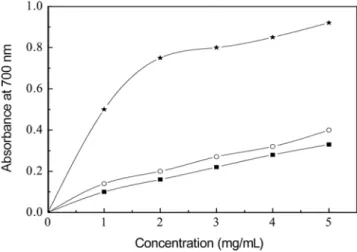
has strong reducing power, it may donate an electron to other compounds at the expense of its oxidation. In this case, the free radical chain reaction and decomposition of peroxides maybe prevented. Hence, reducing power may be used as an indicator of potential antioxidant capacity of test samples. In this test, higher absorbance values mean better reducing power.
The changes in the absorbance under the influence of concentrations, compared to ascorbic acid as a reference standard are shown in Fig. 2. Like the superoxide anion radical scavenging activity, the reducing power of the 2 fractions increased with the increasing concentration, but was weaker than that of ascorbic acid. The highest absorbance values of ascorbic acid, PRM1, and PRM2 were about 0.91, 0.35, and 0.28, respectively, indicating that the polysaccharides had certain potential for reducing power.
The reducing power decreased in the order of PRM1> PRM2, and the same order was the sulfate content in the polysaccharides (18.75 and 10.00%, respectively), indicating that the sulfate content might be the major contributor to the reducing power of the 2 polysaccharides. This finding is similar to that of Wang et al. (19), who reported that
sulfate content of fucoidans affected their antioxidant activity.
Hydroxyl radical scavenging activity The chemical
activity of hydroxyl radicals is the strongest among reactive oxygen species (ROS). In cells, hydroxyl radicals can
Table 1. Chemical composition of the 2 polysaccharide fractions from rapeseed meal
Sample1)Carbohydrate
(%) Protein(%) SO(%)42− Uronic acid(%) Molecular weight(kDa) Asp Thr Ser Glu Ala Cys Val Me Ile Leu Tyr Phe His Lys ArgAmino acid (mol %) PRM1 2)74.422) 3.94 18.75 2.71 131 3.10 4.62 5.56 25.6111.56 2.46 6.48 2.97 4.53 8.91 1.03 3.22 5.01 7.92 6.96 PRM2 70.35 16.28 10.30 7.61 290 3.11 4.61 5.79 25.7911.63 2.42 6.48 2.96 4.54 8.90 1.04 3.25 5.04 7.51 6.82 1)PRM1, the 1st polysaccharide fraction from rapeseed meal; PRM2, the 2nd polysaccharide fraction from rapeseed meal.
2)Values are mean of triplicates.
Fig. 2. Reducing power of the rapeseed meal polysaccharides (PRM1 and PRM2) and ascorbic acid.★ VC, L-ascorbic acid; ○ PRM1, the 1st polysaccharide fraction from rapeseed meal (average Mw about 131 kDa); ■ PRM2, the 2nd polysaccharide fraction from rapeseed meal (average Mw 290 kDa).
Fig. 1. Superoxide radical scavenging activity of the rapeseed meal polysaccharides (PRM1 and PRM2) and ascorbic acid.
★ VC, L-ascorbic acid; ○ PRM1, the 1st polysaccharide fraction from rapeseed meal (average Mw about 131 kDa); ■ PRM2, the
2nd polysaccharide fraction from rapeseed meal (average Mw 290 kDa).
easily cross cell membranes at specific sites, react with most biomolecules, such as amino acids, proteins, and DNA (20) and furthermore cause tissues damage and cells death. Therefore, the removal of hydroxyl radicals is probably one of the most effective defenses against various diseases in a living body (21).
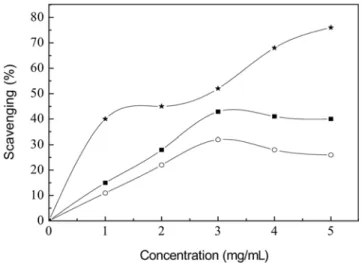
The scavenging activity of the polysaccharides and ascorbic acid on hydroxyl radicals is presented in Fig. 3. Obviously, the scavenging activity of the polysaccharides increased with the increasing concentration, reached the maximum and then declined to the termination, respectively. The scavenging activity of the polysaccharides was weaker than that of ascorbic acid. At the concentration ranges considered, the highest scavenging activity of PRM1 and PRM2 were 27 and 40%, respectively, at 3 mg/mL against hydroxyl radicals. These experimental results demonstrate the polysaccharides are efficient scavengers against hydroxyl radicals.
There are 2 types of antioxidation mechanisms for scavenging hydroxyl radicals. One is to suppress the generation of hydroxyl radicals, and another is to scavenge hydroxyl radicals generated (22). In the present study, the carboxyl group in the polysaccharide molecules might chelate the metal ions, which could not further react with H2O2 to give hydroxyl radicals (18). Furthermore, the
polysaccharides showed good hydroxyl radical scavenging activity, presumably because some functional groups including mercapto and aromatic groups could donate protons and increase the rate of H-atom transfer to hydroxyl radicals. It was likely that both of the mechanisms might be responsible for the inhibition against hydroxyl radicals. Finally, as higher protein content meant that higher numbers of mercapto and aromatic groups which could donate protons and higher numbers of carboxyl groups could chelate metal ions, PRM2 showed higher hydroxyl radical scavenging activity than PRM1. Further studies are needed to determine the specific mechanisms involved.
Scavenging abilities on nitric oxide radicals Nitric oxide radicals (NO·) have apivotal roles in the regulation of diverse physiological and pathophysiological processes (23). Over-produced NO· can trigger several disadvantage cellular responses and causes some diseases including inflammation, sepsis, stroke, and atherosclerosis (24). However, scavengers of NO· may help terminating the chain of reactions initiated by excess generation of NO·. As a kind of the scavengers of NO·, polysaccharides have the properties to counteract the effects of NO· formation and their scavenging activity may also help to arrest the chain of reactions initiated by excess generation of NO·.
The plot of the inhibition (%) vs. concentration (µg/mL)
is shown in Fig. 4. The inhibition effects of PRM1 and PRM2 were evident at the tested concentrations, though were weaker than that of ascorbic acid. The order of the inhibition effects is as follows: ascorbic acid>PRM1> PRM2. The half inhibition concentrations (IC50s) of ascorbic
acid, PRM1, and PRM2 were 6, 13, and 18µg/mL,
respectively, clearly demonstrating the good capacity of the polysaccharides to quench nitric oxide radicals.
It was observed that those compounds including glutathione and cysteine, which contained the thiol group, displayed considerable NO· scavenging activity (23). As mentioned above, the 2 polysaccharides all contain 15 kinds of amino acids (Table 1), hence, they reasonably have some NO· scavenging activity. However, the relation of the NO· scavenging activity to the protein content of the 2 polysaccharides is insignificant. The protein content of the 2 polysaccharides whereby might not be the unique mechanism required to scavenge the NO·. The mechanism of scavenging the NO· by the polysaccharides from rapeseed requires further investigation.
Antioxidant effects on microsomal lipid peroxidation Owing to high levels of unsaturation and increased consumption of oxygen, mitochondrial lipids are susceptible
Fig. 4. NO scavenging activity of the rapeseed meal polysaccharides (PRM1 and PRM2) and ascorbic acid.★ VC, L-ascorbic acid; ○ PRM1, the 1st polysaccharide fraction from rapeseed meal (average Mw about 131 kDa); ■ PRM2, the 2nd polysaccharide fraction from rapeseed meal (average Mw 290 kDa).
Fig. 3. Hydroxyl radical scavenging activity of the rapeseed meal polysaccharides (PRM1 and PRM2) and ascorbic acid.
★ VC, L-ascorbic acid; ○ PRM1, the 1st polysaccharide fraction from rapeseed meal (average Mw about 131 kDa); ■ PRM2, the
2nd polysaccharide fraction from rapeseed meal (average Mw 290 kDa).
to oxidative damage and the microsome has been widely used as a model for oxidative stress and antioxidant studies (25). Antioxidant effect on microsomal lipid peroxidation by antioxidants has many physiological implications (26). The inhibitory effects against the microsomal lipid peroxidation of the 2 fractions and ascorbic acid all increased in a dose-dependant manner (Fig. 5). It was also found that there were no significant differences between the inhibitory effects given by both the fractions. The inhibitory effect of PRM2 was comparable to that of ascorbic acid and even exceeded that of ascorbic acid from 0.3 to 2.2µg/mL. Collectively, the 2 fractions are effective
in inhibiting the microsomal lipid peroxidation.
Generally, the polysaccharides protect the microsomal lipid against peroxidation by at least 3 kinds of mechanisms, iron-chelating, radical scavenging, and reducing power (27). On the one hand, as there is much protein in the polysaccharide molecules, carboxyl groups may chelate metal ions, which otherwise may promote microsomal lipid peroxidation. On the other hand, as mentioned above, the polysaccharides could scavenge free radicals, which otherwise may accelerate microsomal lipid peroxidation. Furthermore, the polysaccharides might break the free radical chain and exert antioxidant activity with the presence of cysteine and aromatic amino acids by donating hydrogen atoms. Since it is a combination of several factors, there was not much difference between PRM1 and PRM2 in inhibiting the microsomal lipid peroxidation.
The results reported in this paper demonstrate that the novel polysaccharides obtained by mild alkaline extraction from rapeseed meal are protein-bound polysaccharides. This is the first exhaustive report on the in vitro antioxidant
activity of the polysaccharides from rapeseed meal, taking into consideration their major chemical compositions. In accordance with their sulfate contents, PRM1 showed better reducing power than PRM2. Furthermore, PRM1 was also highly effective in scavenging nitric oxide radical. On the other hand, high-protein-content PRM2 is more effective in scavenging hydroxyl radicals and superoxide
anions radicals than low-protein-content PRM1. With the help of the in vitro antioxidant models, the experimental
results provide us with insights into the antioxidant mechanisms associated with the sulfate and protein contents. Overall, the results obtained in this study will substantially aid in elucidating the use of the polysaccharides from rapeseed meal as a new source of functional food and medicine in the future.
Acknowledgments
The authors are grateful to the Chinese Ministry of Science and Technology for the financial support of this work (the National the 11th-5-year Projects supported by Science and
Technology reference 2006BAD05A12).
References
1. Schepetkin IA, Quinn MT. Botanical polysaccharides: Macrophage immunomodulation and therapeutic potential. Int. Immunol. 6: 317-333 (2006)
2. Bae IY, Oh IO, Lee S, Yoo S, Lee HG. Rheological characterization of levan polysaccharides from micro bacterium laevaniformans. Int. J. Biol. Macromol. 42: 10-13 (2008)
3. Huang X, Wang D, Hu Y, Lu Y, Guo Z, Kong X, Sun J. Effect of sulfated astragalus polysaccharide on cellular infectivity of infectious bursal disease virus. Int. J. Biol. Macromol. 42: 166-171 (2008)
4. Yang B, Jiang Y, Zhao M, Shi J, Wang L. Effects of ultrasonic extraction on the physical and chemical properties of polysaccharides from longan fruit pericarp. Polym. Degrad. Stabil. 93: 268-272 (2008)
5. Alonso-Sande M, Teijeiro-Osorio D, Remunán-López C, Alons MJ. Glucomannan, a promising polysaccharide for biopharmaceutical purposes. Eur. J. Pharm. Biopharm. 2: 1-10 (2008)
6. Sun H, Jiang S, Mu P, Qi D. In vivo antioxidative capacities of rapeseed mealpolysaccharides. J. Food Agric. Environ. 7: 97-102 (2009)
7. Dubois M, Gilles KA, Hamilton JK, Rebers PA, Smith F. Colorimetric method for determination of sugars and related substances. Anal. Chem. 28: 350-356 (1956)
8. Kawai Y, Seno N, Anno K. A modified method for chondrosulfatase assay. Anal. Biochem. 32: 314-321 (1969)
9. Bitter T, Muir HM. A modified uronic acid carbazole reaction. Anal. Biochem. 330-334 (1962)
10. Baethgen WE, Alley MM. A manual colorimetric procedure for measuring ammonium nitrogen in soil and plant Kjeldahl digests. Commun. Soil Sci. Plan. 20: 961-969 (1989)
11. Siddhuraju P, Manian S. The antioxidant activity and free radical-scavenging capacity of dietary phenolic extracts from horse gram
(Macrotyloma uniflorum (Lam.) Verdc.) seeds. Food Chem. 105: 950-958 (2007)
12. Xiang ZN, Ning ZX. Scavenging and antioxidant properties of compound derived from chlorogenic acid in South-China honeysuckle. LWT-Food Sci. Technol. 41: 1189-1203 (2008) 13. Dong CH, Yao YJ. In vitro evaluation of antioxidant activities of
aqueous extracts from natural and cultured mycelia of Cordyceps sinensis. LWT-Food Sci. Technol. 41: 669-677 (2008)
14. Awah FM, Uzoegwu PN, Oyugi JO, Rutherford J, Ifeonu P, Yao X-J, Fowke KR, Eze MO. Free radical scavenging activity and immunomodulatory effect of Stachytarpheta angustifolia leaf extract. Food Chem. 9: 1-8 (2009)
15. Srivastava A, Harish SR, Shivanandappa T. Antioxidant activity of the roots of Decalepis hamiltonii (Wight & Arn.). LWT-Food Sci. Technol. 39: 1059-1065 (2006)
16. Halliwell B. Phagocyte-derived reactive species: Salvation or suicide? Trends Biochem. Sci. 31: 509-515 (2006)
17. Gülçin İ. Antioxidant and antiradical activities ofL-carnitine. Life
Sci. 78: 803-811 (2006) Fig. 5. In vitro protective effects of the rapeseed meal
polysaccharides(PRM1 and PRM2)and ascorbic acid against
microsomal lipid peroxidation. ★ VC, L-ascorbic acid; ○
PRM1, the 1st polysaccharide fraction from rapeseed meal (average Mw about 131 kDa); ■ PRM2, the 2nd polysaccharide fraction from rapeseed meal (average Mw 290 kDa).
18. Rajapakse N, Mendis E, Jung WK, Je JY, Kim SK. Purification of a radical scavenging peptide from fermented mussel sauce and its antioxidant properties. Food Res. int. 38: 175-182 (2005)
19. Wang J, Zhang Q, Zhang Z, Li Z. Antioxidant activity of sulfated polysaccharide fractions extracted from Laminaria japonica. Int. J. Biol. Macromol. 42: 127-132 (2008)
20. Cacciuttolo MA, Speca D, Renard P, Lumpkin J, Remacle J, Rao G. DNA damage by hyperoxia in hybridoma cells is mediated by metal ions and hydroxyl radicals. Free Radical Bio. Med. 15: 486 (1993) 21. Qian ZJ, Jung WK, Byun HG, Kim SK. Protective effect of an
antioxidative peptide purified from gastrointestinal digests of oyster,
Crassostrea gigas against free radical induced DNA damage. Bioresource Technol. 99: 3365-3371 ( 2008)
22. Qi H, Zhang Q, Zhao T, Chen R, Zhang H, Niu X, Li Z. Antioxidant activity of different sulfate content derivatives of polysaccharide extracted from Ulva pertusa (Chlorophyta)in vitro. Int. J. Biol. Macromol. 37: 195-199 (2005)
23. Magalhães LM, Segundo MA, Reis S, Lima JLFC. Methodological aspects about in vitro evaluation of antioxidant properties. Ana. Chim. Acta 613: 1-19 (2008)
24. Bruckdorfer R. The basics about nitric oxide. Mol. Aspects Med. 26: 3-31 (2005)
25. Rathee JS, Hassarajani SA, Chattopadhyay S. Antioxidant activity of Mammea longifolia bud extracts. Food Chem. 99: 436-443 (2006)
26. Wu WM, Lu L, Long Y, Wang T, Liu L, Chen Q, Wang R. Free radical scavenging and antioxidative activities of caffeic acid phenethyl ester (CAPE) and its related compounds in solution and membranes: A structure-activity insight. Food Chem. 105: 107-115 (2007)
27. Li XL, Zhou AG, Han Y. Anti-oxidation and anti-microorganism activities of purification polysaccharide from Lygodium japonicum in vitro. Carbohyd. Polym. 66: 34-42 (2006)