Korean Journal of Microbiology (2019) Vol. 55, No. 2, pp. 164-166 pISSN 0440-2413
DOI https://doi.org/10.7845/kjm.2019.9024 eISSN 2383-9902
Copyright ⓒ 2019, The Microbiological Society of Korea
Complete genome sequence of Microbacterium aurum strain KACC 15219 T , a carbohydrate-degrading bacterium
YeonGyun Jung
1, Byung Kwon Jung
1, Chang Eon Park
1, Jerald Conrad Ibal
1, Sang-Jun Kim
2, and Jae-Ho Shin
1*
1
School of Applied Biosciences, College of Agriculture and Life Sciences, Kyungpook National University, Daegu 41566, Republic
of Korea
2
Department of Natural Sciences, Republic of Korea Naval Academy, Changwon 51704, Republic of Korea
탄수화물 분해 세균 Microbacterium aurum KACC 15219 T 의 유전체 염기서열 해독
정연균
1・ 정병권
1・ 박창언
1・ 제랄드 콘라드 이발
1・ 김상준
2・ 신재호
1*
1
경북대학교 농업생명과학대학 응용생명과학부,
2해군사관학교 자연과학부
(Received February 27, 2019; Revised April 9, 2019; Accepted April 10, 2019)
*For correspondence. E-mail: [email protected];
Tel.: +82-53-950-5716; Fax: +82-53-953-7233
The complete genomic information of Microbacterium aurum KACC 15219
T(= IFO 15204
T= DSM 8600
T) is described. The genome of M. aurum KACC 15219
Tcontains 3,096 protein coding genes and an average G+C content of 69.9% in its chromosome (3.42 Mbp). This strain can use various carbon sources for growth, including quinic acid. Quinic acid is used as a substrate for the synthesis of aromatic amino acids via the shikimate pathway which are useful in the industry. M. aurum KACC 15219
Twill provide basis to improve our understanding of this organism and allow more efficient application of the strain to industry.
Keywords: Microbacterium aurum, aromatic amino acids, quinic acid, shikimate pathway
Microbacterium aurum strain KACC 15219
T(= IFO 15204
T= DSM 8600
T) was isolated from corn steep liquor. A poly- phasic taxonomic study revealed that M. aurum KACC 15219
Tcould utilize 16 types of sole carbon substrates (Yokota et al., 1993). This strain has the potential to utilize quinic acid as a
sole carbon source. Quinic acid is the substrate used to synthesize aromatic amino acids via the shikimate pathway (Guo et al., 2014). These aromatic amino acids are useful in food and pharmaceutical industries (Koma et al., 2012). Although many DNA sequences from the genus Microbacterium are available, genome sequencing of M. aurum KACC 15219
Thas not been conducted. We obtained the whole genome sequence and reported the complete genome of the strain.
Genomic DNA was extracted using QIAmp DNA Mini kit
(Qiagen) through the manufacturer’s instructions. A single
molecule real-time sequencing platform from PacBio RS II
(Pacific Biosciences) was used to obtain the whole genome
sequence (Eid et al., 2009; Nzila et al., 2018). The sub-reads
from the raw sequencing reads following adapter-removal
were used for de novo assembly using HGAP version 2 (Chin
et al., 2013) based on 85,020 quality reads with a mean length
of 12,521 bp. It produced a circular chromosome having
3,424,892 bp with 192.19-fold average coverage and was
annotated automatically by using the RAST server (Aziz et al.,
2008) and PGAAP from NCBI (Angiuoli et al., 2008). Genome
annotation was performed by the prediction of protein-coding
Complete genome sequence of M. aurum strain KACC 15219
T∙ 165
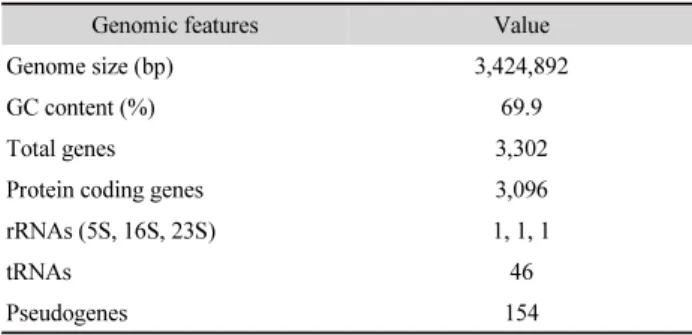
Korean Journal of Microbiology, Vol. 55, No. 2 Table 1. Genome features of Microbacterium aurum strain KACC15219
TGenomic features Value
Genome size (bp) 3,424,892
GC content (%) 69.9
Total genes 3,302
Protein coding genes 3,096
rRNAs (5S, 16S, 23S) 1, 1, 1
tRNAs 46
Pseudogenes 154
Fig. 1. Circular representation and subsystem category distribution of the genome of Microbacterium aurum KACC15219
T. Circles are numbered from 1 (the outermost circle) to 6 (the innermost circle). The outer four circles show the forward and reverse strand of COG categories and coding sequence (CDS). The fifth circle represents the GC content (black). The sixth circle demonstrates the GC skew curve (green, positive GC skew; violet, negative GC skew). The genome position scaled in kb from base 1 is shown on the inner circle.
genes, RNA genes, and pseudo genes. Additional gene prediction analyses and functional annotation were performed
using the Integrated Microbial Genomes and Microbiome samples from JGI (Markowitz et al., 2008).
The complete genome features of M. aurum KACC 15219
Tare summarized in Table 1 and Fig. 1. The genome was composed of a circular chromosome having the size of 3,424,892 bp with a GC content of 69.9%. In total, 3,302 genes, including 154 pseudogenes, were predicted from the genome sequence, and 52 RNA genes (3 rRNAs, 46 tRNAs) were identified.
Approximately 72.00% of the total genes encoded proteins
with known functions and 886 genes were annotated as
hypothetical protein. Among the total genes, 2,012 genes were
assigned to COGs. Genome analysis revealed that this strain
166 ∙ Jung et al.
미생물학회지 제55권 제2호
possessed putative enzymes for central carbohydrate metabolism to assimilate these carbon sources through different metabolic pathways (Justice et al., 2014). Putative enzymes responsible for the utilization of diverse sole carbons were found in the genome. All key enzymes in the Embden-Meyerhof-Parnas pathway and TCA cycle were present in M. aurum KACC 15219
T. The presence of dihydrolipoamide acyltransferase (APZ34619.1), pyruvate dehydrogenase (acetyl-transferring) E1 component subunit alpha (APZ34621.1), and dihydro- lipoamide acetyltransferase (APZ34487.1) in the pyruvate metabolism pathway suggests that pyruvate is converted to acetyl-CoA. Moreover, the presence of type II 3-dehydroquinate dehydratase (APZ34549.1), shikimate dehydrogenase (APZ 34542.1), shikimate kinase (APZ34544.1), 3-phosphoshikimate 1-carboxyvinyltransferase (APZ34994.1), and chorismate synthase (APZ33558.1) indicateds that M. aurum KACC 15219
Tmay utilize quinic acid to synthesize three aromatic amino acids via the shikimate pathway (Guo et al., 2014). This strain can use various carbon sources including quinic acid and may provide basis to improve our understanding of this organism and allow more efficient application of the strain to industry.
Availability of the sequence data and strain
The complete genome sequence of M. aurum strain KACC 15219
Thas been deposited in EMBL/GenBank under the accession number CP018762.1. The genome project for this strain is listed in the JGI GOLD under project Gp0191354.
적 요
이 연구에서는 Microbacterium aurum KACC 15219
T(=
IFO 15204
T= DSM 8600
T)의 완전한 유전체 서열이 해독되었 다. 하나의 원형 염색체는 3.42 Mbp였으며 G+C 함량이 69.9%
였다. 해당 염색체 염기서열을 주석화한 결과, 총 3,096개의 유 전자 서열이 발견되었다. 16종 이상의 탄소원을 분해하는 것 으로 알려진 M. aurum KACC 15219
T에는 방향족 아미노산 합성 기질인 quinic acid를 비롯한 다양한 탄소원의 이용과 관 련된 유전자가 존재하였다. M. aurum KACC 15219
T의 유전 체 정보는 이 미생물에 대한 이해를 높이고 산업적인 이용을 위한 기반이 될 것이다.
Acknowledgements
This work was carried out with the support of "Cooperative Research Program for Agriculture Science and Technology Development (Project No. PJ013383)" Rural Development Administration, Republic of Korea.
References