Korean Journal of Microbiology (2016) Vol. 52, No. 3, pp. 388-390 pISSN 0440-2413
DOI http://dx.doi.org/10.7845/kjm.2016.6052 eISSN 2383-9902
Copyright ⓒ 2016, The Microbiological Society of Korea
Genome Announcement
Complete genome sequence of a cold-adapted humic acid degrading bacterium Pedobacter sp. PAMC 27299 from the Antarctic seashore
Hye-Jin Kim
1, Jae Wan Park
1, Ha Ju Park
2, Dockyu Kim
2, and Woo Jun Sul
1*
1
Department of Systems Biotechnology, Chung-Ang University, Anseong 17546, Republic of Korea
2
Division of Life Sciences, Korea Polar Research Institute, Incheon 21990, Republic of Korea
남극 해안으로부터 저온적응 부식산 분해 Pedobacter sp. PAMC 27299의 유전체 서열 해독
김혜진
1・ 박재완
1・ 박하주
2・ 김덕규
2・ 설우준
1*
1
중앙대학교 시스템생명공학과,
2극지연구소 생명과학연구부
(Received September 1, 2016; Accepted September 8, 2016)
ABSTRACT: Pedobacter sp. PAMC 27299 with humic acid cultivated on low temperature was isolated from the moss debris on the coast of the Barton Peninsula of King George Island of the maritime Antarctic region. Here, we present the complete genome sequence of Pedobacter sp. PAMC 27299, which contains 6,147,290 bp with a G+C content of 40.54%. PAMC 27299 may possess cold-adapted humic acid degradation enzymes with implication on global warming.
Key words: antarctica, degradation, global warming, humic acid
*For correspondence.
E-mail: [email protected];Tel.: +82-31-670-4707; Fax: +82-31-675-1381
Antarctica seashore, extremely cold region, is the storage of huge amount of organic sources and mosses nearby seashore are great reservoir of humic substances through long-term accumulation by bacterial degradation in low rate (Park et al., 2015). Global warming lead to increasing of bacterial ability to degrade humic substances even in low temperatures and not only increase emission of carbon dioxide but also leach dissolved organic carbon (DOC) to the Southern Ocean. In order to identify cold-adapted humic acid degrading bacteria and obtain genetic information, Pedobacter sp. PAMC 27299, a Gram- negative, an aerobic bacterium, was isolated from moss debris collected on the coast of the Barton Peninsula of King George Island of the maritime Antarctic region (62° 13 ′ S, 58° 47′ W) during the austral summer. One gram of collected Antarctic moss debris was homogenized in 10% glycerol and placed at
4
oC in 1h. The supernatants (100 μl) were spread on minimal
medium (MB Cell) containing humic acid (MB Cell) as sole
carbon source at 15
oC. The bacterial cells grown on humic acid
plates were re-cultured in fresh humic acid medium. Final
bacterial cells grown on re-culturing condition were considered
humic acid degrading isolates (Park et al., 2015). The genomic
DNA of Pedobacter sp. PAMC 27299 was isolated with the
MG
TMGenomic DNA Purification kit (MG MED, Inc.). The
extracted DNA was used to construct 20 kb SMRTbell
TMtemplate libraries. The whole genome sequencing of Pedobacter
sp. PAMC 27299 was determined using PacBio RS II platform
(Pacific Biosciences). De novo assembly was conducted by
using Hierarchical Genome Assembly Process (HGAP, Version
2.3) workflow, including consensus polishing with Quiver
(Chin et al., 2013). As the estimated genome size was 6 Mbp
and average was about 214 X for 1,282,028,238 bp filtered
subreads. We performed error correction based the longest 30 X
(180 Mbp) seed bases with rest shorter reads and then assembled
Complete genome of Pedobacter sp. PAMC 27299 ∙
389
Korean Journal of Microbiology, Vol. 52, No. 3
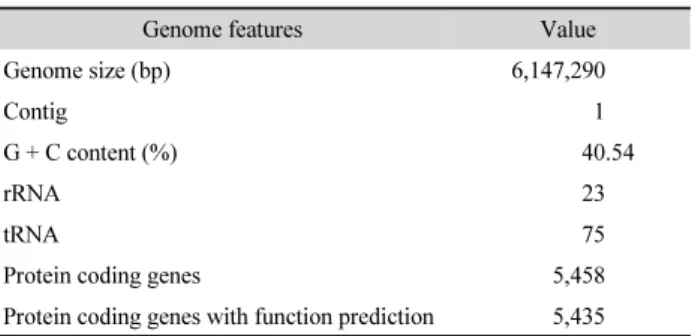
Fig. 1. Forward CDS, reverse CDS, rRNA, plot of GC percent, and GC skew (G-C)/(G+C) of Pedobacter sp. PAMC 27299 from outer to inner circles.Table 1. Genome features of Pedobacter sp. PAMC 27299
Genome features Value
Genome size (bp) 6,147,290
Contig 1
G + C content (%) 40.54
rRNA 23
tRNA 75
Protein coding genes 5,458
Protein coding genes with function prediction 5,435
with error corrected reads. A contig of 6,179,929 bp from HGAP polish process was checked and trimmed for genome closure using MUMmer 3.5 (Kurtz et al., 2004). The complete genome of Pedobacter sp. PAMC 27299 is made up of a circular chromosome of 6,147,290 bp with 40.54% G+C contents. Putative gene coding sequences (CDSs) from the assembled contig were identified by Glimmer v3.02 (Delcher et al., 2007) and 5,435 predicted open reading frames (ORFs) were obtained. The ORFs were searched by Blastall alignment against the NCBI Non-redundant protein database for all species. GO annotation was assigned to each of ORFs by Blast2GO software (Conesa et al., 2005) analyzing the best hits
of the BLAST results. Ribosomal RNAs and transfer RNAs were predicted by using RNAmmer 1.2 (Lagesen et al., 2007) and tRNAscan-SE 1.4 (Lowe and Eddy, 1997). Twenty three rRNAs and 75 tRNAs were found in the genome (Table 1 and Fig. 1).
This Antarctic Pedobacter strain will contribute to a better understanding of increasing humic acid degradation from current climate change resulting in accelerating carbon dioxide emission and leaching dissolved organic carbon (DOC) to the Southern Ocean.
Nucleotide sequence accession numbers
The Pedobacter sp. PAMC 28299 is available at KCTC (accession no. KCTC 42781). The complete genome sequence of Pedobacter sp. PAMC 28299 was deposited in GenBank under the accession no. CP012996.
Acknowledgements
This work was supported by the Antarctic organisms: Cold-
390
∙ Kim et al.미생물학회지 제52권 제3호
Adaptation Mechanisms and its application Grant (PE16070), funded by the Korea Polar Research Institute and the National Research Foundation of Korea (NRF) grant funded by the Korea government (MSIP) (NRF-2014R1A1A2A16055779).
적 요
부식산(humic acid)을 이용하여 저온에서 배양된 Pedobacter sp. PAMC 27299는 남극 바톤 반도(Barton Peninsula) King George Island 의 해안가 이끼(moss debris)로부터 분리되었다.
본 연구에서는 Pedobacter sp. PAMC 27299의 유전체 서열을 해독하였으며 크기 6,147,290 bp, G+C 함량 40.54%의 PAMC 27299는 지구 온난화 관련 저온적응 부식산 분해 효소를 보유 하는 것으로 확인되었다.
References
Chin, C.S., Alexander, D.H., Marks, P., Klammer, A.A., Drake, J.,
Heiner, C., Clum, A., Copeland, A., Huddleston, J., Eichler, E.E., et al. 2013. Nonhybrid, finished microbial genome assemblies from long-read SMRT sequencing data. Nat. Methods 10, 563–
569.
Conesa, A., Gotz, S., Garcia-Gomez, J.M., Terol, J., Talon, M., and Robles, M. 2005. Blast2GO: a universal tool for annotation, visualization and analysis in functional genomics research.
Bioinformatics 21, 3674–3676.
Delcher, A.L., Bratke, K.A., Powers, E.C., and Salzberg, S.L. 2007.
Identifying bacterial genes and endosymbiont DNA with Glimmer.
Bioinformatics 23, 673–679.
Kurtz, S., Phillippy, A., Delcher, A.L., Smoot, M., Shumway, M., Antonescu, C., and Salzberg, S.L. 2004. Versatile and open software for comparing large genomes. Genome Biol. 5, R12.
Lagesen, K., Hallin, P., Rodland, E.A., Staerfeldt, H.H., Rognes, T., and Ussery, D.W. 2007. RNAmmer: consistent and rapid annotation of ribosomal RNA genes. Nucleic Acids Res. 35, 3100–3108.
Lowe, T.M. and Eddy, S.R. 1997. tRNAscan-SE: a program for improved detection of transfer RNA genes in genomic sequence.
Nucleic Acids Res. 25, 955–964.
Park, H.J., Chae, N., Sul, W.J., Lee, B.Y., Lee, Y.K., and Kim, D. 2015.
Temporal changes in soil bacterial diversity and humic substances degradation in subarctic tundra soil. Microb. Ecol. 69, 668–675.