A novel marine bacterium belonging to the family Rhodo- bacteraceae was designated as strain PG104 after being isolated from red algae collected in the coastal region of Pohang, South Korea. The genome consists of one circular chromosome of 2,279,458 bp with 66.68 GC mol% content and five plasmids; pL104-1 to pL104-5 with lengths ranging from 44,911 bp to 175,961 bp. Furthermore, the genome contains 2,643 protein-coding sequences (CDSs), 51 tRNA genes, as well as 9 rRNA operons as 16S-23S-5S rRNA. Genome analysis revealed that the PG104 strain harbors alginate lyase genes, which are responsible for the degradation of algal polysaccharides.
Keywords: Rhodobacteraceae, Oxford Nanopore GridION, poly- saccharide, red algae
One of the major subdivisions within the class Alpha- proteobacteria is the family Rhodobacteraceae, which was first proposed by Garrity et al. (2005) and comprises more than 100 genera and 300 species with very diverse physiologies (Pujalte et al., 2014). Physiological and genomic charac-
teristics of this family show high metabolic diversity in terms of utilization of organic and inorganic compounds, sulfur oxi- dation, aerobic anoxygenic photosynthesis, carbon monoxide oxidation, secondary metabolite production, and symbiotic relationships with various marine eukaryotic hosts (Buchan et al., 2005; Pujalte et al., 2014). This strain was isolated from the marine red algae of the Grateloupia species collected in the coastal region of Pohang, South Korea. Rhizoidal holdfast regions for culturing novel microbes were processed according to previously reported method (Tanaka et al., 2012). The sample was serially diluted with sterilized DTS medium and then was spread on DTS agar plate and incubated at 25°C for 5 days. The strain PG104 was picked and purified by sub- cultivation on marine agar 2216 (MA; Difco) and routinely incubated on MA at 30°C. The strain PG104 is a yellow- pigmented, aerobic, and Gram-negative bacterium that pro- duces a wide variety of industrially important enzymes such as alginate lyase, asparaginase, and xylanase (unpublished data).
The information of the complete Falsirhodobacter sp. PG104 genome provides an opportunity for comparative genomic analyses within species from the same genus and evolutionary surveys of alga-associated bacteria.
Korean Journal of Microbiology (2020) Vol. 56, No. 3, pp. 327-330 pISSN 0440-2413
DOI https://doi.org/10.7845/kjm.2020.0080 eISSN 2383-9902
Copyright ⓒ 2020, The Microbiological Society of Korea
Complete genome sequence of Falsirhodobacter sp. PG104, an alginate-degrading marine bacterium
Yong Min Kwon
1, Ajit Kumar Patra
2, Dawoon Chung
1, and Youngik Yang
1*
1
National Marine Biodiversity Institute of Korea (MABIK), Seocheon 33662, Republic of Korea
2
Division of EcoScience, Ewha Womans University, Seoul 03760, Republic of Korea
알긴산을 분해하는 해양 박테리아 Falsirhodobacter sp. PG104의 유전체 염기서열 분석
권용민
1・ Ajit Kumar Patra
2・ 정다운
1・ 양영익
1*
1
국립해양생물자원관,
2이화여자대학교 환경과학과
(Received August 19, 2020; Revised August 28, 2020; Accepted August 28, 2020)
*For correspondence. E-mail: [email protected];
Tel.: +82-41-950-0956; Fax: +82-41-950-0951
328
∙ Kwon et al.미생물학회지 제56권 제3호
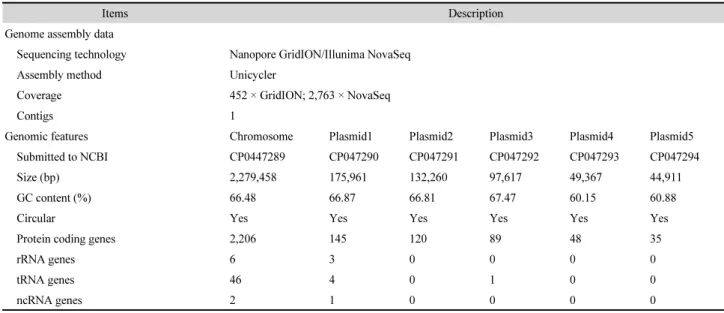
Whole genome sequencing was performed using Oxford Nanopore Technologies’ GridION Mk1 and Illunima NovaSeq 6000 sequencers (Table 1). De novo assembly of 50,957,782 reads (8,935,048,407 bp total) were conducted using the Unicycler assembler (version 0.4.8). Structural and functional annotations were performed via the National Centre for Biotechnology Information’s Prokaryotic Genomes Annota- tion Pipeline (PGAP v4.10). Predicted genes from the PGAP pipeline were further annotated for COG by WebMGA web server (Wu et al., 2011). Putative secondary biosynthetic meta- bolites of the genome were predicted using antiSMASH 5.0 (Blin et al., 2019). Polysaccharide lyases were classified by the Carbohydrate-Active Enzymes (CAZy) Database (Lombard et al., 2010).
The complete PG104 genome was seen to contain a single circular chromosome (2,279,458 bp, 66.48% GC content) and five circular plasmids; pL104-1 (175,961 bp, 66,87% GC con- tent), pL104-2 (132,260 bp, 66.81% GC content), pL104-3 (97,617 bp, 67.47% GC content), pL104-4 (49,367 bp, 60.15%
GC content), and pL104-5 (44,911 bp, 60.88% GC content).
Circular maps of the chromosome and plasmids are shown in Fig. 1. The chromosome encodes for a total of 2,206 (80.39%) coding DNA sequences (CDSs), of which 2,001 (90.70%) were assigned to COGs. In addition, the plasmids encode for a total of 437 (15.92%) CDSs, of which 380 (86.96%) were assigned to COGs. Moreover, on one hand, the chromosome encodes for
38 pseudo-genes, 6 rRNAs (5S, 16S, and 23S), 46 tRNAs, and 2 ncRNAs. On the other hand, pL104-1 contains 3 rRNAs, 4 tRNAs, and 1 ncRNA, whereas pL104-3 only contains one coding region for tRNA. Analysis of the 16S rRNA gene sequence (locus tag: GR316_05225) in the PG104 genome was closely related to Falsirhodobacter deserti W402
Tand F.
halotolerans JA744
Twith similarities of 97.13% and 96.90%, respectively. The average nucleotide identity (ANI) between the PG104 genome and the W402
Tone was 84.4% when calculated from dRep (Olm et al., 2017).
The PG104 genome has a wide range of secondary meta- bolite gene clusters related to terpene and terpene-t3pks. The genome was seen to harbor an idi gene, which encodes for isopentenyl pyrophosphate isomerase. Moreover, the genome was also seen to harbor genes required for β-carotene bio- synthesis; including geranylgeranyl pyrophosphate synthase (crtE), phytoene synthase (crtB), phytoene desaturase (crtI), lycopene cyclase (crtY), and β-carotene hydroxylase (crtZ) genes (Teramoto et al., 2003). Importantly, the genome also contained two alginate lyase 2 proteins classified as part of family 7 of the polysaccharide lyases (PL-7) on the CAZy database. These proteins, namely GR316_08445 and GR316_
08665, have the potential to degrade alginate, an algal polysaccharide composed of long heteropolymeric chains of randomly aligned monosaccharides, β-D-mannuronate and α- L-gluronate (Mori et al., 2016). Moreover, another protein
Table 1. Falsirhodobacter sp. PG104 genome assembly and its general features
Items Description
Genome assembly data
Sequencing technology Nanopore GridION/Illunima NovaSeq
Assembly method Unicycler
Coverage 452 × GridION; 2,763 × NovaSeq
Contigs 1
Genomic features Chromosome Plasmid1 Plasmid2 Plasmid3 Plasmid4 Plasmid5
Submitted to NCBI CP0447289 CP047290 CP047291 CP047292 CP047293 CP047294
Size (bp) 2,279,458 175,961 132,260 97,617 49,367 44,911
GC content (%) 66.48 66.87 66.81 67.47 60.15 60.88
Circular Yes Yes Yes Yes Yes Yes
Protein coding genes 2,206 145 120 89 48 35
rRNA genes 6 3 0 0 0 0
tRNA genes 46 4 0 1 0 0
ncRNA genes 2 1 0 0 0 0
Complete genome sequence of Falsirhodobacter sp. PG104 ∙
329
Korean Journal of Microbiology, Vol. 56, No. 3 belonging to the PL15 family, GR316_12750, was only found
in the pL104-2. We believe that the Falsirhodobacter sp.
PG104’s genome information may serve as an important resource for future research in alginate degradation and evolutionary studies.
Nucleotide sequence accession numbers
The complete genome sequence of Falsirhodobacter sp.
PG104 has been deposited at DDBJ/EMBL/GenBank under the accession numbers CP047289, CP047290, CP047291, CP047292, CP047293, and CP047294 for the single circular chromosome and five circular plasmids, respectively. The strain PG104 has been deposited at Korean Collection for Type Cultures (KCTC) as KCTC 82230.
적 요
Rhodobacteraceae 과에 속하는 신종 해양 세균은 대한민국 포항의 해안가에서 채집한 적조류로부터 분리되었으며 PG104
균주로 명명하였다. 이 균주의 유전체는 66.68% GC 함량과 2,279,458 bp 크기를 가진 1개의 염색체와 5개의 플라스미드 (크기가 44,911 bp에서 175,961 bp 범위에 속하는 플라스미드 pL104-1, pL104-2, pL104-3, pL104-4, pL104-5)로 구성되어 있다. 또한 2,643개의 단백질-코딩 염기서열, 51개의 tRNA 유 전자 및 9개의16S-23S-5S 관련 rRNA operon를 포함한다. 나 아가 PG104 균주의 유전체에는 해조류 유래 다당류를 분해 할 수 있는 알긴산 분해효소 유전자가 존재하는 것으로 나타 났다.
Acknowledgments
This work was supported by the MABIK in-house programs (2020M00500 and 2020M00600). We would like to thank Editage (www.editage.co.kr) for English language editing.
Fig. 1. Graphical circular map of the Falsirhodobacter sp. PG104 genome. The genome comprises one chromosome and five plasmids. From outside to the center: The first (forward strand) and second (reverse strand) rings indicate the sites of CDSs (blue) / rRNA (pink) / tRNA (orange). The third ring shows the GC content (black). The 4th ring shows the GC skew (green/purple), where the value is plotted as the deviation from the average GC skew of the complete sequence. The 5th ring depicts the location of the genome.
330
∙ Kwon et al.미생물학회지 제56권 제3호
References
Blin K, Shaw S, Steinke K, Villebro R, Ziemert N, Lee SY, Medema MH, and Weber T. 2019. antiSMASH 5.0: updates to the se- condary metabolite genome mining pipeline. Nucleic Acids Res.
47, W81–W87.
Buchan A, González JM, and Moran MA. 2005. Overview of the marine Roseobacter lineage. Appl. Environ. Microbiol. 71, 5665–
5677.
Garrity GM, Bell JA, and Lilburn T. 2005. Family I. Rhodobac- teraceae fam. nov, pp. 161. In Brenner DJ, Krieg NR, Staley JT, and Garrity GM (eds.), Bergey’s Manual of Systematic Bac- teriology: the proteobacteria vol. 2. Springer, New York, USA.
Lombard V, Bernard T, Rancurel C, Brumer H, Coutinho PM, and Henrissat B. 2010. A hierarchical classification of polysaccharide lyases for glycogenomics. Biochem. J. 432, 437–444.
Mori T, Takahashi M, Tanaka R, Miyake H, Shibata T, Chow S, Kuroda K, Ueda M, and Takeyama H. 2016. Falsirhodobacter sp. alg1 harbors single homologs of endo and exo-type alginate lyases efficient for alginate depolymerization. PLoS ONE 11, e0155537.
Olm MR, Brown CT, Brooks B, and Banfield JF. 2017. dRep: a tool for fast and accurate genomic comparisons that enables improved genome recovery from metagenomes through de-replication.
ISME J. 11, 2864–2868.
Pujalte MJ, Lucena T, Ruvira MA, Arahal DR, and Macián MC. 2014.
The family Rhodobacteraceae, pp. 439–512. In Rosenberg E, DeLong EF, Lory S, Stackebrandt E, and Thompson F. (eds), The Prokaryotes: Alphaproteobacteria and Betaproteobacteria, 4th edn. Springer, Berlin, Germany.
Tanaka Y, Tamaki H, Matsuzawa H, Nigaya M, Mori K, and Kamagata Y. 2012. Microbial community analysis in the roots of aquatic plants and isolation of novel microbes including an organism of the candidate phylum OP10. Microbes Environ. 27, 149–157.
Teramoto M, Takaichi S, Inomata Y, Ikenaga H, and Misawa N. 2003.
Structural and functional analysis of a lycopene β-monocyclase gene isolated from a unique marine bacterium that produces myxol. FEBS Lett. 545, 120–126.
Wu S, Zhu Z, Fu L, Niu B, and Li W. 2011. WebMGA: a customizable web server for fast metagenomic sequence analysis. BMC Genomics 12, 444.