Korean Journal of Microbiology (2019) Vol. 55, No. 1, pp. 55-57 pISSN 0440-2413
DOI https://doi.org/10.7845/kjm.2019.8100 eISSN 2383-9902
Copyright ⓒ 2019, The Microbiological Society of Korea
Complete genome sequence of Runella sp. ABRDSP2, a new mono-aromatic compounds degrading bacterium isolated from freshwater
Hye Kyeong Kang, Byung-Gon Ryu, Kyung Min Choi, and Hyun Mi Jin*
Freshwater Bioresources Utilization Division, Nakdonggang National Institute of Biological Resources, Sangju 37242, Republic of Korea
담수로부터 분리한 단환성 화합물 분해 미생물 Runella sp. ABRDSP2의 전장 유전체 서열
강혜경 ・ 류병곤 ・ 최경민 ・ 진현미*
국립낙동강생물자원관 자원활용기반연구부
(Received December 4, 2018; Revised December 10, 2018; Accepted December 11, 2018)
*For correspondence.
E-mail: [email protected];Tel.: +82-54-530-0913; Fax: +82-54-530-0929
The Runella sp. ABRDSP2, capable of degrading mono-aromatic compounds such as toluene, was isolated from freshwater. The whole genome, consisting of a circular single chromosome and three plasmids, was composed of total 7,613,819 bp length with 44.4% G+C contents and 6,006 genes. The genome of strain ABRDSP2 contains many aromatic hydrocarbon degrading genes such as monooxygenase, ring-cleaving dioxygenase, and catechol 1,2-dioxygenase. The complete genome reveals versatile biodegradation capabilities of Runella sp. ABRDSP2.
Keywords: Runella, bioremediation, mono-aromatic hydrocarbon degradation
The genus Runella was first proposed by Larkin and Williams (1978) and includes five recognized species. The member of genus Runella has been generally found in aquatic habitats such as activated sludge and these strains showed aerobic, chemoorganotrophic phenotypic characteristics and produced pale-pink pigmentation (Kim et al., 2017). The size of reported
genome sequence of strains, belonging to genus Runella, is approximately 7.16 Mb encoding 5,826 genes with 44.8% G+
C contents (NCBI database, https://www.ncbi.nlm.nih.gov/
genome/71020). Here, we report the complete genome sequence of newly isolated bacterium, Runella sp. ABRDSP2, containing genes related with aromatic compounds degradation.
Runella sp. ABRDSP2 (= KACC 19854), capable of degrading aromatic hydrocarbons (benzene, phenol, toluene, and naph- thalene), was isolated from freshwater. The genomic DNA was obtained from the cultivated cells on R2A agar during 2 days using the Wizard Genomic DNA Purification kit (Promega), following the protocol recommended by the manufacturer. The purified genomic DNA was completely sequenced by a com- bination of PacBio RSII and Illumina Hiseq 2500 sequencing.
Briefly, the 20-kb sequencing library was constructed using a
PacBio DNA Template Prep Kit 1.0 and analyzed by single-
molecule real-time (SMRT) sequencing at Macrogen. De novo
assembly of the sequencing reads was performed through the
hierarchical genome assembly process (HGAP 2, version 2.3.0),
and paired-end reads (101 bp) obtained from the Illumina
sequencing were mapped on assembled contig for error correc-
56
∙Kang et al.미생물학회지 제55권 제1호
Fig. 1. Graphical circular maps of the chromosome and plasmids of Runella sp. ABRDSP2. Circles illustrate the following characteristics from the outside to the center: (1) coding sequences on forward strand, (2) coding sequences on reverse strand, (3) Transfer RNAs (tRNAs), (4) ribosomal RNAs (rRNAs), (5) GC content, and (6) GC skew.
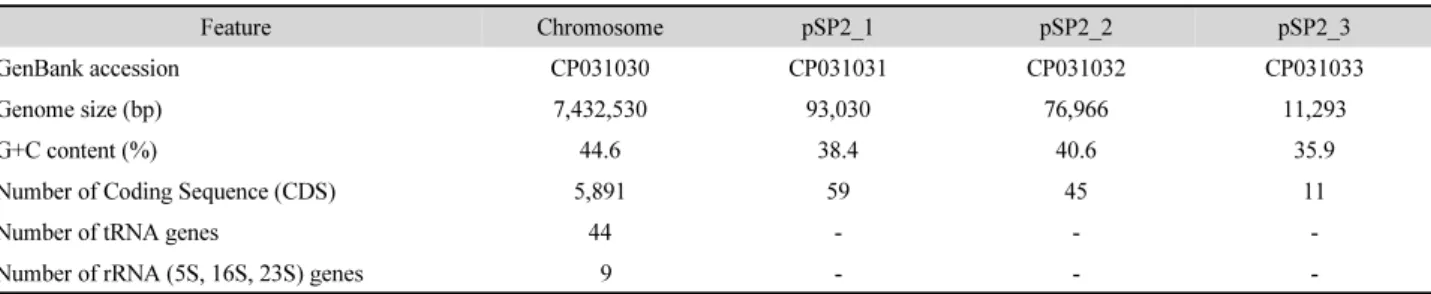
Table 1. General genomic features of the Runella sp. ABRDSP2
Feature Chromosome pSP2_1 pSP2_2 pSP2_3
GenBank accession CP031030 CP031031 CP031032 CP031033
Genome size (bp) 7,432,530 93,030 76,966 11,293
G+C content (%) 44.6 38.4 40.6 35.9
Number of Coding Sequence (CDS) 5,891 59 45 11
Number of tRNA genes 44 - - -
Number of rRNA (5S, 16S, 23S) genes 9 - - -
tions. The genome was annotated by the NCBI Prokaryotic Genome Annotation Pipeline (PGAP) (Tatusova et al., 2016).
Total of 1,170,121,330 bp consisting 129,294 sequencing reads was yielded from PacBio sequencing and N
50value for the assembly was 7,432,530 bp. After de novo assembly and error correction, the whole genome of strain ABRDSP2 con- sisting of a circular single chromosome and three plasmids have been deposited in GenBank with the accession numbers of CP031030-CP031033. The circular maps representing the genome of strain ABRDSP2 (Fig. 1) were generated using the Web-based CGview program (Grant and Stothard, 2008).
Sequencing depth of total four circular contigs is about 113.0 times and total contigs size, CDS, tRNA, rRNA, and G+C contents were estimated as shown in Table 1.
The genome of strain ABRDSP2 contained more than 27
oxygenase genes related with catalyzing oxidation of various
organic compounds such as aromatic hydrocarbon. In particular,
genes annotated as monooxygenase (WP_122930018.1), probably
degrading of mono-aromatic compounds (such as benzene,
phenol, and toluene) were identified. In addition, many other
aromatic hydrocarbon metabolizing genes such as ring-cleaving
dioxygenase (WP_122932451.1 and WP_122933798.1), homo-
Complete genome sequence of Runella sp. ABRDSP2 ∙
57
Korean Journal of Microbiology, Vol. 55, No. 1 gentisate 1,2-dioxygenase (WP_122930416.1), catechol 1,2-
dioxygenase (WP_122930014.1), protocatechuate 3,4-dioxygenase (WP_122934357.1 and WP_122930784.1), and hydroxybenzoate 3-monooxygenase (WP_122930782.1), were also found. The complete genome reveals versatile biodegradation capabilities of Runella sp. ABRDSP2 and will provide insights into the bioremediation of contaminated aquatic environment by strain ABRDSP2.
Nucleotide sequence accession number
The whole-genome sequence was deposited in GenBank under accession number NZ_CP031030-CP031033.
적 요
페놀과 같은 단환성 화합물을 분해하는 미생물인 Runella sp.
ABRDSP2 균주는 담수로부터 분리되었다. 원형으로 완성된 하
나의 chromosome과 3개의 plasmid로 구성된 유전체는 GC 함 량이 44.4%인 총 7,613,819 bp의 크기를 나타내며 6,006개의 유 전자를 인코딩하고 있다. ABRDSP2 균주는 monooxygenase, ring-cleaving dioxygenase 및 catechol 1,2-dioxygenase 등의 다수의 방향성 탄화수소를 분해하는 유전자를 함유하고 있다.
이런 전장 유전체는 Runella sp. ABRDSP2 균주가 다양한 생 분해능력이 있음을 나타낸다.
Acknowledgements
This research was supported by a grant from the Nakdonggang National Institute of Biological Resources (NNIBR), funded by the Ministry of Environment (MOE) of the Republic of Korea.
References
Grant JR and Stothard P. 2008. The CGView server: a comparative genomics tool for circular genomes. Nucleic Acids Res. 36, W181–W184.
Kim H, Kang H, Joung Y, and Joh K. 2017. Runella palustris sp. nov., isolated from wetland freshwater. Int. J. Syst. Evol. Microbiol.
67, 676–680.
Larkin JM and Williams PM. 1978. Runella slithyformis gen. nov., sp.
nov., a curved, nonflexible, pink bacterium. Int. J. Syst. Bacteriol.
28, 32–36.
Tatusova T, DiCuccio M, Badretdin A, Chetvernin V, Nawrocki EP, Zaslavsky L, Lomsadze A, Pruitt KD, Borodovsky M, and Ostell J. 2016. NCBI prokaryoticgenome annotation pipeline. Nucleic Acids Res. 44, 6614–6624.