Korean Journal of Microbiology (2016) Vol. 52, No. 4, pp. 500-502 pISSN 0440-2413
DOI https://doi.org/10.7845/kjm.2016.6065 eISSN 2383-9902
Copyright ⓒ 2016, The Microbiological Society of Korea
Genome Announcement
Complete genome sequence of Paenibacillus swuensis DY6 T , a bacterium isolated from gamma-ray irradiated soil
Myung Kyum Kim
1, Seung-Yeol Lee
2, Hee-Young Jung
2,3*, and Sathiyaraj Srinivasan
1*
1
Department of Bio & Environmental Technology, College of Natural Science, Seoul Women’s University, Seoul 01797, Republic of Korea
2
College of Agricultural and Life Sciences, Kyungpook National University, Daegu 41566, Republic of Korea
3
Institute of Plant Medicine, Kyungpook National University, Daegu 41566, Republic of Korea
감마선 조사된 토양에서 분리된 박테리아 Paenibacillus swuensis DY6 T 의 완전한 게놈 서열
김명겸
1・ 이승열
2・ 정희영
2,3* ・ 스리니바산 사티야라지
1*
1
서울여자대학교 자연대학 생명환경공학과,
2경북대학교 농업생명과학과,
3경북대학교 식물의학연구소
(Received November 21, 2016; Revised December 15, 2016; Accepted December 15, 2016)
ABSTRACT: Several bacterial species have been reported to be surviving after the ionizing radiation treatment due to the presence of sophisticated enzymes systems and some endospores producing bacterial strains can also resist, due to the presence of thick spore coat. In this study, we report the complete genome sequence of a bacterium Paenibacillus swuensis DY6
T, isolated from an irradiated soil sample. The genome comprised of 5,012,599 bp with the G+C content of 49.93%, the genome included 4,463 protein coding genes and 133 RNA genes.
Key words: Paenibacillus, endospore, irradiated soil
*For correspondence.
(S. Srinivasan) E-mail: [email protected] / (H.Y. Jung) E-mail: [email protected]The members of the Paenibacillus are aerobic or facultative aerobic, Gram-positive, have L-ornithine in the cell wall without teichoic acids and produce endospores. The spores without nutrients become metabolically dormant, contain little or no high-energy compounds such as ATP and NADH, exhibit no detectable metabolism (Setlow, 1994). The short period of dormant state during irradiation, will not affect the spore outgrowth, due to DNA repair during spore germination and it ensures the spore survival (Setlow, 2006). In this study, we report a complete genome sequence of Paenibacillus swuensis DY6
Tisolated from a gamma ray-irradiated soil sample collected from the mountain Deogyusan (GPS; N 35° 51' 38" E 127° 44' 47"; altitude 1,500 m), Jeonbuk Province, South Korea (Lee et al., 2014). Strain DY6 is characterized as a Gram-positive,
endospore-forming, motile and rod-shaped bacterium, belongs to the family Paenibacillaceae in the class Bacilli.
The genomic DNA was extracted using a genomic DNA purification kit (Promega). A library was constructed according to Pacific Biosciences RS II sequencing method manual. The 82,221 sequencing reads were obtained and were assembled using the PacBio SMRT Analysis (version, 2.3.0) with default options. Genome sequencing and annotation were carried out using Pacific Biosciences RS II platform. The final assembly resulted in 1 contig generating corresponding genome size of 5,012,599 bp. The protein-coding sequences (CDS) were pre- dicted by Glimmer 3.02 (Delcher et al., 1999), and the genome annotation was performed by NCBI Prokaryotic Genome Automatic Annotation Pipeline (PGAP, http://www.ncbi.nlm.
nih.gov/books/NBK174280/). The rRNA and tRNA were predicted
by using RNAmmer ENREF-39 (Lagesen , et al., 2007) and
Complete genome sequence of P. swuensis DY6T ∙
501
Korean Journal of Microbiology, Vol. 52, No. 4
Fig. 1. Graphical circular map of Paenibacillus swuensis DY6T.From outside to the center:
Genes on forward strand Genes on reverse strand
RNA genes (tRNAs green, rRNAs red, other RNAs black) GC content
GC skew
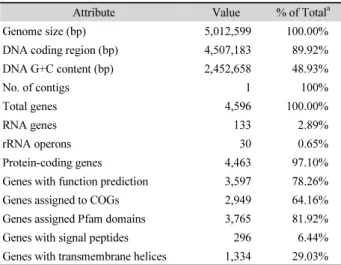
Table 1. Genome statistics
Attribute Value % of Totala
Genome size (bp) 5,012,599 100.00%
DNA coding region (bp) 4,507,183 89.92%
DNA G+C content (bp) 2,452,658 48.93%
No. of contigs 1 100%
Total genes 4,596 100.00%
RNA genes 133 2.89%
rRNA operons 30 0.65%
Protein-coding genes 4,463 97.10%
Genes with function prediction 3,597 78.26%
Genes assigned to COGs 2,949 64.16%
Genes assigned Pfam domains 3,765 81.92%
Genes with signal peptides 296 6.44%
Genes with transmembrane helices 1,334 29.03%
a The total is based on either the size of the genome in base pairs or the total number of protein-coding genes in the annotated genome.
Abbreviation; bp, base pair; DNA, deoxyribonucleic acid; RNA, ribonucleic acid
Infernal (Nawrocki et al., 2009) respectively.
The genome of strain DY6
Tconsists of a circular chromosome of the size 5,012,599 bp with the GC content of 48.93%. A total of 4,596 genes were predicted, among them, 4,463 genes are protein-coding genes, 133 RNA genes, and 3,597 genes were assigned to have putative functions and remaining genes are annotated as hypothetical or converted hypothetical proteins.
A total of 2,949 genes is categories into Cluster of Orthologues
Groups (COGs) (Tatusov et al., 2003) were predicted (Table 1
and Fig. 1). The genomic features revealed the key enzymes
involved in the DNA recovery after the ionizing radiation
recovery. The damaged DNA is repaired using UvrABC pathway
(Excinuclease ABC subunt A, B, and C), RecFOR (DNA
recombination proteins), and UvrD (ATP-dependent DNA
helicase) mediated pathways. The cluster of genes involving in
the nucleotide excision repair (NER) (Cai et al., 2014; Kim et
502
∙ Kim et al.미생물학회지 제52권 제4호
al., 2015; Srinivasan et al., 2015) are also present in the genome. The high spore resistance is may be by low core water content that reduced the production of reactive oxygen species (ROS) which damage protein, lipids and nucleic acids of the spore, which leads to cell death. The cells of Paenibacillus swuensis DY6
Tdid not show gamma and UVC radiation, but the endospores in the soil resist the 5 KGy radiation that is used to irradiate the soil sample before the bacterial isolation.
Nucleotide sequence accession number
The genome sequence was deposited in DDBJ/EMBL/GenBank under the under the accession number CP011388. The strain is deposited at the Korean Collection for Type Cultures, and its ID is KCTC 33026
T.
적 요
박테리아 종들은 정교한 효소 시스템의 존재로 인해 이온 화 방사선 처리 후에 생존할 수 있는 것으로 보고되어 왔고 몇 몇 내생 포자를 생산하는 박테리아 또한 두꺼운 포자껍질의 존재 때문에 방사선에 저항할 수 있다. 이 연구에서는 방사선 이 조사된 토양의 시료에서 추출된 Paenibacillus swuensis DY6
T의 완전한 게놈 서열을 분석하였다. 이 게놈은 G+C 함량 이 49.93%인 5,012,599 bp으로 구성되어 있고 단백질 정보를 암호화한 유전자 4,463개와 133개 RNA 유전자를 포함하고 있다.
Acknowledgements
This work was supported by a research grant from Seoul Women’s University (2016).
References
Cai, Y., Geacintov, N.E., and Broyde, S. 2014. Ribonucleotides as nucleotide excision repair substrates. DNA Repair 13, 55–60.
Delcher, A.L., Harmon, D., Kasif, S., White, O., and Salzberg, S.L.
1999. Improved microbial gene identification with glimmer.
Nucleic Acids Res. 27, 4636–4641.
Kim, M.K., Srinivasan, S., Back, C.G., Joo, E.S., Lee, S.Y., and Jung, H.Y. 2015. Complete genome sequence of Deinococcus swuensis, a bacterium resistant to radiation toxicity. Mol. Cell Toxicol. 11, 315–321.
Lagesen, K., Hallin, P., Rodland, E.A., Staerfeldt, H.H., Rognes, T., and Ussery, D.W. 2007. RNAmmer: Consistent and rapid annotation of ribosomal RNA genes. Nucleic Acids Res. 35, 3100–3108.
Lee, J.J., Yang, D.H., Ko, Y.S., Park, J.K., Im, E.Y., Kim, J.Y., Kwon, K.Y., Lee, Y.J., Kim, H.M., and Kim, M.K. 2014. Paenibacillus swuensis sp. nov., a bacterium isolated from soil. J. Microbiol.
52, 106–110.
Nawrocki, E.P., Kolbe, D.L., and Eddy, S.R. 2009. Infernal 1.0:
Inference of rna alignments. Bioinformatics 25, 1335–1337.
Setlow, P. 1994. Mechanisms which contribute to the long-term survival of spores of bacillus species. J. Appl. Bacteriol. 76, 49S–60S.
Setlow, P. 2006. Spores of Bacillus subtilis: Their resistance to and killing by radiation, heat and chemicals. J. Appl. Microbiol. 101, 514–525.
Srinivasan, S., Kim, M.K., Joo, E.S., Lee, S.Y., Lee, D.S., and Jung, H.Y. 2015. Complete genome sequence of Rufibacter sp. DG31D, a bacterium resistant to gamma and UV radiation toxicity. Mol.
Cell Toxicol. 11, 415–421.
Tatusov, R.L., Fedorova, N.D., Jackson, J.D., Jacobs, A.R., Kiryutin, B., Koonin, E.V., Krylov, D.M., Mazumder, R., Mekhedov, S.L., Nikolskaya, A.N., et al. 2003. The cog database: An updated version includes eukaryotes. BMC Bioinformatics 4, 41.