Korean Journal of Microbiology (2019) Vol. 55, No. 4, pp. 441-444 pISSN 0440-2413
DOI https://doi.org/10.7845/kjm.2019.9119 eISSN 2383-9902
Copyright ⓒ 2019, The Microbiological Society of Korea
The complete genome sequence of Rhodobacteraceae bacterium strain SH-1 isolated from a gut content of whiteleg shrimp Litopenaeus
vannamei
Young-Sam Kim and Kyoung-Ho Kim*
Department of Microbiology, Pukyong National University, Busan 48513, Republic of Korea
흰다리새우 Litopenaeus vannamei의 장 내용물로부터 분리된 Rhodobacteraceae sp. SH-1의 유전체
김영삼 ・ 김경호*
부경대학교 미생물학과
(Received September 27, 2019; Revised December 2, 2019; Accepted December 2, 2019)
*For correspondence. E-mail: [email protected];
Tel.: +82-51-629-5611; Fax: +82-51-629-5619
Strain SH-1, a novel bacterium belonging to the family Rhodo- bacteraceae was isolated from a gut content of a whiteleg shrimp Litopenaeus vannamei collected from Tongyeong, South Korea. The complete genome sequence which is 3,892,138 bp with 66.1% G + C content was obtained using PacBio RS II platform. The genome annotation showed that the complete genome contains total 3,772 genes including 3,649 CDSs, 47 RNAs and 76 pseudogenes. Subsystems related to biosynthetic gene clusters for vitamins, amino acids and colicin V production protein were also predicted. The results may provide insights for understanding the symbiotic relationship between the strain and its host shrimp.
Keywords: Litopenaeus vannamei, Rhodobacteraceae, complete genome sequence, whiteleg shrimp
One of the major aquatic bacterial groups in Alphaproteo- bacteria, the family Rhodobacteraceae is mainly found in various aquatic environments including fresh water and sea water. Currently, the family comprises more than 100 genera and 300 species and over 60% of them originated from marine
environments (Simon et al., 2017). In marine environments, the family Rhodobacteraceae plays important roles in recycling of biochemical resources and symbiotic relationships with various marine eukaryote hosts (Elifantz et al., 2013; Simon et al., 2017). One of the marine invertebrates, a shrimp also has symbiotic relationship with its symbiotic microbiota including the family Rhodobacteraceae and studies about the bacterial diversity and interactions between a shrimp and its symbiotic microbiota showed that the microbiota produces various ex- tracellular enzymes and metabolites which are beneficial for their hosts (Corbari et al., 2008; Tzuc et al., 2014; Cowart et al., 2017).
Strain SH-1 was isolated from the gut content of a whiteleg shrimp Litopenaeus vannamei collected from a shrimp farm (34° 51' 35.7" N 128° 26' 53" E, Tongyeong, South Korea) using serial dilution method after incubation on Marine Agar (MA, Difco) at 28°C for three days. The 16S rRNA sequence of the strain showed low sequence similarity compared to the close species Thalassococcus halodurans DSM 26915
T[96.1%;
Lee et al. (2007)], Phaeobacter gallaeciensis DSM 26640
T[96.09%; Martens et al. (2006)], and Pontibaca methylaminivorans
442
∙ Kim and Kim미생물학회지 제55권 제4호
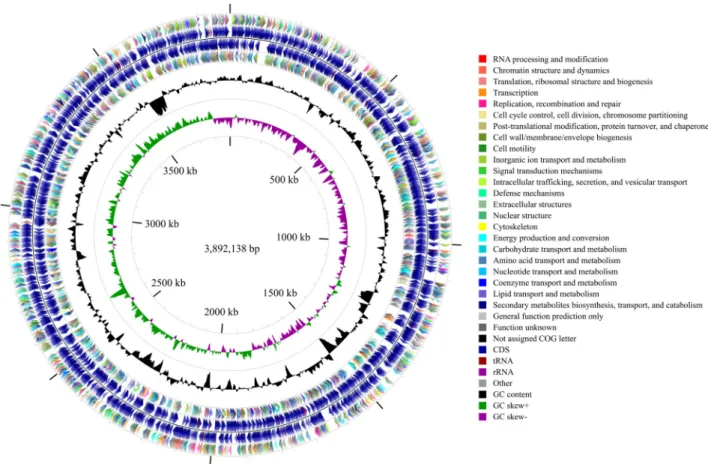
Fig. 1. Complete genome map of Rhodobacteraceae sp. SH-1. From the center to the outside: genome size label, GC skew (green and purple), G + C content (black), CDSs colored by COG categories on the reverse strand, CDSs including RNAs on the reverse strand, CDSs including RNAs on the forward strand, CDSs colored by COG categories on the forward strand.
DSM 21219
T[96.03%; Kim et al. (2010)] which all belong to the family Rhodobacteraceae. Here, we present the genome features of the complete genome of a novel strain SH-1, which may provide insights into the symbiotic relationship in shrimps.
For whole genome sequencing, Genomic DNA Prep Kit (BIOFACT) was used to extract and purify the genomic DNA.
PacBio RS II platform (Pacific Biosciences) yielded total 133,108 sequence reads, including 1,178,79,850 bases (N
50, 12,787 bp;
mean length, 8,855 bp) and de novo assembly of sequence reads was performed with Hierarchical Genome Assembly Process [HGAP, Version 3.0; Chin et al. (2013)]. The assembly generated a total of six contigs including one chromosome (3,892,138 bp with 66.1 mol% G + C content) and five plasmids (167,434 bp, 61.4 mol%; 78,245 bp, 60.8 mol%; 67,363 bp, 58.5 mol%; 41,166 bp, 61.8 mol%; 16,620 bp, 59 mol%).
Rapid Annotations using Subsystems Technology [RAST;
(http://rast.nmpdr.org/rast.cgi) Aziz et al. (2008)] and NCBI Prokaryotic Genome Annotation Pipeline [PGAP; Tatusova et
al. (2016)] were used for the functional annotation and gene prediction, respectively. Total 3,772 genes including 3,649 CDSs, 47 RNAs and 76 pseudogenes were annotated by NCBI PGAP. Biosynthetic gene clusters related to vitamins and amino acids biosynthesis were also identified through RAST annotation.
CGView Comparison Tool (Grant et al., 2012) was used to assign genes to Clusters of Orthologous Groups (COGs) category and generate the circular genome map containing genome features (Fig. 1). One CRISPR locus was detected by CRISPRFinder [http://crispr.i2bc.paris-saclay.fr; Grissa et al.
(2007)] and PHAge Search Tool Enhanced Release [PHASTER, http://phaster.ca/; Arndt et al. (2016)] detected three intact and one incomplete prophage sequences coding tail, head, terminase and phage related proteins of virus from chromosome sequence.
The genome of strain SH-1, as a symbiotic bacterium of
whiteleg shrimp, contained various biosynthetic gene clusters
for vitamins, amino acids which might be beneficial for host
and colicin V which inhibits other bacterial groups to be
Complete genome sequence of Rhodobacteraceae bacterium strain SH-1∙
443
Korean Journal of Microbiology, Vol. 55, No. 4
Table 1. General features of Rhodobacteraceae sp. SH-1Feature Value
Genome size (bp) 3,892,138
G + C content (%) 66.1
Total genes 3,772
Total CDS 3,649
Genes assigned to COGs 2,483
rRNAs (5S, 16S, 23S) 1, 1, 1
tRNAs 41
ncRNAs 3
Pseudogenes 76
dominant in the gut environment. The result may provide a basis for understanding the symbiotic relationship in the host.
Further experiments are in progress for identifying characteristics and comprehension of strain SH-1.
Nucleotide sequence accession number
The genome and plasmid sequences of Rhodobacteraceae bacterium strain SH-1 have been deposited at GenBank under the accession numbers of CP027665 and CP043619-CP043623, respectively. The strain has been deposited in the Korean Collection for Type Cultures (KCTC) with the preservation number KCTC 62276.
적 요
SH-1 균주는 Rhodobacteraceae 과에 속하는 신균으로서 대 한민국의 통영에서 채취된 흰다리새우 Litopenaeus vannamei 의 장내용물에서 분리되었다. PacBio RS II 분석법을 이용하 여 얻어진 전장유전체의 길이는 3,892,138 bp이며 66.1%의 G + C 함유량을 가지고 있다. 이 유전체는 3,649개의 CDS와 47 개의 RNA, 76개의 유사유전자를 포함하여 총 3,772개의 유전 자를 가지고 있는 것으로 분석되었다. 콜리신 생산 단백질과 비타민 생합성 유전자 클러스와 관련된 하위체계(subsystem) 가 존재하는 것이 확인되었다. 본 결과는 이 균주와 숙주인 새 우의 공생관계를 이해하는데 도움을 줄 것이다.
Acknowledgements
This research was supported by Basic Science Research
Program through the National Research Foundation of Korea (NRF) funded by the Ministry of Education (2016R1D1A3B 04935909).
References
Arndt D, Grant JR, Marcu A, Sajed T, Pon A, Liang Y, and Wishart DS.
2016. PHASTER: a better, faster version of the PHAST phage search tool. Nucleic Acids Res. 44, W16–21.
Aziz RK, Bartels D, Best AA, DeJongh M, Disz T, Edwards RA, Formsma K, Gerdes S, Glass EM, Kubal M, et al. 2008. The RAST Server: rapid annotations using subsystems technology.
BMC Genomics 9, 75.
Chin CS, Alexander DH, Marks P, Klammer AA, Drake J, Heiner C, Clum A, Copeland A, Huddleston J, Eichler EE, et al. 2013.
Nonhybrid, finished microbial genome assemblies from long- read SMRT sequencing data. Nat. Methods 10, 563–569.
Corbari L, Zbinden M, Cambon-Bonavita MA, Gaill F, and Compère P. 2008. Bacterial symbionts and mineral deposits in the branchial chamber of the hydrothermal vent shrimp Rimicaris exoculata: relationship to moult cycle. Aquat. Biol. 1, 225–238.
Cowart DA, Durand L, Cambon-Bonavita MA, and Arnaud-Haond S.
2017. Investigation of bacterial communities within the digestive organs of the hydrothermal vent shrimp Rimicaris exoculata provide insights into holobiont geographic clustering. PLoS one 12, e0172543.
Elifantz H, Horn G, Ayon M, Cohen Y, and Minz D. 2013. Rhodo- bacteraceae are the key members of the microbial community of the initial biofilm formed in Eastern Mediterranean coastal seawater. FEMS Microbiol. Ecol. 85, 348–357.
Grant JR, Arantes AS, and Stothard P. 2012. Comparing thousands of circular genomes using the CGView Comparison Tool. BMC Genomics 13, 202.
Grissa I, Vergnaud G, and Pourcel C. 2007. CRISPRFinder: a web tool to identify clustered regularly interspaced short palindromic repeats. Nucleic Acids Res. 35, W52–57.
Kim KK, Lee JS, Lee KC, Oh HM, and Kim SG. 2010. Pontibaca methylaminivorans gen. nov., sp. nov., a member of the family Rhodobacteraceae. Int. J. Syst. Evol. Microbiol. 60, 2170–2175.
Lee OO, Tsoi MM, Li X, Wong PK, and Qian PY. 2007. Thalasso- coccus halodurans gen. nov., sp. nov., a novel halotolerant member of the Roseobacter clade isolated from the marine sponge Halichondria panicea at Friday Harbor, USA. Int. J. Syst.
Evol. Microbiol. 57, 1919–1924.
Martens T, Heidorn T, Pukall R, Simon M, Tindall BJ, and Brinkhoff T. 2006. Reclassification of Roseobacter gallaeciensis Ruiz-Ponte et al. 1998 as Phaeobacter gallaeciensis gen. nov., comb. nov., description of Phaeobacter inhibens sp. nov., reclassification of Ruegeria algicola (Lafay et al. 1995) Uchino et al. 1999 as
444
∙ Kim and Kim미생물학회지 제55권 제4호
Marinovum algicola gen. nov., comb. nov., and emended des- criptions of the genera Roseobacter, Ruegeria and Leisingera.
Int. J. Syst. Evol. Microbiol. 56, 1293–1304.
Simon M, Scheuner C, Meier-Kolthoff JP, Brinkhoff T, Wagner- Dobler I, Ulbrich M, Klenk HP, Schomburg D, Petersen J, and Goker M. 2017. Phylogenomics of Rhodobacteraceae reveals evolutionary adaptation to marine and non-marine habitats.
ISME J. 11, 1483–1499.
Tatusova T, DiCuccio M, Badretdin A, Chetvernin V, Nawrocki EP, Zaslavsky L, Lomsadze A, Pruitt KD, Borodovsky M, and Ostell J. 2016. NCBI prokaryotic genome annotation pipeline. Nucleic Acids Res. 44, 6614–6624.
Tzuc JT, Escalante DR, Rojas Herrera R, Gaxiola Cortes G, and Ortiz ML. 2014. Microbiota from Litopenaeus vannamei: digestive tract microbial community of Pacific white shrimp (Litopenaeus vannamei). Springerplus 3, 280.