Cells of Deinococcus puniceus DY1
Tare Gram-positive, coccus- shaped, and crimson color-pigmented. Strain DY1
Twas isolated from soil irradiated with 5 kGy gamma radiation and showed resistance to UVC and gamma radiation. In this study, we report the complete genome sequence of a bacterium Deinococcus puniceus DY1
Tis consist of circular chromosome comprised of 2,971,983 bp, with the G + C content of 62.5%. The complete genome sequence was obtained using the PacBio RS II platform, it included 2,617 coding sequences (CDs), 2,762 genes, and 88 pseudogene.
Keywords: Deinococcus, complete genome, nucleotide excision repair, PacBio RS II, radiation resistance
The radiation resistant bacteria belonging to the genus Deinococus are known to have extreme DNA repair mechanism and protein system to repair the damaged DNA after the radiation (White et al., 1999; de Groot et al., 2009; Daly, 2012;
Yu and Lee, 2017). The bacterial species belonged to the genus
Hymenobacter (Kim et al., 2017a; Srinivasan et al., 2017) and Spirosoma (Kim et al., 2017b), have been reported for radiation resistance. Strain DY1
Twas isolated from soil irradiated with 5 kGy gamma radiation and showed resistance to gamma irradiation with the D
10value of 10 kGy. Cells of Deinococcus puniceus DY1
Tare Gram-positive, coccus-shaped, and produced crimson colored pigments (Lee et al., 2015).
To understand the genomic features of radiation resistance, we determined the genome sequence of Deinococcus puniceus DY1
T. The genome annotation confirmed the presence of key enzymes involved in the recovery of damaged DNA from ionizing radiation. The nucleotide excision repair (NER) pathway was reported from other highly radiation-resistant bacteria such as D. radiodurans (Battista and Cox, 2006; Blasius et al., 2008).
The genome of the strain DY1
Twas sequenced by Pacific Biosciences RS II platform, and a library was constructed according to Pacific Biosciences RS II Sequencing method.
The 104,937 sequence reads were obtained and assembled using the PacBio SMRT Analysis (version 2.3.0) with default
Korean Journal of Microbiology (2018) Vol. 54, No. 1, pp. 84-86 pISSN 0440-2413
DOI https://doi.org/10.7845/kjm.2018.8004 eISSN 2383-9902
Copyright ⓒ 2018, The Microbiological Society of Korea
Complete genome sequence of Deinococcus puniceus DY1 T , a radiation resistant bacterium
Sathiyaraj Srinivasan
1, Eun-Hwa Sohn
2, Hee-Young Jung
3,4*, and Myung Kyum Kim
1*
1
Department of Bio & Environmental Technology, College of Natural Science, Seoul Women’s University, Seoul 01797, Republic of Korea
2
Department of Herbal Medicine Resources, Kangwon National University, Samcheok 25949, Republic of Korea
3
School of Applied Biosciences, Kyungpook National University, Daegu 41566, Republic of Korea
4
Institute of Plant Medicine, Kyungpook National University, Daegu 41566, Republic of Korea
방사선 내성 세균 Deinococcus puniceus DY1 T 의 완전한 게놈 서열 분석
스리니바산 사티야라지
1・ 손은화
2・ 정희영
3,4* ・ 김명겸
1*
1
서울여자대학교 자연과학대학 생명환경공학과,
2강원대학교 생약자원개발학과,
3경북대학교 농업생명과학대학 응용생명과학부 응용생물학전공,
4경북대학교 식물의학연구소
(Received February 8, 2018; Revised February 22, 2018; Accepted February 22, 2018)
*For correspondence. (M.K. Kim) E-mail: [email protected];
Tel.: +82-2-970-5667; Fax: +82-2-970-5974 / (H.Y. Jung) E-mail:
[email protected]; Tel.: +82-53-950-5760; Fax: +82-53-950-6758
Complete genome sequence of Deinococcus puniceus DY1
T∙ 85
Korean Journal of Microbiology, Vol. 54, No. 1 options. The protein-coding sequences (CDS) were predicted
by Glimmer (version 3.02), and the genome annotation was performed by NCBI Prokaryotic Genome Automatic Annotation Pipeline (PGAP, http://www.ncbi.nlm.nih.gov/books/NBK174280/).
The rRNA and tRNA were predicted by using rRNAmmer and tRNAscan-SE, respectively.
The complete genome of Deinococcus puniceus DY1
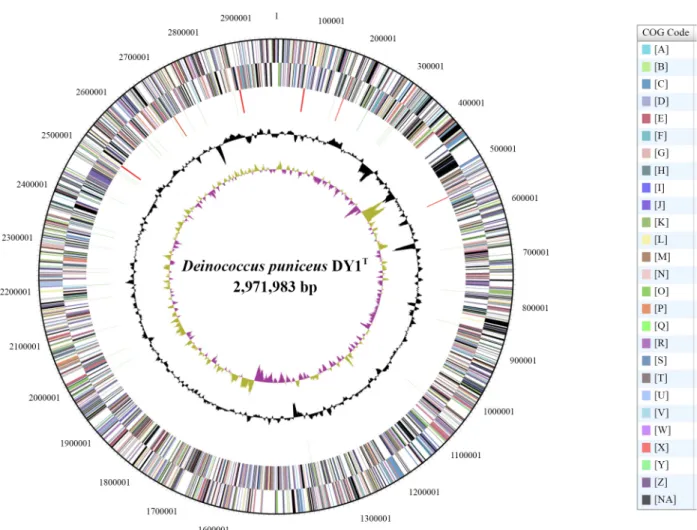
Tcontain a chromosome of 2,971,983 bp with a G + C mol of 62.6%, a total of 2,815 genes (Fig. 1); 2,759 genes with protein-coding and 56 are RNA genes were assigned a putative function, and the remaining was annotated as hypothetical or conserved hypothetical proteins (Table 1).
The complete genome sequence of Deinococcus puniceus DY1
Tshowed the presence of the NER pathway enzymes, the key enzymes including excinuclease UvrABC complex, which recognizes and repair the structural changes caused by ionizing
radiation (Petit and Sancar, 1999). The genome of strain Deinococcus puniceus DY1
Talso contained the UV damage repair endonuclease (UvdE) coding gene and several genes for homologs recombination; that plays a central role in the nucleic acid metabolism. The genomic information about radiation
Fig. 1. Graphical circular map of Deinococcus puniceus DY1
T. From outside to the center: Genes on forward strand, Genes on reverse strand, RNA genes (tRNAs green, rRNAs red, other RNAs black), GC content, GC skew.
Table 1. General features of Deinococcus puniceus DY1
Features Chromosome
Length (bp) 2,971,983
G + C content (%) 62.56
Number of genes 2,815
Protein coding genes 2,759
Pseudogenes 88
CDS 2,617
rRNA gene 9
tRNA genes 47
86 ∙ Srinivasan et al.
미생물학회지 제54권 제1호
resistance can be very useful to understand the mechanisms and also apply it in the field of radiation biotechnology.
Nucleotide sequence accession number
The genome sequence was deposited in DDBJ/EMBL/GenBank under the accession number CP011387. The strain is deposited at the Korean Collection for Type Cultures, and its ID is KCTC 33027
T.
적 요
이 연구에서는 5 kGy 의 감마선에 조사된 토양으로부터 분 리된 Deinococcus puniceus DY1
T의 완전한 게놈서열을 분석 하였다. 이 균주는 UVC 와 감마선에 대한 저항성을 보였으며, PacBio RS II platform 을 통해 시퀀싱을 진행하였다. 해당유전 체의 분석결과 G + C 함량이 62.5%인 2,971,983 bp 크기의 원 형 염색체를 확인하였으며, 해당 염색체는 2,617 개의 코딩 서 열과 2,762 개의 유전자 그리고 88 개의 위유전자를 포함하고 있다.
Acknowledgements
This work was supported by a research grant from Seoul Women’s University (2018).
References